Feeling uncertain about what to expect in your upcoming interview? We’ve got you covered! This blog highlights the most important Fiber Optic Network Planning and Deployment interview questions and provides actionable advice to help you stand out as the ideal candidate. Let’s pave the way for your success.
Questions Asked in Fiber Optic Network Planning and Deployment Interview
Q 1. Explain the difference between single-mode and multi-mode fiber optic cables.
The core difference between single-mode and multi-mode fiber optic cables lies in the diameter of their core and how light propagates through them. Think of it like this: single-mode is like a single-lane highway for light, while multi-mode is a multi-lane highway.
- Single-mode fiber: Has a very small core diameter (around 8-10 microns). This allows only one mode (path) of light to propagate, resulting in minimal signal dispersion and significantly lower attenuation over long distances. It’s ideal for long-haul telecommunications and high-bandwidth applications.
- Multi-mode fiber: Possesses a larger core diameter (50 or 62.5 microns). This allows multiple modes of light to travel simultaneously, leading to greater signal dispersion and higher attenuation compared to single-mode. It’s more suitable for shorter distances and applications like local area networks (LANs) or building infrastructure where cost is a primary concern.
In essence, if you need to transmit data over long distances with high bandwidth, single-mode is the way to go. For shorter distances and less demanding applications, multi-mode is a cost-effective option. Choosing the right fiber type depends entirely on your network’s specific needs.
Q 2. Describe the process of fiber optic cable splicing.
Fiber optic cable splicing involves precisely joining two fiber optic cables to create a continuous optical path. The process demands meticulous care to avoid signal loss or degradation. Here’s a breakdown:
- Fiber Preparation: The ends of the fibers are carefully cleaved using a specialized cleaver to ensure a perfectly perpendicular and smooth surface. This is crucial for optimal light transmission.
- Splice Alignment: The prepared fiber ends are precisely aligned using a fusion splicer. This device uses microscopic cameras and lasers to ensure the cores of the fibers are perfectly matched.
- Fusion Splicing (or Mechanical Splicing): A fusion splicer uses an electric arc to melt and fuse the fiber ends together. Mechanical splicing uses a precision alignment mechanism and a sleeve to mechanically hold the fibers together. Both methods aim for minimal loss and strong connection.
- Splice Testing: After splicing, the connection is tested using an OTDR (Optical Time Domain Reflectometer) or a power meter to measure the signal loss at the splice. This ensures the splice meets quality standards.
Improper splicing can lead to significant signal loss and network issues. Therefore, proper training and the use of quality equipment are crucial for successful fiber optic splicing. In professional settings, technicians are rigorously trained to ensure accuracy and efficiency. I’ve personally witnessed the difference between a perfectly executed splice and a poorly done one – the latter can dramatically impact network performance.
Q 3. What are the advantages and disadvantages of different fiber optic connector types (e.g., SC, LC, ST)?
Various fiber optic connector types exist, each with its own strengths and weaknesses. The most common ones are SC, LC, and ST. Here’s a comparison:
- SC (Subscriber Connector): One of the oldest and most widely used connectors. It’s robust and relatively inexpensive, but it’s larger than other options and can be more prone to dust and debris accumulation.
- LC (Lucent Connector): A smaller, more compact connector than SC, leading to higher port density in equipment. It’s becoming increasingly popular due to its smaller size and improved reliability. It’s also generally more dust-resistant.
- ST (Straight Tip): Features a bayonet-style locking mechanism. Though once prevalent, it’s less commonly used now because of its larger size and higher susceptibility to damage compared to LC and SC. The push-pull locking mechanism is also not as secure as the push-and-twist mechanism on LC.
The choice of connector depends on factors like application, budget, and desired port density. Data centers, for instance, often favor LC connectors due to their small size and high density, while older infrastructure might still use SC connectors. Selecting the appropriate connector type is a critical aspect of network planning to ensure compatibility and performance.
Q 4. How do you plan the routing of fiber optic cables in a network design?
Planning fiber optic cable routing is a crucial aspect of network design that requires careful consideration of several factors. It’s not just about connecting points A and B; it’s about optimizing for performance, maintainability, and cost-effectiveness. The process typically involves:
- Network Topology Design: Determine the overall network layout – star, ring, mesh, etc. – to define the paths required for fiber optic cables.
- Physical Infrastructure Assessment: Survey the available space, identify potential obstacles (e.g., walls, existing cables, underground utilities), and assess the environmental conditions (e.g., temperature, humidity).
- Cable Route Planning: Develop detailed cable routes, minimizing bends and sharp turns to reduce signal loss. Consider using cable trays, conduits, or aerial pathways. This frequently involves using CAD software and other specialized tools to model potential routes.
- Splice Point Location: Strategically plan the locations of splice points to facilitate maintenance and repairs. Minimize the number of splices to reduce signal attenuation.
- Cable Length Calculation: Accurately calculate cable lengths to avoid waste and ensure sufficient cable for each connection. This ensures minimal signal degradation.
- Documentation: Maintain thorough documentation of cable routes, splice points, and connector types for future maintenance and troubleshooting.
A well-planned fiber optic cable route minimizes signal loss, improves reliability, and simplifies future maintenance. Failing to plan properly can result in costly re-work and network performance issues down the line. In my experience, using specialized software for cable routing significantly reduces errors and streamlines the planning process.
Q 5. What are common causes of fiber optic cable attenuation?
Fiber optic cable attenuation, or signal loss, is a significant concern in fiber optic network design and maintenance. Several factors contribute to this attenuation:
- Material Absorption: The glass fibers themselves absorb some light energy depending on their composition and wavelength. This is inherent to the material.
- Scattering: Microscopic imperfections and variations in the fiber’s core cause light to scatter, reducing the amount of light reaching the receiver.
- Bending Losses: Sharp bends or kinks in the fiber can significantly increase attenuation due to light leaking out of the core. This is why careful cable routing is essential.
- Connector Losses: Imperfectly connected connectors introduce signal loss due to misalignment or air gaps.
- Splice Losses: Imperfect splices also introduce signal loss.
- Wavelength Dependence: Attenuation varies with the wavelength of light used; certain wavelengths experience more loss than others.
Minimizing these factors through careful cable handling, proper connectorization, and strategic routing is key to maintaining a high-quality fiber optic signal. Regular OTDR testing helps identify and pinpoint locations with excessive attenuation, enabling timely repairs or replacements.
Q 6. Explain OTDR testing and its importance in fiber optic network maintenance.
OTDR (Optical Time Domain Reflectometer) testing is an essential tool for diagnosing and maintaining fiber optic networks. It works by sending light pulses down the fiber and measuring the amount of light reflected back at various points. This allows technicians to identify:
- Fiber Faults: Broken fibers, splices with high loss, and other discontinuities along the fiber are easily detected as significant reflections.
- Attenuation Measurement: The OTDR measures the signal loss along the fiber length, highlighting areas with excessive attenuation.
- Fiber Length Measurement: The OTDR accurately measures the fiber length.
- Splice Loss: This is measured at the point where two fibers are spliced together. High loss at a splice can be a symptom of poor splicing technique or degradation of the splice.
The data generated by OTDR testing provides valuable insights into the overall health of the fiber optic network. It enables proactive maintenance, preventing major outages by identifying potential problems before they escalate. OTDR testing is especially vital for long-haul networks where troubleshooting without this technology would be extremely time-consuming and difficult. I’ve used OTDRs countless times to quickly pinpoint faults in complex network environments, saving significant time and resources.
Q 7. What are the key considerations for designing a fiber optic network for a data center?
Designing a fiber optic network for a data center presents unique challenges and considerations due to the high bandwidth requirements and density of equipment. Key aspects include:
- High Bandwidth Capacity: Data centers require very high bandwidth, necessitating the use of high-fiber-count cables and potentially multiple fiber paths for redundancy.
- Fiber Type Selection: Single-mode fiber is usually preferred for its long-distance capabilities and high bandwidth, though multi-mode may be considered for shorter interconnects within the data center.
- Connectivity Density: Data centers have high port densities, necessitating the use of compact connectors like LC. The use of high-density patch panels is almost universally required.
- Redundancy and Fault Tolerance: Redundant fiber paths are critical to maintain high availability and prevent network disruptions. This might involve multiple parallel fiber runs or ring topologies.
- Cabling Management: Careful planning and management of cables are crucial to prevent signal loss, maintain accessibility for troubleshooting, and ensure efficient cooling within the data center environment. This almost always requires the use of cable management trays, patch panels, and well-defined pathways.
- Future Scalability: The design should allow for future expansion and upgrades without requiring major re-cabling. It’s very important to plan for future growth, considering spare capacity and modularity in the design.
A well-designed fiber optic network in a data center is vital for maintaining high performance and availability. Overlooking these considerations can lead to significant operational issues and downtime.
Q 8. Describe different types of fiber optic network topologies (e.g., star, ring, mesh).
Fiber optic network topologies describe how nodes (like computers or routers) are interconnected. Think of them as different road maps for your data to travel. The most common are:
- Star Topology: This is like a wheel with a central hub (a switch or router) and all other nodes connected directly to it. It’s simple, easy to manage, and a single node failure doesn’t bring down the entire network. Most home internet setups use a simplified version of this.
- Ring Topology: Nodes are connected in a closed loop, with data flowing in one direction. It’s robust because if one connection fails, data can still flow in the opposite direction (using a dual ring). However, a single node failure can disrupt the entire network in a single-ring design.
- Mesh Topology: This is the most complex, with multiple connections between nodes, providing high redundancy and fault tolerance. It’s often used in large-scale networks where reliability is paramount, like in telecommunications backbones. Think of it like a highway system with multiple routes between cities.
The choice of topology depends heavily on factors like network size, cost, required reliability, and scalability. Small networks might favor star topologies for simplicity, while large metropolitan area networks (MANs) often use mesh topologies for resilience.
Q 9. What are the safety precautions involved in working with fiber optic cables?
Working with fiber optic cables requires stringent safety precautions because the fibers, although seemingly harmless, can pose risks. Here are key considerations:
- Eye Protection: Always wear appropriate eye protection. Looking directly into a fiber optic cable end during testing or connection can cause serious eye damage from the intense light.
- Fiber Handling: Fiber is fragile. Avoid bending it too sharply or applying excessive pressure, as this can lead to breakage. Use proper handling techniques and tools to prevent damage.
- Cutting and Splicing: When cutting or splicing fibers, use specialized tools and follow the manufacturer’s instructions carefully. Improper handling can lead to fiber breakage and potentially sharp ends.
- Laser Safety: Some fiber optic systems use lasers, which are potentially hazardous. Make sure you understand the laser safety precautions relevant to your equipment and work environment. Adhere to all posted laser safety signage and warnings.
- Skin Protection: Some fiber optic cables have sharp or rough surfaces that could cause irritation. Avoid direct skin contact.
Proper training and adherence to safety protocols are crucial to prevent injury and ensure a safe working environment. Following the manufacturer’s safety instructions for all equipment used is paramount.
Q 10. How do you troubleshoot a fiber optic network outage?
Troubleshooting a fiber optic network outage is a systematic process. Here’s a typical approach:
- Visual Inspection: Check for any obvious physical damage to the cables or connectors. Look for broken fibers, loose connectors, or damaged splices.
- Optical Power Meter (OPM): Use an OPM to measure the optical power levels at various points in the network. Low or no power indicates a problem. This helps to isolate the fault area.
- Optical Time-Domain Reflectometer (OTDR): An OTDR is essential for locating faults along the fiber. It sends a pulse of light down the fiber and measures the reflections to identify breaks, bends, or other impairments.
- Connector Inspection: Inspect connectors for cleanliness and proper insertion. Dirt or debris can significantly attenuate the signal. Use appropriate cleaning tools and techniques.
- Network Monitoring Tools: Use network monitoring tools to check for errors or performance issues at various points in the network. This might include checking packet loss, latency and signal strength.
- Splice Inspection: Inspect fiber optic splices using a microscope to check for alignment and damage. Poor splices can cause significant attenuation of the optical signal.
The specific steps will vary depending on the network’s complexity and the nature of the outage. Good documentation and network diagrams are invaluable during troubleshooting.
Q 11. Explain the concept of optical dispersion and its impact on network performance.
Optical dispersion refers to the spreading of light pulses as they travel down an optical fiber. Imagine throwing a stone into a pond – the ripples spread out. Similarly, different wavelengths of light travel at slightly different speeds in the fiber, causing the pulse to broaden. This broadening can lead to a loss of signal quality and reduces the data transmission rate that can be successfully achieved.
There are two main types of dispersion:
- Chromatic Dispersion: This occurs because different wavelengths of light travel at different speeds in the fiber. This is wavelength dependent, and causes pulses to broaden resulting in intersymbol interference (ISI) – where one pulse overlaps the next, making it difficult to decipher the data.
- Modal Dispersion: This happens in multimode fibers where light travels along multiple paths, causing the pulse to spread out. It’s less significant in single-mode fibers, which confine light to a single path.
The impact on network performance is a reduction in bandwidth and transmission distance. To mitigate dispersion, techniques like using dispersion-shifted fiber, dispersion compensating fibers, or implementing digital signal processing (DSP) are employed.
Q 12. What are the different types of optical amplifiers used in long-haul fiber optic networks?
Optical amplifiers boost the optical signal directly, avoiding the need for converting the light to electrical signals, then back to light. This is crucial for long-haul networks. Common types include:
- Erbium-doped fiber amplifier (EDFA): The most widely used, EDFAs amplify light in the 1550nm wavelength range. They are relatively low cost and offer good performance in the C-band (1530-1565nm) and L-band (1565-1625nm).
- Raman amplifier: These amplifiers use stimulated Raman scattering to amplify the light signal. They are flexible and can be used over a wide range of wavelengths and are often used to compensate for loss in specific areas.
- Semiconductor optical amplifier (SOA): SOAs are smaller and less expensive than EDFAs, but typically offer less gain and higher noise. They are often used in applications where space and cost are paramount.
The choice of amplifier depends on factors such as the desired wavelength range, gain requirement, noise figure, and cost.
Q 13. What is DWDM and how does it enhance network capacity?
Dense Wavelength-Division Multiplexing (DWDM) is a technology that significantly increases the capacity of a single fiber optic cable. Instead of transmitting one signal at a time, DWDM allows the transmission of multiple wavelengths (or colors) of light simultaneously on the same fiber. Each wavelength carries a separate data stream.
Imagine a highway with multiple lanes—each lane carries different traffic. DWDM is like adding many lanes to your optical fiber highway, allowing significantly more data to be transmitted without needing to lay more cables. This drastically increases network capacity and reduces the overall cost.
DWDM systems use sophisticated devices like wavelength-selective switches and multiplexers/demultiplexers to combine and separate the different wavelengths. This enhancement reduces costs associated with laying more fiber and enables higher bandwidth for the same physical infrastructure.
Q 14. Describe the process of testing and commissioning a newly installed fiber optic network.
Testing and commissioning a newly installed fiber optic network involves a series of rigorous tests to ensure its proper functioning and meet performance specifications. This process typically includes:
- Fiber Acceptance Testing: Testing to verify that the fibers installed meet the required specifications, including attenuation, dispersion and return loss.
- Optical Power Measurements: Using an Optical Power Meter (OPM) to measure the power levels at various points throughout the network.
- OTDR Testing: Employing an Optical Time-Domain Reflectometer (OTDR) to identify any faults, such as breaks, splices or connectors, along the fiber optic cable.
- End-to-End Testing: Testing the entire network path to ensure that signals can propagate correctly from end-to-end. This might include testing bit error rates (BER) to verify data integrity.
- Splice Loss Measurement: Measuring the loss of power at each splice location using an OPM or OTDR.
- Return Loss Measurement: Measuring the amount of optical signal reflected back towards the source. High return loss indicates possible problems with connectors or splices.
- Chromatic Dispersion Measurement: Measuring how much the signal spreads out over the fiber due to chromatic dispersion.
- Polarization Mode Dispersion Measurement: Measurement of how much the polarization state of the optical signal changes, affecting data integrity.
- Network Configuration and Testing: Configure network equipment, such as routers and switches, and test the network performance using tools such as ping tests, bandwidth tests, and traceroutes.
Once all tests have passed and the network operates as expected, the system is deemed commissioned and ready for service.
Q 15. How do you manage fiber optic cable slack in a deployment?
Managing fiber optic cable slack is crucial for ensuring network longevity and preventing damage. Think of it like giving a garden hose some extra length – it allows for movement and prevents strain on the connections. Too little slack can lead to fiber breakage during expansion or contraction due to temperature changes, while excessive slack creates clutter and potential tripping hazards.
We typically manage slack by using:
- Slack loops: These are carefully planned loops of cable in designated areas like cable trays or splice closures. The size of the loop is calculated based on the potential expansion and contraction of the cable, and the loop is secured to prevent it from becoming tangled or dragging.
- Slack storage: In buildings, slack is often stored in dedicated areas such as cable trays or racks, ensuring it’s organized and accessible for maintenance.
- Cable grips and restraints: These mechanisms help secure excess cable and prevent it from moving or becoming damaged. These are essential in areas where vibration or movement is expected, for example along railway lines.
For example, in a long-haul deployment across varying terrain, we’d carefully plan slack loops at regular intervals to account for potential ground movement or temperature fluctuations. In an indoor data center, we’d use cable management solutions to ensure neat and organized slack storage, avoiding any tripping hazards.
Career Expert Tips:
- Ace those interviews! Prepare effectively by reviewing the Top 50 Most Common Interview Questions on ResumeGemini.
- Navigate your job search with confidence! Explore a wide range of Career Tips on ResumeGemini. Learn about common challenges and recommendations to overcome them.
- Craft the perfect resume! Master the Art of Resume Writing with ResumeGemini’s guide. Showcase your unique qualifications and achievements effectively.
- Don’t miss out on holiday savings! Build your dream resume with ResumeGemini’s ATS optimized templates.
Q 16. Explain the role of optical transceivers in a fiber optic network.
Optical transceivers are the crucial interface between your fiber optic cable and the network equipment. Imagine them as the ‘translator’ that converts electrical signals from your network devices (like routers and switches) into light signals for transmission through the fiber, and vice versa. They contain both a light source (laser or LED) and a photodetector, working together to facilitate this conversion.
Different types of transceivers cater to various fiber types and distances:
- SFP/SFP+/QSFP+: These are common pluggable transceivers offering various speeds and fiber types (single-mode or multi-mode).
- XFP/X2/CXP: These are higher-speed transceivers typically used in high-bandwidth applications.
Without optical transceivers, your network equipment couldn’t effectively communicate over fiber optic cables. The type of transceiver used dictates the fiber type (single-mode for longer distances, multi-mode for shorter distances), data rate, and wavelength.
Q 17. What is the importance of proper grounding and earthing in fiber optic installations?
Proper grounding and earthing in fiber optic installations are vital for protecting equipment from voltage surges and ensuring safety. Although fiber itself is dielectric and doesn’t carry electrical current in the way copper does, there are metallic components in the system that can be susceptible to surges from lightning strikes or power fluctuations. These include the connectors, cable armour, and equipment housings.
Poor grounding can lead to:
- Equipment damage: Voltage surges can fry delicate electronics within network devices.
- Data loss: Transient spikes can corrupt data in transit.
- Safety hazards: Improper grounding can create shock hazards for technicians.
We use grounding methods like connecting metallic parts to an earth ground via bonding wires and grounding strips. This creates a low-impedance path for stray currents to safely dissipate into the earth. Regular testing with earth resistance meters is critical to verify the efficacy of the grounding system. This helps prevent catastrophic failure and ensures the safety of personnel working on the network.
Q 18. How do you calculate the required fiber optic cable length for a given network design?
Calculating fiber optic cable length requires a detailed understanding of your network topology and deployment plan. It’s not just a matter of measuring point A to point B; you need to account for extra length for slack, splices (connections between cable sections), and bends.
Here’s a simplified approach:
- Map the network: Draw a diagram of your network, including all devices and their locations.
- Measure distances: Measure the distances between each device and location where cable will run, factoring in any physical obstacles.
- Add contingency: Add a percentage for extra cable length to account for slack (usually 10-20%, depending on environment and application), extra cable for terminations, and potential future expansion.
- Account for splices: If using multiple cable sections, factor in the extra length needed for making splices.
- Consider installation method: Different installation methods (aerial, underground, duct) require varying amounts of extra cable.
Example: Let’s say you need to connect two buildings 1000 meters apart. Adding 20% for slack and splices, you would order approximately 1200 meters of cable. The exact amount would depend on the specifics of the installation and local regulations.
Q 19. What are the common challenges faced during fiber optic network deployments?
Fiber optic network deployments, while offering high bandwidth and low latency, present various challenges:
- High initial cost: Fiber optic cable and equipment are more expensive than copper counterparts.
- Complex installation: Fiber optic cable installation requires specialized tools, knowledge, and expertise, which can lead to longer installation times and higher labour costs.
- Difficult troubleshooting: Troubleshooting fiber optic problems can be more complex than with copper cabling, often requiring specialized equipment like OTDRs (Optical Time Domain Reflectometers).
- Environmental factors: Fiber optic cables are susceptible to damage from bending, crushing, and rodent gnawing.
- Splice loss: Imperfect splices can introduce signal attenuation, necessitating precise handling and specialized equipment.
- Permitting and right-of-way issues: Obtaining permits for underground or aerial installations can be time-consuming and expensive.
Effective project management, skilled workforce, and careful planning are crucial for mitigating these challenges and ensuring successful deployment.
Q 20. Describe different methods of fiber optic cable termination.
Fiber optic cable termination involves preparing the cable end for connection to network equipment or other cables. It requires precision and specialized tools to ensure signal integrity. Common methods include:
- Mechanical splicing: This method uses a mechanical splice to join two fiber optic cables. It’s faster and less expensive than fusion splicing but can have higher insertion loss.
- Fusion splicing: This involves melting the ends of two fiber optic cables together using an arc discharge. It creates a strong, low-loss connection, considered superior in terms of performance and longevity.
- Connectors: Various connectors (like SC, LC, ST, FC) are attached to the cable end using specialized tools and polishing techniques. These allow for easy plug-and-play connection to network devices.
The choice of termination method depends on factors such as budget, required performance levels, and installation environment. For high-performance long-haul networks, fusion splicing is preferred. For patching in data centers, connectors are more commonly used. Each method requires skilled technicians and specialized tools to avoid damage to the fibers or introduction of excessive signal loss.
Q 21. What are the key performance indicators (KPIs) used to monitor fiber optic network performance?
Monitoring the performance of a fiber optic network is crucial for maintaining service quality and identifying potential issues. Key Performance Indicators (KPIs) include:
- Optical Return Loss (ORL): Measures the amount of light reflected back towards the light source. High ORL indicates potential problems like bad connections or fiber damage.
- Optical Signal-to-Noise Ratio (OSNR): Measures the ratio of optical signal power to noise power. Low OSNR indicates noise interference that could affect signal quality.
- Bit Error Rate (BER): Measures the number of bit errors per unit time. A high BER indicates data transmission problems.
- Attenuation: Measures the signal loss in the fiber optic cable. High attenuation indicates a potential issue with the cable or connectors.
- Availability: Measures the percentage of time the network is operational. High availability is critical for service uptime.
Monitoring these KPIs using tools like OTDRs and network monitoring systems helps detect potential issues proactively, enabling preventative maintenance and avoiding service disruptions. Regular testing and analysis of these metrics are essential for maintaining a robust and reliable fiber optic network.
Q 22. How do you handle fiber optic cable damage during construction or excavation?
Preventing fiber optic cable damage during construction or excavation is paramount. It’s all about proactive measures and adherence to strict protocols. Before any digging begins, we utilize a crucial tool – One-Call notification systems. These systems alert underground utility companies about planned excavation, allowing them to mark the locations of their buried infrastructure, including fiber optic cables, with paint or flags. This is a vital first step to prevent accidental damage.
Beyond One-Call, we employ technologies like ground-penetrating radar (GPR) to create a detailed map of underground utilities, providing a clearer picture of cable locations. This helps to further minimize the risk of accidental damage during excavation.
During the actual excavation, we implement several strategies: hand digging near suspected cable routes, using caution and visual inspection to prevent damage. We also use cable locators which pinpoint the precise location of underground cables using electromagnetic signals. Finally, careful coordination and communication amongst the construction crew are absolutely essential. A single misstep can lead to costly repairs and downtime.
In the unlikely event of damage, immediate action is required. We first secure the area, ensuring worker safety and preventing further damage. Then, specialized repair crews are called in, equipped to splice damaged fibers using fusion splicing techniques or replacing damaged sections of cable. Post-repair testing is then carried out to ensure network integrity and restore full functionality.
Q 23. Explain the principles of wavelength-division multiplexing (WDM).
Wavelength-division multiplexing (WDM) is a technology that allows multiple wavelengths (colors) of light to travel simultaneously over a single optical fiber. Imagine a highway with multiple lanes – each lane carries a separate stream of traffic. Similarly, in WDM, each wavelength acts as a separate channel, carrying independent data streams.
The principle lies in the ability to precisely control and separate the different wavelengths using specialized devices such as multiplexers and demultiplexers. A multiplexer combines multiple wavelengths into a single fiber, while a demultiplexer separates them at the receiving end. This allows for significantly increased bandwidth and capacity over a single fiber compared to using only one wavelength.
There are two main types of WDM: Coarse WDM (CWDM) and Dense WDM (DWDM). CWDM uses a wider spacing between wavelengths, making it simpler and more cost-effective, while DWDM employs much narrower spacing, allowing for significantly higher channel density and increased capacity. DWDM is commonly used in long-haul and high-capacity networks.
For example, a DWDM system might carry hundreds of wavelengths, each operating at a different frequency, on a single fiber, enabling the transmission of massive amounts of data across long distances.
Q 24. What experience do you have with different types of fiber optic testing equipment?
My experience with fiber optic testing equipment encompasses a wide range of tools, from basic OTDRs to advanced optical spectrum analyzers. I’m proficient in using Optical Time-Domain Reflectometers (OTDRs) for measuring fiber length, identifying faults (breaks, macrobends), and assessing overall fiber quality. OTDRs are essential for locating the exact spot of a break or attenuation along the fiber cable.
I also have experience with Optical Power Meters (OPMs), used to measure the optical power level at various points in the network. This is crucial for troubleshooting power budget issues and ensuring signal integrity. Further, I’m skilled in operating Optical Source Meters (OSMs) and Light Sources, which generate the light signals used in fiber optic communication systems.
Beyond these basic instruments, I’ve worked with more sophisticated equipment, such as Optical Spectrum Analyzers (OSAs), which provide detailed analysis of the optical spectrum, allowing for precise characterization of WDM systems. I’ve also worked with fiber inspection scopes, vital for visual inspection of fiber end-faces to ensure clean connections and prevent signal degradation. The proper use of these tools is crucial in ensuring a well-functioning fiber optic network.
Q 25. Describe your experience with fiber optic network documentation and management.
Comprehensive fiber optic network documentation and management are critical for efficient operation and maintenance. My experience includes developing and maintaining detailed as-built drawings, showing the precise location of cables, splices, and equipment. This includes using both physical and digital documentation methods, ensuring that all information is easily accessible and up-to-date.
I utilize specialized software for network mapping and management, such as fiber optic management systems (FOMS) which provide a centralized repository of network information. These systems allow for tracking of fiber usage, fault locations, and maintenance history. This ensures traceability and ease of troubleshooting.
Beyond software, a robust system of physical labeling and documentation is maintained. This includes labeling of cables, connectors, and equipment with clear, consistent identifiers. This physical labeling complements the digital records and aids in quick identification during maintenance or repair activities. Regular audits of the documentation, ensuring accuracy and completeness, are performed. This commitment to thorough documentation is what ensures the smooth, long-term operation of the network.
Q 26. How do you ensure the security of a fiber optic network?
Securing a fiber optic network requires a multi-layered approach. Physical security is the first line of defense. This includes securing cable pathways and equipment rooms with physical access controls like locks and surveillance systems, preventing unauthorized access. It also involves employing robust cable protection methods, such as conduits and armoring, to deter tampering and theft.
Beyond physical security, robust network security protocols are essential. This includes employing encryption technologies to protect data transmitted over the fiber, particularly for sensitive applications. Secure protocols such as IPsec and TLS are essential. Regular security audits and penetration testing are necessary to identify vulnerabilities and strengthen the network’s defenses.
Furthermore, regular monitoring of the network for suspicious activity is vital. Intrusion detection systems (IDS) and intrusion prevention systems (IPS) can be employed to detect and prevent unauthorized access or malicious activity. Employee training on security best practices is also crucial to ensure that everyone understands their role in protecting the network. A combination of physical, network, and personnel security measures provides a comprehensive approach to safeguard the fiber optic infrastructure.
Q 27. What are your strategies for managing projects involving fiber optic network deployments?
Managing fiber optic network deployment projects requires a structured approach that encompasses several key stages. I begin with a comprehensive feasibility study, which evaluates factors like network requirements, budget constraints, and potential challenges. This study helps inform the design phase.
The design phase involves creating detailed network diagrams and specifications, including cable routing, equipment selection, and the development of a detailed project schedule. This phase also includes thorough site surveys to identify potential obstacles and determine the best cable routes.
The next phase is procurement, which involves sourcing the necessary equipment and materials. Careful vendor selection and contract management are crucial to ensure timely delivery and quality. The implementation phase involves the actual installation of the fiber optic network, adhering strictly to safety protocols and best practices.
Finally, testing and commissioning are critical steps to ensure the network’s functionality. Thorough testing and documentation are vital. Throughout the entire process, I employ project management tools and techniques to track progress, manage resources, and address any challenges that arise. Effective communication with stakeholders is key to ensuring project success and timely completion.
Key Topics to Learn for Fiber Optic Network Planning and Deployment Interview
- Network Design Principles: Understanding different network topologies (star, ring, mesh), and their suitability for various applications. Consider factors like scalability, redundancy, and cost-effectiveness.
- Fiber Optic Cable Selection and Specifications: Learn about various fiber types (single-mode, multi-mode), their characteristics, and how to choose the appropriate cable for specific needs and distances. Practical application: Calculating fiber loss and dispersion.
- Optical Transceiver Technologies: Familiarize yourself with different types of optical transceivers (SFP, QSFP), their data rates, and compatibility with various fiber types. Practical application: Matching transceivers to network requirements for optimal performance.
- Splice and Connectorization Techniques: Understand the importance of proper splicing and connectorization for minimizing signal loss. Practical application: Troubleshooting signal degradation issues related to poor connections.
- Optical Test Equipment and Measurement Techniques: Gain proficiency in using OTDRs, power meters, and other test equipment for network troubleshooting and performance monitoring. Practical application: Interpreting OTDR traces to identify faults in the fiber optic network.
- Network Management and Monitoring: Learn about different network management systems and tools used for monitoring network performance and identifying potential issues. Practical application: Implementing proactive monitoring strategies to prevent network outages.
- Deployment Strategies and Best Practices: Understand the various stages of fiber optic network deployment, including site surveys, route planning, cable installation, testing, and commissioning. Practical application: Developing efficient and cost-effective deployment plans.
- Troubleshooting and Repair Techniques: Learn common troubleshooting techniques for identifying and resolving issues in fiber optic networks. Practical application: Diagnosing and resolving fiber breaks, connector issues, and other network problems.
- Optical Amplifier Technologies: Understand how optical amplifiers work and their role in extending the reach of fiber optic networks. Practical application: Designing long-haul fiber optic networks that incorporate optical amplifiers.
- Security Considerations: Learn about security threats and vulnerabilities in fiber optic networks and best practices for securing the network. Practical application: Implementing security measures to protect against unauthorized access and data breaches.
Next Steps
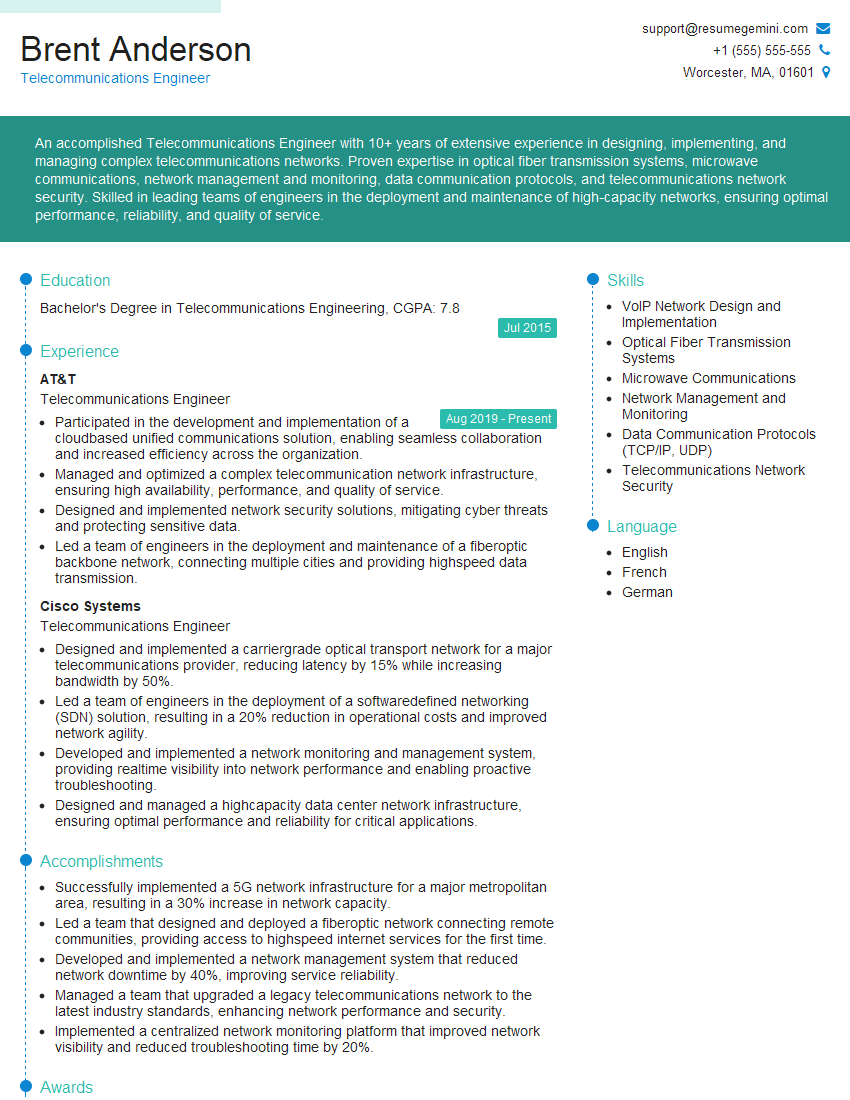
Mastering Fiber Optic Network Planning and Deployment opens doors to exciting career opportunities with significant growth potential in the rapidly expanding telecommunications industry. To maximize your job prospects, focus on building an ATS-friendly resume that highlights your skills and experience effectively. ResumeGemini is a trusted resource that can help you create a professional and impactful resume. ResumeGemini provides examples of resumes tailored to Fiber Optic Network Planning and Deployment to help guide you through the process. Take the next step in your career journey today!


Explore more articles
Users Rating of Our Blogs
Share Your Experience
We value your feedback! Please rate our content and share your thoughts (optional).
What Readers Say About Our Blog
I Redesigned Spongebob Squarepants and his main characters of my artwork.
https://www.deviantart.com/reimaginesponge/art/Redesigned-Spongebob-characters-1223583608
IT gave me an insight and words to use and be able to think of examples
Hi, I’m Jay, we have a few potential clients that are interested in your services, thought you might be a good fit. I’d love to talk about the details, when do you have time to talk?
Best,
Jay
Founder | CEO