Interviews are more than just a Q&A session—they’re a chance to prove your worth. This blog dives into essential Firsthand knowledge of valet operations interview questions and expert tips to help you align your answers with what hiring managers are looking for. Start preparing to shine!
Questions Asked in Firsthand knowledge of valet operations Interview
Q 1. Describe your experience handling high-volume valet operations during peak hours.
Managing high-volume valet operations during peak hours requires a systematic approach and a calm, decisive team. Think of it like orchestrating a well-oiled machine. My experience involves coordinating a team of at least 10 valets during peak periods, typically Friday and Saturday evenings, and holidays. This includes efficiently directing traffic flow, assigning cars to attendants, and ensuring a quick turnaround time to minimize guest wait times. We utilize a pre-determined system where cars are parked according to size and type in designated areas of the parking lot. This optimized organization ensures maximum space utilization, preventing congestion and maximizing efficiency. For instance, during a large event at a hotel I managed, we successfully processed over 200 vehicles within a two-hour window, with an average wait time of less than 5 minutes. Key strategies included clear communication amongst the team, efficient vehicle routing, and a well-defined parking layout.
We also employ a system of prioritizing vehicles – VIPs, hotel guests, and those with special needs get immediate attention. This ensures customer satisfaction while maintaining operational efficiency. It’s all about anticipating surges in demand and proactively managing resources to maintain a smooth, quick service.
Q 2. How do you ensure the safety and security of guest vehicles?
Guest vehicle safety and security are paramount. We implement a multi-layered approach. First, each vehicle receives a numbered ticket meticulously logged into our system. This system is often computerized, with detailed descriptions of each vehicle, including make, model, color, and any noticeable damage upon arrival. Second, our attendants are trained to inspect vehicles for pre-existing damage before accepting them. This is documented on the ticket and in our system. The lot itself is well-lit, fenced, and regularly patrolled. We also utilize security cameras with remote monitoring capabilities. Third, keys are stored securely in a dedicated key system, often with individual compartments and often a numbered, locking system to ensure only authorized personnel can access them. In case of an emergency, we have a protocol for contacting the guest, authorities, and insurance company. We’ve even partnered with local towing services for exceptional situations. We always prioritize preventative measures, reducing the risk of accidents or theft, keeping security as a core component of our daily operations.
Q 3. Explain your process for managing valet tickets and keys.
Managing valet tickets and keys is crucial for efficient and secure operations. We use a two-part system: a numbered ticket given to the guest, which includes the valet’s name or ID number, and a corresponding ticket kept by the valet. This system helps ensure accountability and prevent mix-ups. A detailed record is kept in our management system, digitally or on paper, with all relevant information – vehicle details, guest information, ticket number, time of arrival and departure, attendant’s name, and any special instructions. Keys are always kept secure, often in a designated key box or system, with individual compartments for each vehicle key. This organized approach prevents loss, theft, and ensures accountability for all keys. Our system tracks the key and ticket’s location throughout the entire valet process, allowing for quick retrieval and efficient return of vehicles.
For example, if a guest loses their ticket, we can use the vehicle details and time of arrival to locate their record quickly and retrieve their key.
Q 4. What strategies do you use to optimize valet parking flow and efficiency?
Optimizing valet parking flow and efficiency is a continuous process that involves several key strategies. First, efficient traffic management is essential. Clearly marked signage, well-trained attendants directing traffic, and designated drop-off and pick-up zones minimize congestion. Second, a well-organized parking lot layout is crucial. We use a system that categorizes parking spaces according to vehicle size, which allows us to maximize space utilization and reduce search times for vehicles. Third, technology plays a huge role. Software and systems that track vehicles, tickets, and keys in real-time can significantly improve efficiency. Fourth, regular team training, focusing on efficient vehicle handling and customer service, is critical. We also conduct regular reviews of our processes to identify bottlenecks and areas for improvement.
For example, we’ve implemented a color-coded system for parking spaces, making it quicker for attendants to locate vehicles and improve retrieval times. This improves speed and reduces confusion, creating a better experience for both the customer and the valet team.
Q 5. How do you handle difficult or irate customers?
Handling difficult or irate customers requires patience, empathy, and effective communication skills. My approach involves actively listening to the guest’s concerns without interrupting. I acknowledge their feelings, validating their frustration, and empathize with their situation. I explain the situation clearly, providing a factual account of events. I offer sincere apologies if there were genuine errors or delays, taking ownership and responsibility where appropriate. I avoid getting defensive or arguing, instead focusing on finding a solution that satisfies the guest. If necessary, I offer a compromise, such as a discount on future services or expedited service. Documenting the interaction is crucial, noting the customer’s complaint and the resolution provided.
For instance, if a guest is upset about a long wait time, I’ll apologize sincerely, explain the reasons for the delay (e.g., high volume), and offer a small discount on their next visit as a gesture of goodwill.
Q 6. Describe your experience with valet damage claims and reporting procedures.
Valet damage claims require a methodical approach to ensure fairness and transparency. Upon discovering any damage, whether reported by a guest or discovered by an attendant, we meticulously document the damage using photographs, detailed descriptions, and witness statements (if applicable). This documentation, along with the initial vehicle inspection report, is crucial for determining liability. We then follow our established reporting procedures, which may involve notifying our insurance provider, completing claim forms, and coordinating with the guest to resolve the issue. We often have a policy regarding liability that clarifies the responsibilities of both the valet service and the guest. Open and honest communication throughout the process is essential in managing expectations and maintaining a positive relationship with the customer.
Q 7. What software or systems are you familiar with for managing valet operations?
I am familiar with several software and systems used for managing valet operations. These typically include cloud-based platforms that manage key details, such as vehicle information, guest data, ticket numbers, and attendant assignments. These systems often provide real-time tracking of vehicles and allow for efficient reporting and analytics. I have experience with systems that integrate with other hotel or venue management software for seamless data transfer and overall operation integration. Some systems also allow for mobile check-in/check-out, streamlining the process for both customers and staff. Experience with these systems allows for better operational efficiency, improved customer service, and improved risk management.
Q 8. How do you train new valet attendants?
Training new valet attendants is a multi-stage process focusing on both theoretical knowledge and practical skills. It begins with a comprehensive orientation covering company policies, safety procedures, and customer service expectations. We then move into practical training, starting with vehicle handling – proper parking techniques, understanding different vehicle types and their unique characteristics (e.g., low clearance, manual transmissions), and safe driving practices within the valet area.
Next, we emphasize customer interaction, including greeting customers professionally, handling tickets efficiently, and addressing customer inquiries or concerns with tact and professionalism. We role-play various scenarios to build their confidence and competence in handling diverse situations. Finally, we focus on damage prevention and reporting procedures, showing them how to perform a thorough vehicle inspection before and after parking and what steps to take in case of an incident. Regular refresher training sessions and ongoing performance evaluations ensure consistent high standards of service.
For instance, we might use a specific checklist for pre- and post-parking inspections, ensuring every attendant follows the same process, minimizing the risk of overlooking potential damage. We also incorporate scenario-based training where attendants practice handling difficult customers or unexpected events.
Q 9. Explain your experience with scheduling and staff management for valet services.
Scheduling and staff management are critical for efficient valet operations. My experience involves forecasting demand based on historical data, event calendars, and predicted weather conditions. This allows me to create optimized staffing schedules that account for peak and off-peak hours. I utilize scheduling software to manage employee availability, ensuring sufficient coverage and minimizing overtime costs.
Effective staff management includes ongoing communication, performance monitoring, and regular feedback sessions. I foster a positive work environment by recognizing employee contributions and addressing concerns promptly. I also use performance metrics like customer satisfaction scores and vehicle turnaround time to identify areas for improvement and adjust staffing strategies accordingly. For example, during large events, we might implement a tiered system where experienced attendants handle premium vehicles, while newer attendants work under supervision on standard vehicles.
Q 10. How do you maintain a clean and organized valet area?
Maintaining a clean and organized valet area is essential for both operational efficiency and customer perception. This requires a comprehensive approach that involves regular cleaning, designated parking zones for different vehicle types (e.g., SUVs, compact cars), and clearly marked traffic flow patterns. We establish a strict cleaning schedule for the valet area, including sweeping, mopping, and trash removal.
We also emphasize the importance of prompt vehicle removal from the valet area to prevent congestion and improve turnaround times. Designated spaces for keys and tickets are implemented to maintain order and prevent misplacing important items. Regular inspections ensure that the area is free of debris, spills, and potential hazards. Furthermore, we regularly update our signage and markings to ensure clarity and efficient vehicle flow. A clean and organized valet area creates a positive first impression for customers and significantly contributes to a smoother, more efficient operation.
Q 11. Describe your experience with vehicle damage assessment.
Accurate vehicle damage assessment is crucial to avoid liability and maintain customer trust. My experience involves performing thorough pre- and post-parking inspections, documenting any existing damage using photographs and detailed written descriptions. We use a standardized damage reporting form to ensure consistency and completeness. The form includes specific sections for documenting scratches, dents, broken parts and tire pressure etc.
For example, if a scratch is identified, its location, size, and color are recorded meticulously, along with accompanying photographs. This detailed documentation protects both the customer and the valet company in case of discrepancies. If damage is detected after parking, we follow a strict protocol that includes reporting the incident to management, contacting the customer, and initiating an appropriate course of action such as repair or insurance claim processing. Thorough record-keeping is crucial for accountability and efficient resolution of any damage claims.
Q 12. What is your approach to resolving customer complaints regarding valet services?
Resolving customer complaints is a critical aspect of providing excellent valet service. My approach emphasizes active listening and empathy. I begin by patiently hearing the customer’s concerns without interruption. I then clearly summarize their complaint to ensure understanding. I aim to find a solution that satisfies the customer while upholding company policies and procedures.
If the complaint is justified (e.g., damage to their vehicle), I will take immediate action to address the issue. This could involve initiating repairs, offering a discount on future services, or providing a sincere apology. For example, if a customer complains about a long wait time, I might offer a complimentary valet service on their next visit. Documenting the complaint and the resolution process is essential for learning from mistakes and improving service quality. A calm and professional demeanor is crucial for de-escalating tense situations and creating positive customer interactions even in difficult circumstances.
Q 13. How do you handle lost or misplaced keys?
Handling lost or misplaced keys requires a systematic approach to minimize disruption and maintain customer satisfaction. Our system involves a secure key storage system with numbered slots corresponding to each vehicle. Every valet attendant is trained to accurately record the key’s location and vehicle information. In the event of a lost key, we immediately initiate a thorough search of the valet area and vehicles.
If the key remains unfound, we follow a predetermined procedure which often involves contacting the customer, offering assistance with locksmith services, and providing regular updates on our search. We maintain a detailed log of all keys handled, including timestamps and the attendant responsible. This ensures that we can trace the key’s movements and address any potential issues promptly. Thorough documentation is crucial in handling situations like this, particularly for insurance claims or potential liability issues.
Q 14. What are your strategies for ensuring the timely return of vehicles?
Ensuring timely vehicle return is crucial for a positive customer experience. This requires efficient organization and communication. We use a ticketing system to track vehicles and customer requests, allowing us to prioritize retrievals based on urgency. The system also allows us to quickly locate vehicles within the valet parking area. We maintain clear communication channels between the attendants inside and outside, allowing for seamless vehicle retrieval.
We regularly monitor vehicle turnaround times to identify any bottlenecks or areas for improvement. During peak hours, we often employ a system where multiple attendants coordinate vehicle retrieval to reduce waiting times. This streamlined approach ensures a consistently quick and reliable service, leaving our customers with a positive experience. Real-time updates to customers on their vehicle’s status contribute to reduced anxiety and increased satisfaction.
Q 15. How do you enforce company policies and procedures related to valet operations?
Enforcing company policies and procedures in valet operations requires a multi-pronged approach focusing on training, monitoring, and consistent feedback. We begin with thorough onboarding, where new staff receive comprehensive training on all aspects of the operation, including our specific policies on vehicle handling, customer interaction, and safety protocols. This training isn’t just a lecture; it includes hands-on practice and role-playing to ensure they understand and can apply the procedures.
Ongoing monitoring is crucial. This involves regular supervision by experienced team members, the use of CCTV cameras to review performance and identify potential issues, and random spot checks of vehicle handling and ticketing procedures. We also use checklists for each shift, ensuring all staff complete pre-shift and post-shift inspections.
Finally, regular performance reviews and feedback sessions provide opportunities to address any shortcomings and reinforce positive behaviors. We use a system of progressive discipline, starting with verbal warnings, moving to written warnings, and then, if necessary, suspension or termination. For example, if a valet consistently fails to follow proper vehicle handling procedures, leading to damage, we’d first offer retraining, then a written warning, and ultimately disciplinary action if the behavior doesn’t improve.
Career Expert Tips:
- Ace those interviews! Prepare effectively by reviewing the Top 50 Most Common Interview Questions on ResumeGemini.
- Navigate your job search with confidence! Explore a wide range of Career Tips on ResumeGemini. Learn about common challenges and recommendations to overcome them.
- Craft the perfect resume! Master the Art of Resume Writing with ResumeGemini’s guide. Showcase your unique qualifications and achievements effectively.
- Don’t miss out on holiday savings! Build your dream resume with ResumeGemini’s ATS optimized templates.
Q 16. How do you handle situations involving intoxicated individuals?
Handling intoxicated individuals requires a calm and firm approach, prioritizing safety for both the guest and our staff. Our protocol starts with careful observation. If we suspect intoxication, we politely assess their condition, and if they seem impaired, we refuse service. We explain this decision firmly but politely, emphasizing safety concerns.
If they become disruptive or aggressive, we immediately contact security personnel or, depending on the severity, the local authorities. We’ll also ensure a clear path to exit, keeping other guests and our staff safe. Detailed records are maintained of the incident, including the time, date, description of the individual, and actions taken. We strongly emphasize de-escalation techniques during staff training to ensure that even difficult situations can be managed without conflict escalating.
For example, if a visibly intoxicated guest insists on driving, we would refuse to return their vehicle and contact either their designated driver, a ride-sharing service, or local authorities if necessary. The safety of our guests and the public is paramount.
Q 17. Describe your experience with managing valet staff performance.
Managing valet staff performance involves a blend of coaching, mentoring, and performance management techniques. I begin by setting clear expectations and performance goals, using a system of Key Performance Indicators (KPIs) to track efficiency, customer satisfaction, and safety. These KPIs might include average service time, the number of vehicle incidents, customer feedback scores, and adherence to safety regulations.
Regular one-on-one meetings are crucial for providing constructive feedback and addressing any performance issues promptly. I use a combination of positive reinforcement and constructive criticism, highlighting both strengths and areas for improvement. For example, if a valet consistently exceeds customer service expectations, I’ll publicly recognize their achievement. If someone is struggling with a specific task, I’ll offer additional training or mentorship.
Performance reviews incorporate both quantitative data (KPIs) and qualitative feedback from customers and supervisors. This holistic approach allows for a fair and comprehensive evaluation of each employee’s performance. Ultimately, effective performance management helps to foster a high-performing, safe, and customer-centric valet team.
Q 18. How do you prioritize tasks during peak demand periods?
Prioritizing tasks during peak demand requires a strategic approach combining efficient workflow management and effective team communication. We use a color-coded system to categorize tickets: urgent requests (e.g., disabled guests) are red, high-priority (e.g., large vehicles) are yellow, and standard requests are green. This visual system allows staff to quickly assess task urgency and prioritize accordingly.
Clear communication is paramount. I use a combination of verbal instructions, two-way radios, and a digital dispatch system (in some operations) to coordinate tasks and ensure everyone is informed of any changes in demand or priorities. We may also implement a ‘zone’ system during high volume times assigning valets to specific areas to reduce confusion and optimize efficiency.
Cross-training is invaluable for peak times. If one area becomes overwhelmed, we can quickly re-assign staff to assist where needed. We also ensure there’s adequate staffing for expected peak periods, based on historical data and anticipated events. For example, if we know a major concert is happening, we’ll proactively schedule extra staff to ensure smooth operations.
Q 19. What measures do you take to ensure the safety of both staff and guests?
Ensuring the safety of both staff and guests is a top priority, and we employ a layered approach. This includes thorough staff training on safe driving practices, vehicle handling techniques, and emergency procedures. We use high-visibility vests and uniforms for increased visibility, and require staff to undergo regular background checks. Our vehicles are regularly maintained and inspected to ensure they are roadworthy.
The valet area itself is designed with safety in mind, with clear signage, well-lit areas, and defined pedestrian pathways. CCTV cameras monitor the entire operation, providing a record of activity and deterring any unauthorized actions. We implement strict protocols for handling keys and vehicles, including assigning each vehicle a unique ticket number and maintaining a detailed log.
Finally, we foster a safety-conscious culture, where reporting near misses or incidents is encouraged. This proactive approach, along with regular safety meetings, reinforces our commitment to safety and minimizes risks. For instance, if a valet reports a minor incident like a near-collision, we investigate it to identify underlying causes and implement corrective measures, preventing future occurrences.
Q 20. How familiar are you with different types of vehicles and their specific handling requirements?
My experience encompasses handling a wide variety of vehicles, from compact cars to large SUVs, luxury vehicles, and even motorcycles. I am familiar with the unique handling requirements of different vehicles, including low-clearance vehicles, vehicles with manual transmissions, and those with specific technological features (e.g., automatic braking systems). I understand the importance of adjusting driving techniques to match the vehicle’s characteristics.
This includes an awareness of potential issues such as low ground clearance affecting parking in certain areas, the need for extra care when driving vehicles with sensitive features, or the unique challenges presented by unusual vehicle dimensions or configurations. Proper knowledge of vehicle types ensures minimal risk of damage and provides guests with confidence in our service. For instance, I know how to safely park a low-riding sports car without scraping the undercarriage, and how to safely operate vehicles with uncommon transmission systems or features.
Ongoing training and keeping up-to-date on new vehicle technology are essential to maintain this expertise. I actively seek opportunities to expand my knowledge and experience, especially when it comes to handling emerging technologies in vehicles.
Q 21. What is your experience with cash handling and reconciliation procedures?
I have extensive experience with cash handling and reconciliation procedures, including following strict protocols for receiving payment, issuing receipts, and balancing cash drawers at the end of each shift. I’m adept at using point-of-sale (POS) systems, and familiar with various payment methods, including cash, credit cards, and mobile payments. Accuracy and security are paramount in this area.
My procedures include regularly counting cash throughout the shift to minimize discrepancies and ensure proper accounting. At the end of each shift, I carefully reconcile the cash drawer against the day’s transactions, documenting any discrepancies and reporting them according to company protocol. This process ensures the accurate tracking of all financial transactions. We usually employ a two-person counting procedure to minimize the risk of error and ensure transparency.
Any discrepancies are thoroughly investigated, with any potential losses reported to management immediately. We follow strict security protocols to protect cash from theft or loss, ensuring all financial processes adhere to company policy and industry best practices. This includes the use of secure cash boxes and adherence to procedures for handling large sums of money.
Q 22. How would you address a situation where a vehicle is accidentally damaged?
Addressing vehicle damage is a crucial aspect of valet operations, requiring immediate action and thorough documentation. My first step would be to assess the damage, taking photos from multiple angles to accurately record the extent of the damage. I’d then immediately report the incident to my supervisor, following established protocols for damage reporting. This typically involves completing an incident report form which details the date, time, location of the damage, description of the damage, the vehicle’s details (make, model, license plate, etc.), and the customer’s contact information.
Next, I would contact the customer to inform them of the situation, expressing sincere apologies and assuring them we’re taking care of it. Depending on the severity of the damage and our insurance policy, we’d either arrange for repairs at a reputable body shop of their choice or, in less severe cases, handle repairs in-house. Throughout the process, I’d maintain open communication with the customer, providing updates on the repair progress and ensuring their satisfaction. Transparency and a proactive approach are key to managing such situations effectively, mitigating potential disputes and maintaining a positive customer experience. For example, once I experienced a minor scratch on a customer’s bumper. I immediately reported it, took pictures, and contacted the customer. We arranged for a repair at a trusted body shop, keeping the customer updated until the vehicle was restored to its pristine condition.
Q 23. Describe your knowledge of local traffic laws and regulations impacting valet services.
My understanding of local traffic laws and regulations pertaining to valet services is comprehensive. This includes knowledge of parking regulations, traffic laws related to vehicle operation (speed limits, right-of-way, etc.), and specific ordinances that might govern valet operations in the area. For example, I am aware of regulations regarding parking permits, designated loading zones, and restrictions on parking during specific events or times.
Furthermore, I’m familiar with any local licensing or permitting requirements for valet services. I understand the importance of adhering to these regulations to ensure legal compliance and avoid penalties. In our city, for instance, valet companies must obtain a specific permit, adhere to insurance requirements, and complete background checks for all employees. Regular training on traffic laws and local regulations is essential to maintaining a safe and legally sound operation.
Q 24. Explain your experience with coordinating valet services with other hotel/restaurant operations.
Coordinating valet services with other hotel/restaurant operations requires seamless communication and efficient teamwork. In my previous role, I worked closely with the front desk, concierges, and restaurant managers to ensure smooth operations. Effective communication is paramount; I’ve utilized various communication tools, including two-way radios, text messages, and shared digital platforms to relay information regarding customer requests, vehicle locations, and any potential delays.
For example, I’d coordinate with the front desk to receive incoming valet requests and ensure that the customer’s information is accurately recorded. With the restaurant manager, I would synchronize valet staffing levels to accommodate peak dining hours, ensuring sufficient personnel to handle increased vehicle volume. This collaborative approach guarantees a positive experience for guests and reduces operational friction between different departments. Efficient coordination minimizes waiting times, improves customer satisfaction, and streamlines the overall operational flow.
Q 25. How do you maintain accurate records of valet transactions and activities?
Maintaining accurate records is critical for efficient valet operations, both financially and legally. We typically use a combination of a digital valet management system and physical logs. The digital system allows for real-time tracking of vehicles, customer information, and transactions. This ensures that every vehicle is accounted for and that transactions are promptly recorded and reconciled. The system usually includes features such as vehicle entry and exit timestamps, customer details, payment information, and a unique claim ticket number for each vehicle.
In addition to the digital system, we also maintain physical claim tickets and a daily logbook. This serves as a backup record and allows for manual tracking of transactions if the digital system experiences technical difficulties. Regular reconciliation between the digital and physical records is essential to ensure data integrity. At the end of each shift, we conduct a thorough reconciliation, verifying that all transactions are accurately recorded in both systems. This detailed record-keeping helps us manage revenue, track customer interactions, and respond effectively to any queries or disputes.
Q 26. What are your strategies for preventing vehicle theft or vandalism?
Preventing vehicle theft and vandalism is a top priority. Our strategies are multi-faceted and incorporate both physical and procedural measures. Firstly, we have a secure parking area, ideally with lighting, security cameras and barriers. We train all valet staff on the importance of vehicle security, including proper vehicle handling, ensuring keys are secured, and never leaving keys unattended.
Secondly, we implement strict procedures for key handling, often using a key tracking system that logs when keys are received and returned. We also utilize security cameras that cover the parking area and the valet stand, providing visual monitoring of activity. Regular inspection of the parking area and vehicles is essential in identifying potential issues early. Our staff is trained to report any suspicious activity immediately to their supervisor and, if necessary, to security personnel. Lastly, regular training and background checks on our personnel are integral in maintaining a trustworthy team and minimizing risks.
Q 27. Describe your experience with utilizing GPS tracking or other technological aids for valet management.
GPS tracking technology offers significant advantages in valet management, providing real-time tracking of vehicles within the parking area, improving efficiency and security. In my previous role, we employed a GPS-enabled valet system that allowed us to locate vehicles quickly, reducing search time and enhancing customer satisfaction. The system provided data regarding the location of each vehicle and its movement within the parking facility.
This technology also assisted in managing vehicle inventory and preventing losses. By tracking vehicles, we could easily verify their presence in the parking area, reducing the risk of misplacement or unauthorized movement. The data collected by the system also enabled improved operational analysis, helping us identify potential bottlenecks or inefficiencies in valet operations. The integration of GPS tracking with our existing valet management software improved data accuracy, providing comprehensive insights into our operations and enhancing the overall customer experience.
Q 28. How would you handle a situation where a customer disputes a valet charge?
Handling customer disputes over valet charges requires a calm, professional, and empathetic approach. My first step would be to listen carefully to the customer’s concerns, allowing them to fully explain their perspective without interruption. Next, I’d review the valet transaction records, including the claim ticket, payment information, and any relevant notes from the valet staff. This verification helps establish the facts and understand the basis of the dispute.
If the customer’s claim is legitimate, I’d apologize for any inconvenience and promptly address the issue. This might involve issuing a refund or adjusting the charge accordingly, depending on the circumstances. If the discrepancy is due to a misunderstanding or error on the customer’s part, I’d patiently explain the charges, referring to the valet’s rate card or company policy. Maintaining a calm and respectful demeanor throughout the process is crucial in resolving disputes and maintaining customer goodwill. In situations where a resolution can’t be reached immediately, I’d escalate the issue to my supervisor for further investigation and resolution, keeping the customer informed at each step. Documentation throughout the process is critical to ensure fair and transparent handling of the dispute.
Key Topics to Learn for Firsthand Knowledge of Valet Operations Interview
- Customer Service Excellence: Understanding and implementing strategies for providing exceptional customer service in a fast-paced environment. This includes handling difficult situations with grace and professionalism.
- Vehicle Handling and Safety: Demonstrating proficiency in safely receiving, parking, and retrieving vehicles of various makes and models. This involves understanding parking lot layout, traffic flow, and safety protocols.
- Teamwork and Communication: Explaining how you effectively collaborate with colleagues, communicate efficiently with customers and supervisors, and contribute to a positive team dynamic.
- Inventory Management and Ticketing Systems: Describing your experience with managing vehicle keys, tickets, and related paperwork accurately and efficiently. This includes familiarity with digital ticketing systems and procedures.
- Loss Prevention and Security: Highlighting your understanding of security procedures, including preventing vehicle damage, theft, and ensuring the safety of both vehicles and customers.
- Cash Handling and Reconciliation: Demonstrating experience with accurate cash handling, processing payments, and reconciling daily transactions. This may include credit card processing and other forms of payment.
- Problem-Solving and Decision-Making: Providing examples of how you’ve handled unexpected situations, such as dealing with difficult customers, mechanical issues, or parking lot emergencies.
- Operational Efficiency and Process Improvement: Discussing your ability to identify areas for improvement in valet operations and implementing solutions to enhance efficiency and productivity.
Next Steps
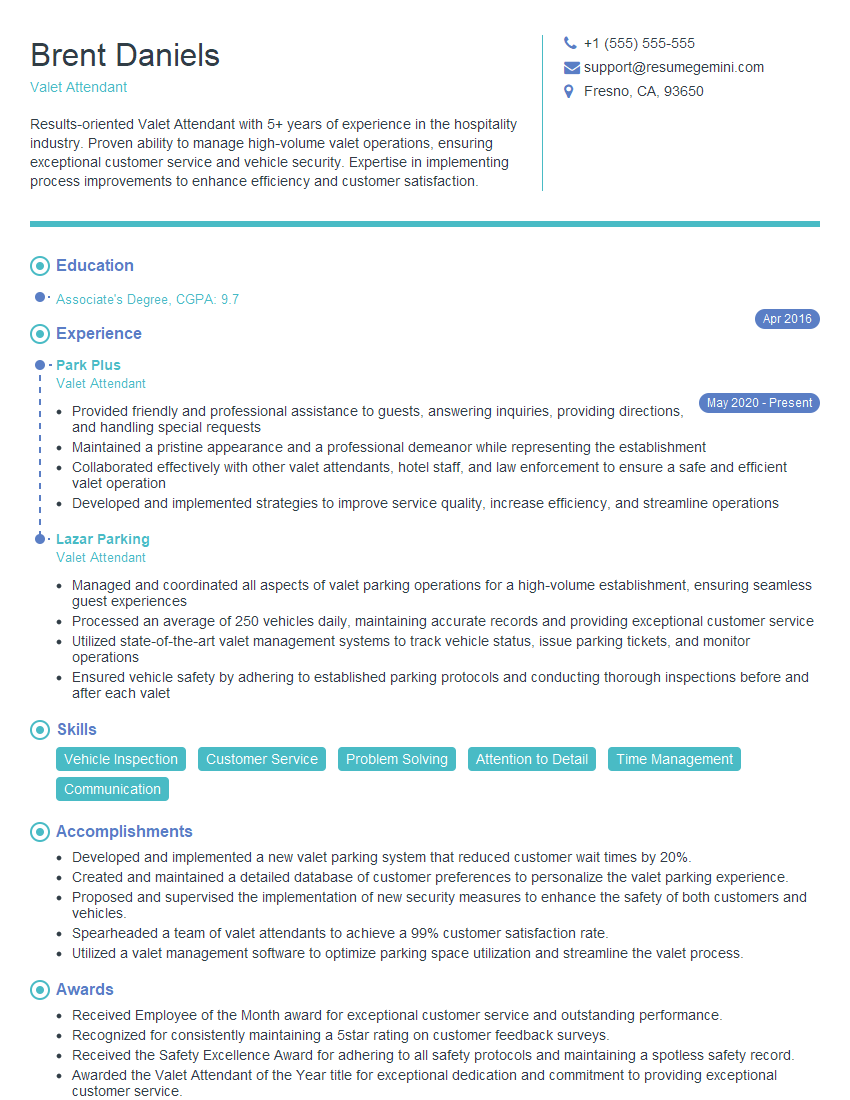
Mastering firsthand knowledge of valet operations is crucial for career advancement, opening doors to supervisory roles, management positions, and increased earning potential. An ATS-friendly resume is your key to unlocking these opportunities. ResumeGemini can help you craft a compelling and effective resume that highlights your skills and experience in valet operations, maximizing your chances of landing your dream job. Examples of resumes tailored to valet operations are available through ResumeGemini, providing valuable templates and guidance to build your professional profile.
Explore more articles
Users Rating of Our Blogs
Share Your Experience
We value your feedback! Please rate our content and share your thoughts (optional).
What Readers Say About Our Blog
Really detailed insights and content, thank you for writing this detailed article.
IT gave me an insight and words to use and be able to think of examples