Interviews are opportunities to demonstrate your expertise, and this guide is here to help you shine. Explore the essential High Reach Operation interview questions that employers frequently ask, paired with strategies for crafting responses that set you apart from the competition.
Questions Asked in High Reach Operation Interview
Q 1. Describe the pre-operational checks you perform on a boom lift.
Pre-operational checks on a boom lift are crucial for ensuring safe and efficient operation. Think of it like a pilot performing a pre-flight check – it’s a systematic process to identify any potential hazards before starting work. My checklist always includes:
- Visual Inspection: Checking for any visible damage to the boom, chassis, tires, and hydraulic lines. I look for leaks, cracks, or any signs of wear and tear. For example, a small crack in a hydraulic line could lead to a significant leak and failure during operation.
- Fluid Levels: Verifying the levels of hydraulic fluid, engine oil, and coolant. Low fluid levels indicate potential problems and require immediate attention.
- Electrical Systems: Testing the functionality of lights, horns, and emergency stop mechanisms. These are critical safety features. A faulty horn, for instance, could compromise safety in a busy work environment.
- Controls and Gauges: Checking the responsiveness of all controls – boom extension, rotation, and platform movement. I also ensure all gauges are functioning correctly, providing accurate readings of vital parameters.
- Safety Devices: Inspecting the condition of safety harnesses, outriggers, and emergency stops. These are non-negotiable for safe operation. Outriggers, for example, must be properly deployed to provide a stable base.
- Ground Conditions: Assessing the stability of the ground where the boom lift will be operated. Uneven or soft ground can affect stability and increase the risk of tipping. I look for potential obstacles and ensure the ground is level and firm before commencing work.
These checks are documented in a pre-start checklist, which I always complete and sign before starting any work. This ensures accountability and helps maintain a safe working environment.
Q 2. Explain the different types of aerial lifts and their applications.
Aerial lifts are broadly categorized into several types, each suited for specific tasks. Choosing the right type is crucial for safety and efficiency. The main categories are:
- Articulating Boom Lifts: These offer exceptional versatility with multiple articulating joints that allow them to reach around obstacles. They’re ideal for tight spaces and complex work scenarios. I’ve used these extensively for working on building facades where navigating obstacles like windows and pipes is crucial.
- Telescopic Boom Lifts: These have a straight boom that extends telescopically, offering excellent reach in a straight line. They’re perfect for high-reach tasks in open areas. We utilized these on large construction sites where unobstructed access was available.
- Scissor Lifts: These have a platform that raises vertically using a scissor mechanism. They are relatively simple to operate and are commonly used for tasks requiring less height and broader platform area. I’ve used these frequently for indoor maintenance tasks where the ceiling height isn’t excessive.
- Vertical Mast Lifts: These are essentially vertical lifts with limited horizontal reach. Their strength is in straight vertical access. These are useful for warehouse work or maintenance of high ceilings in smaller spaces.
The application depends heavily on the job. For instance, a telescopic boom lift would be unsuitable for working around tight corners, while a scissor lift might not be appropriate for high-altitude work.
Q 3. How do you calculate the working load limit (WLL) of a high reach machine?
Calculating the Working Load Limit (WLL) of a high reach machine isn’t a simple calculation; it’s a complex process that considers several factors. The WLL is the maximum load the machine can safely lift under specific conditions and should never be exceeded. It’s not simply a single number.
The WLL is determined by the manufacturer based on rigorous testing and engineering calculations. This involves considering factors like:
- Boom configuration: The angle and extension of the boom significantly affect the WLL. Extending the boom fully reduces the load capacity.
- Platform Load: The weight of the operator, tools, and materials on the platform all contribute to the total load.
- Ground Conditions: Uneven or soft ground reduces the stability of the machine, and the WLL should be adjusted accordingly.
- Wind speed: High wind speeds can affect stability and reduce the safe working load.
The manufacturer’s data plate displays the WLL under various boom configurations. This information is crucial. Operators should never attempt to exceed the specified WLL as doing so could result in serious accidents or equipment damage. It’s essential to consult the operator’s manual for precise WLL values for specific situations.
Q 4. What are the safety regulations you must adhere to while operating a high reach machine?
Safety regulations for operating high reach machines are stringent and essential for preventing accidents. They cover several key areas:
- Training and Certification: Operators must receive proper training and certification to demonstrate competency in operating the specific type of high reach machine. This ensures they understand safety procedures and limitations.
- Pre-operational Checks: As mentioned earlier, thorough pre-operational checks are mandatory before each use. This is non-negotiable.
- Personal Protective Equipment (PPE): Operators must always wear appropriate PPE, including hard hats, safety harnesses, and high-visibility clothing. This protects against falls and other hazards.
- Safe Operating Procedures: Adherence to safe operating procedures is critical. This includes avoiding overloading the machine, maintaining a safe distance from power lines, and never exceeding the WLL.
- Environmental Awareness: Operators must be aware of their surroundings, including other workers, obstructions, and weather conditions. This requires constant vigilance.
- Emergency Procedures: Operators should be familiar with emergency procedures, including how to safely lower the platform and evacuate in case of equipment failure or an emergency.
- Regular Inspections: Regular inspections of the equipment are crucial for identifying and addressing potential issues before they lead to accidents.
Non-compliance can result in serious consequences, including injury, death, and legal repercussions. Safety is paramount in high-reach operations.
Q 5. Describe your experience with different types of aerial lift controls.
My experience encompasses several types of aerial lift controls. They range from simple, mechanical controls to more sophisticated electronic systems.
- Mechanical Controls: These involve levers and handwheels for controlling the boom movements. They provide a direct feel and are often used on older or simpler machines. The responsiveness can be different compared to newer systems.
- Proportional Controls: These systems use joysticks or levers that provide precise control over boom movements. The degree of movement is proportional to the joystick or lever’s position – providing more finesse and accuracy.
- Electronic Controls: More modern machines have electronic controls, often with digital displays providing information on height, load, and other parameters. These systems often include features like automatic leveling and overload protection.
- Hybrid Systems: Some machines utilize a hybrid approach, combining aspects of mechanical and electronic controls. For example, boom extension might be mechanical, while platform rotation is controlled electronically.
Each type requires a different level of familiarity and understanding. Proper training is necessary to safely and efficiently operate all types of controls. The key is to understand the responsiveness of the system and to practice smooth and controlled movements.
Q 6. How do you handle unexpected situations, such as equipment malfunction during operation?
Handling unexpected situations, like equipment malfunctions, requires a calm and methodical approach. My priority is always safety. My response strategy is as follows:
- Immediate Stop: The first step is to immediately stop all operations and activate the emergency stop mechanism.
- Assess the Situation: Carefully assess the nature of the malfunction and the potential hazards involved. Is there a risk of a fall? A hydraulic leak?
- Alert Others: Notify other personnel in the area of the situation. Clear the work zone to prevent any accidents.
- Follow Emergency Procedures: Implement the established emergency procedures for the specific equipment. This often involves lowering the platform safely to the ground.
- Report the Malfunction: Report the incident to the supervisor and maintenance personnel. Provide a detailed account of what happened.
- Do Not Attempt Repairs: Do not attempt to repair the equipment yourself unless you are specifically trained to do so. Leave repairs to qualified technicians.
Proper training and a clear understanding of emergency procedures are essential for effectively handling unexpected situations and mitigating potential risks. I’ve dealt with situations involving hydraulic leaks and control system failures and followed this protocol each time.
Q 7. Explain the importance of daily inspections for high reach equipment.
Daily inspections are not just a formality; they’re a critical safety measure. Think of it as a routine health check for your equipment. Regular inspections help to identify potential problems early, preventing catastrophic failures and accidents. My daily inspection covers:
- Hydraulic System: Checking for leaks in hydraulic lines and cylinders. Even small leaks can escalate into significant problems.
- Tires and Wheels: Inspecting tire pressure and looking for damage or wear. Underinflated tires or damaged wheels compromise stability.
- Electrical System: Testing lights, horns, and other electrical components to ensure proper functioning.
- Safety Devices: Checking the condition of safety harnesses, outriggers, and emergency stops. These are vital safety features.
- Controls and Gauges: Verifying the responsiveness of all controls and the accuracy of gauges.
- Boom and Platform: Inspecting the boom and platform for any damage or wear.
- Documentation: Recording the results of the inspection in a daily logbook. This provides a valuable record of the equipment’s condition and helps identify trends.
These inspections help maintain the equipment in optimal working condition, extending its lifespan and, most importantly, preventing accidents. Failing to perform daily inspections is a serious oversight that can compromise safety.
Q 8. What are the common causes of accidents involving high reach equipment?
Accidents involving high-reach equipment, such as aerial work platforms (AWPs) and cranes, stem from a variety of factors. Human error is a leading cause, encompassing inadequate training, rushing, ignoring safety procedures, and operating under the influence of drugs or alcohol. Mechanical failures, from faulty components to inadequate maintenance, also contribute significantly. Environmental factors, including adverse weather conditions like strong winds or icy surfaces, can compromise stability and control. Finally, inadequate site preparation, such as insufficient space for maneuvering or lack of appropriate fall protection, can increase risks considerably.
- Example: A poorly maintained boom lift with a hydraulic leak can lead to sudden loss of height, resulting in a serious accident.
- Example: An operator not properly assessing wind conditions before raising a platform can cause the machine to become unstable and tip over.
Q 9. How do you ensure the stability of the machine during operation?
Ensuring stability during high-reach operations is paramount. This involves a multi-pronged approach starting with thorough pre-operational checks. This includes inspecting all components for damage or wear, checking fluid levels, testing the emergency systems, and verifying the machine’s leveling system is functioning correctly. Ground conditions must also be assessed for stability – soft ground or uneven surfaces require extra caution or the use of stabilizing outriggers. During operation, the operator must adhere to load limits, maintain awareness of the machine’s center of gravity, and avoid sudden movements. Wind speeds must be carefully monitored, and the machine must not be operated in excessively windy conditions. Regular calibration of the machine’s sensors that monitor the position and stability is crucial for long-term safety.
- Example: Before operating a scissor lift, always ensure the outriggers are fully extended and firmly planted on a level surface.
Q 10. How do you communicate with ground personnel during high reach operations?
Clear and effective communication with ground personnel is essential for safety. This usually involves a combination of visual signals and two-way radios. Pre-determined hand signals should be established and understood by all involved. Two-way radios allow for immediate communication regarding changes in the work plan, potential hazards, or emergencies. Operators should always confirm the message has been received and understood. The use of visual aids, such as flags or cones, to delineate the work area and warn others of potential hazards is equally important. Regular communication check-ins are crucial to maintain situational awareness.
- Example: Using pre-agreed hand signals, the ground crew can communicate to the operator if an obstruction is near the boom or platform.
- Example: Using a radio, the operator can alert the ground crew about the start and stop of lift operations to avoid unexpected movements.
Q 11. What are the limitations of different types of high reach equipment?
Different types of high-reach equipment have unique limitations. For instance, boom lifts offer greater reach and versatility but can be less stable than scissor lifts. Scissor lifts are typically simpler to operate and more compact, but their vertical reach is limited. Articulated boom lifts have exceptional maneuverability, enabling them to reach awkward positions, but have lower lifting capacity compared to telescopic booms. Crane limitations include reach, load capacity, and swing radius. Each machine’s specifications, including maximum load capacity, operational height, and outreach, must be carefully considered for the specific job requirements.
- Example: A telescopic boom lift is ideal for reaching high points in an open area, but may not be suitable for confined spaces where an articulated boom would be better.
Q 12. Describe your experience with working at height.
Throughout my career, I’ve accumulated extensive experience working at height, primarily using a range of high-reach equipment including boom lifts, scissor lifts, and telehandlers. I’ve worked on diverse projects, from building maintenance and construction to industrial plant upkeep. This experience has instilled in me a deep understanding of the safety protocols and risk mitigation strategies necessary for these operations. I’ve handled situations requiring precision and accuracy at considerable heights, always prioritizing safety. I’ve also overseen training for new personnel, emphasizing safe work practices and the importance of emergency procedures.
- Example: In one instance, I used a boom lift to repair damaged exterior cladding on a high-rise building, meticulously planning movements and maintaining constant communication with the ground crew.
Q 13. How do you select the appropriate high reach equipment for a specific task?
Selecting the appropriate high-reach equipment depends on several factors. Firstly, the task’s specific requirements, such as the required working height, reach, and load capacity, must be carefully assessed. The worksite’s conditions, including ground stability, access restrictions, and environmental factors such as wind and weather, are also crucial considerations. The equipment’s maneuverability needs to be aligned with the site layout. Finally, cost-effectiveness and availability also play a role. A thorough risk assessment should be conducted before making a final decision to ensure the chosen equipment is suitable for the task and the safest option available.
- Example: For indoor work with limited space, a compact scissor lift might be preferable over a larger boom lift. For outdoor work reaching great heights, a telescopic boom lift with a high working capacity might be better.
Q 14. What is your experience with emergency procedures in case of equipment failure?
My experience with emergency procedures encompasses a range of scenarios, from minor mechanical issues to more serious equipment failures. In case of any equipment malfunction, the immediate priority is to secure the machine and ensure the safety of all personnel involved. This frequently involves lowering the platform or boom in a controlled manner using the emergency lowering system. Communication with ground personnel is crucial, and evacuation procedures may need to be implemented. Post-incident investigations are carried out to determine the root cause of the failure and prevent similar incidents in the future. I am also proficient in handling emergency situations where operators experience difficulties at height, requiring prompt and calm responses. Regular training and drills keep my emergency response skills sharp.
- Example: During a routine inspection, a hydraulic leak was detected on a boom lift. Following the established emergency protocol, the operator carefully lowered the platform and the machine was taken out of service for repair.
Q 15. Explain the different types of load charts and their significance.
Load charts are crucial documents in high-reach operations, detailing the safe weight limits and center of gravity for various boom configurations and working radii. Different types exist to cater to specific equipment and situations.
- Capacity charts: These charts graphically represent the maximum load capacity of the equipment at different boom angles and extensions. Think of it like a map showing safe weight limits based on the boom’s position. For example, a crane’s capacity will be significantly reduced with a fully extended boom compared to a retracted one.
- Load moment indicators (LMI): These are electronic systems built into many high-reach machines, providing real-time load capacity information. The LMI will show the operator if exceeding safe limits and often prevents operation until the load is reduced. This is analogous to a car’s speedometer; it warns you before you exceed safe speeds.
- Stability charts: These charts consider the ground conditions and machine’s stability, adding another layer of safety to the load calculation. They often define limits for operation on slopes or uneven terrain.
- Custom charts: In some cases, specialized load charts are created for unique tasks or modifications made to the equipment, ensuring accurate capacity assessment for non-standard situations.
Their significance lies in preventing overloading, which can lead to equipment failure, injuries, or even fatalities. By consulting these charts before every lift, operators ensure that the machine’s structural integrity isn’t compromised and that operations remain safe.
Career Expert Tips:
- Ace those interviews! Prepare effectively by reviewing the Top 50 Most Common Interview Questions on ResumeGemini.
- Navigate your job search with confidence! Explore a wide range of Career Tips on ResumeGemini. Learn about common challenges and recommendations to overcome them.
- Craft the perfect resume! Master the Art of Resume Writing with ResumeGemini’s guide. Showcase your unique qualifications and achievements effectively.
- Don’t miss out on holiday savings! Build your dream resume with ResumeGemini’s ATS optimized templates.
Q 16. How do you identify and mitigate potential hazards during high reach operations?
Hazard identification and mitigation during high-reach operations are paramount. A systematic approach using a job safety analysis (JSA) is essential.
Identification: We begin by identifying potential hazards, classifying them by likelihood and severity. This could include:
- Environmental hazards: Overhead power lines, nearby structures, unstable ground conditions, weather (wind, rain).
- Equipment hazards: Mechanical failure, hydraulic leaks, faulty safety systems.
- Human hazards: Improper training, fatigue, distracted operators, lack of communication.
Mitigation: Once hazards are identified, we implement controls using the hierarchy of controls:
- Elimination: If possible, completely remove the hazard (e.g., rerouting power lines before work).
- Substitution: Replace the hazardous task or material with a safer alternative.
- Engineering controls: Implement physical barriers or modify equipment to reduce risk (e.g., using a boom-limiting device to prevent contact with overhead power lines).
- Administrative controls: Develop procedures, training, and communication protocols to minimise risk (e.g., implementing a detailed pre-operation inspection checklist).
- Personal protective equipment (PPE): Use safety harnesses, hard hats, high-visibility clothing as a last line of defense.
For instance, if working near overhead power lines, we would utilize a spotter to warn the operator of any close approaches and ensure proper clearance, and likely use a non-conductive boom.
Q 17. Describe your experience with confined space entry procedures related to high reach operations.
My experience with confined space entry related to high-reach operations involves working on tasks requiring access to machinery compartments or other restricted areas within the reach of the equipment. This necessitates strict adherence to confined space entry procedures outlined in OSHA and other relevant standards.
This always involves a permit-to-work system, atmospheric monitoring for oxygen levels, flammables, and toxins, and a designated rescue plan. Before entering, we ensure adequate ventilation, utilize appropriate respiratory protection, and have a standby worker outside to monitor conditions and assist in emergencies. I’ve personally been involved in inspecting and repairing hydraulic components located within confined spaces of the equipment, always following the established safety procedures to ensure the well-being of the workers.
One specific example was working on a scissor lift where access to a critical hydraulic component required entering a confined area beneath the platform. This involved creating a permit-to-work, conducting a thorough atmospheric test, deploying a ventilation system, and having a rescue plan in place.
Q 18. What are the different types of fall protection systems used in high reach operations?
Several fall protection systems are employed in high-reach operations to safeguard personnel working at heights. The choice depends on the specific task and work environment.
- Full-body harnesses: These are the most common and provide comprehensive protection. They are coupled with an anchorage point on the equipment, providing a reliable connection to prevent falls.
- Lanyards: These connect the harness to the anchorage point and allow for a limited range of movement. Shock-absorbing lanyards are preferred to mitigate impact forces during a fall.
- Self-retracting lifelines (SRLs): These devices automatically retract the lifeline, minimizing the distance of a potential fall. They are particularly useful in situations with variable working heights.
- Guardrails and safety nets: Where feasible, these passive systems offer a physical barrier to prevent falls. They should always be integrated with harnesses and other active fall protection measures.
- Fall arrest systems: These systems are designed to stop a fall and keep a worker from impacting the ground. They may incorporate energy-absorbing devices to minimize the impact force.
Selecting the right system necessitates a risk assessment, considering factors like fall distance, work environment, and the type of equipment involved. The systems must be regularly inspected and certified to ensure they meet relevant safety standards.
Q 19. How do you comply with OSHA or relevant safety regulations regarding high reach equipment?
Compliance with OSHA regulations (or equivalent international standards) for high-reach equipment is fundamental. This involves several key aspects:
- Operator training and certification: Ensuring operators are properly trained and certified to operate the specific type of high-reach equipment, adhering to all safety procedures.
- Regular inspections and maintenance: Conducting thorough pre-operational and periodic inspections of the equipment, addressing any defects promptly to prevent failures.
- Safe operating procedures: Establishing and enforcing written safe operating procedures (SOPs) for all tasks involving high-reach equipment.
- Record-keeping: Maintaining detailed records of inspections, maintenance, training, and any incidents or near misses.
- Compliance with load limits: Strict adherence to the load charts and load moment indicators to prevent overloading.
- Emergency response plan: Having a detailed emergency response plan in place to address potential incidents.
We use a combination of checklists, internal audits, and regular training to uphold these standards. For example, all our operators undergo regular refresher training on safe operating procedures, and our equipment undergoes thorough inspections before and after each use. This ensures we are always up to code with all the relevant regulations.
Q 20. What is your experience with lockout/tagout procedures on high reach equipment?
Lockout/Tagout (LOTO) procedures are critical for high-reach equipment maintenance and repair. This process prevents accidental energization or startup of the equipment during servicing, preventing injuries.
Before any work begins, we follow a strict LOTO procedure. This involves:
- Energy isolation: Disconnecting all power sources (hydraulic, electrical, pneumatic).
- Lockout: Applying individual locks to the energy isolation devices, with each worker having their own lock and key. This prevents accidental re-energization.
- Tagout: Attaching clearly visible tags to each lockout device, indicating who has locked the equipment and why.
- Verification: Checking that the equipment is indeed de-energized before work commences.
- Tag removal: Once the work is complete, locks are removed only by the person who applied them. Only after verification can the tag be removed.
In my experience, we have always adhered to a meticulous LOTO protocol for all high-reach machinery maintenance, reducing the risk of accidents. If I’m working on a hydraulic system, for example, I ensure that all hydraulic lines are isolated and locked out before beginning any maintenance or repair work.
Q 21. How do you perform a thorough inspection of the equipment’s hydraulic system?
A thorough inspection of a high-reach equipment’s hydraulic system requires a systematic approach, combining visual checks with functional tests.
Visual inspection:
- Fluid level: Check the hydraulic reservoir fluid level and condition. Look for discoloration, contamination, or excessive foaming.
- Leaks: Inspect all hydraulic lines, fittings, and components for leaks. Small leaks can be significant safety hazards over time.
- Hoses and lines: Examine hoses and lines for cracks, abrasions, bulges, or other damage. Replace any damaged components immediately.
- Components: Visually inspect hydraulic pumps, valves, cylinders, and other components for signs of damage or wear.
Functional testing:
- Operation: Test the equipment’s hydraulic functions (boom movement, lifting, tilting) to check for smooth, controlled operation. Listen for any unusual sounds or noises.
- Pressure: Verify that the system maintains proper operating pressures. Low or high pressure can indicate a problem.
- Temperature: Monitor the hydraulic fluid temperature. Excessive heat can indicate a problem within the system.
The inspection must be documented and any issues identified must be addressed before further operation is permitted. Imagine this like a doctor’s check-up: a visual and functional assessment is crucial to identifying potential problems and preventing catastrophic failure.
Q 22. What are the signs of hydraulic fluid leakage and how do you address them?
Hydraulic fluid leaks are a serious safety concern on high-reach equipment, often indicating a more significant problem. Signs can range from obvious puddles of fluid under the machine to more subtle indicators like discoloration on components or a persistent whining sound from the hydraulic system.
- Visible Leaks: Look for dripping or spraying fluid from hoses, fittings, cylinders, or pumps. The color and consistency of the fluid will indicate the type and potential severity.
- Fluid Level Drops: Regularly check the hydraulic fluid reservoir level. A significant drop indicates a leak somewhere in the system.
- Discoloration: Look for staining on equipment components or the ground. Oil stains are a common sign of leakage.
- Whining Noise: A constant whining or squealing sound from the hydraulic system often suggests low fluid levels or air in the lines due to a leak.
- Sluggish Operation: If the machine is operating sluggishly or unresponsive, low hydraulic fluid levels due to a leak could be the cause.
Addressing leaks requires a systematic approach. First, isolate the source of the leak using visual inspection and potentially using cleaning solvents to trace the origin of the fluid. Then, you’ll need to determine the severity and cause. Minor leaks from a loose fitting might be solved by tightening it. Major leaks from a damaged hose or component may necessitate complete replacement. Always use caution, follow manufacturer instructions, and consider having a qualified technician handle major repairs.
Example: During a routine inspection, I noticed a slow leak from a hydraulic hose fitting on a boom lift. By tightening the fitting with the appropriate wrench, the leak was successfully stopped. A larger leak that I encountered required replacing the entire hydraulic hose.
Q 23. How do you troubleshoot common electrical problems on a high reach machine?
Troubleshooting electrical problems in high-reach machines involves a systematic approach, prioritizing safety. Always de-energize the machine before working on electrical components. Common issues include blown fuses, faulty wiring, malfunctioning sensors, and problems with the control system.
- Visual Inspection: Carefully check all wiring for fraying, damage, or loose connections. Look for signs of overheating such as burnt insulation or discoloration.
- Fuse Checks: Test all fuses with a multimeter to identify blown fuses, which can indicate a short circuit or an overloaded circuit. Replace them with the appropriate amperage rating.
- Sensor Testing: Sensors provide critical data to the machine’s control system. Use a multimeter to check their output voltage and resistance against the manufacturer’s specifications. A faulty sensor can lead to erratic machine behavior.
- Wiring Continuity: Use a multimeter to test the continuity of wires. Open circuits are indicated by a lack of continuity.
- Control System Diagnostics: Many modern high-reach machines have onboard diagnostic systems that can pinpoint electrical faults. Refer to the machine’s service manual for instructions on accessing and interpreting these diagnostics.
Example: On a telescopic handler, the boom wouldn’t extend. Through a methodical process, I found a blown fuse in the control panel that was powering the boom extension system. Once replaced, the problem was immediately resolved.
Q 24. What is your experience with maintaining accurate operational logs and records?
Maintaining accurate operational logs and records is crucial for safety, compliance, and equipment maintenance. I’ve consistently used digital and paper-based methods to document every aspect of a machine’s operational history.
- Pre-Operational Inspections: Before each use, I record the results of a thorough pre-start inspection, noting any defects or anomalies. This includes checks of hydraulic fluid levels, tire pressure, and general mechanical condition.
- Daily Usage Logs: I meticulously log the machine’s daily operating hours, types of work performed, operator’s name, and any issues encountered.
- Maintenance Records: All maintenance activities, including repairs, part replacements, and scheduled services, are documented with dates, descriptions of work done, and any related documentation.
- Incident Reporting: Any accidents or near misses are promptly recorded with a detailed description of events, contributing factors, and corrective actions taken.
Practical Application: These logs are essential for tracking machine performance, identifying potential issues before they become major problems, complying with regulatory requirements and assisting with insurance claims if required.
Q 25. Describe your approach to training new operators on high reach equipment.
Training new operators on high-reach equipment is a multifaceted process that prioritizes safety and competence. My approach is structured and emphasizes both theoretical knowledge and hands-on experience.
- Classroom Training: This covers the machine’s operating procedures, safety regulations, pre-operational checks, emergency procedures, and hazard awareness. I use diagrams, videos, and interactive exercises.
- Simulator Training: Where possible, simulator training provides a safe environment to practice operating the machine in various scenarios without risk of damage or injury.
- Hands-on Training: Under close supervision, operators receive progressively challenging practical training, starting with basic maneuvers and gradually progressing to more complex tasks. I closely monitor their performance and provide immediate feedback.
- Practical Assessments: I conduct rigorous assessments to evaluate operators’ competence, ensuring they meet safety standards before operating the equipment independently.
- Ongoing Monitoring: After completing the training, I encourage regular refresher courses and continued monitoring of operator performance to ensure skills remain sharp and safe practices are maintained.
Example: I once trained a new operator on a cherry picker. We started with ground-level controls before progressing to simple lifts. Throughout the training, I provided ongoing feedback and corrected any unsafe practices. This step-by-step method builds confidence and competency.
Q 26. How do you handle difficult or challenging work environments?
Challenging work environments can include confined spaces, uneven terrain, inclement weather, or difficult access. My approach focuses on risk assessment, meticulous planning, and adaptable problem-solving.
- Risk Assessment: Before starting work in a challenging environment, I thoroughly assess all potential hazards, including ground stability, overhead obstructions, weather conditions, and potential environmental factors like proximity to power lines.
- Adaptive Planning: My plans are flexible and adaptable, accommodating unexpected situations or changes in the work environment. This often requires alternative lifting methods, or adjusting the work schedule based on conditions.
- Safety Precautions: I enforce strict safety protocols, including appropriate personal protective equipment (PPE), spotters, and communication systems. I communicate clearly and frequently with the team.
- Problem-Solving: I anticipate potential issues and develop contingency plans. I’m adept at quickly identifying and resolving unexpected challenges.
Example: Working on a construction site with limited access and uneven ground, I devised a plan involving additional spotters and careful maneuvering to avoid tipping or damage. Close communication with the team was critical to a successful lift.
Q 27. What is your experience with using different types of lifting accessories?
Experience with various lifting accessories is essential for safe and efficient operation. I’m proficient in using a wide range of equipment, including:
- Standard Hooks: Used for general lifting tasks, ensuring correct weight capacity is observed and the hook is properly secured.
- Chain Slings: Durable and versatile, suitable for various loads. I’m knowledgeable about safe chain angles and proper inspection techniques.
- Wire Rope Slings: Strong and lightweight for heavier loads but require careful inspection for fraying or damage.
- Webbing Slings: Flexible and suitable for delicate or oddly-shaped loads. I understand their limitations and proper handling procedures.
- Vacuum Lifters: Effective for handling smooth, flat objects, but require appropriate surface preparation.
- Magnetic Lifters: Ideal for ferrous metals but require verification of the load’s magnetic properties and secure attachment.
Safety is paramount: I always ensure the right lifting accessory is used for the job and that it’s in good working condition, properly inspected and rated for the load’s weight and type. The selection process includes careful consideration of the object’s weight, shape, and material properties. Improper selection could lead to accidents, damaged equipment, and injury.
Q 28. How do you ensure the safe transport and storage of high reach equipment?
Safe transport and storage of high-reach equipment involves careful planning and execution to prevent accidents and damage.
- Secure Transport: Properly securing the machine on a suitable trailer is critical. This includes using appropriate tie-down straps and ensuring they are correctly tensioned to prevent movement during transit. The trailer needs to meet weight and size specifications.
- Weather Protection: When transporting or storing the equipment, protection from inclement weather, such as rain or excessive sun exposure, should be ensured by using tarps or storage in covered areas.
- Designated Storage Area: I ensure the machine is stored in a designated area, away from obstructions and other hazards, ensuring proper leveling of the ground to prevent accidents from uneven surfaces.
- Regular Inspections: Before and after transport, I conduct a thorough inspection of the machine, trailer, and tie-down equipment to confirm everything is secure and undamaged.
- Lockout Procedures: Appropriate lockout procedures are implemented to prevent unauthorized operation during transport or storage.
Example: Before transporting a large boom lift, I ensured it was properly secured to the trailer using multiple tie-down straps, distributed evenly to prevent uneven weight distribution. We also used protective covers to shield it from potential weather damage during the journey.
Key Topics to Learn for High Reach Operation Interview
- Safety Procedures and Regulations: Understanding and applying relevant safety protocols, including risk assessments and emergency procedures specific to high-reach operations.
- Equipment Operation and Maintenance: Demonstrating knowledge of various high-reach equipment (e.g., cherry pickers, boom lifts, scissor lifts), their functionalities, limitations, and routine maintenance checks.
- Job Site Assessment and Planning: Explaining the process of evaluating work sites, identifying potential hazards, and developing safe and efficient operation plans.
- Load Capacity and Stability: Calculating load limits, understanding center of gravity principles, and ensuring equipment stability during operation.
- Communication and Teamwork: Highlighting effective communication techniques with ground personnel and colleagues, emphasizing collaboration for safe and productive operations.
- Troubleshooting and Problem-Solving: Describing approaches to identifying and resolving mechanical issues, addressing operational challenges, and implementing corrective actions.
- Legal and Compliance Aspects: Demonstrating familiarity with relevant regulations, permits, and licensing requirements for high-reach operations.
- Advanced Techniques (if applicable): Depending on the specific role, prepare to discuss specialized techniques like confined space operation or working at height in challenging weather conditions.
Next Steps
Mastering High Reach Operation opens doors to rewarding careers with excellent growth potential in various industries. A strong understanding of these operations significantly enhances your employability and showcases your commitment to safety and efficiency. To maximize your job prospects, creating an ATS-friendly resume is crucial. ResumeGemini can help you build a professional and impactful resume that highlights your skills and experience effectively. Examples of resumes tailored to High Reach Operation are available to guide you through this process.
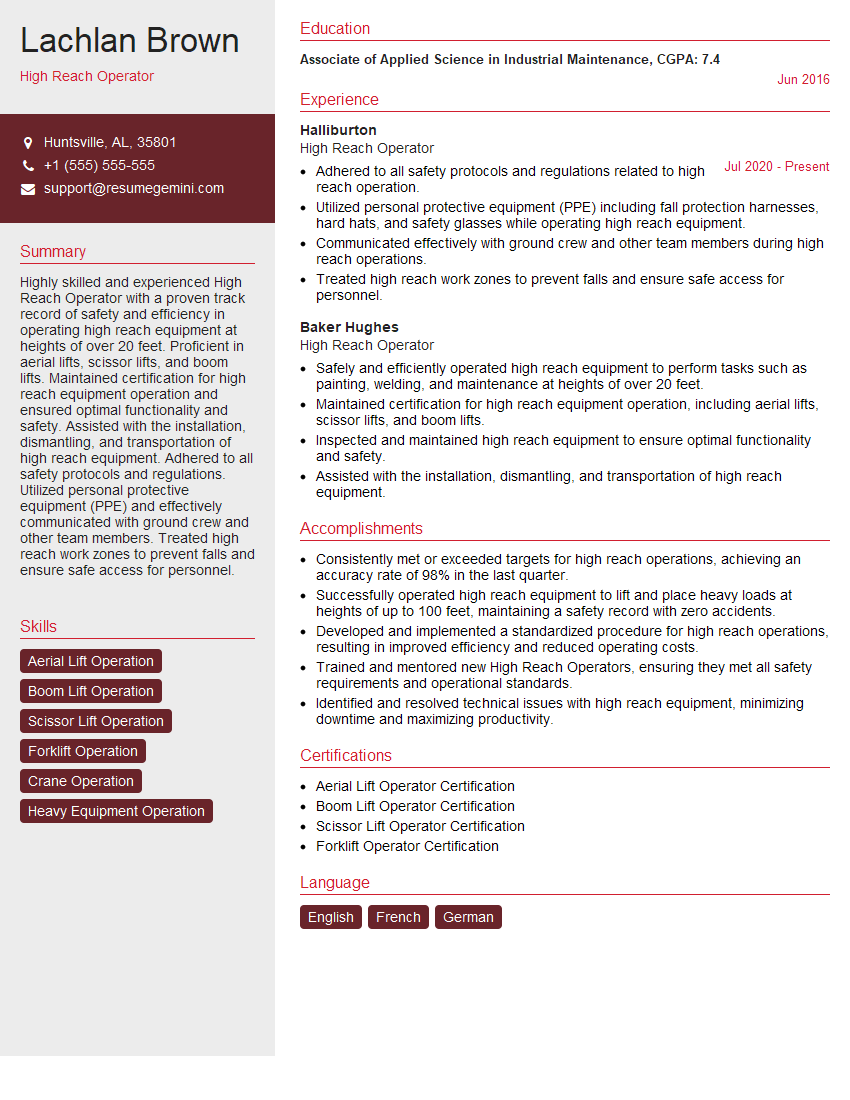
Explore more articles
Users Rating of Our Blogs
Share Your Experience
We value your feedback! Please rate our content and share your thoughts (optional).
What Readers Say About Our Blog
I Redesigned Spongebob Squarepants and his main characters of my artwork.
https://www.deviantart.com/reimaginesponge/art/Redesigned-Spongebob-characters-1223583608
IT gave me an insight and words to use and be able to think of examples
Hi, I’m Jay, we have a few potential clients that are interested in your services, thought you might be a good fit. I’d love to talk about the details, when do you have time to talk?
Best,
Jay
Founder | CEO