The right preparation can turn an interview into an opportunity to showcase your expertise. This guide to IBM Cloud interview questions is your ultimate resource, providing key insights and tips to help you ace your responses and stand out as a top candidate.
Questions Asked in IBM Cloud Interview
Q 1. Explain the difference between IaaS, PaaS, and SaaS in the context of IBM Cloud.
IBM Cloud, like other cloud providers, offers services categorized as Infrastructure as a Service (IaaS), Platform as a Service (PaaS), and Software as a Service (SaaS). Think of it like building a house: IaaS is providing the land and raw materials; PaaS is providing the pre-fabricated walls and roof; and SaaS is providing a fully furnished and ready-to-live-in house.
- IaaS (Infrastructure as a Service): This provides the fundamental building blocks of IT infrastructure, such as virtual servers, storage, and networking. You have complete control over the infrastructure, managing operating systems, applications, and everything in between. In IBM Cloud, this includes Virtual Servers, Block Storage, and Virtual Private Clouds (VPCs). Imagine you are a construction company – you get the land (IaaS) and build the house (your application) from scratch.
- PaaS (Platform as a Service): This provides a platform for developing, running, and managing applications without the complexities of managing the underlying infrastructure. IBM Cloud offers various PaaS services like Kubernetes Service for container orchestration, App Engine for application deployment, and Cloud Foundry for application development and deployment. This is akin to a builder giving you the pre-fabricated walls and roof of a house – you just need to finish the interior and add your own touches.
- SaaS (Software as a Service): This provides ready-to-use software applications over the internet. You don’t need to manage anything; you just subscribe and use it. IBM offers many SaaS solutions, including collaboration tools, analytics platforms, and security software. This is like moving into a fully furnished house. All you need to do is unpack your bags and live in it.
Choosing the right model depends entirely on your application’s needs and your team’s expertise. A team with strong infrastructure skills might prefer IaaS for maximum control, while a team focused on application development might favor PaaS for speed and efficiency.
Q 2. Describe your experience with IBM Cloud’s various compute options (e.g., Virtual Servers, Kubernetes, Functions).
I have extensive experience with IBM Cloud’s compute options. My work has involved deploying and managing applications across various services:
- Virtual Servers: I’ve provisioned and configured numerous virtual servers using various operating systems (Linux, Windows) and sizes, optimizing them for different workloads. I’ve used them for web servers, databases, and application servers, leveraging features like snapshots and backups for high availability and disaster recovery.
- Kubernetes: I have significant experience deploying and managing containerized applications using IBM Kubernetes Service (IKS). I’m proficient in creating deployments, services, and managing namespaces. I understand concepts like rolling updates, canary deployments, and autoscaling, crucial for maintaining application resilience and scaling efficiently. I’ve used Helm charts for streamlined deployment and management.
- Functions: I’ve utilized IBM Cloud Functions for building event-driven, serverless applications. This allows for efficient scaling and cost optimization by only paying for compute time used. I’ve integrated them with other services like Cloudant (NoSQL database) and Object Storage for a complete serverless architecture.
For example, in a recent project, we leveraged IKS for deploying a microservices-based application. We used IKS’s autoscaling capabilities to dynamically adjust the number of pods based on demand. This ensured the application remained responsive even during peak traffic. For less demanding tasks, we utilized Cloud Functions to handle specific event-driven workflows, enhancing efficiency and cost-effectiveness.
Q 3. How familiar are you with IBM Cloud’s networking capabilities (e.g., VPC, VPN, load balancing)?
I’m very familiar with IBM Cloud’s networking capabilities, having worked extensively with VPCs, VPNs, and load balancing solutions.
- VPC (Virtual Private Cloud): I routinely create and manage VPCs, defining subnets, routing tables, and security groups to isolate and secure applications and resources. This creates a highly secure and isolated environment for applications.
- VPN (Virtual Private Network): I’ve configured VPN connections to securely connect on-premises networks with IBM Cloud resources, allowing seamless data transfer and access to resources while maintaining security.
- Load Balancing: I have experience using IBM Cloud’s load balancing services to distribute traffic across multiple instances of an application, ensuring high availability and performance. I understand different load balancing algorithms and have configured them to optimize for specific application requirements. I’ve used both Classic Load Balancers and Application Load Balancers for different use cases.
A recent project involved setting up a highly available web application using multiple virtual servers within a VPC. A load balancer distributed traffic across these servers, while a VPN ensured secure access from our on-premises network. Security groups within the VPC strictly controlled network access to further enhance security.
Q 4. Explain your understanding of IBM Cloud’s security features and best practices.
IBM Cloud offers robust security features and emphasizes best practices to protect data and resources. My understanding encompasses:
- Identity and Access Management (IAM): I’m proficient in using IAM to manage user access, roles, and permissions, ensuring the principle of least privilege is applied. This controls who can access what resources, limiting potential security breaches.
- Key Management Service (KMS): I have experience using KMS for encrypting sensitive data both at rest and in transit, ensuring data confidentiality. This provides strong encryption for data security.
- Security Groups and Network ACLs: I understand how to configure these to control network traffic in and out of VPCs and instances. This creates a layered security approach, limiting unauthorized access.
- Vulnerability Scanning and Patch Management: I understand the importance of regularly scanning for vulnerabilities and patching systems to protect against known threats. IBM Cloud provides tools and services to aid in these processes.
Best practices include implementing multi-factor authentication, regularly rotating credentials, and adhering to security guidelines set by industry standards like NIST and CIS. I prioritize security from the outset of every project, incorporating security considerations into the design and implementation phases.
Q 5. How would you design a highly available and scalable application on IBM Cloud?
Designing a highly available and scalable application on IBM Cloud involves several key strategies:
- Multiple Availability Zones: Deploying application components across multiple availability zones ensures resilience against regional outages. If one zone fails, the application continues to function from another.
- Load Balancing: Distributing traffic across multiple instances of the application using a load balancer ensures high availability and responsiveness, even under peak loads.
- Autoscaling: Configuring autoscaling groups allows the application to automatically scale up or down based on demand, optimizing resource utilization and cost.
- Redundant Storage: Utilizing redundant storage solutions like Cloud Object Storage with multiple replicas guarantees data durability and availability. If one storage node fails, the data remains accessible from other replicas.
- Database High Availability: Implementing high availability for databases, such as using Db2’s high availability features or deploying a geographically replicated database service like Cloudant, ensures data availability even during database failures.
- Monitoring and Alerting: Implementing robust monitoring and alerting systems allows for proactive identification and resolution of potential issues before they impact users.
For example, a critical application might have its database replicated across multiple regions, load balanced web servers in multiple availability zones, and autoscaling groups to dynamically adjust the number of instances based on real-time demands. This ensures both high availability and the capacity to scale to handle unexpected surges in traffic.
Q 6. Describe your experience with IBM Cloud’s storage services (e.g., Object Storage, Block Storage, File Storage).
I possess practical experience with IBM Cloud’s diverse storage services:
- Object Storage: I’ve extensively used Object Storage for storing unstructured data like images, videos, and backups. Its scalability, durability, and cost-effectiveness make it ideal for storing large amounts of data.
- Block Storage: I’ve used Block Storage to provide persistent storage for virtual servers, offering high performance and reliability for applications needing fast access to data. This is ideal for applications needing high IOPS (input/output operations per second).
- File Storage: I’ve leveraged File Storage for applications requiring network file sharing, providing a shared file system accessible by multiple servers. This facilitates collaboration and data sharing between various components of the application.
In a past project, we used Object Storage for storing user-uploaded images and videos. We leveraged its scalability to handle the increasing amount of data generated by our growing user base. The low cost of Object Storage compared to other solutions resulted in significant cost savings.
Q 7. How familiar are you with IBM Cloud’s database services (e.g., Db2, Cloudant, MongoDB)?
I have experience working with several of IBM Cloud’s database services:
- Db2: I’ve deployed and managed Db2 instances on IBM Cloud, leveraging its features for relational database management. I understand the importance of proper indexing, query optimization, and database tuning to ensure efficient performance.
- Cloudant: I’ve utilized Cloudant, a NoSQL database, for handling large volumes of unstructured data, particularly where scalability and flexibility are paramount. Its document database model is suited for various use cases.
- MongoDB: I have experience working with MongoDB on IBM Cloud, integrating it with applications requiring a flexible, schema-less database. This offers good scalability and ease of use.
Choosing the right database depends on the specific application requirements. For structured data and transactional workloads, Db2 might be preferred. For unstructured data and applications requiring high scalability, Cloudant or MongoDB could be better choices. I’ve often found myself evaluating various database needs and selecting the appropriate technology to ensure optimal performance and scalability.
Q 8. Explain your experience with deploying and managing applications using Kubernetes on IBM Cloud.
Deploying and managing applications on Kubernetes within IBM Cloud involves leveraging their managed Kubernetes service, typically IBM Cloud Kubernetes Service (IKS). My experience encompasses the entire lifecycle, from initial cluster provisioning and configuration to application deployment, scaling, and ongoing maintenance.
For instance, I’ve extensively used YAML manifests to define deployments, services, and ingress rules. I’ve configured different deployment strategies like rolling updates and blue/green deployments to minimize downtime during application updates. I am proficient in using kubectl for interacting with the cluster, monitoring its health, and troubleshooting issues.
One project involved migrating a legacy application to IKS. We initially faced challenges with resource allocation and scaling. By implementing Horizontal Pod Autoscaling (HPA) based on CPU utilization and carefully tuning resource requests and limits in our deployments, we ensured the application scaled efficiently based on demand and maintained high availability.
Furthermore, I’ve utilized Kubernetes concepts like ConfigMaps and Secrets to securely manage application configuration and sensitive data outside of the source code. This approach improves security and maintainability. My experience extends to integrating IKS with other IBM Cloud services like IBM Cloud Object Storage for persistent storage.
Q 9. Describe your experience with using Infrastructure as Code (IaC) tools on IBM Cloud (e.g., Terraform, Ansible).
Infrastructure as Code (IaC) is fundamental to automating and managing infrastructure on IBM Cloud. I have extensive experience with Terraform and Ansible, using them to provision and configure various IBM Cloud resources. Terraform excels at managing the infrastructure’s state declaratively, allowing for version control and easy reproducibility.
Using Terraform, I’ve automated the creation of virtual networks, VPCs, subnets, security groups, and load balancers. I define these resources in Terraform configuration files (typically .tf files), ensuring that the infrastructure matches the desired state. For example, here’s a snippet demonstrating Terraform provisioning of a virtual server:
resource "ibm_is_instance" "example" { name = "my-instance" image = "ubuntu-minimal-20-04" ...}Ansible, on the other hand, shines in automating configurations and deployments on existing infrastructure. I’ve used Ansible playbooks to install and configure software, manage users and permissions, and automate application deployments.
A recent project involved using Ansible to deploy and configure a multi-tier application across several VMs in an IBM Cloud VPC. Ansible’s idempotency ensures that configurations are applied consistently, even across multiple runs. Both Terraform and Ansible improve efficiency and reduce manual errors significantly.
Q 10. How would you monitor and troubleshoot performance issues in an IBM Cloud environment?
Monitoring and troubleshooting performance issues in IBM Cloud involves a multi-faceted approach. It starts with selecting the right tools and metrics to track and establishing clear baselines for performance.
IBM Cloud provides several monitoring tools, including IBM Cloud Monitoring, which allows for centralized monitoring of various resources. Key metrics I focus on include CPU utilization, memory usage, disk I/O, network latency, and application response times. These metrics are collected and visualized through dashboards, allowing for easy identification of performance bottlenecks.
When troubleshooting, my approach involves:
- Identifying the root cause: Analyzing logs, metrics, and traces to pinpoint the source of the problem.
- Isolating the issue: Determining whether the issue lies within the application, the infrastructure, or a specific service.
- Implementing solutions: Implementing fixes, such as scaling resources, optimizing code, or adjusting configurations.
- Testing and verification: Verifying that the implemented solution resolves the issue and does not introduce new problems.
For example, if I observe high CPU utilization on a specific virtual server, I would investigate the application logs for errors or resource-intensive operations, analyze the server’s resource allocation, and potentially scale the server or optimize the application code to reduce the CPU load.
Q 11. Explain your understanding of IBM Cloud’s cost optimization strategies.
Cost optimization on IBM Cloud is critical. My strategies focus on right-sizing resources, leveraging discounts and pricing models, and utilizing cost management tools provided by IBM Cloud.
Right-sizing means ensuring that you’re using only the resources needed. This often involves analyzing resource utilization patterns and adjusting instance sizes or scaling configurations to match actual demand. For example, scaling down resources during off-peak hours can dramatically reduce costs.
Leveraging discounts and pricing models is important. IBM Cloud offers various pricing models, including pay-as-you-go, reserved instances, and volume discounts. Choosing the appropriate model based on your usage patterns is crucial. Reserved instances, for instance, offer significant cost savings for long-term commitments.
Utilizing cost management tools like the IBM Cloud Cost Analysis dashboard is essential for monitoring spending, identifying cost anomalies, and generating reports. This tool provides detailed insights into resource consumption and cost breakdown, helping to identify areas for optimization.
Regular cost reviews and proactively adjusting configurations are also key to maintaining optimal cost efficiency.
Q 12. How familiar are you with IBM Cloud’s logging and monitoring tools?
I’m very familiar with IBM Cloud’s logging and monitoring tools. IBM Cloud Monitoring provides a centralized platform for collecting and analyzing logs and metrics from various resources. It allows for creating custom dashboards to visualize key metrics and proactively identify potential issues.
For log management, I often use IBM Cloud Log Analysis, which allows for searching, filtering, and analyzing logs from diverse sources. This service helps in identifying error patterns, security threats, and performance bottlenecks. I’ve configured log forwarding from various services to IBM Cloud Log Analysis, enabling a centralized and efficient approach to log management.
In addition, I’m also familiar with using the command line tools and APIs to interact with the monitoring and logging services, allowing for automated log collection, analysis, and alerting.
Q 13. Describe your experience with automating deployments and configurations on IBM Cloud.
Automating deployments and configurations on IBM Cloud is crucial for efficiency and reliability. My experience spans various approaches, including using Continuous Integration/Continuous Delivery (CI/CD) pipelines and IaC tools discussed earlier.
For CI/CD, I frequently leverage tools like Jenkins or GitLab CI to automate the build, testing, and deployment process. The pipeline orchestrates various steps, including building the application, running automated tests, and deploying the application to IKS or other deployment environments.
IaC tools like Terraform and Ansible play a vital role in the automation process. They automate the provisioning of infrastructure and the configuration of applications. This ensures consistent and repeatable deployments, reducing manual intervention and the risk of errors.
For example, I’ve integrated Terraform with a CI/CD pipeline to ensure that infrastructure changes are automatically deployed and tested. This creates a reliable and efficient process for managing the application’s entire lifecycle.
Q 14. How would you handle a security incident in an IBM Cloud environment?
Handling a security incident in an IBM Cloud environment requires a structured and methodical approach. My response would follow a well-defined incident response plan, encompassing containment, eradication, recovery, and post-incident activity.
Containment involves immediately isolating the affected system or resource to prevent further damage or compromise. This might involve disabling the affected system, blocking network access, or revoking compromised credentials.
Eradication entails identifying and removing the root cause of the incident. This might involve removing malware, patching vulnerabilities, or changing compromised passwords. Analyzing logs is crucial during this phase.
Recovery involves restoring the affected system or resource to its operational state. This might involve restoring data from backups or reinstalling software.
Post-incident activity includes reviewing the incident to identify weaknesses in security procedures, implementing corrective actions, and documenting the incident for future reference. This involves updating security policies, conducting security awareness training, and strengthening security controls to prevent future incidents.
Throughout the process, communication and collaboration with IBM Cloud support and relevant stakeholders are essential to ensure a swift and effective resolution.
Q 15. Explain your experience with integrating IBM Cloud services with on-premises infrastructure.
Integrating IBM Cloud services with on-premises infrastructure often involves creating a hybrid cloud environment. This allows organizations to leverage the scalability and flexibility of the cloud while retaining control over sensitive data or legacy systems residing on-premises. The integration strategy depends heavily on the specific needs of the organization, but common approaches include using VPN connections for secure network access, utilizing hybrid cloud management tools for unified monitoring and control, and employing technologies like IBM Cloud Private (though now deprecated, its principles are still relevant) or IBM Cloud Kubernetes Service (IKS) to deploy applications across both environments.
For example, I’ve worked on a project where we connected an on-premises data center to IBM Cloud using a dedicated VPN connection. This allowed us to securely extend our private network into the cloud, enabling applications to access both on-premises databases and cloud-based services like object storage. We used IBM Cloud Director to manage both our on-premises VMs and our cloud-based workloads, providing a single pane of glass for monitoring and management. This hybrid approach minimized latency for data-intensive operations while leveraging the scalability of the cloud for handling peak demands.
Another approach is leveraging APIs to connect on-premises applications to cloud services. This allows you to create custom integrations and automate workflows between your on-premises infrastructure and cloud-based resources.
Career Expert Tips:
- Ace those interviews! Prepare effectively by reviewing the Top 50 Most Common Interview Questions on ResumeGemini.
- Navigate your job search with confidence! Explore a wide range of Career Tips on ResumeGemini. Learn about common challenges and recommendations to overcome them.
- Craft the perfect resume! Master the Art of Resume Writing with ResumeGemini’s guide. Showcase your unique qualifications and achievements effectively.
- Don’t miss out on holiday savings! Build your dream resume with ResumeGemini’s ATS optimized templates.
Q 16. How familiar are you with IBM Cloud’s disaster recovery and business continuity solutions?
IBM Cloud offers robust disaster recovery (DR) and business continuity (BC) solutions. These solutions aim to minimize downtime and data loss in the event of a disaster. Key offerings include IBM Cloud Hyper Protect Services, offering high-availability solutions for critical workloads, and IBM Cloud Resiliency Orchestrator which enables the automation of DR plans for streamlined failover. The solutions are designed with various recovery time objective (RTO) and recovery point objective (RPO) options to meet specific business needs.
My experience includes designing and implementing DR strategies using IBM Cloud’s services. For instance, I worked on a project where we replicated a client’s critical databases to a geographically separate IBM Cloud region using Hyper Protect DBaaS. This ensured that in the event of a regional outage, the databases could be quickly recovered with minimal data loss. We also implemented automated failover mechanisms using Resiliency Orchestrator, ensuring a rapid transition to the secondary site in case of an incident. Furthermore, regular DR drills using these tools were critical for validation.
Q 17. Describe your experience with using IBM Cloud’s API.
Extensive experience with IBM Cloud’s APIs is crucial for automating tasks and building integrated solutions. The APIs are RESTful and typically use JSON for data exchange. I’ve used various APIs, including those for compute (like creating and managing virtual servers), storage (managing object storage buckets), networking (configuring VPC networks), and database services (managing databases in DBaaS). Familiarity extends to using API gateways for security and management.
For example, I’ve used the IBM Cloud Object Storage API in Python to automate the backup and restoration of application data. import ibm_boto3 and similar libraries allow easy interaction with these services. A typical code snippet might involve s3 = ibm_boto3.client('s3', ...) followed by methods to upload, download, and manage objects. This automation eliminates manual intervention and ensures consistent data management. I understand the importance of authentication and authorization through API keys and IAM roles for secure API access.
Q 18. Explain your understanding of serverless computing on IBM Cloud.
Serverless computing on IBM Cloud, primarily through IBM Cloud Functions, allows developers to run code without managing servers. Developers write functions that respond to events, and the platform handles scaling, infrastructure, and maintenance. This is ideal for event-driven architectures, microservices, and applications requiring automatic scaling to handle fluctuating workloads. This contrasts sharply with traditional server-based models where you manage the complete infrastructure lifecycle.
Consider an image processing application. Using serverless functions, the application can be triggered by new images uploaded to Cloud Object Storage. A function then processes the image and the platform automatically scales the number of function instances to handle the workload. When there are no new images, the functions scale down to zero, minimizing costs. This flexibility and cost-efficiency are major benefits of using serverless architectures. The key is understanding the tradeoffs, for example, cold starts can introduce latency.
Q 19. How would you implement a CI/CD pipeline for IBM Cloud?
Implementing a CI/CD pipeline for IBM Cloud typically involves integrating tools like Jenkins, GitLab CI, or similar with IBM Cloud’s services. The pipeline automates building, testing, and deploying applications to the cloud. This involves stages like code commit, build, unit testing, integration testing, deployment to a staging environment, testing in the staging environment, and finally deployment to production. Using tools like IBM Cloud DevOps allows for monitoring and management of the entire pipeline.
A typical pipeline might involve using Git for source code management, Jenkins for build automation, and tools like Ansible or Terraform for infrastructure provisioning. The pipeline stages might involve building Docker images, pushing these images to IBM Cloud Container Registry (ICR), deploying to IKS or Cloud Foundry, and performing automated testing using tools like Selenium or JUnit. Implementing robust monitoring and rollback capabilities is essential for ensuring reliable deployments.
Q 20. Describe your experience with containerization technologies on IBM Cloud (e.g., Docker, containerd).
Containerization technologies like Docker and containerd are fundamental to modern application deployment on IBM Cloud. Docker provides the image format for packaging applications and their dependencies, while containerd is a container runtime managing the execution of the containers. IBM Cloud offers Kubernetes services (IKS) and container registries (ICR) to facilitate working with these technologies.
My experience involves using Docker to build and package applications, pushing the images to ICR, and deploying them to IKS using Kubernetes manifests. Understanding the concepts of container orchestration, deployment strategies (like rolling updates and blue/green deployments), and networking within Kubernetes is essential. Tools like Helm greatly simplify managing applications deployed to IKS. This allows for creating reproducible, scalable and manageable deployment pipelines.
Q 21. How familiar are you with IBM Cloud’s compliance and regulatory offerings?
IBM Cloud offers a comprehensive suite of compliance and regulatory offerings to help organizations meet industry standards and regulations. These offerings address various compliance frameworks, such as HIPAA, PCI DSS, GDPR, and FedRAMP. Services like IBM Cloud Hyper Protect Services provide enhanced security and compliance features for sensitive data. IBM also provides detailed compliance documentation and certifications to demonstrate adherence to specific regulatory requirements.
In my experience, I’ve helped clients navigate the complexities of meeting regulatory compliance through proper configuration of IBM Cloud services and implementing secure coding practices. Understanding the specific requirements of a given regulation and mapping them to the capabilities of IBM Cloud services are crucial. For example, ensuring data encryption at rest and in transit and maintaining detailed audit logs are important steps in achieving compliance with frameworks like GDPR. I can identify and ensure compliance certifications like SOC 2 or ISO 27001 are met by using IBM Cloud services.
Q 22. Explain your understanding of IBM Cloud’s hybrid cloud capabilities.
IBM Cloud’s hybrid cloud capabilities allow organizations to seamlessly integrate their on-premises infrastructure with cloud-based services. Think of it like building a bridge between your existing data center and the vast resources of the cloud. This integration isn’t just about moving data; it’s about creating a unified, flexible environment that leverages the strengths of both worlds.
Key components of IBM’s hybrid cloud strategy include:
- IBM Cloud Private: This allows you to run containerized workloads (like Kubernetes) on-premises, mirroring your cloud environment locally for consistency and control.
- Cloud Paks: These pre-integrated software solutions offer a consistent experience across on-premises and cloud environments. For example, you can deploy a Cloud Pak for Data on-premises and extend it to IBM Cloud for additional scalability.
- Direct Link and VPN connections: Secure, high-bandwidth connections enable private communication between your on-premises network and IBM Cloud, enhancing security and performance.
- Hybrid Multicloud Management: IBM offers tools to manage and monitor resources across multiple cloud environments, including both IBM Cloud and other public cloud providers, providing a consolidated view of your entire infrastructure.
In a real-world scenario, a financial institution might use IBM Cloud for disaster recovery, keeping critical systems replicated in the cloud. They could also use on-premises infrastructure for sensitive data that requires strict local regulatory compliance, while leveraging cloud-based AI and analytics services for fraud detection.
Q 23. How would you migrate an existing application to IBM Cloud?
Migrating an application to IBM Cloud is a strategic process, not a simple lift-and-shift. The best approach depends heavily on the application’s architecture, dependencies, and your business objectives. I typically follow these steps:
- Assessment and Planning: Thoroughly analyze the application, identifying dependencies, identifying potential challenges (database compatibility, network configuration), and defining migration goals (e.g., improved scalability, reduced costs).
- Choosing a Migration Strategy: Options include rehosting (lifting and shifting with minimal changes), refactoring (optimizing for the cloud), repurchasing (replacing with a cloud-native alternative), replatforming (migrating to a different platform in the cloud), and retiring (removing obsolete applications). The choice depends on application complexity and business needs.
- Implementation: This phase involves the actual migration. Tools like IBM Cloud Migration Center can automate portions of this process, simplifying the move. For complex applications, a phased approach—migrating components incrementally—is often preferable.
- Testing and Validation: Rigorous testing is crucial to ensure the application functions correctly in the new environment. This includes performance testing, security testing, and functional testing.
- Monitoring and Optimization: Post-migration, continuous monitoring is vital for identifying and addressing any performance bottlenecks or issues. This often involves adjusting resource allocation and optimizing the application’s configuration for the cloud environment.
For example, migrating a legacy Java application might involve replatforming it on Kubernetes on IBM Cloud Kubernetes Service (IKS) for better scalability and manageability.
Q 24. Describe your experience with managing and configuring IBM Cloud resources.
My experience encompasses the full lifecycle of managing and configuring IBM Cloud resources, from provisioning and configuring virtual machines (VMs) and containers to implementing networking and security policies. I’m proficient with the IBM Cloud console, command-line interface (CLI), and Infrastructure-as-Code (IaC) tools like Terraform.
I’ve worked extensively with:
- Virtual Servers (VMs): Creating, configuring, and scaling virtual machines using various operating systems and configurations.
- Containers and Kubernetes (IKS): Deploying and managing containerized applications using Kubernetes on IBM Cloud Kubernetes Service (IKS). This includes managing deployments, services, and ingress controllers.
- Networking: Configuring virtual networks, subnets, firewalls (including security groups), and load balancers to ensure secure and efficient network connectivity.
- Storage: Utilizing various storage solutions, including object storage (COS), block storage, and file storage, based on specific application needs and performance requirements. This includes setting up storage policies and managing backups.
- Databases: Deploying and managing databases, such as Db2, PostgreSQL, and MySQL, on IBM Cloud.
- Monitoring and Logging: Implementing monitoring and logging solutions to track resource utilization and troubleshoot performance issues.
I’ve successfully managed resource costs by employing automation, right-sizing instances based on actual usage, and utilizing cost-optimization tools provided by IBM Cloud.
Q 25. Explain your understanding of the different IBM Cloud pricing models.
IBM Cloud offers a variety of pricing models to cater to different needs and budgets. Understanding these is crucial for cost management. Key models include:
- Pay-as-you-go: You only pay for the resources you consume, offering flexibility but potentially higher costs for sustained usage.
- Subscription: A fixed monthly fee for a reserved amount of resources, offering predictable costs and potentially discounts for long-term commitments.
- Dedicated Hosts: For stricter security and compliance requirements, you can provision dedicated physical servers, typically at a higher cost.
- Pre-paid plans: Purchase resources upfront for a discounted rate.
The best pricing model depends on your workload’s characteristics. For example, a development environment might use pay-as-you-go, while a production system with consistent resource needs might benefit from a subscription. IBM Cloud’s pricing calculator is a valuable tool for estimating costs based on your specific needs.
Q 26. How familiar are you with IBM Cloud’s governance and compliance features?
IBM Cloud offers robust governance and compliance features to help organizations meet regulatory requirements and maintain secure environments. My familiarity extends to:
- Identity and Access Management (IAM): Managing user access, permissions, and roles to ensure only authorized personnel can access resources. This involves implementing least privilege access principles.
- Data Security and Encryption: Leveraging encryption at rest and in transit to protect sensitive data. This includes understanding and configuring encryption options for different services.
- Compliance certifications: IBM Cloud adheres to numerous compliance standards, such as SOC 2, ISO 27001, and HIPAA. Understanding these certifications and ensuring your deployments align is key.
- Resource tagging and policies: Using tagging and policies for cost allocation, access control, and compliance reporting.
- Auditing and logging: Utilizing detailed auditing and logging capabilities to monitor activity and track changes for compliance and security investigations.
In practice, I ensure all deployments adhere to security best practices and comply with relevant regulations. For instance, when deploying a healthcare application, I’d carefully configure access controls and encryption to meet HIPAA requirements.
Q 27. Describe your experience with using IBM Cloud’s DevOps tools and services.
I have extensive experience with IBM Cloud’s DevOps tools and services, enabling me to streamline the software development lifecycle. My expertise includes:
- IBM Cloud Continuous Delivery (CD): Automating the build, test, and deployment processes using pipelines and automation tools.
- Git Repositories: Utilizing Git for version control and collaborative code management.
- IBM Cloud Code Engine: Deploying and scaling serverless applications using this platform.
- IBM Cloud Functions: Implementing serverless functions for event-driven architectures.
- DevOps practices: Implementing Agile methodologies, Infrastructure-as-Code (IaC), and CI/CD principles for faster and more reliable deployments.
In a recent project, I implemented a CI/CD pipeline using IBM Cloud CD to automate the deployment of a microservices-based application to IKS, significantly reducing deployment time and improving the overall development process. This involved integrating with our existing Git repository and automating testing and deployment steps.
Q 28. How would you troubleshoot network connectivity issues in an IBM Cloud environment?
Troubleshooting network connectivity issues in IBM Cloud requires a systematic approach. I typically follow these steps:
- Identify the Problem: Pinpoint the affected service or application. Is it impacting all users or just some? Are there specific error messages?
- Check Network Configuration: Verify the VM’s network interface card (NIC) configuration, including IP address, subnet mask, gateway, and DNS settings. Ensure that the security groups allow the necessary inbound and outbound traffic.
- Inspect Firewall Rules: Review both the network-level firewall (e.g., virtual router) rules and the instance-level security groups to ensure that they aren’t blocking the required ports and protocols.
- Verify Connectivity: Use tools like
pingandtracerouteto diagnose connectivity issues. Can you ping the gateway, DNS servers, and the destination host? - Examine Logs: Check the VM’s logs and any relevant networking logs for error messages or clues about the connectivity problem. IBM Cloud’s monitoring tools can help here.
- Check for Resource Limits: Confirm that the VM’s network bandwidth isn’t exhausted. Are there any resource limits preventing proper connectivity?
- IBM Cloud Support: If the problem persists, contact IBM Cloud support for assistance. They have specialized tools and expertise to resolve complex network issues.
For instance, if a VM cannot access the internet, I’d first check the instance’s network interface, then verify that the security groups allow outbound internet traffic on port 80 and 443, and finally, check the VM’s routing tables.
Key Topics to Learn for IBM Cloud Interview
- Compute Services: Understand the various compute options offered by IBM Cloud, including Virtual Servers, Virtual Machines, and Kubernetes clusters. Consider practical applications like deploying web applications or microservices architectures.
- Storage Services: Explore IBM Cloud’s storage solutions – Object Storage, Block Storage, and File Storage. Focus on understanding their use cases and how to choose the right storage type for different applications, including data backup and archiving.
- Networking: Familiarize yourself with IBM Cloud’s networking capabilities, including Virtual Private Clouds (VPCs), load balancers, and firewalls. Practice designing secure and scalable network architectures for cloud-based applications.
- Databases: Learn about the various database services offered, such as managed databases (SQL and NoSQL), and their best-fit scenarios. Be prepared to discuss database design considerations within the IBM Cloud environment.
- Security: Understand IBM Cloud’s security features and best practices, including Identity and Access Management (IAM), security groups, and encryption. Discuss how to implement a robust security posture for cloud applications.
- Serverless Computing: Explore IBM Cloud Functions and other serverless offerings. Understand the benefits and limitations of this approach and how it applies to event-driven architectures.
- Cost Optimization: Discuss strategies for optimizing cloud costs, including resource right-sizing, leveraging free tiers, and understanding billing models.
- Deployment and Management: Gain experience with deploying and managing applications on IBM Cloud, utilizing tools and services for automation and orchestration. Be ready to discuss your experience with CI/CD pipelines.
Next Steps
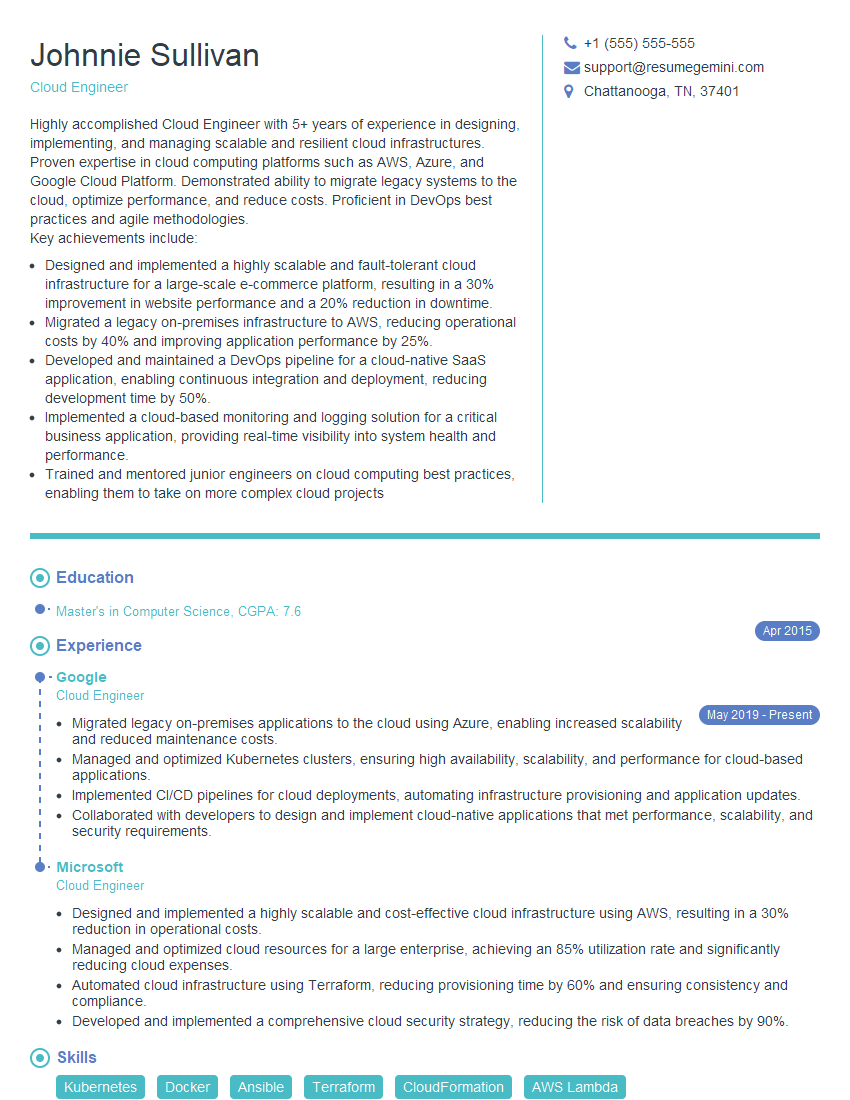
Mastering IBM Cloud significantly enhances your career prospects in the rapidly growing field of cloud computing. A strong understanding of these technologies demonstrates valuable skills highly sought after by employers. To maximize your chances of landing your dream role, invest time in crafting an ATS-friendly resume that effectively highlights your relevant skills and experience. ResumeGemini is a trusted resource to help you build a professional and impactful resume. Examples of resumes tailored to IBM Cloud are available to further assist you in this process.
Explore more articles
Users Rating of Our Blogs
Share Your Experience
We value your feedback! Please rate our content and share your thoughts (optional).
What Readers Say About Our Blog
I Redesigned Spongebob Squarepants and his main characters of my artwork.
https://www.deviantart.com/reimaginesponge/art/Redesigned-Spongebob-characters-1223583608
IT gave me an insight and words to use and be able to think of examples
Hi, I’m Jay, we have a few potential clients that are interested in your services, thought you might be a good fit. I’d love to talk about the details, when do you have time to talk?
Best,
Jay
Founder | CEO