The thought of an interview can be nerve-wracking, but the right preparation can make all the difference. Explore this comprehensive guide to Jig and Fixture Assembly interview questions and gain the confidence you need to showcase your abilities and secure the role.
Questions Asked in Jig and Fixture Assembly Interview
Q 1. Explain the difference between a jig and a fixture.
The core difference between a jig and a fixture lies in their primary function: jigs guide the tool, while fixtures hold the workpiece. Think of it this way: a jig ensures a tool performs its operation in the correct location and orientation, whereas a fixture ensures the workpiece remains securely positioned and aligned throughout the machining or assembly process.
For example, a drilling jig guides a drill bit to create precisely located holes in a workpiece, ensuring accurate hole placement. A milling fixture, on the other hand, rigidly holds a component in place while a milling machine removes material, maintaining the workpiece’s position and preventing movement during the cutting operation.
- Jig: Guides the tool, ensuring accurate positioning and operation.
- Fixture: Holds the workpiece securely in place for machining or assembly operations.
Q 2. Describe your experience with different types of jigs and fixtures (e.g., welding jigs, milling fixtures).
My experience encompasses a wide range of jig and fixture types. I’ve extensively worked with welding jigs, utilizing various clamping mechanisms and alignment features to ensure consistent and accurate weld placement in complex assemblies. These often involve designing for specific welding processes, like MIG or TIG welding, and considering factors like heat distortion and access for the welder.
Similarly, I have substantial experience designing and implementing milling fixtures for high-precision machining operations. This involved creating fixtures with robust clamping systems, precise locating pins, and datum surfaces to maintain dimensional accuracy throughout the milling process. I’ve also designed fixtures for other machining processes like turning, grinding, and drilling, always prioritizing part security and efficient material removal.
Beyond these common types, I’ve also worked with specialized fixtures, such as those for sheet metal forming, assembly, and inspection, adapting design strategies to meet the specific needs of each process. Each project requires careful consideration of the material properties, tooling, and process parameters.
Q 3. What materials are commonly used in jig and fixture construction?
The choice of materials for jig and fixture construction depends heavily on factors like the application, workpiece material, and the process involved. Common materials include:
- Steel: Offers high strength and rigidity, making it suitable for heavy-duty applications and high-precision work. Various grades of steel are used based on the required strength and wear resistance.
- Cast iron: Provides excellent vibration damping and good wear resistance, making it a preferred choice for milling fixtures. Its machinability also facilitates detailed features.
- Aluminum: Lighter than steel, it’s ideal for less demanding applications where weight is a concern. It also possesses good machinability.
- Plastics (e.g., polymers, composites): Used in applications where lower cost and lighter weight are paramount, but often with limitations on strength and temperature resistance. They are suitable for less demanding applications.
- Other Materials: Depending on specific needs, materials like hardened steel, wear-resistant coatings, or even specialized polymers might be used.
The selection process involves carefully evaluating these material properties to ensure the fixture’s longevity, accuracy, and safety during operation.
Q 4. How do you ensure the accuracy and precision of a jig or fixture?
Accuracy and precision in jig and fixture design and manufacturing are paramount. Several strategies are employed to achieve this:
- Precise Design: Utilizing CAD/CAM software, ensuring all dimensions and tolerances are carefully defined and controlled. This includes considering thermal expansion and workpiece deflection.
- High-Precision Machining: Employing advanced manufacturing processes like CNC machining to create features with extremely tight tolerances.
- Proper Material Selection: Choosing materials with minimal dimensional instability and high wear resistance.
- Rigorous Inspection: Implementing comprehensive quality control measures including dimensional inspection using coordinate measuring machines (CMMs) to verify conformance to design specifications.
- Calibration and Adjustment: Regular calibration and adjustment of fixtures to maintain accuracy over time. This might include checking for wear or damage.
By meticulously following these steps, we can build jigs and fixtures that consistently produce parts within the required tolerances.
Q 5. Describe your experience with CAD/CAM software for jig and fixture design.
I’m proficient in several CAD/CAM software packages including SolidWorks, AutoCAD, and Mastercam. My experience involves using these tools not only for 3D modeling and design but also for generating CNC machining programs for fixture manufacturing. This streamlined process ensures a seamless transition from design to fabrication, minimizing errors and maximizing efficiency.
In SolidWorks, for instance, I’ve used advanced features like simulation tools to analyze stress and deflection within the fixture under load, optimizing the design for strength and stability before manufacturing. Mastercam allows me to create complex toolpaths, taking advantage of features like high-speed machining for efficient and precise part production.
My experience extends beyond simple modeling; I actively use the CAM features of these programs to generate efficient G-code for CNC machining, reducing lead time and enhancing the accuracy of the fabricated fixture.
Q 6. How do you select appropriate clamping mechanisms for a jig or fixture?
Selecting appropriate clamping mechanisms is crucial for workpiece security and fixture efficiency. The choice depends heavily on the workpiece geometry, material, and the forces involved during the machining or assembly process.
Some common clamping mechanisms include:
- Clamps: Various types, such as toggle clamps, cam clamps, and hand screws, offer different levels of force and convenience.
- Vices: Ideal for holding cylindrical or prismatic workpieces firmly.
- Pneumatic or Hydraulic Clamps: Provide high clamping forces with precise control, particularly useful in automated systems.
- Magnetic Clamps: Suitable for ferrous materials, offering quick and efficient clamping.
- Locating Pins and Bushings: Ensure precise workpiece positioning and repeatability.
The selection process often involves considering the clamping force needed, accessibility, ease of use, and the potential for workpiece damage. It’s also crucial to ensure that the clamping mechanism doesn’t interfere with the machining process or damage the workpiece.
Q 7. Explain your process for designing a jig or fixture for a new part.
My design process for a new jig or fixture follows a structured approach:
- Part Analysis: Thorough review of the part’s geometry, material, and manufacturing process requirements to understand the clamping needs and necessary features.
- Design Concept: Conceptualization of the fixture design, considering factors like accessibility, clamping strategies, and material selection. Sketches and initial 3D models are created.
- Detailed Design: Utilizing CAD software, a detailed 3D model is created, including all dimensions, tolerances, and features. Simulation tools are often employed to verify the design’s strength and stability.
- Manufacturing Planning: Developing a manufacturing plan, selecting appropriate machining processes and materials, and creating CNC programs if needed.
- Fabrication and Assembly: Overseeing the fabrication and assembly of the jig or fixture, ensuring adherence to design specifications.
- Testing and Verification: Rigorous testing to verify the functionality and accuracy of the fixture, including dimensional inspection and performance trials.
- Documentation: Creating comprehensive documentation including drawings, specifications, and assembly instructions.
This methodical approach guarantees a robust, accurate, and efficient jig or fixture tailored to the specific needs of the part and its manufacturing process.
Q 8. How do you troubleshoot problems with a malfunctioning jig or fixture?
Troubleshooting a malfunctioning jig or fixture involves a systematic approach. Think of it like diagnosing a car problem – you need to identify the symptoms, isolate the cause, and implement the solution. I start by carefully observing the issue: Is the part being produced incorrectly? Are there signs of damage to the jig or fixture itself? Is the problem consistent, or intermittent?
Next, I’ll perform a thorough inspection, checking for things like loose fasteners, worn components, misalignment, or damage to clamping mechanisms. I might use measuring tools like calipers and dial indicators to verify dimensions and alignments. If the problem is electrical (in the case of automated jigs), I’ll check wiring, sensors, and actuators. Documentation is key here – reviewing the jig’s design drawings and operational manuals can help pinpoint potential weaknesses or areas prone to failure.
For example, I once worked on a welding jig where the weld quality was inconsistent. After a careful inspection, I found that the clamping mechanism was slightly misaligned, causing uneven pressure on the work piece. A simple adjustment corrected the problem. If the problem is more complex, I may use root cause analysis tools like a fishbone diagram to identify contributing factors.
Q 9. What safety precautions do you take when working with jigs and fixtures?
Safety is paramount when working with jigs and fixtures. I always follow strict safety protocols, starting with a comprehensive risk assessment before any work begins. This includes identifying potential hazards like sharp edges, moving parts, and potential pinch points. Appropriate personal protective equipment (PPE) is mandatory – this includes safety glasses, gloves, steel-toed shoes, and hearing protection where necessary.
When working with machinery involved in jig construction or operation, I ensure all guards are in place and operational. I never attempt repairs or adjustments while machinery is running. Lockout/Tagout procedures are strictly followed when working on energized equipment. I also emphasize proper lifting techniques to avoid injuries from handling heavy jigs and fixtures. Regular maintenance and inspection of jigs and fixtures themselves is critical to prevent unexpected failures that could cause injury.
For instance, I always double-check the integrity of clamping mechanisms before using a jig to prevent workpieces from suddenly shifting during operation. Regular cleaning of chips and debris is crucial to prevent accidents.
Q 10. Describe your experience with different manufacturing processes relevant to jig and fixture construction (e.g., machining, welding).
My experience spans various manufacturing processes vital for jig and fixture construction. I’m proficient in machining, using CNC milling machines and lathes to create precise components with tight tolerances. I’m skilled in selecting appropriate materials based on the application’s needs – for example, using hardened steel for high-wear areas or aluminum for lightweight designs. I’m also experienced in welding techniques such as MIG, TIG, and stick welding, crucial for creating robust and durable jig structures. I understand the importance of proper weld preparation and post-weld inspection to ensure structural integrity.
Beyond machining and welding, I’m familiar with other processes, including sheet metal fabrication (bending, punching, forming), casting (where appropriate for larger, less precise components), and assembly techniques using various fasteners and adhesives. I can effectively choose the optimal manufacturing method depending on factors like cost, production volume, material properties, and required precision.
For example, in one project, I used CNC machining to create the precise locating pins for a complex jig, and then used welding to assemble the main jig structure from steel plates. This combined approach ensured both accuracy and strength.
Q 11. How do you ensure the durability and longevity of a jig or fixture?
Ensuring the durability and longevity of a jig or fixture relies on several key factors. First, the selection of appropriate materials is crucial. High-strength materials like hardened steel are preferred for high-wear areas, while materials like aluminum alloys might be chosen for their lightweight properties. The surface treatment also plays a significant role: processes like hard chrome plating, powder coating, or zinc plating can enhance corrosion resistance and wear resistance.
Proper design is vital. The jig or fixture should be robust enough to withstand the forces encountered during use. Over-engineered designs are costly but under-engineered designs lead to premature failure. Careful consideration should be given to stress points, ensuring adequate support and reinforcement. Regular maintenance is essential: this includes periodic inspections for wear, damage, or loose fasteners. Components exhibiting excessive wear should be replaced promptly. Proper storage and handling also help extend lifespan, preventing damage from impact or corrosion.
Think of it like maintaining a car – regular servicing, replacing worn parts, and careful driving practices extend the vehicle’s life significantly. The same principle applies to jigs and fixtures.
Q 12. What are the key considerations for designing a jig or fixture for high-volume production?
Designing a jig or fixture for high-volume production requires careful consideration of several factors. First, simplicity and robustness are paramount. Complex designs increase manufacturing costs and the risk of failure. The design needs to be easily manufactured and maintained. Modular designs are often preferred for ease of repair and replacement of individual components.
Efficiency is key. The jig or fixture should minimize setup time and maximize cycle time. Standardized components and tooling reduce manufacturing costs and lead times. Ergonomics must be considered – the design should minimize operator fatigue and maximize safety. Material selection should prioritize cost-effectiveness without compromising durability and precision. Finally, thorough testing and validation are crucial to ensure consistent part quality and prevent costly production stoppages.
For example, in a high-volume automotive assembly line, we might use a modular jig design with quick-change tooling to accommodate different variations of a particular part. This approach maximizes efficiency and minimizes downtime.
Q 13. How do you handle design changes or modifications to existing jigs and fixtures?
Handling design changes or modifications to existing jigs and fixtures requires a methodical and documented approach. First, a thorough needs assessment is performed to determine the reasons for the modification. This may involve reviewing production data, analyzing quality issues, or responding to changes in product design. The design change request should be formally documented, outlining the necessary alterations and their impact on the jig or fixture.
Next, the design modifications are implemented, taking into account the impact on existing components and processes. This may involve creating new drawings, revising existing documentation, and updating assembly instructions. A rigorous testing phase follows to validate the modified jig or fixture’s performance, ensuring that it meets the required specifications and maintains quality standards. All changes are formally documented and approved before implementation in the production environment.
Imagine a situation where a new part design necessitates a change in the clamping mechanism of an existing jig. We’d document the change request, modify the design, create new drawings, build the modified components, and thoroughly test the updated jig before releasing it for use on the production line.
Q 14. Describe your experience with documentation and record-keeping for jigs and fixtures.
Accurate documentation and record-keeping are crucial for the effective management of jigs and fixtures. This involves maintaining a comprehensive database that includes detailed design drawings, assembly instructions, parts lists, maintenance records, and operational procedures. Using a Computer-Aided Design (CAD) system is crucial for managing design files and generating accurate drawings. Version control is essential to track revisions and changes. A well-organized filing system, either physical or digital, is necessary for easy retrieval of information.
Maintenance records should document regular inspections, repairs, and component replacements. This information is vital for preventive maintenance and for understanding the life cycle of the jigs and fixtures. Detailed operational procedures guide operators on the correct usage of jigs and fixtures, ensuring consistent part quality and safety. A robust documentation system is critical for efficient troubleshooting, maintenance, and future modifications, ensuring a smooth production workflow.
For example, we utilize a digital database to track every jig in our facility, including its design specifications, maintenance history, and any associated documentation. This ensures that we always have access to the most up-to-date information, contributing to efficient troubleshooting and maintenance.
Q 15. How do you ensure that a jig or fixture meets the required tolerances?
Ensuring a jig or fixture meets required tolerances is paramount for producing parts within specifications. This involves a multi-step process starting even before assembly. First, the design must meticulously incorporate GD&T (Geometric Dimensioning and Tolerancing) to clearly define acceptable variations in dimensions and geometry. This avoids ambiguity and ensures all team members understand the critical tolerances.
Secondly, during component selection, we must choose parts with tolerances that are tighter than the final fixture’s tolerance requirement. This accounts for cumulative errors. For example, if the final fixture needs a ±0.05mm accuracy, we might use components with tolerances of ±0.02mm or better. This ensures that even with slight variations in individual components, the final assembly falls well within the specified tolerance.
Thirdly, during assembly, precision measuring instruments are crucial. We use tools like dial indicators, coordinate measuring machines (CMMs), and optical comparators for precise measurements throughout the assembly process. Any deviations are immediately addressed through adjustments or part replacement. Finally, post-assembly inspection using the same precise instruments verifies that the final fixture meets the required tolerances. We often document these measurements and create a comprehensive inspection report for traceability and quality control.
Career Expert Tips:
- Ace those interviews! Prepare effectively by reviewing the Top 50 Most Common Interview Questions on ResumeGemini.
- Navigate your job search with confidence! Explore a wide range of Career Tips on ResumeGemini. Learn about common challenges and recommendations to overcome them.
- Craft the perfect resume! Master the Art of Resume Writing with ResumeGemini’s guide. Showcase your unique qualifications and achievements effectively.
- Don’t miss out on holiday savings! Build your dream resume with ResumeGemini’s ATS optimized templates.
Q 16. What are some common sources of error in jig and fixture design and assembly?
Errors in jig and fixture design and assembly can stem from several sources. Poorly defined designs, neglecting GD&T, or inadequate material selection are primary culprits. Imagine designing a fixture without considering thermal expansion – a common mistake. As temperature fluctuates, the fixture dimensions might change, leading to inaccurate part production.
- Design Errors: Incorrect calculations, overlooking interference, improper support, and insufficient rigidity contribute significantly.
- Manufacturing Errors: Inaccurate machining, improper welding, or incorrect component selection can cause dimensional inconsistencies.
- Assembly Errors: Loose fasteners, misaligned components, improper clamping, and inadequate quality control during the assembly process can all lead to errors.
- Material Selection Errors: Choosing inappropriate materials that lack the necessary strength, stiffness, or resistance to wear and tear can impact the fixture’s accuracy and longevity.
For instance, using a material prone to warping under stress can render the entire fixture useless. Regular audits, thorough design reviews, and rigorous quality control procedures can minimize these errors and ensure the accuracy and stability of the jig or fixture.
Q 17. How do you verify the functionality of a newly assembled jig or fixture?
Verifying the functionality of a newly assembled jig or fixture involves a series of rigorous tests. These tests go beyond simple dimensional checks and focus on ensuring the fixture performs its intended function accurately and reliably.
First, we perform a trial run using a representative part. This assesses the fixture’s ability to hold the part securely and accurately throughout the manufacturing process. We then use precision measuring instruments to check the part’s dimensions after processing in the fixture, comparing these measurements against the design specifications.
Secondly, we conduct stress tests to evaluate the fixture’s ability to withstand the forces encountered during operation. This might involve applying simulated loads to assess its rigidity and durability. Finally, we conduct endurance tests by repeatedly using the fixture with multiple parts to assess its long-term performance and identify potential wear or fatigue issues.
Think of building a house – before you move in, you’d ensure the plumbing, electricity, and structural integrity are sound. Similarly, these tests ensure our jig or fixture is ready for the production environment.
Q 18. What are your preferred methods for inspecting and maintaining jigs and fixtures?
Regular inspection and maintenance are crucial to extend the lifespan and ensure the accuracy of jigs and fixtures. Our preferred methods include visual inspection for wear and tear, dimensional checks using precision instruments, and functional testing using representative parts. We document all inspections and create a detailed maintenance schedule.
We use specialized cleaning agents and techniques to remove debris and contaminants. Lubrication is applied to moving parts to ensure smooth operation and reduce wear. Regular calibration of measuring instruments is performed to maintain accuracy. For damaged components, we either repair them using appropriate methods or replace them with new components. We also maintain a detailed history of all maintenance and repair work done to each fixture. This preventative approach minimizes downtime and ensures the ongoing accuracy of our manufacturing processes. It’s similar to regularly servicing a car – regular maintenance prevents major breakdowns later.
Q 19. Describe your experience with different types of fastening systems used in jig and fixture construction.
My experience encompasses a wide range of fastening systems, each with its own strengths and limitations. Common systems include:
- Bolts and Nuts: Offer high strength and adjustability, suitable for larger fixtures and heavy-duty applications. However, they can be time-consuming to install and require precise torque control.
- Clamps: Provide quick and secure clamping actions, ideal for repetitive operations. Different types, like toggle clamps, provide varying clamping forces and adjustability.
- Screws: Offer various types (machine screws, self-tapping screws, etc.) providing versatility in material and application. Careful selection is necessary considering material compatibility and required strength.
- Welding: Suitable for creating strong, permanent joints in metal fixtures. It demands skilled welders to ensure quality and prevent warping.
- Locating Pins and Dowels: Provide accurate location and alignment of parts, vital for ensuring repeatability.
The choice depends on several factors, including the required clamping force, repeatability, ease of use, material compatibility, and the overall complexity of the jig or fixture. For example, in a high-volume production setting, quick-release clamps might be preferable over bolted systems for speed and efficiency.
Q 20. How do you handle unexpected problems or challenges during jig and fixture assembly?
Handling unexpected problems during assembly requires a systematic approach. First, we thoroughly assess the problem, identifying its root cause. This might involve examining the assembly drawings, checking the components for defects, and analyzing the assembly process itself.
Once the root cause is determined, we develop a solution. This could involve design modifications, component replacements, or adjustments to the assembly procedure. Documentation is crucial throughout this process. We meticulously record the problem, the steps taken to resolve it, and the outcome. This allows us to prevent similar issues in the future. In some cases, we may need to consult with design engineers or other experts for assistance. A collaborative approach often yields the most effective solutions. Imagine troubleshooting a car engine – a systematic approach, starting with a visual inspection, is crucial to pinpointing the problem.
Q 21. Explain your understanding of GD&T (Geometric Dimensioning and Tolerancing) and its relevance to jig and fixture design.
GD&T (Geometric Dimensioning and Tolerancing) is a critical element in jig and fixture design. It provides a standardized language for specifying and controlling the form, orientation, location, and runout of features on a part. This ensures that the parts produced using the fixture meet the required specifications. It goes beyond simply stating nominal dimensions.
GD&T symbols, like position, parallelism, perpendicularity, and circularity tolerances, provide clear and concise specifications, leading to less ambiguity and errors. The use of GD&T in design ensures that the fixture itself is designed with the necessary tolerances to accurately locate and constrain the parts, directly impacting the accuracy of the final product.
For example, specifying a position tolerance on a locating pin ensures it is positioned correctly within the fixture, reducing the chance of errors in the final product. Without GD&T, simple dimensional tolerances could lead to inaccuracies due to accumulated errors across different components. GD&T creates a standardized, unambiguous system, reducing potential discrepancies between design and manufacturing.
Q 22. What software or tools do you use for jig and fixture design and analysis?
For jig and fixture design and analysis, I utilize a suite of software and tools tailored to the specific needs of the project. This often includes CAD software like SolidWorks or Autodesk Inventor for 3D modeling and design. These programs allow for precise creation of the jig or fixture, including all necessary components and tolerances. Furthermore, Finite Element Analysis (FEA) software, such as ANSYS or Abaqus, is crucial for simulating the performance of the jig or fixture under various loads and conditions. This ensures structural integrity and prevents potential failures. Finally, CAM software, such as Mastercam or Fusion 360, assists in generating CNC machining programs for efficient manufacturing of the jig or fixture components. For simpler designs or quick prototyping, I also utilize specialized 3D printing software and hardware. The choice of software depends on project complexity, budget, and the specific manufacturing processes involved.
Q 23. How do you manage multiple jig and fixture projects simultaneously?
Managing multiple jig and fixture projects simultaneously requires a structured and organized approach. I employ project management tools such as Asana or Jira to track tasks, deadlines, and resource allocation for each project. Prioritization is key; I use a system that weighs the urgency and impact of each project, focusing on the most critical tasks first. This often involves breaking down large projects into smaller, manageable sub-tasks to improve visibility and progress tracking. Regular meetings with team members are crucial to ensure coordination and address any potential roadblocks. Maintaining clear communication and meticulous documentation across all projects is essential for preventing confusion and ensuring everyone is on the same page. Finally, consistent review and adjustment of the project schedule based on progress and unforeseen challenges are vital for successful simultaneous project management.
Q 24. Describe your experience with lean manufacturing principles and their application to jig and fixture design and assembly.
Lean manufacturing principles are deeply ingrained in my approach to jig and fixture design and assembly. The core principles of minimizing waste, maximizing efficiency, and improving quality are directly applicable. For instance, I focus on designing jigs and fixtures that reduce setup times, minimizing the time wasted between production runs (a key source of waste in lean manufacturing). This includes designing modular jigs and fixtures, which are easily adaptable to different parts or operations. I also emphasize the use of standardized components to simplify design, reduce lead times, and lower inventory costs. Value stream mapping helps me identify bottlenecks in the process and optimize the design to eliminate unnecessary steps. Finally, continuous improvement (Kaizen) is crucial. I regularly evaluate the performance of jigs and fixtures, identify areas for improvement, and implement changes to enhance efficiency and reduce defects.
Q 25. How do you collaborate with other team members in the design and implementation of jigs and fixtures?
Collaboration is paramount in jig and fixture design and implementation. I actively engage with various team members including design engineers, manufacturing engineers, and shop floor personnel. We use collaborative design platforms such as cloud-based CAD systems to share designs and provide feedback in real-time. Regular meetings, both formal and informal, allow for open communication and problem-solving. I utilize a clear communication strategy employing emails, project management software, and face-to-face meetings, ensuring all relevant parties are kept informed of the design process and any changes. Active listening and consideration of input from all team members are essential to incorporating diverse perspectives and ensuring the final design meets the needs of all stakeholders. This collaborative approach fosters a shared understanding and improves overall project success.
Q 26. Describe a time you had to troubleshoot a complex jig or fixture problem. What was your approach?
In one project, a complex welding fixture experienced inconsistent weld quality. My initial approach was to systematically investigate the problem. First, I gathered data: analyzing weld quality reports, reviewing manufacturing logs, and observing the welding process. This revealed that inconsistent clamping pressure was the root cause. To solve it, I used a combination of approaches. I employed FEA to simulate the clamping forces under various conditions, identifying weak points in the fixture’s design. Based on the simulation results, I redesigned critical components to improve clamping force uniformity and stability. Additionally, I implemented a sensor system to monitor clamping pressure in real-time, providing immediate feedback and alerts in case of anomalies. The redesigned fixture, incorporating these modifications, delivered a significant improvement in weld quality and consistency.
Q 27. What are some emerging trends in jig and fixture design and technology?
Several emerging trends are transforming jig and fixture design and technology. One key trend is the increasing adoption of additive manufacturing (3D printing) for rapid prototyping and even direct manufacturing of complex jig and fixture components. This significantly reduces lead times and costs. Another significant trend is the integration of smart sensors and data analytics to monitor fixture performance, predict maintenance needs, and optimize production processes. This move towards Industry 4.0 solutions allows for data-driven decision-making and continuous improvement. Furthermore, the use of advanced materials, such as composites and high-strength polymers, is increasing, enabling the creation of lighter, more durable, and cost-effective jigs and fixtures. Finally, the use of digital twins, virtual representations of physical jigs and fixtures, is becoming increasingly common, allowing for simulations and optimization before physical prototyping, reducing design iterations and lead times.
Q 28. How do you stay current with the latest advancements in jig and fixture technology?
Staying current with advancements in jig and fixture technology involves a multi-faceted approach. I actively participate in industry conferences, workshops, and webinars to learn about the latest innovations and best practices. I regularly read industry publications, journals, and online resources to stay informed about emerging trends and technologies. Furthermore, I maintain a professional network with colleagues and experts in the field, engaging in discussions and knowledge sharing. I also actively seek out opportunities for professional development, such as training courses and certifications, to enhance my skills and knowledge base. This ongoing commitment to continuous learning ensures I remain at the forefront of jig and fixture technology and effectively apply the latest advancements to my work.
Key Topics to Learn for Jig and Fixture Assembly Interview
- Jig and Fixture Design Principles: Understanding fundamental design concepts, including locating, clamping, and guiding principles. This includes exploring different types of jigs and fixtures and their applications.
- Material Selection and Tolerances: Knowing how to select appropriate materials for jigs and fixtures based on the workpiece material, manufacturing process, and required tolerances. This includes understanding the impact of material properties on accuracy and durability.
- Manufacturing Processes and Techniques: Familiarity with various manufacturing processes used in jig and fixture creation, such as machining, welding, and casting. This also involves understanding the implications of chosen processes on cost and precision.
- Assembly Methods and Techniques: Understanding different assembly methods, including bolted, welded, and adhesive joining. This includes knowledge of best practices for efficient and accurate assembly.
- Quality Control and Inspection: Understanding quality control procedures for ensuring the accuracy and functionality of jigs and fixtures. This involves methods for inspecting for dimensional accuracy and functionality.
- Troubleshooting and Problem Solving: Developing skills in identifying and resolving issues with jig and fixture designs and assembly processes. This includes experience analyzing and resolving issues that impact production efficiency and quality.
- Blueprint Reading and Interpretation: Proficiency in reading and interpreting engineering drawings and specifications related to jigs and fixtures. This is crucial for understanding design intent and assembling components correctly.
- Safety Procedures and Practices: Understanding and adhering to all relevant safety procedures and regulations related to jig and fixture assembly and manufacturing. This is essential for a safe and productive work environment.
Next Steps
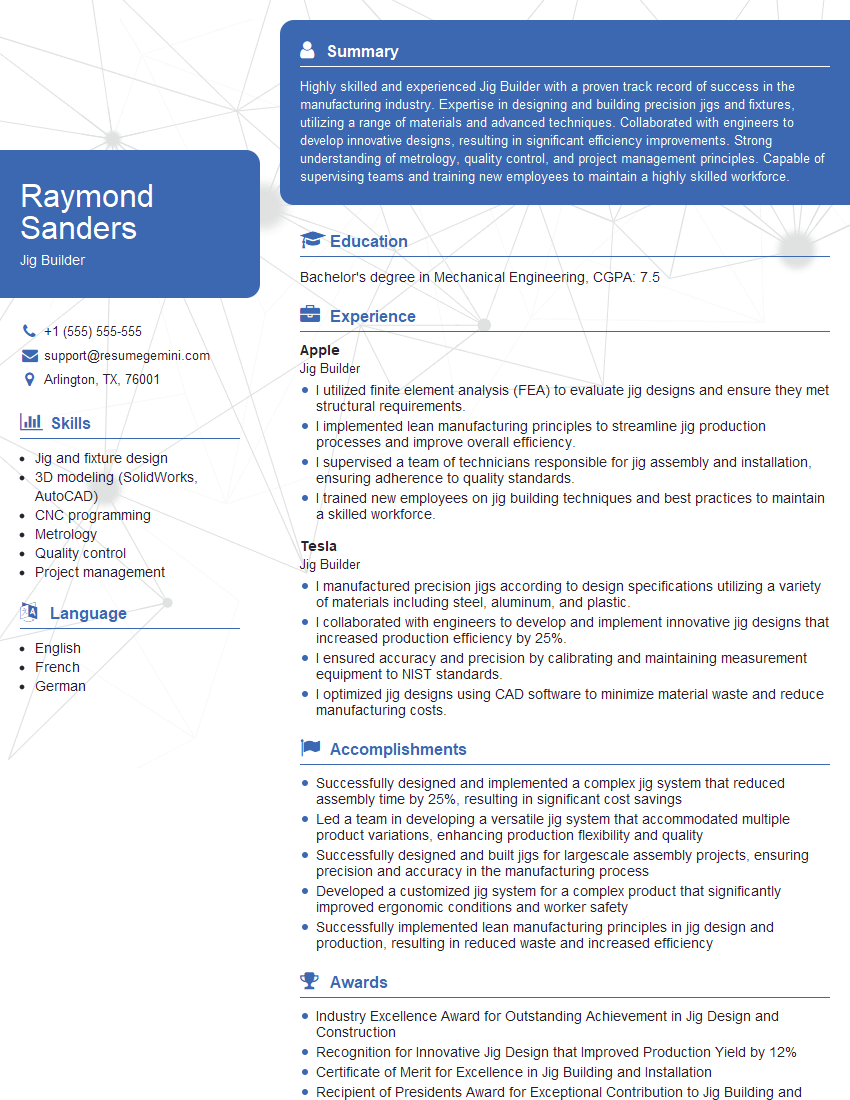
Mastering Jig and Fixture Assembly opens doors to exciting career opportunities in manufacturing and engineering, offering a rewarding path with significant growth potential. A well-crafted resume is key to showcasing your skills and experience effectively to potential employers. Building an ATS-friendly resume is crucial to ensuring your application is seen by recruiters. To help you create a compelling and impactful resume, consider using ResumeGemini. ResumeGemini provides a user-friendly platform and offers examples of resumes tailored to Jig and Fixture Assembly, giving you a head start in creating a document that truly reflects your capabilities. This will significantly improve your job prospects in this competitive field.
Explore more articles
Users Rating of Our Blogs
Share Your Experience
We value your feedback! Please rate our content and share your thoughts (optional).
What Readers Say About Our Blog
I Redesigned Spongebob Squarepants and his main characters of my artwork.
https://www.deviantart.com/reimaginesponge/art/Redesigned-Spongebob-characters-1223583608
IT gave me an insight and words to use and be able to think of examples
Hi, I’m Jay, we have a few potential clients that are interested in your services, thought you might be a good fit. I’d love to talk about the details, when do you have time to talk?
Best,
Jay
Founder | CEO