Cracking a skill-specific interview, like one for Mailpiece Identification and Verification, requires understanding the nuances of the role. In this blog, we present the questions you’re most likely to encounter, along with insights into how to answer them effectively. Let’s ensure you’re ready to make a strong impression.
Questions Asked in Mailpiece Identification and Verification Interview
Q 1. Explain the different types of mailpieces and their corresponding identification codes.
Mailpieces are classified into various types, each with a unique identification code. This categorization facilitates efficient sorting and processing within the postal system. The codes are often barcodes, but can also include other machine-readable formats. Let’s look at some examples:
- Letters: These are typically identified by their size and weight. The identification code, often a barcode, reflects this information along with the destination address. A simple letter might just have a basic barcode indicating First-Class Mail.
- Flats: Larger, flatter mailpieces like magazines and catalogs are similarly coded, but their barcode will reflect their larger dimensions and often their mailing class (e.g., Standard Mail).
- Packages: Parcels, packages, and oversized mail require more complex identification codes. These often incorporate tracking numbers, which are essential for monitoring delivery. These codes might be human-readable and machine-readable labels.
- Postcards: These have their own specific size and weight criteria and receive a corresponding identification code reflecting this smaller format.
The specific coding system can vary by country and postal service, but the principle remains the same: unique codes for efficient sorting and tracking.
Q 2. Describe the process of verifying a mailpiece’s address and postage.
Verifying a mailpiece’s address and postage involves a multi-step process, often highly automated. First, Optical Character Recognition (OCR) technology reads the address on the mailpiece and converts it into a digital format. This digital address is then compared against a database of valid addresses. This step flags potential errors or undeliverable addresses.
Simultaneously, a machine reads the postage indication – whether it’s a stamp, a printed postage label, or an indicia – verifying the sufficient postage for the mailpiece’s weight, size, and destination. Sophisticated systems can detect counterfeit postage. If there is insufficient postage, the mailpiece is flagged for additional payment or return.
Any discrepancies are highlighted for human review. For example, a manually handwritten address that is illegible might require an operator to examine the piece and determine the intended recipient. The entire process is designed to ensure the efficient and accurate delivery of mail.
Q 3. How do you identify and handle undeliverable mailpieces?
Undeliverable mailpieces are identified through a combination of automated address verification and manual handling. If the address is incorrect, incomplete, or the recipient has moved, the mailpiece is returned to the sender. This return process is facilitated by a return address which is read by machines.
Other reasons for undeliverability include: the recipient refuses the mail, the address is inaccessible, or the mailpiece is damaged. In these cases, the mailpiece is processed according to postal service regulations. This may involve attempting redelivery, sending a return-to-sender notification, or disposing of the mailpiece (after a period of time). A significant portion of handling undeliverable mailpieces involves effective record-keeping so senders can be notified.
Q 4. What are the implications of incorrect mailpiece identification?
Incorrect mailpiece identification has several significant implications. The most obvious is delayed or failed delivery. If the wrong identification code is applied, the mailpiece can be sorted to the wrong location, causing significant delays. For businesses this represents lost revenue and dissatisfied customers.
Furthermore, incorrect identification can lead to inaccurate postage accounting and financial losses for postal services and mailers. Finally, incorrect identification can disrupt overall mail processing efficiency, causing bottlenecks in the sorting and distribution process.
Accurate identification is crucial for smooth operations and efficient delivery across the entire postal network.
Q 5. Explain the role of automation in mailpiece identification and verification.
Automation plays a pivotal role in modern mailpiece identification and verification. OCR, barcode scanners, and high-speed sorting machines are used to process vast amounts of mail quickly and accurately. These technologies enable efficient address verification, postage validation, and automated sorting based on destination and mail class.
Advanced image processing and machine learning algorithms further enhance accuracy. For instance, they are able to identify and interpret handwritten addresses, or identify damaged or partially obscured mailpieces. Automation dramatically increases throughput and reduces human error.
However, automation isn’t perfect. Human oversight is still needed to handle exceptions and complex cases that automation systems may struggle with.
Q 6. Describe your experience with different mail sorting machines and their functionalities.
My experience encompasses working with several generations of mail sorting machines. I’ve worked with both older, mechanical machines and the latest high-speed automated systems. Older machines relied heavily on manual intervention for sorting, using human operators to guide mailpieces based on their destination. These machines were slower but reliable for specific mail types.
Modern machines utilize a combination of optical character recognition (OCR), barcode scanning, and robotic arms to sort mail based on destination, size, and weight. The newer models are much faster, more efficient, and handle a wider range of mailpieces. I have a good understanding of the functionalities and maintenance of several brands, and am adept at troubleshooting issues that arise.
For instance, I’m familiar with the use of advanced imaging systems to identify fragile items and route them accordingly, minimizing potential damage during the sorting process.
Q 7. How do you ensure the accuracy of mailpiece identification and verification processes?
Ensuring accuracy in mailpiece identification and verification involves a multi-layered approach. This starts with regular quality control checks of the equipment. Machines undergo calibrations and testing to ensure accurate readings. Human operators regularly review a sample of the processed mailpieces to detect any discrepancies. This process is critical in identifying and correcting any systemic errors.
Data analysis plays a key role. Performance metrics, such as error rates and processing speeds, are closely monitored to identify areas needing improvement. Regular training for operators and technicians keeps them updated on procedures and the latest technologies. Finally, a robust system for feedback and continuous improvement is in place to address any arising issues.
By combining advanced technology with stringent quality control measures and continuous monitoring, we maintain a high degree of accuracy.
Q 8. What quality control measures do you employ to minimize errors?
Minimizing errors in mailpiece identification and verification is paramount. We employ a multi-layered approach involving both automated systems and human oversight.
- Automated Checks: Our systems utilize Optical Character Recognition (OCR) to read and verify addresses, barcodes, and other identifying information. Data validation rules flag inconsistencies or potential errors, such as incorrect zip codes or missing information. We also employ image analysis to detect damaged or irregular mailpieces.
- Human Review: A crucial element is human review, especially for flagged items or those requiring interpretation beyond the capabilities of automated systems. Trained personnel manually inspect these mailpieces, ensuring accuracy and identifying any anomalies.
- Regular Audits: We conduct regular audits of our processes and systems to identify areas for improvement and prevent recurring errors. This includes analyzing error rates, identifying common causes of errors, and implementing corrective actions.
- Training and Development: Ongoing training for our staff is essential. We provide comprehensive training on mailpiece identification, USPS regulations, and the use of our verification systems. This ensures that personnel are equipped to handle various scenarios and maintain consistent quality.
For example, imagine a situation where OCR misreads a zip code. Our data validation rules would flag this discrepancy, triggering a human review to correct the error before the mailpiece is processed.
Q 9. How do you handle discrepancies between the mailpiece’s content and its address label?
Discrepancies between a mailpiece’s content and its address label are serious and require careful handling. Our process involves a detailed investigation to determine the source of the error.
- Verification: We first verify the address on the label against the content inside the mailpiece (if safely accessible). For example, if a package is labeled for John Doe but contains items addressed to Jane Doe, a discrepancy is evident.
- Return to Sender or Forwarding: If the correct address is known, we either return the mailpiece to the sender with an explanation or forward it to the correct recipient. This depends on the type of mailpiece and client instructions.
- Investigation and Documentation: In more complex cases, where the correct address is unclear, we conduct a thorough investigation and document the process. This documentation might involve photographs of the mailpiece and its contents. This step is crucial for audit trails and to prevent similar errors in the future.
- Client Notification: We always notify the client about any discrepancies found and the steps taken to resolve them.
In such cases, meticulous record-keeping and clear communication are vital to ensure the mailpiece is handled correctly and accountability is maintained.
Q 10. Describe your experience with mailpiece tracking systems.
I have extensive experience with various mailpiece tracking systems, ranging from simple barcode scanners to sophisticated enterprise-level solutions. My experience includes using systems that track mailpieces from origin to destination, providing real-time updates on location and status.
- Data Integration: I’ve worked with systems that integrate with different databases, providing comprehensive tracking information and reporting capabilities. This allows for efficient analysis of mailpiece movement and performance metrics.
- Exception Handling: My experience includes using systems that automatically flag exceptions such as delays, misdeliveries, or return-to-sender events. This allows for proactive interventions and improved service delivery.
- Reporting and Analysis: I’m proficient in generating reports based on tracking data, analyzing trends, and identifying areas for process improvement.
For instance, I recall a project where we implemented a new tracking system that drastically reduced delivery times and improved accuracy by providing real-time visibility into the mailpiece journey. This resulted in significant cost savings and enhanced customer satisfaction.
Q 11. How familiar are you with USPS regulations regarding mailpiece identification?
I possess a thorough understanding of USPS regulations regarding mailpiece identification. This knowledge extends to the various mail classes (First-Class Mail, Periodicals, Packages, etc.), acceptable mailpiece dimensions and weights, address formatting requirements, and proper labeling procedures.
- Compliance: My experience includes ensuring strict adherence to USPS regulations to prevent delays, returns, and potential penalties.
- Staying Updated: The USPS periodically updates its regulations, so staying current on these changes is essential. I actively monitor these updates to maintain compliance.
- Documentation: I’m adept at using the USPS’s online resources and publications to confirm regulations and ensure proper documentation for compliance.
For example, I am well-versed in the specifications for dimensional weight calculations and the implications for postage rates. This knowledge allows for accurate postage application and avoidance of errors.
Q 12. How do you deal with damaged or irregular mailpieces?
Damaged or irregular mailpieces require careful attention and often necessitate specific handling procedures. Our approach involves:
- Assessment: We first assess the extent of the damage. This includes checking for tears, crushing, water damage, or other irregularities.
- Documentation: The condition of the mailpiece is thoroughly documented, often with photographs or detailed descriptions.
- Salvage Attempts: If possible, we attempt to salvage the mailpiece. This might involve repackaging or repairing minor damage.
- Return to Sender: If the damage is too extensive to salvage, the mailpiece is typically returned to the sender.
- Disposal: If the content is hazardous or irrecoverable, appropriate disposal procedures are followed.
Imagine a package arriving with a significant tear. We would document the damage, attempt to repair it if the content allows, and if not possible, return it to the sender, notifying them of the situation.
Q 13. Explain the process of identifying and handling international mailpieces.
Handling international mailpieces requires a deeper understanding of customs regulations, international postal treaties, and specific requirements for documentation.
- Customs Declarations: Accurate completion of customs declarations is crucial. This involves specifying the contents, value, and origin of the mailpiece.
- International Postal Regulations: We must adhere to the regulations set by both the sending and receiving countries’ postal services, which can vary widely.
- Prohibited Items: We screen for prohibited items that are not allowed to be shipped internationally.
- Tracking and Delivery: Tracking systems for international mailpieces are often more complex, involving coordination between multiple postal services.
For example, I’ve been involved in situations where we needed to ensure proper documentation for sensitive items shipped overseas to ensure compliance with international trade laws and prevent delays or rejection at customs.
Q 14. Describe your experience with different mailpiece formats (e.g., letters, flats, parcels).
My experience encompasses a wide variety of mailpiece formats, each with its unique characteristics and handling requirements.
- Letters: Handling letters involves verifying the address, ensuring proper postage, and processing them efficiently through sorting and delivery systems.
- Flats: Flats, such as magazines or large envelopes, require different sorting and processing techniques than letters, due to their size and shape. We use specialized equipment optimized for these formats.
- Parcels: Parcels, ranging from small boxes to large packages, require careful handling to prevent damage. Weight and dimensional measurements are crucial for accurate postage and efficient sorting.
This experience across diverse formats ensures I can adapt to different mailpiece types and identify potential issues associated with each. For instance, the handling of a large parcel requires a different approach than processing a standard letter, including considerations for weight limits, fragility, and handling procedures.
Q 15. How do you ensure compliance with postal regulations related to mailpiece identification?
Ensuring compliance with postal regulations regarding mailpiece identification is paramount for efficient and cost-effective mail delivery. It involves meticulous adherence to standards set by postal services like the USPS (United States Postal Service) or equivalent international organizations. This includes correct addressing, using appropriate postage, and adhering to size and weight restrictions. Non-compliance leads to delays, returns, and financial penalties.
- Address Verification: We use address verification systems to ensure addresses are accurate and deliverable. This often involves using CASS (Coding Accuracy Support System) certified software to standardize addresses and correct errors.
- Postage Application: We meticulously apply the correct postage, considering weight, dimensions, and mail class. This involves understanding the intricacies of different postage rates and utilizing postage meters or automated systems for accuracy.
- Mailpiece Preparation: Proper preparation is crucial. This includes ensuring mailpieces are properly sorted, bundled, and packaged to meet postal requirements, preventing damage during transit.
- Regular Audits: Conducting regular audits of our mailpiece preparation processes is essential to identify and correct any compliance issues before they escalate. This might involve reviewing a sample of mailpieces for accuracy and adherence to guidelines.
For instance, failing to use the correct barcode or address format can lead to significant delays or even the entire batch of mail being returned. A simple oversight can have cascading effects.
Career Expert Tips:
- Ace those interviews! Prepare effectively by reviewing the Top 50 Most Common Interview Questions on ResumeGemini.
- Navigate your job search with confidence! Explore a wide range of Career Tips on ResumeGemini. Learn about common challenges and recommendations to overcome them.
- Craft the perfect resume! Master the Art of Resume Writing with ResumeGemini’s guide. Showcase your unique qualifications and achievements effectively.
- Don’t miss out on holiday savings! Build your dream resume with ResumeGemini’s ATS optimized templates.
Q 16. What software or tools are you proficient in using for mailpiece identification?
My proficiency in mailpiece identification software and tools is extensive. I’m highly skilled in using various address verification systems like USPS’s Intelligent Mail barcode (IMB) generators and other CASS-certified software. I am also proficient with postal automation systems, including those for weighing, sorting, and labeling mailpieces. These systems significantly reduce manual handling, thereby increasing accuracy and efficiency.
- Address Verification Software: I’m experienced with various software packages used for verifying and correcting addresses, ensuring compliance with postal regulations.
- Postage Meter Software: I’m adept at using postage meters and their associated software for accurately applying postage based on weight and mail class.
- Mail Tracking Systems: I am familiar with tracking software to monitor the movement of mailpieces throughout the processing and delivery chain, enabling proactive identification of potential delays or issues.
For example, I routinely use usps.com‘s tools for address validation and IMB generation, ensuring each mailpiece has the correct barcode for efficient automated sorting. The software itself provides real-time feedback to detect and correct errors before they cause problems.
Q 17. How do you prioritize mailpieces for processing based on urgency or destination?
Prioritizing mailpieces is crucial for ensuring timely delivery, especially during peak periods. This often involves a combination of automated systems and manual intervention. We leverage mail class designations (e.g., First-Class Mail, Priority Mail) and service level agreements (SLAs) to determine processing order.
- Automated Sorting: Automated sorting systems prioritize mailpieces based on pre-defined rules, such as zip code, mail class, and delivery date. This ensures that urgent mail is processed first.
- Manual Intervention: In cases requiring special attention (e.g., time-sensitive documents), manual intervention may be necessary to flag and prioritize specific mailpieces for expedited processing.
- Destination-Based Routing: Mailpieces are routed based on their destination to optimize the transportation network and minimize transit times. This involves prioritizing mail headed to nearby destinations for faster delivery.
Think of it like a busy airport—planes with urgent passengers or cargo get priority on the runway. Similarly, our systems ensure that urgent mail gets prioritized through the processing and delivery network.
Q 18. Describe your experience with troubleshooting mail processing equipment malfunctions.
Troubleshooting mail processing equipment malfunctions requires a systematic approach. My experience encompasses identifying the root cause of malfunctions, implementing temporary workarounds, and collaborating with maintenance personnel for repairs.
- Identifying the Issue: The initial step is to accurately identify the nature of the malfunction. This involves examining error codes, reviewing logs, and conducting visual inspections of the equipment.
- Temporary Workarounds: In some cases, temporary workarounds can be implemented to minimize disruption while waiting for repairs. This could involve manually processing mailpieces or rerouting them to alternative equipment.
- Collaboration with Maintenance: Close collaboration with maintenance technicians is crucial. Providing detailed information about the malfunction and the steps taken to troubleshoot is essential for effective repairs.
- Preventative Maintenance: Regular preventative maintenance is key to minimizing equipment downtime and ensuring smooth mail processing.
For instance, I once dealt with a jam in a high-speed sorting machine. By carefully isolating the affected section and clearing the jam, we were able to restore operation quickly. However, identifying the cause of the jam (a faulty sensor) required collaboration with maintenance for a permanent fix.
Q 19. What are the common errors in mailpiece identification and how to prevent them?
Common errors in mailpiece identification include incorrect or incomplete addresses, improper postage, and incorrect mail class selection. These errors can lead to delays, returns, or additional costs. Prevention involves a multi-faceted approach.
- Address Verification: Using address verification software and ensuring accurate data entry are fundamental in preventing address errors.
- Postage Accuracy: Using appropriate postage meters and double-checking weight and dimensions are critical in avoiding postage-related issues.
- Mail Class Selection: Understanding the different mail classes and their associated requirements is essential to selecting the appropriate class for each mailpiece.
- Training and Procedures: Providing thorough training for staff involved in mailpiece preparation and establishing clear procedures for handling mailpieces are crucial for minimizing errors.
- Regular Audits: Regular audits help identify and correct any inconsistencies or emerging errors in the mailpiece identification process.
Imagine sending a postcard with an incomplete address – it’s highly likely to be returned or get lost. Implementing preventative measures ensures this doesn’t happen on a larger scale.
Q 20. How do you handle a large volume of mailpieces during peak periods?
Handling large volumes of mail during peak periods requires a well-planned strategy involving leveraging technology, optimizing workflows, and potentially increasing staffing. This ensures that mail processing remains efficient and meets deadlines.
- Automation: Maximizing the use of automated sorting and processing equipment significantly increases throughput during peak periods.
- Optimized Workflows: Streamlining workflows to minimize bottlenecks and maximize efficiency is vital. This involves careful planning of personnel allocation and task assignment.
- Increased Staffing: In some cases, temporary increases in staffing may be necessary to handle the increased volume of mail.
- Predictive Modeling: Utilizing data and predictive modeling can help anticipate peak volumes and make proactive adjustments to staffing and resource allocation.
Think of it like a restaurant during the dinner rush. Having enough staff, efficient kitchen processes, and a well-organized system are essential for serving customers quickly and efficiently. Similarly, we employ various strategies to handle the increased workload during peak mail periods.
Q 21. Explain the importance of proper mailpiece handling to ensure delivery efficiency.
Proper mailpiece handling is the cornerstone of efficient delivery. It minimizes damage, reduces processing errors, and ensures mailpieces reach their intended destinations on time. Neglecting proper handling leads to delays, returns, and potentially lost revenue.
- Damage Prevention: Careful handling prevents damage to mailpieces, especially fragile items. This includes using appropriate packaging and handling materials.
- Accurate Processing: Proper labeling and sorting ensure mailpieces are processed accurately and efficiently, reducing the risk of delays or misdeliveries.
- Security: Proper handling contributes to mail security by preventing theft or loss. This involves secure storage and transportation methods.
- Customer Satisfaction: Ensuring efficient delivery enhances customer satisfaction and builds trust in the mail service.
Imagine a delicate package being tossed around during transit. The result could be damage to the contents, delays, and a frustrated customer. Proper mailpiece handling ensures this doesn’t happen.
Q 22. How do you maintain accurate records of mailpiece processing?
Maintaining accurate mailpiece processing records is crucial for operational efficiency, compliance, and cost analysis. We employ a multi-layered approach combining automated systems with manual oversight.
Automated Data Capture: Our systems automatically log each mailpiece’s entry into the processing stream, including its barcode scan (if applicable), weight, dimensions, destination, and processing timestamps. This data is stored in a secure, relational database.
Manual Verification and Reconciliation: Regular spot checks and audits are performed to compare automated data with physical counts and manually logged exceptions. This helps identify and correct discrepancies promptly. For example, we might compare the number of mailpieces scanned against the number physically counted at various points in the process.
Exception Reporting and Management: A robust system flags any unusual patterns or errors during processing. For instance, unusually high rejection rates for a specific type of mailpiece trigger an investigation to identify the root cause. This data is used to improve processes and prevent future errors.
Data Archiving and Retrieval: All processing data is archived according to regulatory requirements and internal policies, ensuring easy retrieval for audits, reporting, and performance analysis. This helps with trend analysis and operational improvements over time.
Q 23. What strategies do you use to improve the efficiency of mailpiece identification?
Improving mailpiece identification efficiency involves optimizing both the technology used and the processes surrounding it. Key strategies include:
Advanced Imaging Technologies: We utilize high-resolution scanners and OCR (Optical Character Recognition) software to accurately read addresses and other critical information from mailpieces, even those with poor print quality or damaged envelopes. This drastically reduces manual intervention.
Barcode Integration: We encourage the use of intelligent mail barcodes (IMb) and other relevant barcodes. This provides instant, machine-readable identification, speeding up sorting and routing significantly. For example, IMb allows for automated presorting, drastically reducing processing times.
Automated Address Correction: Sophisticated software algorithms and databases compare addresses against national address databases to correct inaccuracies and improve deliverability. This reduces errors and improves efficiency.
Process Optimization: We continuously analyze processing bottlenecks and implement changes to streamline workflow. This could involve re-arranging equipment, improving training for staff, or implementing automated routing systems based on mailpiece characteristics.
Q 24. Describe your experience with implementing new mail processing technologies.
I have extensive experience in implementing new mail processing technologies, from planning and procurement to training and integration. One notable project involved the transition from a legacy system to a fully automated high-speed mail sorting system.
Needs Assessment and Planning: We began by carefully assessing our current processes and identifying areas where automation could deliver the greatest benefits. This involved analyzing current throughput, error rates, and staffing requirements.
System Selection and Procurement: After a thorough evaluation of available technologies, we selected a system that met our needs and budget. This included considerations such as processing speed, scalability, and integration with existing systems.
Implementation and Testing: The implementation process was phased to minimize disruption to our operations. Rigorous testing was conducted at each stage to ensure seamless integration and optimal performance.
Training and Support: Comprehensive training was provided to our staff on operating and maintaining the new system. Ongoing technical support was also crucial to address any issues that arose.
Results: The project resulted in a significant increase in processing speed, a reduction in errors, and improved overall efficiency. We saw a nearly 40% increase in mailpiece processing capacity.
Q 25. How do you stay updated on changes in postal regulations and best practices?
Staying updated on postal regulations and best practices is crucial for maintaining compliance and optimizing our processes. We employ a multi-pronged approach:
Subscription to Postal Service Updates: We subscribe to official newsletters, publications, and online resources from the relevant postal authorities to receive timely updates on regulatory changes and best practices.
Industry Conferences and Workshops: We regularly attend industry conferences and workshops to learn about the latest technologies, trends, and best practices from leading experts in the field.
Professional Networking: Maintaining strong relationships with other professionals in the mail processing industry provides valuable insights and allows us to learn from their experiences.
Internal Training Programs: We conduct regular internal training sessions to keep our staff informed about the latest regulations and best practices.
Q 26. Describe a situation where you had to resolve a complex mailpiece identification issue.
One challenging case involved a significant increase in mailpieces being rejected due to illegible addresses. Initially, we suspected a problem with our scanning equipment. However, after a thorough investigation, we discovered the issue stemmed from a change in the ink used by a major client.
Problem Identification: We used data analysis to pinpoint the source of the problem—a specific client and a correlation with a recent change in their printing methods.
Collaboration and Communication: We immediately contacted the client to discuss the issue and explore potential solutions, such as a return to the previous ink or an adjustment to the printing process.
Testing and Implementation: We tested various solutions, including adjustments to our image processing software and collaborated with the client to test different printing parameters.
Outcome: Through close collaboration, we identified a solution that allowed us to process the mailpieces efficiently, preventing significant delays and avoiding financial losses for the client and our organization.
Q 27. How do you collaborate with other team members to ensure smooth mail processing operations?
Effective collaboration is essential for smooth mail processing operations. We foster a team-oriented environment through:
Regular Team Meetings: We hold regular meetings to discuss operational challenges, share best practices, and coordinate efforts. This ensures everyone is informed and aligned on goals.
Open Communication Channels: We encourage open communication and feedback through various channels, including email, instant messaging, and regular one-on-one meetings. This facilitates quick problem-solving and collaboration.
Cross-Training and Skill Development: We provide cross-training opportunities for our team members to enhance their skills and understanding of various aspects of mail processing. This ensures flexibility and adaptability in addressing unexpected challenges.
Shared Responsibility and Accountability: Team members share responsibility for the overall success of mail processing operations. This fosters a sense of ownership and commitment.
Key Topics to Learn for Mailpiece Identification and Verification Interview
- Mailpiece Anatomy and Characteristics: Understanding the physical components of different mailpieces (letters, flats, parcels, etc.) and their identifying features.
- Address Interpretation and Validation: Applying rules and algorithms to accurately interpret and verify addresses, including postal codes, street addresses, and delivery points.
- Barcode Reading and Interpretation: Understanding different barcode symbologies used in mail (e.g., Intelligent Mail barcode) and their role in automated mail processing.
- Mailpiece Sorting and Routing: Knowledge of the processes and technologies involved in sorting and routing mail based on address information and barcode data.
- Data Quality and Error Handling: Identifying and resolving inconsistencies or errors in address data to ensure accurate mail delivery.
- Automation and Technology in Mail Processing: Familiarity with automated mail processing equipment and software used for mailpiece identification and verification.
- Regulatory Compliance and Best Practices: Understanding relevant postal regulations and industry best practices for accurate and efficient mail processing.
- Problem-solving and Troubleshooting: Applying logical reasoning and analytical skills to identify and resolve issues related to mailpiece identification and verification.
- Security and Fraud Prevention: Understanding the role of mailpiece identification in preventing mail fraud and ensuring secure mail delivery.
Next Steps
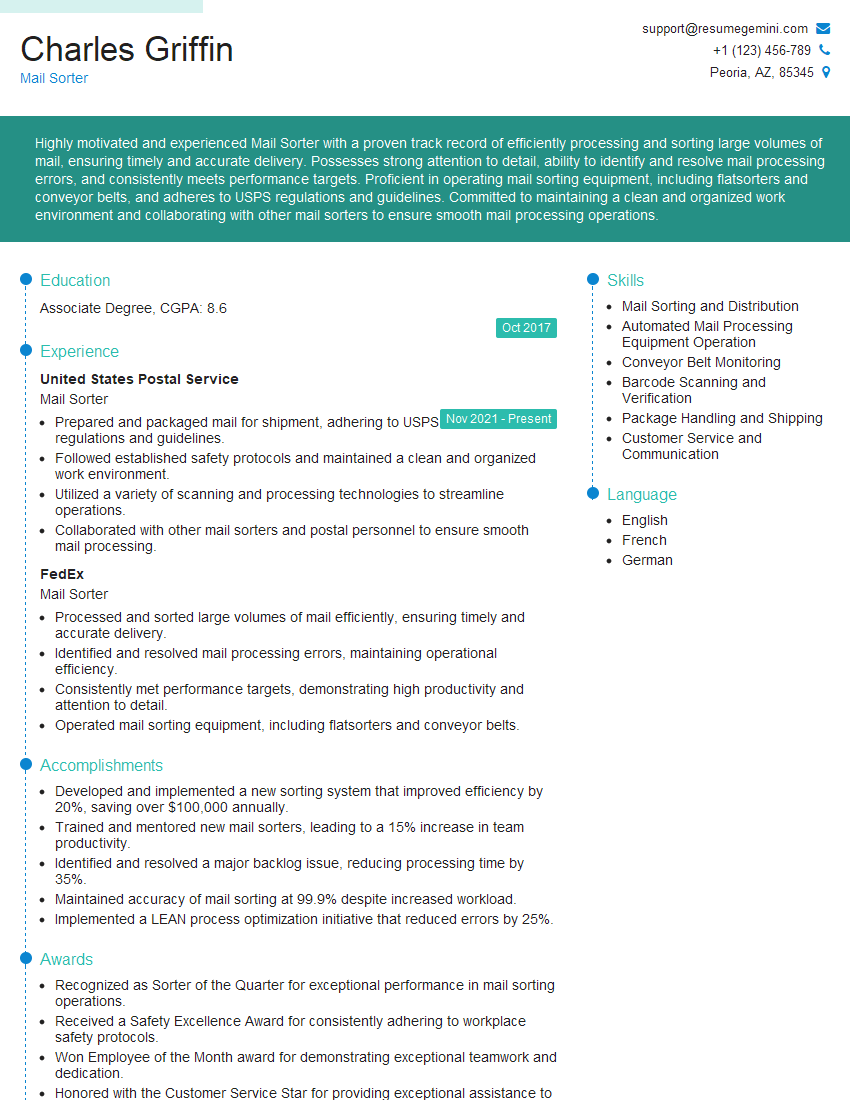
Mastering Mailpiece Identification and Verification opens doors to exciting career opportunities in logistics, postal services, and data management. To stand out in a competitive job market, a well-crafted, ATS-friendly resume is crucial. ResumeGemini can help you create a professional and impactful resume that highlights your skills and experience. Take advantage of ResumeGemini’s resources to build a compelling resume – examples of resumes tailored to Mailpiece Identification and Verification are available to guide you. Investing time in this process will significantly enhance your job prospects and accelerate your career growth.



Explore more articles
Users Rating of Our Blogs
Share Your Experience
We value your feedback! Please rate our content and share your thoughts (optional).
What Readers Say About Our Blog
I Redesigned Spongebob Squarepants and his main characters of my artwork.
https://www.deviantart.com/reimaginesponge/art/Redesigned-Spongebob-characters-1223583608
IT gave me an insight and words to use and be able to think of examples
Hi, I’m Jay, we have a few potential clients that are interested in your services, thought you might be a good fit. I’d love to talk about the details, when do you have time to talk?
Best,
Jay
Founder | CEO