Are you ready to stand out in your next interview? Understanding and preparing for Manufacturing Automation interview questions is a game-changer. In this blog, we’ve compiled key questions and expert advice to help you showcase your skills with confidence and precision. Let’s get started on your journey to acing the interview.
Questions Asked in Manufacturing Automation Interview
Q 1. Explain the difference between PLC and SCADA systems.
PLCs (Programmable Logic Controllers) and SCADA (Supervisory Control and Data Acquisition) systems are both crucial components of industrial automation, but they serve distinct purposes. Think of a PLC as the ‘brains’ of a machine, directly controlling individual devices like motors, valves, and sensors. SCADA, on the other hand, acts as the ‘management’ system, providing a centralized overview and control of multiple PLCs and other equipment across an entire facility or even multiple facilities.
PLC: A PLC is a ruggedized computer specifically designed for industrial environments. It executes a program to monitor and control physical processes, using input from sensors and outputting commands to actuators. For example, a PLC might control the timing and sequencing of a robotic arm in a pick-and-place operation.
SCADA: A SCADA system uses a combination of hardware and software to collect data from PLCs, other devices, and sensors across a wide geographical area. This data is then presented via a user interface (HMI), providing operators with a real-time overview of the entire process, and allowing them to monitor and control it from a central location. A SCADA system might show the status of multiple production lines, alert operators to potential issues, and allow remote adjustments to process parameters.
In essence, PLCs handle the low-level control of individual machines, while SCADA provides high-level supervisory control and monitoring of the entire system. They work together seamlessly to provide comprehensive automation control.
Q 2. Describe your experience with robotic programming languages (e.g., RAPID, KRL).
I have extensive experience with several robotic programming languages, including RAPID (ABB robots) and KRL (KUKA robots). My experience spans diverse applications, from simple pick-and-place operations to complex assembly tasks. I’m proficient in both offline programming using simulation software and online programming directly on the robot controller.
RAPID: RAPID is a structured, Pascal-like language known for its strong support for motion control and data manipulation. I’ve used it to program complex robot movements, including path planning, trajectory generation, and synchronization with other equipment. For instance, I developed a RAPID program to control a robotic arm that precisely placed components onto a circuit board, using vision system feedback for precise alignment.
KRL: KRL (KUKA Robot Language) has a different syntax but provides similar functionality to RAPID. I’ve utilized KRL to program robots in welding, painting, and palletizing applications. A recent project involved using KRL to program a robotic arm to perform arc welding on complex metal structures, requiring precise control of weld parameters and robot path.
My expertise also includes working with robot libraries, creating custom functions, and implementing error handling routines to ensure reliable robot operation. I am adept at troubleshooting and optimizing robotic programs for improved efficiency and performance.
Q 3. What are the key considerations for selecting a suitable robot for a specific manufacturing application?
Choosing the right robot for a manufacturing application requires careful consideration of several key factors. It’s not a one-size-fits-all situation, and the optimal choice depends on the specific needs of the task.
- Payload Capacity: How much weight will the robot need to handle?
- Reach: What is the maximum distance the robot needs to reach?
- Degrees of Freedom (DOF): How many axes of movement are required for the task (e.g., 6 DOF for intricate manipulation)?
- Speed and Accuracy: What speed and precision are needed for the application? A high-speed robot might be suitable for pick-and-place, while a high-accuracy robot is better for precise assembly.
- Work Envelope: The robot’s workspace must accommodate the application’s requirements.
- Environment: Is the environment clean and controlled, or harsh and dirty? Different robots are designed for different environments (e.g., IP ratings for dust and water resistance).
- Integration: How easily can the robot be integrated with existing equipment and systems?
- Cost: The initial purchase price and ongoing maintenance costs must be considered.
For example, a small, lightweight robot with high speed and accuracy might be ideal for electronics assembly, while a larger, heavy-duty robot with a high payload capacity would be better suited for material handling in a heavy industry setting. Thorough assessment of these factors is crucial for selecting the most effective and cost-efficient robotic solution.
Q 4. How do you troubleshoot PLC program errors?
Troubleshooting PLC program errors is a systematic process requiring a blend of technical skills and problem-solving abilities. I use a structured approach, combining diagnostic tools with a methodical investigation.
- Review the PLC program: Start by carefully examining the ladder logic or structured text code to identify potential errors. Look for syntax errors, logic flaws, or incorrect addressing.
- Check I/O signals: Verify that all input and output signals are functioning correctly. Use diagnostic tools to monitor the status of inputs and outputs, ensuring they match the expected values.
- Utilize diagnostic tools: Most PLCs have built-in diagnostic features like forcing bits, monitoring internal variables, and tracing program execution. These tools allow for step-by-step analysis of the program’s behavior.
- Simulation: If possible, simulate the PLC program using simulation software to isolate the problem without affecting the physical system.
- Examine error logs: Check the PLC’s error logs for specific error messages that pinpoint the location and nature of the issue.
- Test systematically: Once a potential error has been identified, test the program section by section to confirm the fix.
For example, if a motor isn’t starting, I would check the input signal from the start button, the motor’s power supply, and the status of the output signal to the motor controller within the PLC program. This methodical approach ensures efficient resolution of PLC program errors.
Q 5. Explain your experience with different types of sensors used in automation systems (e.g., proximity, photoelectric, vision).
My experience encompasses a wide range of sensors used in automation systems, each offering unique capabilities and applications. I’ve worked extensively with proximity, photoelectric, and vision sensors, understanding their strengths and limitations.
- Proximity Sensors: These sensors detect the presence of an object without physical contact. Inductive proximity sensors work with metallic objects, while capacitive sensors can detect both metallic and non-metallic objects. I’ve used them in applications like detecting the presence of parts on a conveyor belt or ensuring proper placement of components in an assembly process.
- Photoelectric Sensors: These sensors use light beams to detect the presence or absence of objects. They are available in various configurations (e.g., thru-beam, retro-reflective, diffuse reflective) allowing for flexible integration into different applications. I have used these for detecting the color of products on a conveyor belt or detecting the presence of a specific part.
- Vision Sensors: These sensors use cameras and image processing techniques to provide detailed information about objects, including their position, orientation, and characteristics. I’ve used vision systems for complex tasks like part inspection, guiding robots, and reading barcodes. For example, in one project, a vision system guided a robotic arm to pick and place components with high accuracy, compensating for variations in component position and orientation.
Sensor selection depends heavily on the application. For instance, a simple proximity sensor might suffice for basic presence detection, whereas a sophisticated vision system is needed for more complex tasks requiring high-level image analysis.
Q 6. Describe your experience with HMI design and implementation.
I have significant experience in HMI (Human-Machine Interface) design and implementation, focusing on creating user-friendly and effective interfaces for industrial automation systems. My approach emphasizes intuitive navigation, clear visual representation of data, and efficient operator interaction.
My design process involves understanding the operator’s tasks and workflows to create an interface that is both visually appealing and functional. I use industry-standard HMI software to create the interfaces, paying close attention to aspects such as screen layout, alarm management, and data visualization. I’ve implemented HMIs for various applications, from single-machine control panels to large-scale SCADA systems.
For example, in one project, I designed an HMI for a complex packaging line, integrating data from multiple PLCs and sensors. The interface presented real-time production data, provided alerts in case of failures, and allowed operators to control the line parameters. This HMI significantly improved the efficiency of the packaging line and reduced downtime.
In designing an HMI, I consider factors like alarm prioritization, user permissions, trend analysis, and reporting capabilities. Accessibility for operators with diverse skills and experiences is also a top priority.
Q 7. What are the advantages and disadvantages of different automation architectures (e.g., centralized, decentralized)?
Automation architectures, whether centralized or decentralized, each present advantages and disadvantages. The best choice depends on factors like system size, complexity, redundancy requirements, and maintenance considerations.
Centralized Architecture: In a centralized architecture, a single controller manages all aspects of the automation system. This approach simplifies programming and monitoring but creates a single point of failure. If the central controller fails, the entire system shuts down. This is suitable for smaller, simpler systems.
Decentralized Architecture: In a decentralized architecture, multiple controllers manage different parts of the system, increasing redundancy and improving fault tolerance. If one controller fails, the rest of the system can continue operating. This approach is more complex to program and manage but provides greater reliability and scalability. It is well-suited for larger, more complex systems.
Advantages of Centralized: Simplicity, easy programming, lower initial cost.
Disadvantages of Centralized: Single point of failure, limited scalability.
Advantages of Decentralized: High reliability, scalability, modularity, better fault tolerance.
Disadvantages of Decentralized: Increased complexity, higher initial cost, more complex programming and maintenance.
The decision between centralized and decentralized architectures often involves balancing cost, complexity, and system reliability requirements.
Q 8. How do you ensure the safety of automated systems?
Ensuring the safety of automated systems is paramount. It’s not just about meeting regulations; it’s about protecting human life and preventing costly downtime. My approach is multi-layered, focusing on inherent safety, protective measures, and fail-safe mechanisms.
- Inherent Safety: Designing systems with safety in mind from the outset. This includes using intrinsically safe components, minimizing moving parts in areas with human interaction, and incorporating design features that prevent hazards from occurring in the first place. For instance, I’d design a robotic cell with light curtains to create a safety zone, automatically stopping the robot if a person enters.
- Protective Measures: Implementing safeguards like emergency stop buttons, safety interlocks, and light curtains. These are physical barriers or mechanisms that interrupt operation if a safety violation occurs. Think of it like a car’s airbag system – a secondary protection layer. Regular testing and maintenance of these are critical.
- Fail-Safe Mechanisms: Designing redundancy into the system so that if one component fails, the system gracefully shuts down without causing harm or damage. This might involve using dual sensors or backup power supplies. Imagine a flight control system – multiple systems work in parallel to ensure reliable performance.
- Risk Assessment and Mitigation: Conducting thorough risk assessments (more on this in a later answer) to identify potential hazards and implementing appropriate control measures. This process is iterative and continues throughout the system’s lifecycle.
- Training and Procedures: Ensuring that operators are properly trained on the safe operation and maintenance of automated systems. Clear and concise operating procedures are vital to reduce human error.
I always prioritize safety and believe a proactive, multi-faceted approach is essential for reliable and safe automation systems.
Q 9. Explain your experience with different types of industrial communication protocols (e.g., Ethernet/IP, Profinet, Modbus).
I have extensive experience with various industrial communication protocols, each suited for different applications and environments. My experience spans from simple point-to-point communication to complex, distributed control systems.
- Ethernet/IP: A common protocol in industrial automation, particularly in North America. I’ve used it extensively in projects involving PLCs (Programmable Logic Controllers), robots, and HMIs (Human-Machine Interfaces). Its speed and flexibility are ideal for complex systems requiring high data throughput. I’ve leveraged its capabilities for real-time data acquisition and control in high-speed manufacturing lines.
- Profinet: A popular protocol in Europe, renowned for its high-speed, real-time capabilities. I’ve used it for advanced motion control applications, requiring precise synchronization of multiple axes, and in applications demanding deterministic communication for timing-critical processes.
- Modbus: A simpler, more established protocol well-suited for less complex applications. It’s robust and reliable, making it suitable for applications where simplicity and cost-effectiveness are paramount. I’ve used Modbus for interfacing legacy systems and implementing basic monitoring and control functions.
My experience enables me to select the most suitable protocol based on the specific project requirements – considering factors like speed, reliability, cost, and the existing infrastructure.
Q 10. Describe your experience with implementing Lean Manufacturing principles in automated systems.
Lean Manufacturing principles, focusing on eliminating waste and maximizing efficiency, are fundamental to my approach to automation. I integrate these principles into my automation projects to achieve significant improvements in productivity and quality.
- Value Stream Mapping: I utilize this tool to analyze the entire production process, identifying bottlenecks and areas where waste (e.g., overproduction, waiting, transportation, inventory, motion, over-processing, defects) can be reduced. This helps us pinpoint where automation can have the greatest impact.
- Kaizen Events: I facilitate Kaizen events to engage cross-functional teams in continuous improvement efforts. This iterative approach identifies quick wins and incremental improvements in the automated system’s efficiency. Real-world example: optimizing robot cell layout to reduce travel time.
- 5S Methodology: Implementing 5S (Sort, Set in Order, Shine, Standardize, Sustain) to create a clean, organized, and efficient work environment around automated systems. This improves safety, reduces downtime, and enhances overall productivity.
- Poka-Yoke (Error-Proofing): Designing automated systems to prevent errors and defects. This might involve using sensors, limit switches, and other devices to detect and prevent deviations from the specified process. For instance, implementing a sensor to detect a missing part before the assembly process begins.
By combining Lean principles with automation, we achieve optimized processes, reduced costs, improved quality, and increased overall efficiency. The result is a more agile and responsive manufacturing operation.
Q 11. How do you perform risk assessments for automated systems?
Risk assessment for automated systems is a systematic process aimed at identifying potential hazards and determining the level of risk associated with them. I follow a structured approach, typically using a HAZOP (Hazard and Operability Study) or a similar methodology.
- Hazard Identification: We systematically examine all aspects of the system, including the design, operation, and maintenance procedures, to identify potential hazards. We consider various scenarios, including equipment malfunction, human error, and environmental factors.
- Risk Analysis: We assess the likelihood and severity of each identified hazard, assigning a risk level. This involves considering the frequency of the hazard, the potential consequences (injury, damage, downtime), and the existing control measures.
- Risk Evaluation: We evaluate the identified risks, comparing them to predetermined criteria to determine if they are acceptable. This may involve using a risk matrix that plots likelihood versus severity.
- Risk Mitigation: We develop and implement control measures to reduce or eliminate identified risks. This could involve incorporating safety devices, revising operational procedures, providing additional training, or modifying the system design.
- Risk Monitoring and Review: We regularly monitor the effectiveness of implemented control measures and review the risk assessment process on a periodic basis to ensure it remains current and relevant. Changes in operations or technology may require updates.
The goal is to minimize risks to an acceptable level, striking a balance between safety and productivity. Detailed documentation of the risk assessment process is crucial for regulatory compliance and future reference.
Q 12. What is your experience with vision systems and image processing in automation?
Vision systems and image processing are crucial for many automated systems, enabling tasks like part inspection, guidance, and robotic manipulation. My experience encompasses various aspects of this technology, from system selection to integration and application development.
- System Selection: Choosing the right cameras, lenses, lighting, and processing hardware based on the specific application’s requirements (e.g., resolution, speed, accuracy, lighting conditions). For example, high-speed cameras are necessary for inspecting parts moving on a conveyor belt.
- Image Processing Algorithms: Developing or utilizing algorithms for image analysis, including object detection, pattern recognition, and measurement. This may involve using tools like OpenCV or specialized vision software. Examples include algorithms to identify defects on a surface or to locate and guide a robot to a specific object.
- System Integration: Integrating vision systems with PLCs, robots, and other automation components. This requires a deep understanding of communication protocols and software interfaces. I’ve worked with various industrial communication protocols (Ethernet/IP, Profinet) to achieve seamless data exchange.
- Calibration and Verification: Calibrating the vision system to ensure accurate and consistent results. This involves careful consideration of factors such as camera position, lighting, and object orientation. Thorough testing and verification are crucial to ensure accuracy and reliability.
I’ve worked on projects ranging from simple part identification to complex 3D object recognition and inspection, always adapting my approach to the unique challenges of each project.
Q 13. Explain your experience with motion control systems.
Motion control systems are the backbone of many automated systems, enabling precise and coordinated movement of robotic arms, conveyor belts, and other mechanical components. My experience encompasses various aspects of motion control, from system design and programming to troubleshooting and optimization.
- System Design: Selecting appropriate motors, drives, controllers, and feedback devices (encoders, resolvers) based on the application’s requirements. This involves considering factors such as speed, accuracy, torque, and payload capacity.
- Programming and Control: Developing motion control programs using PLC programming languages (e.g., ladder logic, structured text) or specialized motion control software. This involves creating trajectories, defining speed profiles, and managing synchronisation between multiple axes.
- Tuning and Optimization: Fine-tuning the motion control system to achieve optimal performance. This involves adjusting parameters such as gains, PID (Proportional-Integral-Derivative) control settings, and acceleration/deceleration profiles to minimize errors and maximize efficiency. For instance, fine-tuning PID values to minimize overshoot and settling time in a robotic arm movement.
- Troubleshooting and Maintenance: Diagnosing and resolving issues with motion control systems. This involves analyzing error messages, monitoring system performance, and identifying and replacing faulty components.
I have experience with various motion control technologies, including servo, stepper, and brushless DC motors, and I’m adept at optimizing systems for speed, accuracy, and reliability.
Q 14. Describe your experience with different types of actuators used in automation systems (e.g., pneumatic, hydraulic, electric).
Actuators are the muscle of automation systems, converting energy into motion. My experience includes selecting and integrating various types of actuators based on the specific application requirements.
- Pneumatic Actuators: These use compressed air to generate force and motion. They are relatively inexpensive, simple, and safe for certain applications, but can be less precise than other types. I’ve used them in applications requiring quick, forceful movements, such as clamping or gripping operations.
- Hydraulic Actuators: These use pressurized liquids to generate force and motion. They are capable of generating very high forces and are suitable for heavy-duty applications. However, they require more complex and costly systems compared to pneumatic or electric systems. I’ve used them in applications involving large loads or high pressures.
- Electric Actuators: These use electric motors to generate force and motion. They offer high precision, repeatability, and controllability. I prefer them for applications requiring precise positioning and complex movements. Examples include servo motors used in robotics and stepper motors for precise positioning in assembly lines.
The choice of actuator depends on factors such as the required force, speed, accuracy, environmental conditions, and cost. I always select the most suitable actuator type for the specific application, balancing performance and cost-effectiveness.
Q 15. How do you manage and maintain automated systems?
Managing and maintaining automated systems is a multifaceted process requiring a proactive and preventative approach. It’s not just about fixing problems when they arise, but about ensuring consistent, reliable operation. This involves a combination of scheduled maintenance, predictive maintenance using data analytics, and a robust system for monitoring performance.
- Preventive Maintenance: This includes regular inspections, lubrication, cleaning, and replacement of parts according to the manufacturer’s recommendations. Think of it like servicing your car – regular oil changes and checks prevent major breakdowns.
- Predictive Maintenance: We leverage data from sensors embedded in the equipment to identify potential issues before they lead to downtime. For example, analyzing vibration data from a robot arm can predict bearing wear and allow for timely replacement, preventing costly unexpected failures.
- Monitoring and Alerting: Implementing a system that monitors key performance indicators (KPIs) like production rate, error rates, and energy consumption is crucial. Alerts are triggered when deviations from acceptable ranges occur, allowing for prompt intervention.
- Documentation: Thorough documentation of the system, including schematics, maintenance logs, and spare parts inventories, is essential for efficient troubleshooting and repairs. This is your system’s instruction manual, and it needs to be meticulously kept up to date.
In one project, we implemented a predictive maintenance system for a packaging line using machine learning algorithms. By analyzing sensor data, we reduced unplanned downtime by 40% and improved overall equipment effectiveness (OEE).
Career Expert Tips:
- Ace those interviews! Prepare effectively by reviewing the Top 50 Most Common Interview Questions on ResumeGemini.
- Navigate your job search with confidence! Explore a wide range of Career Tips on ResumeGemini. Learn about common challenges and recommendations to overcome them.
- Craft the perfect resume! Master the Art of Resume Writing with ResumeGemini’s guide. Showcase your unique qualifications and achievements effectively.
- Don’t miss out on holiday savings! Build your dream resume with ResumeGemini’s ATS optimized templates.
Q 16. Explain your experience with data acquisition and analysis in automated systems.
Data acquisition and analysis are fundamental to optimizing automated systems. It’s how we understand what the system is doing, how well it’s performing, and where improvements can be made. This involves collecting data from various sources, processing it, and extracting meaningful insights.
- Data Sources: Data comes from various sensors (temperature, pressure, vibration, etc.), PLCs (Programmable Logic Controllers), and other control systems. The type of data collected depends on the specific application. For example, in a robotic welding cell, we’d collect data on weld parameters, robot position, and material properties.
- Data Processing: Raw data is often noisy and requires cleaning and preprocessing before analysis. This may include filtering, smoothing, and outlier removal. We often use SCADA (Supervisory Control and Data Acquisition) systems to manage this process.
- Data Analysis: We use statistical methods, machine learning algorithms, and data visualization techniques to identify trends, anomalies, and areas for improvement. For instance, we might use control charts to monitor process stability or regression analysis to predict future performance.
In a recent project involving an automated painting system, we analyzed data on paint consistency and robot trajectory to identify the root cause of inconsistent paint thickness. This led to adjustments in the robot’s control program and improved the quality of the finished product.
Q 17. Describe your experience with integrating different automation components from various vendors.
Integrating automation components from various vendors requires careful planning, expertise in different communication protocols, and a deep understanding of each component’s capabilities and limitations. It’s like assembling a complex puzzle where each piece comes from a different manufacturer.
- Communication Protocols: Different vendors use various communication protocols (e.g., Ethernet/IP, Modbus, Profibus). A thorough understanding of these protocols is crucial for seamless integration. We often use industrial communication gateways to bridge the gaps between different protocols.
- Data Exchange: Defining clear data exchange standards and formats between different systems is critical. This might involve using OPC UA (Open Platform Communications Unified Architecture) for standardized data access.
- Interface Design: The interfaces between different components need careful consideration to ensure smooth data flow and interoperability. This often requires custom software development and testing.
- Testing and Validation: Rigorous testing is essential to ensure that the integrated system functions as expected. This might include unit testing, integration testing, and system testing.
In a project involving the integration of a robotic arm from Fanuc, a vision system from Cognex, and a PLC from Siemens, we developed a custom software solution using OPC UA to facilitate data exchange and control, resulting in a fully synchronized and efficient system.
Q 18. What are your experiences with different types of industrial robots (e.g., articulated, SCARA, delta)?
My experience encompasses various industrial robot types, each suited to different applications. The choice of robot depends heavily on the task’s requirements for speed, payload, reach, and precision.
- Articulated Robots: These are the most common type, with multiple rotational joints providing a wide range of motion. They are versatile and well-suited for a variety of applications, from welding and painting to material handling. I’ve worked extensively with Kuka and ABB articulated robots.
- SCARA Robots: These robots are particularly adept at high-speed pick-and-place operations in a horizontal plane. They are often used in electronics assembly and other applications requiring quick and precise movements. I have experience integrating SCARA robots from Yaskawa.
- Delta Robots: Also known as parallel robots, these are optimized for high-speed applications, particularly in pick-and-place scenarios. Their parallel structure enables fast and accurate movements with minimal vibration. I’ve utilized these in high-throughput food packaging applications.
The selection of the right robot type is crucial. For example, while an articulated robot offers flexibility, a SCARA robot would be a better choice for applications requiring high speed and precision in a 2D plane.
Q 19. How do you ensure the accuracy and repeatability of automated systems?
Ensuring accuracy and repeatability in automated systems is paramount. Inconsistent performance can lead to product defects, reduced throughput, and increased costs. This is achieved through careful design, precise calibration, and ongoing monitoring.
- Mechanical Design: Precise mechanical design and construction minimize errors caused by component wear or misalignment. This includes using high-quality components and ensuring proper tolerances.
- Calibration: Regular calibration of sensors, actuators, and robots is essential to maintain accuracy. This involves comparing the system’s output to known standards and adjusting settings to minimize deviations.
- Control Algorithms: Sophisticated control algorithms, such as PID control or advanced motion control techniques, minimize errors and ensure consistent performance. These algorithms continuously monitor the system’s output and adjust control signals to maintain the desired accuracy.
- Quality Control: Implementing robust quality control measures, including in-process inspections and statistical process control (SPC), helps identify and address inconsistencies.
In a pharmaceutical packaging application, we implemented a vision system to verify the correct number of pills in each package. This ensured high accuracy and prevented errors that could have had serious consequences.
Q 20. Describe your experience with designing and implementing automated assembly lines.
Designing and implementing automated assembly lines involves a systematic approach that considers various factors, from product design to overall line layout and control.
- Process Analysis: We begin by analyzing the assembly process to identify individual steps, their sequence, and required tooling. This might involve using time-motion studies to optimize the process.
- Line Layout: The line layout is designed to optimize workflow and minimize material handling. This often involves using simulation software to evaluate different layouts and identify bottlenecks.
- Component Selection: Selecting appropriate automation components, including robots, conveyors, and specialized tooling, is crucial. This involves considering factors such as speed, accuracy, and capacity.
- Control System Design: A robust control system is essential to coordinate the different components and ensure smooth operation. This typically involves PLCs and SCADA systems.
- Safety: Safety is paramount. This requires the incorporation of safety features such as light curtains, emergency stops, and interlocks.
In one project, we designed and implemented an automated assembly line for a consumer electronics product. This involved integrating robots, vision systems, and various specialized tooling to assemble the product efficiently and accurately.
Q 21. Explain your experience with different types of control strategies (e.g., PID control, feedback control).
Control strategies are the brains behind automated systems, determining how the system responds to inputs and achieves its goals. Different strategies are suited to different applications.
- PID Control: Proportional-Integral-Derivative (PID) control is a widely used feedback control mechanism that adjusts a control variable (e.g., temperature, pressure) to maintain a desired setpoint. It uses three terms – proportional, integral, and derivative – to correct errors and improve stability. We use PID control extensively in temperature control for ovens and in process control for chemical reactions.
- Feedback Control: Feedback control uses sensor measurements to compare the actual system output with the desired output. This difference, or error, is used to adjust the control inputs. Many automated systems rely on feedback control to maintain accuracy and consistency. For example, a robotic arm uses feedback from its position sensors to precisely control its movements.
- Other Control Strategies: More advanced control strategies such as model predictive control (MPC) and fuzzy logic control are used in complex systems requiring precise control and adaptability. MPC, for example, predicts future system behavior and optimizes control actions based on this prediction.
The choice of control strategy depends on the specific application requirements. For example, a simple temperature control system might use PID control, while a complex robotic system might use more advanced control algorithms.
Q 22. How do you optimize the performance of automated systems?
Optimizing automated systems’ performance is a multifaceted process that hinges on a holistic approach. It’s not just about tweaking individual components, but rather understanding the entire system’s behavior and identifying bottlenecks.
Data-Driven Analysis: We start by collecting comprehensive data on system performance – cycle times, throughput, defect rates, energy consumption, etc. This data is analyzed using statistical process control (SPC) techniques and other analytical tools to pinpoint areas for improvement. For instance, identifying a specific machine consistently lagging behind allows us to target optimization efforts there.
Process Optimization: Once bottlenecks are identified, we focus on process improvements. This might involve re-sequencing operations, optimizing robot trajectories (in robotic systems), fine-tuning control parameters, or even redesigning tooling. For example, if material handling is a bottleneck, we might implement a more efficient conveyor system or automated guided vehicles (AGVs).
Predictive Maintenance: Implementing predictive maintenance strategies using sensors and machine learning algorithms helps anticipate equipment failures before they occur, minimizing downtime and maintaining optimal performance. This prevents costly emergency repairs and ensures consistent output.
Human-Machine Interface (HMI) Enhancement: A user-friendly HMI is crucial for efficient operation. Clear visualizations, intuitive controls, and readily available diagnostic information empower operators to quickly identify and resolve issues, thus enhancing overall system performance. We would, for example, ensure all alarms and alerts are easily interpreted and actionable.
Continuous Improvement: Optimization is an ongoing process. Regular reviews, performance monitoring, and adjustments are essential to adapt to changing conditions and continuously improve system efficiency. This could involve implementing Kaizen or Lean methodologies to foster a culture of continuous improvement across the team.
Q 23. Describe your experience with preventative maintenance for automation equipment.
Preventative maintenance (PM) is crucial for ensuring the reliability and longevity of automation equipment. My experience involves developing and implementing comprehensive PM schedules based on manufacturers’ recommendations, historical data analysis, and risk assessments.
Developing PM Schedules: I utilize Computerized Maintenance Management Systems (CMMS) to track maintenance activities, manage spare parts inventory, and generate reports. Schedules are customized based on equipment criticality and historical failure rates. For example, high-speed robotic arms require more frequent lubrication and inspection than slower-moving conveyors.
Implementing PM Procedures: I work closely with technicians to ensure consistent and accurate execution of PM procedures. This includes creating detailed checklists, providing training on proper maintenance techniques, and verifying the completion of tasks. I would ensure all work is performed safely and according to relevant standards, such as OSHA regulations.
Data Analysis and Improvement: PM data is continuously analyzed to identify trends and improve the effectiveness of our maintenance strategies. For example, if a particular component consistently fails within a certain timeframe, we may adjust the PM schedule or explore alternative, more reliable components. This data-driven approach ensures we are proactively addressing potential problems.
Q 24. What are your experiences with simulations and modeling of automated systems?
Simulation and modeling are essential tools in the design and optimization of automated systems. I have extensive experience using various simulation software packages (e.g., Arena, AnyLogic, Rockwell Automation’s FactoryTalk Simulation) to create virtual representations of manufacturing processes.
Design and Validation: Simulations allow us to test different system configurations and control strategies before implementation, minimizing costly errors and delays. We can model material flow, robot movements, machine interactions, and potential bottlenecks to optimize layout and process parameters.
Troubleshooting and Optimization: Simulations can be used to identify and resolve problems in existing systems. By modeling the system’s behavior, we can pinpoint the root causes of inefficiencies or breakdowns and test potential solutions virtually before implementing them in the real world. This reduces downtime and operational risk.
Training and Education: Simulations can be used to train operators and maintenance personnel on the operation and maintenance of automated systems in a safe and controlled environment. This reduces the learning curve and enhances operational efficiency.
Example: In a recent project, I used simulation software to optimize the layout of a robotic welding cell. By adjusting the robot’s trajectory and the placement of workpieces, I was able to reduce the cycle time by 15% and improve throughput significantly.
Q 25. Explain your understanding of Industry 4.0 and its impact on manufacturing automation.
Industry 4.0 represents a paradigm shift in manufacturing, driven by the convergence of technologies like the Internet of Things (IoT), cloud computing, big data analytics, and artificial intelligence (AI). Its impact on manufacturing automation is profound.
Smart Factories: Industry 4.0 enables the creation of smart factories, where machines, systems, and processes are interconnected and communicate with each other seamlessly. This allows for real-time monitoring, data-driven decision-making, and proactive problem-solving.
Predictive Maintenance: IoT sensors and data analytics enable predictive maintenance, reducing downtime and optimizing maintenance schedules. This reduces unplanned downtime and maximizes operational efficiency.
Automation Enhancement: AI and machine learning are used to improve the performance of automated systems, enabling more flexible, adaptive, and self-optimizing processes. For example, AI-powered vision systems can detect defects with greater accuracy than traditional methods.
Digital Twins: Digital twins – virtual representations of physical assets – allow for remote monitoring, simulation, and optimization of manufacturing processes. This can reduce the reliance on physical prototypes and accelerates the implementation of improvements.
Q 26. How do you handle unexpected downtime in automated systems?
Unexpected downtime in automated systems can be disruptive and costly. My approach to handling such situations involves a structured methodology focusing on rapid response and effective root cause analysis.
Immediate Response: The first step is to immediately assess the situation and prioritize safety. This involves securing the affected area, ensuring the safety of personnel, and taking steps to prevent further damage.
Root Cause Analysis: Once the immediate danger is mitigated, we conduct a thorough root cause analysis (RCA) using tools like the 5 Whys or fishbone diagrams. This involves systematically investigating the sequence of events leading to the downtime. For example, if a sensor failed, we’d investigate why it failed – was it a faulty component, a power surge, or improper installation?
Corrective Actions: Based on the RCA, we implement corrective actions to prevent recurrence. This could involve replacing faulty components, improving maintenance procedures, or redesigning a process that proved to be error-prone. Often, a combination of hardware and software solutions are necessary.
Documentation and Reporting: All incidents are meticulously documented, including the root cause, corrective actions, and lessons learned. This information is used to improve system reliability and prevent future occurrences. Regular reports on downtime and its causes help identify areas needing improvement.
Q 27. Describe your experience with cybersecurity in industrial automation.
Cybersecurity in industrial automation is paramount, given the increasing connectivity and reliance on networked systems. My experience involves implementing robust security measures to protect automation systems from cyber threats.
Network Segmentation: We implement network segmentation to isolate critical automation systems from the corporate network, limiting the potential impact of a breach. This creates a more secure environment for the sensitive machinery.
Firewall and Intrusion Detection Systems (IDS): Firewalls and intrusion detection systems are crucial for monitoring network traffic and detecting suspicious activity. These actively protect the network from external and internal threats.
Access Control: Strict access control measures are implemented to limit access to sensitive systems and data. This involves using strong passwords, multi-factor authentication, and role-based access controls to ensure only authorized personnel can access critical information.
Regular Security Audits and Penetration Testing: Regular security audits and penetration testing are conducted to identify vulnerabilities and assess the effectiveness of our security measures. This ensures systems are consistently protected.
Employee Training: Employees are trained on cybersecurity best practices to help mitigate human error, a significant vulnerability in many systems. This includes safe internet browsing, password management and phishing awareness.
Key Topics to Learn for Manufacturing Automation Interview
- Robotics in Manufacturing: Understand different robot types (articulated, SCARA, delta), their applications (welding, painting, assembly), and programming languages (e.g., RAPID, KRL).
- PLC Programming and Control Systems: Learn about Programmable Logic Controllers (PLCs), their role in automation, ladder logic programming, troubleshooting techniques, and safety protocols.
- Industrial Networking and Communication Protocols: Familiarize yourself with common industrial networks (Profibus, Profinet, EtherCAT) and communication protocols (Modbus, Ethernet/IP) used in automated systems.
- Sensors and Actuators: Understand the various types of sensors (proximity, vision, force) and actuators (pneumatic, hydraulic, electric) used in automation, their applications, and integration.
- Industrial Control Systems (ICS) Security: Explore the vulnerabilities and security measures crucial for protecting automated systems from cyber threats.
- Human-Machine Interfaces (HMIs): Learn about the design and operation of HMIs, their role in system monitoring and control, and different HMI software packages.
- Process Optimization and Lean Manufacturing: Understand how automation contributes to process efficiency, waste reduction, and overall productivity improvement.
- Troubleshooting and Maintenance of Automated Systems: Develop your skills in diagnosing and resolving malfunctions in automated equipment and processes.
- Data Acquisition and Analysis: Learn how data from automated systems is collected, analyzed, and used for process improvement and predictive maintenance.
- Simulation and Virtual Commissioning: Understand the use of simulation software to design, test, and optimize automated systems before physical implementation.
Next Steps
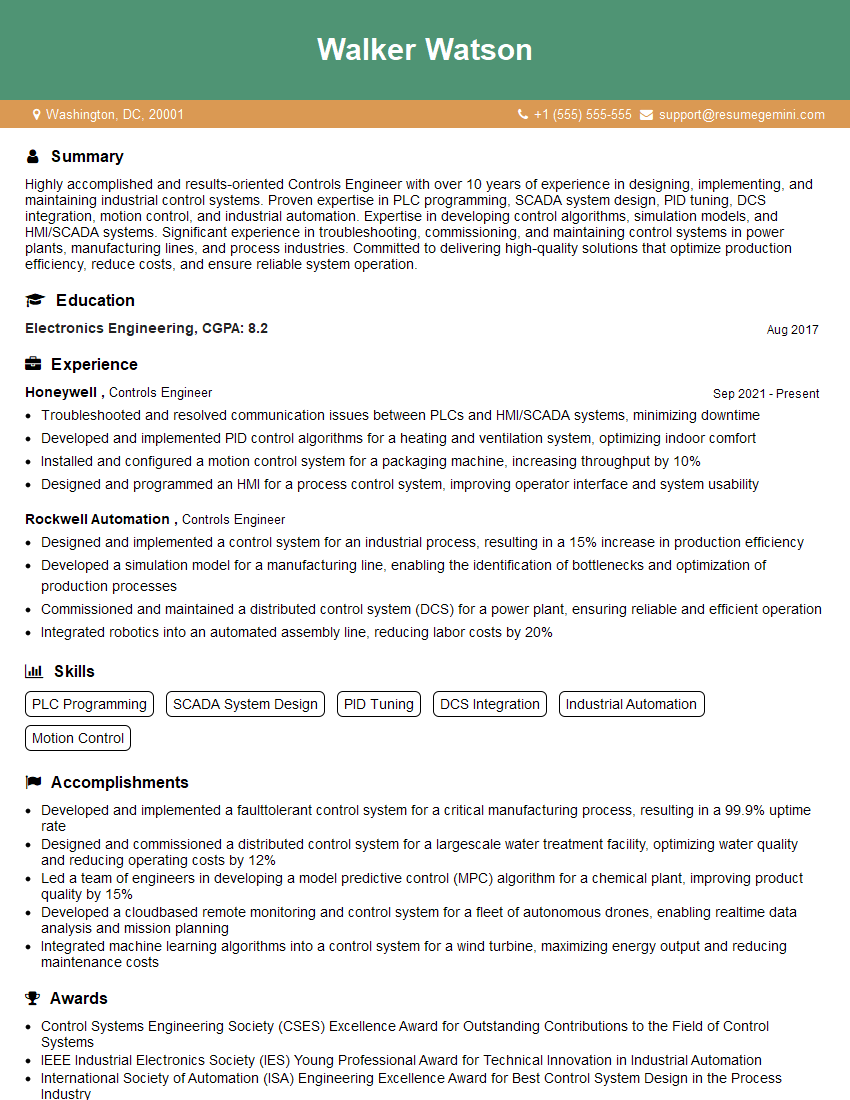
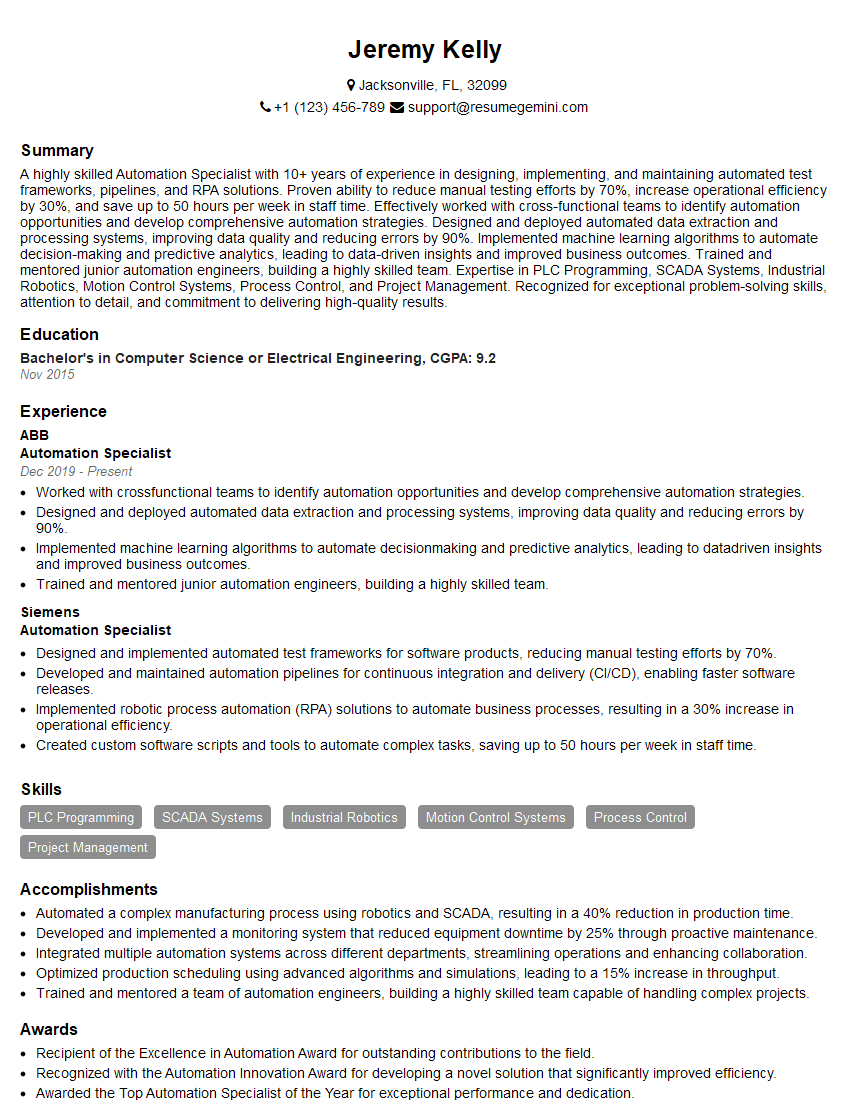
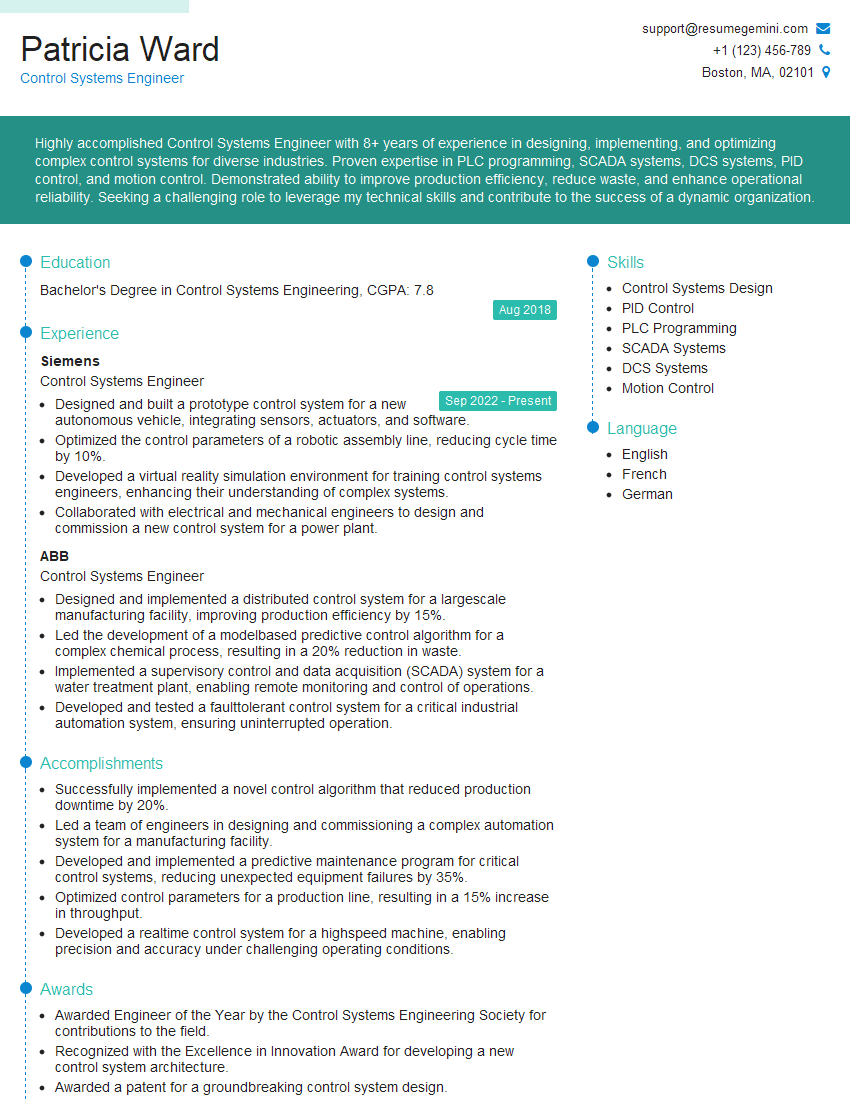
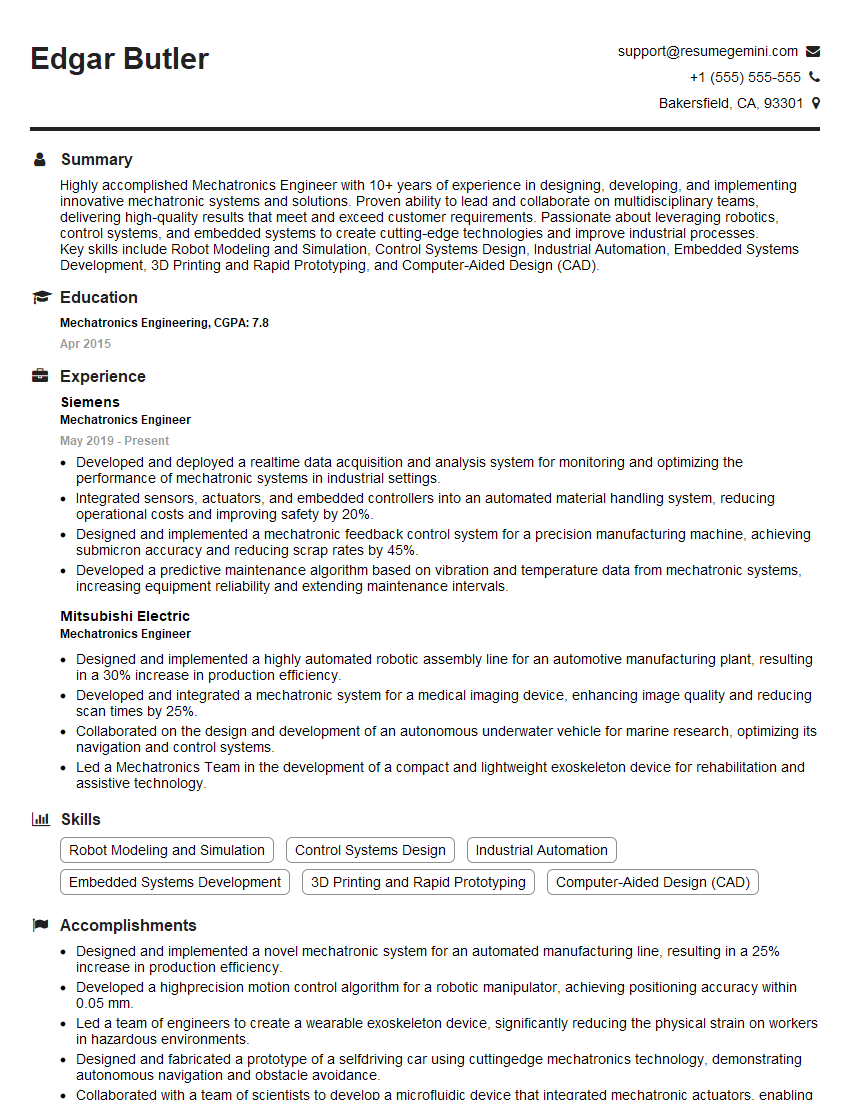
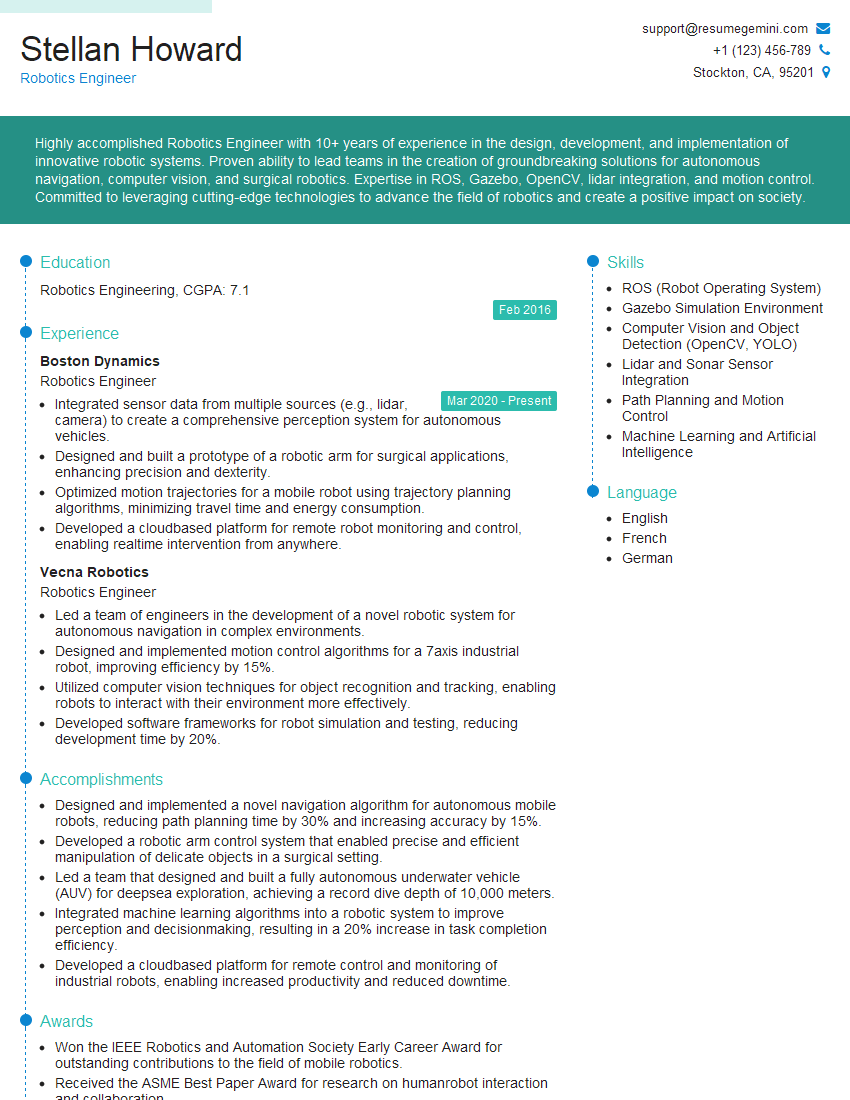
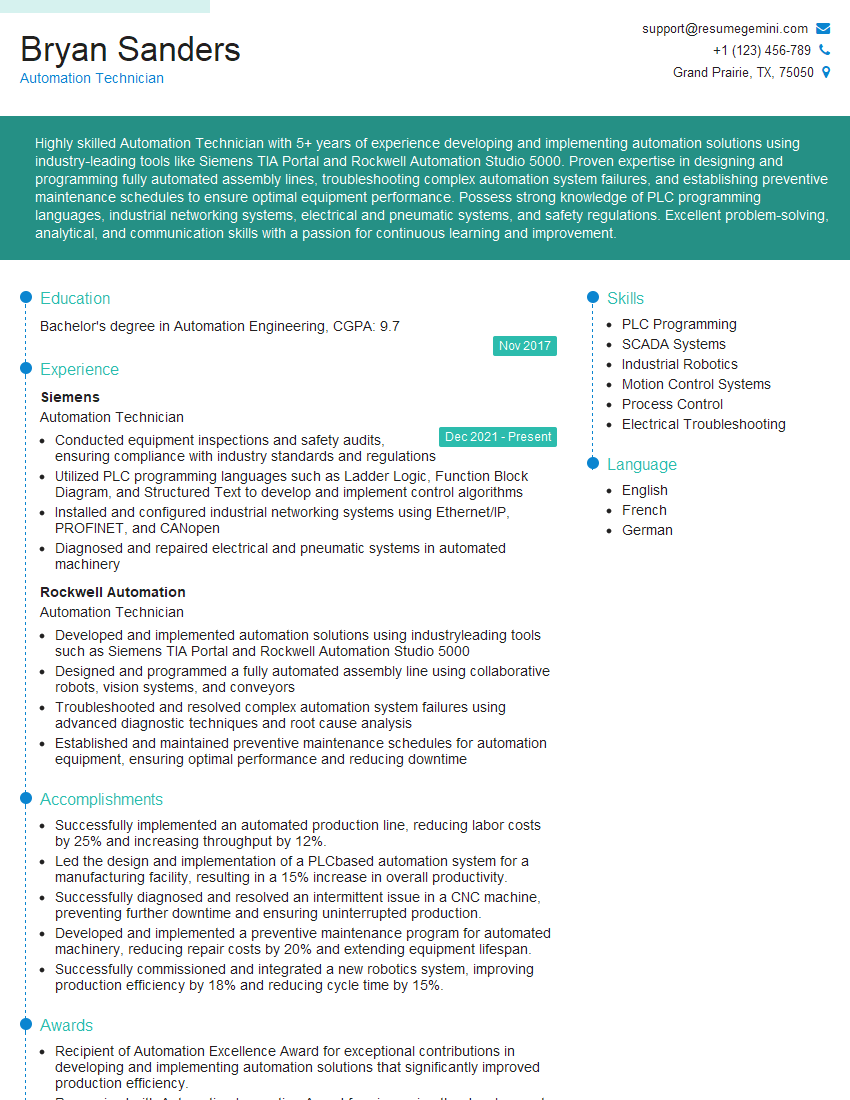
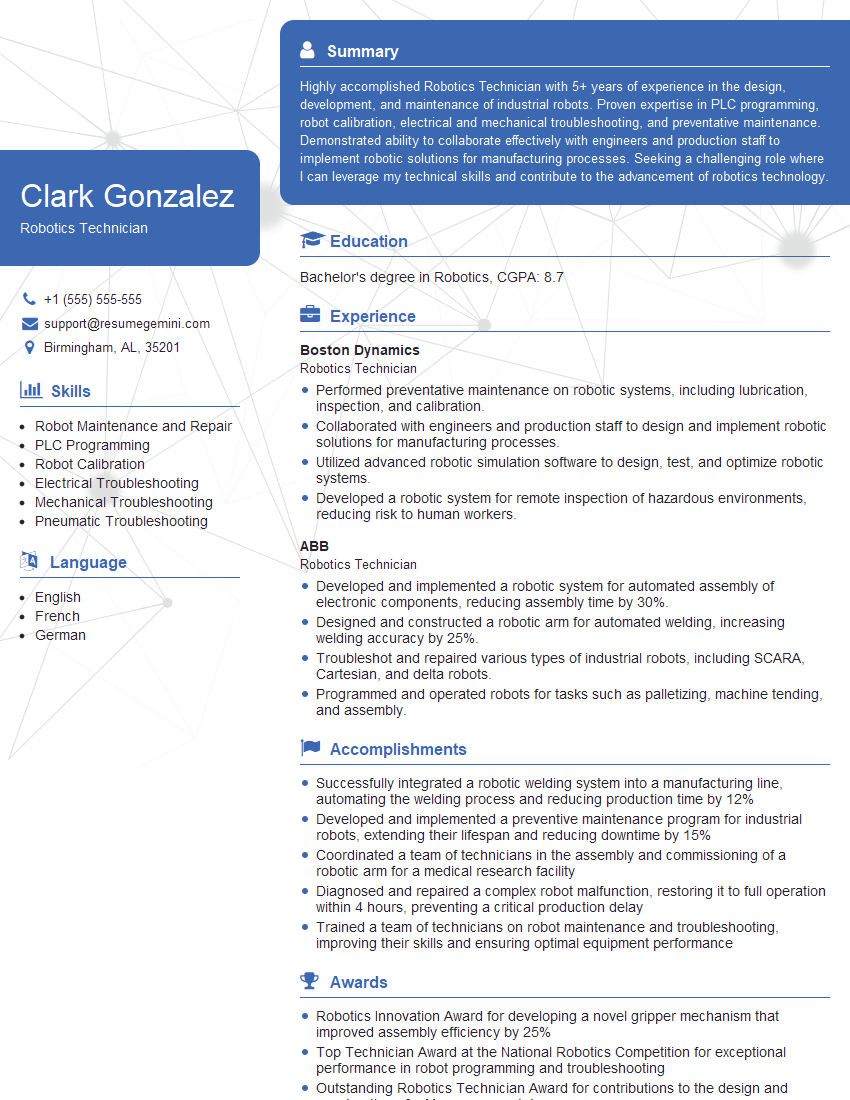
Mastering Manufacturing Automation opens doors to exciting and high-demand roles offering excellent career growth potential. To maximize your job prospects, focus on creating a compelling, ATS-friendly resume that highlights your skills and experience effectively. ResumeGemini is a trusted resource that can help you build a professional resume tailored to the specific requirements of Manufacturing Automation roles. Examples of resumes tailored to this field are available to help you get started. Invest time in crafting a strong resume; it’s your first impression on potential employers.
Explore more articles
Users Rating of Our Blogs
Share Your Experience
We value your feedback! Please rate our content and share your thoughts (optional).
What Readers Say About Our Blog
I Redesigned Spongebob Squarepants and his main characters of my artwork.
https://www.deviantart.com/reimaginesponge/art/Redesigned-Spongebob-characters-1223583608
IT gave me an insight and words to use and be able to think of examples
Hi, I’m Jay, we have a few potential clients that are interested in your services, thought you might be a good fit. I’d love to talk about the details, when do you have time to talk?
Best,
Jay
Founder | CEO