Cracking a skill-specific interview, like one for Map Projections and Datum Transformations, requires understanding the nuances of the role. In this blog, we present the questions you’re most likely to encounter, along with insights into how to answer them effectively. Let’s ensure you’re ready to make a strong impression.
Questions Asked in Map Projections and Datum Transformations Interview
Q 1. Explain the difference between a map projection and a datum.
Imagine trying to flatten a basketball onto a piece of paper. You can’t do it without distortion! That’s essentially what map projections and datums help us manage. A map projection is a systematic method of transforming the three-dimensional surface of the Earth onto a two-dimensional map. This inherently involves distortion, as it’s impossible to perfectly represent a sphere on a flat surface. Different projections prioritize different properties, like area, shape, or distance. A datum, on the other hand, is a reference model of the Earth. It defines the shape and size of the Earth and the location of a starting point (origin) for coordinate systems. Think of it as the underlying framework upon which you build your map projection. The datum determines the coordinates you’ll use to place features on the map.
Q 2. What are the common types of map projections and their characteristics?
There are numerous map projections, each with its strengths and weaknesses. Some common types include:
- Cylindrical projections (e.g., Mercator): These wrap a cylinder around the globe, projecting points from the globe onto the cylinder. They are useful for navigation but greatly distort areas at higher latitudes.
- Conical projections (e.g., Albers Equal-Area): These use a cone to approximate the globe, leading to less distortion in mid-latitudes. They are good for representing areas spanning limited longitude.
- Azimuthal projections (e.g., Gnomonic): These project points onto a plane tangent to the globe at a central point. They are often used for navigation and mapping polar regions. They preserve direction from the center point but distort shape and area further from the center.
- Pseudo-cylindrical projections (e.g., Robinson): These blend characteristics of cylindrical and other projection types to attempt to reduce distortion across a wider area. They are popular for world maps.
The choice of projection depends entirely on the intended use of the map. A map designed for navigation will prioritize accurate directions, while a map showcasing population density might prioritize accurate area representation.
Q 3. Describe the Mercator projection. What are its strengths and weaknesses?
The Mercator projection is a cylindrical projection where the lines of latitude and longitude are projected as parallel straight lines. This maintains correct angles (shapes of small areas), making it ideal for navigation.
Strengths:
- Preserves direction (rhumb lines are straight lines)
- Useful for navigation
- Simple to construct
Weaknesses:
- Severely distorts areas, particularly at higher latitudes (Greenland appears much larger than it actually is).
- Not suitable for global area comparisons.
Think of it as a world map you might see in a classroom – while geographically inaccurate in terms of area, it serves well for showing directions.
Q 4. What is the Transverse Mercator projection and where is it commonly used?
The Transverse Mercator projection is a modified version of the Mercator projection, where the cylinder is rotated 90 degrees. Instead of running along the equator, the cylinder runs along a meridian (line of longitude). This creates minimal distortion along that central meridian.
Common Uses:
- Universal Transverse Mercator (UTM): The UTM system divides the Earth into 60 zones, each with its own Transverse Mercator projection. It’s widely used for large-scale mapping and GIS applications because it minimizes distortion within a zone.
- National mapping systems: Many countries use the Transverse Mercator projection for their national coordinate systems, providing accurate coordinates for a region spanning mostly north-south.
For example, the UTM system is frequently used in surveying and land management, providing accurate coordinates for precise land measurements and boundaries.
Q 5. Explain the concept of a geodetic datum.
A geodetic datum is a reference system that defines the shape and size of the Earth (the ellipsoid) and the origin and orientation of a coordinate system. It’s the foundation upon which geographic coordinates (latitude and longitude) are calculated and referenced. Different datums use different ellipsoids and may have different origins, leading to slight variations in the coordinates of the same location. Imagine a basketball with multiple slightly different molds; each mold creates its own version of the ‘earth’ with slightly different dimensions. The datum tells you which ‘mold’ is being used.
Q 6. What is the difference between WGS84 and NAD83 datums?
WGS84 (World Geodetic System 1984) and NAD83 (North American Datum 1983) are two widely used geodetic datums. While both are designed to represent the Earth’s shape, they differ slightly. WGS84 is a global datum used by GPS, while NAD83 is a North American datum. The key difference lies in their reference ellipsoids and origins. Although they have become very similar over time thanks to improvements in understanding the earth’s shape, slight coordinate discrepancies still exist between them. These discrepancies can be significant enough to cause errors in applications that require high accuracy, such as surveying and navigation. Converting between them often requires a datum transformation.
Q 7. How do you perform a datum transformation?
Performing a datum transformation involves converting coordinates from one datum to another. This is crucial for working with data from different sources, as using incompatible datums will lead to inaccuracies. There are several methods for performing datum transformations, including:
- Grid-based methods: These methods use grids containing shift values between the two datums. You input your coordinates, and the grid provides the corrections needed. This is the most common approach because it’s highly accurate and widely available through tools such as GIS software.
- Parametric methods: These use mathematical formulas to transform the coordinates. They are less common now due to the higher accuracy achieved by grid-based methods.
In practical terms, most GIS software (ArcGIS, QGIS) provides built-in tools for datum transformations. You simply select the source datum, target datum, and your coordinates, and the software automatically performs the transformation using pre-defined grids or formulas.
The choice of method depends on the required accuracy and the availability of transformation grids or parameters for the specific datums involved. Always use high-quality, reliable grids and parameters from trusted sources.
Q 8. What are the common methods for datum transformation?
Datum transformation involves converting coordinates from one geodetic datum to another. A datum defines the size and shape of the Earth (ellipsoid) and the position of that ellipsoid relative to the Earth’s surface. Different datums exist because the Earth isn’t perfectly spherical, and various surveys have yielded slightly different models over time. Common methods include:
Coordinate Frame Transformations (3-parameter, 7-parameter): These methods use a set of parameters (translation, rotation, scale) to mathematically shift and rotate coordinates from one datum to another. A 3-parameter transformation involves shifts along the X, Y, and Z axes, while a 7-parameter transformation adds rotations about these axes and a scale factor. These are relatively simple and fast but can lack accuracy over large areas.
Molodensky-Badekas Transformation: This method accounts for differences in the ellipsoids used by the datums. It’s more precise than 3-parameter transformations and is suitable for smaller regional areas but is more complex computationally.
Grid-based Transformations (e.g., NTv2, NADCON): These methods use pre-computed grids that contain the transformation values for specific locations. Coordinates are interpolated from the grid to determine the transformed values. These provide high accuracy, especially for regional transformations, but require large grid files and might not be suitable for global transformations. Examples include NADCON (North American Datum transformations) and NTv2 (used in many parts of the world).
Polynomial Transformations: More complex transformations, frequently used for high-accuracy applications where other methods fall short. These use polynomial equations to model the transformation, often requiring many control points.
The choice of method depends on the required accuracy, the extent of the area, and the availability of transformation parameters or grid data.
Q 9. Describe the process of projecting data from one coordinate system to another.
Projecting data from one coordinate system to another involves converting coordinates from a 3D geographic coordinate system (latitude and longitude) to a 2D projected coordinate system (e.g., UTM, State Plane). This process involves:
Defining the source and target coordinate systems: This includes specifying the datum, projection type, and parameters (e.g., central meridian, standard parallels) for both systems.
Transforming the coordinates (if necessary): If the source and target coordinate systems use different datums, a datum transformation must be performed first, using one of the methods described in the previous answer.
Applying the map projection: This step uses mathematical formulas specific to the chosen projection to transform the latitude and longitude coordinates into the 2D projected coordinates (x, y).
Applying any necessary scaling or units conversion: This ensures that the projected coordinates are in the desired units (e.g., meters, feet).
Consider a scenario where you have GPS data in WGS84 latitude/longitude and need to display it on a map using the UTM projection. You’d first ensure that your software understands both systems, and then it will internally perform the conversion. The specifics of the mathematical formulas are handled by the software or library used.
Q 10. What software or tools are you familiar with for map projections and datum transformations?
I’m proficient in several software packages and tools for map projections and datum transformations. These include:
GIS Software: ArcGIS Pro, QGIS (open-source), and MapInfo Pro are my go-to tools. These provide comprehensive capabilities for handling various coordinate systems, projections, and transformations, often with built-in tools or extensions.
Programming Languages and Libraries: I have experience using Python with libraries like GDAL/OGR and PROJ for handling spatial data and performing projections and transformations programmatically. This allows for automation and customization beyond what is available in standard GUI-based software.
Specialized Geospatial Tools: Depending on the complexity of the task, specialized tools such as Coordinate Transformation software or online services might be employed. These can offer high-accuracy transformations or access to specific datum grids.
My selection of tools depends on the project scope and the level of automation required. For large datasets and complex operations, a combination of programming and GIS software often offers the most efficient and flexible workflow.
Q 11. Explain the concept of map scale and its importance in map projections.
Map scale represents the ratio between a distance on a map and the corresponding distance on the ground. It’s crucial for map projections because it directly influences the level of detail and the accuracy of spatial measurements. The scale can be represented as a ratio (e.g., 1:100,000), a fraction (1/100,000), or a statement (e.g., ‘1 cm = 1 km’).
A large-scale map (e.g., 1:10,000) shows a small area with great detail, while a small-scale map (e.g., 1:1,000,000) covers a large area but with less detail. Map projections inherently distort distances, areas, shapes, and directions, and the choice of projection and the scale of the map should be carefully considered to minimize distortions and ensure the map’s intended use.
For example, a large-scale topographic map might require a projection that minimizes distortion within a small area, while a world map needs a projection that balances the distortions over a vast globe.
Q 12. How do distortions occur in map projections, and how are they minimized?
Distortions in map projections arise because it’s impossible to perfectly represent a 3D curved surface (the Earth) onto a 2D plane without some form of deformation. Four main types of distortion occur:
Shape (conformal): Distortion of angles and shapes. Conformal projections preserve angles, ensuring that shapes are accurately represented at small scales, while other projections may have significant shape distortions.
Area (equal-area): Distortion of area. Equal-area projections accurately represent the relative areas of features but often distort shapes.
Distance (equidistant): Distortion of distance. Equidistant projections preserve distances along certain lines (e.g., from a central point), but distances may be distorted elsewhere.
Direction (azimuthal): Distortion of direction. Azimuthal projections accurately depict directions from a central point, but directions may be distorted at other locations.
Minimizing distortions involves selecting the appropriate projection for the specific application. For example, a Mercator projection, while useful for navigation, significantly exaggerates areas at higher latitudes. An equal-area projection like Albers Equal-Area Conic is suitable when accurate area representation is paramount, but it will distort shapes. The best approach is to understand the inherent limitations of each projection and choose the one that best minimizes the most critical distortions for your specific needs.
Q 13. What are the implications of using an incorrect datum or projection?
Using an incorrect datum or projection can lead to significant inaccuracies in spatial analysis, measurement, and location determination. The implications can range from minor inconveniences to substantial errors with serious consequences:
Inaccurate measurements: Distances, areas, and angles calculated using incorrectly projected data will be wrong.
Mislocation of features: Features may appear in the wrong place on a map, leading to potential errors in planning, resource management, or infrastructure development.
Errors in spatial analysis: Results from spatial analysis (e.g., overlay analysis, proximity analysis) will be unreliable and potentially misleading.
Safety concerns: Inaccurate positioning data can have serious safety implications in applications like navigation, emergency response, or surveying.
Legal issues: Inaccurate land boundaries due to incorrect datum or projection can lead to property disputes and legal issues.
For instance, using a local datum in a large-scale project without considering its transformation to a global datum like WGS84 could lead to significant errors in positioning and area calculations.
Q 14. How would you handle discrepancies in data from different coordinate systems?
Handling discrepancies in data from different coordinate systems involves a multi-step process:
Identify the coordinate systems: Determine the datum, projection, and units for each dataset. This information is usually found in metadata or data documentation.
Transform data to a common coordinate system: Choose a suitable coordinate system (often a common datum like WGS84 and a suitable projection). Then, transform all datasets to this common system using appropriate datum transformations and map projections.
Assess the accuracy of the transformations: Compare the transformed data to known ground control points or other high-accuracy data to assess the accuracy of the transformations and identify potential errors.
Resolve inconsistencies: If inconsistencies remain, investigate the source of the errors. These could stem from inaccurate original data, errors in the transformation parameters, or limitations in the transformation methods employed.
Document the process and results: Clearly document the coordinate systems, transformations used, and the resulting accuracy to ensure reproducibility and transparency.
Imagine you’re merging data from an old state plane coordinate system with a more recent GPS data in WGS84. You’d first transform the old data to WGS84 using an appropriate transformation method. Careful consideration of potential errors and thorough documentation are crucial for avoiding misinterpretations or incorrect conclusions.
Q 15. Explain the concept of geographic coordinate systems and projected coordinate systems.
Geographic Coordinate Systems (GCS) and Projected Coordinate Systems (PCS) are fundamental concepts in representing locations on the Earth’s surface. A GCS uses a three-dimensional spherical coordinate system (latitude, longitude, and height) to define a point’s position relative to a reference ellipsoid (a mathematical approximation of the Earth’s shape). Think of it as the Earth’s address in its natural form – latitude and longitude pinpointing a location globally.
A PCS, on the other hand, transforms those spherical coordinates into a two-dimensional plane. This projection is essential for creating maps because we can’t directly flatten the Earth’s curved surface onto a flat piece of paper without distortion. Different map projections use different mathematical formulas to achieve this transformation, each with its own strengths and weaknesses. A PCS gives you a ‘flattened’ address, suitable for use in maps and many GIS applications.
For example, a location might be described in a GCS as Latitude: 34.0522° N, Longitude: 118.2437° W. This same location would have different coordinates in a PCS depending on the projection used, potentially something like x = 650000, y = 3700000 in a UTM zone.
Career Expert Tips:
- Ace those interviews! Prepare effectively by reviewing the Top 50 Most Common Interview Questions on ResumeGemini.
- Navigate your job search with confidence! Explore a wide range of Career Tips on ResumeGemini. Learn about common challenges and recommendations to overcome them.
- Craft the perfect resume! Master the Art of Resume Writing with ResumeGemini’s guide. Showcase your unique qualifications and achievements effectively.
- Don’t miss out on holiday savings! Build your dream resume with ResumeGemini’s ATS optimized templates.
Q 16. What is a spheroid, and why is it important in map projections?
A spheroid is a mathematical model of the Earth’s shape, approximating the slightly flattened sphere. It’s an oblate spheroid, meaning it bulges at the equator and is flattened at the poles. Its importance in map projections is paramount because it forms the foundation for the coordinate system. Map projections use the spheroid’s dimensions (semi-major and semi-minor axes) to calculate the transformation from 3D spherical coordinates to 2D planar coordinates.
Different spheroids exist, each reflecting different models of the Earth’s shape and size. Choosing the right spheroid for a specific area is crucial for accuracy. For example, using a spheroid optimized for North America in a map of Australia would introduce significant errors. The spheroid’s accuracy directly impacts the accuracy of the resulting map and coordinate data.
Q 17. What is the difference between a local and a global coordinate system?
The key difference between local and global coordinate systems lies in their spatial extent and application. A global coordinate system, like latitude and longitude, covers the entire Earth. It’s a universal reference system, irrespective of location. This is useful for globally distributed data. Latitude and longitude form a natural global coordinate system.
A local coordinate system, on the other hand, is confined to a smaller, specific area. It’s often used for engineering projects, land surveying, or local mapping initiatives. Its origin and orientation are arbitrarily defined for a specific area, simplifying calculations and reducing coordinate values’ magnitude. The State Plane Coordinate System (SPCS) in the US is an example of a local system optimized for smaller areas. It uses different projections depending on the geographic region for improved accuracy within that region.
Imagine you need to map a small city – a local coordinate system is much more efficient and less prone to rounding errors compared to using a global system where the coordinates are numerically very large.
Q 18. Describe the UTM coordinate system.
The Universal Transverse Mercator (UTM) coordinate system is a widely used projected coordinate system based on the Transverse Mercator projection. It divides the Earth into 60 longitudinal zones, each 6 degrees wide, covering the entire globe (excluding the polar regions). Within each zone, the UTM projection maps the Earth’s surface onto a plane using a cylindrical projection, minimizing distortion.
Each UTM zone has its own central meridian, and coordinates are expressed in Easting (x-coordinate, distance east of the central meridian) and Northing (y-coordinate, distance north of the equator). The units are typically meters. This system offers a compromise between global coverage and local accuracy. While distortion increases as you move away from the central meridian, it remains manageable within each 6-degree zone. A significant advantage of UTM is that it’s a metric system, so measurements of distance are straightforward.
For example, a coordinate within a UTM zone might be represented as Zone 16N, Easting: 500000 meters, Northing: 4000000 meters. The ‘N’ denotes the northern hemisphere.
Q 19. What are the limitations of using a single map projection for a large area?
Using a single map projection for a large area introduces significant distortions, particularly in shape, area, and distance. This is because it’s impossible to accurately represent a curved surface on a flat plane without some form of compromise. The larger the area, the greater these distortions become.
For example, a Mercator projection, while excellent for navigation, severely exaggerates areas near the poles, making Greenland appear much larger than South America when in reality, South America’s area is significantly larger. Using this projection for a global map would result in highly inaccurate area calculations, making it unsuitable for applications that require precise area measurements. Consequently, for large areas, a mosaic of multiple map projections tailored to smaller zones is usually preferred to maintain accuracy.
Q 20. How do you choose the appropriate map projection for a specific application?
Choosing the appropriate map projection involves considering several factors specific to the application:
- Area of interest: The size and location of the area will determine the appropriate projection type and the potential distortions to expect.
- Purpose of the map: What information is being portrayed? If navigation is key, a projection preserving shape (like Mercator) is crucial. If area comparisons are the priority, an equal-area projection is needed. A thematic map showcasing population densities, for instance, might use an equal-area projection.
- Scale: The map scale dictates the acceptable level of distortion. Larger scale maps can often tolerate slightly more distortion as the detail is higher.
- Desired properties: What properties need to be preserved? Is shape, area, distance, or direction more important? No projection perfectly preserves all properties. For example, a map focused on land surveying might require high accuracy in distance measurement, while a world map showing countries might prioritize the preservation of area.
Often, there’s a trade-off involved. For instance, preserving shapes might lead to area distortions, and vice-versa. The selection process requires a careful assessment of project requirements to identify the most suitable compromise.
Q 21. What is a geoid, and how does it relate to a datum?
A geoid is a model of the Earth’s shape based on mean sea level. Imagine extending the mean sea level globally, considering gravitational variations. This undulating surface is the geoid. It’s a complex, irregular shape reflecting the uneven distribution of mass within the Earth.
A datum is a reference system that defines the position of the spheroid relative to the Earth. It essentially anchors the coordinate system to the Earth. Different datums use different spheroids and reference points, resulting in slight variations in coordinate values between datums. The geoid plays a crucial role in defining the vertical component of a datum, establishing a consistent reference for height measurements. A precise geoid model helps accurately convert ellipsoidal height (height above the spheroid) to orthometric height (height above the geoid), which is more relevant for many applications like flood modeling.
Think of it this way: the spheroid is a mathematical best-fit shape, while the geoid represents the actual equipotential surface of gravity. The datum relates the two, bridging the gap between the mathematical model and the real-world variations in the Earth’s gravity field.
Q 22. Explain the concept of ellipsoidal height versus orthometric height.
Ellipsoidal height and orthometric height both represent elevation, but they do so relative to different surfaces. Think of it like this: imagine the Earth as a slightly squashed ball (the ellipsoid). Ellipsoidal height measures your elevation directly above the ellipsoid’s surface. It’s like measuring your height from the ground if the ground was perfectly smooth and followed the shape of that squashed ball. Orthometric height, however, measures your height above the geoid. The geoid is an equipotential surface – imagine it as the average sea level extended over the continents. It’s a more complex surface that reflects the gravitational pull of the Earth, meaning it’s bumpy and uneven.
The difference is crucial because the geoid is a more accurate representation of the actual, physical Earth’s surface. Ellipsoidal height is simpler to calculate and use but can lead to discrepancies when comparing elevations across different locations. Orthometric height provides a more accurate representation of true height above mean sea level, essential for things like flood modeling or determining the vertical accuracy of a specific point.
Q 23. Discuss the challenges of working with different vertical datums.
Working with different vertical datums presents several challenges. Vertical datums define the reference surface for elevation measurements, and inconsistencies between them lead to inaccurate comparisons and data integration problems. For example, using data from one vertical datum (like NAVD88 in the US) and combining it with data from another (like the Australian Height Datum) without proper transformation will lead to errors in elevation, potentially affecting construction projects, hydrological modeling, or even flight paths.
These challenges stem from the fact that vertical datums are defined differently across regions and can change over time due to factors such as tectonic plate movement and improved geodetic survey techniques. This means that a point with the same geographic coordinates will have different elevation values depending on the applied vertical datum. Transforming between vertical datums requires specialized software and precise geodetic models to ensure accuracy. Moreover, reliable transformation models might not be readily available for all datum pairings, further complicating the process.
Q 24. What is the role of metadata in map projections and datum transformations?
Metadata plays a vital role in managing map projections and datum transformations. It acts as a passport for spatial data, providing crucial information about its origin, coordinate system, and transformations applied. Without comprehensive metadata, datasets become ambiguous, untrustworthy, and difficult to integrate. Think of it as the label on a food item; without it, you don’t know the ingredients, expiration date, or even if it’s safe to consume!
Specific metadata elements include the projection name (e.g., UTM, Albers), the parameters defining the projection, the datum (e.g., WGS84, NAD83), the units (e.g., meters, feet), and details on any transformations performed. Using standardized metadata formats like ISO 19115 ensures interoperability and allows software and users to readily interpret the data’s properties. This makes it possible to automate transformations and analysis, ultimately improving efficiency and reducing errors.
Q 25. How can you ensure data accuracy and consistency when dealing with different coordinate systems?
Ensuring data accuracy and consistency when working with different coordinate systems is paramount. The key lies in a methodical approach. First, clearly identify all the coordinate systems involved in your project. Next, employ appropriate datum transformations using reliable software and models. Many GIS software packages offer built-in tools for coordinate system conversions, but always verify the accuracy of these transformations.
It’s vital to understand the limitations of any transformation – no method is perfect. Choose the transformation most appropriate for your data’s geographic extent and the required accuracy. Always document the transformations applied in the metadata to ensure future users understand the data’s history and potential limitations. Regular data quality checks, including visual inspection and comparison with trusted data sources, are also essential to detect any discrepancies or errors early on. Finally, adopting a strict workflow ensures consistency and traceability, making it easier to identify and correct errors if they occur.
Q 26. Describe a situation where you had to troubleshoot a problem related to map projections or datum transformations.
During a large-scale infrastructure project, we encountered inconsistencies in elevation data derived from different LiDAR surveys. One dataset used NAVD88, while another utilized a legacy vertical datum. This led to significant discrepancies in planned drainage systems. The initial approach involved directly combining the datasets, leading to errors in the design.
To troubleshoot, we first meticulously reviewed the metadata of both datasets, pinpointing the exact vertical datums. Next, we used a specialized geodetic software package to transform one dataset to the common datum (NAVD88). We then performed rigorous quality checks by comparing transformed data with ground control points. Finally, after successfully transforming and validating the data, we recalculated the drainage system design, resolving the initial inconsistencies. This experience highlighted the critical importance of understanding and handling different vertical datums to avoid costly mistakes.
Q 27. What are your preferred resources for learning more about map projections and datum transformations?
My preferred resources for learning about map projections and datum transformations include textbooks such as ‘Map Projections: A Working Manual’ by John P. Snyder and ‘Geospatial Data Science with Python’ by Dr. Paul Ramsey. These resources provide foundational knowledge and practical examples. Additionally, I frequently consult online resources such as the websites of national mapping agencies (like the USGS in the US or Ordnance Survey in the UK) which contain detailed information about their datums and coordinate systems. Finally, participation in professional organizations like the American Congress on Surveying and Mapping (ACSM) provides access to workshops, publications, and networking opportunities for continued learning.
Q 28. What are some future trends in map projection and datum technology?
Several future trends are shaping map projection and datum technology. The increasing use of global navigation satellite systems (GNSS) is leading to more precise and readily available geospatial data. Advancements in computing power and algorithmic efficiency are allowing for real-time transformations and more sophisticated modeling of the Earth’s geoid. The development and adoption of new, improved datums are also underway, aiming to accommodate ongoing tectonic changes and provide better accuracy.
Furthermore, the integration of AI and machine learning holds the potential to automate aspects of datum transformation and projection selection, increasing efficiency and improving accuracy. Finally, the growing emphasis on open-source geospatial data and software is fostering innovation and making these powerful technologies more accessible to a broader community.
Key Topics to Learn for Map Projections and Datum Transformations Interview
- Map Projections: Fundamentals: Understanding the limitations of representing a 3D sphere on a 2D plane; comparing different projection types (e.g., cylindrical, conical, azimuthal); analyzing projection properties (e.g., area, shape, distance preservation).
- Datum Transformations: Core Concepts: Defining datums and their role in geospatial referencing; explaining the difference between horizontal and vertical datums; understanding coordinate systems and their transformations (e.g., NAD83 to WGS84).
- Practical Applications: GIS and Remote Sensing: Applying projection and datum transformations in GIS software; using transformations for data integration and analysis; handling real-world scenarios involving different coordinate systems and datums.
- Error Analysis and Mitigation: Identifying sources of error in projections and transformations; evaluating the accuracy of transformed data; implementing strategies to minimize error propagation.
- Software and Tools: Familiarity with GIS software (e.g., ArcGIS, QGIS) and their functionalities related to projections and transformations; understanding the use of coordinate transformation tools and libraries.
- Advanced Topics (for Senior Roles): Geodetic considerations; understanding map projection parameters; experience with custom projection development or adaptation.
Next Steps
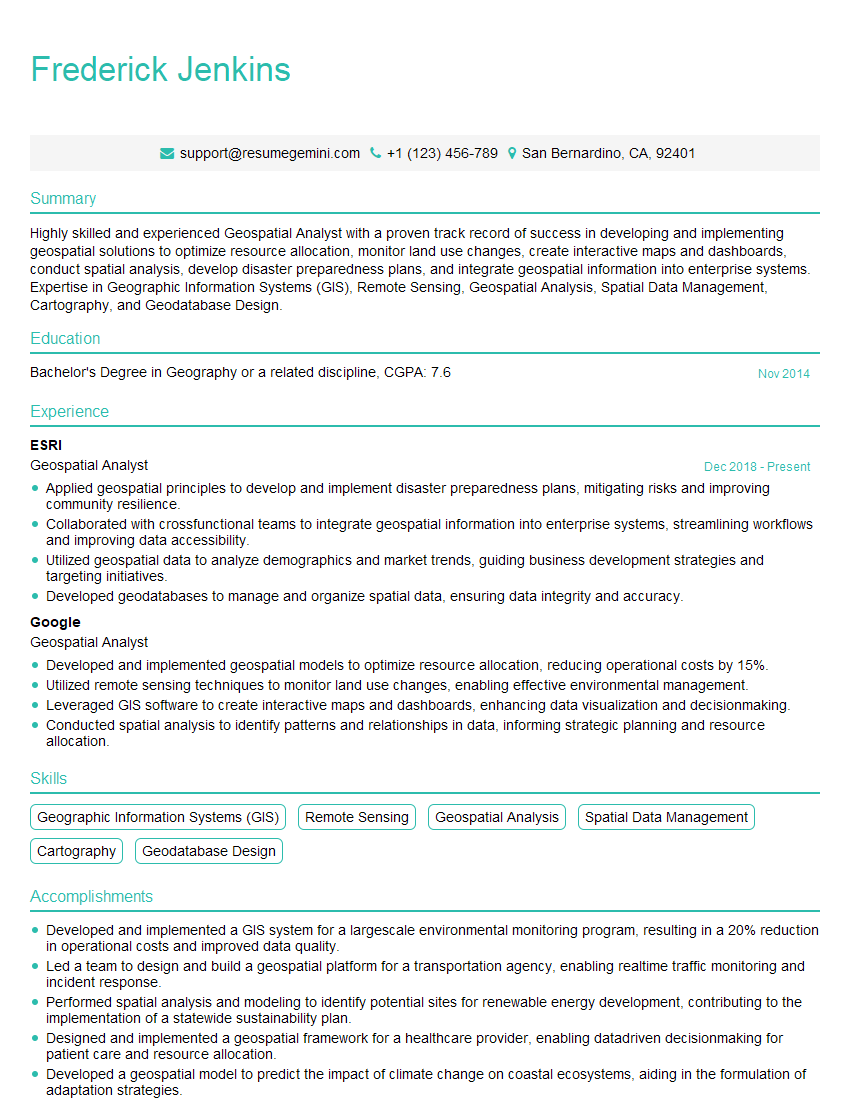
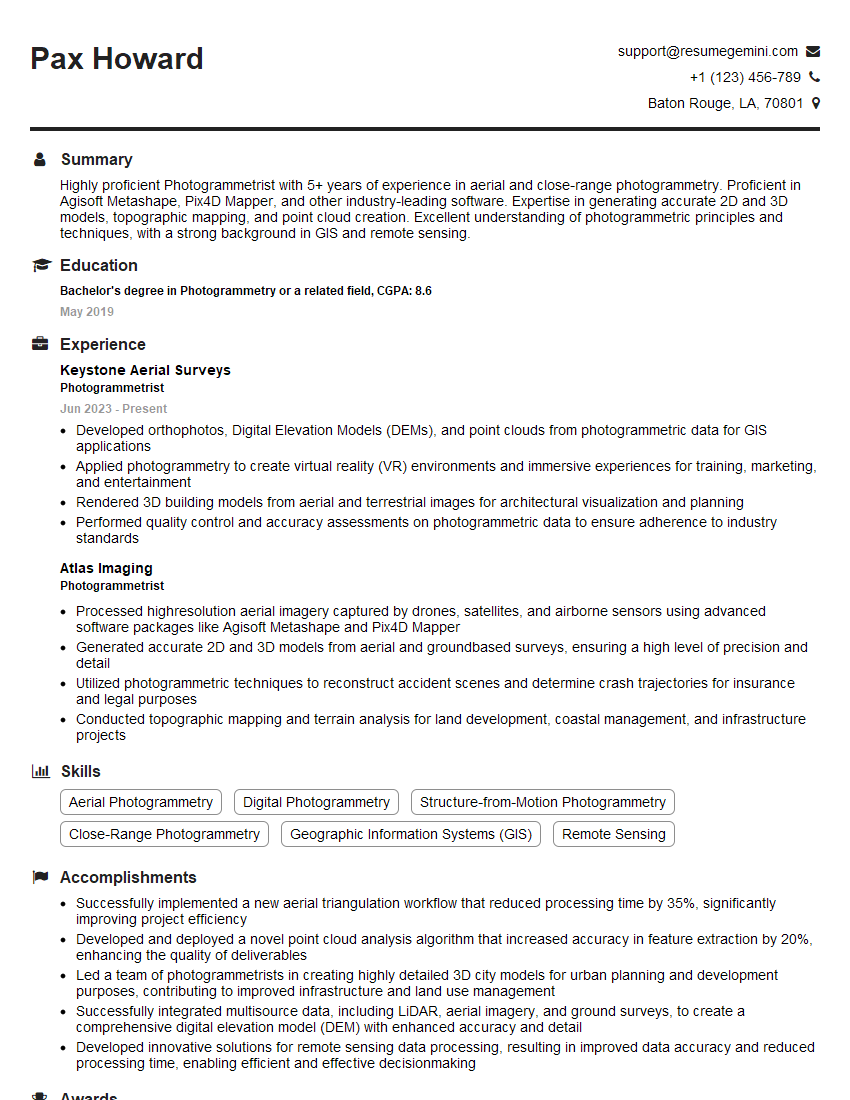
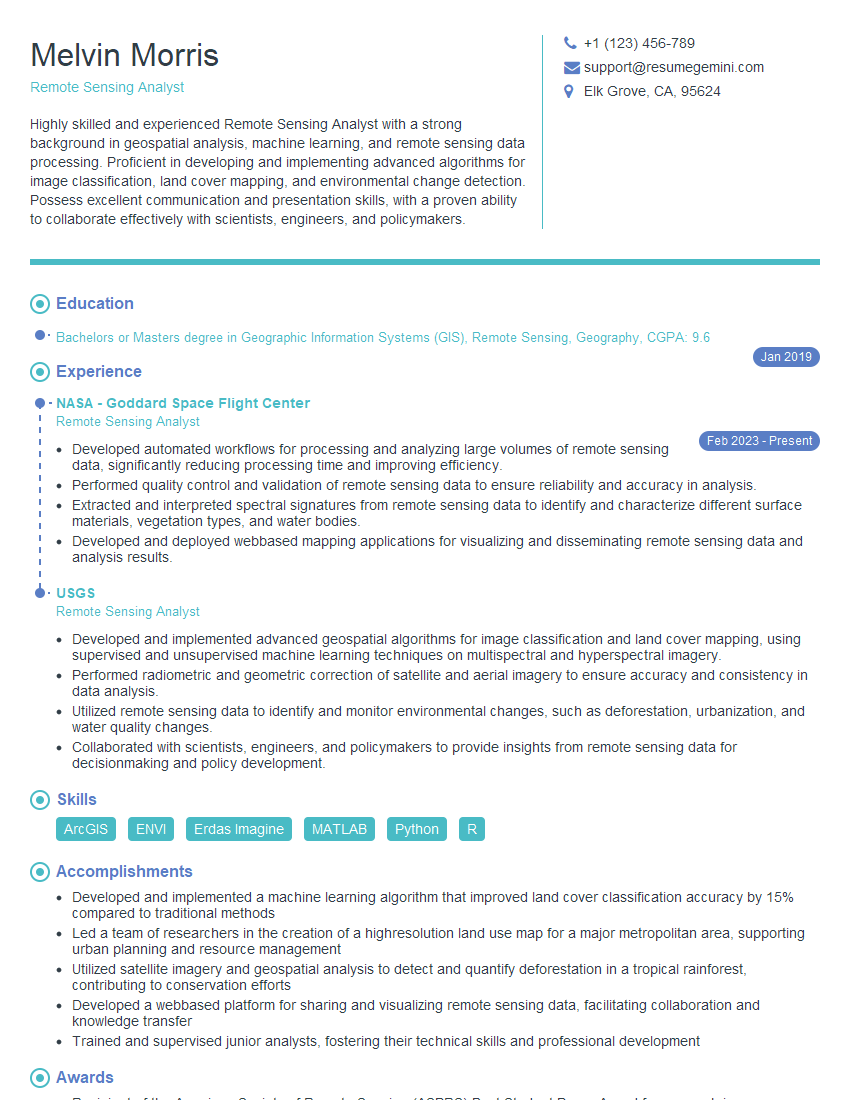
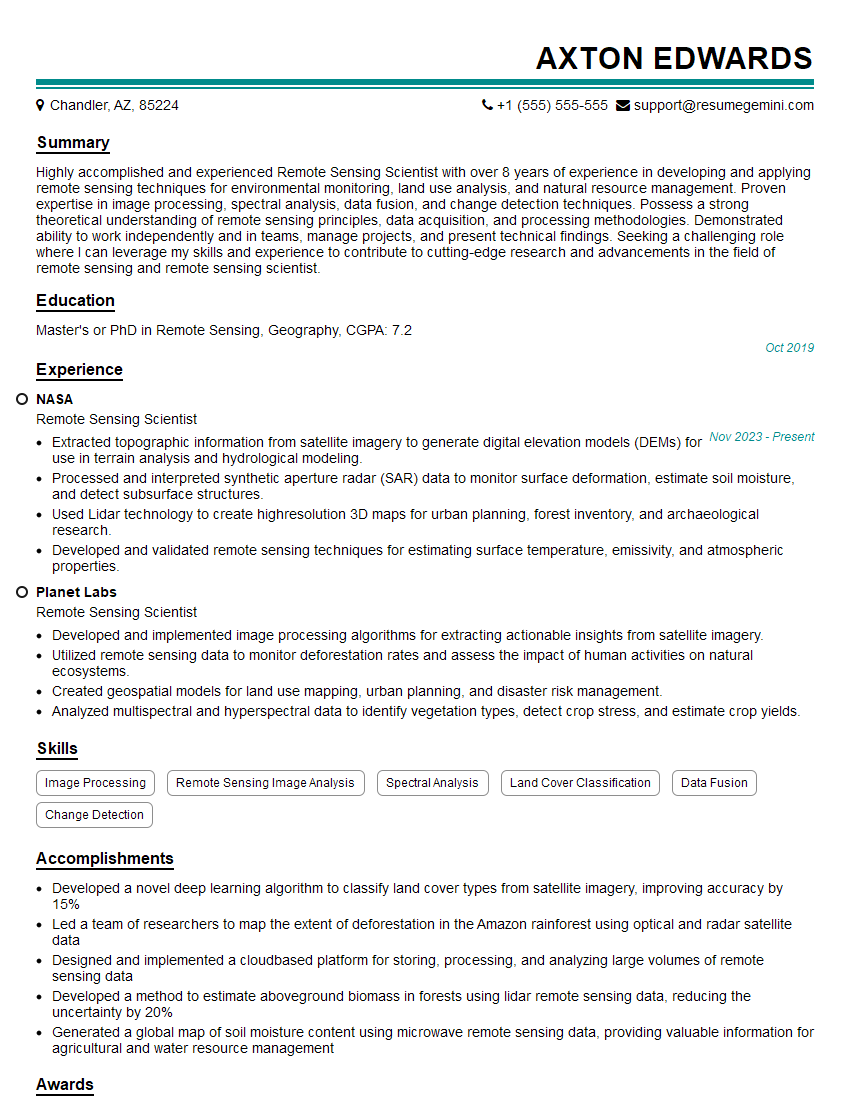
Mastering Map Projections and Datum Transformations is crucial for career advancement in fields like GIS, remote sensing, surveying, and cartography. A strong understanding of these concepts significantly enhances your problem-solving abilities and opens doors to exciting opportunities. To maximize your job prospects, creating an ATS-friendly resume is essential. ResumeGemini is a trusted resource that can help you build a professional and impactful resume, showcasing your expertise effectively. Examples of resumes tailored to Map Projections and Datum Transformations are available to help you craft a compelling narrative of your skills and experience.


Explore more articles
Users Rating of Our Blogs
Share Your Experience
We value your feedback! Please rate our content and share your thoughts (optional).
What Readers Say About Our Blog
I Redesigned Spongebob Squarepants and his main characters of my artwork.
https://www.deviantart.com/reimaginesponge/art/Redesigned-Spongebob-characters-1223583608
IT gave me an insight and words to use and be able to think of examples
Hi, I’m Jay, we have a few potential clients that are interested in your services, thought you might be a good fit. I’d love to talk about the details, when do you have time to talk?
Best,
Jay
Founder | CEO