The right preparation can turn an interview into an opportunity to showcase your expertise. This guide to Marine Claims Investigation interview questions is your ultimate resource, providing key insights and tips to help you ace your responses and stand out as a top candidate.
Questions Asked in Marine Claims Investigation Interview
Q 1. Explain the process of investigating a marine cargo claim.
Investigating a marine cargo claim is a meticulous process that requires a systematic approach. It begins with receiving the claim notification, usually from the cargo owner or their insurer. We then gather all relevant documentation, including the bill of lading, commercial invoice, packing list, certificate of insurance, and any other pertinent documents. This stage is crucial as it forms the foundation of our investigation.
Next, we conduct a thorough examination of the alleged damage or loss. This might involve inspecting the cargo itself, if possible, or reviewing photographs, surveys, and other evidence. We interview all relevant parties, including the shipper, consignee, carrier, and port authorities, to collect statements and gather different perspectives on the events leading to the claim.
The analysis phase involves comparing the evidence gathered against the terms of the contract of carriage and the relevant insurance policy. We look for inconsistencies, discrepancies, and any potential contributing factors that may have led to the damage or loss. This may include issues with packaging, improper handling, stowage, or even unforeseen perils at sea.
Finally, we prepare a detailed report summarizing our findings and conclusions. This report includes our assessment of liability and a recommendation regarding compensation. The entire process requires meticulous attention to detail and a deep understanding of maritime law, insurance policies, and the intricacies of international trade.
Example: Imagine a shipment of electronics damaged by seawater during a storm. We would investigate the adequacy of the packaging, the vessel’s seaworthiness, the master’s actions during the storm, and whether the damage was a result of inherent vice (a defect in the goods themselves) or an insured peril.
Q 2. Describe your experience with various types of marine insurance policies (e.g., Hull & Machinery, Cargo, P&I).
My experience spans a wide range of marine insurance policies. I’ve handled numerous claims under Hull & Machinery (H&M) policies, which cover damage to the vessel itself, including machinery breakdown, collisions, and grounding. I’m also proficient in Cargo insurance, which protects the goods being shipped from loss or damage. This includes various types of cargo insurance, such as Institute Cargo Clauses (A, B, and C), which offer different levels of coverage.
Furthermore, I have extensive experience with Protection and Indemnity (P&I) insurance. P&I covers liabilities faced by shipowners, such as third-party claims for cargo damage, personal injury, pollution, and collision liability. I have handled claims involving collisions, groundings, and pollution incidents, needing a thorough understanding of maritime law and international conventions like the CLC and the Bunker Convention.
Understanding the nuances of each policy is critical in determining coverage, assessing liability, and fairly resolving claims. Each policy has its specific exclusions and conditions, which necessitate a thorough and careful review during the investigation process.
Q 3. How do you determine liability in a marine casualty?
Determining liability in a marine casualty is a complex process requiring a careful analysis of all available evidence and a strong understanding of maritime law. We use a variety of legal principles, such as negligence, fault, and contributory negligence. The burden of proof often rests on the party alleging negligence.
We examine the facts surrounding the incident to establish who was at fault and to what extent. This may involve analyzing navigational records, witness statements, weather reports, and expert opinions. International regulations and conventions, such as the Collision Regulations (COLREGs), play a crucial role in determining liability.
Example: In a collision case, we might analyze the actions of both vessels involved, considering factors such as speed, course, visibility, and the application of COLREGs. If one vessel acted negligently, leading to the collision, it will be held primarily liable. However, if both vessels contributed to the accident, liability may be apportioned between them. This often requires expert nautical analysis to establish the sequence of events and determine culpability.
Moreover, we consider contractual obligations, such as charter parties and bills of lading, which may specify liability clauses. The entire process demands a nuanced understanding of both the factual circumstances and the relevant legal frameworks.
Q 4. What are the key elements of a marine survey report?
A marine survey report is a crucial document in marine claims investigation. It provides an objective account of the condition of a vessel, cargo, or other marine property. Its key elements include:
- Identifying information: The report should clearly identify the vessel, cargo, or property being surveyed, along with the date, time, and location of the survey.
- Scope of the survey: A clear statement of the purpose of the survey and the specific areas or aspects to be examined.
- Methodology: A description of the methods and techniques used during the survey, including any specialized equipment employed.
- Findings: A detailed and objective description of the surveyor’s findings, including photographs, sketches, and measurements. This section should be factual and avoid subjective opinions or conclusions.
- Conclusions and opinions: The surveyor’s conclusions based on their findings, including any opinions regarding the cause of damage, the extent of the damage, or the cost of repairs.
- Recommendations: Any recommendations regarding further action, such as repairs, salvage, or disposal.
- Surveyor’s credentials: The qualifications and experience of the surveyor conducting the investigation.
The report must be clear, concise, and well-organized to facilitate understanding and avoid ambiguity. Credibility and objectivity are paramount in ensuring the report’s value in the claims process.
Q 5. How familiar are you with the Institute Clauses?
I am very familiar with the Institute Clauses. These are standardized clauses used in marine insurance policies, providing a common framework for defining coverage and exclusions. They are widely accepted and understood in the international marine insurance market. The most common Institute Clauses are those relating to cargo insurance (Institute Cargo Clauses A, B, and C), each offering a different level of coverage.
Institute Cargo Clauses A provide the broadest coverage, including almost all risks of loss or damage except for those specifically excluded. Institute Cargo Clauses B cover a more limited range of risks, excluding, for example, inherent vice and some types of wear and tear. Institute Cargo Clauses C provide the narrowest coverage, essentially covering only loss or damage caused by specific named perils, such as fire, stranding, or collision.
My experience includes interpreting and applying these clauses in numerous claims, understanding their subtleties and nuances to determine coverage appropriately. I also frequently work with Hull and Machinery Institute Clauses and other standardized clauses related to other aspects of marine insurance. Thorough knowledge of the Institute Clauses is crucial to accurately assess liability and determine compensation in marine claims.
Q 6. Explain the concept of General Average.
General Average (GA) is a principle of maritime law where losses incurred by one party to save a ship and its cargo from a common peril are shared proportionately by all parties with an interest in the venture. It’s a fundamental aspect of marine insurance and shipping. Think of it as a shared responsibility for extraordinary losses incurred to prevent a greater disaster.
Example: If a vessel encounters a storm and the master decides to jettison (throw overboard) part of the cargo to lighten the ship and prevent it from sinking, the loss of that cargo constitutes a General Average sacrifice. The cost of this sacrifice, along with any other GA expenses (like salvage costs), is shared proportionately amongst the cargo owners, shipowner, and any other stakeholders based on their respective interests in the venture (value of their cargo or ship).
A GA adjustment is a complex calculation, involving assessing the value of the property saved and the value of the property sacrificed. Specialized adjusters are usually involved to ensure a fair and equitable distribution of the costs.
Understanding GA is crucial in settling marine claims, especially those involving significant losses or damage where extraordinary measures were taken to preserve the rest of the property at risk.
Q 7. How do you handle salvage operations in a marine claim?
Handling salvage operations within a marine claim involves a multifaceted approach that begins with immediate action to secure the vessel and any cargo to minimize further damage or loss. This often necessitates coordination with various parties including salvage companies, maritime authorities and insurers.
We first assess the situation, evaluating the condition of the vessel, the cargo, and the surrounding environment. This involves considering the type and extent of the damage, the location of the casualty, and potential environmental hazards. This assessment helps us determine the most appropriate salvage strategy.
We will then engage with professional salvage companies, negotiating contracts and overseeing the operation to ensure it is carried out safely and effectively. This includes reviewing and approving their salvage plans, overseeing the execution of the plan and ensuring adherence to safety regulations and environmental protection guidelines.
Once the salvage operation is complete, we meticulously document all aspects of the process, from initial assessment to final recovery. We gather evidence to support any claims associated with the salvage including costs, damages, and any losses incurred. Accurate documentation is key in determining liability and resolving any potential disputes regarding salvage costs and the apportionment of the general average contributions.
Example: If a vessel runs aground, the salvage operation would likely involve refloating the vessel, potentially with the assistance of tugs and other equipment. This process would involve carefully assessing the vessel’s structural integrity, considering the environmental impact of the operation and employing methods that minimize further damage.
Q 8. Describe your experience with marine claim documentation and reporting.
Marine claim documentation and reporting is the backbone of any successful claim. It involves meticulously gathering, organizing, and presenting all relevant information to support a claim. This includes everything from the initial incident report and survey reports to cargo manifests, bills of lading, photographs, and expert witness statements.
My experience spans over [Number] years, encompassing a wide range of claim types, from general average adjustments to cargo damage, hull and machinery losses, and even pollution incidents. I’m proficient in using various documentation software and familiar with industry best practices for record-keeping and reporting. For example, in one case involving a container ship collision, I managed the compilation of over 500 documents, including witness testimonies, navigational charts, and damage assessments, ultimately leading to a successful claim settlement.
- Incident reports: Detailed accounts of the event, including date, time, location, and circumstances.
- Survey reports: Independent assessments of damage by qualified marine surveyors.
- Cargo manifests: Lists of all cargo onboard the vessel.
- Photographs and videos: Visual evidence of damage.
- Expert witness reports: Opinions from specialists, like naval architects or cargo experts.
Q 9. How do you assess the value of damaged cargo?
Assessing the value of damaged cargo requires a multi-faceted approach. It’s not simply a matter of looking at the market price. We need to consider the nature and extent of the damage, the salvageable value, and the cost of repairs or replacement. This often involves obtaining quotes from multiple vendors, considering market fluctuations, and potentially employing expert valuation services.
For instance, if a shipment of perishable goods is damaged by seawater, we’d need to consider the degree of spoilage, the cost of disposal, and the market price of undamaged goods at the time of the incident. We use various methodologies, including market value, replacement cost, and repair cost, selecting the most appropriate approach based on the specific circumstances. This often involves consultations with cargo experts and market analysts to ensure accuracy and fairness.
Q 10. Explain the process of negotiating a marine claim settlement.
Negotiating a marine claim settlement is a delicate process requiring strong communication, analytical skills, and a deep understanding of insurance contracts and applicable legal precedents. It’s a collaborative effort aimed at finding a fair and mutually agreeable resolution. The process typically begins with a claim submission, followed by an investigation and evaluation of the claim by the insurer.
I approach negotiations strategically, starting with a thorough review of all supporting documentation and a clear understanding of the client’s objectives. We aim to reach a settlement that fairly compensates our client for their losses, taking into account the principles of good faith and reasonable expectations. Sometimes, mediation is employed to facilitate a quicker and less adversarial resolution. If a settlement cannot be reached through negotiation, litigation may become necessary.
- Preparation: Thoroughly review all supporting documents and understand the client’s needs and expectations.
- Communication: Maintain clear and professional communication with all parties involved.
- Negotiation: Engage in constructive discussions to reach a mutually agreeable settlement.
- Documentation: Keep detailed records of all negotiations and agreements.
Q 11. What is your experience with marine litigation?
I have extensive experience with marine litigation, having been involved in numerous cases ranging from relatively straightforward disputes to complex, multi-party litigations. This includes representing clients in arbitration proceedings, attending court hearings, and working with legal teams to build strong cases. My experience ensures I can effectively prepare for and manage the demands of the legal process.
A memorable case involved a dispute concerning the liability for a grounding incident. My meticulous documentation and analysis of the navigational data and witness statements proved crucial in establishing the vessel’s negligence. The case was eventually resolved favorably for our client through arbitration. Understanding maritime law, evidence presentation, and the complexities of marine insurance contracts is essential to successful litigation. I’m well-versed in these areas and committed to protecting my client’s interests.
Q 12. How familiar are you with international conventions related to marine insurance (e.g., York-Antwerp Rules)?
My familiarity with international conventions related to marine insurance is comprehensive. I have a thorough understanding of the York-Antwerp Rules, which govern the adjustment of general average losses. I am also well-versed in other crucial conventions, such as the Hague-Visby Rules, which address cargo liability and the Carriage of Goods by Sea Act (COGSA), and the Institute Clauses, which provide standardized wording for various marine insurance policies.
These conventions provide a framework for resolving disputes and ensuring fair treatment in international maritime commerce. A proper understanding of these is critical to handling claims accurately and efficiently. For example, knowledge of the York-Antwerp Rules allows for accurate allocation of costs in general average scenarios, where all parties contribute to losses incurred for the common good of the venture.
Q 13. Describe your experience with using marine claim software or databases.
I’m proficient in using several marine claim software and databases, including [Name software 1], [Name software 2], and [Name database]. These tools significantly enhance the efficiency of claim handling by streamlining data management, facilitating communication, and providing analytical capabilities. They allow me to track claims, manage documents, generate reports, and analyze trends to improve our claim handling processes.
For instance, [Name software 1]’s integrated reporting features allow me to quickly compile comprehensive claim summaries for internal and external stakeholders. The database functionalities assist in identifying patterns and potential areas for improvement in risk management. The effective use of these tools has greatly improved my efficiency and overall effectiveness in claim investigation and settlement.
Q 14. How do you handle fraudulent claims?
Handling fraudulent claims requires a highly analytical and skeptical approach. It begins with a thorough review of all evidence presented, looking for inconsistencies or anomalies. This involves scrutinizing documentation for forged signatures, discrepancies in dates and times, or inflated damage assessments. We employ various investigative techniques, including background checks, interviews with witnesses, and, where necessary, engagement of forensic experts.
For instance, in one case involving a suspected cargo theft claim, discrepancies in the shipment’s tracking data and inconsistencies in the claimant’s statements raised red flags. Further investigation revealed that the cargo had never been loaded onto the vessel, leading to the rejection of the fraudulent claim. Dealing with fraudulent claims demands meticulous attention to detail, a keen eye for inconsistencies, and a strong understanding of investigative methodologies.
Q 15. How do you prioritize multiple marine claims simultaneously?
Prioritizing multiple marine claims involves a strategic approach combining urgency, complexity, and potential financial impact. I utilize a system that incorporates several key factors:
- Urgency: Claims with imminent deadlines, like those involving perishable cargo or vessels requiring immediate repairs, take precedence. For example, a reefer container with spoiled goods needs immediate attention to minimize further losses.
- Complexity: Claims involving multiple parties, extensive documentation, or intricate legal issues require more time and resources, and are often prioritized based on their potential for significant cost or liability. A collision case, for example, needs a thorough investigation involving multiple expert witnesses.
- Financial Impact: The potential financial exposure of a claim heavily influences its priority. Larger claims, or those with a higher likelihood of substantial payouts, generally receive more immediate attention.
- Resource Allocation: I consider the available resources—personnel, time, and expertise—to distribute tasks efficiently. A team approach is crucial when handling multiple complex claims simultaneously.
I use project management tools to track progress, set deadlines, and ensure effective communication among the investigation team and stakeholders. Regular review meetings help to readjust priorities as new information emerges or circumstances change.
Career Expert Tips:
- Ace those interviews! Prepare effectively by reviewing the Top 50 Most Common Interview Questions on ResumeGemini.
- Navigate your job search with confidence! Explore a wide range of Career Tips on ResumeGemini. Learn about common challenges and recommendations to overcome them.
- Craft the perfect resume! Master the Art of Resume Writing with ResumeGemini’s guide. Showcase your unique qualifications and achievements effectively.
- Don’t miss out on holiday savings! Build your dream resume with ResumeGemini’s ATS optimized templates.
Q 16. What are the common causes of marine losses?
Marine losses stem from a variety of causes, broadly categorized into:
- Hull & Machinery Damage: This encompasses damage to the vessel itself, including collisions, groundings, fire, and machinery breakdowns. For example, a propeller strike on an underwater obstruction could lead to significant hull damage and repair costs.
- Cargo Loss or Damage: This covers damage to goods during transit, often due to improper handling, inadequate packaging, or adverse weather conditions. Spoilage of refrigerated goods due to equipment failure is a common example.
- Liability Claims: These arise from incidents involving third parties, such as collisions, pollution, or personal injury. A collision between two vessels, causing damage and injury, would necessitate a liability claim investigation.
- General Average: This involves situations where a deliberate sacrifice (e.g., jettisoning cargo) or extraordinary expenditure is made to save the vessel and remaining cargo. The costs are then apportioned amongst all parties involved proportionately.
- Weather-Related Incidents: Storms, high winds, and waves can cause substantial damage to vessels and cargo. A severe typhoon causing a vessel to capsize would be a prime example.
It’s important to note that many incidents involve a combination of these causes, making thorough investigation crucial.
Q 17. How do you determine the cause of a marine casualty?
Determining the cause of a marine casualty is a systematic process involving:
- Gathering Evidence: This includes examining vessel logs, crew statements, weather data, photographs, video footage, and expert reports. This step involves meticulous review of all available information.
- Analyzing Evidence: This involves scrutinizing the gathered evidence to identify patterns, inconsistencies, and contributing factors. For instance, comparing the vessel’s position data with weather reports during a grounding incident.
- Expert Consultations: In complex cases, experts in various fields, such as naval architects, marine engineers, and meteorologists, are often consulted to provide specialized opinions. Their analysis often provides critical insights into the causal chain of events.
- Reconstruction: Based on the evidence, a timeline of events is reconstructed to understand the sequence of actions that led to the casualty. Simulations can be employed in complex cases to model the accident scenario.
- Report Preparation: A comprehensive report outlining the findings, including the probable cause(s) of the casualty, is prepared and presented.
Applying established methodologies and following maritime regulations (like the IMO’s causality investigation guidelines) ensures a thorough and objective determination of the cause.
Q 18. Explain your experience with different types of marine surveys (e.g., pre-shipment, post-arrival).
My experience encompasses various marine surveys, each serving a distinct purpose:
- Pre-shipment Surveys: These are conducted before cargo is loaded onto a vessel to assess its condition and packaging. This minimizes disputes regarding cargo condition at the time of shipment. I’ve conducted many such surveys, verifying the quantity, quality, and packaging of diverse cargo types from consumer goods to heavy machinery. Documentation is key here to avoid future liability issues.
- Post-arrival Surveys: These examine cargo upon its arrival to determine whether damage occurred during transit. I’ve handled numerous cases involving damaged or lost goods, carefully documenting the extent of the damage and determining possible causes. This process requires a detailed comparison of the pre-shipment and post-arrival condition.
- Condition Surveys: These assess the condition of a vessel or its equipment. They’re crucial before purchase, sale, or chartering to identify potential defects and avoid future disputes. A detailed inspection of the vessel’s hull, machinery, and equipment is necessary to identify potential problems.
- Damage Surveys: These are conducted after a casualty to assess the extent of damage to the vessel, cargo, or other property. This often involves detailed photography, measurements, and calculations to determine the costs of repair or replacement.
Each survey type requires specific skills and expertise, including a strong understanding of maritime regulations, cargo handling practices, and damage assessment techniques. Accurate and comprehensive documentation is crucial in every case.
Q 19. How do you manage conflicting expert opinions in a marine claim?
Conflicting expert opinions are common in marine claims. Managing these requires a methodical approach:
- Reviewing the Evidence Base: Carefully examine the underlying data and methodology used by each expert to identify potential biases or flaws in reasoning.
- Seeking Clarification: If possible, engage in dialogue with the experts to clarify inconsistencies and understand the basis for their different opinions. A neutral expert can be beneficial in this step.
- Independent Expert Opinion: If the conflict remains unresolved, an independent expert may be appointed to review all available evidence and provide an objective assessment. This opinion often proves valuable in settling disputes or determining the course of legal action.
- Weight of Evidence: Even with independent expert opinions, the final decision will often hinge on the overall weight of evidence. This involves analyzing all data and determining which opinions are more credible and supported by stronger evidence.
- Negotiation and Mediation: In some cases, bringing the parties together with a mediator may help find a compromise, reducing the need for lengthy and expensive litigation.
The key here is to remain objective, focus on the facts, and ensure a fair and transparent process. The ultimate goal is to reach a resolution that is supported by the evidence and is equitable to all involved parties.
Q 20. Describe your experience with analyzing marine meteorological data.
Analyzing marine meteorological data is a crucial aspect of many marine claim investigations. I have extensive experience in interpreting various datasets including:
- Weather Charts & Forecasts: These provide information on wind speed and direction, wave height, sea state, and visibility at the time and location of an incident. Understanding these parameters can significantly influence the determination of causality, such as in cases of grounding or cargo damage due to inclement weather.
- Satellite Imagery: Satellite data can provide visual evidence of weather conditions and even identify the location of vessels and debris. This is extremely helpful in reconstructing accident scenarios, particularly in remote areas.
- Historical Weather Data: Access to historical weather data allows for comparison with contemporaneous data, enhancing our understanding of the typical weather patterns in the area and determining whether the conditions were exceptional or predictable. This aids in evaluating the reasonableness of a vessel’s actions given the circumstances.
- Specialized Software: I’m proficient in using specialized software to analyze and visualize meteorological data, helping to create accurate representations of weather conditions during the relevant time period. This visualization aids greatly in communicating the findings clearly to all stakeholders.
Proficiency in interpreting meteorological data allows for a thorough assessment of weather’s role in a marine casualty, distinguishing between foreseeable conditions and truly exceptional circumstances.
Q 21. How do you handle disputes between parties involved in a marine claim?
Disputes in marine claims are common and often require a multi-faceted approach to resolution:
- Negotiation: Attempting to reach a mutually agreeable settlement through direct discussions between the parties involved. Effective negotiation involves understanding each party’s perspective and finding common ground.
- Mediation: Employing a neutral third party to facilitate communication and assist in finding a compromise. Mediation allows for a more structured and less adversarial approach than direct negotiation.
- Arbitration: Submitting the dispute to a neutral arbitrator who will hear evidence and render a binding decision. Arbitration is generally faster and less expensive than litigation.
- Litigation: Resorting to court proceedings when other methods of dispute resolution fail. Litigation is often the most expensive and time-consuming option.
My experience involves navigating all these methods, selecting the most appropriate based on the specific circumstances of the claim and the desires of the parties involved. A key element is ensuring clear communication and documentation throughout the entire process.
Q 22. What are your strengths and weaknesses in marine claims investigation?
My greatest strengths lie in my meticulous attention to detail and my ability to analyze complex situations objectively. I possess strong investigative skills, honed over years of experience in handling diverse marine claims, including cargo damage, hull & machinery losses, and liability issues. I’m proficient in interpreting marine insurance policies, surveying damage, and gathering evidence from various sources. My analytical skills allow me to connect seemingly disparate pieces of information to form a clear picture of the incident. My weakness, if I had to identify one, would be my tendency to be overly thorough. While this ensures comprehensive investigations, it can sometimes require careful time management to meet deadlines. I am actively working on improving my efficiency through better prioritization techniques and delegation when possible.
Q 23. How do you stay updated on changes in maritime law and regulations?
Staying current in maritime law and regulations is critical in this field. I achieve this through a multi-pronged approach. I subscribe to several leading maritime law journals and publications, such as Journal of Maritime Law and Commerce and Lloyd’s Maritime and Commercial Law Quarterly. I also actively participate in professional development courses and seminars offered by organizations like the Institute of Chartered Shipbrokers and the American Society of Marine Adjusters. Furthermore, I maintain a network of colleagues and experts in the field, allowing for the exchange of information and insights on recent case law and regulatory changes. Finally, I regularly monitor updates from relevant government agencies, such as the International Maritime Organization (IMO), ensuring that my knowledge base reflects the latest international standards and best practices.
Q 24. Describe a challenging marine claim you handled and how you resolved it.
One particularly challenging claim involved a container ship that suffered a major engine breakdown mid-ocean. The initial claim focused on the cost of repairs and the delay, but as the investigation progressed, it became apparent that improper maintenance by the crew, coupled with a pre-existing, unreported engine fault, significantly contributed to the breakdown. The insurance policy contained clauses related to both seaworthiness and proper maintenance. To resolve this, I meticulously gathered evidence. This included detailed engine logs, crew testimonies (which required careful cross-referencing and analysis due to conflicting accounts), and expert engineering reports. The analysis of the engine logs revealed patterns consistent with negligence and the pre-existing fault. Ultimately, by presenting a comprehensive case supported by strong evidence, I was able to successfully negotiate a settlement that fairly apportioned liability between the ship owner and the crew, considering policy exclusions and contributing factors. The case highlighted the importance of detailed evidence gathering and the necessity of objective analysis in complex claims where multiple factors play a role.
Q 25. How do you ensure the accuracy and completeness of your marine claim investigations?
Accuracy and completeness are paramount. My investigative process adheres to a rigorous framework. First, I begin with a thorough review of all available documentation, including the insurance policy, voyage records, and initial incident reports. Next, I conduct on-site inspections, if necessary, to assess the damage and gather physical evidence. This often includes taking photographs, video recordings, and collecting samples. Third, I interview all relevant parties – crew members, port authorities, surveyors, etc. – meticulously documenting each interview. Crucially, I employ cross-referencing techniques to verify the consistency and accuracy of statements and evidence. Finally, I compile all findings into a comprehensive report, thoroughly documenting the methodology and sources of information, allowing for easy auditability and transparency. This structured approach significantly minimizes the risk of errors and omissions.
Q 26. What is your experience with the claims handling process from initial notification to final settlement?
My experience encompasses the entire claims process, from the initial notification of loss to the final settlement. I am proficient in handling initial reports, verifying coverage under the insurance policy, organizing and overseeing the investigation, conducting detailed assessments of damage, negotiating with parties involved, preparing comprehensive reports and presenting findings, and ultimately participating in settlement discussions. I’m familiar with all the steps involved in managing the claims process efficiently and effectively, adhering to best practices and relevant regulations. I understand the importance of timely communication and proactive management of expectations with all stakeholders. This has enabled successful claim resolutions and minimized financial and reputational risks for insured parties.
Q 27. Explain your understanding of the principles of indemnity in marine insurance.
The principle of indemnity in marine insurance is fundamental. It essentially means that an insured party should be restored to the financial position they were in before the loss occurred, but no better. The aim isn’t to profit from the loss. For example, if a ship is damaged and requires repairs costing $1 million, the insurer will generally pay for the repairs, but not for additional costs incurred due to improved materials or upgrades that weren’t necessary for restoration to pre-loss condition. The concept of ‘insurable interest’ is crucial here; the insured must have a financial stake in the subject matter of the insurance, validating their right to claim. There are exceptions, such as ‘new for old’ clauses that might cover replacement with newer items in certain circumstances, but the overarching goal remains to restore the insured to their pre-loss financial state, preventing them from unjustly profiting from the event.
Q 28. How do you communicate complex technical information to non-technical audiences?
Communicating complex technical information to non-technical audiences requires clear and concise language. I avoid jargon and use analogies to explain complex concepts. For instance, instead of saying ‘the hull sustained a catastrophic failure of the longitudinal bulkheads,’ I might say ‘the ship’s main structural walls gave way, causing significant damage.’ I use visuals like charts, diagrams, and photographs to supplement explanations, making the information more accessible and engaging. I also tailor my communication style to the audience; a report for a legal team will differ significantly from an explanation for a ship owner. The key is to simplify without sacrificing accuracy and to ensure the audience understands the implications of the findings. This approach guarantees that everyone involved in the claim, regardless of their technical expertise, remains well-informed and understands the conclusions of the investigation.
Key Topics to Learn for Marine Claims Investigation Interview
- Understanding Marine Insurance Policies: Grasp the nuances of various marine insurance contracts (Hull & Machinery, Cargo, P&I, etc.), including clauses, exclusions, and coverage limits. Practical application involves analyzing policy wordings to determine coverage in specific scenarios.
- Loss Assessment and Causation: Develop skills in assessing the extent of damage or loss in marine incidents. This includes understanding the principles of causation, determining the proximate cause of loss, and evaluating contributing factors. Practical application involves analyzing survey reports, witness statements, and other evidence to build a comprehensive understanding of the incident.
- Investigation Techniques: Familiarize yourself with various investigative techniques, including interviewing witnesses, reviewing documentation (e.g., voyage data recorders, vessel logs), and conducting site inspections. Problem-solving involves piecing together fragmented information to reconstruct the sequence of events leading to the loss.
- Liability and Indemnity: Understand principles of liability in marine incidents, including determining the responsible parties and assessing the extent of their liability. Practical application involves analyzing contracts, regulations, and legal precedents to determine the appropriate apportionment of liability.
- Claims Handling Procedures: Become familiar with the standard claims handling process, from initial notification to final settlement. This includes understanding the role of surveyors, adjusters, and legal counsel. Practical application includes understanding the timeline of claim handling and the requirements for documentation.
- Regulatory Compliance: Understand relevant international and national regulations impacting marine claims investigation, such as the York-Antwerp Rules and SOLAS conventions. Practical application includes applying regulatory frameworks to assess compliance and determine liability.
Next Steps
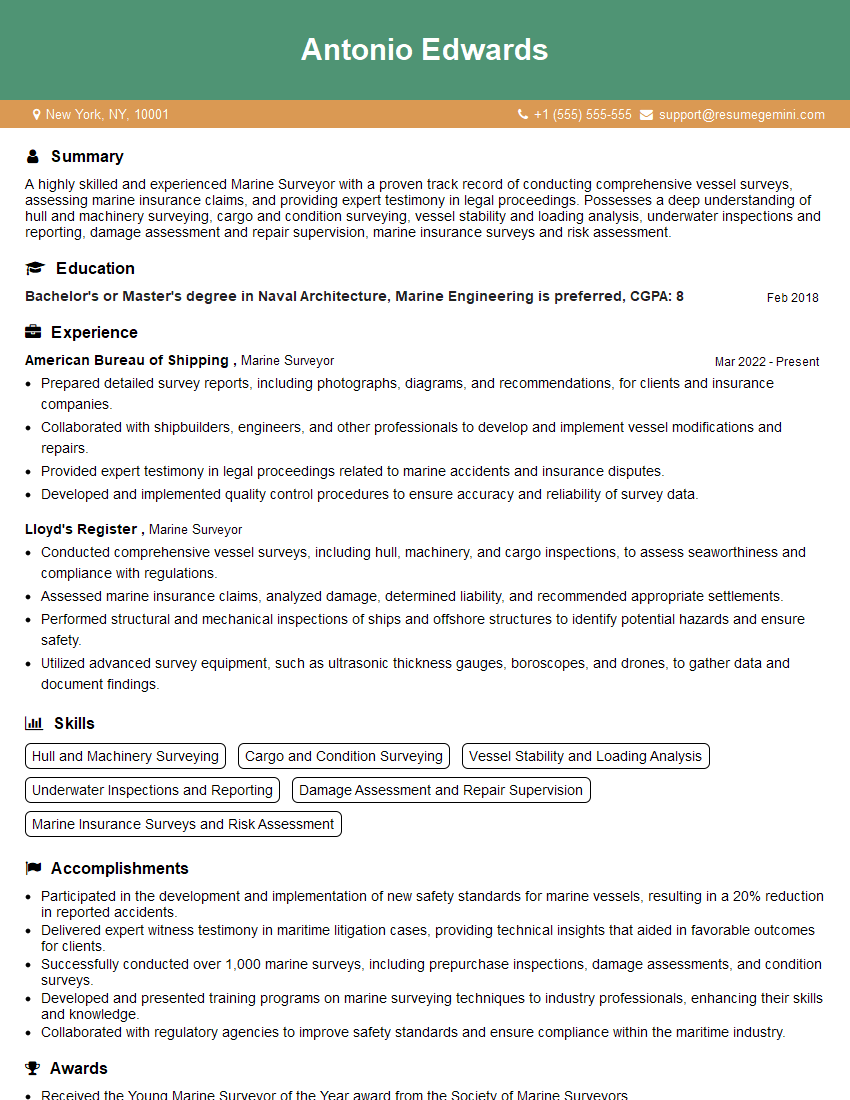
Mastering Marine Claims Investigation opens doors to a rewarding career with excellent growth potential within the maritime industry. A strong understanding of these key concepts is vital for interview success and future career advancement. To significantly increase your chances of landing your dream role, creating an ATS-friendly resume is crucial. ResumeGemini is a trusted resource to help you build a professional and impactful resume that showcases your skills and experience effectively. Examples of resumes tailored to Marine Claims Investigation are available to guide you in this process.
Explore more articles
Users Rating of Our Blogs
Share Your Experience
We value your feedback! Please rate our content and share your thoughts (optional).
What Readers Say About Our Blog
I Redesigned Spongebob Squarepants and his main characters of my artwork.
https://www.deviantart.com/reimaginesponge/art/Redesigned-Spongebob-characters-1223583608
IT gave me an insight and words to use and be able to think of examples
Hi, I’m Jay, we have a few potential clients that are interested in your services, thought you might be a good fit. I’d love to talk about the details, when do you have time to talk?
Best,
Jay
Founder | CEO