Cracking a skill-specific interview, like one for Pattern Marking, requires understanding the nuances of the role. In this blog, we present the questions you’re most likely to encounter, along with insights into how to answer them effectively. Let’s ensure you’re ready to make a strong impression.
Questions Asked in Pattern Marking Interview
Q 1. Explain the difference between slopers and blocks in pattern making.
Both slopers and blocks are foundational patterns in pattern making, serving as the base for designing garments, but they differ significantly in their purpose and level of detail. Think of a sloper as a really basic outline, like a simplified drawing of the human body, while a block is more like a finished sketch, including more details and precision.
A sloper is a two-dimensional representation of a body’s basic shape, typically created using a set of measurements. It’s a very basic, fitted pattern that represents the body’s natural curves and isn’t designed for a specific garment style. It acts as a starting point, a blank canvas upon which we build different garments. It’s highly personalized, typically drafted for a single size, and forms the basis for more detailed pattern making.
A block, on the other hand, is a more developed pattern, usually based on a sloper but already styled for a specific garment type, like a bodice block or a sleeve block. It incorporates design elements such as ease (extra fabric for comfort and movement), shaping, and seam allowances. Blocks are still relatively basic, but they are refined and ready to be modified for specific designs. It often contains details like darts or princess seams, but it still doesn’t include details like collars or pockets.
In short: Slopers are foundational, size-specific, and garment-agnostic; blocks are style-specific and build upon the sloper, adding essential design elements.
Q 2. Describe your experience with various pattern making software (e.g., Gerber, Lectra).
Throughout my career, I’ve extensively used both Gerber and Lectra pattern making software, gaining proficiency in their design, grading, and marker-making capabilities. Gerber’s AccuMark is particularly well-suited for its intuitive interface and powerful grading features; I’ve relied on it extensively for complex designs and large-scale production. Lectra’s Modaris, while more complex initially, offers unparalleled flexibility and precision, ideal for intricate detailing and bespoke projects. I’m adept at leveraging the strengths of each system depending on project requirements. For instance, for a simple design with many sizes, I might prioritize Gerber’s efficient grading capabilities. For a highly customized, detailed design, Lectra’s flexibility is invaluable. My experience also includes utilizing the various modules within these programs, such as marker making and pattern nesting. I understand the importance of efficient workflow and have used both systems to streamline processes and reduce material waste.
Q 3. How do you handle fit adjustments during the pattern making process?
Fit adjustments are crucial to achieving a well-fitting garment. My approach involves a systematic process of fitting a muslin (a prototype garment made from inexpensive fabric) on a live model or dress form. I carefully assess the fit, paying close attention to areas of tightness, looseness, or pulling. The process generally involves these steps:
- Initial Fitting: Observing the overall fit, noting areas needing adjustment.
- Pinning Adjustments: Making adjustments directly on the muslin using pins to mark alterations.
- Transferring Adjustments to the Pattern: Accurately transferring the pin adjustments to the pattern pieces using a ruler and marking tools.
- Grading and Recutting: Ensuring the adjustments are made proportionally and grading them if necessary.
- Iteration: Often multiple rounds of fitting and adjustments are required to reach the desired fit.
For instance, if the shoulder seam is too tight, I would carefully ease the pattern piece at that point, ensuring that the adjustment is evenly distributed to avoid distortion.
Q 4. What are the key considerations for grading patterns for different sizes?
Grading patterns for different sizes requires meticulous attention to detail and a thorough understanding of body proportions. It’s not simply scaling up or down; it involves adjusting key areas differently according to body shape changes across sizes. The key considerations include:
- Understanding body proportions: Different sizes require adjustments to ensure the garment maintains proper proportions. For example, larger sizes may need more ease across the bust or waist.
- Using grading rules: Standardized grading rules are followed to maintain consistency across sizes, particularly within a particular brand’s size system. These rules are adjusted according to the brand and the style.
- Specific adjustments: Not all measurements scale linearly. For instance, the length of the neckline might change minimally, while the width across the chest will increase significantly. This requires specific grading adjustments that are customized for a specific pattern.
- Software and Technology: Pattern making software automates much of the grading process, but manual adjustments are often still needed. The software greatly reduces errors, but checking for appropriate proportions is key.
For example, when grading a sleeve, you would proportionally increase the length, circumference, and cap height, but the amount of increase for each will vary depending on the desired fit and the pattern’s design.
Q 5. Explain your process for creating a basic bodice block.
Creating a basic bodice block is a fundamental skill in pattern making. My process typically involves these steps:
- Measurements: Gathering accurate body measurements from the client or using standard size charts.
- Drafting the Front and Back Bodice: Using these measurements to create the basic bodice shapes, accounting for ease, seam allowances, and design elements such as darts. The creation of darts is often customized depending on the need to shape the bodice.
- Creating the Shoulder and Side Seams: Connecting the front and back bodice pieces to form the shoulder and side seams. Appropriate shaping is introduced here, depending on the style of the garment.
- Adding Darts: Darts are strategically placed to provide shape and fit to the bodice. The placement and shape of darts vary based on the intended design.
- Muslin Fitting and Adjustments: Constructing a muslin prototype and fitting it to test the fit and make necessary adjustments to achieve the desired silhouette.
- Finalizing the Block: Final adjustments to the pattern pieces are made once the fitting is satisfactory.
This process is iterative. Fitting and adjustment is an ongoing process, and the process outlined above may repeat multiple times until a perfect fit is achieved. Each adjustment would necessitate creating a new muslin.
Q 6. How do you ensure accuracy and precision in your pattern making?
Accuracy and precision are paramount in pattern making. My approach involves a combination of meticulous techniques and technological tools to ensure quality. I start with precise measurements, using accurate measuring tools and verifying them multiple times. Throughout the drafting process, I consistently utilize a variety of tools, including rulers, curves, and french curves, ensuring all lines are straight and all angles are correct. This level of precision is carried through to the cutting process as well, using sharp cutting tools and ensuring precise alignment. Digital pattern making software provides additional accuracy through digital grading and precise pattern manipulation, reducing errors related to manual scaling and adjustment. I always double-check my work at each stage, comparing measurements and shapes to ensure consistency and catch any potential errors early on. The muslin fitting serves as a final check to validate the accuracy and precision of the pattern before it is ready for production.
Q 7. Describe your experience working with different fabric types and their impact on pattern design.
Different fabric types significantly impact pattern design and construction. Understanding a fabric’s drape, weight, stretch, and texture is vital for successful pattern making. For example, a lightweight, draping fabric like silk will require a different pattern than a stiff fabric like denim. The same pattern may create a different look and fit on different fabrics.
- Drape: Fabrics with significant drape, like chiffon or silk, may require more ease in the pattern to allow for graceful movement. The pattern may need additional details or changes to create a desired shape.
- Weight: Heavier fabrics, like wool or velvet, will hang differently and may require adjustments to the seam allowances or fit to prevent pulling or bunching.
- Stretch: Fabrics with stretch, such as jersey or spandex, require modifications to account for their ability to expand. The pattern might be drafted smaller to compensate for the stretch.
- Texture: Textured fabrics like tweed or corduroy may require specific adjustments to account for their bulk and potentially altered drape.
My experience working with a wide range of fabrics has enabled me to adapt my pattern making techniques accordingly. For example, I might add seam allowance to a pattern when working with heavy fabrics and reduce it or adjust design lines for fabrics with more drape.
Q 8. How do you incorporate ease and design details into your patterns?
Incorporating ease and design details into patterns is crucial for creating comfortable and aesthetically pleasing garments. Ease refers to the extra fabric added to the base measurements to allow for comfortable movement and a flattering fit. Design details, on the other hand, are the stylistic elements that give a garment its unique character.
Ease: I determine the amount of ease needed based on the garment type, fabric, and intended fit. For example, a close-fitting dress will require less ease than a loose-fitting blouse. I add ease strategically to specific areas like the bust, waist, and hips, using different techniques depending on the pattern. I might add ease by increasing the pattern piece dimensions directly or by adding darts to create shaping. For example, adding 1-2 inches of ease to the bust of a shirt pattern allows for comfortable movement and a natural look.
Design Details: Design details are integrated during the pattern construction phase. For example, creating princess seams involves modifying the basic bodice block to incorporate the seams which, in addition to their aesthetic appeal, can help control fitting across the bust and waist. Similarly, adding a yoke requires creating a separate pattern piece and adapting the rest of the pattern to seamlessly integrate it, affecting the overall ease distribution and the style.
I always document the ease added to each pattern piece and clearly mark all design detail adjustments to maintain consistency and aid in future adjustments or grading.
Q 9. Explain your knowledge of different pattern making methods (e.g., draping, flat pattern making).
My pattern making expertise encompasses both draping and flat pattern making, each with its unique strengths.
Draping: This method involves manipulating fabric directly on a dress form to create a three-dimensional garment shape. It’s ideal for creating unique designs and achieving a precise fit, especially for complex silhouettes. I use draping when I need to create very fitted garments with unique curves or drape well, such as evening gowns or sculpted jackets. I start with a muslin and meticulously shape and pin it to the form to achieve the desired effect. This process requires both technical skill and artistic vision. After I’ve achieved the perfect shape, I carefully remove the fabric and create a paper pattern to make it reproducible.
Flat Pattern Making: This method is based on creating patterns from two-dimensional measurements. I use this approach for garments with simpler designs and for mass production. I start by constructing a basic block (foundation pattern) for the chosen body type, which is then adjusted to create specific garment styles. It relies on precise calculations and knowledge of garment construction. Flat pattern making allows for greater consistency and control over the final product and is often the method of choice for commercial pattern production. I often combine elements of both draping and flat pattern making to leverage the strengths of each technique.
Q 10. How do you troubleshoot fit problems in garments?
Troubleshooting fit problems requires a systematic approach. I typically start by identifying the area(s) with fit issues – too tight, too loose, pulling, gaping, etc. This involves assessing the garment on the wearer and looking for discrepancies between the garment and the body shape.
- Visual Inspection: I carefully examine the garment on the individual, noting specific areas of concern such as excessive wrinkles, pulling at seams, or gaping at the necklines, armholes, or other areas.
- Measurement Comparison: I check against the original measurements to see if there are discrepancies. These discrepancies point to potential fit issues in different areas, helping me zero in on the solution.
- Pattern Adjustment: Based on my observations and measurements, I adjust the pattern. For example, if a garment is too tight in the bust, I might add width to the bust area. If there’s gaping at the neckline, I would reduce the neckline opening or make adjustments to the shoulder slope.
- Grading: If the pattern is not fitting correctly for different size ranges, I then use grading techniques to adapt the pattern sizes effectively across a range of sizes.
- Muslin Testing: Before making final alterations to the actual fabric, I always create a muslin mock-up to test all adjustments and verify the fit.
A detailed understanding of body construction and the effect of pattern adjustments is essential for efficient troubleshooting.
Q 11. Describe your experience with creating patterns for different garment styles (e.g., dresses, pants, jackets).
My experience spans a wide range of garment styles, including dresses, pants, and jackets. I’ve worked on various designs, from simple to complex, integrating various construction techniques in each case.
Dresses: I’ve developed patterns for various dress styles—A-line, sheath, fit-and-flare, wrap dresses, etc.—using a variety of construction methods, including princess seams, darts, and yokes. The complexity of the pattern varies based on the design; a simple A-line dress requires a less complicated pattern than a heavily structured ball gown, for example. I adapt the fit depending on the desired silhouette, whether it is body-con or flowy.
Pants: I have experience in creating patterns for different pant styles, from tailored trousers to jeans. Creating accurate pant patterns requires precise measurements and an understanding of how ease affects the fit and drape. I utilize techniques such as adding ease at the seat and thigh and ensuring accurate crotch curves for optimal fit.
Jackets: I’ve created patterns for various jacket styles—blazer, trench coat, bomber jacket etc. These designs often involve complex features like collars, lapels, and lining. Pattern making for jackets involves creating multiple pattern pieces and fitting them together precisely, requiring careful attention to detail and a thorough understanding of construction techniques.
Each garment style has its specific challenges, and the approach I take to pattern creation and fit is tailored to the unique features of each garment.
Q 12. What quality control measures do you implement in your pattern making workflow?
Quality control is paramount in my workflow. I employ several measures to ensure accuracy and consistency:
- Accurate Measurements: I always double-check my measurements and ensure they are consistent throughout the entire process.
- Pattern Checking: After creating a pattern, I meticulously check it for symmetry, accuracy, and completeness. I look for any inconsistencies or errors that could affect the final garment.
- Test Garments: Before finalizing a pattern, I always create a test garment (muslin) to evaluate the fit and identify any areas needing adjustment.
- Grading Verification: If grading is required, I carefully check the accuracy of each graded size to ensure proportions are correct across the size range.
- Documentation: I maintain comprehensive documentation of my pattern-making process, including measurements, ease, adjustments made, and any specific notes. This documentation facilitates reproducibility and ease of adaptation for future projects.
- Technical Drawing: I create technical drawings of the pattern pieces to ensure clarity and aid in understanding pattern construction and construction details.
These quality control steps minimize errors and ensure that the final garment meets the desired quality standards.
Q 13. How do you manage your time and prioritize tasks in a fast-paced environment?
Managing time effectively in a fast-paced environment is critical. I utilize several strategies:
- Prioritization: I prioritize tasks based on deadlines and importance, focusing on the most urgent and critical projects first.
- Time Blocking: I allocate specific time blocks for particular tasks to maintain focus and prevent multitasking.
- Detailed Planning: I create detailed project plans outlining all necessary steps and timelines. This helps me track progress and adjust my schedule accordingly.
- Efficient Workflow: I streamline my workflow to eliminate unnecessary steps and maximize efficiency. This includes optimizing my workspace and utilizing appropriate tools.
- Delegation (when applicable): If possible, I delegate tasks that can be efficiently handled by others.
By combining these methods, I ensure deadlines are met without sacrificing quality. Flexibility is also key – I anticipate potential delays and plan accordingly, adjusting my schedule as needed.
Q 14. Explain your experience with pattern manipulation techniques.
My expertise extends to various pattern manipulation techniques, which allow for creative design adaptations. I use these techniques to transform basic blocks into unique garments.
- Dart Manipulation: I frequently manipulate darts, converting them into seams or shaping them to create different silhouette effects. For example, shifting a bust dart to the shoulder can create a different shoulder shape and affect the overall fit.
- Seam Manipulation: I skillfully alter seam lines to create interesting details and modify the garment’s shape. For example, altering the placement of a side seam can add shaping or create a more draped effect.
- Adding and Subtracting Fabric: I adeptly add or subtract fabric to achieve particular fitting needs, altering specific areas or creating different draping effects. For example, adding a panel of fabric to a skirt can add volume and change the overall design.
- Grading: I am proficient in grading patterns to create a size range from a base pattern, ensuring consistent fit and proportion across all sizes.
- Pattern Cutting Techniques: I’m well-versed in various pattern cutting techniques, such as slashing and spreading, allowing for sophisticated pattern transformations and design variations.
These techniques allow me to create unique and intricate designs that go beyond simple modifications of existing patterns. A deep understanding of construction and fit is essential when applying these techniques.
Q 15. How do you stay updated on current trends and techniques in pattern making?
Staying current in pattern making requires a multi-pronged approach. It’s not enough to simply rely on past knowledge; the industry is constantly evolving with new technologies and design aesthetics. I actively engage in several key strategies:
- Industry Publications and Online Resources: I subscribe to trade magazines like Threads and Sew News, and regularly visit websites and blogs dedicated to apparel design and manufacturing. This keeps me abreast of the latest software, techniques, and industry best practices.
- Conferences and Workshops: Attending industry events like the Apparel Sourcing Show or specialized pattern making workshops allows me to network with other professionals, learn from leading experts, and see demonstrations of new tools and software firsthand. For example, I recently attended a workshop on advanced CAD software for pattern grading, significantly improving my efficiency.
- Continuous Learning through Online Courses: Platforms like Skillshare and Coursera offer a vast array of courses covering diverse pattern making techniques and software. I regularly take these courses to enhance my skills in specific areas, such as draping or digital pattern making.
- Networking with Peers: I maintain a strong professional network through online forums and industry groups. Sharing experiences and best practices with other pattern makers is invaluable for staying informed about emerging trends and solving challenges.
This combination ensures I am always learning and adapting my skills to meet the ever-changing demands of the fashion industry.
Career Expert Tips:
- Ace those interviews! Prepare effectively by reviewing the Top 50 Most Common Interview Questions on ResumeGemini.
- Navigate your job search with confidence! Explore a wide range of Career Tips on ResumeGemini. Learn about common challenges and recommendations to overcome them.
- Craft the perfect resume! Master the Art of Resume Writing with ResumeGemini’s guide. Showcase your unique qualifications and achievements effectively.
- Don’t miss out on holiday savings! Build your dream resume with ResumeGemini’s ATS optimized templates.
Q 16. Describe your experience working with technical specifications and design briefs.
My experience working with technical specifications and design briefs is extensive. I’m adept at interpreting complex documents to create accurate and functional patterns. This involves a systematic approach:
- Thorough Review: I begin by meticulously reviewing the design brief, paying close attention to measurements, fabric specifications, construction details, and any specific design features. For example, a design might specify a particular ease allowance (the extra fabric added for comfort and movement), which directly impacts the pattern’s dimensions.
- Clarification and Communication: If any information is unclear or requires further clarification, I proactively communicate with the designer and/or the production team to ensure complete understanding. This prevents costly errors further down the line.
- Technical Drawings and Sketches: I use technical drawings and sketches provided in the brief to accurately translate the design into a workable pattern. This often involves scaling diagrams and adjusting measurements to account for the chosen fabric’s drape and properties.
- Sample Creation and Iteration: After creating the initial pattern, I make a sample garment to test the fit and identify any necessary adjustments. This iterative process ensures the final pattern meets the design brief’s requirements.
My approach emphasizes precision and clear communication to translate creative visions into manufacturable garments.
Q 17. How do you collaborate effectively with designers and production teams?
Effective collaboration is crucial in pattern making. I foster strong working relationships with designers and production teams through open communication, proactive problem-solving, and a shared commitment to quality. I frequently employ these strategies:
- Regular Meetings and Updates: I schedule regular meetings with designers and the production team to discuss progress, address any challenges, and ensure everyone is on the same page.
- Clear and Concise Communication: I maintain clear and concise communication, using both verbal and visual aids to explain technical concepts and ensure mutual understanding. For example, I’ll use annotated sketches to explain fit adjustments.
- Active Listening and Feedback: I actively listen to feedback from the team and incorporate suggestions into the pattern, always prioritizing the end goal of a successful garment.
- Proactive Problem Solving: When challenges arise, I proactively seek solutions, drawing on my experience and industry knowledge to resolve them efficiently. I believe in teamwork and a collaborative approach to tackle obstacles.
My goal is to build a cohesive team environment where everyone feels valued and contributes their expertise to creating high-quality garments.
Q 18. What are your strengths and weaknesses as a pattern maker?
My strengths as a pattern maker lie in my precision, problem-solving skills, and adaptability. I’m meticulous in my work, ensuring accuracy in measurements and construction details. I have a knack for identifying and resolving fitting issues quickly and efficiently. My ability to adapt to different design styles and fabric types allows me to handle diverse projects. For example, I recently adapted a pattern for a delicate silk fabric by adjusting the seam allowances and adding interfacing to maintain structural integrity.
One area I’m continually working on is improving my speed in creating patterns for complex designs. While my accuracy is high, I’m exploring new technologies and streamlining my workflow to improve efficiency without compromising quality.
Q 19. Explain your experience with making patterns for plus-size garments.
I have significant experience in creating patterns for plus-size garments. This requires a deep understanding of body proportions and a specialized approach to pattern grading. It’s not simply a matter of enlarging a standard size; plus-size patterns require adjustments in areas such as the bust, waist, hips, and shoulders to ensure a flattering and comfortable fit.
- Accurate Measurements and Grading: I utilize accurate body measurements from a range of plus-size figures and utilize specialized grading techniques to create patterns that accommodate different body shapes and proportions. This includes understanding the difference in body proportions between different plus-size ranges.
- Addressing Design Challenges: Plus-size garments often present unique design challenges, such as draping and ease allowances. I carefully consider these factors during pattern creation to ensure a comfortable and well-fitting garment. This could involve adding extra fabric in certain areas for better drape or adjusting darts for a more flattering silhouette.
- Understanding Fabric Choices: The choice of fabric significantly impacts the fit and drape of a plus-size garment. I select suitable fabrics that offer both comfort and support. Using fabrics with good drape and stretch can significantly enhance fit and comfort.
I am committed to creating plus-size patterns that are not only functional but also stylish and flattering, empowering individuals of all sizes to feel confident and comfortable in their clothing.
Q 20. How do you ensure your patterns are suitable for mass production?
Ensuring patterns are suitable for mass production requires careful planning and consideration throughout the design and pattern-making process. My approach involves:
- Efficient Pattern Construction: The pattern must be designed for ease of construction, minimizing complex steps or intricate details that could slow down production. This involves simplifying construction details wherever possible while maintaining the design integrity.
- Standard Grading: Precise grading is crucial for mass production. My expertise ensures consistent sizing across all sizes to maintain consistent fit and quality throughout the production run. This is accomplished using specialized software or manual techniques, whichever is most appropriate for the project.
- Clear Marking and Documentation: Patterns must be clearly marked and documented, providing detailed instructions for cutting, assembling, and finishing. This will help reduce mistakes on the production floor and maintain consistency.
- Fabric Selection and Testing: Thorough testing of the pattern with the chosen fabric is essential to anticipate potential issues during mass production. This ensures the selected fabric works well with the pattern and construction methods.
- Production Sample Testing: Creating and evaluating several production samples helps identify any issues with the pattern or the production process before full-scale manufacturing. This is vital in minimizing waste and improving the quality of the end product.
By following these steps, I ensure the pattern is not only aesthetically pleasing but also practical and efficient for large-scale manufacturing.
Q 21. Describe your experience with using different types of marking tools.
My experience with various marking tools is extensive. I’m proficient in both traditional and digital methods, selecting the most appropriate tool for the task at hand. This includes:
- Traditional Tools: I’m adept at using French curves, rulers, pattern wheels, and tracing paper for creating accurate and detailed patterns. These tools are invaluable for specific design elements and ensure precision in pattern development.
- Digital Tools: I am proficient in using CAD software such as Gerber Accumark or Optitex. These programs enhance speed, accuracy, and allow for efficient grading and modification. This reduces the reliance on manual methods and increases pattern creation efficiency.
- Specialized Markers: I use different marking tools based on the fabric type and the type of marking needed. This includes tailor’s chalk, marking pencils, and heat-erasable markers. The choice of marking tools depends on the fabric’s sensitivity and the permanence required.
My versatility in using various marking tools allows me to efficiently and accurately translate design ideas into high-quality, manufacturable patterns, regardless of the project’s scale or complexity.
Q 22. How do you use technology to streamline your pattern making process?
Technology significantly streamlines pattern making. I extensively use Computer-Aided Design (CAD) software like Gerber Accumark and Lectra Modaris. These programs allow me to create digital patterns, manipulate them precisely, and generate grading rules efficiently. For example, I can easily adjust a sleeve’s width across multiple sizes with a few clicks, a task that would be incredibly time-consuming manually. Beyond CAD, I leverage digital pattern cutting tables for precise cutting of test garments, eliminating manual errors and saving considerable time. Furthermore, 3D modeling software helps visualize the garment before production, identifying potential fit issues early in the process. This integrated approach ensures accuracy, reduces waste, and accelerates the overall process.
Imagine needing to grade a pattern for 8 sizes; doing this manually is tedious and prone to errors. With CAD, I simply input the grading rules once, and the software automatically generates all sizes, ensuring consistency and precision. This saves significant time and effort, allowing for more focus on the creative aspects of pattern making.
Q 23. Explain your experience working with different types of seams and seam finishes.
My experience encompasses a wide range of seams and finishes. I’m proficient in various seam constructions, including French seams, flat-felled seams, Hong Kong seams, and bound seams, each chosen based on the garment’s style, fabric weight, and desired aesthetic. For instance, French seams are ideal for sheer fabrics as they create a clean, professional finish without visible stitching on the outside. Flat-felled seams, known for their durability, are perfect for workwear or children’s clothing. I also understand various seam finishes to prevent fraying and enhance durability, such as serging, zigzag stitching, and pinking. The choice depends on the fabric type and the garment’s intended use. For example, a delicate silk blouse would require a rolled seam or a hand-finished seam to prevent any damage to the fabric.
I meticulously select seam allowances and finishes according to the project, ensuring professional results. A poorly finished seam can significantly detract from the overall quality of a garment, highlighting the importance of this aspect of pattern making.
Q 24. How do you approach creating patterns for unconventional fabrics?
Working with unconventional fabrics requires a nuanced approach. Understanding the drape, stretch, and texture of the material is crucial. For example, creating a pattern for a heavily textured knit would necessitate additional ease to account for the fabric’s lack of drape. Similarly, a slippery fabric like silk might need adjustments to prevent slippage during construction. I often create muslins (test garments) from the actual fabric to assess its behavior before finalizing the pattern. This allows me to account for any unexpected draping or stretching, leading to a better fit and a more accurate pattern. Additionally, I might need to adapt the seam allowances or choose specific seam finishes to accommodate the unique properties of the fabric.
For instance, when working with a heavily textured fabric, I might increase the seam allowance slightly to allow for ease of sewing and prevent the seams from being too tight. This iterative process of testing and adjusting ensures the final garment looks and fits as intended.
Q 25. What is your experience with pattern alterations for individual fit requirements?
Pattern alteration for individual fit is a core competency. I use a variety of techniques, starting with careful measurements to identify areas needing adjustments. This could involve adjusting the shoulder slope, bust point, waistline, or hip circumference. I employ methods like dart manipulation, adding or removing fullness, and adjusting seam lines to achieve a precise fit. I’m experienced in using slopers (basic patterns) as a foundation for alterations, which helps maintain the design integrity while making necessary changes for individual body types. This usually involves making small adjustments at a time, testing the fit, and repeating the process until the desired fit is achieved.
For example, a client with broad shoulders might require a wider shoulder slope, while someone with a fuller bust might need adjustments to the bust darts or a different pattern completely. I have a knack for understanding the body’s nuances and translating those understandings into pattern adjustments for a comfortable, flattering fit.
Q 26. Describe your experience with creating patterns using different grading systems.
I’m proficient in various grading systems, both manual and automated. I understand the principles of scaling patterns for different sizes, ensuring consistent proportions throughout the size range. Manual grading requires meticulous calculation and attention to detail, while automated grading, using CAD software, employs pre-programmed rules to scale the pattern efficiently. Both methods require a thorough understanding of body measurements and proportions. Different grading systems might use different measurement standards, so familiarity with various systems is essential.
For example, one grading system might use a standard increment of 1 inch per size for the chest circumference, while another might use a slightly different increment. My experience allows me to adapt to and utilize different grading systems to meet the specific needs of a project.
Q 27. How do you handle inconsistencies between the pattern and the finished garment?
Inconsistencies between the pattern and the finished garment require careful analysis. This often involves reviewing the pattern pieces for potential errors in construction, such as incorrect seam allowances or inaccurate markings. I systematically examine the sewing process to rule out any sewing errors. I might compare the finished garment measurements with the pattern measurements to identify discrepancies. Sometimes, the fabric itself can be the culprit—unconventional fabrics may behave unexpectedly during construction.
Problem-solving involves checking for mistakes in the cutting, sewing, and pressing stages. If errors are found in the pattern, I make necessary corrections and create a revised pattern. If the errors are due to the fabric, I might adjust the pattern or recommend alternative fabrics for future projects. I focus on a methodical approach, eliminating possible causes one by one to identify the root of the inconsistency.
Q 28. Explain your experience with working from sketches and technical drawings to create patterns.
I’m highly skilled at translating sketches and technical drawings into functional patterns. I begin by meticulously analyzing the design elements, including garment silhouettes, seam lines, and details like pockets or collars. I then translate these visual elements into technical specifications, defining measurements and construction details. This involves interpreting the designer’s vision and understanding the implied construction methods from the sketches. I use my expertise to create a functional pattern that accurately reflects the design concept while ensuring the garment is structurally sound and aesthetically pleasing.
For example, a sketch showing a gathered sleeve would require me to understand the appropriate amount of fabric needed to achieve the desired fullness. I’d translate this into the pattern through careful calculations and adjustments of the sleeve cap and other elements. This process demands strong technical skills combined with creative interpretation of the designer’s vision.
Key Topics to Learn for Pattern Marking Interview
- Understanding Pattern Design Principles: Grasping the fundamentals of garment construction, including seam allowances, grainlines, and ease.
- Mastering Pattern Making Techniques: Proficiency in various methods like draping, flat pattern making, and using computer-aided design (CAD) software.
- Fabric Knowledge and Selection: Understanding different fabric types, their drapability, and how fabric choice impacts pattern adjustments.
- Pattern Grading and Sizing: Developing skills in scaling patterns to different sizes while maintaining garment proportions and fit.
- Pattern Alterations and Adjustments: Demonstrating the ability to modify existing patterns to accommodate different body shapes and design modifications.
- Computer-Aided Design (CAD) Software Proficiency: Familiarity with industry-standard CAD software for pattern making and digital design.
- Problem-Solving and Troubleshooting: Exhibiting the ability to identify and resolve pattern-related issues, such as fit problems or inconsistencies.
- Production and Manufacturing Considerations: Understanding the practical implications of pattern making on the manufacturing process, including efficiency and cost.
- Industry Best Practices and Standards: Adherence to industry standards for pattern making and technical design.
Next Steps
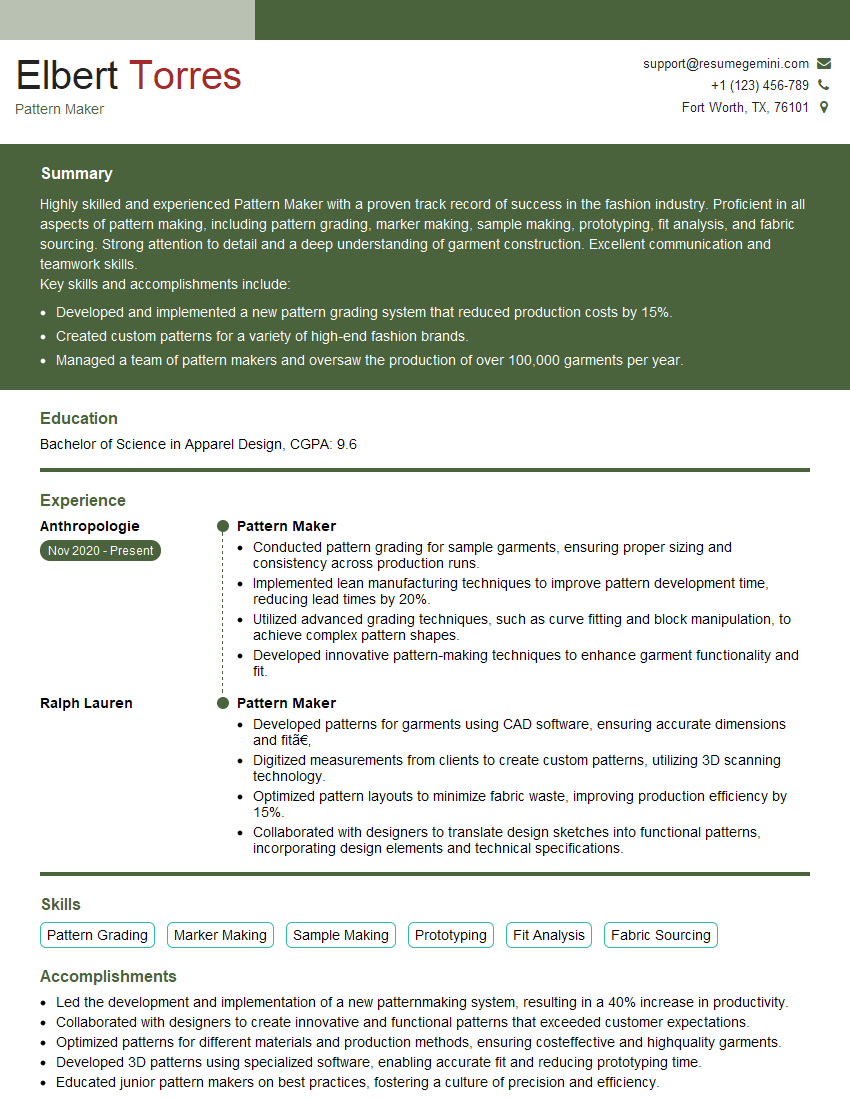
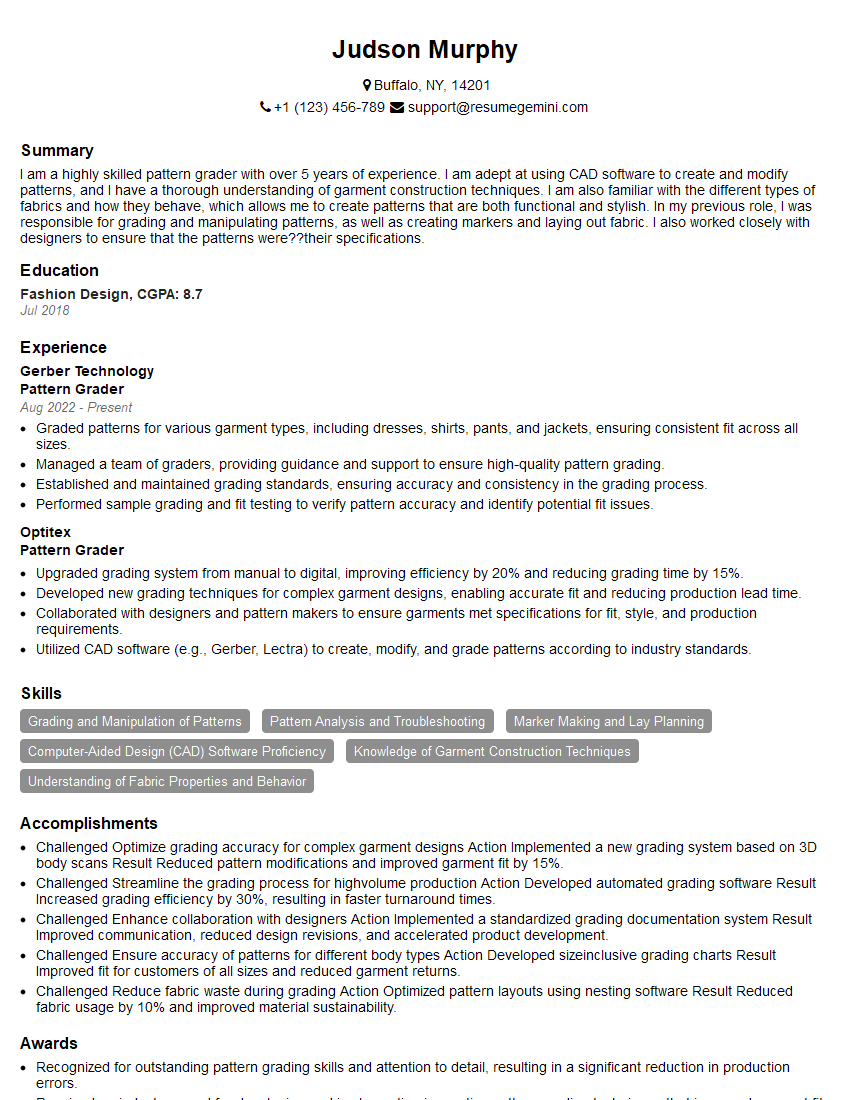
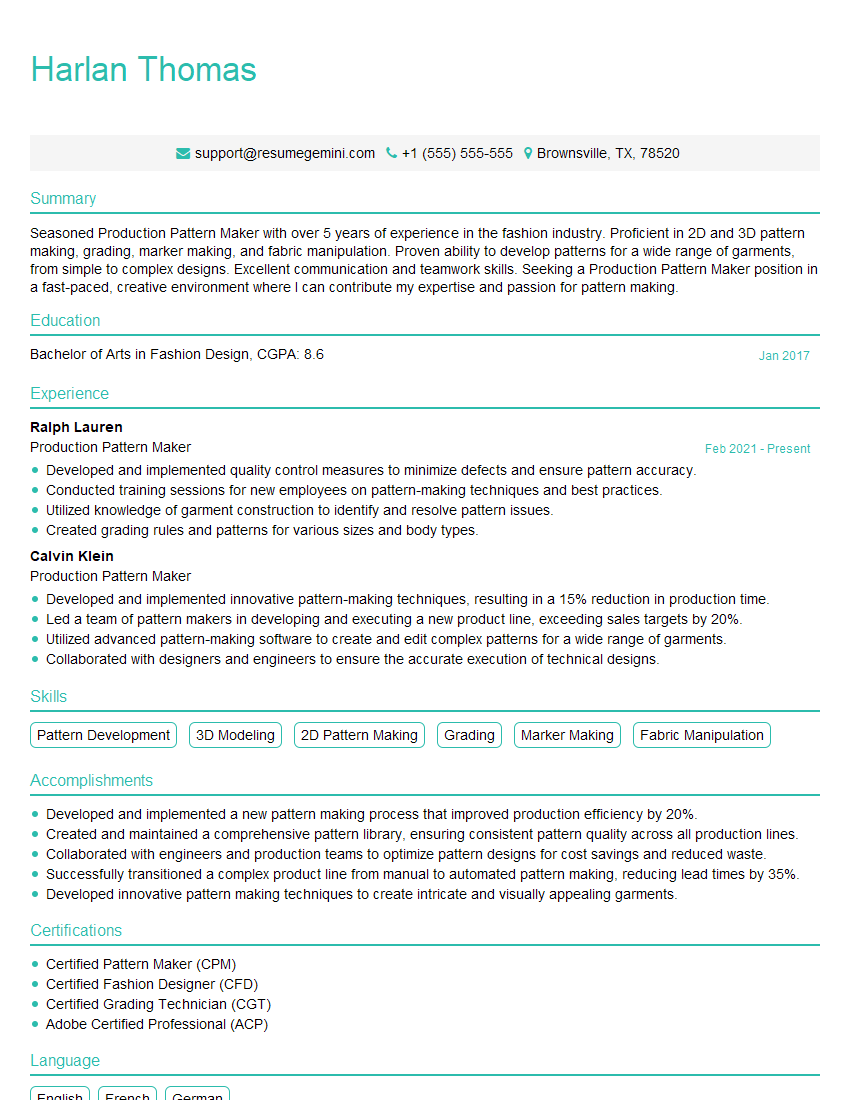
Mastering Pattern Marking is crucial for career advancement in the fashion and apparel industry, opening doors to exciting roles with higher earning potential and greater creative control. To maximize your job prospects, focus on creating a strong, ATS-friendly resume that highlights your skills and experience effectively. ResumeGemini is a trusted resource for building professional resumes, and we provide examples tailored specifically to Pattern Marking professionals to help you showcase your expertise. Invest time in crafting a compelling resume – it’s your first impression on potential employers.
Explore more articles
Users Rating of Our Blogs
Share Your Experience
We value your feedback! Please rate our content and share your thoughts (optional).
What Readers Say About Our Blog
I Redesigned Spongebob Squarepants and his main characters of my artwork.
https://www.deviantart.com/reimaginesponge/art/Redesigned-Spongebob-characters-1223583608
IT gave me an insight and words to use and be able to think of examples
Hi, I’m Jay, we have a few potential clients that are interested in your services, thought you might be a good fit. I’d love to talk about the details, when do you have time to talk?
Best,
Jay
Founder | CEO