Preparation is the key to success in any interview. In this post, we’ll explore crucial Precision Irrigation Techniques interview questions and equip you with strategies to craft impactful answers. Whether you’re a beginner or a pro, these tips will elevate your preparation.
Questions Asked in Precision Irrigation Techniques Interview
Q 1. Explain the principles of precision irrigation.
Precision irrigation, at its core, is about applying the right amount of water, at the right time, and to the right place. It moves away from traditional flood or furrow irrigation methods, which often lead to water waste and inefficient crop growth. Instead, it utilizes technology and data-driven decisions to optimize water use, maximizing crop yields while minimizing environmental impact. Think of it like giving your plants a personalized hydration plan tailored to their specific needs, rather than just hoping for the best with a general watering.
This involves monitoring various factors such as soil moisture, weather conditions, crop type, and growth stage to determine the precise amount of water needed. It frequently incorporates sensors, automated control systems, and data analysis tools to manage irrigation schedules dynamically.
Q 2. Describe different types of irrigation systems (drip, sprinkler, etc.) and their suitability for various crops.
Several irrigation systems cater to different needs and crop types:
- Drip Irrigation: Delivers water directly to the root zone through a network of tubes and emitters. Ideal for high-value crops like vegetables and fruits, requiring precise water delivery and minimizing water loss through evaporation. Think of it as giving your plants a drink directly at their roots, ensuring maximum uptake.
- Sprinkler Irrigation: Applies water through a spray of nozzles, mimicking rainfall. Suitable for a wider range of crops and terrains, but less efficient than drip irrigation as some water is lost to evaporation and runoff. This is a more general approach, but effective for larger areas.
- Center Pivot Irrigation: Uses a rotating sprinkler system around a central pivot point, covering large, usually flat fields. Efficient for crops with high water needs but less precise in water application compared to drip.
- Subsurface Drip Irrigation: Places the drip lines below the soil surface. This reduces evaporation losses and improves water use efficiency, particularly in arid climates. It’s like giving the plants a secret underground water supply.
Choosing the right system depends on factors like crop type, soil conditions, topography, water availability, and budget. For instance, drip irrigation is excellent for vineyards due to its precision, while center pivot might be more suitable for large-scale wheat farming.
Q 3. What are the advantages and disadvantages of using sensors in precision irrigation?
Sensors are crucial for precision irrigation, providing real-time data on soil moisture, weather, and plant health. They allow for informed irrigation decisions, leading to significant benefits. However, there are drawbacks to consider.
- Advantages:
- Optimized water use: Sensors prevent overwatering and underwatering, saving water and energy.
- Improved crop yields: Consistent moisture levels promote healthy plant growth and higher yields.
- Reduced labor costs: Automated systems based on sensor data reduce manual monitoring and adjustment.
- Environmental benefits: Less water use means reduced environmental impact.
- Disadvantages:
- Initial investment costs: Sensor installation and maintenance can be expensive.
- Sensor failure: Sensor malfunction can lead to inaccurate data and poor irrigation decisions. Regular calibration and maintenance are crucial.
- Data interpretation: Understanding and interpreting sensor data requires expertise. A simple sensor reading without context can be misleading.
- Power requirements: Remote sensors might need reliable power sources, possibly solar or battery-based.
Q 4. How do you calculate water requirements for a specific crop?
Calculating water requirements involves considering several factors. One common method utilizes the crop coefficient (Kc), which represents the crop’s evapotranspiration (ET) relative to reference evapotranspiration (ETo).
The formula is: Water requirement (mm/day) = Kc * ETo
Where:
- Kc: Crop coefficient (obtained from crop-specific tables or research data)
- ETo: Reference evapotranspiration (obtained from weather stations or calculated using meteorological data).
To determine the total water needed for a specific period, multiply the daily water requirement by the number of days. You’ll also need to consider soil characteristics, irrigation efficiency, and water application method to adjust the calculated value for practical implementation. For example, a sandy soil will require more frequent, but smaller, irrigation applications compared to clay soil.
Q 5. Explain the concept of evapotranspiration and its role in irrigation scheduling.
Evapotranspiration (ET) is the combined process of evaporation from the soil surface and transpiration from plants. It’s the primary way water is lost from the soil-plant-atmosphere system. Understanding ET is critical in scheduling irrigation.
Irrigation scheduling aims to replace the water lost through ET, maintaining optimal soil moisture levels for plant growth. We monitor ET either directly (using sensors) or indirectly (using weather data and crop coefficients) to determine when and how much to irrigate. For example, high temperatures and wind speed increase ET rates, necessitating more frequent irrigation.
Q 6. Describe different soil moisture sensors and their limitations.
Several soil moisture sensors exist, each with strengths and weaknesses:
- Tensiometers: Measure soil water tension, providing an indication of soil water availability. They are relatively inexpensive and reliable but require frequent calibration and are prone to malfunction in rocky or very dry soil.
- Capacitance probes: Determine soil moisture based on the electrical capacitance of the soil. They can provide accurate readings at different depths but are susceptible to salt build-up and temperature changes.
- Time-domain reflectometry (TDR) probes: Measure soil dielectric constant to determine soil moisture content. They are considered highly accurate and less sensitive to soil salinity and temperature compared to capacitance probes, but they are more expensive.
- Neutron probes: Utilize a radioactive source to measure soil moisture, offering a high degree of accuracy and depth penetration. However, they require specialized training and licensing and are expensive.
The choice depends on the specific application, budget, and technical expertise available. Each sensor type has its own limitations, necessitating careful consideration and potentially employing multiple sensor types for a comprehensive approach.
Q 7. How do you interpret soil moisture data to optimize irrigation?
Interpreting soil moisture data to optimize irrigation involves several steps:
- Establish baseline data: Collect soil moisture readings regularly over time under different irrigation conditions to establish a baseline for the specific soil and crop type.
- Determine the optimal soil moisture range: For each crop, a specific range of soil moisture exists where growth is maximized without causing stress. This information can be obtained from literature or agricultural extension services.
- Monitor soil moisture trends: Track soil moisture data to identify trends and deviations from the optimal range. For instance, a consistent decline below the optimal range indicates the need for irrigation.
- Consider weather conditions: High ET rates due to weather conditions might require more frequent irrigation even if the soil moisture is still within the optimal range.
- Adjust irrigation scheduling: Based on the soil moisture data and weather conditions, adjust the irrigation schedule accordingly. This may involve changing the frequency and duration of irrigation events.
- Evaluate results: Regularly monitor crop growth and yield to assess the effectiveness of the irrigation management strategy and make further adjustments as needed.
By consistently monitoring and interpreting data, you can refine your irrigation strategy over time, ultimately maximizing crop yields while minimizing water usage.
Q 8. What is the role of weather data in precision irrigation?
Weather data is the cornerstone of precision irrigation. It provides the crucial information needed to optimize irrigation scheduling and water application. Without accurate weather information, irrigation decisions are essentially guesswork, potentially leading to overwatering, underwatering, or inefficient water use.
Specifically, key weather parameters include:
- Temperature: High temperatures increase evapotranspiration (water loss from plants and soil), necessitating more frequent irrigation.
- Humidity: High humidity reduces evapotranspiration, meaning less water is needed.
- Solar Radiation: Strong sunlight increases evapotranspiration rates, impacting irrigation needs.
- Wind Speed: Wind increases evapotranspiration by accelerating the drying of plant surfaces.
- Rainfall: Recorded rainfall data helps adjust irrigation schedules to avoid overwatering.
For example, a sudden heatwave would trigger an immediate increase in irrigation based on the predicted evapotranspiration rates. Conversely, a period of heavy rainfall would reduce or eliminate the need for supplemental irrigation.
Q 9. Explain the function of irrigation controllers and scheduling software.
Irrigation controllers are the brains of a precision irrigation system. They automate the process of turning irrigation zones on and off based on a pre-programmed schedule or real-time data inputs. Scheduling software, often integrated with the controller, allows for precise control over irrigation duration, frequency, and timing.
Functions include:
- Scheduling: Creating irrigation schedules based on weather data, soil moisture sensors, or a combination of both. Schedules can be adjusted for specific zones based on their unique water requirements.
- Zone Control: Managing multiple irrigation zones independently. This allows for targeted watering based on crop type, soil conditions, and water needs.
- Real-time Monitoring: Many modern controllers can monitor soil moisture, rainfall, and other parameters in real time, allowing for adaptive irrigation schedules.
- Remote Control: Advanced controllers can be managed remotely through web interfaces or mobile applications, offering flexibility and convenience.
- Data Logging: Recording historical irrigation data for analysis and optimization.
For instance, scheduling software might use a weather forecast to automatically reduce irrigation duration during a rainy period or increase irrigation for a specific zone exhibiting low soil moisture.
Q 10. Describe various irrigation automation techniques.
Irrigation automation encompasses a range of techniques aimed at optimizing water delivery and minimizing human intervention. These techniques leverage technology to enhance efficiency and precision.
Examples include:
- Time-based Irrigation: A simple form of automation where irrigation is scheduled at predetermined times and durations. This is usually less efficient than other methods.
- Sensor-based Irrigation: Soil moisture sensors provide real-time data about soil water content, triggering irrigation only when needed. This approach significantly reduces water waste.
- Weather-based Irrigation: Irrigation schedules are adjusted based on weather forecasts, accounting for evapotranspiration rates and rainfall. This requires a reliable weather station or access to weather data.
- Variable Rate Irrigation (VRI): This advanced technique uses GPS and other mapping technologies to apply different amounts of water to different areas of the field based on their specific water needs. This is ideal for fields with varying topography or soil conditions.
- Remote Control Systems: Allows for remote monitoring and control of irrigation systems, offering significant flexibility and management capabilities.
Imagine a vineyard with varied slopes. VRI ensures that the steeper, drier slopes receive more water while flatter areas receive less, optimizing water usage and maximizing yield.
Q 11. How do you troubleshoot common irrigation system problems (e.g., leaks, clogged emitters)?
Troubleshooting irrigation system problems requires a systematic approach. Begin with a visual inspection of the entire system, followed by targeted investigations based on the observed issue.
Leaks:
- Visual Inspection: Carefully examine all pipes, fittings, and emitters for signs of leaks or cracks. Use water pressure and look for visible leaks.
- Pressure Testing: If a leak is suspected but not visible, isolate sections of the system and test the pressure. A significant pressure drop indicates a leak in that section.
- Repair/Replacement: Repair or replace any damaged pipes, fittings, or emitters.
Clogged Emitters:
- Inspection: Check individual emitters for blockages. Low flow or no flow indicates a clog.
- Cleaning: Flush the emitters with water or use a small wire or tool to clear the blockage.
- Replacement: If cleaning is unsuccessful, replace the clogged emitter.
Low Pressure:
- Check the Pump: Ensure the pump is functioning correctly and has sufficient power.
- Check Filters: Clogged filters can significantly reduce pressure.
- Inspect Pipes: Check for bends, kinks, or blockages in the pipework.
Remember, safety is paramount. Turn off the water supply before performing any repairs or maintenance.
Q 12. What are the key components of a successful irrigation audit?
A successful irrigation audit provides a comprehensive assessment of an irrigation system’s performance, identifying areas for improvement and optimization. Key components include:
- System Evaluation: A detailed assessment of the system’s components (pipes, pumps, valves, emitters, controllers), their condition, and their functionality.
- Water Use Efficiency Analysis: Measuring water application uniformity and identifying areas of over-irrigation or under-irrigation.
- Soil Moisture Monitoring: Assessing soil moisture levels across the field to determine if irrigation is appropriately aligned with crop needs.
- Crop Water Requirements Analysis: Determining the crop’s water needs based on factors such as species, growth stage, and environmental conditions.
- Irrigation Scheduling Assessment: Evaluating the effectiveness of the irrigation schedule and identifying areas for improvement, such as frequency, duration, and zone control.
- Economic Analysis: Determining the cost-effectiveness of the current irrigation system and identifying potential savings from optimization.
- Recommendations for Improvement: Based on the audit findings, proposing specific recommendations for improving efficiency and water conservation.
For example, an audit might reveal that certain zones consistently receive too much water, leading to runoff and water waste. The audit would then recommend adjustments to the irrigation schedule and/or the installation of soil moisture sensors for more precise control.
Q 13. How do you calculate irrigation uniformity?
Irrigation uniformity measures how consistently water is applied across a field. High uniformity indicates efficient water use, while low uniformity suggests uneven water distribution, leading to water stress in some areas and overwatering in others. The most common method is the Christiansen Uniformity Coefficient (CU).
Calculating CU:
- Measure Water Application: Use catch cans placed throughout the irrigated area to measure the amount of water applied at various points.
- Calculate Average Application: Add the amounts of water collected in all cans and divide by the total number of cans.
- Identify Lowest Application: Find the lowest water application amount among all cans.
- Calculate the CU: Use the formula:
CU = 100 × (1 - (Σ|xi - x̄|/ Σxi)), where: xi= amount of water collected in each canx̄= average water applicationΣ= sum of all values- Interpret the Result: CU values typically range from 60% to 95%. A higher CU signifies more uniform water application.
A CU of 85% indicates that 85% of the field received water within the range of 80% to 100% of the average application. Values below 70% indicate significantly non-uniform distribution.
Q 14. Explain the concept of water use efficiency.
Water use efficiency (WUE) measures how effectively water is used by plants to produce biomass. In irrigation, it’s a crucial metric reflecting the ratio of crop yield to the amount of water consumed. Higher WUE indicates more efficient water use and reduced waste.
Improving WUE:
- Precision Irrigation Techniques: Using techniques like sensor-based, weather-based, or variable rate irrigation to deliver water only where and when it is needed.
- Efficient Irrigation Scheduling: Optimizing irrigation frequency and duration to meet crop water requirements without overwatering.
- Soil Health Management: Improving soil structure and organic matter content to enhance water infiltration and retention.
- Mulching: Reducing evaporation through the application of mulch.
- Appropriate Crop Selection: Selecting drought-tolerant crops suited to the local climate conditions.
For example, by using soil moisture sensors to trigger irrigation, you ensure that water is applied only when the soil is dry enough, reducing wasteful applications. This leads to significant improvements in water use efficiency, enhancing both environmental sustainability and economic viability.
Q 15. Describe different methods for applying fertilizers through irrigation systems.
Applying fertilizers through irrigation systems, also known as fertigation, offers several advantages over traditional methods, primarily increased efficiency and reduced environmental impact. There are several methods:
- Solution Fertigation: This involves dissolving solid fertilizers in water and applying them directly through the irrigation system. This is the most common method and is suitable for water-soluble fertilizers. For example, a farmer might dissolve potassium nitrate in their drip irrigation water to supplement potassium levels in the soil.
- Suspension Fertigation: This method involves using fertilizers that don’t completely dissolve in water, creating a suspension that is applied via irrigation. This is often used for fertilizers containing slow-release components.
- Direct Injection: This involves directly injecting the fertilizer solution into the main irrigation line using specialized equipment. Precise control over fertilizer application rates is achievable with this method. This is crucial for large-scale operations aiming for uniform fertilization.
- Chelated Fertigation: This method involves using chelated fertilizers to improve nutrient uptake by plants. Chelation increases the availability of micronutrients, which may be less soluble or more prone to fixation in the soil. This is particularly useful in addressing micronutrient deficiencies.
Choosing the right method depends on the type of fertilizer, irrigation system, crop requirements, and soil conditions. Careful monitoring is crucial to avoid fertilizer buildup or deficiencies.
Career Expert Tips:
- Ace those interviews! Prepare effectively by reviewing the Top 50 Most Common Interview Questions on ResumeGemini.
- Navigate your job search with confidence! Explore a wide range of Career Tips on ResumeGemini. Learn about common challenges and recommendations to overcome them.
- Craft the perfect resume! Master the Art of Resume Writing with ResumeGemini’s guide. Showcase your unique qualifications and achievements effectively.
- Don’t miss out on holiday savings! Build your dream resume with ResumeGemini’s ATS optimized templates.
Q 16. How do you manage saline soils in irrigation systems?
Managing saline soils in irrigation systems requires a multi-pronged approach focused on minimizing salt accumulation and maximizing crop tolerance. The key strategies include:
- Improved Drainage: Ensuring adequate drainage prevents salt from accumulating in the root zone. This might involve installing subsurface drainage systems or improving soil structure through the addition of organic matter.
- Water Management: Using high-quality irrigation water with low salinity is crucial. Regular monitoring of salinity levels is essential, and adjustments to irrigation scheduling or water sources might be necessary. Techniques like deficit irrigation can also help reduce salinity build-up.
- Soil Amendments: Gypsum (calcium sulfate) is commonly used to improve soil structure and displace sodium ions, reducing soil salinity. Organic matter additions also help improve soil structure and water infiltration, reducing salinity.
- Salt-Tolerant Crops: Selecting crops that are naturally more tolerant to saline conditions is critical. Research into suitable varieties is important for specific soil conditions.
- Leaching: Applying excess irrigation water to flush salts below the root zone. This should be carefully managed to avoid waterlogging. The effectiveness of leaching depends on soil permeability and drainage capacity.
A holistic approach integrating these techniques based on site-specific conditions is essential for effective saline soil management.
Q 17. What is the role of GIS in precision irrigation planning?
Geographic Information Systems (GIS) are invaluable tools in precision irrigation planning. They allow for the integration of diverse spatial data to create detailed site-specific maps used for optimizing irrigation strategies.
- Creating Irrigation Zones: GIS helps delineate areas with different soil types, slopes, and crop needs, allowing for the creation of management zones (zones with similar characteristics) crucial for variable-rate irrigation. This approach helps tailor water and fertilizer application to specific field areas.
- Optimizing Pipe Layouts: GIS assists in designing efficient and cost-effective irrigation layouts by considering topographic constraints, accessibility, and proximity to water sources. This ensures optimized water distribution across the field.
- Analyzing Soil Properties: Soil maps, obtained through GIS, provide crucial insights into texture, drainage, and salinity levels. This allows for targeted irrigation strategies to improve water use efficiency and crop yield.
- Modeling Water Movement: GIS can be used to model the movement of water through the soil, predicting potential areas of waterlogging or dry spots. This helps in refining irrigation schedules and optimizing water distribution.
- Remote Sensing Integration: GIS can seamlessly integrate data from remote sensing platforms to monitor crop health and water stress. This helps create more dynamic and adaptive irrigation strategies.
In essence, GIS empowers precision irrigation by transforming raw data into actionable insights, leading to significant improvements in water resource management and agricultural productivity.
Q 18. Explain the use of remote sensing in monitoring irrigation performance.
Remote sensing plays a critical role in monitoring irrigation performance by providing a bird’s-eye view of crop conditions and water stress levels. Various techniques are employed:
- Satellite Imagery: Satellites equipped with multispectral or hyperspectral sensors capture images that reflect plant health, including water stress indicators. Analysis of these images helps identify areas experiencing water stress requiring immediate attention.
- Aerial Imagery: Drones equipped with high-resolution cameras provide detailed images of individual plants and irrigation systems. This allows for early detection of problems like clogged emitters or uneven water distribution.
- Thermal Imaging: Thermal sensors detect temperature variations across the field. Areas experiencing water stress tend to have higher temperatures than adequately irrigated areas. This information helps pinpoint areas needing more water.
Remote sensing data, combined with GIS, can create dynamic irrigation maps, allowing farmers to make informed decisions regarding irrigation schedules and water allocation, leading to optimized water use and enhanced yields. For example, a farmer might use NDVI data to trigger automated irrigation in specific zones experiencing water stress.
Q 19. What are the environmental impacts of irrigation and how can they be mitigated?
Irrigation, while essential for food production, has significant environmental impacts if not managed sustainably. These impacts include:
- Water Depletion: Irrigation consumes large quantities of water, particularly in arid and semi-arid regions, leading to depletion of groundwater resources and surface water bodies. This can also impact ecosystems that rely on these water sources.
- Soil Salinization: Improper irrigation management can lead to salt accumulation in the soil, reducing soil fertility and affecting crop yields. This is particularly prevalent in areas with high evaporation rates.
- Nutrient Runoff: Fertilizer and nutrient leaching from irrigated fields can contaminate surface and groundwater, causing eutrophication (excessive nutrient enrichment) in lakes and rivers. This can lead to algal blooms and reduced water quality.
- Greenhouse Gas Emissions: Energy consumption for pumping and distributing irrigation water contributes to greenhouse gas emissions. The production of fertilizers also generates greenhouse gas emissions.
Mitigation strategies include:
- Efficient Irrigation Techniques: Adopting water-efficient irrigation methods like drip or micro-sprinkler irrigation significantly reduces water consumption and minimizes nutrient runoff.
- Precision Irrigation: Using sensors and data analytics to optimize water and fertilizer application reduces wastage and environmental impact.
- Water Harvesting and Reuse: Implementing rainwater harvesting and greywater reuse systems reduce reliance on conventional water sources.
- Integrated Water Resource Management: Considering the overall water balance in a region and adopting sustainable water management strategies helps conserve water resources.
Sustainable irrigation practices are vital to ensure long-term food security while mitigating the negative environmental consequences.
Q 20. Describe your experience with different irrigation scheduling techniques.
My experience encompasses various irrigation scheduling techniques, each with its own strengths and limitations. I’ve worked extensively with:
- Climate-Based Scheduling: This relies on weather data (temperature, rainfall, evapotranspiration) to estimate crop water requirements. While relatively simple, it may not fully account for soil variability or specific crop characteristics. I’ve used this method successfully in regions with relatively stable climates and uniform soil types.
- Soil Moisture Monitoring: This involves measuring soil moisture content using sensors. Irrigation is triggered when soil moisture falls below a certain threshold. This is a very effective approach, offering site-specific irrigation schedules. I have used various soil moisture sensors and data loggers, often integrating them with automated irrigation controllers for enhanced precision.
- Plant-Based Scheduling: This method assesses crop water stress through visual observations or measurements of plant parameters (e.g., leaf water potential, stomatal conductance). It’s very labor-intensive but provides direct insight into crop water needs. This is frequently used in conjunction with other methods to cross-validate findings.
- Crop Coefficient Approach: This method uses crop coefficients, derived from research, to estimate evapotranspiration rates. These coefficients are modified based on crop growth stage and weather conditions. It offers a balance between simplicity and accuracy, being widely applied in many regions.
The selection of the most appropriate technique depends on factors such as available resources, field size, crop type, and the desired level of precision. I often utilize a combination of approaches, leveraging their complementary strengths for optimal irrigation management.
Q 21. How do you design an irrigation system for a specific site considering topography, soil type, and crop requirements?
Designing an irrigation system requires a thorough understanding of the site’s specific conditions. My approach involves a systematic process:
- Site Assessment: This involves detailed surveys to collect data on topography, soil type, and crop requirements. Soil sampling and analysis are crucial to understand soil properties like texture, drainage, and water-holding capacity. Topographic maps help identify slopes and potential drainage issues. Information on the crop being grown, including its water needs at different growth stages, is essential.
- Irrigation System Selection: The choice of irrigation method (e.g., drip, sprinkler, surface irrigation) depends on factors like soil type, topography, and crop characteristics. Drip irrigation is ideal for areas with sandy soils and undulating topography, while sprinkler irrigation is better suited for flat areas with good soil drainage. Considerations about the water source and its quality are also integral to the selection process.
- Design and Layout: Using GIS and specialized irrigation design software, the optimal layout of pipes, emitters, and other components is determined. This considers water pressure, flow rates, and uniformity of water distribution. The design also takes into account accessibility for maintenance and repair.
- Component Selection and Sizing: Appropriate pipes, valves, pumps, and other components are selected based on design specifications. Careful attention is paid to component durability and compatibility with the chosen irrigation method.
- Installation and Testing: The system is installed following best practices, and thorough testing is conducted to ensure uniform water distribution and proper functionality. This includes checking pressure, flow rates, and emitter uniformity.
- Monitoring and Maintenance: After installation, regular monitoring of the system’s performance is crucial. Regular maintenance, including cleaning of emitters and checking for leaks, is critical for long-term efficiency and sustainability.
This systematic approach ensures the design of an efficient, effective, and sustainable irrigation system tailored to the specific site conditions and crop requirements.
Q 22. Explain your understanding of water rights and regulations related to irrigation.
Water rights and regulations surrounding irrigation are complex and vary significantly by location, often determined by historical use, land ownership, and environmental considerations. These regulations aim to ensure equitable access to water resources and prevent overuse that could lead to depletion or environmental damage.
For example, in many areas, a permit or license might be required to withdraw water for irrigation, specifying the amount of water allowed, the timing of withdrawals, and the methods of irrigation permitted. These permits often involve detailed assessments of water availability, potential impacts on downstream users, and environmental protection measures. Failure to comply can result in significant penalties.
Another key aspect is the concept of ‘prior appropriation,’ common in western US states, where water rights are allocated based on the historical order of use. Senior water rights holders have priority access to water, even during periods of drought, potentially impacting junior users. Furthermore, regulations frequently address water quality, requiring treatment or restrictions on certain irrigation practices to prevent contamination. Understanding these regulations is paramount to ensure legal and sustainable irrigation practices.
Q 23. Describe your experience with data analysis and reporting in the context of irrigation management.
My experience with data analysis in irrigation management involves collecting, processing, and interpreting data from various sources to optimize irrigation scheduling and resource management. This often includes data from soil moisture sensors, weather stations, flow meters, and yield monitors.
I’m proficient in using software like ArcGIS and various statistical packages to analyze this data, creating maps of soil moisture variations and correlating this information with weather patterns, crop growth stages, and irrigation inputs. This allows me to identify areas requiring more or less water, optimizing water use and improving yields. I also generate regular reports summarizing irrigation performance, water usage, and cost savings, helping stakeholders make informed decisions.
For instance, in one project, we used sensor data to create a variable rate irrigation (VRI) system, applying water precisely to areas needing it most. This resulted in a 20% reduction in water consumption while maintaining or improving crop yields, a success clearly documented in my reporting.
Q 24. How do you maintain and calibrate irrigation equipment?
Maintaining and calibrating irrigation equipment is crucial for efficient and accurate water application. It involves regular inspections, cleaning, and adjustments to ensure optimal performance and prevent failures.
- Regular Inspections: This involves visually checking for leaks, cracks, or damage in pipes, valves, and emitters. Regularly checking pressure gauges and flow meters to identify any issues. A visual inspection should be accompanied by a functional test to ensure all components are operating as intended.
- Cleaning: Clogged emitters and filters reduce efficiency and uniformity of water distribution. Regular cleaning is essential, often involving flushing with water and the removal of debris. Filters require more frequent cleaning depending on the water quality.
- Calibration: Calibration verifies the accuracy of water application. This often involves measuring the flow rate of individual emitters and comparing it to the manufacturer’s specifications. Adjustments may be needed to ensure uniformity. For larger systems, flow measurements at various points in the system are essential to ensure the designed flow rates are achieved.
- Lubrication: Moving parts in pumps and valves should be lubricated regularly according to the manufacturer’s recommendations. This prevents wear and tear, and ensures smooth operation.
Think of it like regular car maintenance; neglecting it can lead to expensive repairs down the line and reduced efficiency. A well-maintained irrigation system ensures the effectiveness of your water management strategy.
Q 25. What are the challenges of implementing precision irrigation in developing countries?
Implementing precision irrigation in developing countries presents unique challenges. These include:
- Limited Access to Technology and Resources: The high initial investment costs of precision irrigation technologies (sensors, control systems, etc.) can be prohibitive. Access to reliable electricity and internet connectivity is often limited, hindering the operation and maintenance of sophisticated systems.
- Lack of Technical Expertise: Sufficient skilled labor for installation, operation, and maintenance of advanced irrigation systems is frequently scarce. Training programs and capacity building are crucial.
- Infrastructure Limitations: Poor infrastructure, including inadequate roads and water distribution networks, can hamper the installation and efficient operation of irrigation systems.
- Socioeconomic Factors: Land tenure issues, farmer education levels, and access to credit also play significant roles in determining the successful adoption of precision irrigation practices.
- Water Scarcity: In many developing countries, water scarcity is a critical challenge, complicating the implementation and effective use of water-saving technologies.
Addressing these challenges requires a multi-faceted approach involving government support, international collaborations, and community engagement to promote affordable and sustainable irrigation solutions tailored to local conditions.
Q 26. How do you ensure the sustainability of irrigation practices?
Ensuring the sustainability of irrigation practices necessitates a holistic approach that considers environmental, economic, and social factors.
- Water Conservation: Implementing efficient irrigation techniques like drip irrigation or micro-sprinklers, optimizing irrigation scheduling using soil moisture sensors and weather data, and adopting water harvesting techniques can minimize water consumption.
- Soil Health Management: Promoting practices like crop rotation, cover cropping, and reduced tillage improves soil health, enhances water infiltration and retention, reducing the need for excessive irrigation.
- Energy Efficiency: Using energy-efficient irrigation pumps and optimizing pump operations minimizes energy consumption and greenhouse gas emissions.
- Economic Viability: Irrigation practices need to be economically viable for farmers. This requires careful consideration of investment costs, operating expenses, and potential increases in crop yields.
- Environmental Protection: Sustainable irrigation practices should minimize environmental impacts such as salinization, water pollution, and habitat degradation. Implementing water quality monitoring programs is beneficial.
Ultimately, sustainable irrigation is about finding a balance between meeting agricultural needs and preserving vital water resources for future generations.
Q 27. Describe your experience with different types of irrigation pumps and their applications.
I have experience with various irrigation pumps, each suited for specific applications. The choice of pump depends on factors such as water source, discharge rate, pressure requirements, and energy availability.
- Centrifugal Pumps: These are commonly used for high-volume, low-pressure applications. They are relatively inexpensive and easy to maintain but are less efficient at higher pressures.
- Submersible Pumps: Ideal for deep wells, these pumps are immersed directly in the water source, minimizing suction lift losses and making them suitable for high-pressure applications. They are quieter than other pump types.
- Positive Displacement Pumps: These pumps deliver a consistent flow rate regardless of pressure, making them suitable for situations with variable demand. They’re often used in drip irrigation systems or systems requiring high pressure, but are generally less efficient for high flow applications.
- Diaphragm Pumps: These are suitable for handling slurries or water with suspended solids, a potential benefit in some agricultural settings. They offer good self-priming capabilities but typically have a lower flow rate than centrifugal pumps.
For example, in one project, we used submersible pumps for a large-scale irrigation system drawing water from a deep aquifer, while in another, we opted for centrifugal pumps for a surface water irrigation scheme due to the high flow rates required.
Q 28. Explain your understanding of pressure regulating devices in irrigation systems.
Pressure regulating devices are essential components of irrigation systems, ensuring uniform water distribution and protecting sensitive equipment from damage caused by excessive pressure. Fluctuations in pressure can lead to uneven water application, reduced efficiency, and premature failure of emitters or other components.
Common pressure regulating devices include:
- Pressure Reducing Valves (PRVs): These valves automatically reduce the incoming water pressure to a predetermined level, ensuring consistent pressure throughout the irrigation system. They are essential for systems with fluctuating inlet pressure or those using different types of emitters with varying pressure requirements.
- Pressure Compensating Emitters: These emitters deliver a constant flow rate even when the inlet pressure varies. They are particularly useful in systems with undulating terrain or where there’s significant pressure variation along the pipeline.
- Pressure Relief Valves: These valves automatically release excess pressure to prevent damage to the irrigation system in case of a pressure surge or blockage. They are a crucial safety feature.
- Flow Control Valves: While not strictly pressure regulators, these valves control the flow rate to specific areas of the system, ensuring the desired amount of water is delivered to each zone, even with variations in pressure.
Proper selection and maintenance of pressure regulating devices are crucial for efficient and reliable irrigation system operation. A well-designed system with appropriately sized and located pressure regulating valves will ensure optimum performance and minimize water waste.
Key Topics to Learn for Precision Irrigation Techniques Interview
- Water Management Strategies: Understanding various irrigation scheduling methods (e.g., soil moisture sensors, weather-based irrigation), water budgeting, and efficient water use techniques.
- Irrigation System Design & Components: Knowledge of drip irrigation, micro-sprinklers, center pivots, subsurface drip irrigation, their components, advantages, and limitations. Practical experience with system installation, maintenance, and troubleshooting is highly valuable.
- Soil Science & Plant Physiology: Understanding soil types, water infiltration rates, plant water requirements, and the impact of irrigation on plant growth and yield. This includes interpreting soil moisture data and adjusting irrigation schedules accordingly.
- Technology Integration: Familiarity with precision irrigation technologies such as GPS, GIS, remote sensing, and data logging systems. Understanding how these technologies are used for monitoring and optimizing irrigation efficiency.
- Environmental Considerations: Awareness of the environmental impact of irrigation practices, including water conservation, nutrient management, and minimizing runoff and leaching. Knowledge of sustainable irrigation techniques is a significant asset.
- Economic Analysis: Understanding the cost-benefit analysis of different irrigation methods, including initial investment, operational costs, and return on investment. Ability to demonstrate a practical understanding of optimizing irrigation for economic gains.
- Troubleshooting & Problem-Solving: Ability to diagnose and resolve common irrigation system problems, including leaks, clogged emitters, and malfunctioning equipment. Experience in using diagnostic tools and methods is highly beneficial.
Next Steps
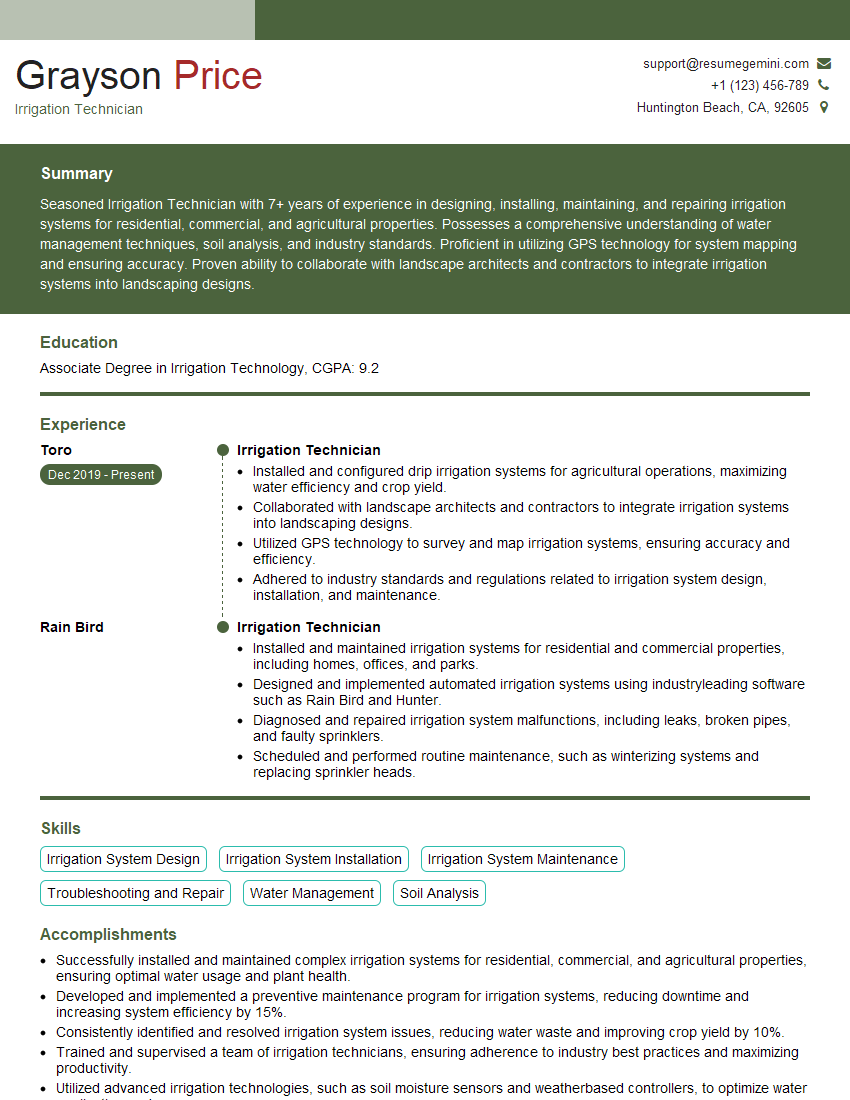
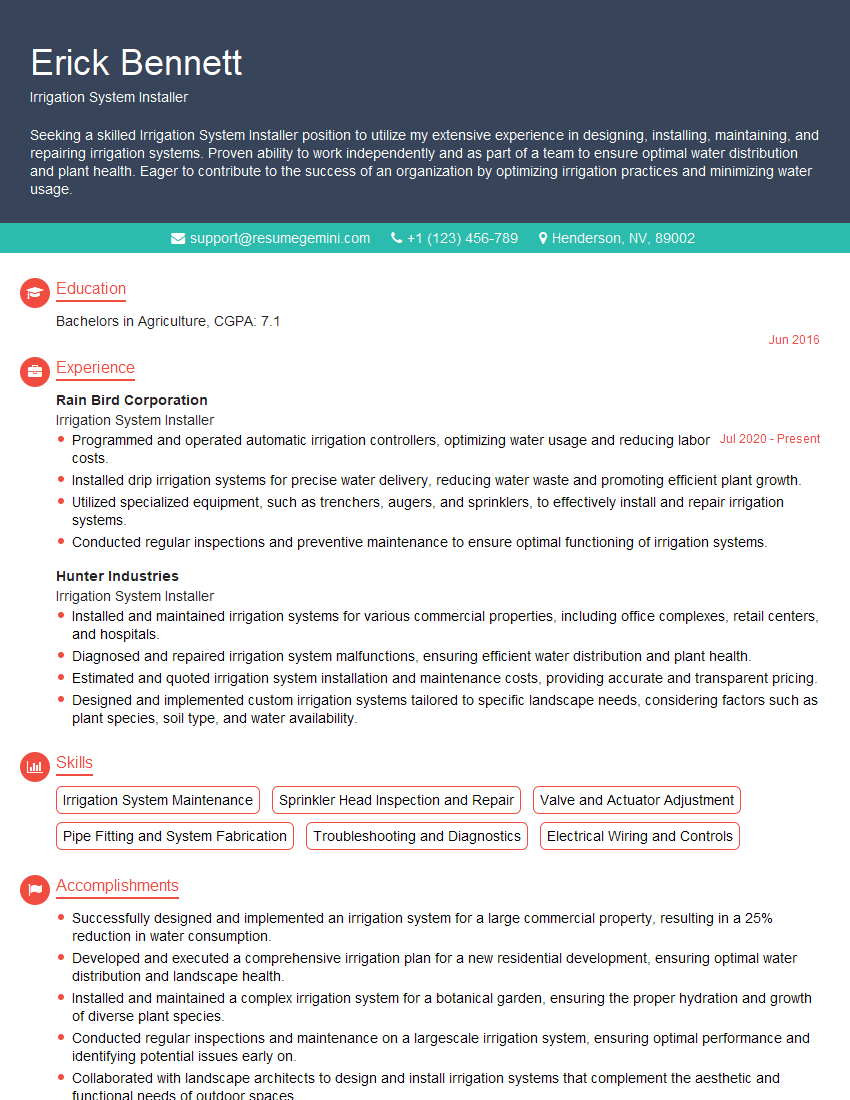
Mastering Precision Irrigation Techniques is crucial for career advancement in a field demanding efficiency and sustainability. Demonstrating a strong understanding of these techniques will significantly enhance your job prospects. To increase your chances of landing your dream role, create an ATS-friendly resume that effectively showcases your skills and experience. ResumeGemini is a trusted resource that can help you build a professional and impactful resume tailored to the specific demands of Precision Irrigation Techniques roles. Examples of resumes tailored to this field are available to help guide you through the process. Invest in your resume – invest in your future.

Explore more articles
Users Rating of Our Blogs
Share Your Experience
We value your feedback! Please rate our content and share your thoughts (optional).
What Readers Say About Our Blog
I Redesigned Spongebob Squarepants and his main characters of my artwork.
https://www.deviantart.com/reimaginesponge/art/Redesigned-Spongebob-characters-1223583608
IT gave me an insight and words to use and be able to think of examples
Hi, I’m Jay, we have a few potential clients that are interested in your services, thought you might be a good fit. I’d love to talk about the details, when do you have time to talk?
Best,
Jay
Founder | CEO