Are you ready to stand out in your next interview? Understanding and preparing for RTK and Network RTK Surveying interview questions is a game-changer. In this blog, we’ve compiled key questions and expert advice to help you showcase your skills with confidence and precision. Let’s get started on your journey to acing the interview.
Questions Asked in RTK and Network RTK Surveying Interview
Q 1. Explain the difference between RTK and Network RTK surveying.
Both RTK (Real-Time Kinematic) and Network RTK surveying use GPS signals to achieve centimeter-level accuracy, but they differ in how they obtain correction data. RTK uses a single base station located near the survey area to transmit corrections to a rover, while Network RTK uses a network of base stations across a wider region. Think of it like this: RTK is like having a dedicated personal assistant correcting your measurements, whereas Network RTK is like having access to a vast team of assistants across a wider area, providing corrections even if you’re far from a single base station.
In essence, RTK is a point-to-point correction system, requiring line-of-sight between base and rover. Network RTK, however, leverages a network of base stations and a communication network (often cellular or radio) to provide corrections regardless of the rover’s proximity to a specific base station. This makes Network RTK more flexible and suitable for larger projects or areas with challenging terrain.
Q 2. Describe the components of an RTK GPS system.
A typical RTK GPS system consists of several key components:
- Base Station: A receiver with a precisely known location (often surveyed using high-accuracy methods). It continuously monitors GPS signals and calculates corrections.
- Rover: A portable receiver that moves around the survey area. It receives GPS signals and correction data from the base station to determine its precise location.
- Radio Modem (or other communication link): Enables the transfer of correction data between the base and rover in real-time. Common methods include radio, cellular networks, or even internet connections.
- Data Logger/Controller: Records the rover’s coordinates and other relevant data. This may be integrated into the rover or a separate device.
- Processing Software: Software that processes the raw GPS data and correction information to calculate accurate coordinates.
Some systems also include features such as antennas, batteries, and specialized poles to optimize performance and usability in the field.
Q 3. What are the sources of error in RTK surveying, and how can they be mitigated?
Several sources of error can affect the accuracy of RTK surveys. These include:
- Atmospheric Delays: Ionospheric and tropospheric delays affect GPS signal propagation. These can be mitigated using advanced atmospheric models and precise point positioning (PPP) techniques within Network RTK systems.
- Multipath Errors: Reflections of GPS signals from surfaces like buildings or water can introduce inaccuracies. Careful antenna placement and signal processing techniques help reduce these errors.
- Satellite Geometry (GDOP): Poor satellite geometry (high GDOP) can lead to reduced accuracy. Planning surveys for optimal satellite visibility minimizes this error.
- Receiver Noise: Electronic noise in the receivers can affect the accuracy of measurements. High-quality receivers and careful calibration minimize this.
- Cycle Slips: Interruptions in the GPS signal can cause cycle slips, leading to large errors. Using robust receivers and strong communication links mitigates this.
Mitigation strategies include using high-quality equipment, carefully planning the survey, employing advanced processing techniques, and implementing rigorous quality control procedures. Regular calibration and maintenance of equipment is also crucial.
Q 4. What are the advantages and disadvantages of RTK and Network RTK?
RTK Advantages:
- Relatively simple setup and operation.
- Cost-effective for smaller projects with a localized base station.
- High accuracy achievable within the range of the base station.
RTK Disadvantages:
- Limited range due to line-of-sight requirement between base and rover.
- Requires a skilled operator to set up and operate.
- Not suitable for large projects spanning wide areas.
Network RTK Advantages:
- Greater coverage area due to reliance on a network of base stations.
- No line-of-sight requirement between rover and a specific base station.
- Improved efficiency for larger projects.
Network RTK Disadvantages:
- Higher cost due to reliance on subscription-based correction services.
- Dependent on the availability and reliability of the correction network and communication infrastructure.
- Can be affected by signal interference or outages within the network.
Q 5. Explain the concept of base station setup and its importance.
Base station setup is critical to the accuracy of an RTK survey. The base station’s location must be known with high precision. This is usually achieved through techniques like precise point positioning (PPP), or by tying the base station into a known control point using traditional surveying methods. The base station’s coordinates are essential for calculating the corrections applied to the rover’s measurements.
Imagine trying to draw a perfect circle without knowing your starting point – it’s impossible! Similarly, without a precisely known base station position, the corrections relayed to the rover are inaccurate, leading to errors in the final survey data. Factors like stable location, clear view of the sky, and proper antenna grounding are crucial for successful base station setup. A poorly set-up base station will lead to inaccurate results regardless of how good the rest of the equipment is.
Q 6. How do you ensure data quality and accuracy in RTK surveys?
Ensuring data quality and accuracy in RTK surveys involves a multi-faceted approach:
- Proper Equipment Calibration and Maintenance: Regularly calibrate receivers and antennas to ensure optimal performance.
- Optimal Base Station Setup: Select a location with minimal obstructions and a clear view of the sky.
- Careful Rover Operation: Avoid obstructions and multipath errors. Maintain a stable signal connection.
- Post-processing: Verify the data for any obvious errors or inconsistencies. Use post-processing software to refine the results if needed.
- Quality Control Checks: Conduct regular checks on the data using independent measurements or known control points.
- Environmental Considerations: Account for atmospheric conditions and their impact on GPS signal propagation.
By adhering to these practices, surveyors can significantly improve the reliability and accuracy of their RTK survey data.
Q 7. What are the different types of RTK correction services available?
Several types of RTK correction services are available, categorized mainly by their transmission method and coverage area:
- Radio-Based Corrections: These corrections are transmitted via radio waves to the rover. The range is limited by the radio’s power and line-of-sight restrictions, but they usually offer high update rates for real-time accuracy.
- Cellular-Based Corrections: Corrections are sent via cellular networks. This expands the coverage area, eliminating line-of-sight limitations, but update rates might be slower compared to radio.
- Internet-Based Corrections (Network RTK): A network of base stations across a wider area provides corrections, transmitted over the internet. This offers the widest coverage but depends on a reliable internet connection.
- Various Correction Formats: Different providers use various correction data formats like RTCM, CMR, or proprietary formats. Compatibility between the rover and base station (or network provider) is crucial.
The choice of correction service depends on the project’s specific needs, such as the size of the survey area, budget, and required accuracy.
Q 8. Describe your experience with post-processing RTK data.
Post-processing RTK data is crucial for achieving the highest accuracy in surveying. It involves taking the raw data collected by the rover receiver and using it, along with base station data, in specialized software to refine the coordinates. This process accounts for atmospheric delays and other errors that can’t be corrected in real-time. Think of it like taking a slightly blurry photo and then using editing software to sharpen it up. Instead of a photo, we’re refining GPS coordinates.
My experience includes processing data from various RTK systems using several software packages. A typical workflow involves importing the raw RINEX files from both the rover and base station. The software then uses precise ephemeris data (highly accurate satellite orbit information) to correct for satellite position errors. Furthermore, atmospheric models are employed to account for the ionospheric and tropospheric delays that affect signal propagation. The output is a highly accurate set of coordinates for each point surveyed, often with centimeter-level precision.
For example, I once worked on a project where the initial RTK measurements had some inconsistencies due to challenging terrain. Through post-processing with precise ephemeris and atmospheric correction, we achieved sub-centimeter accuracy, which was critical for the precision engineering project.
Q 9. How do you handle signal obstructions or multipath errors in RTK surveying?
Signal obstructions and multipath errors are common challenges in RTK surveying. Multipath occurs when the GPS signal reflects off surfaces like buildings or water before reaching the receiver, leading to inaccurate position estimations. Obstructions, such as trees or buildings, can simply block the signal entirely.
To mitigate these, we employ several strategies. Firstly, careful site selection is key. Choosing locations with clear sky view is paramount. If obstructions are unavoidable, we may need to take multiple measurements from different positions to average out errors. Secondly, advanced RTK receivers can identify and filter multipath signals using sophisticated algorithms. These algorithms analyze the characteristics of incoming signals and discard those that show signs of multipath interference. Finally, during post-processing, careful analysis of the data is crucial. Flagging points with low signal quality or those exhibiting clear signs of multipath is essential to maintain data integrity. If a point has exceptionally poor quality data, it may be necessary to re-observe that location.
Imagine trying to find your way using only a compass and sometimes a nearby landmark isn’t visible (obstruction), or your compass needle keeps wavering slightly (multipath). We use various techniques to ensure we get a reliable fix on our location.
Q 10. What software are you proficient in for processing RTK data?
I am proficient in several software packages for processing RTK data, including but not limited to:
- RTKPOST: A widely used and robust post-processing software capable of handling various data formats and providing detailed quality control reports.
- Trimble Business Center (TBC): A comprehensive software suite offering a complete workflow, including data collection, processing, and visualization.
- AutoCAD Civil 3D: While primarily a CAD software, it offers robust tools for importing and working with processed RTK data.
My familiarity extends to understanding the intricacies of various file formats such as RINEX and specific processing techniques involved in error mitigation and data quality control. Each software has its strengths, and selecting the appropriate one depends on the specific project requirements and the available data.
Q 11. Explain the concept of Differential GPS (DGPS).
Differential GPS (DGPS) improves the accuracy of GPS by using a second receiver located at a known position (a base station). The base station continuously tracks the same satellites as the rover (your moving receiver) and detects the errors in the GPS signals. This error information is then transmitted to the rover, which uses it to correct its own position readings.
Think of it like having a friend who already knows the exact location of a landmark. They tell you how far off your estimation is, allowing you to correct your position. While DGPS improves accuracy, RTK is far more precise because it utilizes carrier phase measurements, offering centimeter-level accuracy whereas DGPS usually offers only meter-level accuracy.
Q 12. What is the role of a rover in an RTK survey?
In an RTK survey, the rover is the mobile receiver that collects the data at each point to be surveyed. It’s the ‘eyes and ears’ on the ground. It communicates wirelessly with the base station, receiving corrections to its raw GPS measurements in real-time (or recording data for later post-processing). The rover is equipped with an antenna, a GPS receiver, and often data logging capabilities. The accuracy of the final coordinates directly depends on the precise functioning and positioning of the rover.
Imagine a treasure hunt where the base station is your headquarters with a precise map, and the rover is you searching for the treasure (survey points). The base station constantly guides you towards the correct location.
Q 13. How do you select appropriate control points for a survey?
Selecting appropriate control points is critical for any survey. Control points are points with known, highly accurate coordinates that serve as references for the entire survey. They anchor the survey and allow us to accurately determine the positions of all other points.
Several factors guide the selection:
- Distribution: Control points should be strategically distributed throughout the survey area to minimize error propagation. A good distribution ensures that no area is too far from a control point.
- Accessibility: Points should be easily accessible and visible to the GPS receiver. Obstructions should be minimal.
- Stability: Control points should be stable features that won’t move over time. This might involve using permanent markers like benchmarks or referencing fixed infrastructure.
- Elevation variation: To account for elevation changes, control points should span the range of elevations within the survey area.
Poor control point selection can lead to significant errors that propagate throughout the entire survey. Therefore careful planning and consideration are essential before the survey even begins. I often use existing control points from previous surveys if available and feasible.
Q 14. Describe your experience with different types of survey equipment.
My experience encompasses a variety of RTK survey equipment from leading manufacturers. This includes different models of receivers from companies such as Trimble, Leica, and Topcon. I am familiar with both single-frequency and dual-frequency receivers, understanding the trade-offs between cost, accuracy, and signal robustness of each type. I’ve also worked with various antenna types, including geodetic-grade antennas for high-precision applications and more compact antennas suitable for smaller-scale projects. Furthermore, I have experience using different data collectors and software packages for controlling and recording data from the receivers.
For instance, I used a Trimble R10 GNSS receiver with a high-precision antenna for a large-scale land surveying project. The dual-frequency capabilities and superior signal processing capabilities were essential to overcoming challenges in the dense urban environment where the project was situated. In other projects, I may have utilized a lighter, more compact system when high precision wasn’t as critical.
Q 15. Explain your understanding of coordinate systems and datums.
Coordinate systems and datums are fundamental to surveying. A coordinate system defines a grid on the Earth’s surface used to express locations numerically. Think of it like a giant graph paper draped over the planet. Common examples include Universal Transverse Mercator (UTM) and State Plane Coordinate Systems (SPCS). Each coordinate system has a specific projection, essentially a mathematical transformation that flattens the Earth’s curved surface onto a 2D plane, introducing some inherent distortion. The less distortion you want, the smaller the area your coordinate system covers.
A datum, on the other hand, is a reference surface that approximates the Earth’s shape. It defines the origin and orientation of the coordinate system. Think of it as the foundation upon which the graph paper is laid. Different datums use different mathematical models to represent the Earth, leading to slight differences in coordinate values for the same point. Examples include NAD83 (North American Datum of 1983) and WGS84 (World Geodetic System 1984), which are commonly used in North America and GPS respectively. Choosing the correct coordinate system and datum is critical for ensuring accuracy and consistency in surveying projects, as using incompatible systems can lead to significant errors.
For instance, a project using NAD83 in a local State Plane Coordinate system needs consistent use of both to prevent errors. Mixing NAD83 with WGS84, even if within the same coordinate system, introduces minor yet potentially significant coordinate discrepancies, especially in extensive projects.
Career Expert Tips:
- Ace those interviews! Prepare effectively by reviewing the Top 50 Most Common Interview Questions on ResumeGemini.
- Navigate your job search with confidence! Explore a wide range of Career Tips on ResumeGemini. Learn about common challenges and recommendations to overcome them.
- Craft the perfect resume! Master the Art of Resume Writing with ResumeGemini’s guide. Showcase your unique qualifications and achievements effectively.
- Don’t miss out on holiday savings! Build your dream resume with ResumeGemini’s ATS optimized templates.
Q 16. How do you manage data and documentation in a survey project?
Data and documentation management are crucial for the success and legal defensibility of any survey project. I use a structured approach involving both physical and digital systems. Physically, I maintain organized field books, meticulously recording all measurements, observations, and sketches. Each page is clearly dated and referenced. Digitally, I rely on dedicated survey software packages which allow for efficient data entry and quality control. These software packages provide tools to check data for inconsistencies and errors and allow easy importing of data from different RTK instruments. Raw data, processed data, and final reports are stored in a secure, organized system with version control, ensuring that previous versions are accessible if needed.
Metadata is crucial; every file is properly named and tagged with relevant information such as project name, date, location, and equipment used. I use cloud storage with access control to ensure data backup and team collaboration while maintaining data integrity. Furthermore, all project documentation (including contracts, permits, and client communications) is meticulously stored and organized in a central, easily accessible location. This comprehensive approach guarantees data integrity, facilitates future reference, and ensures compliance with industry standards and legal requirements. This is essential in case of any disputes or future reference to the survey.
Q 17. What are the safety procedures you follow during RTK surveying?
Safety is paramount in RTK surveying. Before any fieldwork, I conduct a thorough site assessment identifying potential hazards such as uneven terrain, overhead obstructions (power lines, trees), traffic, and nearby excavation activities. I always wear appropriate personal protective equipment (PPE), including high-visibility clothing, safety boots, and hard hats. When working near roads or in high-traffic areas, I employ traffic control measures like cones, warning signs, and flaggers. I ensure the RTK equipment is correctly grounded to prevent electrical hazards and maintain safe distances from energized equipment. Team communication is vital, with regular check-ins to ensure everyone’s safety and awareness of potential risks. I always adhere to local regulations and company safety protocols, and ensure the appropriate safety briefing before commencement of work. In case of emergencies, I know the location of emergency services and have a communication plan in place.
Q 18. How do you troubleshoot common problems encountered during RTK surveying?
Troubleshooting in RTK surveying often involves systematically checking various aspects of the setup and data acquisition. Common problems include:
- Loss of signal: This could be due to atmospheric interference (heavy rain, foliage), obstructions, or receiver/base station issues. The first step is checking satellite visibility using the RTK receiver’s diagnostics. Then verifying base station connectivity and antenna alignment. Obstructions should be identified and moved.
- Poor accuracy: This often points to issues with base station positioning, multipath (signal reflections), or cycle slips. Checking the base station’s coordinates and signal strength is crucial. Careful antenna placement helps mitigate multipath. Cycle slips may require restarting the RTK session.
- Equipment malfunctions: Malfunctioning equipment demands a methodical approach. Start by checking power sources, cables, and antenna connections. If the problem persists, consider replacing components and logging details for further technical support.
A systematic approach involving thorough checks, understanding the RTK system components, and access to technical support enables effective troubleshooting.
Q 19. Describe your experience with various RTK antenna types and their applications.
I have experience with various RTK antenna types, each suited to different applications. Geodetic antennas, with their high accuracy and stability, are ideal for high-precision base stations and demanding applications like cadastral surveys. Compact antennas offer portability and convenience, making them suitable for smaller projects or fieldwork where maneuverability is important. Choke ring antennas are designed to suppress multipath errors, especially in urban environments with many reflective surfaces. High-frequency antennas can provide improved performance in challenging environments with limited satellite visibility. The selection of antenna depends heavily on the specific needs of the project—accuracy requirements, environmental conditions, and budget considerations.
For instance, in a dense urban environment, a choke ring antenna would be preferred to minimize multipath effects. Conversely, for a rapid, less demanding survey in an open area, a compact antenna might suffice.
Q 20. Explain the significance of real-time kinematic (RTK) positioning.
Real-Time Kinematic (RTK) positioning provides centimeter-level accuracy in real-time, revolutionizing surveying and various other positioning applications. It achieves this high accuracy by utilizing a network of base stations transmitting correction data to the rover unit. Unlike traditional GPS, which provides only meter-level accuracy, RTK drastically improves precision by correcting for errors inherent in satellite signals, such as atmospheric delays and satellite clock errors. This near-instantaneous feedback allows surveyors to make precise measurements during the surveying process, rather than post-processing data afterwards. The real-time accuracy is a significant improvement, enabling rapid completion of surveys and minimizing the need for subsequent checks.
This real-time capability significantly improves efficiency and reduces the overall project time. The accuracy enables applications like precision agriculture, construction layout, and deformation monitoring that rely on very precise location data.
Q 21. What is the difference between static and kinematic GPS surveying?
Static GPS surveying involves long observation sessions (often hours) at a fixed point to achieve high accuracy. Think of it as meticulously measuring a point with a very accurate ruler over a long time. Multiple satellites are observed to minimize errors. The data collected needs post-processing, often requiring specialized software, to achieve centimeter-level precision. This method is best for establishing control points or highly accurate baselines.
Kinematic GPS surveying, on the other hand, involves continuously moving the receiver while collecting data. Imagine walking with the ruler, continuously taking measurements as you move. While still using multiple satellites, post-processing may be needed, but some receivers offer real-time kinematic (RTK) processing which provides immediate, centimeter-level accurate positions. This makes it much faster and more suitable for tasks like mapping and boundary surveys. RTK is a sub-type of kinematic surveying that leverages real-time correction data for immediate accuracy.
The choice between static and kinematic depends on the project’s accuracy requirements, time constraints, and the type of survey being conducted.
Q 22. How does Network RTK improve upon the capabilities of traditional RTK?
Traditional RTK (Real-Time Kinematic) surveying relies on a base station and a rover, both equipped with GPS receivers. The base station is positioned at a known location, and its data is used to correct the rover’s measurements in real-time, providing centimeter-level accuracy. Network RTK significantly enhances this by replacing the single base station with a network of base stations strategically located across a wider geographic area. This network provides corrections to the rover, even in challenging environments where a single base station might have limited reach or suffer from signal obstructions. Think of it like this: a single lighthouse only helps ships within a certain radius, while a network of lighthouses provides guidance across a much larger area.
The key improvements Network RTK offers are:
- Increased Coverage Area: Access to precise positioning data in areas previously inaccessible to traditional RTK due to distance or obstacles.
- Improved Reliability: The redundancy of multiple base stations ensures that the system can continue to provide corrections even if one station is temporarily unavailable.
- Reduced Costs: No need to establish and maintain your own base station, lowering operational expenses. You only need a rover receiver and a connection to the network.
- Simplified Workflow: Easier setup and reduced logistical burden compared to setting up and managing your own base station.
Q 23. Describe your understanding of CORS networks and their benefits.
CORS (Continuously Operating Reference Stations) networks are the backbone of Network RTK. They consist of multiple permanently installed GPS/GNSS base stations with precise known coordinates. These stations continuously collect data, which is processed and transmitted to users via a network connection (often cellular or radio). The data is used to create highly accurate correction models.
The benefits of CORS networks include:
- High Accuracy: The continuous operation and precise calibration of CORS stations provide highly reliable correction data.
- Wide Area Coverage: Extensive coverage spans broad geographical areas, eliminating the need for users to set up their own base stations.
- Cost-Effectiveness: Users pay a subscription fee for access, which is often far more affordable than establishing and maintaining a private base station network.
- Accessibility: CORS networks are readily accessible through various service providers, simplifying the process of obtaining precise positioning data.
- Improved Data Quality: Advanced processing techniques used by CORS network operators often provide superior quality corrections compared to those derived from a single base station.
Q 24. Explain your experience with different types of RTK applications (e.g., construction, mining).
I have extensive experience in various RTK applications, particularly in construction and mining. In construction, RTK is crucial for precise machine control, stakeout of buildings and infrastructure, and as-built surveys. For instance, I’ve used RTK to guide excavators in precisely digging foundations, ensuring that they meet the required dimensions and elevations. This minimizes material waste and saves time.
In mining, RTK is essential for high-precision surveying of open-pit mines, underground mine development, and the monitoring of mine stability. I’ve been involved in projects where RTK was used to accurately map ore bodies, control the positioning of drilling equipment, and monitor the movement of mine walls to prevent collapses. The precision afforded by RTK reduces safety risks and enhances operational efficiency.
Beyond these sectors, I’ve also worked on utility mapping projects, where the accuracy of RTK is essential for precisely locating underground pipelines and cables.
Q 25. How do you assess the accuracy of your RTK measurements?
Assessing the accuracy of RTK measurements involves several steps. First, I always check the signal quality indicators on the receiver. Poor satellite geometry or signal interference can significantly impact accuracy. Next, I examine the reported position errors provided by the RTK system itself (usually in terms of standard deviations). These errors should always be within the specified accuracy limits of the equipment and the chosen correction service.
Furthermore, I perform regular calibrations and check the equipment for any faults. Periodically, I conduct independent checks by comparing my RTK measurements to known control points or by using other independent surveying methods. For instance, I might use total station measurements to verify the accuracy of key points obtained using RTK.
Finally, I meticulously document all the measurements, along with their associated uncertainties, to ensure complete traceability and transparency. This allows for thorough assessment and minimizes the chances of errors going undetected.
Q 26. Explain your understanding of error propagation in RTK surveying.
Error propagation in RTK surveying refers to how uncertainties in measurements accumulate and affect the final results. Errors can originate from various sources, including atmospheric effects, multipath errors (signals reflecting off surfaces), satellite clock errors, and receiver noise. These individual errors combine to influence the overall accuracy of the final coordinates.
Understanding error propagation is crucial for proper quality control. For example, a small error in the initial base station coordinates will be amplified in the coordinates calculated for points further away from the base station. This is why careful planning of base station placement and the selection of appropriate correction methods are so important.
I employ several strategies to mitigate error propagation. These include selecting suitable RTK settings, careful planning of survey design (base station location and rover trajectories), monitoring signal quality throughout the survey, and implementing rigorous quality control procedures, such as data validation and outlier detection.
Q 27. Describe your experience with data logging and transfer in RTK surveying.
Data logging and transfer in RTK surveying are critical for efficiency and project management. Modern RTK receivers typically log data directly onto internal memory cards or to external data loggers, recording coordinates, timestamps, and other relevant information. The data format varies depending on the equipment and software used, but common formats include .txt, .csv, and proprietary formats specific to the manufacturer.
Data transfer methods include direct download via cable connection, Bluetooth, or wireless communication. Many receivers can communicate directly with field computers, allowing for immediate data processing and visualization. Some systems even allow for data uploading to cloud-based storage for centralized data management and sharing. I always ensure that a backup of the data is created and stored securely. Data integrity is paramount. Data security practices are adhered to with appropriate password protection and data encryption. This helps in ensuring long term security and usability of collected data.
Q 28. How do you manage project timelines and budgets effectively in RTK surveying?
Effective management of project timelines and budgets in RTK surveying requires careful planning and execution. This starts with a thorough understanding of the project scope, including the area to be surveyed, the required accuracy, and the complexity of the terrain. I typically develop a detailed survey plan that outlines the specific tasks, resources needed (equipment, personnel), and estimated time required for each stage. This plan helps in creating a realistic project timeline and budget.
Throughout the project, I regularly monitor progress against the plan, identifying and addressing any potential delays or cost overruns promptly. I leverage technology, such as project management software, to track progress and communicate effectively with clients and team members. Efficient utilization of equipment, proper planning of routes, and avoidance of unnecessary rework are key factors in optimizing both time and cost. I also proactively communicate any potential issues to stakeholders to manage expectations effectively.
Key Topics to Learn for RTK and Network RTK Surveying Interview
- RTK Fundamentals: Understanding the principles of Real-Time Kinematic (RTK) GPS, including carrier phase measurements, differential corrections, and base station setup.
- Network RTK: Differentiating between RTK and Network RTK, exploring the advantages of using a network correction service, and understanding its limitations.
- GNSS Constellations: Familiarity with different global navigation satellite systems (GNSS) like GPS, GLONASS, Galileo, and BeiDou, and their impact on RTK accuracy and availability.
- Data Processing and Quality Control: Understanding data post-processing techniques, identifying and addressing potential errors, and implementing quality control measures to ensure data accuracy.
- Equipment and Software: Demonstrating knowledge of various RTK GPS receivers, data loggers, and survey software packages used in the field. Be prepared to discuss their capabilities and limitations.
- Practical Applications: Discuss real-world applications of RTK and Network RTK surveying, such as construction layout, topographic mapping, precise positioning for infrastructure projects, and asset management.
- Error Sources and Mitigation: Identify common sources of error in RTK and Network RTK surveys (e.g., atmospheric effects, multipath, obstructions) and explain strategies to mitigate them.
- Coordinate Systems and Transformations: Demonstrate a strong understanding of different coordinate systems (e.g., UTM, State Plane) and the ability to perform coordinate transformations.
- Health and Safety: Discuss relevant safety procedures and best practices for working with RTK equipment in various field environments.
Next Steps
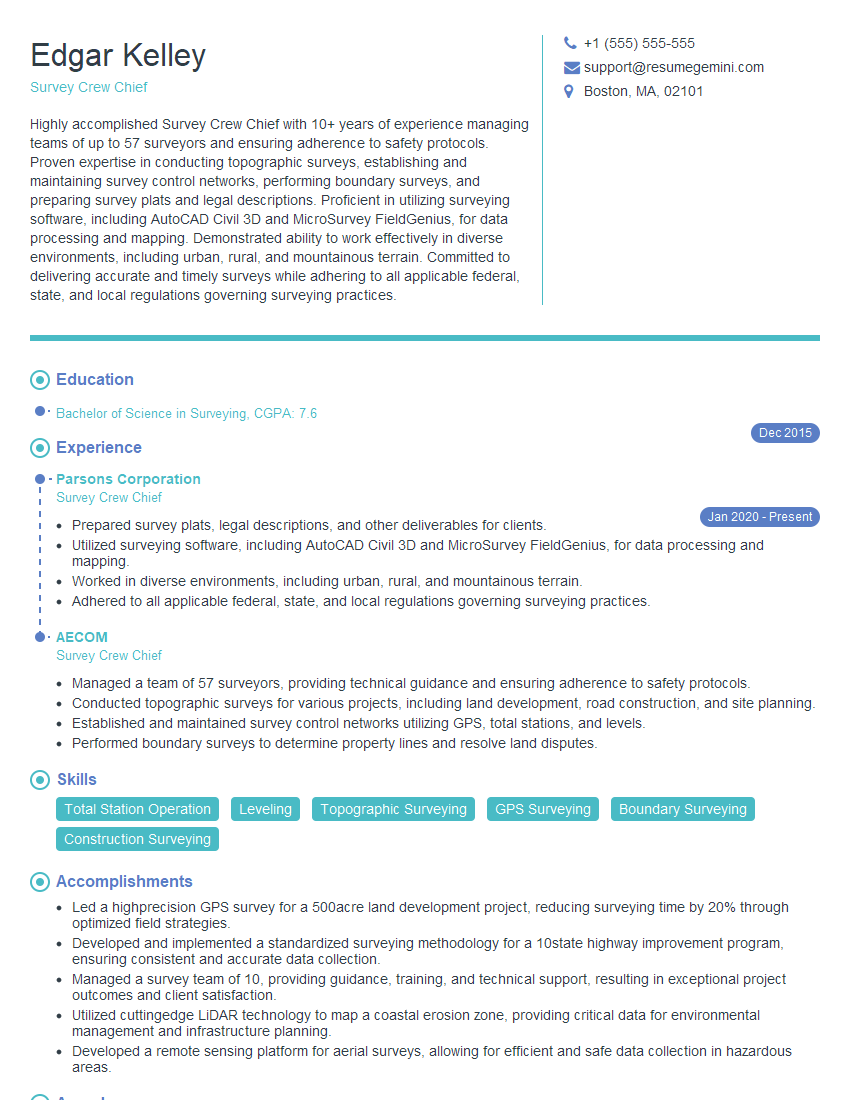
Mastering RTK and Network RTK surveying opens doors to exciting career opportunities in a rapidly growing field. To maximize your job prospects, it’s crucial to present your skills effectively. Creating an ATS-friendly resume is paramount. ResumeGemini is a trusted resource to help you build a professional resume that highlights your expertise. They offer examples of resumes tailored to RTK and Network RTK Surveying roles, helping you stand out from the competition and land your dream job. Invest the time in crafting a compelling narrative of your skills and experience – it’s an investment in your future.





Explore more articles
Users Rating of Our Blogs
Share Your Experience
We value your feedback! Please rate our content and share your thoughts (optional).
What Readers Say About Our Blog
I Redesigned Spongebob Squarepants and his main characters of my artwork.
https://www.deviantart.com/reimaginesponge/art/Redesigned-Spongebob-characters-1223583608
IT gave me an insight and words to use and be able to think of examples
Hi, I’m Jay, we have a few potential clients that are interested in your services, thought you might be a good fit. I’d love to talk about the details, when do you have time to talk?
Best,
Jay
Founder | CEO