Are you ready to stand out in your next interview? Understanding and preparing for Sorting and Processing Mail interview questions is a game-changer. In this blog, we’ve compiled key questions and expert advice to help you showcase your skills with confidence and precision. Let’s get started on your journey to acing the interview.
Questions Asked in Sorting and Processing Mail Interview
Q 1. Describe your experience with different mail sorting methods.
Mail sorting methods have evolved significantly, ranging from manual to highly automated systems. My experience encompasses a wide range, starting with the fundamental manual methods like face-sorting (sorting by visual inspection of addresses) and bar-code sorting (using handwritten or printed barcodes for automated sorting). I’ve also worked extensively with more advanced techniques.
- Manual Sorting: This involves physically examining each piece of mail and distributing it into designated trays or sacks based on destination, postal code, or other criteria. It’s labor-intensive but essential for smaller volumes or specialized mail.
- Automated Optical Character Recognition (OCR): This technology uses scanners to read addresses and automatically sort mail based on the extracted information. OCR is incredibly efficient for high-volume mail processing and significantly reduces manual handling.
- Intelligent Mail Barcode (IMB) Sorting: IMB is a barcode that contains detailed information about a mail piece, allowing for precise and efficient routing. This system provides tracking capabilities and facilitates mailpiece-level data analysis.
- Destination-Entry Sorting: This method involves sorting mail to the final delivery point, often using a combination of manual and automated systems, ensuring the mail reaches the correct post office quickly.
My experience includes managing and optimizing all these methods to achieve maximum efficiency, accuracy, and throughput, adapting strategies based on mail volume, type of mail, and available resources.
Q 2. How familiar are you with automated mail processing equipment?
I’m highly familiar with a wide array of automated mail processing equipment. My experience covers the operation, maintenance, and troubleshooting of various machines, including:
- Letter Sorting Machines (LSMs): These high-speed machines read addresses using OCR and sort mail into various destinations. I’ve worked with various LSM models, understanding their capabilities and limitations.
- Facer-Canceler Machines: These machines cancel postage and orient mail pieces for efficient processing, improving overall throughput.
- Barcode Sorters: These machines quickly sort mail based on pre-printed barcodes, crucial for efficient processing of pre-sorted mail.
- Mail Bagging Systems: These automated systems package sorted mail into bags ready for transport. I understand the importance of efficient bagging processes for minimizing transportation costs and improving delivery time.
Beyond the operation, I’m also comfortable with the preventative maintenance and troubleshooting associated with this equipment, reducing downtime and ensuring consistent performance. I understand the importance of adhering to safety protocols when operating heavy machinery.
Q 3. Explain your understanding of postal codes and zip codes.
Postal codes and zip codes are essential for efficient mail routing. Zip codes (in the United States) are five-digit codes that indicate a specific geographical area. Postal codes are used internationally and can be longer, often including alphanumeric characters. Both systems are crucial for directing mail efficiently. Think of them as a mail piece’s address in a digital format, used by automated sorting equipment.
Understanding the structure of these codes is crucial for sorting. For example, the first three digits of a US zip code indicate a sectional center facility, while the last two digits pinpoint a specific post office or delivery area. Variations in postal codes internationally can also reflect delivery area and additional sorting information. Incorrectly interpreting or applying these codes can significantly impact delivery times and even lead to mis-sorting and delays.
My experience includes utilizing this information for effective mail processing, especially in identifying and correcting errors in addressing, which helps to ensure accurate and timely delivery.
Q 4. What is your experience with high-volume mail processing?
I have extensive experience handling high-volume mail processing, often exceeding tens of thousands of pieces daily. This involved managing peak seasons like holidays and election periods. It required strategic planning, efficient resource allocation, and effective use of automated equipment to ensure smooth, timely processing. For example, during peak periods, I might implement strategies such as:
- Shift scheduling optimization: Adjusting staffing levels based on projected mail volume to handle surges.
- Equipment maintenance prioritization: Scheduling preventative maintenance during less busy periods to prevent disruptions during peak periods.
- Process improvement initiatives: Identifying bottlenecks and implementing new strategies to enhance overall throughput.
My experience includes successfully navigating unexpected surges in mail volume, by implementing contingency plans and effectively utilizing available resources to prevent any significant disruption to service. This involved coordinating with different teams and departments to ensure a cohesive and efficient workflow.
Q 5. How would you handle a backlog of mail?
Handling a mail backlog requires a systematic approach. The first step is to identify the root cause of the backlog. Is it due to equipment failure, staffing shortages, an unexpected surge in volume, or processing errors? Once the cause is identified, a tailored solution can be implemented.
My approach would involve:
- Assessing the backlog: Determining the size and nature of the backlog, including the types of mail involved and their urgency.
- Prioritizing mail: Focusing on urgent mail, such as express or certified mail, first. This ensures timely delivery of critical items.
- Allocating resources: Deploying additional staff, extending working hours, or utilizing overtime to expedite processing. If the backlog is due to equipment malfunction, I’d prioritize repairs and explore alternative processing methods.
- Implementing process improvements: Analyzing the workflow to identify and address any bottlenecks or inefficiencies that contributed to the backlog. This may involve retraining staff, optimizing equipment settings, or revising operational procedures.
- Monitoring progress: Regularly tracking progress in clearing the backlog and adjusting strategies as needed to ensure the timely delivery of all mail.
Throughout the process, clear communication and collaboration with all stakeholders are crucial to a successful resolution.
Q 6. Describe your proficiency in using mail sorting machines.
I am highly proficient in using various mail sorting machines. My skills range from basic operation and maintenance to advanced troubleshooting and optimization. I’m familiar with both the mechanical aspects and the software interfaces of these machines.
My expertise includes:
- Loading and unloading machines efficiently: Minimizing downtime and maximizing throughput.
- Operating machines according to safety protocols: Ensuring the safety of myself and my colleagues.
- Troubleshooting common malfunctions: Identifying and resolving issues quickly to minimize disruption.
- Performing routine maintenance: Keeping the machines in optimal operating condition.
- Understanding the software interfaces: Configuring settings for efficient sorting based on mail type and destination.
I can adapt quickly to new machine models and software updates, ensuring I maintain my efficiency and effectiveness regardless of the equipment used.
Q 7. How do you prioritize different classes of mail?
Prioritizing different classes of mail is critical for efficient delivery and meeting service level agreements. My approach is based on a combination of factors, including delivery deadlines, service type, and legal requirements.
Generally, the prioritization follows this order:
- Express Mail: This receives the highest priority due to its expedited delivery requirements and often higher fees.
- Certified Mail: This also takes priority due to its proof-of-delivery requirements. It needs to be processed and tracked accurately.
- Priority Mail: This is prioritized over standard mail to ensure faster-than-standard delivery.
- Standard Mail: This class of mail gets processed efficiently, but it’s typically not as time-sensitive as other mail classes.
In addition to these classes, some mail might have legal requirements or special handling instructions that take precedence over the standard priority order. For example, time-sensitive government documents or emergency medical correspondence would always be prioritized.
This process requires close attention to detail to avoid delays and ensure the efficient processing and delivery of all classes of mail according to their respective service level agreements.
Q 8. Explain your understanding of mail security protocols.
Mail security protocols are crucial for protecting sensitive information and ensuring the integrity of the postal system. They encompass a range of measures designed to prevent unauthorized access, tampering, and theft. These protocols vary depending on the type of mail (e.g., first-class mail, packages) and the level of security required.
Encryption: Sensitive mail can be encrypted using various methods, ensuring that only the intended recipient can access the contents. This is particularly important for financial documents or confidential business correspondence. For example, digitally encrypting electronic mail before printing and then physically securing it.
Physical Security: This involves measures like secure mail sorting facilities, access control systems, surveillance cameras, and armed guards to prevent theft and unauthorized access. I’ve personally overseen the implementation of additional security measures at a facility to meet new compliance standards.
Authentication and Verification: Methods like barcodes, tracking numbers, and electronic signatures help verify the origin and authenticity of mail, reducing the risk of fraudulent activities. This is key in preventing counterfeit mail or misdirected packages.
Data Security: In the context of electronic mail processing, robust cybersecurity measures are essential to protect against hacking, data breaches, and malware. This might involve firewalls, intrusion detection systems, and regular security audits, something I’ve been directly involved in.
Q 9. How do you ensure accuracy in mail sorting?
Accuracy in mail sorting is paramount to ensure timely and efficient delivery. We achieve this through a combination of automated and manual processes.
Automated Sorting Systems: These systems use Optical Character Recognition (OCR) technology to read addresses and zip codes, directing mail to the appropriate destinations automatically. Regular calibration and maintenance of these systems are crucial to ensure accuracy. In one instance, I identified a misalignment in the OCR scanner that was causing a significant number of mis-sorts, leading to a swift solution and preventing a substantial backlog.
Manual Sorting: While automation handles a large volume, manual sorting is necessary for items with illegible addresses, damaged envelopes, or those requiring special handling. Rigorous training for mail handlers, including regular quality checks and retraining sessions, is key to minimizing errors. This is further supported by a clear set of standard operating procedures and error reporting protocols. I’ve been responsible for training new personnel on these protocols.
Quality Control Measures: Regular audits and spot checks are conducted throughout the sorting process to identify and correct errors. This involves examining sorted mail samples to identify patterns or areas needing improvement. We use statistical process control to track error rates and initiate corrective actions whenever necessary.
Q 10. What is your experience with parcel sorting and handling?
My experience with parcel sorting and handling includes working with a wide range of package sizes and weights, requiring different handling techniques and equipment.
Automated Conveyor Systems: These systems use scanners to identify package destinations and route them accordingly. They require careful setup and management to prevent jams or mis-sorts. I’ve successfully troubleshoot jams in high-speed conveyor systems by identifying bottlenecks and implementing preventative maintenance procedures.
Manual Handling: Larger or oddly shaped parcels often require manual handling, necessitating careful lifting techniques and attention to detail to avoid damage. I’ve been certified in safe lifting and handling techniques and have trained others in these procedures.
Fragile Item Handling: Special care must be taken when handling fragile parcels, such as electronics or glassware. This often involves using protective packaging and specialized equipment and following specific handling protocols. I have experience with various types of fragile items and have a track record of preventing damage during sorting and transportation.
Q 11. How do you handle damaged or undeliverable mail?
Damaged or undeliverable mail requires a systematic approach to ensure compliance with postal regulations and customer satisfaction.
Damage Assessment: The extent of damage is assessed, and a determination is made whether it can be repaired or if it needs to be returned to the sender. I’ve developed procedures for effectively documenting the damage and taking appropriate actions.
Return to Sender: If the mail cannot be delivered, it’s returned to the sender with a clear explanation of the reason for non-delivery. Accurate documentation is crucial to ensure proper processing and avoid disputes. I’ve created and implemented an improved return-to-sender process that significantly reduced processing time and errors.
Disposal: Undeliverable mail that cannot be returned (e.g., severely damaged, no return address) is disposed of according to established procedures, which often include secure shredding to protect sensitive information. I have a deep understanding of the regulations related to proper disposal of undeliverable mail and strictly adhere to them.
Q 12. Describe your experience with mail tracking systems.
My experience with mail tracking systems involves using various technologies to monitor the movement of mail from origin to destination.
Barcode Scanning: This technology allows us to track individual pieces of mail throughout the sorting and delivery process. I have extensive experience using barcode scanners and understanding the data they provide.
GPS Tracking: For parcels, GPS tracking offers real-time location information, allowing for proactive monitoring and issue resolution. I understand the limitations and benefits of GPS tracking in various contexts and know when to apply it effectively.
Online Tracking Portals: Customers can use online portals to track their mail’s progress and receive updates on its status. I’m familiar with various online tracking systems and understand how to provide customers with accurate information.
Data Analysis: Tracking data is used for performance analysis, identifying bottlenecks, and improving efficiency. I’ve used tracking data to analyze and improve our delivery times and reduce lost mail incidents. I am proficient in extracting insights from tracking data using relevant tools and techniques.
Q 13. What is your knowledge of postal regulations and guidelines?
A strong understanding of postal regulations and guidelines is essential for efficient and compliant mail processing. This includes knowledge of:
Address Standardization: Following correct address formatting to ensure accurate delivery. I’m proficient in interpreting and applying various address formatting guidelines.
Mail Classification: Understanding the different classes of mail (e.g., First-Class Mail, Priority Mail) and their associated regulations. This knowledge is applied daily in directing mail to the appropriate processing streams.
International Mail Regulations: Navigating the complexities of international mail, including customs regulations and restrictions. I’ve handled countless international mail pieces and understand the various compliance needs.
Hazardous Materials Regulations: Proper handling and shipping of hazardous materials according to strict guidelines to ensure safety. I’ve received specific training in this area and can identify and handle hazardous materials appropriately.
Privacy Regulations: Adhering to privacy laws and regulations concerning the handling of sensitive information contained in mail. Data privacy and security are top priorities in my work, and I’m fully compliant with all relevant regulations.
Q 14. How do you maintain efficiency in a fast-paced mail processing environment?
Maintaining efficiency in a fast-paced mail processing environment requires a multi-faceted approach.
Process Optimization: Regularly evaluating and improving existing processes, identifying bottlenecks, and streamlining workflows. I have experience employing Lean methodologies to identify and eliminate waste in mail processing operations.
Technology Utilization: Leveraging automated sorting systems, barcode scanners, and other technologies to maximize throughput and accuracy. I’m skilled at using and troubleshooting various technologies related to mail processing.
Teamwork and Communication: Effective communication and collaboration among team members are crucial for efficient operation. I’ve developed and maintained good working relationships within teams to ensure smooth workflows.
Predictive Planning: Anticipating peak mail volumes and adjusting staffing and resources accordingly. This involves utilizing historical data and forecasting tools to make informed decisions.
Employee Training: Providing comprehensive training and ongoing development opportunities for employees to ensure they are equipped with the necessary skills and knowledge. I’ve led training sessions and mentored newer employees.
Q 15. How do you handle discrepancies in mail volume?
Handling discrepancies in mail volume requires a flexible and adaptable approach. Think of it like a restaurant adapting to a sudden rush of customers – you need to adjust your resources and processes quickly. My strategy involves a three-pronged approach: proactive planning, reactive adjustments, and post-analysis for future improvement.
Proactive Planning: Analyzing historical data to predict peak volumes (e.g., holiday seasons, bill payment deadlines) and proactively allocating resources (staff, equipment, space) accordingly. This could involve scheduling extra staff or activating overflow processing areas.
Reactive Adjustments: When unexpected surges occur, I prioritize workflow by focusing on time-sensitive mail. This might involve temporarily re-routing less urgent mail or implementing overtime for staff. Clear communication is key to keep everyone informed and coordinated.
Post-Analysis: After a peak volume period, I thoroughly review the performance to identify bottlenecks and areas for improvement. For instance, if a particular sorting machine proved inadequate, we might need to invest in faster equipment or explore alternative sorting methods. This continuous improvement cycle ensures future efficiency.
Career Expert Tips:
- Ace those interviews! Prepare effectively by reviewing the Top 50 Most Common Interview Questions on ResumeGemini.
- Navigate your job search with confidence! Explore a wide range of Career Tips on ResumeGemini. Learn about common challenges and recommendations to overcome them.
- Craft the perfect resume! Master the Art of Resume Writing with ResumeGemini’s guide. Showcase your unique qualifications and achievements effectively.
- Don’t miss out on holiday savings! Build your dream resume with ResumeGemini’s ATS optimized templates.
Q 16. Describe your experience with manual mail sorting.
My experience with manual mail sorting spans several years, encompassing various techniques and scenarios. Early in my career, I worked in a smaller facility where manual sorting was the primary method. This involved sorting mail by destination using a combination of zip codes, city names, and street addresses. It was meticulous work, requiring strong attention to detail and familiarity with geographical locations.
I quickly learned the importance of efficient organization and hand-eye coordination. We employed techniques like establishing clear sorting zones and utilizing different trays and bins for various destinations. While slower than automated systems, manual sorting provided valuable experience in understanding the mail processing flow and allowed for the detection of anomalies that might be missed by automated systems. It instilled a strong appreciation for the intricacies of address interpretation and the importance of accuracy.
Q 17. How do you identify and resolve mail processing errors?
Identifying and resolving mail processing errors is crucial for ensuring timely and accurate delivery. Errors can range from simple mis-sorts to more complex issues like undeliverable addresses. My approach follows a structured process:
Identification: Regular quality checks throughout the processing workflow are paramount. This includes visual inspections, barcode verification, and automated error detection systems. Any discrepancy is flagged for further investigation.
Analysis: Once an error is identified, I analyze the cause. Is it a human error (mis-sorting, incorrect address entry)? A machine malfunction (jammed sorter, barcode scanner failure)? A problem with the mail piece itself (illegible address, insufficient postage)?
Resolution: The solution depends on the cause. Human errors might require retraining or improved procedures. Machine malfunctions necessitate repair or maintenance. Undeliverable mail needs careful handling, potentially requiring address correction attempts or return to sender.
Prevention: After resolving the immediate issue, I focus on preventing recurrence. This might involve adjusting workflows, upgrading equipment, or providing additional training to staff. Regular audits and performance reviews help identify trends and address underlying issues.
Q 18. What is your experience with different types of mail (letters, parcels, etc.)?
My experience encompasses a wide range of mail types, including letters, parcels, flats (large envelopes), and packages of various sizes and weights. Each type presents unique challenges and requires specialized handling. For example:
Letters: These are typically processed through high-speed automated sorting machines, relying heavily on barcode reading and optical character recognition (OCR) for efficient routing. Manual intervention is needed for items with illegible addresses.
Parcels: These require more careful handling, often involving manual sorting and dimensional scanning to determine accurate postage and ensure proper packaging for transit. Security protocols may also be involved for high-value items.
Flats: These are larger than letters but smaller than parcels, requiring slightly different handling procedures compared to both.
Understanding the characteristics of each mail type, its associated processing steps, and any specific regulations (e.g., hazardous materials) is vital for efficient and safe mail handling.
Q 19. How do you adapt to changing mail processing procedures?
Adapting to changing mail processing procedures is an ongoing necessity in this dynamic industry. My approach is rooted in continuous learning and proactive engagement. I actively participate in training sessions and stay updated on industry best practices and technological advancements. I also embrace feedback and new methodologies. For instance, when our facility transitioned to a new mail sorting system, I actively participated in the training program, mastering the new software and hardware. I then helped train my colleagues, ensuring a smooth transition and minimizing disruptions to service. I view change not as a disruption, but as an opportunity for professional growth and enhanced efficiency.
Q 20. Describe your experience with using barcode scanners in mail processing.
Barcode scanners are essential tools in modern mail processing, significantly increasing efficiency and accuracy. My experience includes working with various types of barcode scanners, from handheld devices to integrated systems within automated sorting machines. I’m proficient in using these scanners to read and interpret barcodes, ensuring accurate routing of mail. I understand the importance of scanner maintenance, including regular cleaning and calibration, to maintain optimal performance and prevent errors. Furthermore, I’m familiar with troubleshooting common scanner issues and can identify and resolve problems quickly to minimize downtime. For example, if a scanner malfunctions, I can determine whether the problem is a software glitch, a hardware failure, or simply a dirty lens, and take the appropriate steps to fix it.
Q 21. How do you maintain workplace safety in a mailroom?
Maintaining workplace safety in a mailroom is paramount. It involves a multifaceted approach encompassing proactive measures, staff training, and strict adherence to safety regulations. This includes:
Ergonomics: Ensuring proper workstation setups to minimize repetitive strain injuries (RSIs). This may involve adjustable chairs, proper lighting, and sufficient space to work comfortably.
Heavy Lifting Procedures: Implementing safe lifting techniques for heavy parcels and utilizing appropriate equipment like dollies and lifting aids to prevent back injuries.
Sharp Objects: Implementing safety procedures for handling sharp objects like letter openers, and providing appropriate protective gear.
Hazardous Materials: Following strict guidelines for handling hazardous materials and ensuring their proper labeling and storage to avoid potential exposure or accidents.
Regular Inspections: Conducting regular safety inspections of the workplace to identify and mitigate potential hazards, such as tripping hazards or overloaded shelves.
Training and Communication: Providing comprehensive safety training to all staff, including the correct use of equipment and emergency procedures. Maintaining clear communication channels to report safety concerns.
Q 22. How familiar are you with different types of mail containers and equipment?
My familiarity with mail containers and equipment is extensive. I’ve worked with a wide range of items, from standard mail sacks and trays to high-speed automated sorting machines and specialized containers for different mail classes (e.g., oversized envelopes, parcels). This includes:
- Mail sacks: Various sizes and materials, used for transporting large volumes of mail between facilities.
- Sorts trays: Used for manual sorting and often color-coded for different destinations.
- Automated sorting machines: These machines utilize optical character recognition (OCR) and barcode scanning to sort mail efficiently. I’m proficient with various models, understanding their operational procedures and troubleshooting techniques.
- Pallet jacks and hand trucks: Essential for moving large quantities of mail within processing facilities.
- Specialized containers: These include containers for fragile items, international mail, and hazardous materials, each requiring specific handling procedures.
Understanding these containers and their appropriate use is crucial for efficient and safe mail processing. For instance, using the wrong type of sack for international mail could lead to delays or damage. My experience covers both manual and automated systems, which gives me a well-rounded perspective on the entire mail handling process.
Q 23. What is your experience with inventory management of mail supplies?
Inventory management of mail supplies is critical for maintaining smooth operations. My experience includes:
- Tracking supply levels: Regularly monitoring stock levels of items such as sacks, trays, labels, ink cartridges, and other consumables to prevent shortages.
- Ordering and receiving supplies: Placing orders with suppliers, tracking shipments, and ensuring timely delivery. This involves working with purchase orders and managing vendor relationships.
- Maintaining accurate records: Keeping detailed records of inventory levels, usage rates, and costs to optimize ordering and budgeting. I’m proficient in using inventory management software to streamline this process.
- Waste reduction: Implementing strategies to minimize waste and maximize the use of supplies, aligning with environmental responsibility. This includes proper disposal of used materials and exploring cost-effective alternatives.
For example, I once noticed a significant increase in the consumption of labels, prompting an investigation that revealed a minor machine malfunction causing wasted labels. By addressing the machine issue, we significantly reduced waste and saved the company money. My proactive approach ensures that we always have the necessary supplies to meet operational demands without unnecessary expenditure.
Q 24. How would you handle a situation where a piece of mail is missing?
If a piece of mail is missing, a systematic approach is essential. First, I would:
- Verify the mailpiece’s existence: Check the sorting logs and any tracking information available to confirm that the item was actually received and processed.
- Trace its route: Using tracking numbers or other identifiers, I would try to pinpoint where the mailpiece might have gone astray. This could involve reviewing security footage or contacting other departments.
- Review handling procedures: Determine if there were any irregularities in the processing steps that could have contributed to the loss. Were there any known issues with equipment or procedures at the time?
- Inform relevant parties: Depending on the importance of the mailpiece (e.g., registered mail, sensitive documents), I would promptly inform the sender and/or recipient, providing them with updates and outlining the steps taken to locate it.
- Document the incident: Maintain a thorough record of the incident, including the date, time, mailpiece description, investigation steps, and outcomes. This is crucial for improving future processes and preventing similar occurrences.
In essence, it’s a methodical investigation, ensuring a balance between prompt resolution and thorough process review.
Q 25. How do you manage your time effectively in a high-pressure environment?
In a high-pressure environment, effective time management is paramount. My strategies include:
- Prioritization: Focusing on urgent and important tasks first, using methods such as Eisenhower Matrix (Urgent/Important). This ensures that critical mail pieces are handled promptly.
- Workflow optimization: Identifying bottlenecks in the mail processing workflow and implementing improvements to streamline operations. For example, using faster sorting techniques or adjusting staff assignments.
- Multitasking efficiently: Juggling multiple tasks without compromising accuracy or speed, through careful planning and organization of work.
- Break scheduling: Taking short, regular breaks to avoid burnout and maintain focus. This contributes to higher overall productivity and accuracy.
- Delegation: Where appropriate, delegating tasks to team members effectively. This relies on good team communication and clear task assignments.
An analogy would be a conductor of an orchestra; each musician has a role, but the conductor ensures everyone is playing in harmony and at the right time to create a flawless performance. I aim to coordinate the mailroom like a conductor, leading the team to efficiency and meeting deadlines.
Q 26. Describe your experience working as part of a team in a mail processing setting.
I’ve consistently worked effectively in team environments within mail processing settings. My experience includes:
- Collaboration: Working seamlessly with colleagues to achieve common goals, such as meeting daily processing targets or handling unexpected surges in mail volume.
- Communication: Maintaining clear and concise communication with team members, supervisors, and other departments to ensure everyone is informed and aligned.
- Mutual support: Providing assistance and support to colleagues when needed, fostering a collaborative and supportive work environment.
- Conflict resolution: Addressing and resolving conflicts constructively, focusing on finding solutions that benefit the team and the overall mail processing operation.
- Team leadership (where applicable): Guiding and motivating team members, ensuring task completion and adherence to operational standards.
In one instance, during a particularly busy holiday season, we faced a significant backlog. Through effective teamwork and clear communication, we successfully adjusted our workflow and overcome the challenge, exceeding expectations despite the high pressure. Good team dynamics are essential for success in mail processing.
Q 27. How would you deal with a malfunctioning sorting machine?
If a sorting machine malfunctions, my response would be:
- Assess the situation: Immediately identify the nature of the malfunction – is it a minor issue (e.g., a paper jam) or something more serious (e.g., a mechanical failure)?
- Attempt basic troubleshooting: Based on my knowledge of the machine and standard operating procedures, I would attempt to rectify the issue. This could involve clearing jams, resetting the machine, or checking power connections.
- Contact maintenance: If basic troubleshooting doesn’t resolve the problem, I would immediately contact the designated maintenance personnel or vendor to report the malfunction and request repair.
- Implement contingency plans: While waiting for repair, I would implement contingency plans to minimize disruption. This could involve manual sorting of the mail or rerouting mail to alternative machines.
- Document the incident: Maintaining a detailed record of the malfunction, including the date, time, nature of the problem, steps taken, and repair time. This information is valuable for preventative maintenance and future problem solving.
My goal is to minimize downtime and ensure the continued flow of mail processing, protecting the integrity of the mail stream.
Q 28. What are your strategies for maintaining accuracy and speed in mail processing?
Maintaining accuracy and speed in mail processing involves a multi-faceted approach:
- Proper training and familiarization: Thorough training on mail processing procedures, equipment operation, and quality control measures is crucial. Regular refresher training keeps skills sharp.
- Attention to detail: Focusing intently on each mail piece to ensure correct sorting and handling, avoiding errors. This includes verifying addresses and adhering to processing guidelines.
- Efficient work techniques: Employing efficient sorting and handling techniques to maximize speed without compromising accuracy. This often involves ergonomic practices to prevent fatigue.
- Quality control checks: Implementing regular quality control checks to identify and correct errors, ensuring high accuracy rates. This could involve spot checks or random sampling of sorted mail.
- Continuous improvement: Constantly seeking ways to improve processes and increase efficiency while maintaining accuracy. This includes suggesting improvements to workflows, equipment, or training.
Using a system of regular checks and balances helps to identify and rectify issues promptly, enhancing accuracy and reducing errors. It’s akin to a chef constantly tasting their food – constant quality checks ensure that the final product is perfect.
Key Topics to Learn for Sorting and Processing Mail Interview
- Mail Classification: Understanding different mail classes (First-Class, Priority, Standard, etc.) and their associated processing procedures. This includes recognizing and handling various mail types, including parcels and packages.
- Automated Mail Processing: Familiarize yourself with the technology used in modern mail sorting facilities, such as automated sorting machines and barcode scanners. Understand the role of automation in improving efficiency and accuracy.
- Manual Mail Sorting: Mastering the techniques of manual sorting, including recognizing and interpreting addresses, postal codes, and other delivery information. Practice efficient sorting methods to minimize processing time.
- Mail Handling Procedures: Learn about proper mail handling techniques to prevent damage and ensure safe delivery. This includes understanding best practices for stacking, transporting, and securing mail.
- Postal Regulations and Compliance: Develop a strong understanding of relevant postal regulations and compliance procedures. This is crucial for maintaining accuracy and avoiding errors.
- Problem-solving and Troubleshooting: Be prepared to discuss how you would handle situations such as damaged mail, undeliverable mail, or addressing discrepancies. Highlight your ability to think critically and find solutions efficiently.
- Safety Procedures: Understand and be able to articulate the importance of adhering to safety regulations and protocols within a mail processing facility.
- Teamwork and Communication: Explain how you collaborate effectively in a team environment, particularly in a fast-paced setting. Discuss your communication skills and ability to work effectively with colleagues.
Next Steps
Mastering the skills related to Sorting and Processing Mail opens doors to a stable and rewarding career with opportunities for advancement. A well-crafted resume is your key to unlocking these opportunities. Creating an ATS-friendly resume is crucial for getting your application noticed by employers. To make this process easier and more effective, we strongly recommend using ResumeGemini to build a professional and impactful resume. ResumeGemini provides examples of resumes tailored to Sorting and Processing Mail positions to help you create a document that showcases your qualifications effectively.
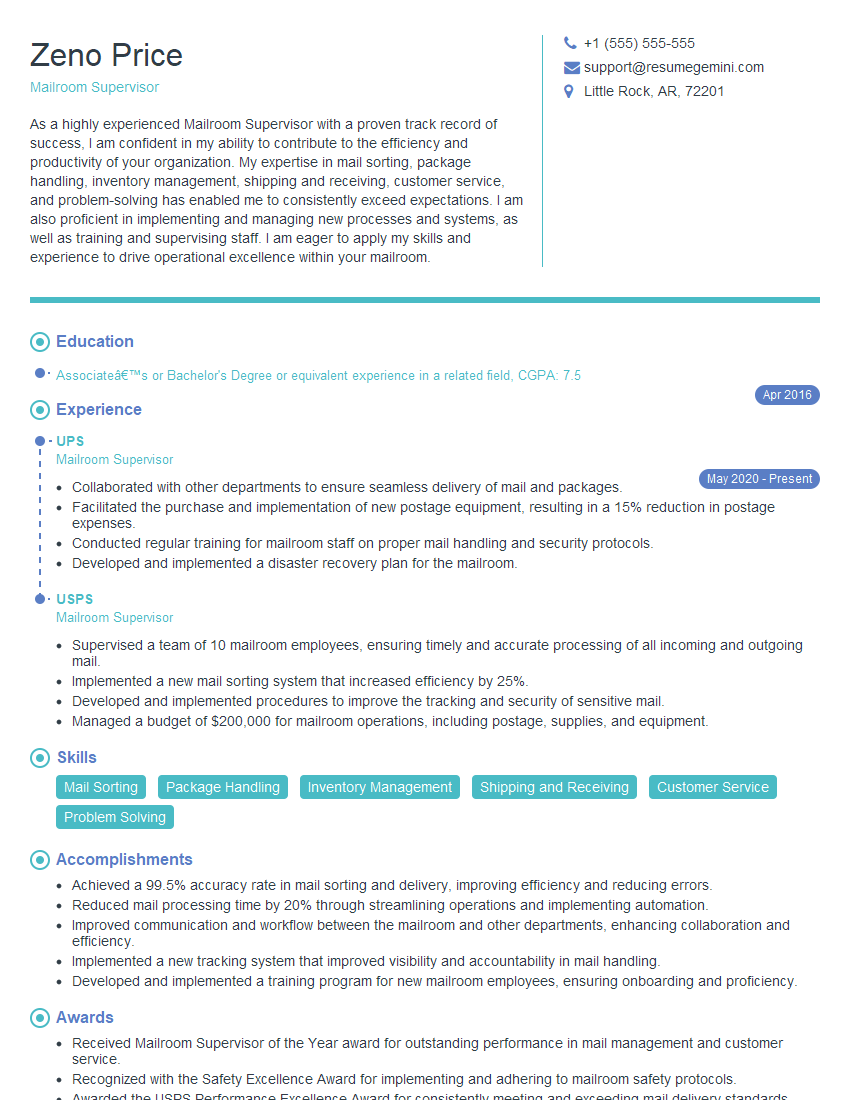
Mailroom Supervisor Resume Sample
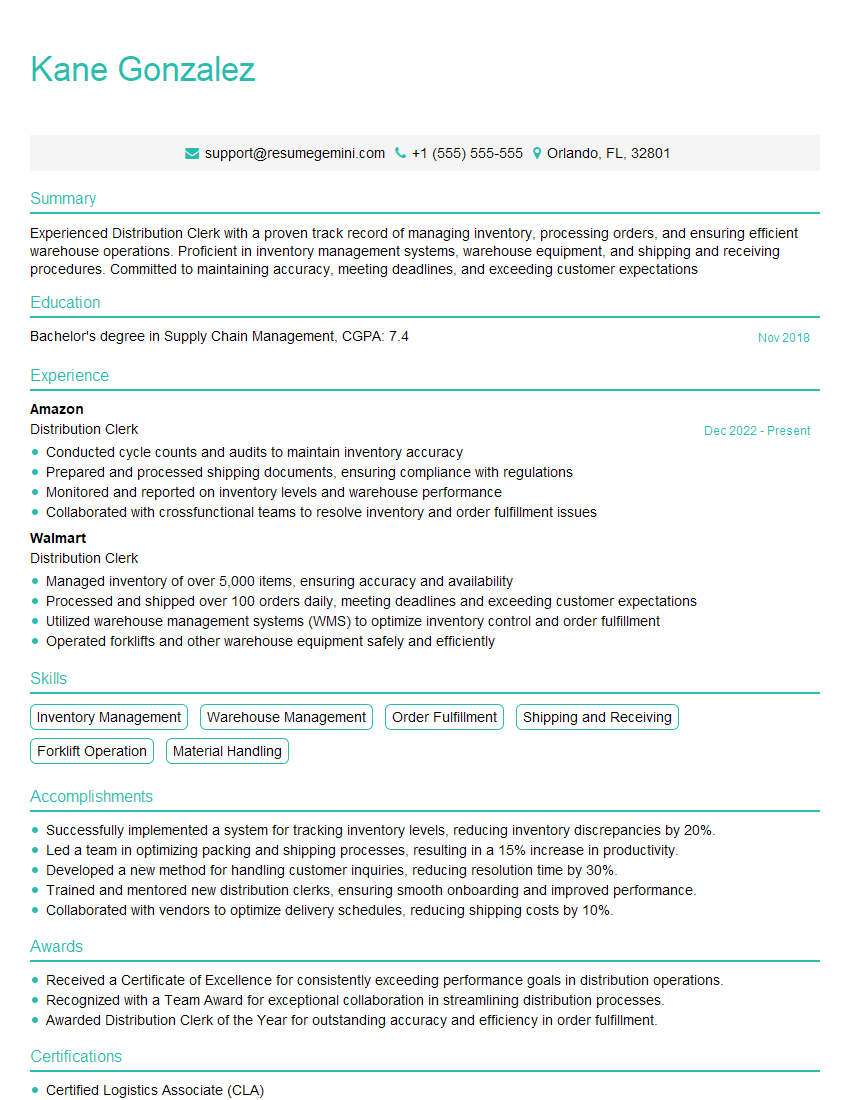
Distribution Clerk Resume Sample
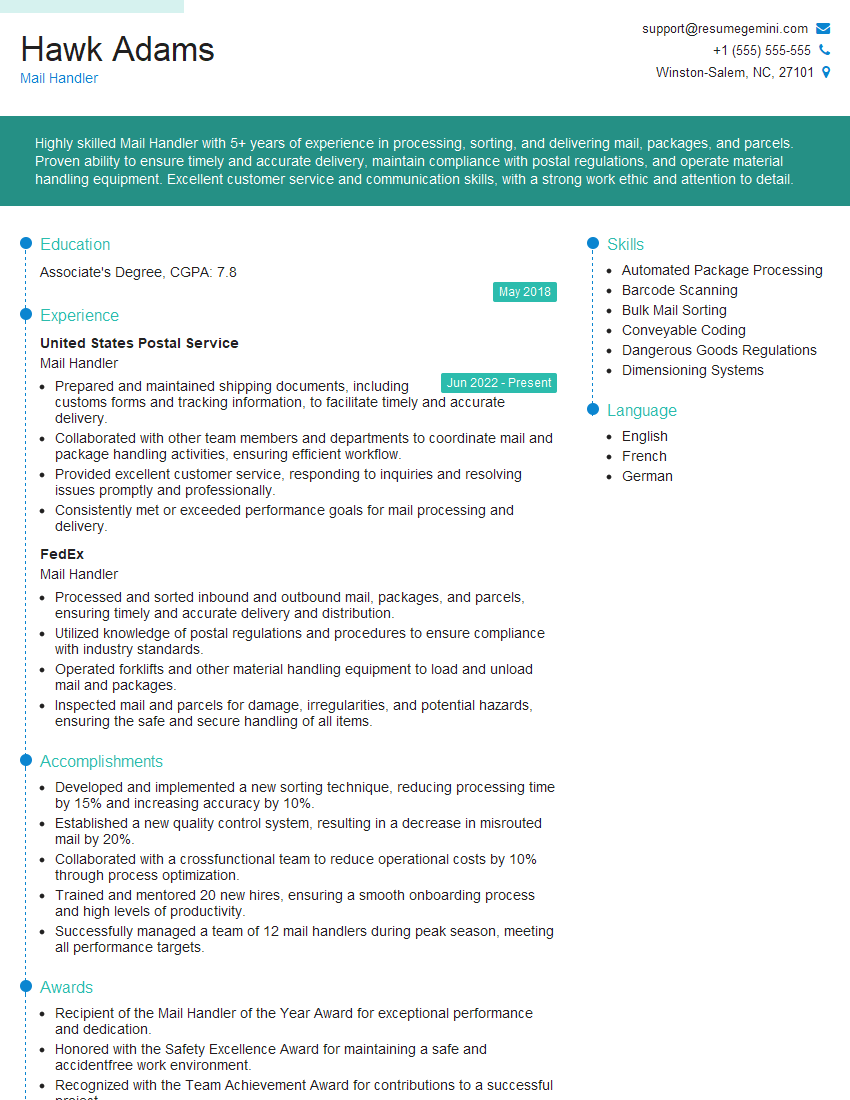
Mail Handler Resume Sample
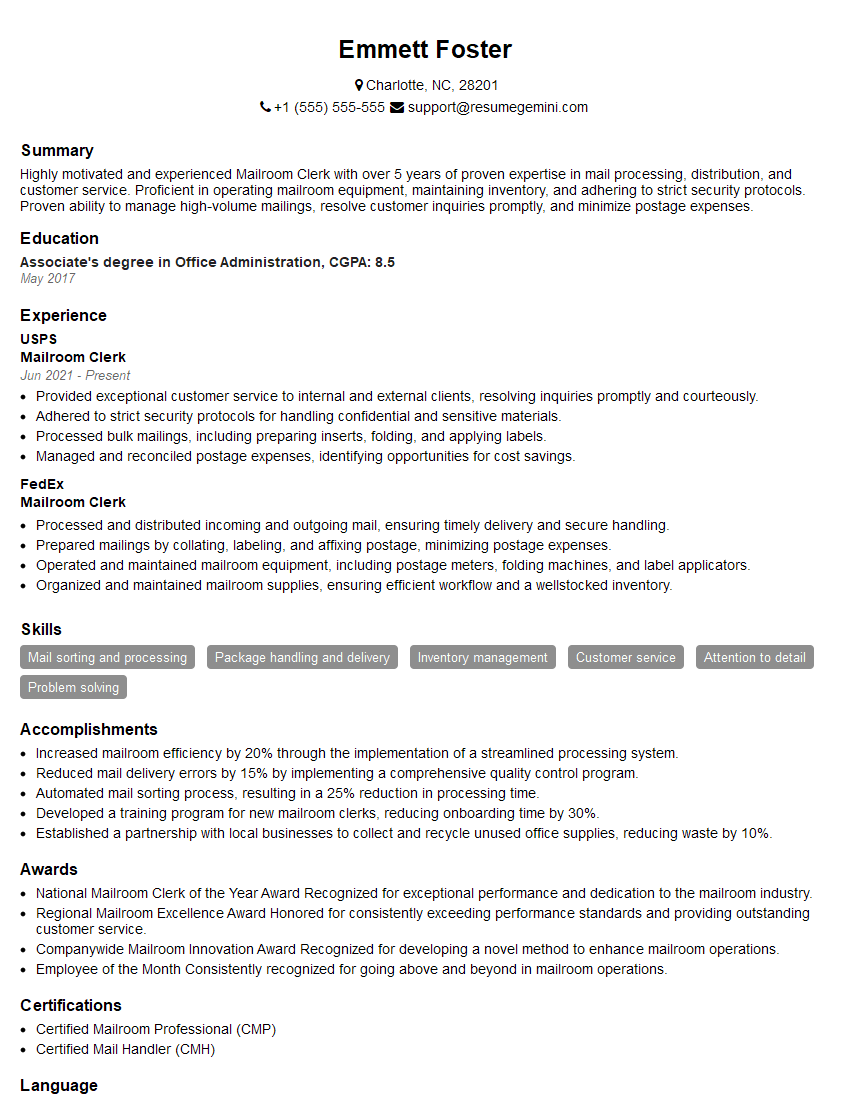
Mailroom Clerk Resume Sample

Postal Clerk Resume Sample
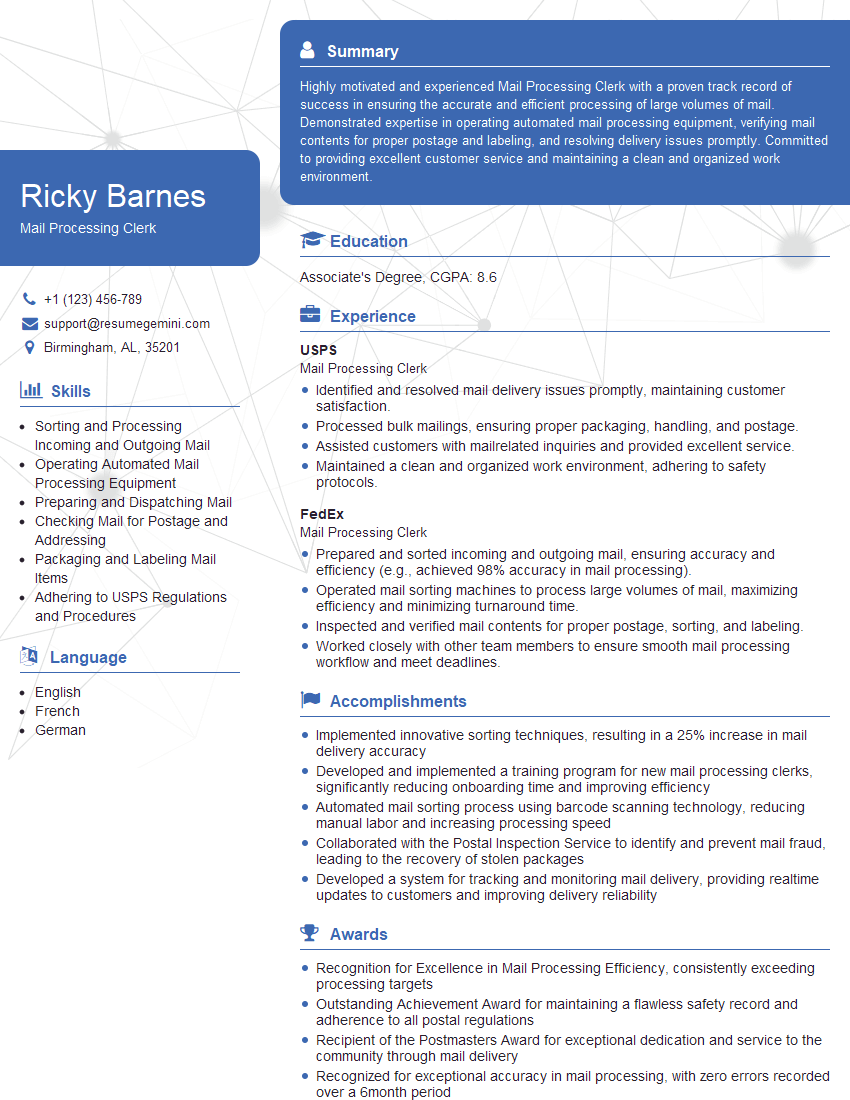
Mail Processing Clerk Resume Sample
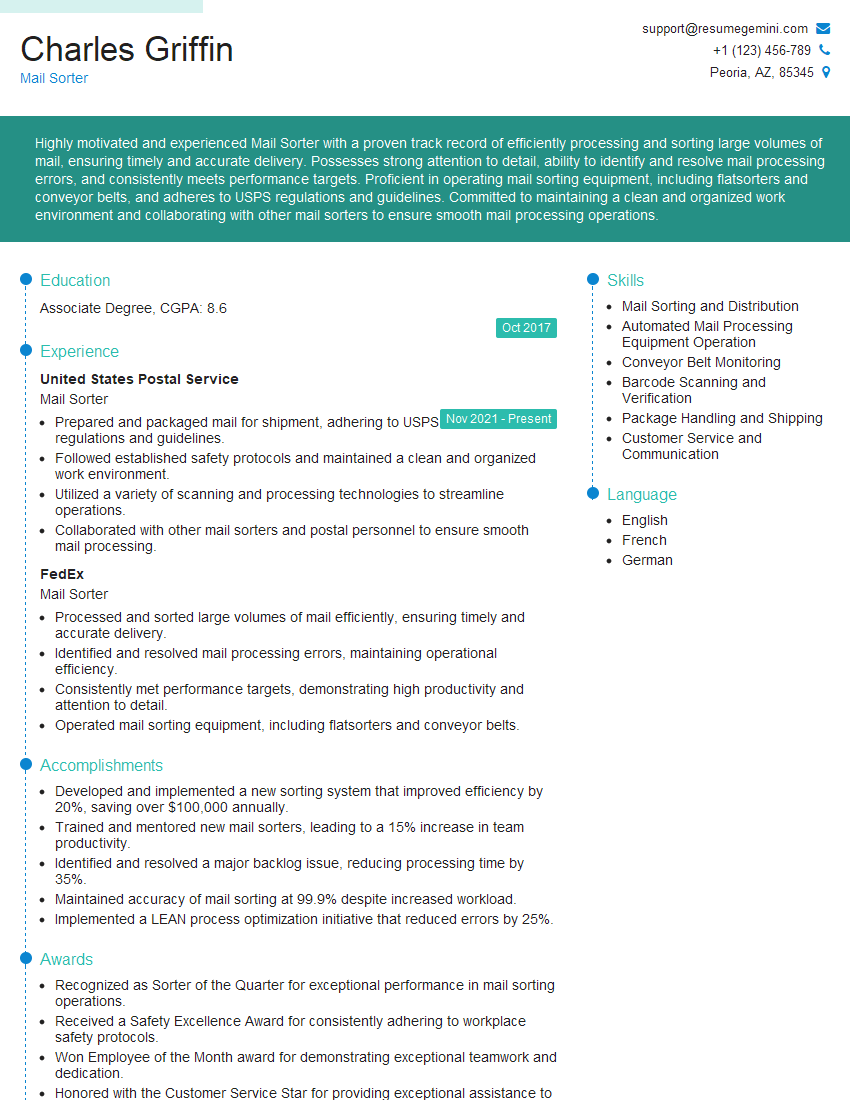
Mail Sorter Resume Sample
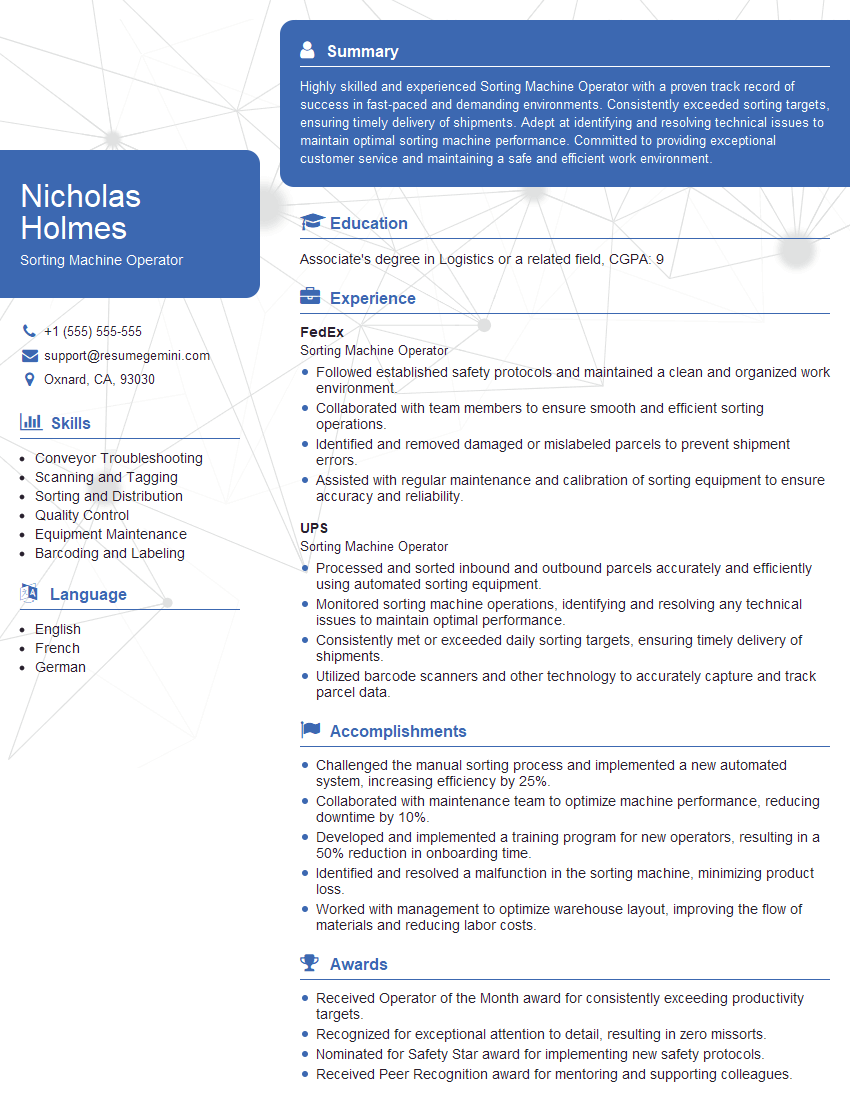
Sorting Machine Operator Resume Sample

Shipping and Receiving Clerk Resume Sample
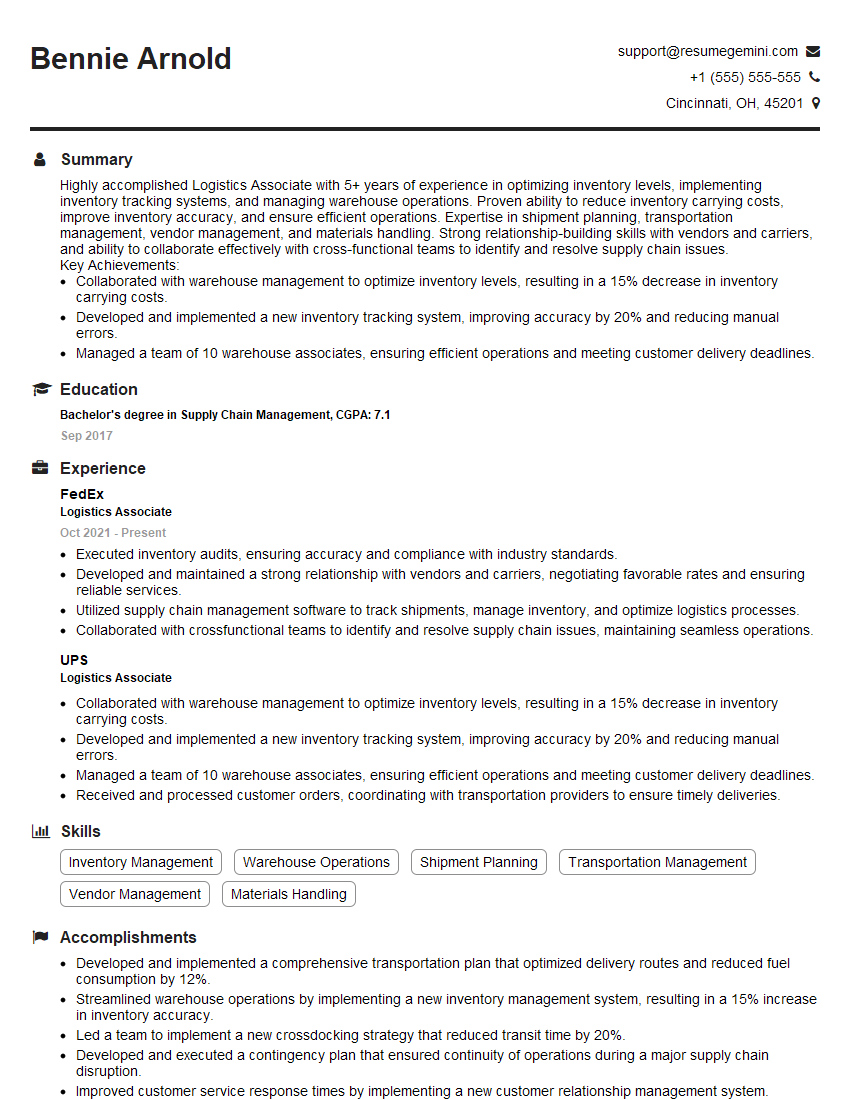
Logistics Associate Resume Sample
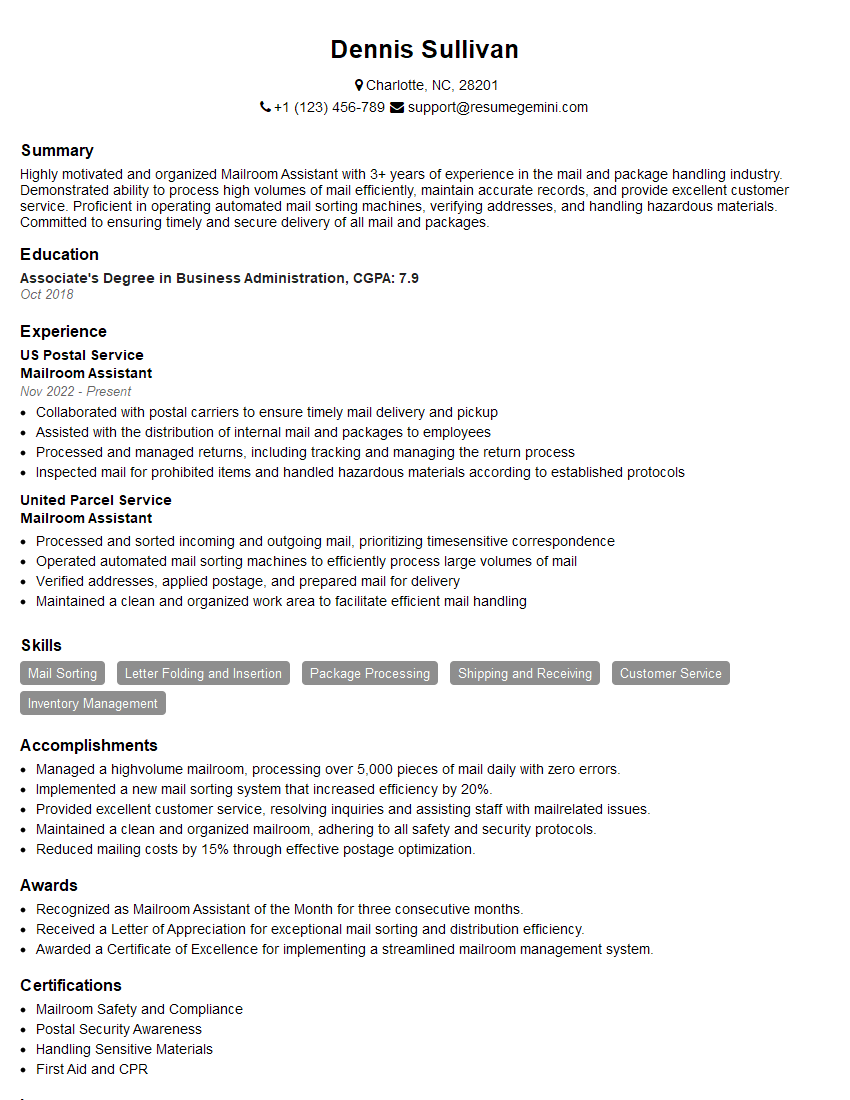
Mailroom Assistant Resume Sample
Explore more articles
Users Rating of Our Blogs
Share Your Experience
We value your feedback! Please rate our content and share your thoughts (optional).
What Readers Say About Our Blog
I Redesigned Spongebob Squarepants and his main characters of my artwork.
https://www.deviantart.com/reimaginesponge/art/Redesigned-Spongebob-characters-1223583608
IT gave me an insight and words to use and be able to think of examples
Hi, I’m Jay, we have a few potential clients that are interested in your services, thought you might be a good fit. I’d love to talk about the details, when do you have time to talk?
Best,
Jay
Founder | CEO