The right preparation can turn an interview into an opportunity to showcase your expertise. This guide to Stapling and Binding interview questions is your ultimate resource, providing key insights and tips to help you ace your responses and stand out as a top candidate.
Questions Asked in Stapling and Binding Interview
Q 1. What types of stapling machines are you familiar with?
I’m familiar with a wide range of stapling machines, from basic manual hand-held staplers to heavy-duty electric models capable of stapling hundreds of sheets. This includes:
- Manual Staplers: These are the simplest, ideal for light-duty tasks and small offices. They are inexpensive and require minimal maintenance.
- Electric Staplers: These offer increased speed and efficiency, perfect for high-volume stapling. They often have adjustable depth settings for varying paper thicknesses.
- Heavy-Duty Staplers: Designed for high-volume and thick stacks of paper, these machines usually have a larger staple capacity and stronger mechanisms.
- Specialty Staplers: This category includes staplers designed for specific applications, like book staplers for saddle stitch binding, or those with angled heads for easier access in confined spaces.
My experience encompasses various brands and models, allowing me to diagnose and resolve issues efficiently.
Q 2. Explain the difference between saddle stitch binding and perfect binding.
Saddle stitch binding and perfect binding are two common methods for binding documents, but they differ significantly in their approach and final product. Think of it like this: saddle stitch is like stitching a booklet together, while perfect binding is like creating a hardcover book.
- Saddle Stitch Binding: This method involves folding sheets of paper in half and then stapling them through the fold line along the spine. It’s best suited for documents with a relatively low page count (typically under 64 pages), such as brochures or magazines. The staples are visible on the outside of the document.
- Perfect Binding: This method involves gluing the edges of the pages together to create a smooth spine. The pages are then trimmed and a cover is wrapped around the glued spine. Perfect binding is more durable and suitable for larger documents, books, and reports that require a professional finish. The spine is smooth and the staples are hidden.
The choice depends largely on the page count, budget, and the desired aesthetic of the final product.
Q 3. How do you ensure accurate alignment when stapling documents?
Accurate alignment is crucial for a professional-looking finished product. Here’s how I ensure it:
- Using Guides: Most staplers have built-in guides or margins to help position the documents correctly. I always double-check these guides before stapling.
- Pre-Alignment: Before stapling large stacks, I meticulously align the edges of all pages to ensure they are perfectly straight. This can be done using a paper trimmer or by careful manual alignment.
- Test Run: For particularly important documents, I perform a small test run with a few sheets to check the alignment before stapling the whole batch.
- Staple Placement: I ensure to choose the appropriate staple depth and location, considering the document’s thickness and the desired aesthetic outcome. This often involves adjusting settings on electric staplers.
Consistency in these steps minimizes errors and ensures a neat, professional finish.
Q 4. What are the common issues encountered with stapling machines, and how do you troubleshoot them?
Common issues with stapling machines range from simple jams to more complex mechanical problems. Here are some I frequently encounter and how I troubleshoot them:
- Jams: Caused by misaligned paper, too many sheets, or damaged staples. I clear the jam carefully, checking for obstructions and ensuring correct paper alignment.
- Staple Misfires: Often due to worn-out staples, low staple supply, or a malfunctioning mechanism. I check staple supply, replace the staples if needed, and inspect the mechanism for any visible damage.
- Uneven Stapling: This can result from incorrect depth settings, bent stapling pins, or worn-out parts. I adjust the depth settings and inspect the stapling mechanism for damage, replacing components if necessary.
- Mechanical Malfunctions: More complex issues may require professional repair. I identify the symptoms and contact a qualified technician if I can’t resolve the problem.
Regular maintenance, like cleaning and lubricating moving parts, can prevent many of these problems.
Q 5. Describe your experience with different binding methods (e.g., wire-o, coil, thermal).
My experience extends to various binding methods beyond stapling. I’m proficient in:
- Wire-O Binding: Creates a professional and durable binding using double-loop wire. I’ve used this for calendars, notebooks, and proposals where a lay-flat design is desirable.
- Coil Binding (Spiral Binding): A cost-effective method using plastic or metal coils. I’ve used this for reports, manuals, and documents that need to lie flat easily.
- Thermal Binding: Uses a glue-like adhesive to bind pages together. This provides a clean, professional look and is suitable for thicker documents and books.
Each method has its advantages and disadvantages, and the choice depends on the document’s size, budget, and the desired final look and feel. My experience allows me to recommend the best option for each project.
Q 6. How do you handle jams in a high-speed stapling machine?
Handling jams in a high-speed stapling machine requires a careful and systematic approach to prevent injury and further damage.
- Turn Off the Machine: Always power down the machine before attempting to clear a jam.
- Consult the Manual: High-speed staplers often have specific instructions for clearing jams. Refer to the operating manual for detailed steps.
- Identify the Jam: Locate the exact point of the jam. It could be in the staple loading area, the stapling mechanism, or the paper exit path.
- Careful Removal: Gently remove the jammed paper or staples. Avoid forcing anything, as this could damage the machine.
- Inspect for Damage: Once the jam is cleared, thoroughly inspect the machine for any signs of damage. If components are bent or broken, repairs may be needed.
- Test Function: Before resuming high-volume stapling, test the machine with a few sheets to confirm it is operating correctly.
Prevention is key: Regular maintenance and proper paper handling can significantly reduce the frequency of jams.
Q 7. What safety precautions do you follow when operating binding equipment?
Safety is paramount when operating binding equipment. My safety procedures include:
- Proper Training: I’ve received thorough training on all equipment I operate, understanding the specific safety protocols for each machine.
- Personal Protective Equipment (PPE): When necessary, I use appropriate PPE, such as safety glasses, to protect myself from potential hazards like flying staples or paper cuts.
- Machine Guards: I ensure all safety guards are in place and functioning correctly before operating any equipment.
- Clear Workspace: I maintain a clean and organized workspace, free from clutter that could cause accidents.
- Emergency Procedures: I am familiar with the emergency shutdown procedures for all equipment and know how to react to various scenarios.
- Regular Inspections: I regularly inspect the machines for any signs of damage or wear and tear, reporting any issues immediately.
By adhering to these safety precautions, I ensure a safe and productive work environment.
Q 8. How do you determine the appropriate type of binding for a given project?
Choosing the right binding method depends on several factors: the document’s length, the desired look and feel, the budget, and the intended use. Think of it like choosing the right tool for a job – you wouldn’t use a hammer to screw in a screw!
- For fewer than 50 pages of lightweight paper, stapling is often sufficient. It’s quick, inexpensive, and ideal for handouts or short reports.
- For documents between 50 and 200 pages, saddle stitch binding (where the pages are folded and stapled in the center) or wire-O binding (with double-loop wire) are popular choices. Saddle stitch is cost-effective but limits page count; wire-O allows for lay-flat opening, great for calendars or notebooks.
- For larger documents or those needing a more professional appearance, perfect binding (where the edges are glued together and a cover is added), case binding (similar to hardback books), or spiral binding (plastic or metal coils) are better suited. Perfect binding is common for softcover books and reports, while case binding offers durability for high-use documents. Spiral binding allows for easy page turning and is great for reference manuals.
For instance, a short marketing brochure would be best suited to stapling, whereas a thesis would be better served by perfect or case binding.
Q 9. How do you ensure the quality and consistency of your work in stapling and binding?
Quality and consistency are paramount. I ensure this through meticulous attention to detail at every stage. This includes:
- Careful preparation: Ensuring pages are cleanly cut, accurately collated, and free of creases or damage before binding.
- Proper equipment use: Using the right binding machine for the job and regularly calibrating it to ensure accurate stapling depth or coil pitch. This prevents misaligned staples or loose coils.
- Consistent technique: Developing a standardized workflow to ensure consistent results, regardless of the volume. This includes maintaining a consistent speed and pressure when operating the equipment.
- Regular quality checks: Inspecting each finished document to ensure proper binding, alignment, and overall presentation. I even have a checklist to ensure consistency.
For example, I always use a paper cutter that allows precise adjustment for different paper weights to prevent skewed edges that could impact the final binding.
Q 10. What is your experience with different paper weights and their impact on binding?
Paper weight significantly affects binding. Heavier paper (e.g., cardstock) requires more robust binding methods and potentially stronger equipment. Lighter paper (e.g., standard printer paper) may be sufficient with simpler methods like stapling or saddle stitch. Too-heavy paper can also jam machines and lead to uneven binding.
- Stapling: Works best with lighter papers; heavy paper might tear or cause the staples to bend.
- Perfect Binding: Can handle a wider range of weights but requires adjustments to the glue application based on the paper’s absorbency.
- Wire-O Binding: Adaptable to various weights, but very heavy paper might be difficult to punch through cleanly.
Imagine trying to staple twenty sheets of cardboard – it’s simply not feasible! Conversely, light tissue paper would be inappropriate for a wire-O binding. The paper weight directly influences the choice of binding mechanism.
Q 11. Describe your experience with different types of binding covers and materials.
My experience encompasses a wide variety of binding covers and materials. The choice depends heavily on the project’s requirements and desired aesthetic.
- Cardstock Covers: Offer a cost-effective and versatile option for many projects. Different weights and finishes (matte, gloss) provide design flexibility.
- Plastic Covers: Durable and water-resistant, ideal for documents that require protection. Clear covers allow the document’s design to show through.
- Leatherette or Fabric Covers: Provide a more luxurious and professional finish, suitable for high-end presentations or books.
- Custom-Printed Covers: Allow for full branding and personalization, often for corporate reports or special publications.
For a client presentation, a high-quality leatherette cover projects a certain professionalism. A simple training manual might call for a more practical, plastic cover. The selection is crucial for conveying the right image.
Q 12. How do you handle large-volume binding projects efficiently?
Handling large-volume projects efficiently requires planning and effective workflow management. This involves:
- Pre-production planning: Thorough preparation is essential, including accurately counting pages, ensuring consistent paper, and organizing the production line to optimize flow.
- Specialized equipment: Using high-capacity machines designed for high-volume production, which increases speed and efficiency.
- Teamwork (if applicable): Effective teamwork is vital if handling multiple machines or steps simultaneously. Clear roles and responsibilities prevent bottlenecks.
- Quality control checkpoints: Implementing quality checks at various stages to catch errors early and avoid rework.
For example, using a high-speed perfect binding machine for a 1000-book project, along with a team dedicated to collating and preparing the books before binding, allows for fast and consistent output.
Q 13. How do you maintain and clean stapling and binding equipment?
Regular maintenance is crucial for both safety and consistent performance. My routine includes:
- Daily cleaning: Removing paper scraps, dust, and debris from the machine’s interior and exterior to prevent jams and ensure smooth operation.
- Lubrication: Applying appropriate lubricants to moving parts according to the manufacturer’s instructions to reduce friction and extend the machine’s life.
- Blade sharpening (for cutters): Regularly sharpening blades to maintain accuracy and prevent ragged cuts, which could affect binding quality.
- Regular inspections: Checking for wear and tear, loose parts, or any signs of damage. Any issues are reported promptly to prevent breakdowns.
Neglecting maintenance could lead to costly repairs, inefficient production, and even safety hazards. A well-maintained machine is a crucial asset.
Q 14. What are your experience levels with different finishing techniques?
Beyond basic stapling and binding, I’m experienced in a range of finishing techniques that enhance the final product:
- Foil Stamping: Adding metallic or colored foil to create a professional and visually appealing look.
- Embossing/Debossing: Creating raised or indented designs on covers for a tactile element.
- Die-cutting: Creating custom shapes or designs in the document or cover.
- Lamination: Applying a protective film to documents for durability and water resistance.
For example, foil stamping a logo onto a report cover significantly elevates its professional appearance, while lamination adds protection against wear and tear.
Q 15. Describe a time you had to troubleshoot a binding machine malfunction.
One time, our high-volume saddle-stitcher started misfeeding sheets. Instead of panicking, I systematically checked the common culprits. First, I inspected the paper feed tray for jams or misaligned paper—a common issue, especially with different paper weights. Finding nothing, I moved to the rollers, carefully cleaning any dust or debris that might be affecting the paper’s grip. Still no luck. Then I checked the timing belt for slippage; it had slightly loosened, causing inconsistent feeding. After tightening the belt (following the machine’s manual, of course), the machine ran smoothly again. This experience highlighted the importance of a methodical troubleshooting approach, starting with the simplest potential problems and working my way to the more complex mechanical issues.
This process emphasizes the need for preventative maintenance as well. Regular cleaning and inspection of the machine could have prevented this issue in the first place. I now incorporate scheduled preventative maintenance into my workflow to avoid costly downtime and ensure consistent high quality.
Career Expert Tips:
- Ace those interviews! Prepare effectively by reviewing the Top 50 Most Common Interview Questions on ResumeGemini.
- Navigate your job search with confidence! Explore a wide range of Career Tips on ResumeGemini. Learn about common challenges and recommendations to overcome them.
- Craft the perfect resume! Master the Art of Resume Writing with ResumeGemini’s guide. Showcase your unique qualifications and achievements effectively.
- Don’t miss out on holiday savings! Build your dream resume with ResumeGemini’s ATS optimized templates.
Q 16. What software or systems are you familiar with for managing binding projects?
I’m proficient in several software solutions for managing binding projects. For example, I use MIS (Management Information Systems) software like PrintVis or EFI Pace to manage job tickets, track materials, and monitor production progress. These systems allow for precise scheduling and efficient resource allocation, crucial for meeting deadlines in high-pressure bindery environments. I also use project management software such as Asana or Trello for simpler projects to collaborate with clients and internal teams, ensuring transparency and accountability throughout the entire binding process.
In addition to this, I use spreadsheets (Microsoft Excel or Google Sheets) to track inventory, costs and generate detailed reports for clients. This helps maintain accuracy and provides a clear overview of project financials.
Q 17. How do you ensure the accuracy and speed of your work meets deadlines?
Ensuring both accuracy and speed requires a multi-pronged approach. First, careful planning is key. I meticulously review specifications before starting any project, ensuring complete understanding of client requirements and potential challenges. Second, efficient workflow is paramount. I optimize my processes to minimize wasted time, using techniques like pre-sorting materials and setting up equipment in advance. Think of it like a well-orchestrated symphony—each instrument (machine) plays its part in perfect harmony.
Finally, quality control is integrated throughout the entire process, not just at the end. Regular checks during each step allow for the early identification and correction of errors. This proactive approach minimizes delays caused by having to redo work later. A combination of planning, efficient workflow, and continuous quality control consistently allows me to meet or even exceed deadlines.
Q 18. What is your understanding of quality control procedures in a bindery setting?
Quality control in a bindery is crucial. It’s not just about the final product; it’s about ensuring consistent quality throughout the entire process. We use a multi-stage approach. First, there’s incoming material inspection—checking the paper stock for defects and ensuring it meets the project’s specifications. Next, in-process checks happen at every stage of binding—from folding and gathering to stitching and trimming. This ensures problems are caught early.
Finally, a comprehensive final inspection includes checking for things like misaligned pages, uneven stitching, poor spine alignment, and damage to the cover. We use checklists and standardized procedures to ensure consistency and reduce human error. The goal is to consistently meet or exceed client expectations and maintain a high standard of quality—after all, the final bound document is often the client’s most important deliverable.
Q 19. Explain your experience with different types of folding techniques.
My experience encompasses a wide range of folding techniques, each suited to different document types and desired aesthetics. I’m skilled in:
- Letter Folding: Simple and efficient, ideal for standard documents.
- Double Parallel Folding: Creates a neat, compact booklet, often used for brochures.
- Z-Fold: A more complex fold creating panels ideal for marketing materials.
- Gate Fold: Creates a visually appealing panel fold, perfect for maps or large inserts.
- Roll Fold: A continuous fold, often used for leaflets.
The choice of folding technique depends on factors like page count, desired size, and overall design. For instance, a large-page-count magazine might require a sophisticated roll fold, while a simple flyer may only need a basic letter fold. My understanding of these various techniques ensures I can tailor the process to each project’s unique demands, contributing to a superior final product.
Q 20. How do you handle client requests or special instructions for binding?
Handling client requests and special instructions is a critical aspect of my work. I begin by carefully reviewing all specifications, ensuring I fully understand any unique requirements, such as custom spine widths, specific binding methods, or unusual paper stocks. If any clarifications are needed, I proactively communicate with the client to avoid misunderstandings or delays. Open communication is key.
I then integrate these special instructions into the project workflow, adjusting processes as necessary. This might involve sourcing special materials, configuring machinery differently, or coordinating with other departments (e.g., prepress) to ensure seamless execution. Throughout the process, I maintain transparent communication with the client, providing regular updates and addressing any concerns promptly. I view every special request as an opportunity to further enhance the quality and personalization of their final product.
Q 21. What measures do you take to prevent errors in stapling and binding?
Preventing errors in stapling and binding involves a combination of proactive measures and careful attention to detail. This starts with ensuring all equipment is properly maintained and calibrated. Regular cleaning and preventative maintenance are crucial. Think of it as preventative medicine for your machinery—it’s far more cost-effective and less disruptive than dealing with breakdowns.
Next, I rigorously follow standardized operating procedures (SOPs), ensuring consistency and reducing the chance of human error. This includes double-checking page counts, verifying alignment, and confirming the correct binding method before proceeding. Finally, quality control checks are integrated at each stage of the process, allowing for early detection and correction of any mistakes. A rigorous attention to detail, consistent use of SOPs and preventative maintenance is the best way to avoid errors.
Q 22. Describe your experience with operating various types of punches.
My experience encompasses a wide range of punches, from manual hand punches ideal for small-scale projects and quick fixes to high-speed automated punches used for large-volume production runs. I’m proficient with both two-hole and multi-hole punches, including those with adjustable margin settings for precise document preparation. For instance, I’ve used the versatile PowerPunch 3000 for its speed and accuracy in handling various paper weights and thicknesses, and a smaller manual punch for proofing and quick edits. Understanding the nuances of each punch – its capabilities, maintenance requirements, and potential limitations – is critical for efficient and high-quality output.
I’m also familiar with different punch die configurations, allowing me to create custom hole patterns when needed, such as those required for specific binding mechanisms like wire-o or post-binding. Regular maintenance and safety procedures are second nature to me, ensuring the longevity and safe operation of these machines.
Q 23. How do you handle damaged or misprinted documents during the finishing process?
Handling damaged or misprinted documents requires a systematic approach. First, I assess the extent of the damage. For minor imperfections like smudges or minor creases, I might try to carefully clean or flatten the document, depending on the material and the client’s tolerance. If the damage is significant, like a major crease, tear, or extensive misprinting, the document would likely be flagged as unusable. I would immediately notify my supervisor or the project manager to discuss the best course of action—reprinting, issuing a credit, or finding an alternative solution.
I meticulously document all instances of damaged or misprinted documents, including the nature of the damage, quantity, and project details. This documentation is crucial for quality control, preventing similar issues in the future, and managing client expectations. My approach prioritizes transparency and minimizing waste.
Q 24. How do you prioritize tasks when working on multiple binding projects simultaneously?
Prioritizing tasks in a fast-paced bindery environment necessitates a clear understanding of deadlines and project urgency. I typically employ a combination of methods. First, I review all projects and their due dates, noting any time-sensitive orders. Then, I consider the complexity of each project and the resources required. Projects with tighter deadlines or higher complexities are usually prioritized, and I create a schedule to manage my workload effectively, breaking down larger projects into smaller, more manageable tasks.
I utilize project management tools (internal or digital) to visually track progress and efficiently allocate time and resources across multiple projects. Communication with my team members is key to identifying and addressing potential delays or bottlenecks. Flexibility and adaptability are also vital, as priorities can sometimes shift unexpectedly.
Q 25. What is your understanding of the different types of glue used in binding?
My understanding of binding glues extends across various types, each with unique properties and applications. For example, PUR (Polyurethane Reactive) glue is known for its strong, flexible bond and is often used in high-quality perfect binding, offering a durable and aesthetically pleasing finish. EVA (Ethylene Vinyl Acetate) glue is a more economical option, frequently used in case binding or saddle stitching, while hot melt adhesives are suitable for quick-drying applications but may not offer the same longevity as PUR. The choice depends on factors like the paper type, binding method, and client requirements. The key is selecting the right glue to create a secure, long-lasting bond while considering factors like drying time, flexibility, and resistance to environmental factors.
I am also aware of the health and safety implications associated with working with adhesives and always adhere to the necessary precautions, such as proper ventilation and the use of appropriate safety equipment.
Q 26. Explain your experience with working in a fast-paced bindery environment.
I thrive in fast-paced bindery environments. My experience includes working in high-volume production settings with tight deadlines and demanding schedules. I’ve learned to stay calm under pressure and efficiently manage multiple tasks simultaneously without compromising quality. In one instance, we had a large rush order that needed to be completed within 24 hours. By effectively delegating tasks, coordinating with other team members, and maintaining clear communication, we were able to meet the deadline without sacrificing accuracy or professionalism. I approach every challenge with a proactive mindset, constantly looking for ways to optimize workflows and improve efficiency.
My ability to prioritize, problem-solve quickly, and adapt to changing situations has been instrumental in my success in these dynamic work environments.
Q 27. How do you ensure the finished product meets the client’s specifications?
Ensuring the finished product meets client specifications is paramount. I meticulously review the client’s specifications (often provided on a job sheet or style guide) before starting any project, paying close attention to details such as paper type, binding method, cover stock, number of pages, and any special finishing requirements. Throughout the process, I perform regular quality checks to ensure the work is consistent with the client’s requests. If any discrepancies are found, I immediately address them and seek clarification before continuing.
Prior to delivery, I conduct a final quality assurance inspection, including checking for accuracy in pagination, binding quality, cover alignment, and overall presentation. This careful attention to detail ensures a high-quality product that meets or exceeds client expectations, building trust and fostering positive client relationships.
Q 28. What are your strengths and weaknesses related to stapling and binding?
My strengths lie in my meticulous attention to detail, my ability to work efficiently under pressure, and my versatility in handling diverse binding methods and equipment. I’m adept at problem-solving, quickly identifying and resolving issues that arise during the finishing process. For example, I recently solved a problem with a jammed machine by identifying the cause and quickly making the necessary adjustments.
As for weaknesses, while I’m proficient with many types of equipment, there’s always room for improvement. I’m currently working on expanding my knowledge of new technologies and advanced binding techniques to enhance my skillset. I actively seek opportunities to learn and improve, viewing it as continuous professional development.
Key Topics to Learn for Your Stapling and Binding Interview
- Equipment Operation and Maintenance: Understanding the mechanics of various stapling and binding machines, including troubleshooting common issues and performing routine maintenance.
- Material Handling and Selection: Knowing which types of staples, binding materials (e.g., combs, coils, wire-o), and paper are appropriate for different projects and quantities. This includes understanding paper weight and sizing implications.
- Finishing Techniques: Mastering various binding methods (e.g., saddle stitch, perfect binding, wire-o binding) and their applications for different document types and aesthetics. This also includes understanding trimming and folding techniques.
- Production Efficiency and Workflow: Optimizing processes for speed and accuracy, including understanding production flow and minimizing waste. This involves prioritizing tasks effectively.
- Quality Control and Inspection: Identifying and correcting errors in stapling and binding, ensuring consistent quality across all projects and meeting client specifications.
- Safety Procedures and Regulations: Adherence to workplace safety regulations when operating machinery and handling materials.
- Project Planning and Estimation: Accurately estimating the time and materials required for different binding projects.
Next Steps
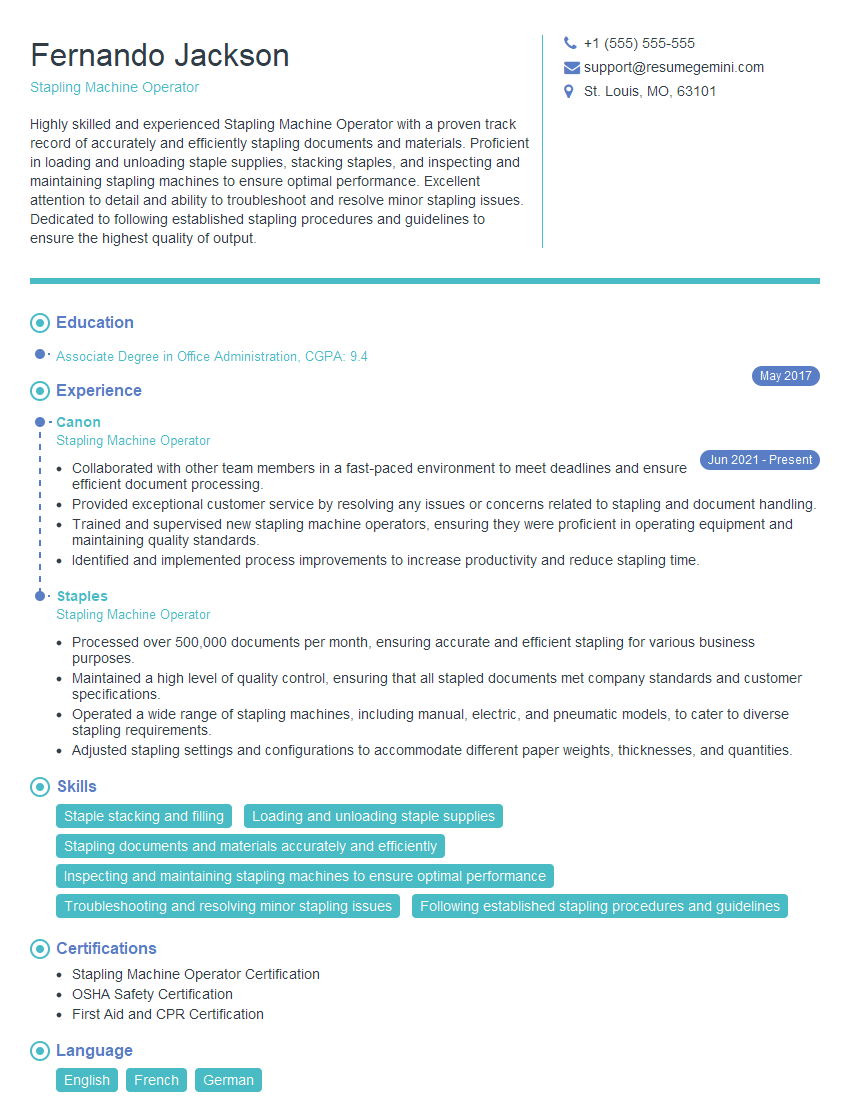
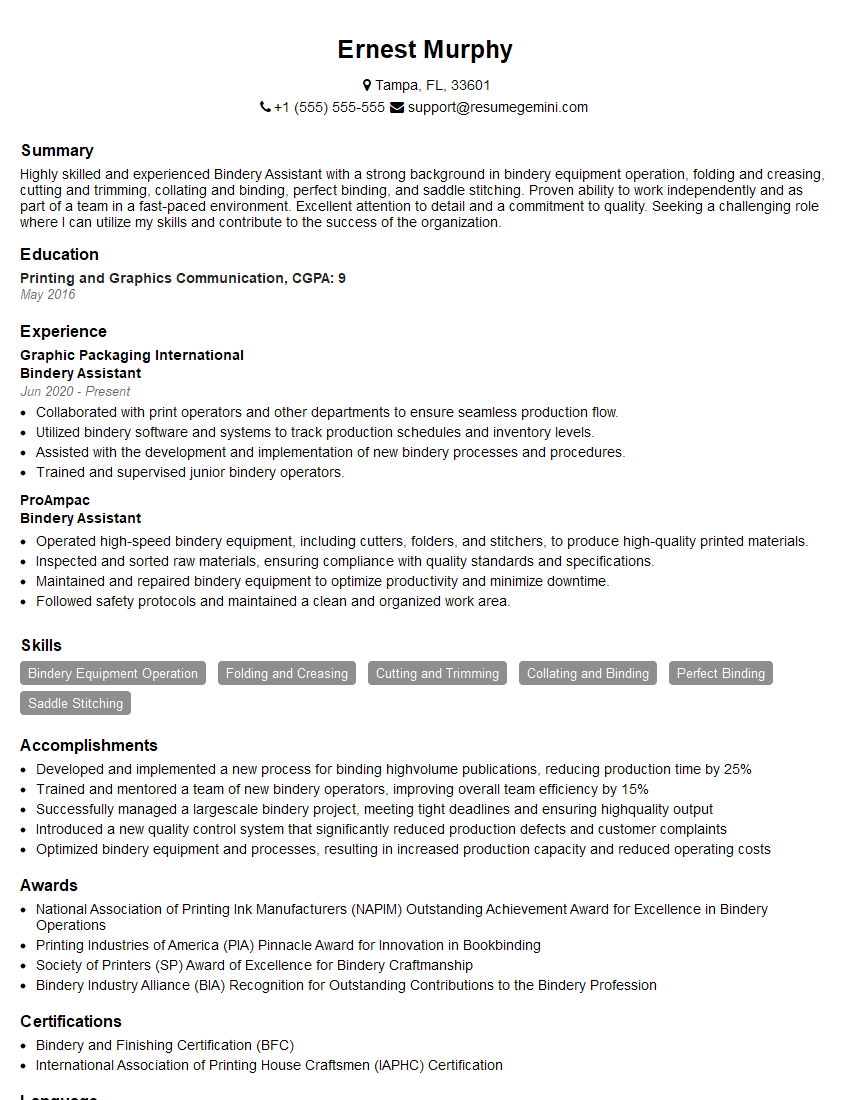
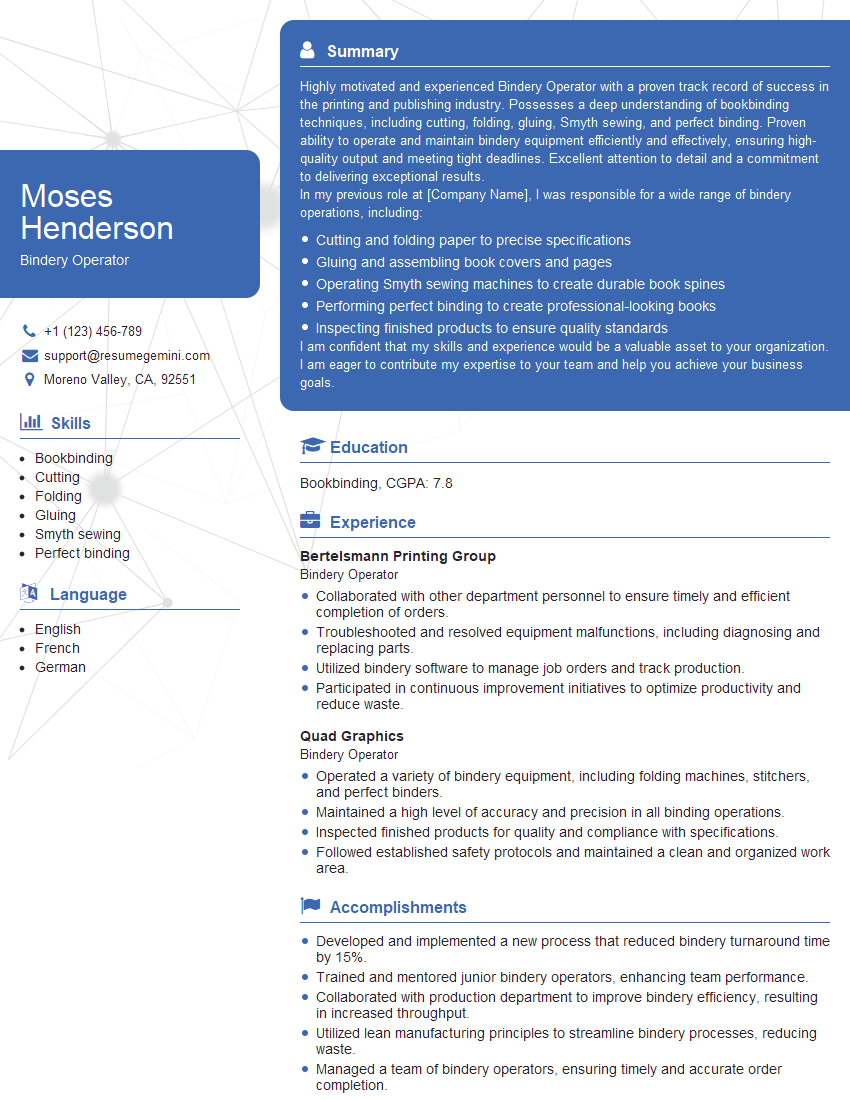
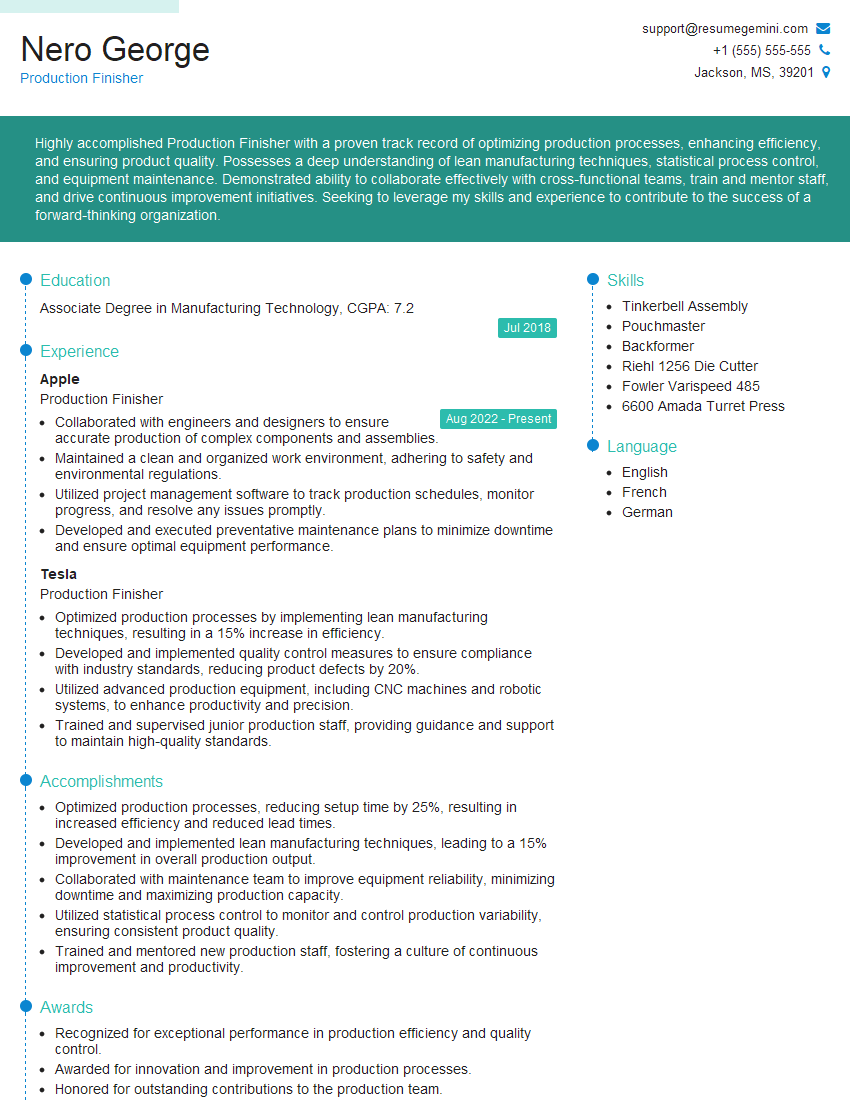
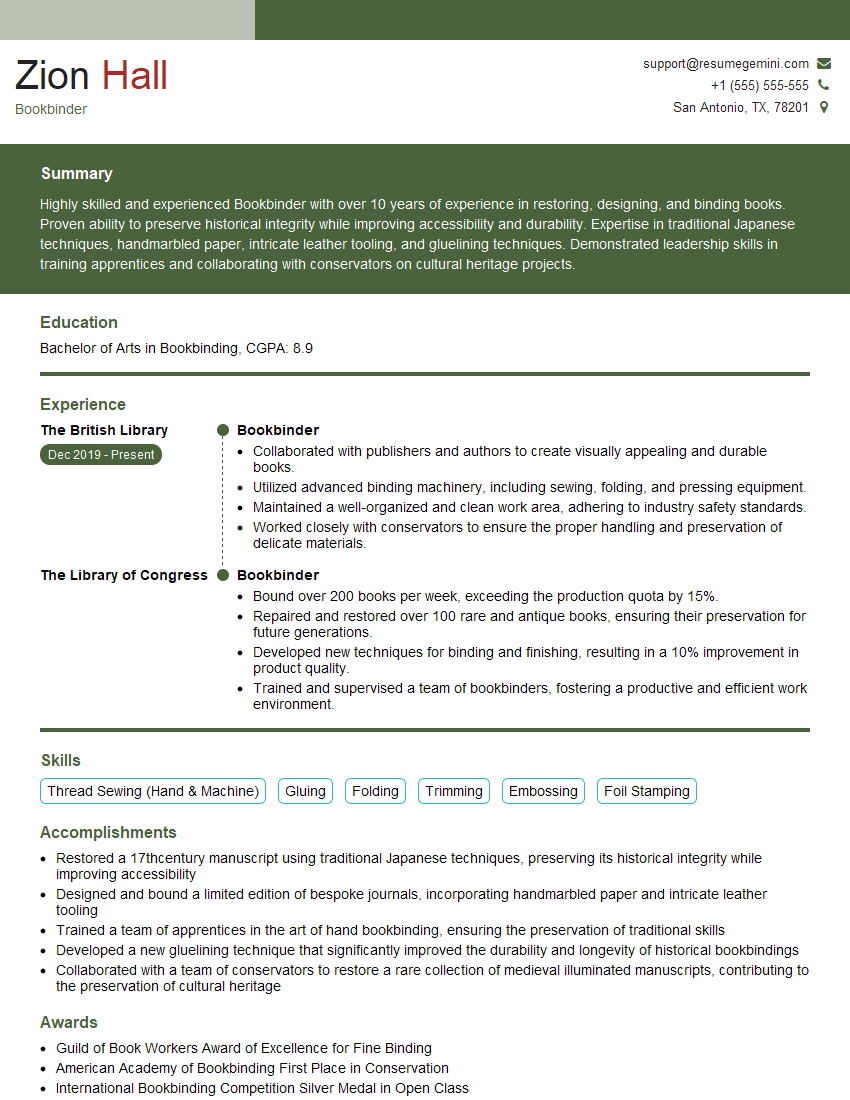
Mastering stapling and binding opens doors to diverse roles in print finishing, document management, and office administration. A strong foundation in these skills demonstrates efficiency, attention to detail, and a commitment to quality – all highly valued attributes in today’s workplace. To stand out from the competition, creating an ATS-friendly resume is crucial. This ensures your application gets noticed by recruiters and hiring managers. ResumeGemini is a trusted resource that can help you build a professional and impactful resume tailored to highlight your stapling and binding skills. We provide examples of resumes specifically tailored to this field to help you craft the perfect application. Take the next step towards your career success!
Explore more articles
Users Rating of Our Blogs
Share Your Experience
We value your feedback! Please rate our content and share your thoughts (optional).
What Readers Say About Our Blog
I Redesigned Spongebob Squarepants and his main characters of my artwork.
https://www.deviantart.com/reimaginesponge/art/Redesigned-Spongebob-characters-1223583608
IT gave me an insight and words to use and be able to think of examples
Hi, I’m Jay, we have a few potential clients that are interested in your services, thought you might be a good fit. I’d love to talk about the details, when do you have time to talk?
Best,
Jay
Founder | CEO