Feeling uncertain about what to expect in your upcoming interview? We’ve got you covered! This blog highlights the most important Surveying Principles interview questions and provides actionable advice to help you stand out as the ideal candidate. Let’s pave the way for your success.
Questions Asked in Surveying Principles Interview
Q 1. Explain the difference between plane surveying and geodetic surveying.
The core difference between plane surveying and geodetic surveying lies in how they handle the Earth’s curvature. Plane surveying assumes the Earth is flat within the survey area, a simplification valid for smaller areas where the Earth’s curvature is negligible. This makes calculations simpler, using plane trigonometry. Geodetic surveying, on the other hand, explicitly accounts for the Earth’s curvature. It uses a more complex mathematical model, often employing ellipsoidal geometry, which is crucial for larger areas where the curvature significantly impacts measurements. Imagine trying to lay out a small garden—plane surveying is perfectly adequate. But for mapping a large country, you absolutely need geodetic surveying to achieve accurate results.
Plane Surveying: Suitable for small areas, uses plane trigonometry, simpler calculations, less accurate over large distances.
Geodetic Surveying: Suitable for large areas, accounts for Earth’s curvature, uses ellipsoidal geometry, more complex calculations, higher accuracy.
Q 2. Describe the various types of surveying equipment and their applications.
Surveying employs a variety of equipment, each with specific applications. These tools range from basic measuring devices to sophisticated electronic instruments.
- Total Stations: These highly versatile instruments measure distances, angles (horizontal and vertical), and can even record coordinates. They are crucial in many types of surveys, including construction and topographic mapping. I once used a total station to precisely locate underground utilities before excavation, preventing costly damage.
- GPS (Global Positioning System) Receivers: Utilizing signals from satellites, GPS receivers determine precise locations. They are indispensable for mapping large areas quickly and efficiently. Real-time kinematic (RTK) GPS offers centimeter-level accuracy, vital for precise engineering projects.
- Leveling Instruments: These are used to determine elevations accurately by creating level lines. They are essential in construction and engineering projects, ensuring that structures are built to the correct height and gradient.
- Theodolite: A precise angle-measuring instrument used for establishing horizontal and vertical angles. It’s a crucial component in various surveys, especially those requiring high accuracy in angular measurements.
- Measuring Tapes/Chains: Basic but essential for measuring distances. They remain critical even in projects alongside sophisticated technology.
- Electronic Distance Measurement (EDM) Instruments: EDM devices, often integrated into total stations, accurately measure distances using electromagnetic waves. They greatly improve efficiency and accuracy compared to traditional taping methods.
Q 3. How do you perform a traverse survey?
A traverse survey establishes a network of points connected by measured lines. It’s like creating a connected chain of points across the terrain. The procedure involves:
- Reconnaissance: Planning the route and identifying suitable points.
- Setting up Stations: Establishing points at each station using permanent markers.
- Measuring Angles: Using a theodolite or total station to accurately measure angles between lines.
- Measuring Distances: Using EDM equipment or tapes to measure the distance between stations.
- Data Recording: Meticulously recording all measurements in a field book.
- Computations: Using trigonometry or surveying software to compute coordinates of each station. This involves adjusting the measurements to account for any errors and ensures the overall shape of the traverse closes accurately.
- Error Analysis: Checking for inconsistencies in the measurements and identifying potential sources of error.
- Mapping/Plotting: Using the computed coordinates to create a map or plot of the survey area.
An example would be creating a survey of a property boundary, where each corner is a station, and we measure the angles and distances between them to accurately define the boundary lines.
Q 4. What are the different methods for determining elevation?
Several methods determine elevation, focusing on establishing a vertical datum:
- Leveling: This is the most precise method using a level and leveling rod to establish a series of level lines. It’s essential for accurate elevation determination over relatively short distances. Think of it as creating a perfectly level staircase across your survey area.
- Trigonometric Leveling: This uses angles and distances measured by a total station to calculate the difference in elevation between points. Useful when direct leveling is impractical, like surveying across a wide river.
- GPS (Global Positioning System): GPS receivers can also provide elevation data, though accuracy can be affected by atmospheric conditions and the specific type of GPS being used. RTK-GPS offers higher accuracy for elevation determination.
- Barometric Leveling: This method uses barometers to measure air pressure, which correlates with altitude. It’s less accurate than leveling but convenient for large areas or rough terrain.
Q 5. Explain the concept of coordinate systems and datums.
Coordinate systems and datums are fundamental to surveying. A coordinate system defines the location of points using a set of coordinates (like latitude and longitude). A datum is a reference surface used for calculations, essentially providing a starting point for measurements. Think of the Earth as a slightly squashed ball, and a datum defines a specific mathematical model of this shape.
Several datums exist, each with its own reference ellipsoid (a mathematical approximation of the Earth’s shape) and origin. The choice of datum affects the accuracy of calculations, particularly over large distances. For instance, using the wrong datum could lead to significant errors in mapping a large-scale infrastructure project. Different coordinate systems, like UTM (Universal Transverse Mercator) and State Plane Coordinates, are used to project this three-dimensional globe onto a two-dimensional map, using appropriate mathematical projections to minimize distortion. Selecting the correct coordinate system and datum is crucial for ensuring the accuracy and consistency of your survey data.
Q 6. How do you account for errors in surveying measurements?
Errors in surveying measurements are inevitable. Handling them involves several steps:
- Error Identification: This involves carefully reviewing field notes and identifying potential sources of errors – instrumental errors, human errors (like misreading a scale), natural errors (like atmospheric refraction).
- Error Classification: Errors are classified as systematic (consistent biases), random (unpredictable variations), or gross errors (blunders). Systematic errors can be corrected through calibration and improved techniques; random errors are handled statistically. Gross errors require re-measurement or rejection of affected data.
- Error Propagation: Understanding how errors in individual measurements propagate through calculations is crucial. This involves using statistical methods to estimate the uncertainty of the final results.
- Error Adjustment: Techniques like least squares adjustment are used to distribute errors among observations in a way that minimizes overall discrepancies. This ensures that the overall survey is consistent and makes the best use of all the available data.
- Quality Control: Implementing quality control procedures like redundant measurements and independent checks throughout the survey process minimizes the impact of errors. Regular instrument calibration is critical for preventing systematic errors.
For example, if we have a series of angles in a traverse that don’t close perfectly, we would use a least-squares adjustment to distribute the error proportionally among the measured angles.
Q 7. Describe the process of boundary surveying.
Boundary surveying involves precisely defining the legal limits of a property. It’s a critical process with legal implications. The process includes:
- Research: Thorough research of deeds, title records, and other legal documents to determine the historical boundaries. This stage is incredibly important as errors in past surveys can have significant consequences.
- Field Survey: Locating existing boundary markers (monuments), using surveying equipment to measure angles and distances, and establishing new markers where necessary. This often requires careful consideration of evidence from the past, such as old fences or other indicators of the historical boundary.
- Monumentation: Permanent markers are set to clearly define the boundary. This can involve various types of markers, from simple stakes to more permanent monuments, depending on local regulations.
- Legal Description: A precise written description of the boundary is prepared, often using metes and bounds (descriptions of boundary lines and distances) or coordinates. This written description is a key element of the survey report and has legal weight.
- Map Preparation: A detailed map is created showing the property boundaries, monuments, and other relevant features.
- Report Preparation: A formal report is compiled, documenting the entire process and providing a final legal description of the boundaries. This report is essential for resolving any disputes and serves as a permanent record of the survey.
One time I had to resolve a boundary dispute where conflicting evidence existed. Thorough research and careful on-site investigation allowed me to correctly establish the legally defensible boundary using historical evidence and modern surveying techniques.
Q 8. What are the legal aspects of land surveying?
Land surveying is heavily regulated, and its legal aspects are crucial. Surveys define property boundaries, which are legally binding. Errors can lead to costly disputes and litigation. Key legal considerations include adherence to state and local licensing requirements, accurate record-keeping compliant with professional standards (like those set by the National Society of Professional Surveyors), proper adherence to boundary law, and ensuring surveys are conducted ethically and competently. For example, a surveyor must carefully research historical records, deeds, and plats to establish accurate property lines, as failing to do so could result in boundary disputes and legal action from affected landowners. Furthermore, surveyors often act as expert witnesses in court cases involving property boundary disputes, highlighting the importance of accurate and meticulously documented work. Understanding and complying with these legal frameworks is vital to avoid professional misconduct and potential legal ramifications.
Q 9. How do you handle conflicting survey data?
Conflicting survey data is a common challenge. My approach is systematic and involves several steps. First, I meticulously review all available data sources, including previous surveys, deeds, plats, and any relevant historical documents. I analyze the discrepancies, looking for potential reasons for the conflict, such as errors in measurement, outdated equipment, or differing interpretations of evidence. I then prioritize the data based on its reliability and age, giving preference to surveys conducted using modern techniques and methods. For example, a recent survey using GPS technology would generally be considered more reliable than an older survey using less accurate methods. If the discrepancies remain significant after careful analysis, I may consult with other professionals, such as title attorneys or experienced surveyors, for a second opinion. In some cases, a field investigation is necessary to physically verify ground markers and features. Ultimately, the goal is to reconcile the data to arrive at the most accurate and legally defensible representation of the land.
Q 10. Explain the principles of GPS surveying.
GPS surveying relies on the Global Positioning System to determine precise coordinates on the Earth’s surface. The principles involve using satellites orbiting the Earth to measure distances to receivers on the ground. By receiving signals from at least four satellites, a receiver can determine its three-dimensional position (latitude, longitude, and elevation). This is based on the precise timing of the signals transmitted by the satellites and the known positions of those satellites. The accuracy is affected by atmospheric conditions (ionospheric and tropospheric delays), multipath errors (signals bouncing off objects before reaching the receiver), and the quality of the GPS equipment. Differential GPS (DGPS) and Real-Time Kinematic (RTK) GPS improve accuracy significantly by correcting for many of these errors using a reference station with known coordinates. Imagine it like triangulation: knowing the exact location of three points (satellites) lets you pinpoint your own location. RTK GPS, in particular, provides real-time centimeter-level accuracy, making it indispensable for many precise surveying tasks.
Q 11. What is the role of GIS in surveying?
GIS, or Geographic Information System, plays a crucial role in modern surveying by providing a platform for data management, analysis, and visualization. Survey data, including boundary information, topography, and other spatial features, is input into a GIS database. This allows surveyors to create maps, analyze spatial relationships between features, and generate various outputs, such as contour maps, cross-sections, and 3D models. GIS software facilitates the integration of diverse datasets, including aerial photographs, LiDAR data, and cadastral maps, into a single, unified system. This integration helps in land planning, urban development, and infrastructure projects. For example, GIS can be used to assess the feasibility of a new road by analyzing terrain, existing infrastructure, and property boundaries. It aids in efficient data sharing among project stakeholders and supports informed decision-making based on thorough spatial analysis.
Q 12. Describe your experience with total station instruments.
I have extensive experience using total station instruments in various surveying projects. These instruments combine electronic distance measurement (EDM) with an electronic theodolite, allowing for highly accurate measurement of distances, angles, and elevations. I’m proficient in setting up and operating total stations, including tasks like instrument leveling, target setting, and data collection. I understand the importance of proper calibration and maintenance to ensure the instrument’s accuracy. I’m skilled in using total stations for a range of applications, from boundary surveys and topographic mapping to construction layout and volume calculations. In one project, for example, we used a total station to accurately lay out the foundation for a large commercial building, minimizing errors and ensuring the project proceeded smoothly. My experience also includes data processing and analysis using total station software to create accurate plans and reports.
Q 13. How do you perform a level survey?
A level survey determines differences in elevation between points. The process involves setting up a level instrument (like an automatic level) over a known benchmark or point with a known elevation. Using a leveling rod, measurements are taken to determine the height of various points relative to the instrument’s height. This establishes a series of elevations, often creating contour lines representing lines of equal elevation on a map. The process is iterative; the instrument is moved to different locations to extend the survey over larger areas. Great care must be taken to ensure the instrument is accurately leveled at each setup and the rod is held vertically to minimize errors. Systematic procedures, such as double-rodding (taking two independent measurements at each point) and employing standard leveling techniques like balancing the backsight and foresight distances, improve accuracy and error detection. These elevations are crucial in engineering projects, construction, and creating topographic maps.
Q 14. What are the different types of leveling instruments?
Several types of leveling instruments exist, each with its own strengths and weaknesses. These include:
- Automatic Levels: These are the most common type, using a compensator to automatically level the line of sight, simplifying the leveling process and increasing efficiency.
- Digital Levels: These combine automatic leveling with electronic distance measurement (EDM) capabilities, directly measuring the distance to the leveling rod and recording the elevation reading digitally. This reduces data entry and processing time, increasing productivity.
- Tilting Levels: These require manual leveling, using a circular bubble and leveling screws to ensure the line of sight is horizontal. While less efficient than automatic levels, they provide a good alternative if maintenance or repair of automatic features is required.
- Precise Levels: These are high-precision instruments designed for very accurate leveling work, often used in engineering or geodetic surveys.
The choice of leveling instrument depends on the required accuracy, the complexity of the project, and budget considerations.
Q 15. Explain the concept of horizontal and vertical control.
Horizontal and vertical control are fundamental aspects of surveying that establish a framework for accurate spatial positioning. Think of it like building a house – you need a solid foundation before you can construct the walls and roof. Horizontal control defines the planar position of points, essentially their location on the Earth’s surface, typically expressed in terms of coordinates (like latitude and longitude or Easting and Northing in a projected coordinate system). Vertical control, on the other hand, defines the elevation of points, their height above a reference datum (usually mean sea level).
For horizontal control, we use techniques like triangulation, traversing, and GPS to determine the precise coordinates of points. These points then serve as control points for subsequent surveys. Imagine creating a network of precisely located markers across a large construction site; these markers are your horizontal control. Vertical control is established using leveling, trigonometric leveling, or GPS, providing elevations for points. This is crucial for tasks like designing roads, buildings, or drainage systems. For instance, knowing the precise elevation of a proposed building’s foundation is vital to prevent flooding. The combination of both systems ensures that all surveyed points have accurate three-dimensional positions.
Career Expert Tips:
- Ace those interviews! Prepare effectively by reviewing the Top 50 Most Common Interview Questions on ResumeGemini.
- Navigate your job search with confidence! Explore a wide range of Career Tips on ResumeGemini. Learn about common challenges and recommendations to overcome them.
- Craft the perfect resume! Master the Art of Resume Writing with ResumeGemini’s guide. Showcase your unique qualifications and achievements effectively.
- Don’t miss out on holiday savings! Build your dream resume with ResumeGemini’s ATS optimized templates.
Q 16. How do you calculate areas and volumes from survey data?
Calculating areas and volumes from survey data involves applying geometric principles to the coordinates and elevations obtained during a survey. For areas, we often use methods like the trapezoidal rule or coordinate geometry.
Trapezoidal Rule: This is a simple method suitable for irregularly shaped areas. Imagine dividing the area into a series of trapezoids using survey lines. The area of each trapezoid is calculated and then summed to find the total area. It’s like breaking a jigsaw puzzle into simpler pieces to make it easier to solve.
Coordinate Geometry: This is a more accurate method, especially for areas defined by a series of coordinate points. This involves using the coordinates of the vertices to compute the area using algorithms like the shoelace formula. This is particularly useful when dealing with areas defined by precise GPS coordinates.
For volume calculations, we can use methods like the cross-sectional area method or the volume of revolution. The cross-sectional method involves calculating the area of several cross-sections along a length and multiplying by the distance between them. This is commonly used for earthworks or dam construction. For example, imagine calculating the volume of soil to be excavated for a foundation. You’d survey multiple cross-sections and use this method to find the total volume.
Q 17. Describe your experience with surveying software.
I have extensive experience using various surveying software packages, including AutoCAD Civil 3D, Leica GeoMos, and ArcGIS. My proficiency extends beyond simple data entry; I’m adept at creating and managing survey databases, processing GPS data (including RTK and PPK), performing calculations for areas, volumes, and earthwork quantities, and generating detailed survey plans and reports. In my previous role, I used AutoCAD Civil 3D to design a complex road network, efficiently handling the large datasets and generating accurate plans and cross-sections, even generating 3D models for visualization.
I’m also comfortable using software for data analysis and visualization, such as statistical packages to assess the quality of my survey data and identify potential sources of error. I’m always eager to learn and adapt to new software and technologies to improve efficiency and accuracy in my work.
Q 18. How do you ensure the accuracy and precision of your survey work?
Ensuring accuracy and precision in surveying is paramount. It’s a multi-faceted process that starts with careful planning and extends to rigorous data processing and quality control. We begin by selecting appropriate equipment based on the project’s requirements and ensuring it’s properly calibrated and maintained. During data acquisition, multiple measurements are taken, and techniques such as redundant observations are employed to detect and mitigate errors. This is like double-checking your work multiple times to catch any mistakes.
After data acquisition, rigorous data processing using appropriate software is critical. This includes error detection, adjustment, and analysis. Statistical analysis helps identify outliers and systematic errors. Finally, rigorous quality control checks are implemented throughout the entire process, involving peer reviews and comparison with existing data where applicable. It’s about building confidence in the results. For instance, if I’m surveying a boundary, I might compare my measurements to existing records to identify discrepancies and ensure the accuracy of my work.
Q 19. What safety procedures do you follow during surveying operations?
Safety is my top priority. Before any surveying operation, a thorough site risk assessment is conducted to identify potential hazards, such as traffic, uneven terrain, overhead power lines, and weather conditions. Appropriate safety measures are then implemented, including the use of personal protective equipment (PPE), such as high-visibility clothing, safety helmets, and safety boots. I always ensure that the work area is properly marked and that traffic control measures are in place when working near roads or other high-traffic areas. I also adhere strictly to all relevant health and safety regulations and company policies, and any potential hazards are communicated to the team and relevant stakeholders. Communication is vital to prevent accidents and ensure a safe working environment.
Q 20. Explain your understanding of surveying ethics and professional standards.
Surveying ethics and professional standards are deeply ingrained in my practice. I firmly believe in upholding the highest levels of integrity, accuracy, and objectivity in all my work. This includes maintaining confidentiality of client data, adhering to professional codes of conduct, and ensuring that all my work is carried out in accordance with relevant regulations and best practices. I’m committed to transparent and honest reporting of findings, even if it means revealing potential shortcomings in my own work. This builds trust with clients and stakeholders. I also actively participate in continuing professional development to stay updated with the latest technologies and standards in the field.
Q 21. Describe your experience with different types of maps and their uses.
My experience encompasses a range of map types, each suited for different applications. For example, topographic maps are used for representing the three-dimensional shape of the earth’s surface using contour lines and spot heights. These are crucial for planning infrastructure projects. Cadastral maps illustrate land ownership boundaries; essential for property surveying and legal purposes. Planimetric maps focus on the horizontal positions of features without elevation data, useful for simple location mapping. Thematic maps present specific information such as soil types, population density, or rainfall patterns. I’ve also worked with digital elevation models (DEMs) for 3D visualization and analysis, greatly aiding in tasks like volumetric calculations and hydrological modeling. The choice of map type depends heavily on the project’s objectives and the information it needs to convey. For example, planning a new road would require detailed topographic maps, while a simple site location sketch might suffice for a less complex project.
Q 22. How do you manage a survey project?
Managing a survey project effectively involves meticulous planning and execution. It’s like orchestrating a symphony – every instrument (team member, equipment, and process) needs to be in harmony to produce a perfect result.
- Pre-Survey Planning: This crucial stage involves defining project objectives, acquiring necessary permits and licenses, conducting thorough site reconnaissance, and preparing a detailed survey plan. This plan includes the methodology (e.g., GPS, Total Station, Leveling), instrumentation, personnel assignments, and a realistic timeline with contingency plans for unexpected delays.
- Fieldwork Execution: This phase requires precise data collection adhering strictly to the survey plan. Regular quality control checks are essential. For example, I always perform double-checking of critical measurements. Effective communication amongst the team is vital to address any on-site challenges promptly.
- Data Processing and Analysis: After fieldwork, data is processed using appropriate software (e.g., AutoCAD Civil 3D, Trimble Business Center). This involves data cleaning, error detection, adjustment, and transformation to the desired coordinate system. Careful analysis of the results is necessary to ensure accuracy and consistency with project specifications.
- Report Preparation: The final step involves compiling all findings into a comprehensive and clear report. The report should include the methodology used, processed data, relevant maps and drawings, and conclusions with implications for the project.
- Project Management Tools: I utilize project management software (e.g., MS Project, Asana) to effectively manage tasks, track progress, and monitor resources.
For instance, on a recent highway alignment project, meticulous planning prevented delays caused by unforeseen underground utilities, ensuring the project was completed on time and within budget.
Q 23. Explain the process of preparing a survey report.
Preparing a survey report is the culmination of a survey project, presenting its findings in a clear, concise, and legally defensible manner. Think of it as crafting a compelling narrative that effectively communicates technical information to a diverse audience.
- Introduction: This section provides background information, project objectives, and methodology employed.
- Data Acquisition: Details about the equipment used, fieldwork procedures, and any challenges encountered are documented.
- Data Processing and Analysis: This section details the methods used to process raw data, including coordinate transformations, error adjustments, and the application of relevant standards.
- Results and Interpretation: This is the core of the report, presenting processed data in tables, maps, and diagrams. Detailed explanations of findings are essential, tailored to the audience’s understanding.
- Conclusion and Recommendations: This section summarizes key findings, addresses project objectives, and provides recommendations based on the survey results.
- Appendices: Any supporting documentation, such as raw data, calculations, and permits, should be included.
A well-structured report ensures that the client understands the findings and can make informed decisions. For instance, a topographic survey report for a building construction project must clearly show contours, spot elevations, and other relevant features to ensure proper site development.
Q 24. How do you deal with challenging fieldwork conditions?
Challenging fieldwork conditions, such as extreme weather, difficult terrain, and limited accessibility, are common in surveying. Preparation and adaptability are key to overcoming these hurdles. It’s like navigating a challenging trail – preparation and flexibility are essential.
- Weather Contingency Planning: Always have backup plans in place for inclement weather. This includes rescheduling fieldwork or utilizing alternative survey techniques.
- Equipment Selection: Choosing appropriate equipment for the specific conditions is critical. For example, using robust instruments that can withstand harsh environments is necessary.
- Safety Protocols: Adhering to strict safety protocols is paramount. This includes wearing appropriate safety gear, employing proper lifting techniques, and ensuring the team is aware of potential hazards.
- Alternative Techniques: In challenging terrains, adapting to alternative survey techniques, such as using drones for inaccessible areas or employing specialized equipment, is often necessary.
During a recent boundary survey in a dense forested area, we utilized a combination of GPS and total station measurements to overcome limitations posed by the thick vegetation.
Q 25. What are the limitations of GPS surveying?
While GPS surveying offers significant advantages, it has limitations that must be understood and addressed. Think of GPS as a very accurate navigation system, but one that still needs refinements for precise surveying applications.
- Atmospheric Effects: The ionosphere and troposphere can affect signal propagation, introducing errors in measurements. These effects are mitigated through advanced processing techniques, but some residual errors will always remain.
- Multipath Errors: Signals reflecting off surfaces can cause errors. This is particularly problematic in urban canyons or areas with dense vegetation.
- Obstructions: Tall buildings, trees, or other obstructions can block GPS signals, leading to data gaps or poor quality data.
- Satellite Geometry: The geometric arrangement of satellites at any given time can affect the precision of position determination. Poor geometry can result in lower accuracy.
- Receiver Limitations: The quality of the GPS receiver itself influences accuracy. Higher-end receivers generally provide better performance.
These limitations necessitate the use of appropriate error correction methods, such as Real-Time Kinematic (RTK) GPS and precise point positioning (PPP), to achieve the desired level of accuracy. For example, in high-precision work such as cadastral surveying, RTK GPS is often complemented by ground control points established by traditional surveying methods to minimize errors.
Q 26. Explain your experience with photogrammetry or LiDAR.
I have extensive experience with both photogrammetry and LiDAR, employing these technologies for various projects. Both provide powerful tools for data acquisition and analysis, each with its own strengths and weaknesses.
- Photogrammetry: I’ve used photogrammetry for creating detailed 3D models from overlapping aerial or ground-based images. This is particularly useful for generating topographic maps, creating digital terrain models (DTMs), and documenting as-built conditions. Software packages like Agisoft Metashape are frequently employed in this process. For example, I used photogrammetry to create a detailed 3D model of a historical building to assess its structural condition before restoration work began.
- LiDAR: I’ve utilized LiDAR for generating high-density point clouds. LiDAR’s ability to penetrate vegetation makes it ideal for mapping challenging terrains. The resulting point cloud data allows for accurate measurements and the creation of detailed topographic maps. I’ve leveraged LiDAR data for applications like flood plain mapping and infrastructure asset management.
Combining photogrammetry and LiDAR can significantly enhance the accuracy and detail of survey data. For instance, in a recent project involving a landslide assessment, we used LiDAR to generate a high-resolution point cloud, while photogrammetry provided additional context and textural information.
Q 27. Describe your experience with cadastral surveying.
Cadastral surveying involves defining and documenting property boundaries. It’s a precise and legally critical area of surveying requiring a deep understanding of legal principles and surveying techniques. It is like drawing a precise map detailing the exact ownership of land.
- Boundary Identification: This is the initial step which involves locating and marking existing boundary monuments (e.g., iron pins, stones) and analyzing legal descriptions to define property limits. This often requires reviewing historical records, deeds, and plats.
- Boundary Surveying Techniques: Precise measurements using total stations or GPS are employed to accurately determine the location of boundary lines. Advanced techniques like RTK GPS enhance precision.
- Legal Compliance: Adhering to all relevant legal requirements and regulations is critical in cadastral surveying. This includes understanding local laws and standards governing boundary demarcation and dispute resolution.
- Data Documentation: All survey data, including measurements, calculations, and relevant legal documentation, must be meticulously documented and archived.
- Survey Plans and Diagrams: Detailed survey plans and diagrams, including boundary lines, monuments, and relevant features, must be prepared and submitted to relevant authorities.
In a recent cadastral survey, I had to resolve a boundary dispute by meticulously reviewing historical documents and conducting a precise survey to establish the correct property line according to legal descriptions and historical evidence.
Q 28. How do you ensure the legal compliance of your survey work?
Ensuring legal compliance in survey work is paramount. It’s about adhering to established standards and regulations to guarantee the accuracy, reliability, and legal defensibility of survey data.
- Licensing and Certification: Maintaining appropriate professional licenses and certifications demonstrates competency and adherence to professional standards. This ensures that I meet the qualifications required to perform specific survey tasks within the legal framework.
- Adherence to Standards: All survey work must adhere to relevant national and international standards (e.g., AS/NZS 4804, ANSI/ASCE). This includes using appropriate equipment, employing accepted survey techniques, and maintaining proper documentation.
- Legal Research: Understanding relevant legislation, case law, and local regulations pertaining to land surveying and boundary disputes is essential. This ensures that survey work aligns with legal requirements.
- Quality Control and Assurance: Implementing robust quality control and assurance procedures is crucial. This ensures that survey data is accurate and reliable. Independent checks and peer reviews are necessary to maintain high quality.
- Proper Documentation: Meticulous record-keeping of survey data, calculations, and procedures are crucial. This ensures transparency and traceability of all survey activities.
For example, on all projects, I meticulously document the methodology, instrument calibration, and data processing procedures to satisfy any future legal inquiries.
Key Topics to Learn for Your Surveying Principles Interview
- Fundamental Surveying Concepts: Understand the different types of surveys (e.g., boundary, topographic, construction), coordinate systems (e.g., UTM, State Plane), and surveying errors and their mitigation.
- Leveling and Height Determination: Master the principles of leveling, including different leveling techniques (e.g., differential leveling, trigonometric leveling), and the use of leveling instruments. Be prepared to discuss applications in construction and engineering projects.
- Traversing and Horizontal Control: Know how to perform traverses, understand traverse adjustments, and discuss the importance of accurate horizontal control in large-scale projects. Be familiar with different methods for establishing control points.
- Distance Measurement Techniques: Understand various methods of measuring distances, including electronic distance measurement (EDM) and total station instruments. Be ready to discuss their accuracy and limitations.
- Data Processing and Analysis: Be familiar with common surveying software and data processing techniques. This includes understanding coordinate geometry, data transformations, and error analysis.
- Legal Aspects of Surveying: Possessing a basic understanding of land surveying laws, property boundaries, and legal descriptions will demonstrate a comprehensive knowledge of the profession.
- Practical Applications: Be prepared to discuss real-world applications of surveying principles in various industries, such as construction, engineering, GIS, and environmental management. Examples might include road design, building site layout, or pipeline route determination.
- Problem-Solving and Critical Thinking: Interviewers will assess your ability to solve complex surveying problems. Prepare to discuss your approach to problem-solving and your ability to analyze and interpret surveying data.
Next Steps
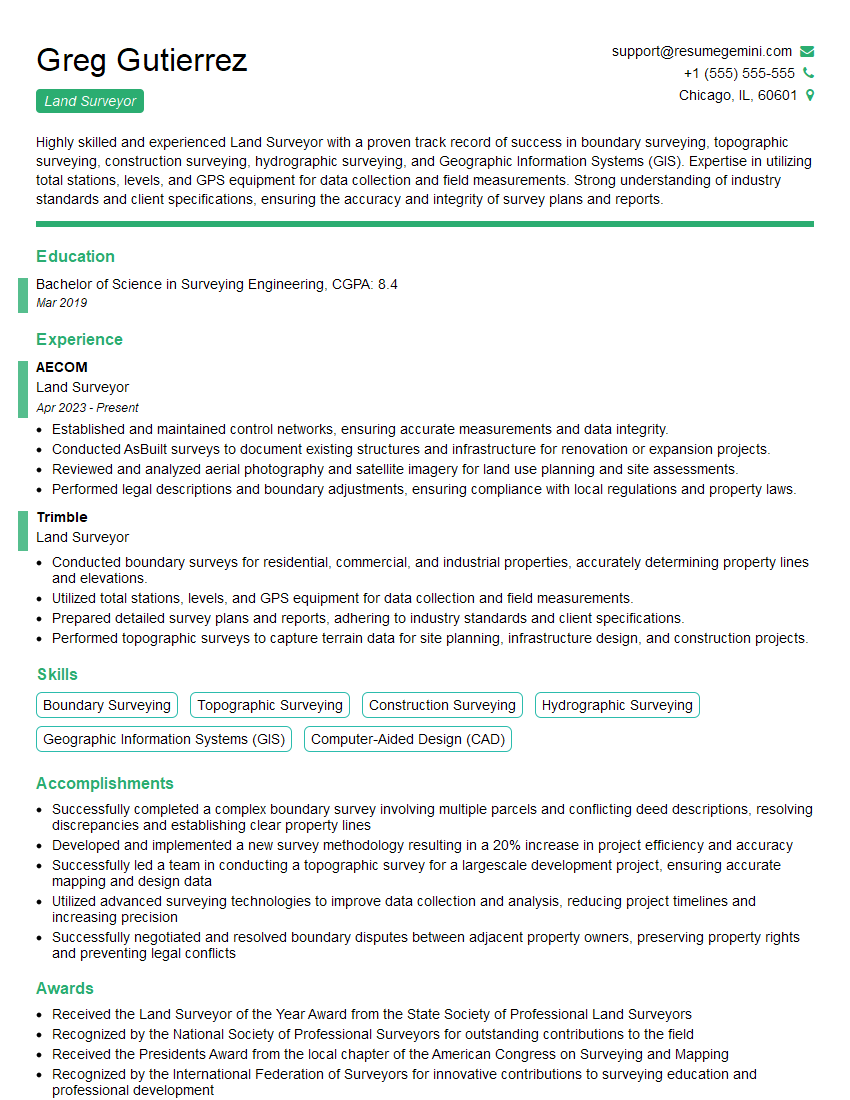
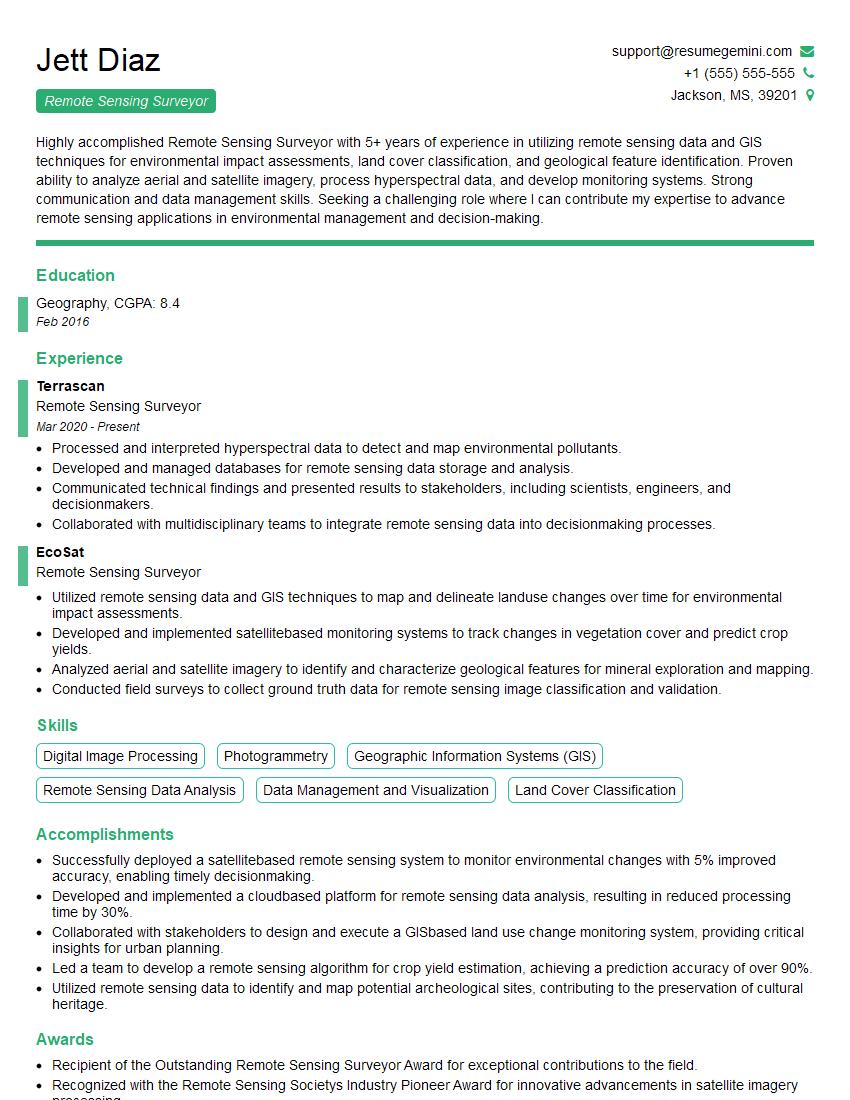
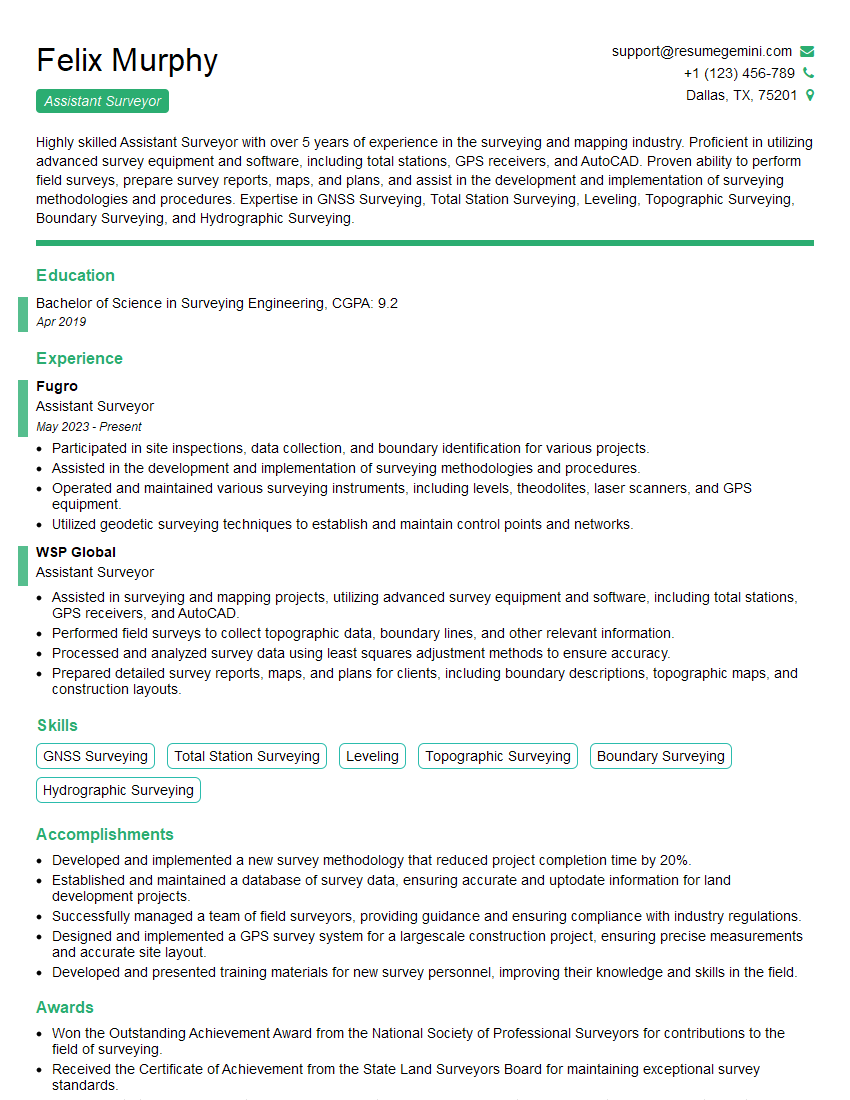
Mastering Surveying Principles is crucial for a successful and rewarding career. A strong understanding of these concepts will significantly enhance your job prospects and allow you to contribute meaningfully from day one. To maximize your chances, create a resume that is both comprehensive and ATS-friendly. This will ensure your application is effectively screened by applicant tracking systems. We highly recommend using ResumeGemini to build a professional and impactful resume tailored to the Surveying Principles field. ResumeGemini provides examples of resumes specifically designed for this industry to help guide you in crafting a winning application. Invest time in this crucial step and you’ll increase your chances of landing your dream surveying role.





Explore more articles
Users Rating of Our Blogs
Share Your Experience
We value your feedback! Please rate our content and share your thoughts (optional).
What Readers Say About Our Blog
I Redesigned Spongebob Squarepants and his main characters of my artwork.
https://www.deviantart.com/reimaginesponge/art/Redesigned-Spongebob-characters-1223583608
IT gave me an insight and words to use and be able to think of examples
Hi, I’m Jay, we have a few potential clients that are interested in your services, thought you might be a good fit. I’d love to talk about the details, when do you have time to talk?
Best,
Jay
Founder | CEO