Are you ready to stand out in your next interview? Understanding and preparing for Tapping Deburring interview questions is a game-changer. In this blog, we’ve compiled key questions and expert advice to help you showcase your skills with confidence and precision. Let’s get started on your journey to acing the interview.
Questions Asked in Tapping Deburring Interview
Q 1. Explain the purpose of deburring in tapping operations.
Deburring after tapping is crucial for ensuring the quality and functionality of tapped holes. A burr, a sharp, raised edge of material, is often formed during the tapping process. These burrs can interfere with mating parts, damage seals, scratch surfaces, or even pose a safety hazard. Removing them ensures smooth assembly, prevents wear, and improves overall product reliability. Think of it like cleaning up after a construction project – you wouldn’t leave jagged edges on a finished piece of furniture, would you?
Q 2. What are the common methods used for deburring tapped holes?
Several methods exist for deburring tapped holes, each with its own advantages and limitations. Common methods include:
- Hand Deburring Tools: These include hand deburring tools like countersinks, chamfer tools, and specialized deburring bits. These are ideal for small batch production or intricate parts where precision is paramount.
- Power Deburring Tools: Rotary files, abrasive wheels, and belt sanders are used for faster deburring of larger quantities. However, they require more skill and precision to avoid damaging the workpiece.
- Automated Deburring Machines: These machines use various methods, including brushing, tumbling, vibratory finishing, and electrochemical deburring, to process a large number of parts efficiently and consistently. They are particularly suited for high-volume manufacturing.
- Chemical Deburring: This method uses chemical solutions to dissolve or etch away burrs. It is often used for delicate parts or complex geometries but needs careful consideration of material compatibility and environmental regulations.
Q 3. Describe the difference between manual and automated deburring.
The primary difference between manual and automated deburring lies in scale and consistency. Manual deburring relies on hand tools and operator skill; it is suitable for low-volume production or intricate parts where precision is critical. However, it’s time-consuming, labor-intensive, and prone to inconsistencies in deburring quality. Automated deburring, on the other hand, uses machines to perform the deburring process, often at higher speeds and with greater consistency. It’s ideal for high-volume production, resulting in a more uniform finish and significantly reduced labor costs. Think of it like hand-writing a letter versus using a printing press – both achieve the same goal, but one is far more efficient for large quantities.
Q 4. What are the advantages and disadvantages of using different deburring tools (e.g., brushes, cutters, etc.)?
Different deburring tools offer varied advantages and disadvantages:
- Brushes: Advantages: Versatile, good for various materials, relatively low cost. Disadvantages: Can leave surface scratches, less precise for tight tolerances.
- Cutters: Advantages: High precision, can remove significant burr material quickly. Disadvantages: More expensive, requires more skill, risk of damaging the part.
- Abrasive Wheels/Belts: Advantages: Fast material removal. Disadvantages: Risk of generating heat and damaging the workpiece, creates dust and requires proper safety measures.
- Vibratory Finishing: Advantages: Processes many parts simultaneously, good for complex shapes. Disadvantages: Requires specialized equipment, can be slow.
The choice depends on factors like part geometry, material, required surface finish, and production volume.
Q 5. How do you determine the appropriate deburring method for a specific part and material?
Selecting the appropriate deburring method involves considering several factors:
- Part Geometry: Complex shapes may necessitate techniques like vibratory finishing or chemical deburring. Simple holes might be easily deburred with hand tools.
- Material: Hard materials require more aggressive methods like cutters or abrasive wheels, while softer materials may be damaged by such techniques.
- Surface Finish Requirements: High-precision applications require delicate methods; less critical applications can tolerate slightly less precise methods.
- Production Volume: High-volume production often favors automated methods for efficiency and consistency.
- Cost Considerations: Balancing the cost of equipment, labor, and materials is crucial. Simple, manual methods might suffice for low-volume projects.
A thorough analysis of these factors will guide you towards the optimal deburring solution. Often, a trial run with different methods on a sample part is beneficial to compare results and choose the most efficient and effective technique.
Q 6. Explain how burr formation is related to the tapping process parameters.
Burr formation during tapping is intrinsically linked to tapping process parameters. Factors contributing to burr formation include:
- Tapping Speed: High speeds can generate more heat and friction, leading to larger burrs.
- Cutting Fluid: Insufficient or improper cutting fluid lubrication can increase friction and heat, resulting in more burrs.
- Tap Geometry: The tap’s design, specifically its flute geometry and rake angle, significantly influences the chip formation and burr size.
- Material Properties: Brittle materials tend to form larger, sharper burrs than ductile materials.
- Feed Rate: Excessive feed rates increase the cutting force, leading to larger burrs.
Optimizing these parameters through experimentation and understanding material behavior can help minimize burr formation and improve the tapping process.
Q 7. How do you inspect for burrs after tapping?
Inspection for burrs after tapping can be done through various methods:
- Visual Inspection: A simple and cost-effective method, especially for small parts. Magnification tools can help with detailed examination.
- Tactile Inspection: Running a finger along the edge of the tapped hole to detect any sharpness or roughness.
- Air Gauging: Measures the internal diameter of the hole, providing an indication of burr presence.
- Optical Measurement: Microscopes and surface profilometers provide precise measurements of the burr size and shape.
- Automated Inspection Systems: High-throughput applications utilize automated vision systems to quickly and reliably detect burrs.
The choice of inspection method depends on the required accuracy, part complexity, and production volume. A combination of methods might be used to ensure thorough and reliable quality control.
Q 8. What are the consequences of inadequate deburring?
Inadequate deburring can have significant consequences, impacting both product quality and safety. Sharp edges and burrs left on parts can lead to a range of problems.
- Safety Hazards: Sharp burrs can cause injuries to workers during assembly, handling, or use of the final product. This is especially critical in industries like medical device manufacturing or automotive parts production.
- Functional Issues: Burrs can interfere with the proper functioning of a component. For example, a burr on a moving part might cause friction, leading to premature wear or even failure. In precision engineering, even small burrs can render a part unusable.
- Aesthetic Defects: In many applications, a smooth, burr-free surface is crucial for aesthetics. Visible burrs can detract from the overall appearance of a product, reducing its market value.
- Assembly Difficulties: Burrs can hinder the assembly process, making it more difficult and time-consuming to join components. They can also damage mating parts during assembly.
- Reduced Product Life: Burrs act as stress concentrators, potentially leading to early failure of the part due to fatigue or cracking.
Think of it like this: imagine trying to assemble a finely crafted clock with burrs on the gears; the burrs would prevent smooth operation and potentially damage the delicate mechanism.
Q 9. Describe your experience with different types of deburring machines.
My experience encompasses a wide range of deburring machines, from manual methods to highly automated systems. I’ve worked with:
- Manual Deburring Tools: This includes hand files, deburring tools, and abrasive media such as brushes and stones. These are suitable for small-batch production or intricate parts where precise control is needed.
- Centrifugal Deburring Machines: These machines use centrifugal force to tumble parts in an abrasive media, effectively removing burrs from various shapes and sizes. I’ve used these extensively for high-volume production of relatively simple parts.
- Vibratory Deburring Machines: Similar to centrifugal machines, vibratory systems use vibration and abrasive media to deburr parts. These are often preferred for delicate parts or those with complex geometries, minimizing damage risk.
- Electrochemical Deburring (ECD): I have experience with ECD systems, which use an electrochemical process to remove burrs. This method is highly precise and suitable for very delicate parts and hard-to-reach areas, but it can be more expensive and requires specialized knowledge.
- Automated Robotic Deburring Systems: In large-scale manufacturing environments, I’ve collaborated with robotic systems equipped with various deburring tools. These provide high speed, consistency, and repeatability.
The choice of machine depends heavily on factors such as part geometry, material, production volume, required precision, and cost considerations.
Q 10. How do you troubleshoot common deburring problems (e.g., inconsistent deburring, damage to the part)?
Troubleshooting deburring problems often involves a systematic approach. Here’s how I tackle common issues:
- Inconsistent Deburring: This could stem from several sources:
- Uneven Media Distribution: Check for proper media loading and distribution in centrifugal or vibratory machines. Insufficient media or clumping can lead to uneven deburring.
- Incorrect Machine Settings: Review the machine parameters such as speed, time, and media type. Optimization might be necessary.
- Part Orientation: Ensure parts are properly oriented within the machine to expose all burr-prone areas to the abrasive media.
- Part Damage: Damage can result from:
- Aggressive Deburring: Reduce the intensity of the process (e.g., lower speed, shorter time, less aggressive media).
- Improper Media Selection: The abrasive media needs to be appropriate for the part material. Using overly abrasive media can cause scratches or damage.
- Machine Malfunction: Inspect the machine for any mechanical issues that could be causing damage (e.g., broken components, misalignment).
My approach involves careful inspection of the parts, machine settings, and the deburring process itself. I use data logging (if available) to identify trends and patterns in defects.
Q 11. What safety precautions are essential during deburring operations?
Safety is paramount in deburring operations. Essential precautions include:
- Eye Protection: Always wear safety glasses or goggles to protect against flying debris.
- Hearing Protection: Some deburring machines are quite noisy; earplugs or earmuffs are crucial.
- Hand Protection: Gloves should be worn, especially when handling sharp parts or abrasive media.
- Respiratory Protection: Depending on the abrasive media used, a respirator might be necessary to prevent inhalation of dust or particles.
- Proper Machine Guarding: Ensure all machine guards are in place and functioning correctly to prevent accidental contact with moving parts.
- Lockout/Tagout Procedures: Always follow lockout/tagout procedures before performing any maintenance or adjustments on the deburring machine.
- Proper Training: All operators must receive thorough training on safe operating procedures for the specific deburring machine and materials being used.
I always emphasize a proactive safety culture, where everyone feels empowered to report hazards and contribute to a safe working environment.
Q 12. How do you ensure the quality and consistency of the deburring process?
Maintaining quality and consistency in deburring requires a multi-faceted approach.
- Process Standardization: Develop and strictly adhere to standardized operating procedures (SOPs) for each deburring process. This ensures that all operators follow the same steps.
- Regular Machine Maintenance: Preventative maintenance, including regular cleaning and inspection of the deburring machine, is vital for ensuring consistent performance.
- Quality Control Checks: Implement a robust quality control system, including regular inspection of deburred parts using appropriate methods (e.g., visual inspection, microscopy). Sampling plans should be used to ensure representative assessment.
- Operator Training and Skill Development: Well-trained operators are crucial for consistent results. Regular training and retraining programs help maintain skill levels and address any challenges.
- Process Monitoring and Adjustment: Continuously monitor the deburring process and make adjustments as needed to maintain quality and efficiency.
Think of it like baking a cake – a consistent recipe (SOP), high-quality ingredients (materials & equipment), and skilled hands (trained operators) are key to a consistent result.
Q 13. Describe your experience with statistical process control (SPC) in deburring.
Statistical Process Control (SPC) is an invaluable tool for maintaining consistent deburring quality. I’ve used SPC extensively to monitor and control key process parameters such as deburring time, media consumption, and the number of defective parts.
By tracking these variables over time, we can create control charts (e.g., X-bar and R charts) to identify trends, detect potential problems before they become major issues, and ensure that the process remains within acceptable limits. For example, if the number of defective parts suddenly increases above the upper control limit, it signals a need for investigation and corrective action.
SPC also provides valuable data for continuous improvement initiatives. By analyzing the data, we can identify areas where the process can be optimized to improve efficiency and quality. This data-driven approach is essential for maintaining a high level of quality consistency in deburring operations.
Q 14. How do you document and track deburring procedures and results?
Documentation and tracking are vital for traceability, regulatory compliance, and continuous improvement in deburring. My approach involves:
- Detailed SOPs: Well-defined, documented SOPs outline the procedures for each deburring process, including machine settings, media type, cycle time, and quality control checks. These are readily accessible to all operators.
- Data Logging: Where possible, I utilize automated data logging systems to record key process parameters (e.g., machine run time, media usage, part count). This data is stored securely and readily accessible for analysis.
- Inspection Records: Each batch of deburred parts is inspected, and the results are documented, including the number of defects found, their type, and any corrective actions taken. This provides a clear audit trail.
- Maintenance Logs: All maintenance activities performed on deburring machines are meticulously recorded, including the date, type of maintenance, and any parts replaced. This helps track machine performance and identify potential issues.
- Non-conformance Reports: Any deviations from the SOPs or instances of defective parts are documented in non-conformance reports, initiating corrective and preventative actions (CAPA).
This comprehensive documentation allows for effective traceability of the deburring process and facilitates continuous improvement efforts.
Q 15. Explain your experience with different types of burr removal tools.
My experience spans a wide range of deburring tools, from manual methods to fully automated systems. I’m proficient with various hand tools like deburring files, rotary burs, and abrasive stones, each suited for different burr sizes and material hardness. I’ve also extensively used power tools including pneumatic and electric deburring tools, offering speed and precision for higher-volume applications. Beyond these, I have considerable experience with specialized tools such as vibratory finishing machines, which excel at deburring large batches of small parts, and electrochemical deburring systems, ideal for delicate parts requiring a very precise finish. I’ve even worked with laser deburring on occasion, offering an exceptional level of control and precision.
- Hand Deburring Tools: These are excellent for intricate parts where precise control is paramount.
- Power Tools: Offer increased speed and efficiency for larger production runs.
- Vibratory Finishing: Ideal for mass deburring of smaller components.
- Electrochemical Deburring: A non-contact method perfect for delicate or intricate parts.
- Laser Deburring: Offers high precision and minimal material removal.
Career Expert Tips:
- Ace those interviews! Prepare effectively by reviewing the Top 50 Most Common Interview Questions on ResumeGemini.
- Navigate your job search with confidence! Explore a wide range of Career Tips on ResumeGemini. Learn about common challenges and recommendations to overcome them.
- Craft the perfect resume! Master the Art of Resume Writing with ResumeGemini’s guide. Showcase your unique qualifications and achievements effectively.
- Don’t miss out on holiday savings! Build your dream resume with ResumeGemini’s ATS optimized templates.
Q 16. How do you select the appropriate deburring tool for a specific material and burr type?
Selecting the right deburring tool depends heavily on the material and the burr itself. For instance, a hard, brittle material like ceramic would require a tool that minimizes chipping and fracturing, perhaps a diamond-coated burr or a gentler method like vibratory finishing. Conversely, a softer material like aluminum might tolerate more aggressive tools such as a rotary burr or even a simple file. The type of burr—sharp, rolled, or ragged—also dictates the tool choice. A sharp burr may necessitate a tool that cleanly shears it off, whereas a rolled burr might be better handled with a tool that progressively removes the material.
Think of it like choosing a knife – you wouldn’t use a butter knife to carve a roast. Similarly, a delicate electrochemical deburring system is inappropriate for heavy material removal from a steel casting. My process always involves a careful assessment of both the material and burr characteristics to optimize tool selection for speed, efficiency, and surface finish quality.
Q 17. Describe your experience with automated deburring systems.
My experience with automated deburring systems encompasses various types, including robotic systems, CNC-controlled deburring machines, and automated vibratory finishing systems. I’ve worked on projects involving the integration of these systems into existing manufacturing lines, ensuring seamless operation and maximizing throughput. I’ve overseen the setup, programming, operation, and maintenance of these systems, including troubleshooting malfunctions and optimizing parameters to achieve desired quality and efficiency levels. For example, I was involved in a project where we implemented a robotic system for deburring complex automotive parts, reducing cycle time by 40% and improving consistency.
Q 18. How do you program or set up an automated deburring system?
Programming or setting up an automated deburring system is a multi-step process. It begins with a thorough understanding of the parts to be deburred, including their geometry, material properties, and burr characteristics. Then, the system needs to be properly fixtured to reliably hold and present each part to the deburring tool. Programming involves creating a tool path that accurately removes the burrs without damaging the part surface. This often involves the use of CAD/CAM software to generate the tool path. Finally, the system requires careful calibration and testing to ensure optimal performance and accuracy. I typically use simulation software to preview the toolpath and identify potential collisions or issues before running the program on the actual machine.
For example, when setting up a robotic deburring cell, I would use specialized software to program the robot’s movements, including its approach angle, deburring speed, and force application, all while considering the part’s complexity and fragility.
Q 19. How do you maintain and troubleshoot automated deburring equipment?
Maintaining and troubleshooting automated deburring equipment is crucial for ensuring consistent operation and high quality. Regular maintenance includes inspecting tools for wear and tear, lubricating moving parts, and cleaning the work area. Troubleshooting involves diagnosing the root cause of malfunctions, which might include faulty sensors, tool breakage, or software errors. I rely on a combination of diagnostic tools, process monitoring data, and my understanding of the system’s mechanics to isolate the problem. For example, I once diagnosed a recurring issue in a robotic deburring cell by analyzing sensor data that revealed a slight misalignment in the part-holding fixture, leading to inconsistent deburring results.
Q 20. What are the key performance indicators (KPIs) for a deburring process?
Key performance indicators (KPIs) for a deburring process include:
- Deburring Efficiency: Measured as the number of parts deburred per unit of time.
- Burr Removal Rate: Percentage of burrs removed successfully.
- Part Rejection Rate: Percentage of parts rejected due to incomplete or improper deburring.
- Surface Finish Quality: Assessed through measurements of surface roughness and other relevant parameters.
- Tool Life: Duration before tool replacement is necessary.
- Operating Costs: Total cost of running the deburring operation, including labor, materials, and energy.
Tracking these KPIs allows for continuous improvement and helps identify areas where the process can be optimized.
Q 21. How do you improve the efficiency of the deburring process?
Improving the efficiency of the deburring process involves several strategies. Optimizing tool selection, as discussed earlier, is crucial. Automation, where feasible, can significantly increase throughput. Process improvements include streamlining part handling and flow, reducing setup times, and implementing preventive maintenance to minimize downtime. Investing in advanced technology, such as laser or electrochemical deburring, can also improve both efficiency and quality. Finally, continuous monitoring of KPIs and data-driven decision making helps identify and address bottlenecks in the process.
For instance, in one project, we implemented a new fixturing system that reduced setup time by 50% and decreased part handling time, resulting in a significant overall efficiency gain. This involved careful analysis of the existing process, identifying areas for improvement, and designing a more efficient solution.
Q 22. Describe your experience with different deburring techniques (e.g., chamfering, counterboring).
My experience encompasses a wide range of deburring techniques, focusing on both manual and automated methods. Chamfering, for instance, involves creating a bevelled edge to remove sharp burrs. I’ve extensively used various chamfering tools, from hand-held files and deburring tools to CNC-controlled machining centers for high-volume, precise chamfering. Counterboring, on the other hand, creates a wider, countersunk hole, often used to accommodate a screw head or other fastener. This technique is crucial for preventing sharp edges and ensuring a flush surface. I’ve worked with both manual counterboring tools and automated systems that incorporate specialized drills and tooling. Beyond these two, I’m proficient in techniques like tumbling (mass deburring using abrasive media), brushing (using power brushes to remove burrs), and electro-chemical deburring (ECD), a highly precise and environmentally friendly method.
For example, in a previous role, we were manufacturing precision components for aerospace applications. Manually chamfering each part was time-consuming and prone to inconsistencies. We transitioned to a CNC-controlled chamfering process, significantly improving efficiency and achieving tighter tolerances. This resulted in reduced production time and less scrap.
Q 23. What are the environmental considerations related to deburring (e.g., waste disposal)?
Environmental considerations in deburring are paramount. Waste disposal is a key concern. Many traditional deburring methods generate significant amounts of abrasive media, spent chemicals, or metal shavings. Improper disposal can lead to environmental pollution. I’ve worked with companies implementing closed-loop systems for abrasive media, ensuring that the media is recycled or reused to minimize waste. For chemical-based deburring processes, we implemented strict protocols for handling and disposal, ensuring compliance with all relevant regulations. Furthermore, noise pollution from some deburring equipment is a factor that can be mitigated through proper machine selection, maintenance, and soundproofing measures. Sustainable practices, such as choosing environmentally friendly deburring fluids and adopting techniques like ECD that minimize waste, are now core considerations in my approach.
Q 24. How do you manage and control burr-related scrap?
Managing and controlling burr-related scrap is vital for maintaining production efficiency and profitability. This involves a multi-pronged approach. Firstly, prevention is key. Optimizing the machining process itself is crucial to minimize burr formation in the first place. This includes proper tooling selection, machine setup, and process parameters. Secondly, rigorous quality control measures are essential. Regular inspections using various methods (visual inspection, microscopy) ensure early detection of burrs. Thirdly, scrap sorting and segregation is crucial for efficient recycling and proper disposal. We used a color-coded system for scrap categorization, making it easier to identify different materials and facilitate their respective recycling streams. Finally, data analysis helps us understand the root causes of burr formation and implement corrective actions. By tracking scrap rates, we identify trends and pinpoint areas for process optimization.
Q 25. Explain your experience working with different materials and their impact on deburring techniques.
The material of the workpiece significantly impacts the choice of deburring technique. For instance, soft metals like aluminum are easier to deburr using relatively gentle methods like brushing or tumbling. Harder materials like stainless steel often require more aggressive techniques such as grinding or ECD. Brittle materials, like ceramics, necessitate careful consideration to avoid fracture. My experience spans a variety of materials, including aluminum alloys, stainless steels, titanium, and plastics. For each material, I select the deburring technique that balances speed, precision, and surface finish, minimizing material removal and potential damage.
For example, when deburring titanium components, I avoid aggressive methods that could introduce surface damage, opting for gentler approaches like vibratory finishing. This ensures the integrity of the component and prevents compromising its mechanical properties.
Q 26. What are the industry standards and regulations relevant to deburring?
Industry standards and regulations related to deburring are crucial for ensuring product quality and worker safety. These often relate to specific industries, such as aerospace or medical devices, where stringent requirements exist. For example, ISO standards address surface finish and dimensional tolerances. OSHA regulations cover workplace safety, including the use of personal protective equipment (PPE) during deburring operations. In my work, I ensure full compliance with these standards and regulations, maintaining detailed records and certifications where necessary. I also stay updated on any changes or new regulations that may impact deburring procedures.
Q 27. Describe a time you had to solve a challenging deburring problem.
One challenging deburring problem involved a complex, intricately shaped part made of a high-strength steel alloy. Traditional methods were proving inefficient and damaged the part’s delicate features. The burrs were particularly stubborn due to the material’s hardness and the part’s geometry. My approach was to first thoroughly analyze the part’s design and the burr formation mechanism. We then experimented with several methods, including precision grinding and ECD. We found that a combination of a specialized robotic ECD system and a final, automated brushing step provided the optimal solution, achieving the desired surface finish without causing any damage.
This experience highlighted the importance of systematic problem-solving and the necessity of exploring different techniques before settling on a final solution. The success involved careful planning, thorough testing, and close collaboration with engineers and technicians.
Q 28. How do you stay updated on the latest advancements in deburring technology?
Staying current with advancements in deburring technology requires a multi-faceted approach. I actively attend industry conferences and trade shows to learn about the latest innovations. I also subscribe to relevant industry publications and online journals. Furthermore, I participate in professional organizations related to manufacturing and materials processing. These activities help me keep abreast of new equipment, techniques, and best practices in the field of deburring, allowing me to continuously improve my skills and adapt to evolving industry demands.
Key Topics to Learn for Tapping Deburring Interview
- Tapping Processes: Understanding various tapping methods (e.g., hand tapping, machine tapping), tap selection criteria (material, size, type), and the importance of proper lubrication.
- Deburring Techniques: Familiarization with different deburring methods (e.g., hand deburring tools, automated deburring machines, vibratory finishing), selecting appropriate techniques based on material and part geometry, and understanding the impact of deburring on surface finish and part functionality.
- Tooling and Equipment: Knowledge of different types of taps, deburring tools, and associated machinery. This includes understanding their maintenance, safety procedures, and troubleshooting common issues.
- Quality Control and Inspection: Understanding quality standards and inspection methods for tapped and deburred parts. This includes recognizing defects, performing measurements, and documenting findings.
- Material Science Basics: A foundational understanding of the properties of different materials commonly used in tapping and deburring (e.g., metals, plastics) and how these properties affect the process.
- Safety Procedures: Thorough knowledge of safety regulations and practices related to tapping and deburring equipment, including personal protective equipment (PPE) and hazard identification.
- Problem-Solving and Troubleshooting: Ability to identify and solve common problems encountered during tapping and deburring, such as broken taps, poor surface finish, or dimensional inaccuracies.
- Process Optimization: Understanding techniques for improving efficiency and reducing waste in tapping and deburring processes. This includes cycle time reduction and defect minimization.
Next Steps
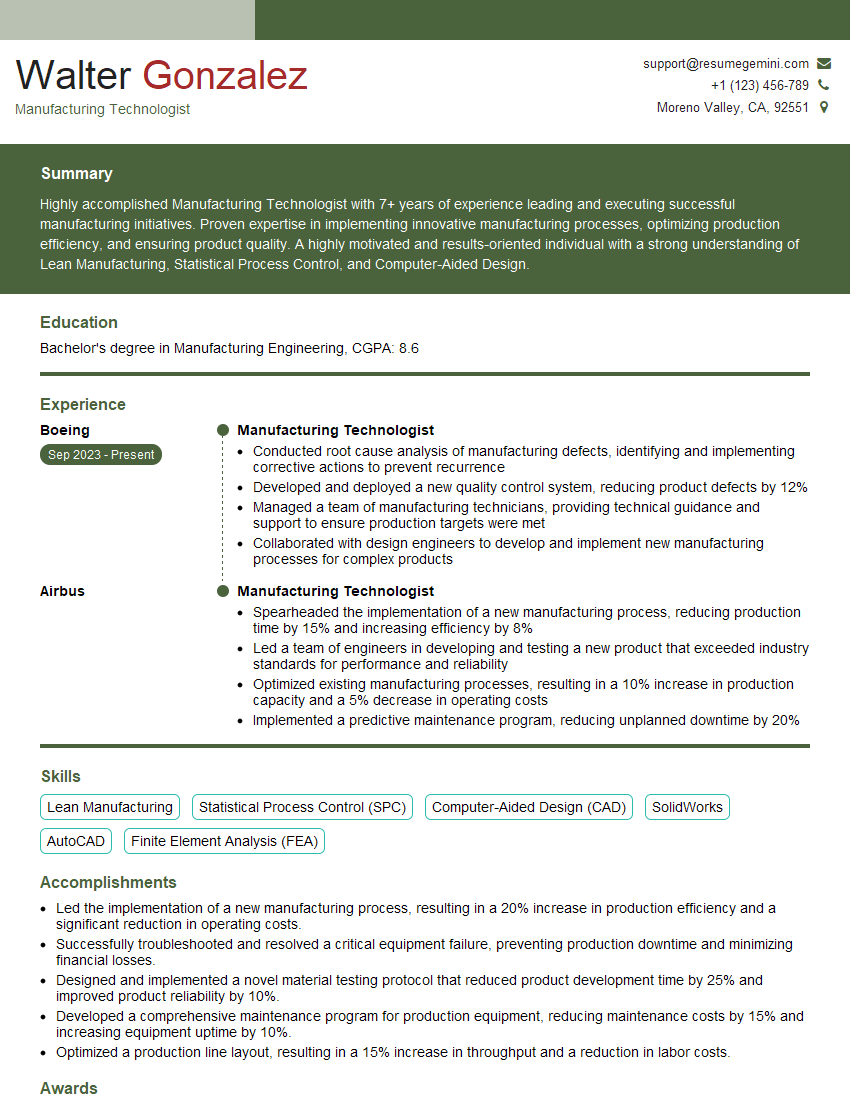
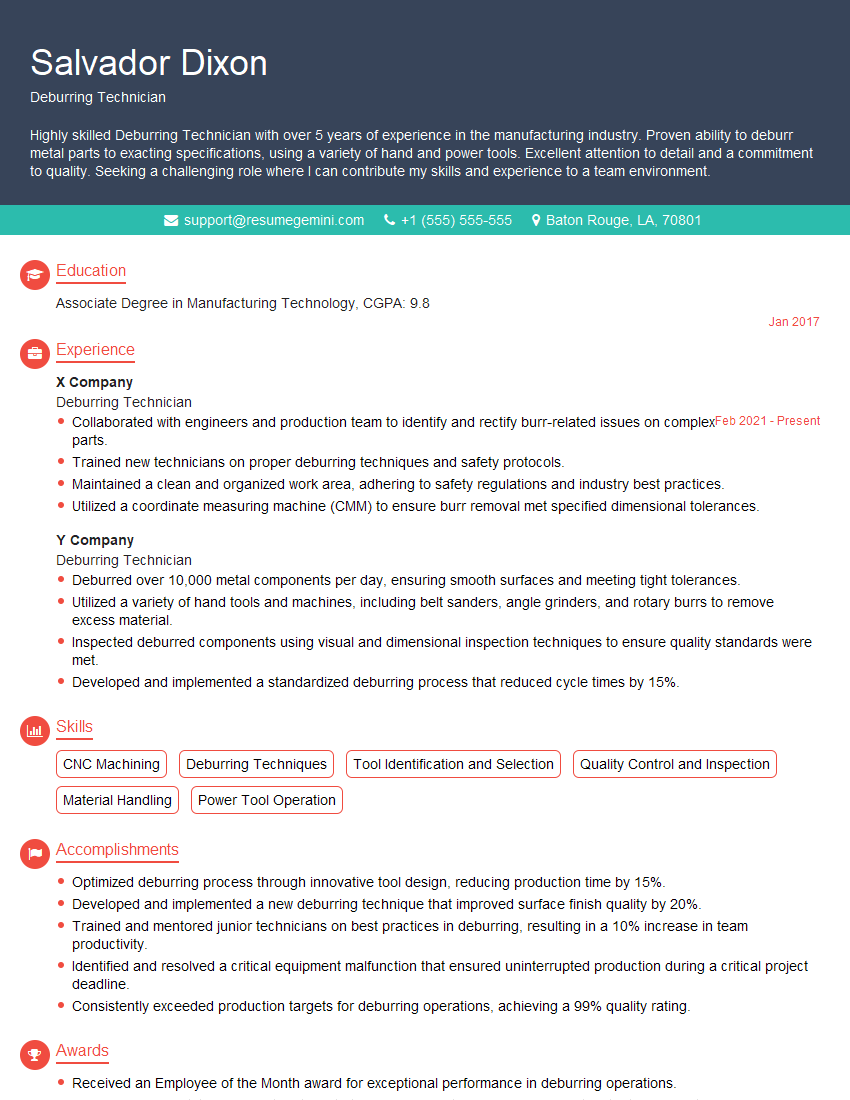
Mastering Tapping and Deburring opens doors to diverse and rewarding manufacturing roles, offering opportunities for advancement and specialization. A well-crafted resume is crucial for showcasing your skills and experience to potential employers. Creating an ATS-friendly resume significantly increases your chances of getting noticed. To enhance your resume-building experience and stand out from the competition, leverage the power of ResumeGemini. ResumeGemini provides valuable tools and resources to craft a professional and impactful resume. Examples of resumes tailored specifically to Tapping Deburring are available to guide your process. Invest time in building a strong resume – it’s your key to unlocking your career potential.





Explore more articles
Users Rating of Our Blogs
Share Your Experience
We value your feedback! Please rate our content and share your thoughts (optional).
What Readers Say About Our Blog
I Redesigned Spongebob Squarepants and his main characters of my artwork.
https://www.deviantart.com/reimaginesponge/art/Redesigned-Spongebob-characters-1223583608
IT gave me an insight and words to use and be able to think of examples
Hi, I’m Jay, we have a few potential clients that are interested in your services, thought you might be a good fit. I’d love to talk about the details, when do you have time to talk?
Best,
Jay
Founder | CEO