The right preparation can turn an interview into an opportunity to showcase your expertise. This guide to Transcription Turnaround Time interview questions is your ultimate resource, providing key insights and tips to help you ace your responses and stand out as a top candidate.
Questions Asked in Transcription Turnaround Time Interview
Q 1. What strategies do you employ to manage and improve transcription turnaround time?
Managing and improving transcription turnaround time (TAT) requires a multifaceted approach focusing on efficiency and process optimization. Think of it like a well-oiled machine – each part needs to work seamlessly.
- Efficient Workflow Design: I meticulously design workflows to minimize redundancies. This includes streamlining the steps from audio receipt to final delivery, ensuring clear handoffs between team members (if applicable).
- Technology Optimization: Leveraging advanced transcription software with features like speech-to-text, automated time stamping, and quality control tools is crucial. I regularly evaluate new technologies to identify efficiency gains. For example, switching from manual transcription to a software with advanced AI features significantly reduced my TAT.
- Team Management (if applicable): If I’m managing a team, clear communication, regular training, and performance monitoring are critical. Establishing clear roles and responsibilities prevents bottlenecks. For instance, dedicated proofreaders can expedite the quality assurance process.
- Resource Allocation: Properly allocating resources—time, personnel, and technology—according to project complexity and urgency ensures timely completion. This includes prioritizing high-priority tasks (which I’ll explain in the next answer).
- Continuous Improvement: Regularly analyzing performance data (metrics mentioned later) helps identify areas needing improvement. It could be something as simple as optimizing keyboard shortcuts or improving communication protocols.
Q 2. How do you prioritize tasks to meet tight deadlines for transcription projects?
Prioritizing tasks for tight deadlines requires a structured approach. I typically use a combination of methods:
- Urgency and Importance Matrix: This classic approach categorizes tasks based on urgency and importance (high/low). High-urgency, high-importance tasks get top priority. For example, a court transcript needed for a trial immediately takes precedence over a less time-sensitive academic paper.
- Deadline-Based Scheduling: I use project management software to schedule tasks based on their deadlines, ensuring sufficient time allocation for each. Visualizing tasks on a calendar allows for better planning and prevents overlapping deadlines.
- Client Communication: Open communication with clients is vital. Clearly understanding their priorities helps me allocate resources effectively. Sometimes, a slight adjustment in the scope or deliverables can help meet demanding deadlines without compromising quality.
- Workload Balancing: I distribute tasks evenly to avoid overwhelming any single member (if applicable) or myself. This ensures sustained productivity and prevents burnout, maintaining high quality throughout the process.
Q 3. Describe your experience with different transcription software and their impact on turnaround time.
My experience encompasses a range of transcription software, each impacting TAT differently.
- Basic Transcription Software: Simpler software with basic features often requires more manual work, increasing TAT. However, they’re excellent for familiarizing oneself with the transcription process. I started with such software, learning the fundamentals before moving on to advanced tools.
- Advanced Speech-to-Text Software: Software incorporating AI-powered speech-to-text capabilities significantly reduces TAT. However, accuracy needs to be checked, so proofreading remains crucial. The accuracy level varies depending on audio quality and speaker clarity. I’ve found that software from
Company XandCompany Yoffer very different levels of accuracy and speed. - Specialized Transcription Software: Software catering to specific needs, like legal or medical transcription, often includes specialized features, speeding up the process for those niche areas. For instance, legal transcription software may include features for automated legal terminology recognition.
The impact on TAT depends on factors like software features, audio quality, and user proficiency. Choosing the right software is crucial for optimal efficiency.
Q 4. How do you handle unexpected delays or challenges that affect transcription turnaround time?
Unexpected delays are inevitable. My approach is proactive and transparent:
- Identify the Root Cause: First, I pinpoint the source of the delay. Is it a technical issue, a data problem, or an unforeseen circumstance? For instance, a corrupted audio file would require different solutions than a sudden illness among team members.
- Communicate with Stakeholders: Prompt and clear communication with clients or stakeholders is paramount. I inform them of the delay, the reasons, and the revised TAT, ensuring they’re aware and understanding.
- Implement Contingency Plans: Having backup plans is essential. This could involve reassigning tasks, leveraging additional resources, or using alternative methods to meet deadlines.
- Learn from the Experience: After resolving the issue, I analyze what happened to prevent similar delays in the future. For example, if the delay was due to a software glitch, I may switch to a more reliable program or implement regular backups.
Q 5. What metrics do you use to track and measure transcription turnaround time?
Tracking and measuring TAT requires key metrics:
- Average Turnaround Time (ATT): This measures the average time taken to complete transcription projects. Calculating it over a period (like a month) reveals trends and improvements.
- Turnaround Time per Project Type: Analyzing TAT for different types of audio (interviews, lectures, meetings) provides insights into areas requiring optimization. I’ve noticed, for instance, that highly technical lectures take significantly longer.
- Time Spent on Each Transcription Phase: Tracking time spent on individual stages (audio preparation, transcription, proofreading, formatting) pinpoints bottlenecks. This allows for focusing improvement efforts on specific areas.
Example:If proofreading consumes a disproportionate amount of time, I might need additional proofreaders or refine my quality control process. - Transcription Speed (Words Per Minute): This metric tracks the speed of transcription, allowing for continuous improvement. It also helps in setting realistic expectations for future projects.
Q 6. Explain your process for quality assurance to ensure both speed and accuracy in transcription.
Quality assurance is critical for balancing speed and accuracy. My process involves:
- Multiple Levels of Review: I often implement multiple checks – a self-review by the transcriber followed by a thorough review by a separate proofreader or quality control team member. This catches errors and ensures consistency.
- Standardized Quality Control Checklists: Using checklists ensures consistent application of quality standards. These checklists cover aspects like accuracy, formatting, punctuation, and adherence to client-specific requirements.
- Automated Quality Control Tools: Software with built-in quality checks can detect inconsistencies or potential errors. This reduces manual effort while maintaining accuracy.
- Regular Calibration and Training: Regular training sessions and calibration exercises for the team (if applicable) ensure consistency in transcription styles and quality standards. This is crucial if I’m managing multiple transcriptionists.
Q 7. How do you communicate turnaround time expectations to clients or stakeholders?
Communicating TAT expectations is crucial for managing client relationships. I strive for clarity and transparency:
- Upfront Communication: Before starting a project, I provide a clear estimate of the TAT, outlining factors that might influence it (e.g., audio quality, complexity of language, length of audio). I’ll often provide a range rather than a fixed number to account for variables.
- Project Management Tools: Using project management platforms allows clients to track progress in real-time, promoting transparency. Updates are given promptly, ensuring the client is always informed.
- Regular Updates: Depending on the project’s length, I provide regular updates (weekly or bi-weekly) on the progress and any potential delays, enabling proactive adjustments. This avoids last-minute surprises.
- Clearly Defined Service Level Agreements (SLAs): For regular clients, having formal SLAs with specified TATs ensures consistent expectations and avoids misunderstandings.
Q 8. What are some common causes of delays in transcription projects, and how do you mitigate them?
Delays in transcription projects are unfortunately common, but proactive mitigation strategies can significantly reduce their impact. Common causes include:
- Poor audio quality: Background noise, low recording levels, multiple speakers, and accents all increase transcription time and difficulty.
- Unclear instructions or specifications: Ambiguous requirements regarding formatting, style, timestamps, or speaker identification lead to rework and delays.
- Unexpected volume surges: A sudden influx of audio files can overwhelm resources and push back deadlines unless properly managed.
- Technical issues: Software glitches, hardware malfunctions, or file corruption can disrupt workflow and delay completion.
- Inadequate staffing or resource allocation: Insufficient transcriptionists or lack of appropriate software can create bottlenecks.
Mitigation involves proactive measures such as:
- Pre-transcription audio quality checks: Implementing a quality control step before assigning files to ensure clarity.
- Clear and detailed project briefs: Providing comprehensive instructions and specifications upfront to avoid ambiguity.
- Efficient workload management: Employing project management tools and techniques to distribute work evenly and track progress.
- Redundancy and backup systems: Having backup systems and procedures to address technical failures quickly.
- Adequate resource allocation: Ensuring sufficient staffing and tools to handle fluctuating workloads.
Q 9. How do you balance speed and accuracy in transcription work?
Balancing speed and accuracy in transcription is crucial. It’s not a simple trade-off; rather, it’s about optimizing the process to achieve both simultaneously. The key is to establish a workflow that prioritizes accuracy without sacrificing reasonable speed. This requires:
- Investing in training and skill development: Skilled transcriptionists possess a blend of speed and precision. Regular training on different accents, terminology, and software enhances both.
- Using appropriate transcription software: Specialized software with features like foot pedal control, speaker identification, and timestamping can greatly improve efficiency without compromising accuracy.
- Implementing quality control measures: This involves proofreading and verification steps, potentially including a second pass by a different transcriptionist, ensuring a high degree of accuracy.
- Setting realistic expectations and deadlines: Deadlines should be achievable given the complexity of the audio and the desired level of accuracy. Rushing leads to errors and compromises quality.
- Using specialized transcription services where necessary: Certain complex projects, like those involving multiple speakers or challenging audio, might benefit from outsourcing to a specialist transcription service.
Q 10. Describe a time you had to significantly reduce the turnaround time on a transcription project. What was your approach?
I once faced a critical situation where a client needed a large volume of interview transcripts within 48 hours—a significantly shorter timeframe than usual. My approach was multifaceted:
- Prioritized urgent tasks: I immediately assessed the project’s scope and divided the audio into smaller, manageable chunks. This allowed us to assign work to multiple skilled transcriptionists concurrently.
- Leveraged team expertise: Each transcriptionist was assigned files based on their proficiency with various accents or specialized terminology present in the interviews.
- Implemented a streamlined quality control process: Instead of a full second review for every file, we adopted a spot-checking method, focusing on critical sections and key information.
- Optimized software settings: The transcription software settings were tweaked to enhance efficiency without compromising accuracy. We utilized features like auto-punctuation and speaker tagging to save time.
- Open communication with the client: We kept the client regularly updated on our progress, ensuring they were informed of any potential challenges and were involved in prioritizing critical segments.
Through this collaborative and focused approach, we successfully delivered all transcripts within the tight deadline, maintaining an acceptable level of accuracy.
Q 11. What are your preferred methods for managing large volumes of transcription work?
Managing large volumes of transcription work requires a robust and scalable system. My preferred methods include:
- Project management software: Tools like Asana, Trello, or Monday.com are essential for tracking projects, assigning tasks, managing deadlines, and monitoring progress.
- Transcription management software: Software designed specifically for transcription tasks often provides features such as automated file distribution, quality control tools, and team collaboration features.
- Cloud storage and collaboration platforms: Using cloud storage services (e.g., Google Drive, Dropbox) and collaboration platforms ensures easy access to files for the entire team, regardless of location.
- Clear workflow and process documentation: Standardizing processes, including quality control checks and communication protocols, avoids confusion and maintains consistent output.
- Regular team meetings and communication: Frequent communication helps address challenges promptly, maintain team morale, and ensures everyone is on the same page.
Q 12. How do you handle transcription projects with varying levels of audio quality?
Handling varying audio quality is a significant part of the job. My approach depends on the severity of the audio issues:
- Audio enhancement tools: For minor issues like background noise, I utilize audio editing software to reduce noise and improve clarity before transcription. Software like Audacity offers basic audio cleaning features.
- Adaptive transcription techniques: For moderate audio challenges, I use techniques like slowing down the playback speed and listening repeatedly to ensure accuracy. This takes more time, impacting turnaround time.
- Detailed notes and timestamps: In cases of severely poor audio quality, I document areas of uncertainty with detailed notes and precise timestamps in the transcript. This allows the client to review and provide clarifications if needed.
- Client communication: If the audio quality is so poor that accurate transcription is impractical, I communicate that to the client immediately, proposing alternative solutions such as re-recording or using specialized noise reduction techniques before continuing.
Q 13. What is your experience with different audio file formats and their impact on turnaround time?
Experience with various audio file formats is essential. Different formats have varying impacts on turnaround time and workflow:
- Common formats: WAV and MP3 are widely used. WAV files are generally preferred for their high fidelity, reducing the time spent trying to decipher audio, but they are larger files. MP3 files, while more common, can have varying levels of compression leading to potential audio quality issues.
- Less common formats: Formats like WMA, AAC, and others might require specialized software or conversion steps, potentially increasing turnaround time.
- Impact on turnaround time: Large file sizes, regardless of format, can slow down processing and increase load times. Formats known for compression artifacts necessitate more time spent on careful listening and verification.
- Software compatibility: Not all transcription software supports all file formats. Ensuring compatibility is essential to avoid delays. Converting files to a supported format adds to the project timeline.
Q 14. How do you adapt your workflow to different transcription styles and requirements?
Adapting to different transcription styles and requirements is fundamental. My workflow is highly customizable:
- Style guides and formatting instructions: I carefully review any provided style guides or formatting specifications. This includes details about punctuation, capitalization, timestamping, speaker identification, and any specialized terminology or abbreviations.
- Verbatim versus non-verbatim transcription: I adjust my approach based on whether verbatim (word-for-word) or non-verbatim (concise summary) transcription is required. Non-verbatim transcription is generally faster.
- Specialized terminology and subject matter expertise: For specialized fields (e.g., medical, legal), I may need to consult resources or utilize prior knowledge to ensure accuracy. This might involve additional research time.
- Customizable software settings: I utilize the software’s features (e.g., speaker labels, custom dictionaries, timestamps) to adapt the output to the specific style and formatting requirements.
- Client communication: Throughout the project, I maintain clear communication with the client to clarify any ambiguities and address any specific needs, ensuring the final product meets their exact expectations.
Q 15. What steps do you take to maintain consistency in turnaround time across multiple projects?
Maintaining consistent turnaround time (TAT) across multiple projects requires a proactive and structured approach. It’s like baking a batch of cookies – you need a reliable recipe and consistent execution. In transcription, this means standardizing processes and resource allocation.
- Standardized Processes: We use established workflows for each project type, including pre-transcription quality checks, transcription procedures, and post-transcription review steps. This ensures uniformity and minimizes variations in time spent on each stage.
- Resource Allocation: We carefully estimate the time required for each project based on factors like audio length, audio quality, speaker count, and required level of detail (e.g., verbatim, intelligent verbatim). This allows for efficient assignment of tasks to team members with matching skillsets and availability.
- Regular Monitoring: We actively track TAT for each project and identify any discrepancies from the initial estimates. This helps us pinpoint potential bottlenecks and adjust our processes accordingly. For instance, if a specific audio type consistently takes longer, we may invest in specialized training or tools.
- Technology: Utilizing transcription software with features like automated timestamping and speaker identification significantly reduces manual effort and streamlines the process, contributing to consistency.
Career Expert Tips:
- Ace those interviews! Prepare effectively by reviewing the Top 50 Most Common Interview Questions on ResumeGemini.
- Navigate your job search with confidence! Explore a wide range of Career Tips on ResumeGemini. Learn about common challenges and recommendations to overcome them.
- Craft the perfect resume! Master the Art of Resume Writing with ResumeGemini’s guide. Showcase your unique qualifications and achievements effectively.
- Don’t miss out on holiday savings! Build your dream resume with ResumeGemini’s ATS optimized templates.
Q 16. How do you stay organized and manage your workload to meet deadlines?
Staying organized and managing workload effectively is crucial for meeting deadlines. Think of it as managing a symphony orchestra – each musician (task) needs to be in the right place at the right time.
- Project Management Software: We leverage project management tools like Asana or Trello to track project progress, assign tasks, set deadlines, and monitor overall workload. This gives a clear, bird’s-eye view of everything.
- Prioritization Matrix: We use a prioritization matrix (e.g., Eisenhower Matrix) to classify tasks based on urgency and importance, ensuring that high-priority transcription requests are tackled first without neglecting other commitments.
- Time Blocking: We allocate specific time blocks for different tasks, reducing context switching and improving focus. For example, dedicating two hours solely to transcription tasks followed by an hour for quality checks greatly boosts productivity.
- Regular Reviews: We conduct regular reviews of our workload, adjusting schedules as needed and addressing potential bottlenecks proactively. This ensures a smooth workflow and helps prevent last-minute rushes.
Q 17. How do you prioritize urgent transcription requests without compromising quality?
Prioritizing urgent requests without compromising quality is a delicate balance. It’s like a firefighter – you need to handle the most critical situations first while maintaining safety standards. We employ a multi-pronged approach:
- Clear Communication: We establish clear communication channels with clients to understand the urgency and importance of each request. This helps in making informed decisions about prioritization.
- Flexible Resource Allocation: We might re-allocate resources temporarily to focus on urgent requests. This could involve reassigning team members or leveraging freelance support for a short period.
- Prioritization Matrix (revisited): Our prioritization matrix helps us identify and address truly urgent requests while ensuring that quality standards aren’t compromised for other requests. It’s not just about speed, but accurate and high-quality output.
- Quality Control: Even with urgent requests, we maintain a rigorous quality control process to ensure accuracy. This may involve additional review steps or assigning the task to our most experienced transcribers.
Q 18. What tools or technologies do you use to streamline your transcription workflow and improve turnaround time?
We utilize several tools and technologies to streamline our workflow and improve TAT. Think of these as power tools for a construction worker – they make the job faster and easier.
- Transcription Software: We use industry-leading transcription software such as Trint, Otter.ai, or Descript, which offer features like automated transcription, speaker identification, and timestamping. This significantly reduces manual effort and improves accuracy.
- Cloud Storage: Cloud-based storage solutions like Google Drive or Dropbox facilitate easy file sharing and collaboration among team members, eliminating delays associated with transferring large audio files.
- Project Management Software (revisited): As mentioned earlier, project management software is crucial for tracking progress, managing deadlines, and ensuring efficient resource allocation.
- Foot Pedal for Transcription Software: Some of our transcribers utilize foot pedals to control playback and ensure a smooth transcription process. This allows hands-free control and boosts productivity.
Q 19. How do you collaborate with other team members to ensure efficient project completion?
Collaboration is key to efficient project completion. It’s like a basketball team – each player has a role, but they work together to achieve a common goal.
- Regular Team Meetings: We conduct regular team meetings to discuss project updates, address challenges, and share best practices. This fosters open communication and ensures everyone is on the same page.
- Clear Communication Channels: We use communication tools like Slack or Microsoft Teams to facilitate real-time communication and quick resolution of issues.
- Shared Workspaces: Cloud-based collaborative platforms allow for seamless document sharing and real-time editing, improving efficiency and reducing the need for email exchanges.
- Cross-Training: We cross-train team members to handle various aspects of the transcription process, allowing for flexibility in task allocation and efficient resource management. For instance, if one member is unavailable, another can easily step in.
Q 20. What is your understanding of the importance of transcription turnaround time for client satisfaction?
Transcription turnaround time is paramount for client satisfaction. It’s like getting a package delivered – the faster and more reliably it arrives, the happier the recipient. Delays can lead to project disruptions and frustration.
- Meeting Deadlines: Meeting or exceeding promised TAT builds trust and demonstrates professionalism. Consistent delivery reinforces reliability.
- Improved Client Relationships: Prompt delivery allows clients to use the transcribed material in a timely manner, contributing to smoother workflows on their end and fostering positive relationships.
- Enhanced Reputation: A reputation for quick and reliable service attracts more clients and improves business prospects. It’s like word-of-mouth marketing, but faster and more efficient.
- Reduced Client Costs: In many cases, faster turnaround times mean a client’s project stays on schedule, saving them money in the long run.
Q 21. How do you identify and address bottlenecks in the transcription process?
Identifying and addressing bottlenecks requires meticulous observation and analysis. It’s like diagnosing a car problem – you need to find the root cause to effect the repair.
- Data Analysis: We regularly analyze project data, including TAT for each stage of the transcription process. This helps us pinpoint areas where delays are occurring.
- Feedback Mechanisms: We encourage feedback from our team members to understand their challenges and identify potential obstacles in the workflow.
- Process Optimization: Based on the data analysis and feedback, we identify and implement process improvements to streamline the workflow and remove bottlenecks. For instance, if we find a bottleneck in the audio quality check, we might invest in better software or additional training for the team.
- Technology Upgrades: Investing in new technologies or upgrading existing ones can significantly improve efficiency and reduce bottlenecks. This might involve adopting AI-powered transcription tools, upgrading our computer hardware, or implementing a new project management system.
Q 22. How familiar are you with different transcription pricing models and their relationship to turnaround time?
Transcription pricing models are intricately linked to turnaround time (TAT). Faster TAT usually commands a higher price due to increased resource allocation and pressure on the transcriptionist. Common models include:
- Per-audio-minute pricing: A fixed rate per minute of audio, often independent of TAT, though expedited requests may incur surcharges.
- Per-project pricing: A flat fee for the entire transcription project, regardless of audio length. TAT is negotiated upfront and influences the price. A shorter TAT means a higher price.
- Hourly rate: The transcriptionist charges by the hour of their work. Faster TAT inherently means more hours billed, directly reflecting in the cost.
- Subscription-based models: Clients pay a recurring fee for access to transcription services within certain TAT limits. Faster turnaround times often form separate pricing tiers.
For example, a 30-minute audio file might cost $30 under a per-minute model, but if expedited service is requested (e.g., 24-hour turnaround), the price might jump to $60. Conversely, a per-project model for that same file might be $50 for a standard TAT and $75 for a rush job.
Q 23. Explain your experience using transcription software with automatic speech recognition (ASR) features.
I have extensive experience using various transcription software incorporating ASR (Automatic Speech Recognition) features. Software like Otter.ai, Trint, and Descript significantly boost efficiency. These tools provide a first pass transcription which is then reviewed and edited by a human. While ASR is incredibly useful, I’ve found it’s crucial to maintain a thorough quality control process, particularly for nuanced or complex speech.
For instance, I might use Otter.ai to generate a draft transcript of a lengthy interview. The ASR output will invariably have errors; words might be misspelled, phrases misconstrued, and speaker identification occasionally flawed. My role then becomes one of meticulous review, correction, and refinement to ensure accuracy and readability. I don’t rely on the software’s output as the final product but rather as a timesaving tool in the larger workflow.
Q 24. Describe your approach to managing transcription projects with multiple speakers and complex audio.
Managing transcription projects with multiple speakers and complex audio requires a structured approach. My strategy usually involves:
- Detailed speaker identification: Clearly identifying each speaker from the start is paramount. I often ask clients to provide a speaker list if possible. During transcription, I employ consistent speaker labels (e.g., Speaker A, Speaker B) for easy organization.
- Timestamping: Precision timestamping is vital, especially with interruptions or overlapping speech. This allows for easy navigation and accurate referencing, which is especially crucial for legal or research contexts.
- Audio segmentation: Breaking down large audio files into smaller, manageable segments simplifies the process. This improves efficiency and allows for parallel processing if utilizing multiple transcriptionists.
- Use of specialized software: Employing software capable of handling multiple audio tracks and speaker tagging enhances accuracy and organization.
For example, if working on a panel discussion with four speakers, I’d first create a clear speaker identification system and timestamp each speaker’s contribution carefully. If the audio contains background noise, I may employ noise reduction tools before beginning the transcription process.
Q 25. How do you handle transcription projects involving specialized terminology or accents?
Handling specialized terminology and accents demands preparation and resourcefulness. My approach involves:
- Research and preparation: Before starting the transcription, I research the relevant field or terminology to familiarize myself with jargon and specialized vocabulary. For accents, I might listen to audio samples beforehand to adapt.
- Utilizing glossaries: If the client provides a glossary of terms, I incorporate it directly into my workflow for consistency.
- Utilizing online resources: Online dictionaries and language learning tools can assist in deciphering unfamiliar words or accents.
- Verification and client consultation: In case of uncertainty, I confirm with the client on difficult words or phrases. Open communication is key for accuracy.
For example, transcribing a medical interview requires understanding medical terminology. Similarly, if transcribing an interview with a strong regional accent, I might spend some time familiarizing myself with the accent’s pronunciation patterns beforehand.
Q 26. What are some best practices for maintaining accuracy while working under time pressure?
Maintaining accuracy under time pressure is a balancing act. My strategies include:
- Prioritization of accuracy over speed: While speed is important, it shouldn’t compromise accuracy. It’s better to complete a smaller portion accurately than a larger portion with numerous errors.
- Effective time management: Breaking down the task into smaller, manageable chunks helps avoid feeling overwhelmed. Setting realistic deadlines and sticking to a consistent schedule is crucial.
- Active listening and concentration: Minimizing distractions and maintaining focus ensures accurate interpretation.
- Proofreading and quality checks: Multiple proofreading passes are essential, ideally with some time elapsed between readings for a fresh perspective. Using tools for grammar and spelling checks is highly recommended.
I often employ the Pomodoro Technique: working in focused bursts with short breaks to maintain concentration throughout a lengthy transcription project. This approach helps avoid burnout and maintain accuracy.
Q 27. How do you continuously improve your efficiency and reduce turnaround time in transcription?
Continuously improving efficiency and reducing turnaround time is an ongoing process. I utilize several strategies:
- Mastering keyboard shortcuts and transcription software: Efficient use of software features significantly reduces the time spent on manual tasks.
- Regular practice and skill development: Continued practice improves speed and accuracy.
- Investing in ergonomic equipment: A comfortable workspace reduces fatigue and improves focus.
- Experimentation with different workflows: Trying new techniques and software to find the most efficient approach for specific tasks.
- Continuous learning: Keeping abreast of industry best practices and emerging technologies helps maximize efficiency.
For instance, I constantly seek out new transcription software and keyboard shortcuts to streamline my workflow. I regularly review my processes and identify areas for improvement.
Q 28. How do you handle feedback and make adjustments to your workflow based on client feedback?
Handling client feedback is essential for improvement and maintaining positive relationships. My approach involves:
- Prompt acknowledgment of feedback: I acknowledge feedback promptly and appreciate the client’s input.
- Careful review and analysis: I meticulously review the feedback to understand the client’s concerns.
- Implementation of changes: Where appropriate, I implement changes to my workflow based on constructive criticism.
- Open communication: I maintain open communication with the client throughout the process, addressing their questions and concerns.
If a client highlights inaccuracies, I meticulously review that section of the transcription and make corrections. If they suggest improvements to the formatting or style, I adjust my template accordingly. Regular feedback loops are crucial for continuous growth and client satisfaction.
Key Topics to Learn for Transcription Turnaround Time Interview
- Defining Transcription Turnaround Time (TTT): Understanding what constitutes TTT, its different aspects (e.g., client expectations, project complexity, transcription methods), and its impact on overall project success.
- Factors Influencing TTT: Analyzing variables such as audio quality, speaker clarity, accents, background noise, transcription software proficiency, and individual work style.
- Estimating TTT Accurately: Developing effective strategies for assessing the workload involved, considering potential challenges, and providing realistic time estimates to clients or managers.
- Optimizing Workflow for Faster TTT: Exploring techniques for improving efficiency, such as utilizing keyboard shortcuts, employing transcription software features effectively, and implementing a streamlined workflow.
- Quality Control within TTT Constraints: Balancing speed and accuracy, integrating quality checks into the workflow without compromising turnaround time. Understanding the consequences of inaccurate transcription and strategies for error reduction.
- Communication and Client Management related to TTT: Effectively communicating estimated and actual turnaround times to clients, managing expectations, and addressing potential delays professionally.
- Technology & Tools impacting TTT: Familiarization with various transcription software, hardware, and techniques to improve efficiency and accuracy.
- Problem-Solving & Troubleshooting related to TTT: Identifying and addressing challenges such as software glitches, unclear audio, or unexpected delays, and developing contingency plans.
Next Steps
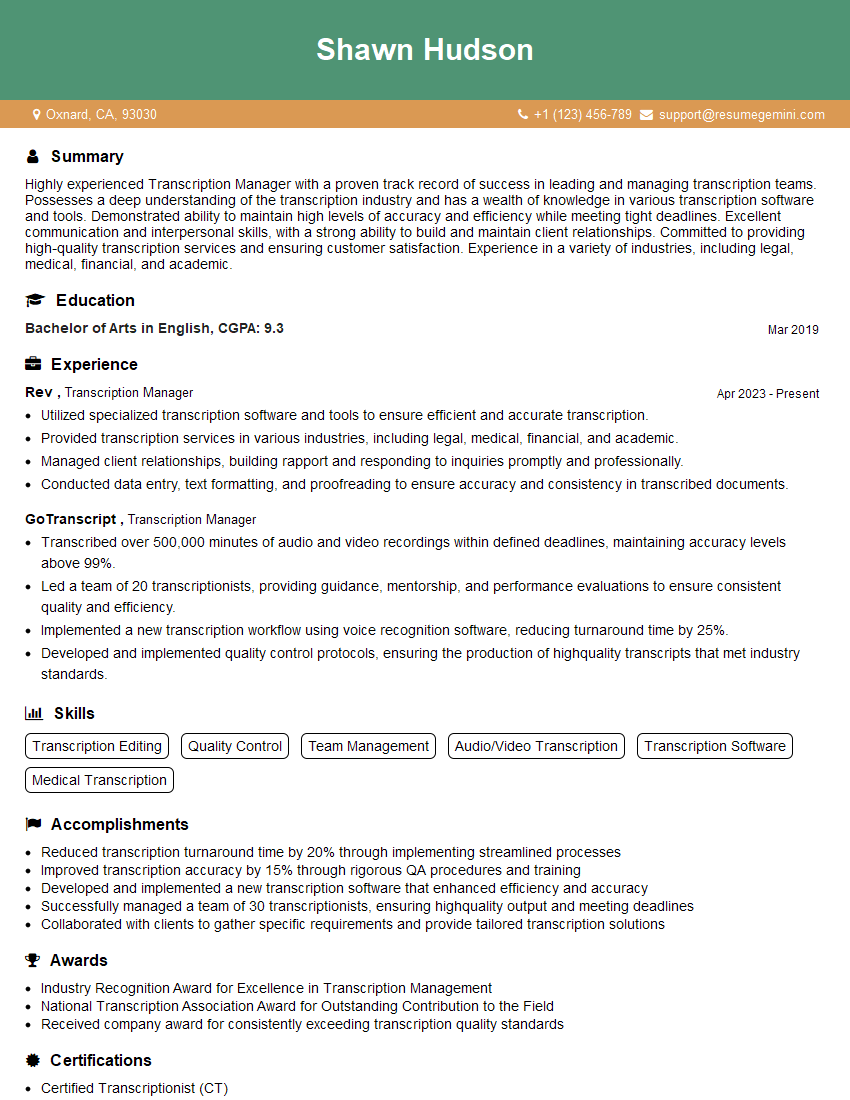
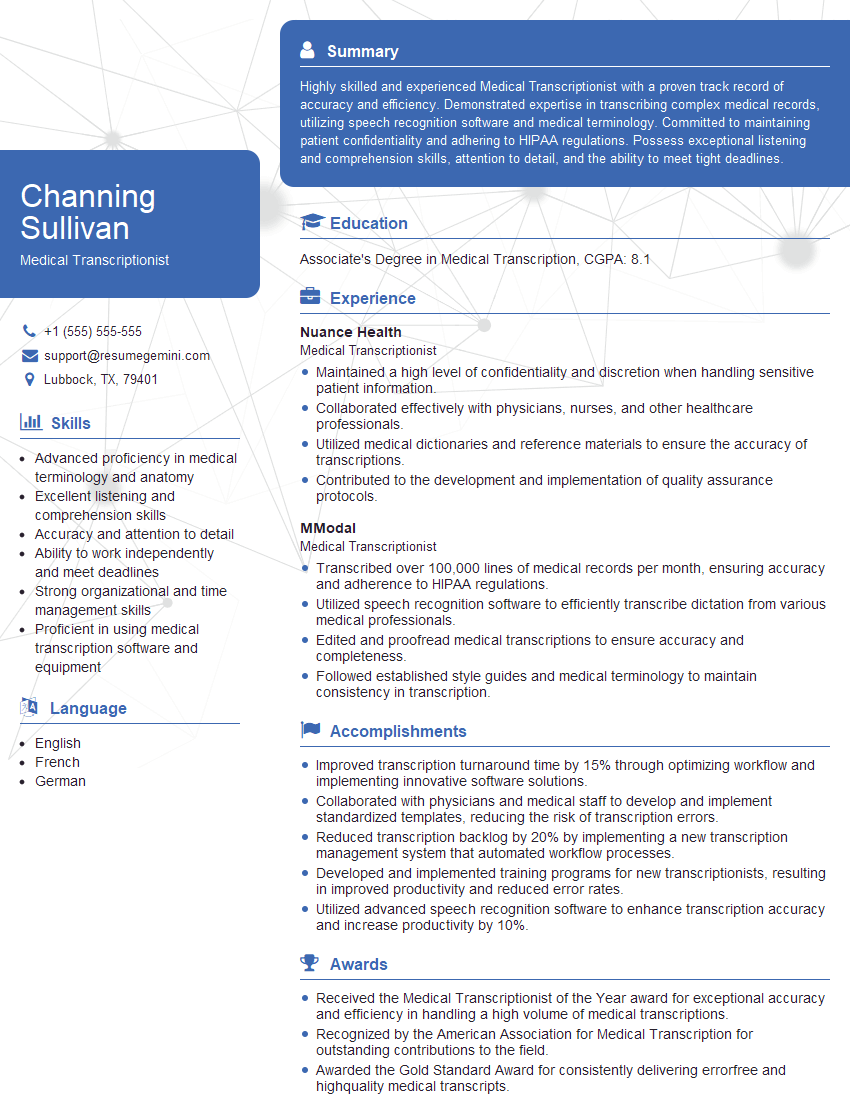
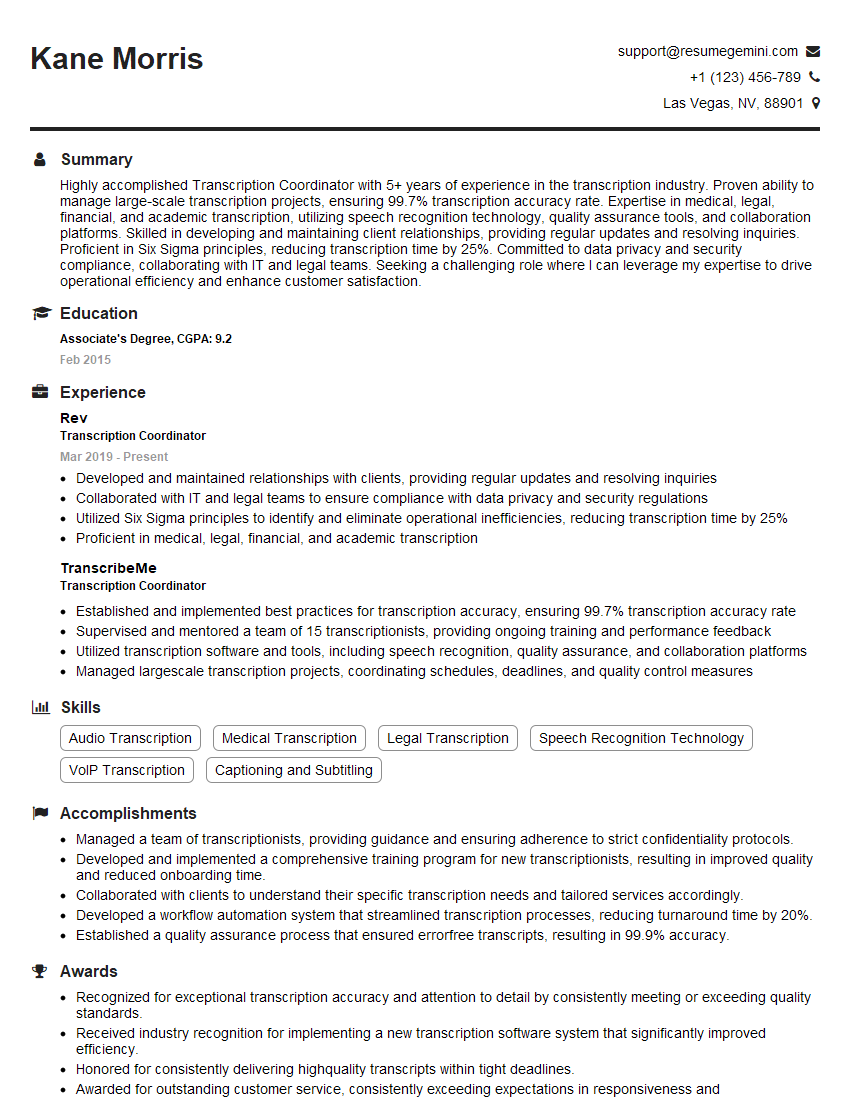
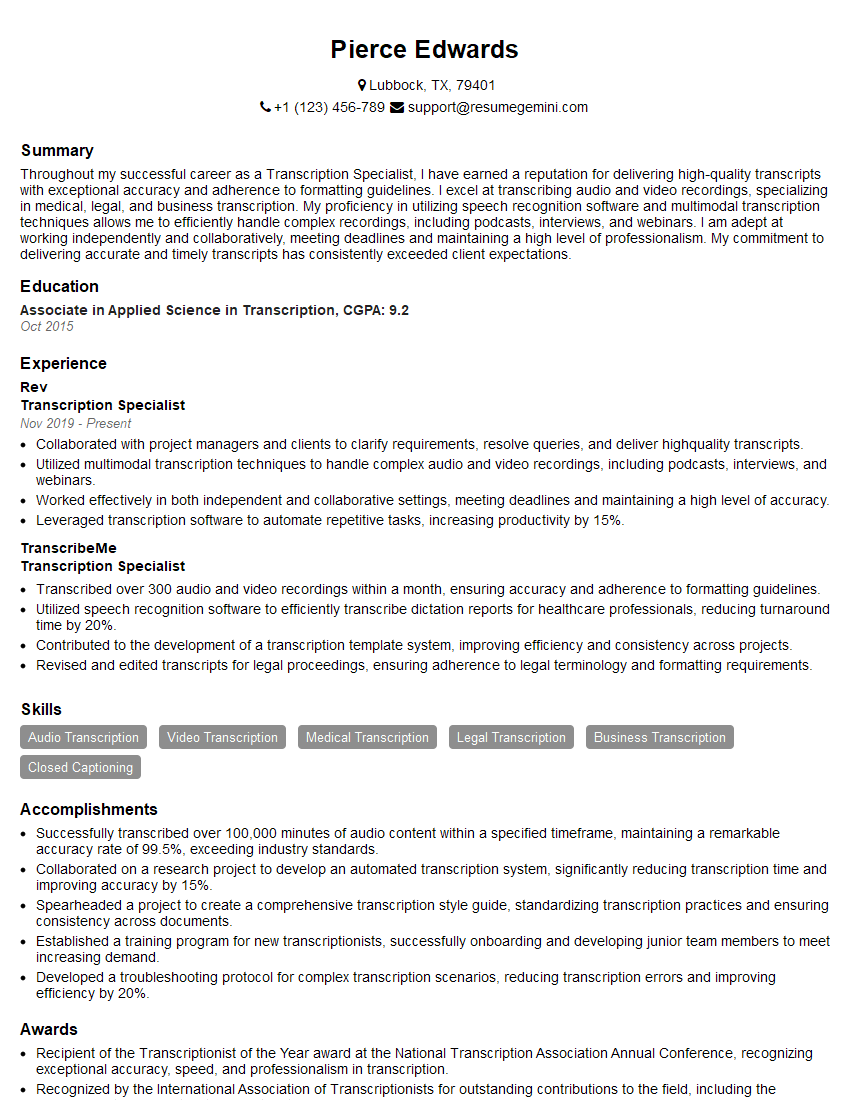
Mastering Transcription Turnaround Time is crucial for career advancement in this field. Demonstrating your understanding of efficient workflows and accurate time estimations is key to securing roles demanding high productivity and reliability. To significantly boost your job prospects, create a compelling, ATS-friendly resume that highlights your skills and experience. We strongly recommend using ResumeGemini to build a professional and impactful resume. ResumeGemini provides tools and examples specifically tailored to highlight experience in managing Transcription Turnaround Time, ensuring your application stands out. Examples of resumes tailored to Transcription Turnaround Time are available below.
Explore more articles
Users Rating of Our Blogs
Share Your Experience
We value your feedback! Please rate our content and share your thoughts (optional).
What Readers Say About Our Blog
I Redesigned Spongebob Squarepants and his main characters of my artwork.
https://www.deviantart.com/reimaginesponge/art/Redesigned-Spongebob-characters-1223583608
IT gave me an insight and words to use and be able to think of examples
Hi, I’m Jay, we have a few potential clients that are interested in your services, thought you might be a good fit. I’d love to talk about the details, when do you have time to talk?
Best,
Jay
Founder | CEO