Cracking a skill-specific interview, like one for Tree Preservation Plan Development, requires understanding the nuances of the role. In this blog, we present the questions you’re most likely to encounter, along with insights into how to answer them effectively. Let’s ensure you’re ready to make a strong impression.
Questions Asked in Tree Preservation Plan Development Interview
Q 1. Explain the key components of a comprehensive Tree Preservation Plan.
A comprehensive Tree Preservation Plan (TPP) is a crucial document for any development project involving trees. It aims to minimize the impact of construction on existing trees and ensure their long-term health and survival. Key components include:
- Detailed Tree Survey: This involves identifying and mapping all trees on the site, recording species, dimensions (DBH – Diameter at Breast Height, height, crown spread), health assessments, and their proximity to proposed development works.
- Risk Assessment: A thorough risk assessment identifies potential hazards to trees during construction, such as root damage from excavation, soil compaction, or damage from machinery. This assessment helps determine appropriate protection measures.
- Protection Measures: The plan outlines specific methods to protect trees during construction. This might involve installing root protection zones (RPZs), tree guards, construction exclusion zones, or employing specific construction techniques.
- Method Statement: A detailed method statement outlines the steps to be taken during construction to protect the trees. This is crucial for contractors to understand and follow the protection strategy.
- Tree Protection Officer (TPO): Often, a TPP includes the appointment of a TPO who will oversee the implementation of the plan and monitor the trees throughout the construction process.
- Post-Construction Monitoring: The plan should outline a post-construction monitoring strategy to assess the impact of construction on tree health and survival and address any potential issues.
- Compensation Planting: In some cases, the plan might include provisions for replacing trees that are inevitably lost due to the development.
Think of it like a detailed care plan for your trees throughout a potentially stressful period. A well-crafted TPP ensures that the trees are not just surviving, but thriving after the construction is complete.
Q 2. Describe your experience in conducting tree surveys and risk assessments.
I have extensive experience in conducting tree surveys and risk assessments, having worked on numerous projects ranging from small residential developments to large-scale infrastructure projects. My surveys involve using advanced measuring tools and techniques to accurately record the dimensions and health of each tree. I utilize a combination of visual assessment, specialist equipment like resistographs (to assess the internal condition of the wood), and soil testing to determine the health and stability of each tree.
The risk assessment is a critical stage. I consider factors like proximity to construction activities, soil type, root spread, tree species’ susceptibility to damage, and the potential impact of construction methods. I use established industry best practices and relevant standards (like BS 5837:2012) to provide a comprehensive assessment that identifies the level of risk to each tree and recommends appropriate mitigation measures. For instance, a large oak tree close to an excavation site will require far more stringent protection than a smaller, younger sapling further away.
I’ve successfully completed risk assessments that have mitigated potential risks, leading to zero tree loss during numerous construction projects. This meticulous approach minimizes liabilities and ensures ecological sustainability.
Q 3. How do you determine the protected status of trees on a development site?
Determining the protected status of trees is a crucial first step in developing a TPP. This involves a multi-pronged approach:
- Local Planning Authority (LPA) Policies: I always begin by consulting the LPA’s tree protection policies and planning documents. These documents often specify protected species or trees above a certain size or within designated areas.
- Protected Species Surveys: If there’s a possibility of protected species (such as bats, nesting birds, or certain insects) inhabiting the trees, I commission a specialist ecological survey to identify and assess their presence. This is vital to ensure compliance with relevant legislation.
- Tree Preservation Orders (TPOs): A TPO is a legal protection order placed on a tree or group of trees preventing their removal or damage without permission from the LPA. I verify if any TPOs exist on the site through LPA records and searches.
- Ancient Woodland Inventories: If ancient woodland is present (or suspected), specialist surveys will be required to verify this and guide appropriate protection strategies. Ancient woodland is generally afforded a high degree of protection.
Ignoring protected status can lead to significant delays, fines, and even prosecution. Careful investigation and documentation of the status of each tree are paramount.
Q 4. What are the common methods for protecting trees during construction?
Protecting trees during construction requires a multi-faceted approach. Common methods include:
- Root Protection Zones (RPZs): These are designated areas around the tree’s root system where no excavation or compaction is permitted. The size of the RPZ depends on the tree species, size, and soil conditions. For larger trees, this may extend to a significant radius.
- Tree Guards/Protective Fencing: Physical barriers, such as tree guards and protective fencing, prevent damage from machinery and construction vehicles. These need to be appropriately sized to avoid restricting the tree while providing effective protection.
- Construction Exclusion Zones: Setting up larger exclusion zones keeps all construction activities well clear of the tree’s crown and vulnerable root areas.
- Ground Protection: Using protective materials like hard-standing areas or mats reduces soil compaction and damage to the root system from heavy machinery.
- Careful Excavation Techniques: Using hand excavation and minimal machinery near tree roots minimizes the risk of damage. Specialist tree surgeons are often employed to perform work close to tree roots.
- Soil Improvement: In some cases, soil improvement techniques, such as adding organic matter or aeration, can enhance the tree’s health and resilience during construction.
The specific methods used will vary depending on the individual circumstances of the project. Often a combination of the measures listed above provides the most robust protection.
Q 5. How do you mitigate the impact of development on tree health and survival?
Mitigating the impact of development on tree health and survival involves proactive measures both during and after construction.
- Pre-construction Assessment: A thorough pre-construction assessment is crucial to evaluate the existing tree health and identify any pre-existing weaknesses that might be exacerbated by construction activities.
- Careful Site Planning: Avoid locating structures, services, or roadways in direct proximity to sensitive tree roots. Careful planning minimizes the need for extensive work near trees.
- Appropriate Construction Techniques: Employing techniques like trenchless technology for utilities avoids extensive ground disturbance around trees.
- Watering and Mulching: Post-construction, regular watering and mulching can aid tree recovery by improving soil moisture and reducing stress.
- Regular Monitoring: Post-construction monitoring tracks the tree’s health, identifies any issues, and allows for prompt remedial actions.
- Tree Surgery: In some cases, professional tree surgery may be needed to address any damage sustained during construction or to improve tree health and longevity.
Successful mitigation often requires a holistic approach and a commitment to ongoing care after the construction phase is complete. Thinking ahead and incorporating mitigation strategies throughout the project lifecycle yields the best results.
Q 6. What software or tools do you use for tree inventory and management?
For tree inventory and management, I utilize a combination of software and tools. This often includes:
- GIS Software (e.g., ArcGIS, QGIS): This allows for accurate mapping and spatial analysis of tree locations and their relationship to the development site.
- Tree Inventory Software (e.g., i-Tree, Arborist 360): Specialized software helps manage tree data, track health assessments, and generate reports. These tools also assist with predicting tree growth and future development.
- Measuring Tools: Accurate measurement is vital. I use tools such as diameter tapes, clinometers, and rangefinders to record precise tree dimensions and data.
- Digital Photography and Drones: Photographs and drone imagery provide a visual record of tree conditions, both before and after construction. This creates a detailed historical record of the tree’s condition and the impact of the development.
Selecting the right software depends on the size and complexity of the project. The goal is to create a detailed, accessible, and easily updated inventory that can be used throughout the development process and beyond.
Q 7. Explain your understanding of BS 5837:2012 (or relevant national standard).
BS 5837:2012 (Trees in relation to design, demolition and construction – Recommendations) is a British Standard that provides guidance on the protection of trees during development projects. It’s a widely adopted standard that provides a framework for best practice.
My understanding encompasses the key aspects, including:
- Tree Surveys and Assessments: The standard outlines requirements for comprehensive tree surveys and risk assessments, considering factors like tree species, size, health, and proximity to development activities.
- Root Protection Zones (RPZs): It details the principles of establishing RPZs, considering various soil types and tree species.
- Protection Measures: The standard recommends suitable protection measures including tree guards, fencing, and ground protection.
- Construction Practices: The standard provides guidance on construction methods to minimize damage to trees, such as careful excavation techniques and the avoidance of soil compaction.
- Post-Construction Monitoring: It also covers the importance of post-construction monitoring to assess the effectiveness of protection measures and identify any necessary remedial actions.
Compliance with BS 5837:2012 (or equivalent national standards) is crucial for demonstrating a responsible and professional approach to tree preservation. It minimizes legal risks and helps ensure the long-term health and survival of trees during and after construction projects.
Q 8. How do you integrate tree preservation into the overall project design?
Integrating tree preservation into project design starts long before construction begins. It’s not an afterthought, but a fundamental part of the planning process. We begin by conducting a thorough arboricultural assessment, identifying all significant trees on the site and assessing their health, species, and value. This assessment informs the site layout. For example, we might strategically place buildings to avoid direct impact on mature trees, or design roads and utility lines around existing root systems. The goal is to minimize tree removal, and where removal is unavoidable, to ensure appropriate compensation planting and mitigation measures are implemented.
We utilize advanced techniques like GIS mapping to overlay tree data with building footprints and infrastructure plans, optimizing the design for maximum tree preservation. This proactive approach significantly reduces conflicts and rework later in the project lifecycle.
Q 9. Describe your experience with different tree protection measures (e.g., root protection barriers, tree bracing).
My experience encompasses a broad range of tree protection measures. Root protection barriers, for instance, are crucial for safeguarding root systems during excavation. We specify the type and installation methods based on the tree species, soil conditions, and construction activities. For example, we might use perforated plastic barriers for smaller trees or more robust, engineered barriers for large, mature specimens. Regular inspections are crucial to ensure the barriers remain intact throughout the construction process.
Tree bracing is another vital technique, particularly for large trees at risk of damage from wind or construction equipment. We might use cables, guy wires, or specialized bracing systems to strengthen vulnerable branches or the main trunk. The selection of bracing materials and methods depends on factors such as tree species, size, and the specific load-bearing requirements.
Beyond these, we also utilize other techniques, including soil aeration and improved drainage to address compaction, and tree watering strategies to ensure tree health through construction.
Q 10. How do you communicate effectively with developers, contractors, and other stakeholders regarding tree preservation?
Effective communication is paramount in tree preservation. I use a multi-pronged approach. First, I provide clear, concise documentation—easily understandable tree preservation plans with detailed maps, specifications, and photographs—to developers and contractors. These plans clearly define protected areas, allowable activities, and emergency contact information.
Regular site meetings are crucial. These provide opportunities to address concerns, clarify instructions, and make necessary adjustments in real-time. I emphasize open communication channels, encouraging contractors and subcontractors to raise concerns promptly. I also maintain ongoing dialogue with stakeholders, including local authorities and community groups, ensuring transparency and maintaining their trust.
Visual aids, such as detailed site plans and photos of mature trees, greatly enhance comprehension and facilitate constructive collaboration.
Q 11. Describe a situation where you had to negotiate a compromise to preserve trees while accommodating development needs.
In one project, a proposed building footprint directly overlapped a large, mature oak tree designated as a protected heritage tree. The developer initially insisted on removing the tree to proceed with their design. However, after presenting a detailed analysis showing the significant environmental and aesthetic value of the tree, and proposing alternative design options, we negotiated a compromise.
Ultimately, the building footprint was slightly altered to circumvent the tree’s root zone. This minor adjustment required some redesign but preserved a valuable asset and demonstrated my commitment to finding mutually beneficial solutions. The compromise resulted in a slightly smaller footprint for the building, but also in a positive impact on the environment and the project’s public image.
Q 12. How do you ensure the long-term health and maintenance of protected trees after construction?
Long-term tree health post-construction requires a dedicated maintenance plan. This includes ongoing monitoring by certified arborists to detect any stress symptoms. We specify post-construction care in the plan, including mulching, fertilization, watering strategies, and pest and disease management. The plan outlines responsibilities for ongoing maintenance, including regular inspections and prompt remedial action if necessary.
Detailed records, including tree species, locations, and maintenance history, are meticulously maintained. This information ensures proper long-term care and facilitates future planning. We also provide detailed handover documents to the site owner/manager, outlining maintenance schedules and contact information for arboricultural professionals.
Q 13. What are the potential liabilities associated with inadequate tree preservation?
Inadequate tree preservation carries significant liabilities. These can include legal action from environmental protection agencies or community groups, reputational damage for the developer, and costly remedial work. If trees are damaged or die due to negligence during construction, the responsible parties could face substantial financial penalties and legal ramifications. Insurance claims could also be denied if proper preservation measures weren’t implemented.
Furthermore, the loss of mature trees may lead to negative environmental impacts, such as increased stormwater runoff, reduced carbon sequestration, and habitat loss. These ecological repercussions can create long-term liabilities, both legally and environmentally.
Q 14. How do you address unforeseen tree issues during a construction project?
Unforeseen tree issues during construction require a quick and flexible response. If damage occurs, a certified arborist assesses the extent of the damage and recommends appropriate remedial actions. This might involve specialized tree surgery, additional bracing, or more extensive root protection measures. Detailed photographic documentation of the damage and the remedial actions is crucial for insurance claims and dispute resolution.
Open communication with all stakeholders, including contractors, developers, and regulatory authorities, is vital. A revised plan must be developed, incorporating the necessary changes to mitigate further risks and ensure the project remains on schedule without further compromising the trees’ health and safety. The revised plan should include contingency plans for similar occurrences.
Q 15. Explain your experience with tree planting and aftercare.
My experience with tree planting and aftercare spans over 15 years, encompassing projects ranging from small-scale residential plantings to large-scale urban greening initiatives. I’m proficient in all aspects, from site preparation and species selection to ongoing maintenance and disease management.
For example, on a recent project involving the planting of 500 saplings in a newly developed park, I oversaw the entire process, from soil testing and amendment to the installation of irrigation systems and ongoing monitoring for pests and diseases. We used a specific planting technique, including the use of tree guards and mulching, that resulted in a 95% survival rate, significantly exceeding industry standards. Post-planting care included regular watering schedules adjusted to weather conditions, fertilization based on soil analysis, and proactive pest and disease control measures using both biological and chemical methods, where necessary, always prioritising environmentally friendly practices.
Another key aspect of my work involves educating clients and communities on proper tree care. I believe empowering individuals with knowledge is crucial for long-term tree health and sustainability.
Career Expert Tips:
- Ace those interviews! Prepare effectively by reviewing the Top 50 Most Common Interview Questions on ResumeGemini.
- Navigate your job search with confidence! Explore a wide range of Career Tips on ResumeGemini. Learn about common challenges and recommendations to overcome them.
- Craft the perfect resume! Master the Art of Resume Writing with ResumeGemini’s guide. Showcase your unique qualifications and achievements effectively.
- Don’t miss out on holiday savings! Build your dream resume with ResumeGemini’s ATS optimized templates.
Q 16. How familiar are you with relevant environmental legislation and regulations?
I have a thorough understanding of relevant environmental legislation and regulations, including local ordinances, state laws, and federal guidelines pertaining to tree preservation. This includes a deep familiarity with the National Environmental Policy Act (NEPA) in the US context, or equivalent legislation in other regions, and its implications on tree protection within development projects. I regularly consult and stay updated on these regulations to ensure compliance and best practices in all my projects.
For instance, I’m well-versed in the permitting processes required for tree removal or significant pruning on protected species. I understand how to conduct thorough environmental impact assessments, incorporating best practices and mitigating potential negative effects on local ecosystems. My expertise allows me to navigate the complexities of these regulations effectively, ensuring projects are environmentally sound and legally compliant.
Q 17. Describe your approach to conflict resolution regarding tree preservation disputes.
My approach to conflict resolution regarding tree preservation disputes centers around open communication, collaboration, and finding mutually acceptable solutions. I believe in fostering a spirit of partnership between stakeholders, including developers, residents, and environmental organizations.
I start by carefully listening to all parties involved, understanding their concerns and priorities. I then present a range of options, emphasizing compromise and creative problem-solving. This often involves exploring alternative solutions that meet the project’s needs while minimizing tree loss. For example, in a recent dispute, I successfully negotiated a compromise that involved relocating the construction site slightly to preserve a significant number of mature trees, utilizing advanced arboricultural techniques to minimise disruption to their root systems. In some cases, where removal is unavoidable, I advocate for comprehensive mitigation strategies, such as planting replacement trees and implementing offsetting initiatives.
Q 18. How do you assess the potential impact of tree removal on the local environment?
Assessing the potential impact of tree removal involves a multi-faceted approach. It starts with identifying the specific trees to be removed, considering factors such as species, size, age, and location. Next, a thorough evaluation of the site is carried out considering its ecological context, taking into account the role of those trees in the local environment, including their contribution to biodiversity, carbon sequestration, and air quality.
We use various assessment tools, including Geographic Information Systems (GIS) mapping and ecological surveys to understand the interconnectedness of trees within the ecosystem. For example, the removal of a single large, mature tree could significantly impact wildlife habitat, shade provision, and erosion control. Therefore, a detailed impact assessment will help determine the extent of these effects and suggest mitigation measures. This comprehensive evaluation informs decision-making and ensures that all potential environmental consequences are considered before any tree removal takes place.
Q 19. Explain your experience with the preparation of Method Statements for tree protection.
I have extensive experience preparing Method Statements for tree protection. These documents detail the specific procedures and precautions that will be taken during construction or development activities to protect trees from damage. A well-written Method Statement is essential for ensuring the safety and well-being of trees throughout the project lifecycle.
Typically, a Method Statement includes a site plan highlighting the location of trees, the proposed construction activities, and the designated protection zones around each tree. It also specifies the protective measures to be implemented, such as the installation of tree guards, fencing, and erosion control measures. The document further details the roles and responsibilities of all personnel involved and any contingency plans in place to deal with unexpected circumstances.
For example, a Method Statement I developed for a recent project included detailed instructions for the safe excavation near tree roots, specifying the use of hand tools in sensitive areas and the monitoring of ground water levels to prevent root damage. This approach ensures the protection of trees during construction and mitigates the risk of long-term damage.
Q 20. What are the key considerations when selecting appropriate replacement trees?
Selecting appropriate replacement trees requires careful consideration of several factors. The key is to choose species that are well-suited to the site’s specific environmental conditions, such as soil type, climate, and sun exposure. Size and maturity at planting also play a vital role.
For example, planting smaller trees might allow for denser planting and a quicker restoration of canopy cover but they will take longer to reach maturity, whereas larger trees establish faster. The choice of species should also consider the aesthetic aspects, the tree’s contribution to biodiversity (providing food and habitat for wildlife), and potential susceptibility to pests and diseases. In my practice, I always opt for native species whenever feasible, as they are better adapted to the local environment and support local ecosystems. Moreover, I involve stakeholders in this selection process, ensuring that the replacement trees align with community preferences and contribute positively to the overall landscape.
Q 21. How do you evaluate the cost-effectiveness of different tree protection strategies?
Evaluating the cost-effectiveness of different tree protection strategies requires a comprehensive approach that goes beyond immediate financial outlay. We consider both short-term and long-term costs and benefits.
For instance, installing robust tree protection measures might entail higher initial costs, but these measures can prevent costly repairs or replacements down the line, significantly reducing long-term expenditure and avoiding potential environmental liability. We use cost-benefit analysis (CBA) to compare different strategies. This involves estimating the costs of each approach, including materials, labor, and potential liabilities, and weighing them against the potential benefits, such as the value of the preserved trees, improved biodiversity, and enhanced property values. Life cycle costing, another useful technique, considers the full cost of ownership, including maintenance, replacements and repairs over the lifespan of the trees, ensuring the chosen strategy provides the best overall value for money.
Q 22. Describe your experience with tree surveys using GIS technologies.
My experience with tree surveys using GIS technologies is extensive. I utilize GIS software such as ArcGIS and QGIS to map tree locations, assess their health, and plan for their preservation. This involves importing high-resolution imagery (aerial photography or LiDAR) to identify individual trees and their characteristics. We then use attribute tables to record vital data, including species, diameter at breast height (DBH), crown spread, and health assessments. This geospatial data is crucial for creating detailed tree surveys, which are essential for developing Tree Preservation Plans (TPPs).
For example, in a recent project involving a large-scale development, we used GIS to overlay the proposed building footprint with the tree survey data. This allowed us to immediately identify trees at risk and develop mitigation strategies, minimizing conflicts between development and tree preservation. The GIS data allowed us to accurately quantify the impact of the development on the existing tree population and to suggest alternative layouts to minimize that impact.
Furthermore, GIS allows for the creation of visually compelling maps and reports that effectively communicate the findings to stakeholders, including planning authorities and clients. This enhances transparency and helps ensure buy-in for the proposed TPP.
Q 23. How do you ensure compliance with tree preservation orders (TPOs)?
Ensuring compliance with Tree Preservation Orders (TPOs) is paramount. My approach involves a multi-faceted strategy. Firstly, a thorough understanding of the specific TPO is crucial. This includes identifying the precise location and boundaries of the protected trees, understanding any specific conditions attached to the order, and knowing the legal implications of non-compliance.
Secondly, I work closely with developers and contractors to incorporate the TPO stipulations into the project plans. This might involve designing works around protected trees, using protective measures during construction (such as fencing, root protection systems, and designated construction access routes), and ensuring that any necessary pruning or removal is carried out by qualified arborists with the necessary permits. Regular site inspections are carried out to monitor compliance, document any unexpected issues, and swiftly rectify any breaches. All actions are meticulously documented, with photographic evidence and detailed records of any tree work undertaken.
Finally, I’m familiar with the potential legal ramifications of non-compliance and can advise clients on how to avoid penalties or legal disputes. This proactive approach ensures that projects proceed smoothly while upholding the legal requirements for tree preservation.
Q 24. What are your strategies for minimizing disruption to tree health during groundworks?
Minimizing disruption to tree health during groundworks requires meticulous planning and execution. This begins with a detailed site investigation, including a thorough tree survey to identify root zones and vulnerable areas. This is again where GIS is very useful in visualizing the subsurface root systems and infrastructure networks.
My strategies include:
- Root Protection Zones (RPZs): Establishing clearly defined RPZs to prevent compaction, damage, or excavation within the critical root areas. This often involves employing techniques such as root barrier installation and directional drilling.
- Protective Barriers: Erecting robust fencing and protective barriers to prevent accidental damage from vehicles or equipment.
- Soil Improvement: Implementing soil improvement techniques where necessary, such as adding organic matter to enhance soil structure and drainage.
- Careful Excavation: Employing careful hand excavation methods near tree roots and using specialist equipment wherever possible to avoid root damage.
- Tree Watering Strategies: Developing and implementing tree watering strategies to mitigate the effects of soil disturbance on tree health. This might involve installing drip irrigation systems or supplementary watering during periods of drought.
Regular monitoring of tree health after groundworks are essential, and any remedial actions (such as fertilization or mulching) are undertaken as needed. It’s a continuous process of careful planning, skilled execution, and diligent monitoring.
Q 25. How do you document and archive tree preservation information effectively?
Effective documentation and archiving of tree preservation information are vital for ensuring long-term protection and accountability. My approach combines physical and digital methods to create a comprehensive and easily accessible record.
Physical records include signed arboricultural reports, site plans with marked tree locations, photographs of tree conditions before, during, and after works, and maintenance logs. These are kept in secure, well-organized physical files. Digital records include geospatial data (GIS files), high-resolution images, and scanned documents, all stored securely in a cloud-based system with controlled access.
A robust metadata system is used to ensure that all information is easily searchable and retrievable. This system allows for easy retrieval of information for future inspections, audits, or potential planning applications involving the same site. The aim is to create a living document that evolves with the trees and the site, providing a valuable history of their management and preservation.
Q 26. Describe your experience with the use of arboricultural reports within a planning application.
Arboricultural reports are fundamental components of planning applications involving trees. My experience involves preparing and reviewing these reports, ensuring they comply with the relevant guidelines and provide sufficient information to support planning decisions. A comprehensive report typically includes a detailed tree survey, assessment of tree health and potential risks, proposed management strategies, and mitigation measures.
In preparing reports, I ensure that the methodology is transparent and complies with British Standard BS 5837:2012 (Trees in Relation to Design, Demolition and Construction). The language used is clear, concise, and understandable to both technical and non-technical audiences. I frequently use photographs and site plans to visually communicate the information effectively. I also anticipate and address potential concerns raised by the planning authority, ensuring the application is complete and persuasive. The aim is to ensure the report clearly demonstrates how the project will avoid or mitigate potential harm to protected trees.
Q 27. How do you interpret and apply tree survey data to inform decision-making?
Interpreting and applying tree survey data for decision-making is a crucial aspect of my work. It begins with careful analysis of the collected data, considering factors such as tree species, size, health, location, and proximity to proposed development works.
For example, a tree’s DBH, crown spread, and visual health assessment provide insights into its maturity, vigor, and overall condition. This information, combined with the location data from the GIS survey, is used to assess the risk of damage during construction, determine the necessity of protective measures, and even inform the design of the project to minimize disruption. This data-driven approach allows for informed and justifiable decisions regarding the preservation or removal of trees. The goal is to make balanced decisions that achieve the development objectives while minimizing the environmental impact.
Q 28. Explain your understanding of tree preservation and biodiversity considerations.
Tree preservation goes beyond simply protecting individual trees; it’s about recognizing their vital role in broader ecological systems and biodiversity. Trees provide habitat for a wide range of species, contribute to carbon sequestration, improve air quality, manage stormwater runoff, and enhance the overall aesthetic value of an area.
My understanding of tree preservation incorporates these wider considerations. When developing TPPs, I assess the overall ecological value of the site, identifying any significant habitats or protected species associated with trees. This often involves consultation with ecologists to assess the biodiversity impact of proposed development works. The plans then aim to incorporate biodiversity net gain principles, potentially including proposals for enhancing the existing tree population or creating new habitats, as compensation for any unavoidable losses. Protecting tree health not only ensures the longevity of individual trees but also safeguards the wider ecosystem services they provide.
Key Topics to Learn for Tree Preservation Plan Development Interview
- Legislation & Regulations: Understanding local, regional, and national regulations governing tree preservation and development. This includes knowing permitted development rights and protected species legislation.
- Site Assessment & Analysis: Mastering techniques for conducting thorough site surveys, identifying significant trees, and assessing their health and condition using appropriate arboricultural methods.
- Tree Risk Assessment: Developing skills in evaluating potential hazards posed by trees and recommending appropriate mitigation strategies, including the use of industry-standard risk assessment matrices.
- Plan Development & Design: Gaining proficiency in creating comprehensive tree preservation plans, incorporating detailed mapping, proposed mitigation measures, and phased implementation strategies.
- Method Statements & Specifications: Understanding how to clearly and concisely detail the methods and specifications for all proposed tree protection and preservation works.
- Communication & Stakeholder Engagement: Developing strong communication skills to effectively present plans to clients, contractors, and regulatory bodies. This includes conflict resolution and negotiation skills.
- Environmental Impact Assessment (EIA): Understanding how tree preservation plans contribute to a wider EIA and the potential impact on biodiversity.
- Budgeting & Cost Estimation: Developing the ability to accurately estimate the costs associated with tree preservation measures and manage budgets effectively.
- Technology & Software: Familiarity with relevant software for tree survey mapping, plan creation, and data management. (e.g., GIS software).
- Best Practices & Arboricultural Standards: Staying up-to-date with current best practices and adhering to relevant arboricultural standards and guidelines.
Next Steps
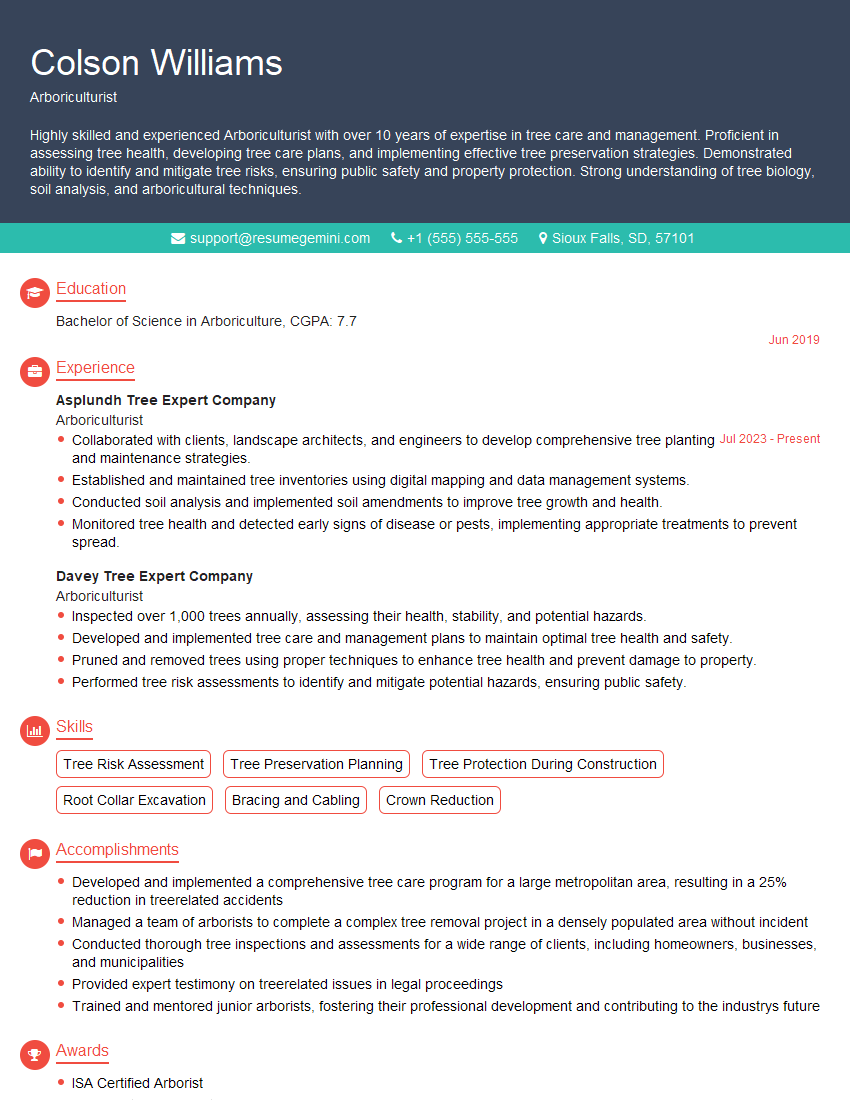
Mastering Tree Preservation Plan Development opens doors to exciting and impactful careers in environmental consulting, construction, and landscape architecture. To maximize your job prospects, a well-crafted, ATS-friendly resume is crucial. ResumeGemini is a trusted resource to help you build a compelling and effective resume that showcases your skills and experience. They provide examples of resumes tailored specifically to Tree Preservation Plan Development, ensuring your application stands out from the competition. Take the next step towards your dream career by leveraging the resources available to you.
Explore more articles
Users Rating of Our Blogs
Share Your Experience
We value your feedback! Please rate our content and share your thoughts (optional).
What Readers Say About Our Blog
Really detailed insights and content, thank you for writing this detailed article.
IT gave me an insight and words to use and be able to think of examples