Cracking a skill-specific interview, like one for Voice Over IP (VoIP) Protocols, requires understanding the nuances of the role. In this blog, we present the questions you’re most likely to encounter, along with insights into how to answer them effectively. Let’s ensure you’re ready to make a strong impression.
Questions Asked in Voice Over IP (VoIP) Protocols Interview
Q 1. Explain the difference between SIP and H.323.
Both SIP (Session Initiation Protocol) and H.323 are signaling protocols used in VoIP, but they differ significantly in their architecture and functionality. Think of them as two different languages used to set up and manage phone calls over the internet. SIP is a more modern, text-based protocol, characterized by its flexibility and scalability. It uses a request-response model, similar to HTTP, making it easier to integrate with other internet technologies. H.323, on the other hand, is an older, binary protocol that’s more complex and less flexible. It’s often used in larger, more established networks, but its complexity can make it harder to manage and troubleshoot.
- SIP: Simpler, text-based, flexible, scalable, widely used in modern VoIP systems. It uses a client-server architecture and is commonly deployed with other protocols like RTP for media transport.
- H.323: More complex, binary protocol, less flexible, often found in legacy systems. Uses a gatekeeper for call control in larger networks, which adds complexity. It handles both call signaling and media transport within its framework.
In essence, SIP is preferred for its ease of use and integration, while H.323 might still be found in older, established enterprise networks due to legacy reasons. Choosing between them depends heavily on the existing infrastructure and future scalability needs.
Q 2. Describe the role of a Session Border Controller (SBC).
A Session Border Controller (SBC) acts as a security and management gateway between VoIP networks. Imagine it as a sophisticated airport security checkpoint for your VoIP calls. It sits at the edge of your network, inspecting and controlling all incoming and outgoing VoIP traffic. Its primary functions include:
- Security: It protects your network from unauthorized access and malicious attacks, such as denial-of-service attacks. It does this by filtering traffic, implementing firewalls, and verifying call authentication.
- Protocol Translation: SBCs can translate between different VoIP protocols (e.g., SIP to H.323), allowing interoperability between disparate systems. This bridges the gap between older and newer technologies.
- QoS Management: SBCs can help prioritize VoIP traffic to ensure good call quality, even during periods of high network congestion. They employ techniques like packet prioritization and bandwidth management.
- Call Admission Control: SBCs can prevent network overload by controlling the number of simultaneous calls allowed. This prevents service degradation due to excessive traffic.
- Network Address Translation (NAT) Traversal: SBCs facilitate calls between networks using different IP address ranges, which is essential for internet-based VoIP.
Without an SBC, your VoIP network is vulnerable to security threats and performance issues. It’s a crucial component for large and complex VoIP deployments. Think of a large corporation with multiple offices globally – an SBC would be essential to manage security and interconnect these offices’ VoIP networks seamlessly.
Q 3. What are the key QoS parameters for VoIP calls?
Quality of Service (QoS) parameters are crucial for ensuring clear and uninterrupted VoIP calls. Poor QoS leads to choppy audio, dropped calls, and general frustration. Key parameters include:
- Jitter: This measures the variation in the arrival times of VoIP packets. High jitter causes audio disruptions, making the call sound uneven and robotic. Think of it like someone speaking erratically, with pauses and bursts.
- Packet Loss: The percentage of VoIP packets that don’t reach their destination. Even a small amount of packet loss can significantly impact call quality, resulting in dropped words or audio gaps.
- Latency (Delay): The time it takes for a packet to travel from one point to another. High latency causes noticeable delays in conversations, often described as ‘echo’ or ‘delay’ by users.
- Bandwidth: The available network capacity. Sufficient bandwidth is crucial to support VoIP calls without affecting other network applications.
- MOS (Mean Opinion Score): This is a subjective metric that rates the overall quality of the call from 1 (bad) to 5 (excellent). It combines the effects of several QoS parameters into a single score.
Monitoring these parameters allows network administrators to identify and address problems that affect call quality. For example, high jitter might indicate network congestion requiring bandwidth upgrades, while packet loss could signal network connectivity problems requiring troubleshooting.
Q 4. How does RTP work in VoIP?
Real-time Transport Protocol (RTP) is the workhorse of VoIP, responsible for transporting the actual voice data (or other media) during a call. It’s not involved in setting up the call (that’s the job of signaling protocols like SIP or H.323), but it handles the continuous, real-time transmission of the audio stream. Imagine RTP as the delivery truck carrying the voice packets from point A to point B.
RTP operates by encapsulating the audio data into packets, adding sequence numbers and timestamps to ensure they’re delivered in the correct order. It also includes mechanisms to detect and handle packet loss. It works in tandem with RTCP (RTP Control Protocol), which provides feedback on the quality of the transmission. RTCP helps track things like packet loss and jitter.
In a typical VoIP call, SIP might be used to establish the call, but RTP is the protocol that actually carries the audio data, making it the backbone of the real-time communication.
Q 5. Explain the concept of codecs and their importance in VoIP.
Codecs are algorithms that compress and decompress audio and video data for transmission over a network. Think of them as translators converting your voice into a format suitable for transmission across the network and back again. They are crucial in VoIP because they significantly reduce the bandwidth required for high-quality voice communications.
Different codecs have different levels of compression and quality. Higher compression reduces bandwidth consumption but might result in some loss of audio quality. Lower compression maintains higher audio quality but requires more bandwidth. Popular codecs include G.711 (high quality but high bandwidth), G.729 (lower quality but lower bandwidth), and Opus (a more modern codec offering a balance between quality and bandwidth efficiency).
The choice of codec depends on several factors, including the available bandwidth, desired quality, and the capabilities of the endpoint devices. For example, a high-bandwidth corporate network might use G.711 for high fidelity, while a low-bandwidth mobile network might favor G.729 to avoid dropped calls. The correct selection ensures optimal voice quality without overburdening the network.
Q 6. What are the common challenges in VoIP deployment?
Deploying VoIP presents several challenges:
- Network Quality: VoIP is highly sensitive to network issues like jitter, packet loss, and latency. Poor network conditions directly translate to bad call quality.
- Security Vulnerabilities: VoIP systems can be targeted by various attacks if not properly secured, especially in larger or more complex deployments.
- Integration with Existing Systems: Integrating VoIP with legacy phone systems and other business applications can be complex and time-consuming.
- QoS Management: Prioritizing VoIP traffic to ensure sufficient bandwidth and prevent call degradation requires careful network planning and QoS management.
- Power Outages: Loss of power can disrupt VoIP services, emphasizing the need for backup power solutions.
- Troubleshooting: Troubleshooting VoIP issues often requires specialized expertise, compared to traditional phone systems.
Addressing these challenges requires careful planning, appropriate network infrastructure, robust security measures, and skilled technical support. For instance, a well-designed network with QoS mechanisms in place can mitigate the impact of network congestion. Similarly, implementing secure firewalls and authentication protocols protects the system from security threats.
Q 7. How would you troubleshoot poor call quality in a VoIP network?
Troubleshooting poor call quality in a VoIP network involves a systematic approach. Here’s a step-by-step process:
- Gather Information: Start by gathering information about the problem, including when it occurs, which users are affected, and the specific symptoms (e.g., choppy audio, dropped calls, echo).
- Check Network Connectivity: Verify the network connection of the affected devices, including their IP addresses, subnet masks, and gateway settings.
- Analyze QoS Metrics: Use monitoring tools to measure key QoS parameters such as jitter, packet loss, latency, and MOS. Look for abnormalities that might indicate network congestion or problems with the VoIP infrastructure.
- Inspect VoIP Call Logs and Traces: Examine VoIP call logs and traces to identify patterns or errors. These logs can pinpoint problems with call setup, media transmission, or codec negotiation.
- Verify Codec Compatibility: Ensure that the codecs used by the endpoint devices are compatible and configured correctly.
- Test Network Bandwidth: Measure the available network bandwidth to determine if it’s sufficient for the number of simultaneous calls.
- Check for Interference: Examine for potential interference from other network devices or applications.
- Review Firewall and NAT Settings: Ensure that firewalls and NAT devices are properly configured to allow VoIP traffic.
- Check Device Drivers and Firmware: Verify that the drivers and firmware of all VoIP devices are updated and functioning correctly.
By systematically checking these elements, you can often isolate the root cause of poor call quality. It’s crucial to document each step and record findings to assist with future troubleshooting.
Q 8. Explain the significance of SRTP in VoIP security.
SRTP, or Secure Real-time Transport Protocol, is crucial for securing VoIP communications. It adds encryption and authentication to the RTP (Real-time Transport Protocol) stream, ensuring confidentiality and integrity of voice data. Imagine sending a postcard – RTP is like sending the postcard openly; anyone could read it. SRTP is like sending the postcard in a sealed, addressed envelope with a tamper-evident seal. It protects against eavesdropping and ensures the message hasn’t been tampered with during transit.
SRTP uses AES (Advanced Encryption Standard) for encryption and provides message authentication codes (MACs) to detect any modifications to the data. This is critical because VoIP often carries sensitive information, and without SRTP, an attacker could easily intercept and listen to calls or even inject malicious data.
In a professional setting, deploying SRTP is a fundamental aspect of securing enterprise VoIP systems, protecting sensitive business conversations and confidential data. Compliance regulations often mandate the use of SRTP for voice communications where data privacy is paramount.
Q 9. What is jitter and how does it affect VoIP calls?
Jitter refers to the variation in the delay of received packets in a data stream. Think of it like receiving a series of packages – ideally, they arrive at regular intervals. However, jitter causes some packages to arrive early, some late, and some even get lost altogether. In VoIP, this manifests as uneven audio quality; you might experience choppy speech, gaps in conversation, or an overall disjointed listening experience. Imagine trying to have a conversation with someone whose words are constantly interrupted or arriving out of sequence.
Jitter significantly impacts VoIP call quality, directly affecting the user experience. High jitter leads to poor audio quality, making the call difficult or impossible to understand. VoIP systems use jitter buffers to mitigate this problem – they temporarily store incoming packets to smooth out the delivery and reduce the impact of jitter. However, excessively large jitter buffers can increase latency, introducing another challenge to call quality.
Q 10. Describe different methods for handling VoIP call routing.
VoIP call routing determines how calls are directed from one endpoint to another. Several methods exist, each with its strengths and weaknesses:
- Static Routing: This involves manually configuring routes, often used in smaller networks with predictable traffic patterns. It’s simple but lacks flexibility for changes.
- Dynamic Routing: Algorithms automatically determine the best path based on network conditions, enabling scalability and adaptability. Protocols like SIP (Session Initiation Protocol) use dynamic routing extensively.
- Session Border Controllers (SBCs): SBCs act as gateways between different networks, translating protocols and enforcing security policies while routing calls. They are crucial in enterprise environments for interoperability and security.
- Location-based Routing: Routes calls based on the geographical location of the caller and recipient, leveraging geographic routing databases for optimization. This is common in international calling scenarios to choose cost-effective routes.
The choice of routing method depends on the size and complexity of the network, security requirements, and the need for scalability. Larger organizations often employ a combination of these methods for optimal call routing.
Q 11. How do you handle VoIP call failures?
Handling VoIP call failures involves a multi-layered approach aimed at identifying the cause and implementing corrective actions. The process begins with diagnostics, leveraging tools like network analyzers and call detail records (CDRs) to pinpoint the failure point. This could be a network issue, a problem with the VoIP server, or a fault at the client endpoint.
Strategies for handling failures include:
- Redundancy: Implementing backup systems (e.g., redundant servers, multiple network paths) ensures continued service during outages.
- Automatic Failover: Automatically switching to a backup system when the primary system fails, minimizing downtime.
- Call Retries: Automatically retrying failed calls after a short delay, accounting for transient network glitches.
- Notifications: Alerting administrators or users about call failures, allowing for timely intervention.
- Detailed Logging: Maintaining comprehensive logs of call attempts, successes, and failures to facilitate troubleshooting and analysis.
A proactive approach to monitoring and maintaining the VoIP infrastructure is essential to minimize call failures and ensure high availability.
Q 12. Explain the process of VoIP call setup and teardown.
VoIP call setup and teardown are governed primarily by the Session Initiation Protocol (SIP). The setup process involves several steps:
- Registration: User devices register with a SIP server, providing their availability information.
- Call Initiation: A user initiates a call by sending an INVITE message via SIP to the recipient’s SIP server.
- Negotiation: The servers negotiate call parameters, such as codecs and media ports.
- Session Establishment: Once the parameters are agreed upon, the media stream begins flowing between the users.
The teardown process is equally crucial:
- Call Termination: One user initiates the call termination by sending a BYE message via SIP.
- Session Release: The servers exchange messages to release the established session.
- Media Stream Closure: The media stream ends.
The entire process relies on SIP signaling messages to coordinate call setup and tear down, ensuring efficient and reliable communication.
Q 13. What are the advantages and disadvantages of using VoIP over traditional PSTN?
VoIP offers several advantages over traditional PSTN (Public Switched Telephone Network):
- Cost Savings: VoIP significantly reduces call costs, especially for long-distance or international calls.
- Flexibility: VoIP supports various devices and platforms, including smartphones, computers, and tablets.
- Scalability: Easy to add or remove users and features as needed.
- Integration: Seamless integration with other communication tools like instant messaging and video conferencing.
- Advanced Features: Provides advanced features like call recording, voicemail-to-email, and call queuing.
However, VoIP also has some disadvantages:
- Dependence on Internet Connectivity: VoIP relies on a stable internet connection; outages can disrupt calls.
- Quality of Service (QoS) Issues: Network congestion can lead to poor call quality.
- Security Concerns: VoIP calls can be vulnerable to interception or tampering without proper security measures (like SRTP).
- Emergency Services: Accessing emergency services through VoIP can be challenging in some areas.
The choice between VoIP and PSTN depends on specific needs and priorities, considering the balance of costs, features, and reliability.
Q 14. What are some common VoIP security threats?
VoIP systems are susceptible to various security threats:
- Eavesdropping: Intercepting voice data without proper encryption (lack of SRTP).
- Man-in-the-Middle (MitM) Attacks: Interfering with calls by intercepting and modifying communication.
- Denial-of-Service (DoS) Attacks: Overwhelming the VoIP system with traffic to disrupt services.
- Session Hijacking: Taking control of an ongoing call.
- Spoofing: Masquerading as a legitimate caller to deceive recipients.
- Phishing: Tricking users into revealing sensitive information.
Implementing strong security measures, such as robust authentication, encryption (SRTP), firewalls, intrusion detection systems, and regular security audits, is essential to mitigate these threats. Regular software updates and user awareness training are also crucial components of a comprehensive VoIP security strategy.
Q 15. How can you monitor the performance of a VoIP network?
Monitoring VoIP network performance involves observing key metrics to ensure call quality and network stability. Think of it like checking your car’s vital signs – oil pressure, temperature, etc. For VoIP, we look at different indicators.
- Packet Loss: This measures the percentage of data packets that fail to reach their destination. High packet loss leads to choppy audio and dropped calls. Tools like Wireshark can help identify the source of packet loss.
- Jitter: Jitter refers to variations in the delay between packets. Consistent jitter results in poor call quality. Network monitoring tools provide jitter measurements.
- Latency (Delay): This is the time it takes for a packet to travel from source to destination. High latency leads to noticeable delays in conversations – a frustrating experience for users. Ping tests measure latency.
- MOS (Mean Opinion Score): MOS is a subjective rating of perceived call quality. It’s a crucial metric for assessing user experience. Network monitoring systems often provide MOS scores.
- CPU and Memory Utilization: On VoIP servers and gateways, high CPU and memory utilization can impact performance. Server monitoring tools track these resources.
By regularly monitoring these metrics, you can proactively identify and resolve issues before they significantly impact users. For example, if packet loss increases suddenly in a specific location, you might investigate network congestion or a faulty router in that area.
Career Expert Tips:
- Ace those interviews! Prepare effectively by reviewing the Top 50 Most Common Interview Questions on ResumeGemini.
- Navigate your job search with confidence! Explore a wide range of Career Tips on ResumeGemini. Learn about common challenges and recommendations to overcome them.
- Craft the perfect resume! Master the Art of Resume Writing with ResumeGemini’s guide. Showcase your unique qualifications and achievements effectively.
- Don’t miss out on holiday savings! Build your dream resume with ResumeGemini’s ATS optimized templates.
Q 16. Describe different types of VoIP gateways.
VoIP gateways are essential for connecting different types of networks. Think of them as translators, converting the language of one network into the language of another. There are several types:
- Analog Telephone Adapters (ATA): These gateways connect analog phones (like the old-fashioned landlines) to a VoIP network. They convert analog signals to digital packets and vice versa.
- Media Gateways: These are more complex gateways that handle multiple simultaneous calls and convert between different VoIP protocols, such as SIP and H.323.
- Session Border Controllers (SBCs): SBCs enhance security and manage traffic between VoIP networks. They act as a firewall and provide features like call admission control and SIP signaling security.
- IP-PBX Gateways: These connect IP-based private branch exchanges (PBXs) to other networks, enabling communication between users on different systems.
The choice of gateway depends on the specific needs of the network. A small business might use a simple ATA, while a large enterprise might deploy a sophisticated SBC for enhanced security and scalability.
Q 17. What is the role of a media gateway in VoIP?
A media gateway in a VoIP system acts as a crucial bridge between different network technologies, enabling communication between users on disparate platforms. Imagine it as an interpreter at an international conference, translating between different languages.
Specifically, it performs these critical functions:
- Protocol Conversion: It converts between different VoIP signaling protocols (like SIP and H.323) and media codecs (like G.711 and G.729).
- Media Transcoding: If two endpoints use incompatible codecs, the media gateway converts the audio stream to a compatible format.
- Rate Adaptation: It adjusts the bit rate of the audio stream to match the available bandwidth.
- Call Routing: It routes calls between different networks and systems.
For example, a media gateway could connect a legacy PBX system using H.323 to a modern SIP-based VoIP infrastructure, allowing users on both systems to communicate seamlessly.
Q 18. Explain the concept of voice activity detection (VAD).
Voice Activity Detection (VAD) is a crucial technique in VoIP that identifies periods of speech and silence in an audio stream. Think of it as a smart microphone that only transmits sound when someone is speaking, saving bandwidth and resources.
During a conversation, there are periods of silence between spoken words. Without VAD, all audio, including silence, would be transmitted, wasting bandwidth. VAD algorithms analyze the audio signal and determine whether speech is present. When silence is detected, the transmission pauses, significantly reducing bandwidth consumption. This is especially beneficial in situations with limited bandwidth.
VAD algorithms vary in complexity, some relying on simple energy thresholds while others use more sophisticated techniques like spectral analysis to accurately distinguish speech from background noise. The effectiveness of VAD can influence the quality and efficiency of a VoIP communication system.
Q 19. What is echo cancellation and why is it important in VoIP?
Echo cancellation is a crucial technique in VoIP that removes echoes from audio streams. Have you ever been on a call where you hear your own voice echoed back to you? That’s because of echo. It’s incredibly disruptive and frustrating.
Echoes occur when audio is reflected back to the source – for example, when a speaker’s audio is picked up by a microphone and then sent back through the network. Echo cancellation algorithms analyze the received audio and subtract the echoed signal, producing a cleaner audio stream. These algorithms are often sophisticated and computationally intensive, employing techniques like adaptive filtering.
Echo cancellation is crucial for providing high-quality VoIP calls. Without it, the listening experience would be significantly degraded by distracting echoes, making the conversation difficult or impossible to follow.
Q 20. Explain the concept of call admission control (CAC).
Call Admission Control (CAC) is a mechanism used in VoIP networks to ensure sufficient network resources are available before establishing a new call. Think of it like a bouncer at a nightclub – it decides whether or not there’s enough space (bandwidth) to accommodate a new guest (call).
CAC algorithms examine available bandwidth, current call loads, and quality-of-service (QoS) parameters before admitting a new call. If sufficient resources aren’t available, the call request might be rejected or delayed to prevent degradation in existing calls. This helps maintain call quality even under heavy loads. CAC is especially important in bandwidth-constrained environments or systems with strict QoS requirements.
CAC algorithms use various factors for their decision-making, such as available bandwidth, current network congestion, the desired quality of the incoming call (e.g., prioritized calls), and the network’s ability to handle the additional traffic.
Q 21. How do you manage bandwidth in a VoIP network?
Managing bandwidth in a VoIP network is crucial for maintaining high-quality calls and preventing congestion. It’s like managing traffic flow on a highway – you need to ensure smooth and efficient movement.
Several strategies are employed:
- QoS Prioritization: VoIP traffic is prioritized over other types of network traffic (like web browsing) to guarantee sufficient bandwidth for calls. This can be achieved through techniques like DiffServ and IntServ.
- Bandwidth Allocation: Allocate a specific amount of bandwidth to VoIP traffic based on the expected call volume. This ensures sufficient resources are available during peak hours.
- Compression Techniques: Using audio codecs that efficiently compress audio data reduces bandwidth consumption. G.729 is a commonly used codec that offers good quality at a lower bit rate than G.711.
- Jitter Buffering: Jitter buffers help smooth out variations in packet arrival times, improving call quality even with some jitter.
- Network Monitoring and Optimization: Regularly monitoring bandwidth usage and network performance allows you to identify and address potential bottlenecks proactively.
By effectively employing these strategies, VoIP network administrators ensure that calls are clear, consistent, and not disrupted by network congestion. Regular review and optimization are key to efficient bandwidth management.
Q 22. Describe different methods for providing redundancy in a VoIP system.
Redundancy in VoIP is crucial for ensuring high availability and preventing service disruptions. Think of it like having a backup generator for your home – if the primary power fails, the backup kicks in. We achieve this in VoIP through several methods:
Redundant Gateways: Employing multiple gateways connected to different carriers. If one gateway fails, calls are seamlessly routed through another. This is like having two different internet providers – if one goes down, the other takes over.
Redundant Servers: Utilizing multiple servers for call processing and media handling. These servers can be geographically dispersed for added protection against localized outages. This is similar to having multiple data centers for a website; if one fails, the other keeps the site operational.
Session Border Controllers (SBCs): Deploying redundant SBCs to protect against border security failures and provide failover for call signaling. SBCs act as gatekeepers for VoIP calls, and having two ensures continuous operation.
Link Redundancy: Using multiple physical connections (e.g., fiber optic cables or multiple internet connections) to connect your VoIP infrastructure. This is like having two separate roads to your destination; if one is blocked, you can still take the other.
The specific redundancy strategy depends on the size and criticality of the VoIP system. For smaller deployments, a combination of redundant gateways and internet connections might suffice. Larger enterprises often utilize a more comprehensive approach involving redundant servers, SBCs, and geographically diverse data centers.
Q 23. What is the role of a PBX in VoIP?
A Private Branch Exchange (PBX) in a VoIP environment acts as the central control unit for managing calls within an organization. Think of it as the traffic controller for your internal calls. In traditional PBX systems, this was primarily a hardware device. However, with VoIP, the PBX can be a hardware appliance, software-based system (often called a ‘virtual PBX’), or a cloud-based service. Its key roles include:
Call Routing: Directing incoming and outgoing calls based on pre-configured rules.
Call Features: Providing features such as call transfer, voicemail, conference calling, call queuing, and more.
Integration with other systems: Connecting with external communication systems such as PSTN (Public Switched Telephone Network), CRM systems, and unified communications platforms.
User Management: Managing user accounts, extensions, and permissions.
In essence, the VoIP PBX ensures efficient and feature-rich internal and external communication management for an organization.
Q 24. What are the different types of VoIP phones?
VoIP phones come in several varieties, each tailored to specific needs and budgets:
Traditional IP Phones: These are standalone devices that directly connect to the VoIP network via Ethernet. They offer a range of features similar to traditional desk phones but leverage the flexibility of VoIP.
Softphones: Software applications that run on computers or mobile devices, turning these devices into VoIP phones. They are cost-effective and readily available but rely on the device’s network connection and processing power. Think of applications like Skype or Zoom.
Wireless IP Phones: These phones use Wi-Fi or DECT (Digital Enhanced Cordless Telecommunications) technology to connect to the VoIP network, offering mobility within a certain range.
Video IP Phones: These enhance traditional voice calls with video capabilities, enabling face-to-face communication.
The choice depends on factors like mobility needs, budget constraints, required features, and the existing IT infrastructure.
Q 25. How does VoIP integrate with other communication systems?
VoIP seamlessly integrates with many other communication systems, enabling a unified communication environment. For instance:
PSTN Integration: VoIP systems can connect to the traditional telephone network (PSTN) using gateways, allowing calls to and from traditional landlines.
Unified Communications (UC) Platforms: VoIP can be a core component of a UC platform, integrating voice calls with instant messaging, video conferencing, and presence information, creating a single communication hub.
CRM (Customer Relationship Management) Systems: VoIP can integrate with CRM systems, displaying caller information and allowing agents to access customer records during calls – improving customer service and agent efficiency.
Contact Center Solutions: VoIP is critical for contact centers, enabling features like call routing, automatic call distribution (ACD), interactive voice response (IVR), and call recording.
This integration helps businesses streamline communication, enhance collaboration, and improve overall productivity. Consider a scenario where a sales representative receives a call. The VoIP system integrated with their CRM automatically displays the customer’s details, allowing them to focus on the conversation, not searching for information.
Q 26. Explain the concept of a virtual PBX.
A virtual PBX is a software-based version of a traditional PBX. Instead of being a physical hardware device, it runs on servers, either on-premise or in the cloud. The key difference is scalability and flexibility. Think of it as renting office space versus owning a building. You only pay for what you need, and you can easily scale up or down as your business needs change. Key benefits include:
Cost Savings: Eliminates the need for expensive hardware and ongoing maintenance.
Scalability: Easily add or remove users and features as needed.
Flexibility: Access from anywhere with an internet connection.
Advanced Features: Often includes a wider range of advanced features compared to traditional hardware PBXs.
Many cloud-based VoIP providers offer virtual PBX services, providing businesses with a cost-effective and easily managed communication solution.
Q 27. What are some best practices for designing a scalable VoIP infrastructure?
Designing a scalable VoIP infrastructure requires careful planning and consideration of future growth. Here are some best practices:
Modular Design: Build the system in a modular fashion, allowing for easy expansion without major overhauls. This ensures that you can easily scale up as your organization grows.
Overprovisioning: Initially overprovision bandwidth and server capacity to handle future growth and unexpected spikes in call volume.
Choose Scalable Hardware and Software: Select hardware and software that can be easily upgraded or expanded as needed. Look for systems that support distributed deployments or cloud-based solutions.
Network Design: Design a robust and resilient network capable of handling the anticipated call traffic. Consider using Quality of Service (QoS) mechanisms to prioritize VoIP traffic.
Monitoring and Management Tools: Implement robust monitoring and management tools to track system performance, identify potential bottlenecks, and proactively address issues.
A well-designed, scalable VoIP infrastructure ensures smooth operation and avoids costly disruptions in the future. It’s akin to building a house with a solid foundation that allows for future additions and renovations without compromising structural integrity.
Q 28. Discuss your experience with VoIP troubleshooting tools and techniques.
My experience encompasses a wide array of VoIP troubleshooting tools and techniques. Effective troubleshooting involves a systematic approach, starting with identifying the problem and narrowing down the possible causes. Tools I frequently utilize include:
Network Monitoring Tools: These tools (e.g., Wireshark, SolarWinds) help analyze network traffic, identify packet loss, jitter, and latency issues – common culprits in VoIP problems. I use them to pinpoint where the communication breakdown is occurring.
VoIP Specific Monitoring Tools: Many VoIP platforms have built-in monitoring tools that provide insights into call quality, registration status, and server performance.
PBX Management Interfaces: The PBX’s administration interface is crucial for checking call logs, user status, and system configuration.
Ping and Traceroute: Basic network diagnostic tools used to check connectivity and identify network path issues.
Techniques involve combining these tools with methodical investigation. I start with the most obvious – checking network connectivity, phone registration, and PBX status. If the issue persists, I delve into more granular details using network monitoring tools to analyze packet loss, jitter, and latency. Experience helps in efficiently identifying the root cause, be it a faulty network configuration, a server issue, or a problem with the phone itself. Documenting each step is essential for efficient troubleshooting and future reference.
Key Topics to Learn for Voice Over IP (VoIP) Protocols Interview
- SIP (Session Initiation Protocol): Understand its role in call setup, tear-down, and management. Explore practical applications like call routing and feature interactions.
- RTP (Real-time Transport Protocol): Learn how RTP handles the actual voice and media transmission. Consider scenarios involving packet loss and jitter mitigation.
- SRTP (Secure Real-time Transport Protocol): Focus on the security aspects of VoIP, including encryption and authentication methods. Explore its role in securing sensitive communications.
- Codec Selection and Compression: Understand different codecs (e.g., G.711, G.729) and their trade-offs between quality and bandwidth. Be prepared to discuss optimal codec choices based on network conditions.
- Quality of Service (QoS): Explore how QoS mechanisms prioritize VoIP traffic to ensure reliable communication. Discuss methods like prioritization and traffic shaping.
- Network topologies and protocols (e.g., TCP/IP): Demonstrate your understanding of underlying network protocols and how they impact VoIP performance. Consider the impact of network latency and bandwidth limitations.
- Troubleshooting VoIP issues: Practice diagnosing common problems such as call failures, poor audio quality, and network connectivity issues. Be ready to discuss troubleshooting methodologies and tools.
- VoIP security threats and mitigation strategies: Discuss common vulnerabilities and how to protect VoIP systems from attacks. This includes understanding denial-of-service attacks, eavesdropping, and spoofing.
Next Steps
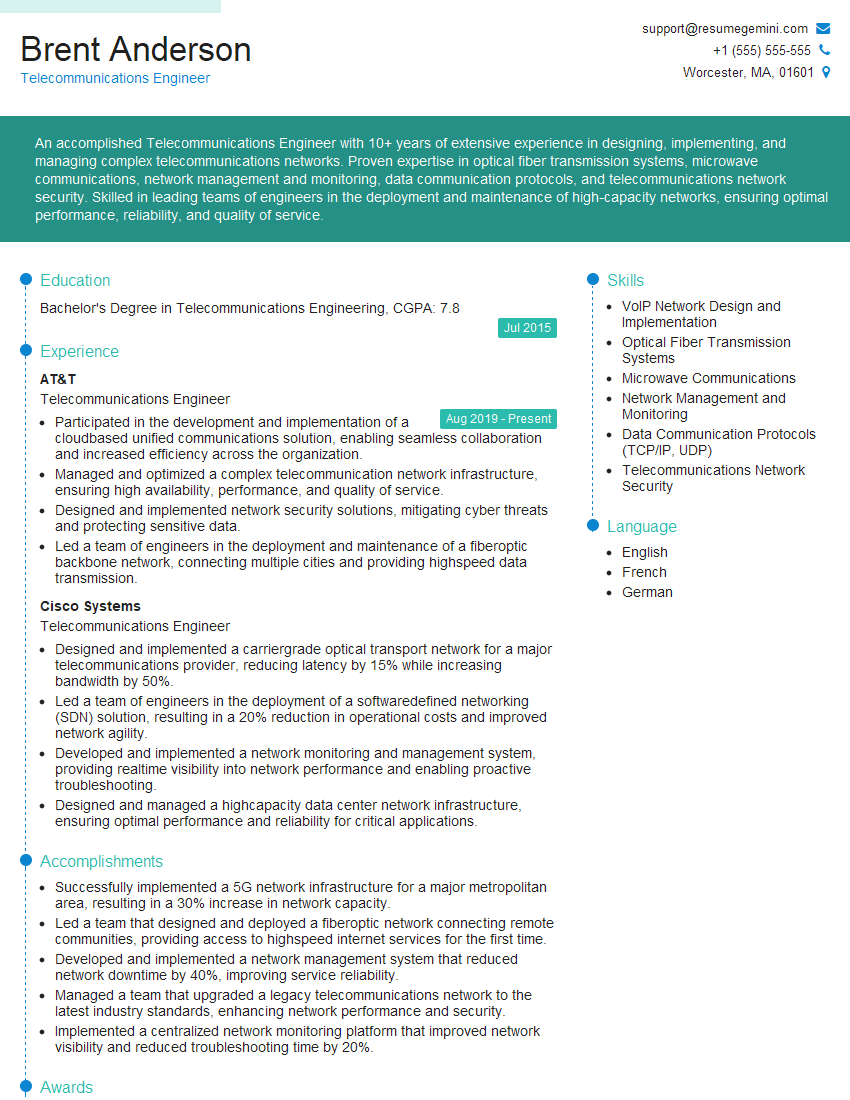
Mastering Voice Over IP (VoIP) Protocols is crucial for career advancement in the rapidly growing telecommunications industry. A strong understanding of these protocols will significantly enhance your job prospects and open doors to exciting opportunities. To make your application stand out, creating an ATS-friendly resume is essential. ResumeGemini can help you build a professional and effective resume that highlights your skills and experience. ResumeGemini offers examples of resumes tailored to Voice Over IP (VoIP) Protocols, providing a valuable template for your own application.
Explore more articles
Users Rating of Our Blogs
Share Your Experience
We value your feedback! Please rate our content and share your thoughts (optional).
What Readers Say About Our Blog
I Redesigned Spongebob Squarepants and his main characters of my artwork.
https://www.deviantart.com/reimaginesponge/art/Redesigned-Spongebob-characters-1223583608
IT gave me an insight and words to use and be able to think of examples
Hi, I’m Jay, we have a few potential clients that are interested in your services, thought you might be a good fit. I’d love to talk about the details, when do you have time to talk?
Best,
Jay
Founder | CEO