Feeling uncertain about what to expect in your upcoming interview? We’ve got you covered! This blog highlights the most important Welding Education interview questions and provides actionable advice to help you stand out as the ideal candidate. Let’s pave the way for your success.
Questions Asked in Welding Education Interview
Q 1. Explain the different types of welding processes and their applications.
Welding encompasses a wide array of processes, each suited to different materials and applications. Think of it like choosing the right tool for a job – you wouldn’t use a hammer to screw in a screw!
- Shielded Metal Arc Welding (SMAW): Also known as stick welding, this is a very versatile process using a consumable electrode coated with flux to protect the weld from atmospheric contamination. It’s great for outdoor use and various metals, but requires skilled hand control.
- Gas Metal Arc Welding (GMAW): Or MIG welding, uses a continuous wire electrode fed into the weld pool, often with a shielding gas like argon or CO2. It’s faster and produces cleaner welds than SMAW, ideal for automotive and manufacturing applications. The wire feed speed and voltage are crucial for good welds.
- Gas Tungsten Arc Welding (GTAW): Also known as TIG welding, this process utilizes a non-consumable tungsten electrode and a shielding gas (usually argon) to produce high-quality, precise welds. It’s excellent for thin materials and applications requiring a very clean finish, such as stainless steel or aluminum fabrication. It requires more precision and skill than GMAW or SMAW.
- Flux-Cored Arc Welding (FCAW): Similar to GMAW but uses a tubular electrode containing its own flux, eliminating the need for a separate shielding gas. This makes it suitable for outdoor applications where shielding gas might be affected by wind.
- Resistance Welding (RW): This process uses electrical resistance to generate heat and fuse metals together. It’s very common in high-volume manufacturing, often used for spot welds in car bodies. It requires specialized equipment.
The choice of process depends on factors like material thickness, joint design, required weld quality, and the environment. For example, GMAW is frequently used in automotive production for its speed and efficiency, while GTAW is favored in aerospace for its precision and high-quality welds.
Q 2. Describe the safety precautions necessary in a welding education environment.
Safety is paramount in any welding education environment. We treat it as a non-negotiable aspect of the curriculum. A single lapse in safety can have devastating consequences. We emphasize a layered safety approach covering:
- Personal Protective Equipment (PPE): This includes welding helmets with appropriate shade lenses, welding jackets or aprons made of flame-resistant materials, gloves, and safety footwear. Students are trained to inspect and maintain their PPE regularly.
- Environmental Safety: Proper ventilation is crucial to remove harmful fumes produced during welding. We ensure adequate ventilation in our workshops and use local exhaust ventilation systems when necessary. Fire prevention is equally important. Fire extinguishers must be readily available and accessible, and we conduct regular fire drills.
- Safe Practices: We teach students about fire hazards, electrical safety, and the proper handling of compressed gases (like argon or CO2). They are trained in emergency procedures, including how to respond to electrical shocks, burns, and fire. Specific procedures for handling each welding process are rigorously followed. We emphasize proper grounding of equipment and the use of appropriate fire-resistant materials.
- Regular Inspections: Equipment undergoes routine safety inspections to ensure it’s in good working order. We also conduct regular safety audits of the welding area.
By combining the proper use of PPE with rigorous training in safe work practices, we create a safer environment. It’s not just about rules, it’s about fostering a safety-conscious culture among our students.
Q 3. How do you assess student competency in welding techniques?
Assessing student competency goes beyond just looking at a pretty weld. It’s about evaluating their understanding of the entire process, safety, and problem-solving skills. We use a multi-faceted approach:
- Practical Examinations: Students perform welds on various materials and joint types. We assess the quality of the weld, including penetration, fusion, and overall appearance, using industry-standard criteria and visual inspection techniques.
- Written Tests: These assess theoretical knowledge of welding processes, safety procedures, material properties, and industry codes. It helps us gauge their understanding of the fundamentals.
- Portfolio Review: Students maintain a portfolio of their work, documenting their progress and showcasing different weld types. This allows us to track their improvement over time and identify areas where they need more practice.
- Performance-Based Assessments: We design scenarios that simulate real-world welding challenges. This tests their ability to problem-solve and apply their knowledge in different situations. For instance, we might ask them to weld a specific joint type under time pressure, simulating the demands of a practical job setting.
This combination ensures we are fully evaluating their competency. We provide constructive feedback during the process and don’t just focus on the final result.
Q 4. What methods do you use to create engaging and effective welding curriculum?
Creating an engaging welding curriculum requires blending theoretical knowledge with hands-on experience and incorporating elements that cater to diverse learning styles.
- Hands-on Projects: Real-world projects that mimic industry tasks, such as creating a simple metal frame or repairing a damaged component, are used to reinforce concepts learned.
- Interactive Demonstrations: We use visual aids, videos, and step-by-step demonstrations to explain complex concepts. Watching a skilled welder is often more effective than simply reading about the process.
- Simulations and Software: Software simulations allow students to practice welding techniques in a risk-free environment before moving to actual welding.
- Guest Speakers and Industry Visits: Inviting experienced welders to share their insights adds a practical perspective. Industry visits allow students to witness real-world applications of welding in diverse settings.
- Gamification and Challenges: Introducing friendly competition, timed challenges or scoring systems can make learning more engaging and motivating.
A well-structured curriculum incorporating these elements fosters a dynamic learning experience that goes beyond rote memorization and translates into practical skills.
Q 5. How do you address different learning styles in a welding classroom?
Welding education needs to cater to a diverse range of learners. Some students learn best through visual demonstrations, others through kinesthetic activity, and still others prefer a more theoretical approach. We address this through:
- Varied Teaching Methods: We employ a variety of methods, combining visual aids, hands-on practice, and theoretical lectures. This ensures that all learning styles are addressed.
- Personalized Feedback: We provide individualized feedback to students, identifying their strengths and weaknesses and adapting our teaching methods accordingly. We emphasize constant communication and observation of each student’s progress.
- Differentiated Instruction: This involves modifying assignments or providing additional support to students who may require extra help. It might involve pairing stronger students with those who are struggling or offering additional practice sessions.
- Collaborative Learning: Teamwork opportunities encourage students to share knowledge and learn from each other. It often reveals the unique understanding each student brings to the table.
By addressing these multiple learning styles, we build a more inclusive and effective learning environment.
Q 6. What are the current industry standards and codes relevant to welding education?
Staying current with industry standards and codes is vital in welding education. These codes ensure consistency and safety in welding practices. Key standards include:
- American Welding Society (AWS) Standards: AWS publishes numerous standards covering various aspects of welding, including welding procedures, qualifications, and safety. These are widely recognized and used throughout the industry.
- American Society of Mechanical Engineers (ASME) Boiler and Pressure Vessel Code: This code sets stringent requirements for welding in the construction of boilers and pressure vessels, focusing on safety and reliability.
- ISO Standards: International Organization for Standardization (ISO) standards provide internationally recognized guidelines for welding and related processes. These are crucial in global projects.
- Local and National Regulations: Compliance with local, state, and national regulations related to occupational safety and health (OSH) is critical.
Keeping abreast of these standards is an ongoing process. We utilize the latest editions in our curriculum and training materials. Staying informed is vital for ensuring students receive the most current and relevant knowledge.
Q 7. Explain your experience in developing and implementing welding training programs.
Throughout my career, I have been extensively involved in developing and implementing numerous welding training programs. My experience spans various levels, from introductory courses for beginners to advanced specialized programs for experienced welders.
In one instance, I led the development of a new curriculum for a community college’s welding program. This involved conducting a thorough needs analysis with local industries to identify their skill requirements. Based on this analysis, I redesigned the program to incorporate more hands-on projects using industry-relevant equipment and materials. The result was a more engaging and effective program that better prepared students for jobs in the industry.
In another instance, I developed a customized training program for a major manufacturing company. This required tailoring the curriculum to their specific welding processes and quality standards. The program included both classroom instruction and extensive hands-on training utilizing the company’s own equipment and materials. The program was highly successful in improving the skills and knowledge of the company’s welding workforce.
In each case, my approach emphasizes a strong foundation in fundamental principles, combined with extensive practical experience. I focus on making the learning engaging and relevant through real-world applications and continuous feedback. This approach consistently yields a highly competent and confident workforce.
Q 8. How do you maintain and manage welding equipment and safety in a training lab?
Maintaining welding equipment and ensuring lab safety is paramount. It’s a multi-faceted process involving preventative maintenance, regular inspections, and strict adherence to safety protocols.
- Preventative Maintenance: We establish a rigorous schedule for cleaning, lubricating, and inspecting all equipment – from welding machines (MIG, TIG, Stick) to safety gear like respirators and fire extinguishers. This includes checking gas cylinders for leaks, ensuring proper ventilation, and verifying the functionality of fume extraction systems. For example, we meticulously log MIG wire spool changes and inspect the wire feed mechanism for any signs of wear and tear.
- Regular Inspections: Beyond scheduled maintenance, daily visual inspections are crucial. We check for damaged cables, loose connections, or any signs of malfunction. This proactive approach helps prevent accidents and ensures equipment reliability. A simple example is checking the grounding clamps on all welding machines before each class begins.
- Safety Protocols: Our lab operates under a strict set of safety rules, rigorously enforced through training and regular reminders. Students are required to wear appropriate PPE (Personal Protective Equipment), including welding helmets with appropriate shade lenses, fire-resistant clothing, gloves, and safety footwear. We conduct regular fire safety drills and emergency procedures training. We even have a designated emergency shutdown procedure for all welding equipment.
This combination of preventative maintenance, regular inspections, and robust safety protocols creates a safe and efficient learning environment.
Q 9. Describe your experience with welding apprenticeship programs or similar initiatives.
I’ve been deeply involved in several welding apprenticeship programs, both as an instructor and a mentor. My experience spans various levels, from entry-level apprentices learning fundamental techniques to experienced welders pursuing advanced certifications.
In one program, I developed and implemented a curriculum focusing on the practical application of welding skills in the shipbuilding industry. We partnered with local shipyards to provide apprentices with real-world experience, shadowing experienced welders and working on actual projects. This hands-on approach significantly improved their skill development and job readiness. Another program involved teaching apprentices the intricacies of stainless steel welding, emphasizing the importance of cleanliness and proper filler metal selection. We simulated various real-world scenarios, such as welding in confined spaces or repairing damaged structures, to give them a comprehensive understanding of the profession.
My role in these programs often extended beyond technical instruction. I provided guidance on career planning, helped them connect with industry professionals, and acted as a mentor, guiding them through challenges and celebrating their successes. Witnessing their growth from novice welders to skilled professionals is incredibly rewarding.
Q 10. How do you incorporate new technologies and advancements in welding into your curriculum?
Integrating new technologies is crucial for preparing students for the evolving welding industry. I actively incorporate advancements like robotic welding, 3D printing, and advanced welding processes into our curriculum.
- Robotic Welding: We introduce students to robotic welding programming and operation, utilizing simulations and hands-on experience with industrial robots. This exposes them to the automation trends in modern manufacturing.
- 3D Printing (Additive Manufacturing): We explore the use of 3D printing for creating custom jigs and fixtures, as well as its potential in direct metal deposition welding, a cutting-edge additive manufacturing process. Students learn about the design considerations and post-processing techniques associated with these technologies.
- Advanced Welding Processes: We cover the latest advancements in processes like Friction Stir Welding (FSW), Laser Beam Welding (LBW), and Electron Beam Welding (EBW). While not always practical for hands-on training at the introductory level, we use simulations and case studies to familiarize students with these techniques and their applications in specialized industries.
By exposing students to these modern technologies, we enhance their marketability and prepare them for a future-proof career in welding.
Q 11. How do you evaluate the effectiveness of your welding instruction?
Evaluating the effectiveness of welding instruction involves a multi-pronged approach combining practical assessments, theoretical exams, and student feedback.
- Practical Assessments: Students are regularly assessed on their welding proficiency through practical exams. These assessments evaluate their ability to execute different welding processes, achieve specific weld quality parameters (e.g., penetration, bead width, reinforcement), and produce visually sound welds. We use standardized weld testing methods like visual inspection, bend testing, and tensile testing to quantify the weld quality.
- Theoretical Exams: Theoretical exams test students’ understanding of welding principles, safety procedures, metallurgy, and the properties of different weld materials. These tests ensure that students have a solid foundation in the theoretical aspects of welding.
- Student Feedback: Regular feedback from students is invaluable. We utilize surveys, informal discussions, and individual meetings to gather their insights and identify areas for improvement in the curriculum or teaching methods. Student feedback helps shape the course to meet their needs and improve the learning experience.
By using a combination of these methods, we can gain a comprehensive understanding of student learning and tailor our instruction to optimize their skill development. We also track the placement rates of our graduates in the industry, which serves as a key performance indicator of the program’s effectiveness.
Q 12. Describe your experience in using different types of welding simulators or virtual reality tools.
I have significant experience using welding simulators and virtual reality (VR) tools to enhance student learning and improve safety.
Welding simulators provide a risk-free environment for students to practice various welding techniques without the expense and hazards associated with using actual equipment and materials. They allow students to repeat welds, experiment with different parameters, and receive immediate feedback on their performance. This is particularly useful for introducing complex techniques like TIG welding, where precision and control are essential.
VR tools offer an even more immersive experience, allowing students to simulate real-world welding scenarios in a virtual environment. This can include welding in confined spaces, working at heights, or undertaking complex repairs. VR’s ability to provide detailed feedback on welding technique and offer a 360-degree view of the weld pool helps greatly in developing spatial awareness and improving dexterity.
While simulators and VR tools cannot entirely replace hands-on practice with real equipment, they are invaluable supplemental tools that accelerate learning and enhance safety. This is particularly crucial when dealing with expensive materials or processes where mistakes can be costly. For example, students could practice welding expensive titanium without the risk of wasting the material.
Q 13. How do you ensure the safety of students while they are engaging in hands-on welding activities?
Safety is our utmost priority in hands-on welding activities. We implement a comprehensive safety program that includes extensive training, strict enforcement of rules, and a focus on creating a safety-conscious culture.
- Safety Training: Before any hands-on welding, students receive thorough safety training covering hazards, PPE use, emergency procedures, and fire safety. This is complemented by regular refresher courses and safety reminders.
- Strict Enforcement of Rules: We have a zero-tolerance policy for violating safety rules. Students are expected to wear appropriate PPE at all times and follow established procedures. Any violations result in immediate corrective action, including potential suspension from the lab.
- Safety Equipment & Procedures: The lab is equipped with fire extinguishers, eye wash stations, emergency showers, and proper ventilation. We regularly inspect and maintain this safety equipment. Designated safety officers monitor the lab during welding sessions, ensuring students follow safety protocols.
- Supervision: Experienced instructors supervise students closely during all welding activities. Individualized attention allows instructors to identify and correct unsafe practices immediately, preventing accidents.
This layered approach to safety minimizes risks and creates a learning environment where students can focus on developing their welding skills without jeopardizing their safety.
Q 14. What are some common welding defects and how do you teach students to identify and prevent them?
Understanding and preventing welding defects is crucial for producing high-quality welds. We cover various common defects, emphasizing their causes and preventative measures.
- Porosity: Porosity (small holes in the weld) is often caused by trapped gases in the weld pool. Students learn to identify it through visual inspection and understand prevention techniques like proper shielding gas coverage, avoiding contaminated materials, and using appropriate welding parameters.
- Undercut: Undercut (a groove at the edge of the weld) results from excessive current or improper travel speed. We teach students to recognize it and how to adjust welding parameters to maintain proper weld bead geometry.
- Lack of Fusion: Lack of fusion (incomplete melting of the base metal to the weld) indicates poor penetration. We emphasize the importance of proper pre-cleaning of the base metal, sufficient heat input, and correct electrode angle to ensure complete fusion.
- Cracks: Cracks can occur due to rapid cooling, excessive stress, or hydrogen embrittlement. Students learn to identify different types of cracks (hot cracks, cold cracks) and the importance of pre-heating, selecting appropriate filler metal, and controlling cooling rates to minimize cracking.
We use samples of welds with different defects to allow students to practice visual identification. We also perform destructive testing methods like bend testing to demonstrate the impact of these defects on weld strength and integrity. This practical approach ensures that students can recognize and prevent these defects in their own work.
Q 15. How do you incorporate problem-solving and critical thinking skills into your welding instruction?
Incorporating problem-solving and critical thinking is paramount in welding education. It’s not just about teaching students *how* to weld, but *why* certain techniques are used and how to adapt to unexpected challenges. I achieve this through several methods:
Real-world scenarios: I present students with flawed welds or incomplete designs and ask them to diagnose the issue, propose solutions, and implement them. For example, I might show them a weld with excessive spatter and ask them to identify the likely cause (e.g., incorrect amperage, improper electrode angle) and suggest corrective actions.
Open-ended projects: Instead of rigidly defined projects, I often provide broad objectives, encouraging students to design their own solutions. This fosters creativity and demands careful consideration of material properties, welding processes, and safety regulations. One example is asking them to design a sturdy but lightweight bracket, leaving the specific materials and welding technique to their judgment.
Troubleshooting activities: Regular practice in troubleshooting common welding defects—porosity, cracks, incomplete fusion—builds their diagnostic skills. I’ll demonstrate various defects, guiding students to analyze the root cause and suggest solutions, emphasizing the importance of meticulous process control.
Peer review and feedback: Students regularly inspect each other’s work, identifying potential issues and offering constructive criticism. This collaborative approach enhances critical thinking and allows for a deeper understanding of the welding process and its challenges.
Career Expert Tips:
- Ace those interviews! Prepare effectively by reviewing the Top 50 Most Common Interview Questions on ResumeGemini.
- Navigate your job search with confidence! Explore a wide range of Career Tips on ResumeGemini. Learn about common challenges and recommendations to overcome them.
- Craft the perfect resume! Master the Art of Resume Writing with ResumeGemini’s guide. Showcase your unique qualifications and achievements effectively.
- Don’t miss out on holiday savings! Build your dream resume with ResumeGemini’s ATS optimized templates.
Q 16. What strategies do you use to maintain a positive and productive learning environment?
Maintaining a positive and productive learning environment is crucial for effective welding instruction. My strategies focus on building a collaborative and respectful atmosphere:
Clear expectations and communication: I establish clear learning objectives and expectations from the outset, ensuring all students understand the course structure, assessment methods, and safety rules. Open communication channels, including regular Q&A sessions and one-on-one feedback, are vital.
Positive reinforcement and encouragement: I actively praise good work and effort, highlighting student successes, both large and small. I believe in fostering a growth mindset where mistakes are seen as learning opportunities.
Teamwork and collaboration: Group projects and peer learning encourage teamwork, allowing students to learn from one another’s strengths and perspectives. This also helps build camaraderie and a sense of community.
Safety-first approach: A safe learning environment is paramount. I enforce strict safety protocols, providing comprehensive safety training, and continuously monitoring the lab to ensure adherence to these rules. Consistent reinforcement of safety rules creates a culture of responsibility.
Addressing conflicts promptly and fairly: If conflicts arise, I address them promptly, ensuring a fair and impartial process to maintain a respectful atmosphere.
Q 17. Describe your experience in working with diverse student populations.
I’ve had the pleasure of working with diverse student populations, including individuals with varying levels of prior experience, different learning styles, and diverse cultural backgrounds. My approach emphasizes inclusivity and caters to individual needs:
Differentiated instruction: I recognize that students learn at different paces and through various methods. I adapt my teaching strategies to meet diverse learning styles, incorporating visual aids, hands-on activities, and verbal explanations to cater to all learners. For example, I provide extra support to students who struggle with a specific technique while offering advanced challenges to those who excel.
Cultural sensitivity: I’m aware of the importance of creating a culturally sensitive and inclusive learning environment. I encourage open communication and respect diverse perspectives and communication styles.
Accessibility: I ensure that my teaching materials and lab environment are accessible to students with disabilities. This involves modifying activities as needed to ensure equal participation and learning opportunities.
Mentorship: I make myself available for mentoring and support, building rapport with students and encouraging open communication about their needs and challenges.
Q 18. How do you integrate theory and practical application in your welding courses?
Integrating theory and practical application is critical in welding education. Simply memorizing facts isn’t enough; students need to understand the underlying principles and apply them in real-world situations. I achieve this through:
Hands-on activities: The majority of our class time is dedicated to hands-on practice, allowing students to apply the theoretical knowledge learned in lectures. For example, after learning about the metallurgy of steel, students will perform various welding procedures on different types of steel to observe how material properties affect the welding process.
Real-world projects: Projects are carefully designed to integrate theory and practice. Students might be tasked with designing and fabricating a specific component, requiring them to apply knowledge of material selection, weld design, and welding parameters.
Demonstrations and simulations: I demonstrate welding techniques and procedures, and where possible, incorporate simulations to visualize processes and effects. This allows students to visualize the underlying principles before applying them practically.
For instance, we may use software simulations to explore the effects of different welding parameters on weld penetration before replicating these experiments in the lab.
Q 19. Explain your experience with developing welding projects and assessments.
Developing engaging and effective welding projects and assessments is crucial for student learning. I strive to create projects that are:
Relevant and practical: Projects often involve real-world applications or replicate scenarios encountered in industrial settings. This makes the learning more engaging and prepares students for future careers.
Challenging yet attainable: Projects should push students’ skills while remaining achievable within the given timeframe and resources. This balances the need for rigorous learning with the importance of fostering a sense of accomplishment.
Varied in assessment methods: Assessments are not limited to just the final product. I assess through different methods such as written exams, practical tests, process observation, and self-assessment to provide a holistic evaluation of student learning. For example, a project might require students to document their process, write a report explaining their design choices, and demonstrate their welding skills during a practical exam.
Progressive in difficulty: Projects increase in complexity throughout the course, starting with simple tasks to build confidence before progressing to more challenging designs.
Examples of projects include fabricating a small metal sculpture, building a functional tool, or repairing a damaged metal object. The design and execution of the projects are carefully assessed, considering both the final product and the welding techniques employed.
Q 20. How do you handle student discipline issues in a welding lab?
Maintaining discipline in a welding lab requires a proactive and consistent approach emphasizing safety and respect. My strategy focuses on:
Preventative measures: Clearly defined safety rules and procedures, coupled with thorough training and reinforcement, are essential. I constantly emphasize the importance of adhering to safety regulations and the potential consequences of neglecting them.
Immediate intervention: Any violation of safety rules is addressed immediately. This might involve a verbal warning, temporary suspension from lab work, or reporting serious infractions to the relevant authorities.
Fair and consistent discipline: I apply disciplinary measures consistently and fairly to all students. This ensures that rules are applied equitably and reduces the likelihood of biased treatment.
Focus on corrective actions: Discipline isn’t merely about punishment; it aims to correct behavior and foster a safe learning environment. After an incident, I engage in a discussion with the student to help them understand their mistake and how to prevent it in the future.
Collaboration with colleagues: In cases of serious or persistent disciplinary issues, I collaborate with colleagues and relevant authorities to develop a suitable plan for addressing the situation and ensuring student safety.
Q 21. Describe your knowledge of different welding metals and their properties.
My knowledge of welding metals and their properties is extensive, encompassing their chemical composition, mechanical properties, and weldability characteristics. This understanding is critical for effective welding instruction.
Steel: I am proficient in working with various grades of steel, understanding the effects of carbon content, alloying elements, and heat treatment on weldability. I can differentiate between low-carbon, mild steel, high-carbon steel, stainless steel (austenitic, ferritic, martensitic), and other alloy steels, and select the appropriate welding processes and filler materials.
Aluminum: I understand the unique challenges associated with welding aluminum, including its high thermal conductivity and susceptibility to oxidation. I know how to select appropriate filler materials, and utilize specific welding techniques like gas metal arc welding (GMAW) or gas tungsten arc welding (GTAW) to achieve high-quality welds.
Stainless Steel: My expertise includes various stainless steel grades and their susceptibility to different forms of corrosion. I know how to mitigate these concerns by carefully selecting appropriate filler metals and welding techniques and understand the importance of post-weld cleaning to prevent corrosion.
Other metals: My understanding extends to other commonly welded metals such as copper, nickel, titanium, and their alloys, considering their unique properties and requirements for successful welding.
This knowledge allows me to effectively teach students how to select appropriate materials and welding processes based on the specific application and desired properties of the final weld.
Q 22. How do you stay current with industry trends and advancements in the field of welding?
Staying current in the dynamic field of welding requires a multi-faceted approach. I actively participate in professional organizations like the American Welding Society (AWS), attending their conferences and webinars to learn about the latest advancements in techniques, materials, and safety regulations. This includes keeping up with new codes and standards, such as the ASME Boiler and Pressure Vessel Code. I also subscribe to industry-specific journals and publications, such as Welding Journal, and regularly review online resources and research papers focusing on innovations in welding automation, robotics, and additive manufacturing. Further, networking with industry professionals through conferences and online forums allows me to learn about real-world challenges and successful solutions. Finally, I actively seek out continuing education opportunities to maintain my certifications and enhance my knowledge base.
Q 23. Explain your experience in using various welding inspection techniques.
My experience encompasses a wide range of welding inspection techniques, both destructive and non-destructive. I’m proficient in visual inspection (VI), which is the foundation of all inspections, meticulously checking for surface defects, cracks, and porosity. I’m also skilled in non-destructive testing (NDT) methods, including radiographic testing (RT) for internal flaws, ultrasonic testing (UT) for assessing weld penetration and discontinuities, and magnetic particle testing (MT) for surface and near-surface cracks in ferromagnetic materials. I have experience using liquid penetrant testing (PT) to detect surface-breaking defects. My experience extends to destructive testing methods, such as tensile testing and bend testing, to determine the mechanical properties of the weld. Each technique has its strengths and weaknesses; for instance, RT excels at detecting internal porosity, while UT is better for assessing the overall integrity of the weld. Choosing the appropriate method depends heavily on the weld’s application and the type of potential defects.
Q 24. How would you adapt your teaching methods to accommodate students with disabilities?
Adapting my teaching methods for students with disabilities is paramount. My approach focuses on individualized instruction and leveraging assistive technologies. For visually impaired students, I utilize tactile models of weld joints and enlarged diagrams. Audio descriptions accompany demonstrations, and I ensure sufficient lighting and contrast. For hearing-impaired students, I provide written instructions and visual aids. I use clear and concise communication, avoiding jargon and employing sign language interpretation when necessary. For students with mobility challenges, I ensure the workspace is accessible and adapt equipment to their physical needs. Collaboration with special education specialists and utilizing adaptive equipment are crucial. Creating a supportive and inclusive learning environment where every student feels comfortable participating and asking for help is also key. I believe in celebrating each student’s unique strengths and fostering their self-confidence.
Q 25. Describe your experience with creating and maintaining effective partnerships with industry.
Building strong partnerships with industry is crucial for relevant and effective welding education. I’ve established relationships with local manufacturers and contractors by providing them with skilled graduates and participating in their industry events. These partnerships provide valuable opportunities for students, including internships, apprenticeships, and site visits. I regularly solicit feedback from industry partners on curriculum relevance and emerging technologies. This collaborative approach ensures our program remains aligned with industry needs and equips students with the in-demand skills employers seek. For example, I’ve worked with a local pipeline company to develop a specialized training module on pipeline welding techniques, which benefits both the students and the company.
Q 26. How do you prepare students for industry certifications and licensing exams?
Preparing students for industry certifications (like AWS certifications) and licensing exams requires a structured and comprehensive approach. We incorporate practice exams throughout the curriculum, mimicking the actual test format and difficulty. Students are given detailed feedback on their performance, identifying areas for improvement. Hands-on practice in the lab is crucial, ensuring they gain proficiency in the required welding processes and procedures. We provide access to relevant codes, standards, and reference materials. Workshops specifically focused on exam preparation techniques, such as time management and stress reduction, are also offered. Furthermore, we organize mock examinations under timed conditions to simulate the real-life exam environment, fostering confidence and reducing exam anxiety.
Q 27. What is your experience with budgeting and resource management in a welding education setting?
Effective budgeting and resource management are critical in a welding education setting. This involves creating a detailed budget that outlines projected expenses, including equipment maintenance, consumable supplies (electrodes, gases), and instructor salaries. Tracking expenses against the budget is crucial to identify areas for potential savings and ensure resources are utilized efficiently. I prioritize securing grants and seeking external funding sources to augment existing resources. This involves writing compelling grant proposals that highlight the program’s impact and demonstrate a clear return on investment. We regularly evaluate the effectiveness of our equipment and training materials, replacing outdated or inefficient equipment to maintain a high standard of training.
Q 28. How would you handle a situation where a student is struggling to master a particular welding technique?
When a student struggles with a particular welding technique, a systematic approach is necessary. First, I’d identify the specific challenge. Is it a problem with hand-eye coordination, understanding the process parameters (amperage, voltage, travel speed), or interpreting weld symbols? Once identified, I would provide individualized instruction, focusing on breaking down the technique into smaller, manageable steps. Using visual aids, demonstrations, and hands-on guidance, I’ll provide targeted feedback and support. I may also introduce different teaching methods, such as simulations or gamification, to make the learning process more engaging. If the problem persists, I would consult with colleagues and utilize additional resources, including online tutorials or specialized training materials. Open communication with the student, creating a safe space for them to ask questions and express their concerns, is vital to their success.
Key Topics to Learn for Your Welding Education Interview
- Welding Processes: Understand the principles and applications of various welding processes (e.g., SMAW, GMAW, GTAW, FCAW). Be prepared to discuss their strengths, weaknesses, and appropriate applications in different scenarios.
- Weld Joint Design & Metallurgy: Demonstrate knowledge of different weld joint types, their mechanical properties, and how material selection impacts weld quality and strength. Discuss the metallurgical changes that occur during welding and their implications.
- Safety Procedures & Regulations: Showcase your understanding of safety protocols, including PPE, hazard identification, and emergency procedures. Familiarize yourself with relevant industry regulations and safety standards.
- Welding Equipment & Techniques: Be ready to discuss the operation and maintenance of various welding equipment, including power sources, consumables, and safety devices. Demonstrate your mastery of proper welding techniques for achieving high-quality welds.
- Blueprint Reading & Interpretation: Show your ability to interpret welding symbols, dimensions, and tolerances on blueprints to accurately execute welding tasks.
- Quality Control & Inspection: Explain different methods for inspecting welds for defects, including visual inspection, non-destructive testing (NDT) methods, and understanding relevant quality control standards.
- Problem-solving and Troubleshooting: Highlight your ability to identify and solve common welding problems, such as porosity, cracking, and lack of fusion. Describe your approach to troubleshooting and maintaining weld quality.
Next Steps
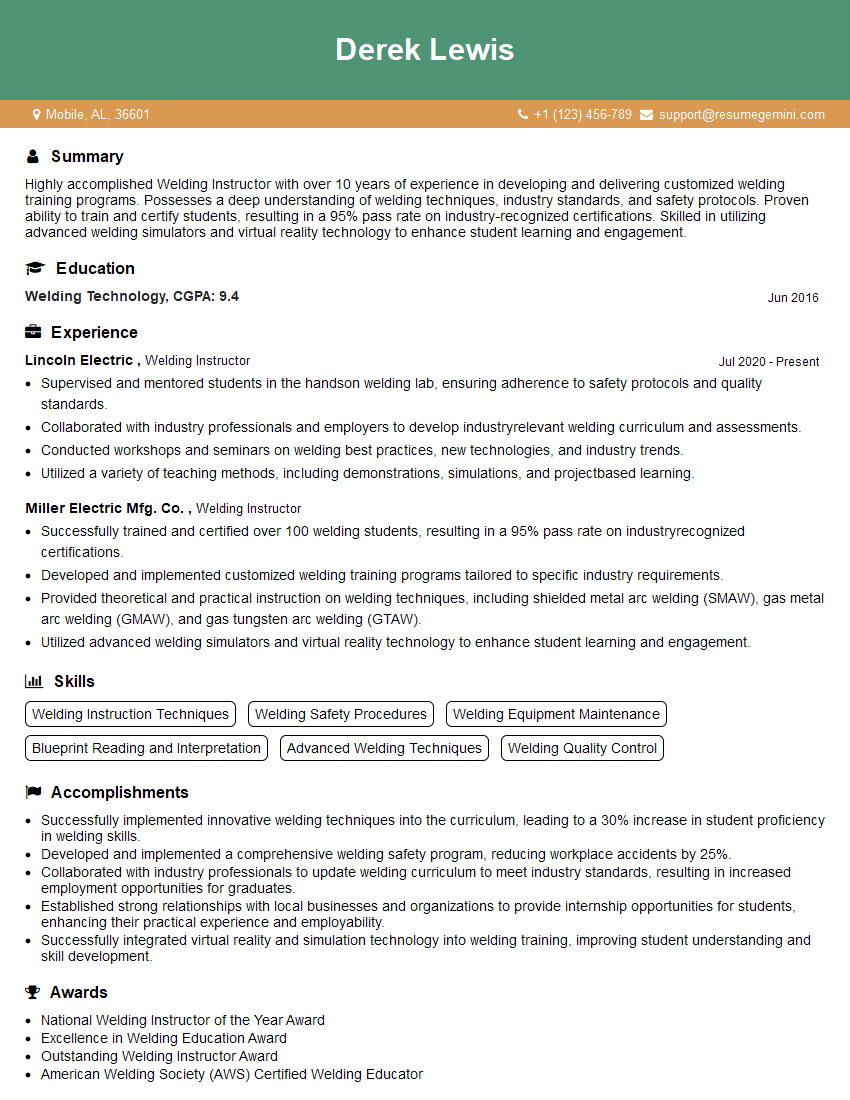
Mastering Welding Education is crucial for launching a successful and rewarding career in a highly skilled and in-demand field. To maximize your job prospects, a well-crafted, ATS-friendly resume is essential. This is where ResumeGemini can help! ResumeGemini provides a powerful platform for building professional resumes that highlight your skills and experience effectively. We offer examples of resumes tailored specifically to Welding Education to guide you in creating a compelling application that will stand out from the competition. Take the next step towards your dream career – build your resume with ResumeGemini today!
Explore more articles
Users Rating of Our Blogs
Share Your Experience
We value your feedback! Please rate our content and share your thoughts (optional).
What Readers Say About Our Blog
I Redesigned Spongebob Squarepants and his main characters of my artwork.
https://www.deviantart.com/reimaginesponge/art/Redesigned-Spongebob-characters-1223583608
IT gave me an insight and words to use and be able to think of examples
Hi, I’m Jay, we have a few potential clients that are interested in your services, thought you might be a good fit. I’d love to talk about the details, when do you have time to talk?
Best,
Jay
Founder | CEO