The right preparation can turn an interview into an opportunity to showcase your expertise. This guide to Welding Terminology interview questions is your ultimate resource, providing key insights and tips to help you ace your responses and stand out as a top candidate.
Questions Asked in Welding Terminology Interview
Q 1. What are the different types of welding joints?
Welding joints classify how the base materials are positioned before welding. The choice of joint significantly impacts the weld’s strength and ease of fabrication. Common types include:
- Butt Joint: The edges of the base materials are butted together, creating a continuous line. Think of joining two pieces of pipe end-to-end. This joint type is strong but requires precise alignment.
- Lap Joint: One base material overlaps the other. It’s easier to align than a butt joint but generally less strong.
- T-Joint: One base material is welded perpendicularly to another, forming a ‘T’ shape. Common in structural welding.
- Corner Joint: Two base materials are joined at a corner, forming an ‘L’ shape. Often used in sheet metal fabrication.
- Edge Joint: The edges of two materials are welded, leaving the weld bead exposed along the edge. Used when edge preparation isn’t feasible or desirable.
The selection of the joint type depends on factors like the materials being welded, the application’s required strength, and the accessibility for welding.
Q 2. Explain the difference between GMAW and SMAW welding processes.
GMAW (Gas Metal Arc Welding) and SMAW (Shielded Metal Arc Welding) are both arc welding processes, but they differ significantly in their shielding methods and filler metal delivery. Imagine SMAW as using a stick electrode that’s both the filler and the shielding source, while GMAW uses a continuous wire fed into the weld pool with a separate shielding gas.
- SMAW (Stick Welding): Uses a consumable electrode coated with flux that melts along with the electrode to provide shielding gas and filler material. It’s relatively portable and requires less expensive equipment. It’s well-suited for outdoor work but offers slower welding speeds and greater spatter compared to GMAW.
- GMAW (MIG Welding): Uses a continuous wire feed mechanism, a shielding gas (often CO2 or argon-based mixtures), and a constant current power source. This allows for higher deposition rates and better control over the weld bead. It’s more suitable for high-production work in controlled environments but demands more equipment and skill for optimal performance.
In essence, GMAW is more efficient and cleaner but necessitates specialized equipment and skill, while SMAW is simpler and more portable but slower and prone to more spatter.
Q 3. Describe the purpose of a welding procedure specification (WPS).
A Welding Procedure Specification (WPS) is a documented set of instructions defining the parameters for a specific welding operation to ensure consistent and quality welds. It’s like a recipe for a specific weld, including details for reproducibility. Think of it as the blueprint for producing a reliable weld. It outlines:
- Base Materials: Type, grade, and thickness of the materials being joined.
- Welding Process: Such as GMAW, SMAW, etc.
- Filler Material: Type, diameter, and manufacturer of the filler metal.
- Welding Parameters: Current, voltage, travel speed, etc.
- Preheating and Post-heating Temperatures: If necessary.
- Joint Design: Type and dimensions of the joint being welded.
- Welding Position: Flat, vertical, overhead, etc.
Adhering to a WPS ensures that welds meet specific quality standards and are consistently repeatable across multiple welds, crucial for safety and project reliability.
Q 4. What are the common welding defects and how are they identified?
Several common welding defects can compromise the integrity of a weld. These can be identified visually (often with magnification) and sometimes through non-destructive testing methods (NDT). Here are a few examples:
- Porosity: Gas entrapment in the weld metal, causing small holes. This weakens the weld and can be identified visually or with radiographic testing.
- Incomplete Fusion: The weld metal doesn’t properly fuse with the base material, leaving un-welded areas. This can lead to cracking and is visible through visual inspection.
- Undercut: A groove melted into the base material adjacent to the weld, reducing the weld’s strength. This is visually identifiable.
- Cracking: Breaks in the weld metal or heat-affected zone, usually caused by stress or metallurgical issues. Identified visually and sometimes by magnetic particle inspection.
- Slag Inclusion: Trapped slag (the by-product of welding) in the weld metal, making it brittle. This is visible after weld cleaning.
Identifying these defects early through proper inspection procedures and NDT ensures timely corrective measures, prevents failures, and maintains safety and quality.
Q 5. Explain the significance of preheating and post-heating in welding.
Preheating and post-heating are thermal treatments used to control the cooling rate during welding, affecting the weld’s microstructure and properties. Imagine preheating as preparing the material, and post-heating as ensuring its proper recovery.
- Preheating: Heating the base material before welding reduces the cooling rate. This is beneficial for preventing cracking in materials susceptible to stress during rapid cooling, particularly in thicker sections or low-temperature materials.
- Post-heating: Heating the weldment after welding also moderates the cooling rate, reducing residual stresses and thus the risk of cracking. It can also enhance the weld’s toughness and ductility.
The specific temperatures for preheating and post-heating depend on the material’s characteristics and the welding process. These measures are especially crucial in critical applications where weld integrity is paramount, such as in pressure vessels or pipelines.
Q 6. What are the safety precautions to be followed during welding?
Welding is inherently dangerous; safety precautions are vital to prevent accidents. Key safety measures include:
- Personal Protective Equipment (PPE): Always wear appropriate PPE including welding helmets with appropriate shade lenses, welding gloves, safety glasses, flame-resistant clothing, and sturdy footwear.
- Ventilation: Ensure adequate ventilation to prevent exposure to hazardous fumes and gases. Use local exhaust ventilation systems or work in well-ventilated areas.
- Fire Prevention: Keep flammable materials away from the welding area. Have a fire extinguisher nearby and be aware of potential fire hazards.
- Eye and Skin Protection: Welding arc radiation can severely damage eyes and skin. Always use the appropriate PPE to protect against burns and UV radiation.
- Safe Handling of Equipment: Properly handle and store welding equipment, gases, and other materials.
- Training and Qualification: All welders should receive adequate training and be qualified for the specific welding tasks they undertake.
Following these safety procedures minimizes risks and creates a safer work environment.
Q 7. What are the different types of electrodes used in SMAW welding?
Electrodes used in SMAW welding are categorized by their composition and intended application. They aren’t just metal rods; each electrode is carefully engineered for specific materials and welding scenarios.
- E6010/E6011: These are low-hydrogen electrodes ideal for welding in all positions with excellent penetration and high-quality welds. The ‘1’ indicates that they are low-hydrogen electrodes which helps with avoiding cracking.
- E7018: This is a low-hydrogen electrode suited for tougher applications, providing superior strength and toughness.
- E6013: A general-purpose electrode, easy to use and offers good versatility in many applications.
- Stainless Steel Electrodes (e.g., 308L): Used to weld stainless steel, maintaining corrosion resistance.
- Cast Iron Electrodes: Specifically designed for welding cast iron, addressing its unique properties.
The electrode selection is crucial; the wrong choice can lead to weak welds, porosity, or cracking. Proper electrode selection ensures the weld meets the required strength and quality for the intended application.
Q 8. Explain the concept of weld penetration and its importance.
Weld penetration refers to the depth to which the weld extends into the base material. Imagine it like pushing a knife into butter – the penetration is how far the knife goes in. It’s absolutely crucial for weld integrity because insufficient penetration leads to weak joints susceptible to cracking or failure under stress. Conversely, excessive penetration can cause burn-through, weakening the base material itself.
For instance, in a structural steel weld, inadequate penetration would mean the weld doesn’t fully fuse with the base metal, creating a discontinuity and compromising the structural strength of the entire beam. Achieving the correct penetration depends on several factors including welding parameters (current, voltage, speed), joint design, and the base material’s properties. Welders use various techniques and visual inspections to ensure proper penetration, often utilizing radiographic testing or ultrasonic testing for critical applications.
Q 9. What is the role of shielding gas in GMAW welding?
In Gas Metal Arc Welding (GMAW), also known as MIG welding, shielding gas plays a vital role in protecting the molten weld pool from atmospheric contamination. Think of it as a protective blanket. The air contains oxygen and nitrogen which readily react with the molten metal, leading to porosity (small holes within the weld) and weakening the weld. The shielding gas, usually argon or a mixture of argon and carbon dioxide, forms a barrier, preventing this reaction and ensuring a clean, sound weld.
The choice of shielding gas depends on the application and the base metal. Argon is often preferred for its inertness, leading to cleaner welds, especially with aluminum or stainless steel. Argon/CO2 mixtures are common for steel applications as CO2 enhances the weld’s penetration but might slightly increase porosity if not carefully controlled. Improper shielding gas coverage can result in spatter, poor bead appearance and significant weld defects.
Q 10. How do you interpret welding symbols?
Welding symbols are a standardized way to communicate all necessary information about a weld on a drawing. They’re essentially a shorthand language for welders and engineers. The symbol contains multiple elements, each conveying specific details: the type of weld, its location, dimensions, and required welding process. The reference line usually separates the arrow side (the side the symbol is placed on) from the other side. Symbols above the reference line refer to the arrow side; below, to the opposite side.
For example, a small square symbol on the arrow side might indicate a fillet weld. Dimensions, such as leg size, are usually found near the symbol. A specific welding process, like GMAW or SMAW, might be indicated by additional symbols or annotations. Learning to interpret these symbols accurately is fundamental for any welder to ensure they create the correct weld according to the design specifications.
Q 11. What are the different types of weld tests and their purpose?
Several weld tests exist to assess the quality and integrity of a weld. The choice of test depends on the weld’s criticality and the required level of assurance. These tests can be destructive or non-destructive.
- Visual Inspection: The simplest method, checking for surface defects like cracks, porosity, or undercutting.
- Destructive Tests: These involve breaking the weld to assess its properties. Examples include tensile testing (measuring strength), bend testing (flexibility), and hardness testing (evaluating resistance to indentation).
- Non-Destructive Tests: These do not damage the weld. Radiographic testing (RT) uses X-rays or gamma rays to detect internal flaws. Ultrasonic testing (UT) uses sound waves to find defects. Liquid penetrant testing (PT) reveals surface-breaking cracks, and magnetic particle testing (MT) identifies subsurface flaws in ferromagnetic materials.
The purpose is always to ensure the weld meets the required specifications for strength, durability, and safety. For instance, a critical weld on a pressure vessel would require more stringent testing like RT or UT to guarantee it can withstand the internal pressure without failure.
Q 12. Describe the process of creating a weld repair procedure.
Creating a weld repair procedure is a systematic process that ensures a consistent and effective repair. It’s like a recipe for fixing a weld. First, you need a detailed assessment of the defect – type, size, location. Then, you define the repair method (e.g., grinding out the defect, preheating, using filler material). The procedure must specify the welding process, parameters (current, voltage, travel speed), and the type of filler metal. It also covers pre- and post-weld cleaning, and importantly, the inspection method to verify the repair’s quality.
Consider a scenario where a crack is found in a pressure vessel weld. The procedure would detail the steps to grind out the crack, clean the area meticulously, preheat the metal to prevent cracking during welding, and then specify the welding process (perhaps SMAW with a specific electrode) and its parameters. After welding, the repaired area would undergo non-destructive testing (like radiography) to ensure the crack has been fully repaired and the weld integrity is restored.
Q 13. What is the difference between a fillet weld and a groove weld?
Fillet welds and groove welds are two fundamental types of welds. A fillet weld joins two members that intersect, usually at a 90-degree angle. Imagine it as filling the corner with weld metal. The size is defined by its leg length (the distance from the root of the weld to the toe). A groove weld, on the other hand, is created in the gap between two members that are joined edge-to-edge or butt-to-butt. This is designed to create a complete fusion of the two base materials, creating a much stronger joint.
Think of it this way: a fillet weld is like gluing two pieces of wood together in a corner, while a groove weld is like welding two metal sheets together, creating a solid continuous piece. The choice between them depends on the application and the required strength and design.
Q 14. Explain the importance of proper weld cleaning.
Proper weld cleaning is paramount for several reasons. It’s like cleaning a wound before applying a bandage; if you don’t remove contaminants, the healing process (or in this case, the weld’s integrity) is compromised. The weld may contain slag (non-metallic byproducts of welding) and spatter (droplets of molten metal), which create imperfections that weaken the weld and reduce its corrosion resistance. Contaminants also impede the proper inspection of the weld, making it harder to identify any defects.
Cleaning methods vary depending on the type of weld and the materials involved. Grinding, chipping, wire brushing, and chemical cleaning are common methods. The level of cleaning required depends on the application’s requirements; a critical weld will demand a higher degree of cleaning than a less demanding one. Improper cleaning can lead to weld failures, corrosion, and difficulty in proper inspection.
Q 15. What are the effects of improper welding techniques on weld quality?
Improper welding techniques significantly compromise weld quality, leading to a range of defects that weaken the joint and potentially cause catastrophic failure. These defects can manifest in several ways.
- Incomplete Fusion: This occurs when the base metal and filler metal don’t properly melt and blend together, leaving voids or un-welded areas. Imagine trying to glue two pieces of wood together without ensuring complete contact – the bond will be weak. This weakens the joint significantly and reduces its strength.
- Porosity: Trapped gases within the weld create small holes, making the weld brittle and susceptible to cracking under stress. Think of Swiss cheese – full of holes and weak overall. This can occur due to improper shielding gas flow or contaminated materials.
- Undercutting: The molten weld metal erodes the base metal’s edges, leaving a groove or undercut that creates a stress concentration point. This is like carving a notch into a strong beam – it significantly reduces its ability to support weight.
- Lack of Penetration: Insufficient penetration of the weld into the base material results in a weak joint that fails easily. This is analogous to only partially gluing two pieces of wood together; the bond will be extremely weak.
- Excessive Penetration: This burns through the base metal and can create a hole or weaken the overall structure. Think of punching a hole through a piece of paper – it creates a weakness.
- Slag Inclusions: Residual slag (the byproduct of the welding process) trapped within the weld metal creates discontinuities. Imagine tiny pebbles embedded in concrete, reducing the overall strength and potentially causing failure points.
Preventing these defects requires meticulous attention to detail, proper welding parameters, and a deep understanding of the welding process and materials involved. Regular inspections and quality control measures are crucial to ensure high-quality welds.
Career Expert Tips:
- Ace those interviews! Prepare effectively by reviewing the Top 50 Most Common Interview Questions on ResumeGemini.
- Navigate your job search with confidence! Explore a wide range of Career Tips on ResumeGemini. Learn about common challenges and recommendations to overcome them.
- Craft the perfect resume! Master the Art of Resume Writing with ResumeGemini’s guide. Showcase your unique qualifications and achievements effectively.
- Don’t miss out on holiday savings! Build your dream resume with ResumeGemini’s ATS optimized templates.
Q 16. How do you determine the correct welding parameters for a specific material?
Determining the correct welding parameters for a specific material is crucial for producing a strong and durable weld. This process involves considering several factors and often requires consulting welding procedure specifications (WPS) or manufacturer’s recommendations. Key parameters include:
- Material Type and Thickness: Different metals have different melting points, thermal conductivities, and susceptibility to cracking. Thicker materials require more heat input.
- Welding Process: Each welding process (e.g., Gas Metal Arc Welding (GMAW), Gas Tungsten Arc Welding (GTAW), Shielded Metal Arc Welding (SMAW)) has its own set of optimal parameters.
- Filler Metal: The filler metal’s composition and diameter must be compatible with the base material. A mismatch can lead to poor fusion and other weld defects.
- Voltage and Current: These control the heat input and penetration. Higher voltage typically leads to increased penetration, while higher current increases the heat input.
- Travel Speed: The speed at which the welding torch or electrode moves across the joint affects heat input and weld bead profile. Too fast and you might get poor penetration, too slow and you might burn through.
- Shielding Gas: The choice of shielding gas depends on the welding process and base metal; it protects the weld from atmospheric contamination.
Often, a trial-and-error approach, guided by experience and WPS documents, is necessary to optimize parameters. Understanding the impact of each parameter and systematically adjusting them is key to achieving successful welds. For instance, if a weld shows insufficient penetration, we might increase the voltage or current, or reduce the travel speed. Conversely, excessive penetration might require reducing voltage, current, or increasing travel speed.
Q 17. Explain the significance of the heat-affected zone (HAZ).
The Heat-Affected Zone (HAZ) is the area of the base material surrounding the weld that has been subjected to heat during the welding process, but has not been completely melted. Understanding the HAZ is crucial because the heat alters the base metal’s microstructure, potentially changing its properties.
Changes in the HAZ can range from subtle to significant, depending on factors like the base material’s composition, the heat input during welding, and the cooling rate. These changes can include:
- Increased Hardness: The heat can cause the formation of hard, brittle phases that make the HAZ more susceptible to cracking.
- Reduced Ductility: The material can become less able to deform before fracturing, reducing its toughness.
- Changes in Grain Size: The heat can affect the grain structure of the metal, making it either coarser or finer.
- Stress Concentrations: Residual stresses can build up in the HAZ due to uneven heating and cooling, further increasing the susceptibility to cracking.
The HAZ’s properties are critical for determining the overall strength and integrity of the weld. Understanding potential changes allows for the selection of appropriate base materials, pre- and post-weld heat treatments, and proper welding parameters to minimize adverse effects and avoid failures.
Q 18. What are the different types of welding power sources?
Welding power sources provide the electrical energy necessary to create the arc, which melts the base and filler metals. Different types cater to various welding processes and applications.
- Constant Current (CC) Power Sources: These maintain a relatively constant current regardless of the arc length. They are commonly used in SMAW (stick welding) because they offer arc stability and are less sensitive to arc length variations.
- Constant Voltage (CV) Power Sources: These maintain a relatively constant voltage, allowing for easier arc starting and a wider range of travel speeds. GMAW (MIG welding) and GTAW (TIG welding) often use CV power sources, offering greater control over the weld bead profile.
- Constant Potential (CP) Power Sources: These are similar to CV power sources but provide even better arc stability and control over the weld pool.
- Rectifier Power Sources: These convert alternating current (AC) from the mains power supply into direct current (DC), required by most welding processes.
- Inverter Power Sources: These use electronic circuitry to convert AC to DC and then invert it to high-frequency AC, offering several advantages such as smaller size, lighter weight, better efficiency, and improved arc characteristics. They are increasingly common across various welding processes.
The choice of power source depends largely on the selected welding process and the application’s specific needs. For instance, a constant current power source is preferable for stick welding because it provides arc stability. On the other hand, a constant voltage power source is more suitable for MIG welding for its versatility in controlling weld bead geometry.
Q 19. How do you identify different types of base metals?
Identifying different types of base metals is crucial for selecting the appropriate welding parameters and filler materials. This can be achieved through various methods:
- Visual Inspection: Observing the material’s color, surface finish, and any markings or stamps can provide initial clues. For example, stainless steel often has a distinctive silvery-white appearance, while aluminum is typically lighter in color.
- Spark Testing: This technique involves striking the material with a grinding wheel and observing the resulting sparks. The color, shape, and intensity of the sparks can help differentiate different metals and their alloying elements.
- Chemical Analysis: This method involves using chemical tests to determine the material’s exact composition. This is particularly helpful for complex alloys or when precise identification is needed.
- Mechanical Testing: This involves performing tests such as tensile testing to determine the material’s strength, ductility, and other mechanical properties. This can help confirm the material’s identity if other methods are inconclusive.
- Material Data Sheets (MDS): If the material is traceable, its MDS will provide precise information about its composition, mechanical properties, and recommended welding parameters.
It’s essential to correctly identify base metals to ensure weld quality and avoid potential problems. Using incorrect welding parameters for a particular metal can lead to weld defects, compromising the integrity of the joint.
Q 20. Explain the principle of arc welding.
Arc welding relies on the principle of using an electric arc to generate intense heat, melting the base metal and filler metal to create a weld. This arc is formed between an electrode and the workpiece.
The process involves:
- Arc Initiation: The electric arc is initiated by bringing the electrode close to the workpiece, creating a short circuit and high current flow. This vaporizes a small amount of metal, creating plasma.
- Heat Generation: The electric arc generates extremely high temperatures (up to 6,500°C or 11,700°F), rapidly melting the base and filler metals at the joint area.
- Weld Pool Formation: The molten metal forms a weld pool, which is protected by shielding gas (in processes like GMAW and GTAW) or slag (in SMAW). This prevents oxidation and contamination.
- Solidification: As the electrode or filler wire is fed into the weld pool, it solidifies, creating a continuous weld bead.
Different arc welding processes vary in their techniques, filler metal delivery, and shielding methods (e.g., SMAW uses a coated electrode that produces slag as shielding, while GMAW uses a continuous wire feed and shielding gas). However, they all share the fundamental principle of using an electric arc to melt and fuse the base and filler metals together to create a weld.
Q 21. What are the common types of filler metals?
Filler metals are essential in arc welding as they fill the gap between the base materials and reinforce the weld joint. The selection of appropriate filler metal is critical for achieving sound welds. The types of filler metals depend greatly on the base metal and desired properties of the final weld.
- Steel Filler Metals: These are commonly used for welding steel and come in various grades depending on carbon content, tensile strength, and other characteristics. Examples include mild steel, low-alloy steel, and high-strength low-alloy (HSLA) steel filler metals.
- Stainless Steel Filler Metals: Used for welding stainless steels, these maintain the corrosion resistance of the base metal. Different grades exist based on chromium and nickel content.
- Aluminum Filler Metals: These are used for welding aluminum and aluminum alloys, requiring specific properties to match the base metal’s characteristics. They often contain alloying elements to enhance specific properties, such as strength and corrosion resistance.
- Copper Filler Metals: These are used to weld copper and copper alloys, requiring high thermal conductivity and electrical conductivity.
- Nickel and Nickel-Alloy Filler Metals: These are employed in high-temperature applications and where high corrosion resistance is required.
Selecting the correct filler metal is vital for ensuring the weld’s mechanical properties match those of the base metal. Incorrect filler metal selection can lead to poor fusion, embrittlement, and other weld defects, ultimately compromising the structural integrity of the welded joint. Always refer to material specifications and welding procedure specifications for accurate guidance on filler metal selection.
Q 22. Describe the characteristics of a good weld.
A good weld is characterized by its strength, integrity, and overall appearance. It should possess complete fusion between the base metal and the filler material, exhibiting a smooth, consistent bead free from defects. Let’s break this down:
- Complete Penetration and Fusion: The weld should penetrate the entire thickness of the base metal, creating a complete metallurgical bond. Think of it like perfectly gluing two pieces of wood together – no gaps or weak spots.
- Proper Bead Profile: The shape and size of the weld bead should be consistent and as specified in the welding procedure. An uneven bead could indicate inconsistencies in the welding process.
- Absence of Defects: This is crucial. Defects such as porosity (tiny holes), cracks, slag inclusions (trapped impurities), or undercuts (grooves at the weld toe) significantly compromise the weld’s integrity. Imagine a chain – one weak link weakens the entire structure.
- Sound Mechanical Properties: A good weld possesses the same or better mechanical properties (strength, ductility, toughness) as the base material. This ensures the weld can withstand the stresses and strains it will experience in service.
- Acceptable Appearance: While not always the primary measure, a consistently smooth and aesthetically pleasing weld indicates a well-executed process.
For example, in a pressure vessel application, a poorly executed weld with porosity could lead to catastrophic failure. The consequences of a substandard weld can range from minor repairs to significant safety hazards and financial losses.
Q 23. What are the different types of non-destructive testing (NDT) used in welding?
Non-destructive testing (NDT) in welding ensures the integrity of the weld without damaging the component. Several methods are employed:
- Visual Inspection (VT): This is the most basic method, involving a visual examination for surface defects like cracks, porosity, or incomplete penetration. Think of a detailed, careful look with a magnifying glass.
- Radiographic Testing (RT): X-rays or gamma rays are passed through the weld, revealing internal flaws like cracks or porosity that are invisible to the naked eye. Imagine using an X-ray machine at the doctor’s office, but for welds.
- Ultrasonic Testing (UT): High-frequency sound waves are used to detect internal flaws. The reflections of these waves indicate the presence and size of defects. Similar to sonar used to detect objects underwater.
- Magnetic Particle Testing (MT): Used for ferromagnetic materials (like steel), a magnetic field is applied, and magnetic particles are sprinkled over the surface. These particles accumulate at the surface of defects, making them visible. Think of it like using iron filings to detect the magnetic field around a magnet.
- Liquid Penetrant Testing (PT): A dye is applied to the weld surface, penetrating any surface-breaking defects. After cleaning, a developer is applied, making the defects visible. Imagine it like finding cracks in a pottery surface using a coloring agent.
The choice of NDT method depends on the specific application, material, and type of defects expected.
Q 24. Explain the importance of maintaining welding equipment.
Maintaining welding equipment is crucial for safety, quality, and efficiency. Neglect can lead to poor welds, equipment failure, and potential injury. Proper maintenance includes:
- Regular Cleaning: Removing spatter, slag, and other debris prevents build-up and ensures proper operation.
- Proper Storage: Keeping equipment clean and dry when not in use extends its lifespan and prevents corrosion.
- Calibration and Inspection: Regularly checking and calibrating equipment, such as measuring tools and gas flow meters, guarantees accuracy and consistency in the welding process. Think of regular check-ups for your car to maintain its performance.
- Preventive Maintenance: Following manufacturer’s recommendations for routine checks and servicing helps prevent major problems and costly repairs.
- Operator Training: Proper training on the safe and effective use of equipment is essential.
For instance, a faulty gas flow meter can lead to inconsistent weld beads and compromise weld integrity. Similarly, neglecting to clean the welding torch can result in electrode jamming or improper gas flow, both creating potential hazards.
Q 25. What is the difference between destructive and non-destructive testing?
The key difference lies in whether the testing process damages the component being tested.
- Destructive Testing (DT): These tests involve destroying a sample of the welded component to determine its mechanical properties (e.g., tensile strength, yield strength, impact resistance). This provides precise data but requires sacrificing part of the weld. Examples include tensile testing, impact testing, and hardness testing.
- Non-Destructive Testing (NDT): As previously discussed, NDT methods assess the weld’s integrity without causing damage, allowing the component to be used. This is cost-effective and ensures the component’s continued usability.
Imagine needing to test the strength of a bridge. You wouldn’t want to destroy part of the bridge to do so; NDT methods are essential to verify its structural integrity while keeping it functional.
Q 26. Describe your experience with different welding codes and standards.
Throughout my career, I’ve worked extensively with various welding codes and standards, including:
- AWS D1.1: Structural Welding Code – Steel. I’ve applied this code extensively in the construction of steel structures, ensuring compliance with stringent requirements for structural integrity.
- ASME Section IX: Welding and Brazing Qualifications. This is crucial for ensuring the qualifications of welders and welding procedures in pressure vessel applications.
- API 1104: Welding of Pipelines and Related Facilities. I’ve used this code in pipeline projects, adhering to rigorous quality standards essential for safe and reliable operation.
- EN ISO 15614-1: This European standard provides guidelines for welding procedures in various applications. My experience includes implementing and verifying adherence to this standard.
My experience spans various industries and applications, ensuring projects are executed to meet the highest quality standards. Understanding these codes is not just about following rules; it’s about ensuring safety and reliability.
Q 27. How do you troubleshoot common welding problems?
Troubleshooting welding problems requires a systematic approach:
- Identify the Problem: Carefully examine the weld and note any defects (porosity, cracks, incomplete penetration, etc.).
- Analyze the Process: Consider all aspects of the welding process: welding parameters (current, voltage, travel speed), electrode type and condition, shielding gas flow and purity, base material properties, and surface preparation.
- Check Equipment: Inspect the welding equipment for malfunctions, ensuring proper calibration and maintenance.
- Investigate Environmental Factors: Wind, humidity, and ambient temperature can significantly affect the weld quality.
- Test and Adjust: Make adjustments to the welding parameters based on your analysis and retest. Keep detailed records of changes made.
- Consult Resources: Refer to welding codes, standards, and manufacturer’s guidelines. If needed, seek expert assistance.
For example, encountering excessive porosity could point to insufficient shielding gas coverage, moisture contamination in the shielding gas, or improper electrode handling. Systematic investigation and methodical adjustments are key to resolving the issue.
Q 28. What are the latest advancements in welding technology?
The welding industry is constantly evolving. Some of the latest advancements include:
- Robotics and Automation: Robotic welding systems offer increased precision, consistency, and speed, improving weld quality and productivity. This reduces human error and fatigue, leading to higher quality welds.
- Additive Manufacturing (3D Printing): Welding techniques are being integrated into 3D printing processes to create complex geometries and reduce material waste. This allows for the creation of customized parts with intricate designs.
- Laser Welding: High-powered lasers provide precise control and deep penetration, enabling welding of various materials including thin sheets and dissimilar metals. The precision and speed of laser welding offer significant advantages.
- Advanced Welding Processes: New processes like friction stir welding and hybrid welding processes are being developed, offering unique advantages in terms of weld quality, speed, and material compatibility.
- Improved Monitoring and Control Systems: Real-time monitoring systems and advanced data analytics provide better control over the welding process, improving consistency and reducing defects.
These advancements not only improve weld quality but also enhance productivity, reduce costs, and open up new possibilities in various industries.
Key Topics to Learn for Your Welding Terminology Interview
- Welding Processes: Understand the differences between various welding processes (e.g., SMAW, GMAW, GTAW, FCAW) including their applications, advantages, and limitations. Consider the impact of different filler metals and shielding gases.
- Joint Design and Preparation: Master the terminology and principles of different weld joint designs (e.g., butt, lap, T-joint) and the critical aspects of proper joint preparation for optimal weld quality. Practice identifying different joint types and explaining their suitability for specific applications.
- Weld Defects and their Causes: Familiarize yourself with common weld defects (e.g., porosity, cracking, undercut) and their root causes. Practice diagnosing potential defects from visual inspection or radiographic images and explaining corrective actions.
- Welding Symbols and Drawings: Learn to interpret welding symbols and blueprints accurately. This includes understanding the various components of a welding symbol and translating them into practical instructions for welding procedures.
- Safety Procedures and Regulations: Demonstrate a thorough understanding of relevant safety regulations and procedures for various welding processes. This includes PPE, fire safety, and hazard identification and control.
- Welding Metallurgy: Gain a foundational understanding of the metallurgical changes that occur during welding and how they affect the properties of the weld metal and the base material. This includes concepts like heat-affected zones (HAZ) and their impact on weld integrity.
- Welding Codes and Standards: Develop familiarity with common welding codes and standards (e.g., AWS D1.1) and their importance in ensuring consistent weld quality and safety.
- Non-Destructive Testing (NDT): Understand the basic principles of various NDT methods used to assess weld quality (e.g., visual inspection, radiographic testing, ultrasonic testing).
Next Steps
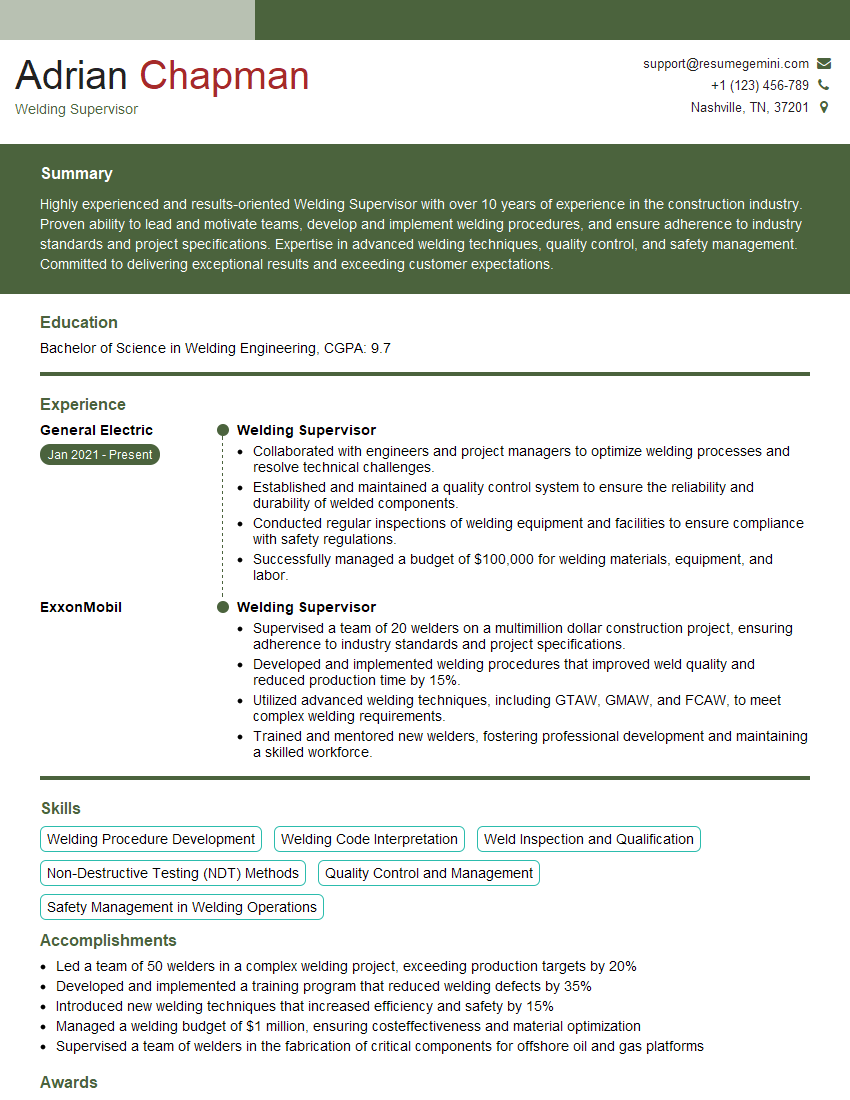
Mastering welding terminology is crucial for showcasing your expertise and advancing your career. A strong understanding of these concepts will set you apart from other candidates and demonstrate your commitment to professional excellence. To further enhance your job prospects, create an ATS-friendly resume that highlights your skills and experience effectively. ResumeGemini is a trusted resource for building professional resumes, and we provide examples tailored to welding terminology to help you present your qualifications in the best possible light. Take advantage of these resources to build a compelling resume that gets noticed.




Explore more articles
Users Rating of Our Blogs
Share Your Experience
We value your feedback! Please rate our content and share your thoughts (optional).
What Readers Say About Our Blog
Really detailed insights and content, thank you for writing this detailed article.
IT gave me an insight and words to use and be able to think of examples