Feeling uncertain about what to expect in your upcoming interview? We’ve got you covered! This blog highlights the most important Working with molten metals and alloys interview questions and provides actionable advice to help you stand out as the ideal candidate. Let’s pave the way for your success.
Questions Asked in Working with molten metals and alloys Interview
Q 1. Describe the different types of melting furnaces used in metal processing.
Melting furnaces are the heart of metal processing, each type optimized for specific metals and applications. The choice depends on factors like the metal’s melting point, the desired quantity, and the level of control needed.
Crucible Furnaces: These are relatively simple and versatile, using a refractory crucible (a heat-resistant container) to hold the molten metal. Heating is typically achieved through electric resistance, gas flames, or induction. They’re ideal for smaller-scale operations and specialty alloys. Imagine a blacksmith’s forge – that’s a basic form of a crucible furnace.
Induction Furnaces: These utilize electromagnetic induction to heat the metal directly, resulting in efficient and rapid melting. The metal itself acts as the resistor, minimizing heat loss. Induction furnaces are excellent for precise temperature control and are frequently used in foundries for high-volume production of ferrous and non-ferrous alloys.
Arc Furnaces: High-power electric arcs between electrodes melt the metal, making them suitable for extremely high temperatures and refractory metals like titanium or steel. They are often used for larger-scale operations and can handle scrap metal effectively. They are incredibly powerful but require careful monitoring due to the extreme temperatures involved.
Reverberatory Furnaces: These furnaces use a flame to heat a large hearth, indirectly heating the metal. They are commonly used for refining and processing non-ferrous metals and are less efficient than induction or arc furnaces.
Q 2. Explain the process of alloying and its importance in material properties.
Alloying is the process of mixing two or more metals (or a metal and a non-metal) to create a new material with improved properties. Think of it like baking a cake – you combine different ingredients to get a desirable outcome. The base metal, known as the matrix, is combined with other elements called alloying agents. This process is crucial for tailoring materials to specific applications.
For example, adding carbon to iron creates steel, significantly increasing its strength and hardness compared to pure iron. Similarly, adding chromium and nickel to steel leads to stainless steel, enhancing its corrosion resistance. The specific properties of the alloy depend heavily on the type and amount of alloying agents, along with the processing methods used.
The importance of alloying lies in its ability to fine-tune a material’s characteristics. We can enhance strength, improve ductility (ability to deform without breaking), increase corrosion resistance, alter electrical conductivity, and much more. Without alloying, we’d be limited to the properties of pure metals, which often aren’t suitable for many practical applications.
Q 3. What are the safety precautions involved in handling molten metals?
Handling molten metals presents significant safety risks due to their extremely high temperatures and potential for splashing and burns. Comprehensive safety precautions are essential.
Personal Protective Equipment (PPE): This is paramount and includes heat-resistant clothing (full-body suits, gloves, footwear), face shields, and respirators to protect against fumes. Proper PPE is not just a recommendation; it’s a requirement.
Emergency Procedures: A well-defined emergency plan including procedures for fire suppression, spill containment, and first aid is absolutely crucial. Everyone involved must be thoroughly trained in these procedures.
Temperature Monitoring: Continuous monitoring of molten metal temperature is vital to prevent overheating and potential accidents.
Proper Ventilation: Adequate ventilation is crucial to remove harmful fumes and gases generated during melting and processing.
Spill Containment: Designated areas for potential spills, equipped with appropriate materials for containment, are necessary.
Training and Supervision: Thorough training on safe handling procedures and strict supervision are essential, especially for new personnel.
Ignoring these precautions can lead to severe burns, inhalation of toxic fumes, and even fatal accidents. Safety is not just a concern; it’s a fundamental principle in molten metal handling.
Q 4. How do you control the temperature of molten metal during casting?
Controlling the temperature of molten metal during casting is critical to obtaining the desired properties in the final product. Temperature fluctuation can lead to defects such as porosity, cracking, or incomplete filling of the mold.
Several methods are used for temperature control:
Thermocouples: These are sensors that directly measure the temperature of the molten metal. The readings provide precise feedback, allowing for adjustments to the heating source.
Pyrometers: These non-contact devices measure the temperature by detecting the emitted radiation from the molten metal. They’re useful for high-temperature environments where direct contact is dangerous.
Furnace Control Systems: Sophisticated control systems are commonly integrated into furnaces. They automatically regulate the heat input based on the desired temperature and thermocouple readings, maintaining optimal conditions.
Insulation: Proper insulation of the furnace and crucibles minimizes heat loss, contributing to better temperature control and energy efficiency.
Heat Treatment: Controlled cooling rates after casting are often necessary to achieve the desired microstructure and properties in the final product. This might involve holding the casting at a particular temperature for a specified time before cooling.
Q 5. Describe various casting methods (sand casting, die casting, investment casting).
Casting is a fundamental process in metalworking, where molten metal is poured into a mold and allowed to solidify. Various methods exist, each with its advantages and disadvantages:
Sand Casting: This is one of the oldest and most versatile methods, using sand molds to shape the metal. It’s relatively inexpensive and can produce complex shapes, but the surface finish is often rough, and dimensional accuracy is limited. Think of creating a sandcastle – similar principles apply, though on a much larger and hotter scale.
Die Casting: In this method, molten metal is injected under high pressure into a reusable metal mold (die). This produces high-volume, highly accurate castings with excellent surface finish. Die casting is commonly used for producing components for automobiles and consumer electronics. The process is very rapid and efficient.
Investment Casting (Lost-Wax Casting): A wax pattern of the desired shape is created and coated with a refractory material. The wax is then melted out, leaving a mold cavity. Molten metal is poured into this cavity to produce a highly accurate casting with intricate details. This method is expensive but ideal for precision parts, like turbine blades.
Q 6. Explain the concept of solidification and its impact on metal structure.
Solidification is the transition of molten metal from a liquid to a solid state. It’s a complex process significantly influencing the final microstructure and mechanical properties of the metal. Understanding solidification is key to controlling the quality of castings.
As the molten metal cools, nucleation (the formation of solid crystals) occurs. These crystals grow, and their arrangement (grain structure) determines the material’s properties. A fine-grained structure generally indicates higher strength and hardness, while a coarse-grained structure might lead to lower strength but greater ductility. The cooling rate significantly affects grain size; rapid cooling results in finer grains.
Solidification can be influenced by several factors, including:
Cooling Rate: Faster cooling leads to smaller grains.
Nucleation Sites: The presence of impurities or mold surfaces can initiate nucleation.
Alloy Composition: The composition of the alloy affects the melting and solidification temperatures and the resulting microstructure.
Controlling the solidification process through techniques like controlled cooling and the addition of inoculants (materials that promote nucleation) is crucial for achieving the desired material properties.
Q 7. What are the common defects found in castings and how are they prevented?
Casting defects are imperfections that reduce the quality and mechanical properties of castings. Several common defects exist, and understanding their causes is vital for prevention.
Porosity: This is the presence of gas pores within the casting. It’s often caused by dissolved gases in the molten metal that are not released during solidification. Proper degassing techniques can prevent this.
Shrinkage Cavities: These form due to volumetric changes during solidification. Proper mold design and feeding systems are essential to prevent them.
Hot Tears: These cracks develop during solidification due to stresses caused by the contraction of the solidifying metal. Careful control of the cooling rate and mold design can minimize this issue.
Cold Shut: This occurs when two streams of molten metal fail to fuse completely during pouring. It can be prevented through proper pouring techniques and mold design.
Inclusions: These are foreign materials trapped within the casting, such as sand particles or slag. Careful mold preparation and metal cleanliness are crucial for preventing them.
Prevention strategies often involve a combination of proper mold design, precise temperature control, appropriate pouring techniques, and meticulous metal preparation. Regular quality checks throughout the process also help identify and address potential problems early.
Q 8. How do you ensure the quality of molten metal before pouring?
Ensuring the quality of molten metal before pouring is paramount to producing sound castings. It involves a multi-step process focusing on chemical composition and temperature control. Think of it like baking a cake – you wouldn’t pour batter into a cold oven, right? Similarly, incorrect temperature or composition will ruin the metal.
Chemical Analysis: We use spectrometry or other analytical techniques to verify the exact chemical composition matches the specified requirements. This ensures the final product possesses the desired mechanical properties, such as strength, ductility, and corrosion resistance. For instance, a slight deviation in carbon content in steel can drastically alter its hardness.
Temperature Control: Precise temperature monitoring is crucial. Molten metal needs to be within a specific temperature range to ensure proper fluidity for filling the mold completely and to avoid defects like porosity or shrinkage. We use thermocouples and sophisticated monitoring systems to maintain this precise temperature. Imagine trying to pour water that’s too cold – it won’t flow smoothly. Similarly, molten metal that’s too cold will be viscous, leading to incomplete mold filling.
Fluxing and Degassing: Fluxes help remove impurities and dissolved gases from the molten metal. Think of it as cleaning the metal. Gases trapped in the metal can cause defects like blowholes in the final casting. Degassing techniques, like vacuum treatment or inert gas purging, are also used to remove dissolved gases.
Visual Inspection: A quick visual check for inclusions, slag, or excessive oxidation is performed. Experienced foundry workers can spot anomalies, like dross (oxidized material) floating on the surface, which would indicate the need for further refinement.
Q 9. What are the different types of refractories used in furnaces and why?
Refractories are materials with high resistance to heat and chemical attack, essential for lining furnaces where molten metals are handled. The choice of refractory depends heavily on the specific application and the type of molten metal being processed. Different metals have different melting points and chemical properties, so a refractory suitable for aluminum might not be suitable for steel.
Types: Common refractories include fireclay bricks (high alumina content, relatively inexpensive), basic refractories (magnesia, dolomite – used for steelmaking due to their resistance to basic slags), and silica bricks (high silica content, used where acidic slags are present). Zirconia and other specialized refractories are also used for high-temperature applications or specialized alloys.
Why they are used: They protect the furnace structure from the extreme temperatures and corrosive effects of molten metals and slags. Without them, the furnace would quickly deteriorate and fail. Imagine trying to bake a pizza directly on a wooden table – the table would catch fire immediately. Refractories act as that protective layer between the heat source and the furnace structure.
Q 10. Explain the principles of heat treatment and its application to metals.
Heat treatment is a process of heating and cooling metals to alter their physical and mechanical properties. It’s like training a muscle – a well-trained muscle is stronger than an untrained one. Similarly, heat treatment modifies the microstructure of the metal to achieve desired characteristics.
Principles: The process involves controlled heating and cooling cycles that modify the arrangement of atoms within the metal’s crystal structure. This alters the metal’s hardness, ductility, toughness, and other properties. Different heating and cooling rates lead to different microstructures.
Applications: Annealing (softening), quenching (hardening), tempering (reducing brittleness after quenching), normalizing (improving uniformity), and stress relieving (reducing internal stresses) are common heat treatment methods. For instance, quenching high-carbon steel in water after heating to a critical temperature creates a hard martensitic structure used for tools and cutting instruments. Tempering this hardened steel then reduces its brittleness, making it more resistant to fracture.
Q 11. Describe different methods of non-destructive testing for metal castings.
Non-destructive testing (NDT) methods for metal castings are crucial for detecting internal flaws without damaging the component. Think of it as a medical checkup for the casting. These methods help ensure structural integrity and safety.
Visual Inspection: A simple but important method, detecting surface cracks, porosity, or other visible defects.
Dye Penetrant Testing: A liquid dye is applied to the surface to penetrate any cracks. A developer then reveals the cracks by drawing the dye out to the surface.
Magnetic Particle Inspection: Used for ferromagnetic materials, magnetic particles are applied to the surface under a magnetic field. Any cracks will disrupt the magnetic field, causing particles to accumulate, indicating the flaw’s location.
Ultrasonic Testing: High-frequency sound waves are used to detect internal flaws. The waves reflect off discontinuities, revealing their size and location. Imagine using sonar to detect objects underwater – it’s a similar principle.
Radiographic Testing (X-ray or Gamma-ray): Penetrating radiation is used to reveal internal flaws. The radiation passes through the casting, with differences in density caused by flaws showing up as variations on a film or digital image. Think of it like an X-ray for the metal casting.
Q 12. How do you interpret a metallographic microstructure?
Interpreting a metallographic microstructure involves examining a polished and etched sample of the metal under a microscope. The microstructure reveals the arrangement of grains, phases, and other constituents within the metal. This is like looking at a detailed map of the metal’s internal structure.
We identify different phases (e.g., ferrite, austenite, cementite in steel) based on their appearance and characteristic features. Grain size, shape, and distribution are also analyzed. The microstructure directly correlates with the metal’s properties. For instance, a fine-grained structure generally means higher strength and hardness, while a coarse-grained structure implies lower strength but potentially higher ductility. Knowing how to correlate microstructure features with mechanical properties is essential for quality control and process optimization.
Q 13. What are the common alloying elements used in steel and their effects?
Many elements are added to steel to modify its properties. Think of it as adding spices to a dish – each spice changes the flavor profile. Similarly, each alloying element alters steel’s characteristics.
Carbon (C): The most important alloying element in steel. Increases hardness and strength but reduces ductility at higher concentrations. Different carbon levels define different steel grades.
Manganese (Mn): Improves strength and hardenability. Also helps remove sulfur and oxygen during steelmaking.
Silicon (Si): Increases strength and improves fluidity during casting. Also deoxidizes the steel.
Nickel (Ni): Increases toughness, corrosion resistance, and ductility. Often used in stainless steels.
Chromium (Cr): Significantly improves corrosion resistance. Essential component of stainless steels.
Molybdenum (Mo): Enhances hardenability and high-temperature strength. Used in high-speed steels.
Vanadium (V): Refines grain size, increases strength, and enhances toughness.
Q 14. Explain the difference between ferrous and non-ferrous metals.
The distinction between ferrous and non-ferrous metals lies in their primary constituent: iron. Ferrous metals contain iron as their base element, while non-ferrous metals do not.
Ferrous Metals: These include various types of steel and cast iron. They are generally strong, relatively inexpensive, and widely used in construction, manufacturing, and transportation. However, they are susceptible to corrosion unless treated appropriately.
Non-Ferrous Metals: This category encompasses a wide range of metals, including aluminum, copper, zinc, titanium, and nickel. These metals offer diverse properties: aluminum is lightweight and corrosion-resistant; copper is an excellent conductor of electricity; titanium possesses high strength-to-weight ratio. Their properties vary significantly, making them suitable for a vast array of specialized applications.
Q 15. Describe the process of vacuum induction melting.
Vacuum induction melting (VIM) is a sophisticated method for producing high-purity metals and alloys. It combines the benefits of induction heating with a vacuum environment to minimize contamination and control the chemical composition of the molten metal. Think of it like this: you’re making a gourmet soup, and the vacuum is like a high-end kitchen hood that removes any unwanted fumes or impurities, ensuring only the purest ingredients remain.
The process begins by placing the raw materials (typically metal scraps or ingots) into a crucible within a vacuum chamber. An induction coil surrounding the crucible generates intense heat via electromagnetic induction, melting the materials without direct contact. This contactless heating is crucial for preventing contamination. The vacuum environment helps remove dissolved gases (like hydrogen and oxygen) and volatile impurities from the molten metal, resulting in a cleaner, more homogenous melt. This is essential for applications requiring high strength, corrosion resistance, or precise chemical makeup, such as aerospace components or specialized medical implants.
Once the metal is fully melted and refined, it’s often cast into ingots or directly used in subsequent processes like forging or rolling. The vacuum is maintained throughout the melting process to ensure the purity of the resulting metal.
Career Expert Tips:
- Ace those interviews! Prepare effectively by reviewing the Top 50 Most Common Interview Questions on ResumeGemini.
- Navigate your job search with confidence! Explore a wide range of Career Tips on ResumeGemini. Learn about common challenges and recommendations to overcome them.
- Craft the perfect resume! Master the Art of Resume Writing with ResumeGemini’s guide. Showcase your unique qualifications and achievements effectively.
- Don’t miss out on holiday savings! Build your dream resume with ResumeGemini’s ATS optimized templates.
Q 16. How do you address a molten metal spill?
Addressing a molten metal spill is a serious safety issue that requires immediate and decisive action. The primary concern is preventing injury and further damage. The approach depends heavily on the type of metal and the quantity spilled. Never attempt to handle molten metal directly. Always use appropriate Personal Protective Equipment (PPE), including heat-resistant suits, gloves, and face shields.
Step-by-step procedure:
- Evacuate the area: Immediately clear the area of all personnel, ensuring a safe distance to prevent burns or splashes.
- Contain the spill: Use appropriate, heat-resistant materials such as sand, vermiculite, or specialized spill kits designed for molten metal. The goal is to prevent the metal from spreading and causing further damage.
- Cool the spill: Allow the metal to cool slowly and naturally, avoiding rapid quenching, which could cause a dangerous reaction. Use water only if specifically recommended for the type of metal involved, as this can lead to explosions with certain metals.
- Clean-up: Once cooled and solidified, the solidified metal can be carefully removed using specialized tools. Dispose of the metal and any contaminated materials according to local regulations.
- Investigate the cause: Thoroughly investigate the root cause of the spill to prevent future incidents. This may include equipment inspection, operator training review, or process optimization.
Example: A spill of molten aluminum requires a different approach than a spill of molten steel. Aluminum reacts violently with water, so sand or vermiculite would be preferred. Steel, while less reactive, still requires careful cooling and handling.
Q 17. Explain the importance of fluxing in metal casting.
Fluxing in metal casting is a crucial process involving the addition of a material (the flux) to the molten metal to improve its fluidity, remove impurities, and protect it from oxidation. Think of it as a cleaning agent and a protective layer for your molten metal. Improper fluxing can lead to casting defects like porosity, inclusions, or poor surface finish.
Benefits of fluxing:
- Removes impurities: Fluxes react with oxides and other impurities present in the molten metal, forming slag which can then be removed. This leads to a cleaner, more homogenous casting.
- Increases fluidity: Some fluxes help reduce the viscosity (thickness) of the molten metal, enabling it to flow more easily into the mold cavity and fill it completely.
- Protects from oxidation: Fluxes create a protective layer on the surface of the molten metal, preventing it from reacting with oxygen in the air and forming oxides, which can weaken the final product.
Types of fluxes: Fluxes vary depending on the metal being cast. Some common examples include borax, fluorspar, and various proprietary mixtures.
Example: In aluminum casting, fluxes are essential to remove dissolved gases and prevent oxidation, resulting in sound and defect-free castings. The choice of flux depends on the alloy and the casting process employed.
Q 18. What are the different types of molds used in metal casting?
Metal casting utilizes a variety of molds, each with its unique characteristics and applications. The choice of mold depends on factors like the metal being cast, the casting’s complexity, production volume, and desired surface finish.
Types of molds:
- Sand molds: These are the most common type, made from sand bonded with clay or other materials. They’re relatively inexpensive and easy to make, suitable for complex shapes and large castings. However, surface finish is usually rough.
- Permanent molds: Made from metal (steel, cast iron), these molds are reusable, offering improved surface finish and dimensional accuracy compared to sand molds. They’re suitable for high-volume production.
- Investment casting (lost-wax casting): A precise and intricate casting method where a wax pattern is created, coated in ceramic, and then heated to melt out the wax, leaving a mold cavity. This results in highly accurate and detailed castings, but it’s more expensive.
- Die casting: Uses metal dies (molds) under high pressure to force molten metal into the mold cavity. This process produces high-volume, highly accurate castings with excellent surface finish but is suitable for metals with low melting points, such as zinc, aluminum, and magnesium.
Example: Engine blocks are often cast using sand molds due to their complexity and relatively low surface finish requirements. Jewelry, however, might be produced via investment casting for its high precision.
Q 19. How do you control the grain size in a metal casting?
Controlling grain size in metal castings is critical for influencing the mechanical properties of the final product. Larger grains generally mean lower strength and ductility, while finer grains result in higher strength and better toughness. Think of it like building a brick wall – smaller bricks (grains) result in a stronger and more resistant wall.
Methods for controlling grain size:
- Cooling rate: A slower cooling rate allows for larger grain growth. Rapid cooling, such as quenching, leads to finer grains.
- Nucleating agents: Adding specific substances (inoculants) to the molten metal increases the number of nucleation sites, leading to a finer grain structure. These agents act as seeds that encourage the formation of many small crystals instead of a few large ones.
- Heat treatment: Processes like annealing and solution heat treatment can influence grain size by promoting grain growth or recrystallization.
Example: In steel casting, the addition of inoculants such as ferrosilicon can significantly refine the grain size, enhancing the mechanical properties of the casting. The exact cooling rate and heat treatment process would also depend on the final desired microstructure and mechanical properties.
Q 20. Describe the role of gating and risering in metal casting.
Gating and risering systems are crucial components of a metal casting process, responsible for directing the flow of molten metal into the mold and managing the shrinkage that occurs during solidification. Think of them as the plumbing system for molten metal.
Gating system: This channels molten metal from the pouring basin into the mold cavity. It should ensure a smooth, controlled flow of metal to fill the mold completely, avoiding turbulence and trapping air bubbles. It’s typically composed of a sprue, runners, and ingates.
Risering system: Risers are reservoirs of molten metal connected to the casting. As the casting solidifies and shrinks, the riser feeds molten metal to compensate for the shrinkage, preventing porosity or internal voids. The riser is carefully designed to solidify after the casting, ensuring it provides sufficient molten metal to fill any shrinkage voids.
Importance of proper design: Improperly designed gating and risering systems can lead to various casting defects, including cold shuts, porosity, shrinkage cavities, and incomplete filling. Careful design and simulation are vital to ensure successful castings.
Example: In large castings, multiple risers may be required to adequately compensate for shrinkage across the entire casting. The gating system would be designed to ensure the smooth and consistent flow of metal into the mold.
Q 21. What are the environmental concerns related to molten metal processing?
Molten metal processing presents several environmental concerns that need careful management. The main issues are air pollution, water pollution, and waste generation.
Air pollution: Melting and casting operations can release harmful gases and particulate matter into the atmosphere, such as sulfur dioxide (SO2), nitrogen oxides (NOx), and metal fumes. These pollutants can contribute to acid rain, respiratory problems, and other health issues. Proper ventilation and filtration systems are essential.
Water pollution: Wastewater from metal processing may contain dissolved metals, acids, and other harmful substances. These pollutants can contaminate water sources if not properly treated. Effective wastewater treatment is crucial to prevent environmental damage.
Waste generation: Molten metal processing generates significant amounts of waste, including slag, grinding dust, and spent fluxes. These wastes may contain hazardous materials and require careful management and disposal according to environmental regulations. Recycling and waste minimization strategies are important for sustainable practices.
Mitigation strategies: Environmental regulations and best practices aim to minimize the environmental impact of molten metal processing. These include using cleaner technologies, implementing effective pollution control systems, implementing recycling programs, and adhering to strict waste management protocols.
Q 22. Explain the concept of viscosity in molten metals.
Viscosity in molten metals refers to their resistance to flow. Imagine honey versus water – honey has a higher viscosity, meaning it flows more slowly. In molten metals, viscosity is crucial because it dictates how easily the metal will fill a mold during casting, influencing the final product’s quality and surface finish. Several factors affect a molten metal’s viscosity, including temperature (higher temperature generally means lower viscosity), composition (different alloying elements affect flow dramatically), and the presence of impurities.
For example, aluminum alloys typically have lower viscosity than steel alloys at their respective melting points. This lower viscosity allows for the casting of more intricate shapes in aluminum compared to steel. Understanding viscosity is vital for selecting appropriate casting processes and parameters.
Q 23. How do you calculate the pour temperature for a specific metal?
Calculating the pour temperature isn’t a simple formula; it’s a process that considers several factors. You need to know the metal’s melting point, the desired fluidity for the casting process (determined by the mold’s complexity and dimensions), the heat loss during pouring, and the temperature at which solidification begins. There isn’t a single equation but rather a combination of experience, material data sheets, and often, experimentation.
Typically, we begin with the metal’s melting point and add a ‘superheat’ – an extra amount of temperature to ensure sufficient fluidity. This superheat depends on the casting method, mold material, and metal’s characteristics. For instance, a complex sand mold might require a higher superheat than a simple metal mold to compensate for heat loss. In practice, we often rely on established practices within a foundry based on years of experience with specific alloys and processes. Data logging and careful observation are crucial for optimizing the pour temperature for consistent, high-quality castings.
Q 24. Describe the different types of metallographic etchants.
Metallographic etchants are chemical solutions used to reveal the microstructure of metals by selectively attacking different crystallographic planes. This reveals grain boundaries, phases, and other microstructural features essential for material characterization. The choice of etchant depends entirely on the metal or alloy being examined.
- For Steel: Nital (nitric acid in ethanol) is commonly used, revealing grain boundaries and carbides. Other etchants include picral (picric acid) and Vilella’s reagent.
- For Aluminum: Keller’s etchant is frequently employed, particularly to reveal precipitates and grain boundaries. Other etchants include HF (Hydrofluoric Acid)-based solutions, which require careful handling due to their corrosive nature.
- For Copper Alloys: Various etchants are used, often involving ferric chloride or ammonium persulfate, depending on the specific alloy composition.
Proper etching technique is crucial; over-etching can obscure features, while under-etching may not reveal the microstructure adequately. The etchant’s concentration, etching time, and temperature are all carefully controlled.
Q 25. What are the safety regulations related to working with molten metals?
Safety is paramount when working with molten metals. The extreme temperatures involved pose severe burn risks. Proper personal protective equipment (PPE) is mandatory, including: heat-resistant gloves, aprons, face shields, and safety glasses. Appropriate footwear is also critical to prevent burns from splashes or spills.
The workplace must have adequate ventilation to remove harmful fumes produced by some metals. Emergency response procedures for burns, fires, and metal spills should be in place and well-rehearsed. Appropriate fire suppression systems (e.g., sand or CO2 extinguishers) must be readily available and regularly inspected. Furthermore, strict adherence to lockout/tagout procedures is necessary when working with furnaces and related equipment to prevent accidental activation.
Regular safety training and refresher courses are essential to maintain a safe working environment. It’s crucial that employees understand the risks and follow established procedures diligently.
Q 26. Explain how different cooling rates affect the mechanical properties of metals.
Cooling rates profoundly influence the microstructure and thus the mechanical properties of metals. Rapid cooling, like quenching in water or oil, favors the formation of fine grains and can lead to harder, stronger, but potentially more brittle materials. This is because rapid cooling prevents the diffusion of atoms necessary to form larger, more stable grains.
Slow cooling, like air cooling, allows for larger grain growth and results in softer, more ductile, but potentially less strong materials. The difference is analogous to making candy – fast cooling makes brittle toffee, while slow cooling makes softer caramel.
For example, steel can be heat-treated to achieve different properties based on the cooling rate. Quenching followed by tempering produces hardened and tempered steel used in tools, while slow cooling produces softer steel used in structural applications. Understanding these relationships is crucial in controlling the final material properties.
Q 27. What are the different types of furnaces used for heat treatment?
Various furnaces are employed for heat treatment depending on the desired process and the metal being treated. Here are a few:
- Box Furnaces: These are versatile furnaces suitable for a wide range of heat treatment operations, like annealing, normalizing, and stress relieving. They offer good temperature uniformity and control.
- Pit Furnaces: Larger furnaces ideal for heat-treating large components. They offer good temperature uniformity and capacity for heavy loads.
- Salt Baths: Used for rapid heating and quenching operations. Molten salt provides excellent heat transfer, ideal for processes like carburizing or nitriding.
- Vacuum Furnaces: Used when high-purity atmospheres are required, as in the heat treatment of reactive metals like titanium or reactive alloys.
- Induction Furnaces: Used for rapidly heating metal parts using electromagnetic induction. They’re very energy-efficient for specific applications.
The selection of a furnace depends on various factors like the required temperature range, atmosphere control, heating rate, load size, and the type of heat treatment.
Q 28. Describe your experience with troubleshooting issues in a metal casting operation.
In my experience, troubleshooting in metal casting often involves a systematic approach. One instance involved a recurring problem with porosity in aluminum castings. We initially suspected the pouring temperature, but after careful review of the pouring parameters (found to be within the acceptable range), we shifted our focus to the mold itself.
A thorough inspection of the mold revealed small cracks, which were allowing air to infiltrate the molten metal as it filled the cavity, leading to the porosity. Addressing the mold defects (through improved mold-making techniques and more rigorous quality control) effectively resolved the issue. This highlights the importance of a systematic, investigative approach: examining all potential sources of error – from material composition and processing parameters to mold quality and equipment functionality – before reaching a conclusion.
Another time, we experienced inconsistent casting dimensions. This was traced to inconsistent heating of the die in our die-casting machine. By implementing a more precise heating and cooling cycle, we significantly improved dimensional accuracy and consistency.
Key Topics to Learn for Working with Molten Metals and Alloys Interviews
- Thermodynamics of Melting and Solidification: Understanding phase diagrams, heat transfer, and the influence of alloying elements on melting points and solidification behavior.
- Melting and Casting Processes: Practical knowledge of various casting methods (e.g., sand casting, die casting, investment casting), including their advantages, limitations, and appropriate applications for different metal alloys.
- Alloy Composition and Properties: Familiarity with common metal alloys (e.g., steel, aluminum, brass), their constituent elements, and how composition affects mechanical properties (strength, ductility, hardness), corrosion resistance, and thermal properties.
- Safety Procedures and Regulations: Deep understanding of safety protocols for handling molten metals, including personal protective equipment (PPE), emergency procedures, and relevant industry regulations to ensure workplace safety.
- Metallurgical Defects and Troubleshooting: Ability to identify common casting defects (e.g., porosity, shrinkage, inclusions) and understand the underlying causes and potential solutions. This includes problem-solving skills and analytical thinking.
- Material Selection and Application: Applying knowledge of material properties to select appropriate alloys for specific applications, considering factors like cost, performance requirements, and environmental considerations.
- Quality Control and Testing: Understanding methods for inspecting and testing castings for quality, including visual inspection, dimensional measurements, and destructive/non-destructive testing techniques.
- Furnace Operation and Maintenance: Knowledge of different types of furnaces used for melting metals, their operational principles, and routine maintenance procedures to ensure efficient and safe operation.
Next Steps
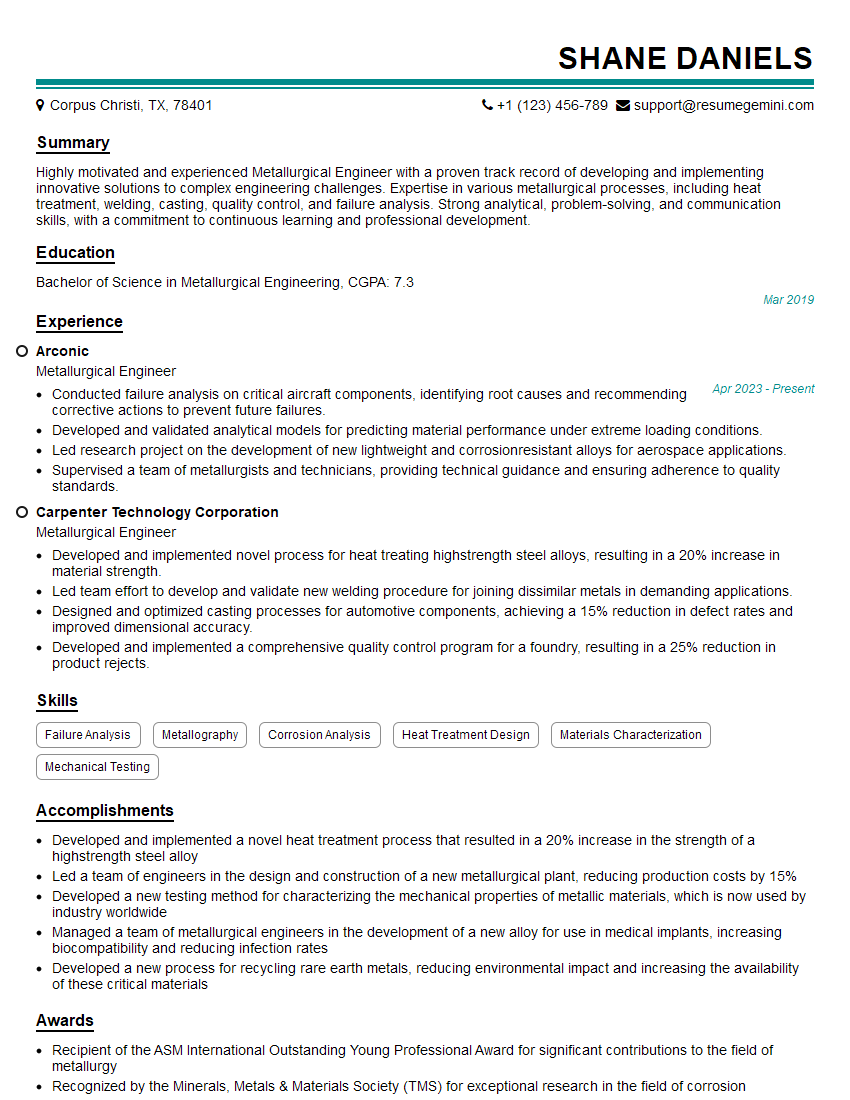
Mastering the intricacies of working with molten metals and alloys is crucial for career advancement in many high-demand industries. A strong understanding of these concepts demonstrates a valuable skill set that employers highly value. To significantly boost your job prospects, create a compelling and ATS-friendly resume that effectively showcases your expertise. ResumeGemini is a trusted resource that can help you build a professional and impactful resume tailored to highlight your skills and experience in this field. We provide examples of resumes specifically designed for professionals working with molten metals and alloys to help you craft the perfect application.




Explore more articles
Users Rating of Our Blogs
Share Your Experience
We value your feedback! Please rate our content and share your thoughts (optional).
What Readers Say About Our Blog
I Redesigned Spongebob Squarepants and his main characters of my artwork.
https://www.deviantart.com/reimaginesponge/art/Redesigned-Spongebob-characters-1223583608
IT gave me an insight and words to use and be able to think of examples
Hi, I’m Jay, we have a few potential clients that are interested in your services, thought you might be a good fit. I’d love to talk about the details, when do you have time to talk?
Best,
Jay
Founder | CEO