Unlock your full potential by mastering the most common Cellular Connectivity interview questions. This blog offers a deep dive into the critical topics, ensuring you’re not only prepared to answer but to excel. With these insights, you’ll approach your interview with clarity and confidence.
Questions Asked in Cellular Connectivity Interview
Q 1. Explain the difference between FDD and TDD.
FDD (Frequency Division Duplex) and TDD (Time Division Duplex) are two different methods for managing the uplink (mobile device to base station) and downlink (base station to mobile device) communication channels in cellular networks. Think of it like a two-lane highway: FDD uses separate lanes for each direction, while TDD uses the same lane in alternating time slots.
- FDD: Uses separate frequency bands for uplink and downlink transmission. For example, one band might be used for downloading data, while another, separate band is used for uploading data. This offers consistent bandwidth in both directions, but requires twice the frequency spectrum.
- TDD: Uses the same frequency band for both uplink and downlink transmission, switching between them in time slots. Imagine a single lane where cars go in one direction for a period, then switch to the opposite direction. This is more spectrum-efficient but requires careful management of time slots to balance uplink and downlink needs. The bandwidth allocation can be dynamic, adjusting to real-time traffic demands.
The choice between FDD and TDD depends on several factors, including spectrum availability, traffic patterns, and the specific requirements of the network. FDD is often preferred in areas with high and relatively consistent data traffic in both directions, while TDD is suitable for areas with fluctuating traffic demands or where spectrum is limited. For example, many 5G deployments use TDD to take advantage of its flexible spectrum usage.
Q 2. Describe the concept of MIMO and its benefits in cellular networks.
MIMO (Multiple-Input and Multiple-Output) technology uses multiple antennas at both the base station and the mobile device to improve the efficiency and reliability of wireless communication. Think of it like having multiple lanes on a highway, allowing more cars (data) to travel simultaneously.
Instead of just one signal path, MIMO uses multiple transmit and receive antennas to create multiple spatial streams. This allows the base station to send more data to the user and the user to send more data to the base station simultaneously, significantly increasing data throughput and link reliability. It also helps to improve the signal quality in challenging environments, like areas with significant signal interference.
- Benefits: Increased data rates, improved link reliability, better coverage, enhanced signal quality in challenging environments.
Imagine a crowded stadium – with a single antenna (single input, single output), it’s difficult for everyone to receive a clear signal. With MIMO, it’s like having multiple speakers broadcasting the same message, allowing everyone to receive a better, clearer signal, even in crowded environments.
Q 3. What are the key performance indicators (KPIs) for a cellular network?
Key Performance Indicators (KPIs) for a cellular network are metrics used to assess its performance and effectiveness. They are crucial for network optimization, troubleshooting, and ensuring a high-quality user experience. Some critical KPIs include:
- Throughput: The amount of data transmitted per unit of time (e.g., Mbps). A higher throughput indicates faster data speeds.
- Latency: The delay experienced between sending a request and receiving a response (e.g., milliseconds). Lower latency means faster response times.
- Call Drop Rate: The percentage of calls that are dropped before completion. A lower rate signifies better call quality.
- Block Error Rate (BLER): The percentage of data packets that are received with errors. A lower BLER indicates better data integrity.
- Coverage: The geographical area served by the network. Good coverage ensures users remain connected.
- Handoff Success Rate: The percentage of successful handovers between cells. High rates ensure seamless connectivity during movement.
- Signal Strength: Measured in dBm or similar units, indicating the strength of the signal received at the mobile device.
These KPIs are constantly monitored and analyzed to identify areas for improvement and maintain optimal network performance. For example, consistently high latency might indicate congestion in a specific area, requiring optimization strategies like adding capacity or adjusting cell configuration.
Q 4. Explain the role of a base station in a cellular network.
The base station (also known as a cell site or eNodeB in 4G/5G) is the central component of a cellular network. It’s the communication hub that connects mobile devices to the core network. Think of it as the central communication point for a specific geographical area (a cell).
Key functions of a base station include:
- Radio signal transmission and reception: It transmits radio signals to mobile devices within its coverage area and receives signals from them.
- Signal processing: The base station processes signals, encoding and decoding data, error correction, and other signal processing functionalities.
- Radio resource management: It manages radio resources (frequency channels, time slots), ensuring efficient allocation to mobile devices.
- Handover management: When a mobile device moves from one cell to another, the base station manages the handover process to maintain continuous connectivity.
- Mobility management: Tracks the location of mobile devices within its cell and provides information to the core network.
Without base stations, there would be no way for mobile devices to communicate with the cellular network. Each base station serves a specific geographical area, ensuring widespread coverage. The number and placement of base stations influence the network’s capacity and performance.
Q 5. What are the different frequency bands used in cellular networks?
Cellular networks operate across a wide range of frequency bands, each with its own characteristics impacting signal propagation, capacity, and coverage. These bands are allocated by regulatory bodies and vary by region. The frequency bands are broadly categorized into low, mid, and high bands:
- Low-band frequencies (below 1 GHz): These offer better propagation, traveling further distances and penetrating obstacles more effectively. This results in better coverage but lower bandwidth.
- Mid-band frequencies (1-6 GHz): These provide a good balance between coverage and capacity, offering a compromise between the characteristics of low-band and high-band frequencies.
- High-band frequencies (above 6 GHz): These offer very high bandwidth, leading to significantly faster data rates, but suffer from limited range and are easily obstructed by obstacles. This improves capacity but reduces coverage.
Examples of frequency bands include 700 MHz, 1800 MHz, 2100 MHz, 3500 MHz, and higher frequencies used in 5G. The specific frequencies used vary based on the cellular technology (2G, 3G, 4G, 5G) and the geographic location. The choice of frequency band is a crucial consideration in network planning, striking a balance between capacity, coverage, and cost.
Q 6. Describe the concept of handover in cellular networks.
Handover (or handoff) in cellular networks is the seamless process of transferring an ongoing call or data session from one base station to another as a mobile device moves from one cell to another. It ensures continuous connectivity while the user is mobile.
This process involves several steps:
- Measurement of signal strength: The mobile device constantly monitors the signal strength from surrounding base stations.
- Selection of target cell: Once a neighboring cell provides a stronger signal, the mobile device selects this cell as the target.
- Request for handover: The mobile device requests the handover from the current base station to the target base station.
- Acknowledgement and handover: The current and target base stations coordinate the handover, ensuring a smooth transition.
Several handover strategies exist, including hard handover (an abrupt switch) and soft handover (a gradual transition, often used in technologies supporting multiple simultaneous connections). Successful handovers are crucial for a positive user experience; dropped calls or data interruptions during handover indicate problems that need attention. The efficiency and speed of the handover mechanism impact the quality of service.
Q 7. What are the advantages and disadvantages of different cellular technologies (2G, 3G, 4G, 5G)?
Different cellular generations (2G, 3G, 4G, 5G) offer varying levels of performance and capabilities. Each generation builds upon its predecessor, adding new features and improvements.
| Technology | Advantages | Disadvantages |
|---|---|---|
| 2G (GSM, CDMA) | Wide coverage, relatively inexpensive | Low data rates, limited bandwidth |
| 3G (UMTS, CDMA2000) | Higher data rates than 2G, mobile broadband access | Lower data rates than 4G, susceptible to interference |
| 4G (LTE) | High data rates, low latency, improved spectral efficiency | Requires significant infrastructure investment, not suitable for massive IoT |
| 5G (NR) | Extremely high data rates, ultra-low latency, massive capacity, supports diverse applications (e.g., IoT, AR/VR) | High infrastructure cost, limited initial coverage, higher frequency bands with reduced range and penetration |
Each generation has its place. 2G remains relevant for basic voice and text communication, while 3G provides a usable mobile broadband experience. 4G is the workhorse of current mobile broadband, and 5G is rapidly expanding, enabling new applications and services. The choice of technology depends on the specific needs of users and network operators, with cost, coverage, data speed, and latency playing significant roles.
Q 8. Explain the concept of cell breathing.
Cell breathing, in the context of cellular networks, refers to the dynamic adjustment of cell site parameters, primarily transmit power, in response to changing traffic conditions and interference levels. Think of it like our lungs: they expand and contract to meet our oxygen needs. Similarly, a cell site ‘breathes’ by adjusting its power to efficiently manage resources and ensure optimal coverage and capacity.
For example, during peak hours when many users are active in a particular area, the cell site might increase its transmit power to handle the increased demand. Conversely, during off-peak hours, it might reduce its power to conserve energy and minimize interference with neighboring cells. This dynamic power control helps to optimize the network’s performance, ensuring reliable connectivity for all users while minimizing energy consumption and interference.
Q 9. What is the significance of signal-to-interference-plus-noise ratio (SINR)?
The Signal-to-Interference-plus-Noise Ratio (SINR) is a crucial metric in cellular networks that measures the strength of the desired signal relative to the combined strength of interference and noise. A higher SINR indicates a stronger, cleaner signal, resulting in better call quality, higher data rates, and improved overall network performance. Think of it like trying to hear someone speak in a crowded room: a high SINR is like having a clear voice in a quiet room, while a low SINR is like struggling to hear someone in a noisy cocktail party.
SINR is critical for network planning and optimization. Engineers use SINR measurements to identify areas with poor coverage or high interference and implement solutions such as adding new cell sites, adjusting antenna tilt, or optimizing power control. A consistently low SINR in a specific area might signal a need for network upgrades or adjustments to improve the user experience.
Q 10. Describe the process of network planning and optimization.
Network planning and optimization is a complex iterative process involving several steps aimed at designing and refining a cellular network to provide optimal coverage, capacity, and quality of service. It’s like designing a city’s road system: you need to plan the routes, the capacity of the roads, and ensure efficient traffic flow.
- Initial Planning: This stage involves analyzing geographic data, population density, traffic patterns, and predicted future demand to determine the placement of base stations and their characteristics (antenna height, power, frequency bands).
- Deployment: This phase involves physically setting up the infrastructure, including installing antennas, base station equipment, and connecting them to the core network.
- Performance Monitoring: Continuous monitoring of key performance indicators (KPIs) such as SINR, call drop rates, throughput, and latency. This is done using specialized network monitoring tools.
- Optimization: Based on performance monitoring, adjustments are made to network parameters such as power levels, antenna tilts, and cell sectorization to improve performance and address any issues. This might involve using sophisticated algorithms and simulations.
- Capacity Planning: Anticipating future demand and ensuring the network can handle increases in user traffic and data consumption. This could mean adding new cells or upgrading existing equipment to support higher bandwidths.
This process involves utilizing specialized software tools that use complex mathematical models and algorithms to simulate network behavior and optimize resource allocation. The goal is to create a reliable, high-performing, and cost-effective cellular network.
Q 11. What are the challenges associated with deploying 5G networks?
Deploying 5G networks presents several significant challenges:
- High Frequency Bands: 5G utilizes higher frequency bands (millimeter wave) which offer significantly higher bandwidth but suffer from increased signal attenuation and limited range. This requires a denser network deployment with more base stations.
- Spectrum Licensing and Availability: Securing sufficient spectrum licenses for 5G deployment can be complex and expensive, varying widely by region and regulatory framework.
- Backhaul Infrastructure: The increased data capacity of 5G necessitates a robust backhaul infrastructure to transport data effectively. Upgrading existing infrastructure to handle this increased volume is a substantial undertaking.
- Device Compatibility and Adoption: The widespread adoption of 5G relies on both device manufacturers and consumers embracing the new technology. The initial cost of 5G devices can be a barrier to adoption.
- Integration with Existing Networks: Seamless integration with existing 4G and other networks is crucial for a smooth transition. This requires careful planning and coordination.
- Power Consumption: The increased power consumption of 5G base stations needs to be addressed efficiently using energy-saving techniques and green technologies.
Overcoming these challenges requires collaboration between network operators, equipment vendors, and regulatory bodies to develop cost-effective solutions and facilitate widespread adoption.
Q 12. How does carrier aggregation work?
Carrier aggregation (CA) is a technique that allows a cellular device to combine multiple frequency bands (carriers) simultaneously to achieve higher data rates and improved network capacity. Think of it like having multiple lanes on a highway instead of just one: you can carry more traffic simultaneously.
For example, a device might aggregate a 10MHz carrier in the 2GHz band with a 20MHz carrier in the 3.5GHz band. This effectively increases the available bandwidth, enabling higher download and upload speeds. CA improves spectral efficiency and boosts network capacity, particularly in areas with high traffic demands. The specific carriers aggregated depend on the network’s configuration and the device’s capabilities.
The success of CA relies on the availability of sufficient bandwidth in different frequency bands and the device’s ability to manage these multiple connections simultaneously. This enhances the user experience by providing faster data speeds and a more reliable connection.
Q 13. Explain the concept of VoLTE.
Voice over LTE (VoLTE) is a technology that allows voice calls to be transmitted over an LTE (4G) network instead of the traditional circuit-switched voice networks (like 2G/3G). This offers several advantages, primarily higher quality calls with better clarity and faster call setup times. Think of it like upgrading your phone line from an old rotary dial to a high-speed fiber connection.
In VoLTE, voice calls are packaged as data packets and transmitted over the LTE network, leveraging its higher bandwidth and capacity. This eliminates the need for separate voice networks and allows for richer features such as HD voice, video calls, and improved call handover during movement between cell sites. VoLTE is a significant improvement over older voice technologies because of its enhanced quality and integration with the data network.
Q 14. What are the different types of cellular antennas?
Cellular antennas come in various types, each designed to optimize signal coverage and performance in specific scenarios. Some common types include:
- Omnidirectional Antennas: These antennas radiate signals in all directions, providing 360-degree coverage. They are commonly used in areas where wide coverage is needed, such as rural areas.
- Sector Antennas: These antennas radiate signals in a specific sector, usually 60, 90, or 120 degrees. They are used in urban areas to focus the signal and improve capacity.
- Panel Antennas: These antennas offer a more directional beam compared to sector antennas and are often used in point-to-point links or in areas where targeted coverage is needed.
- MIMO Antennas: Multiple-input and multiple-output antennas utilize multiple transmit and receive elements to improve capacity and signal quality through spatial multiplexing and beamforming. They are crucial for supporting high data rates in 4G and 5G networks.
- Massive MIMO Antennas: These antennas extend MIMO technology by incorporating a significantly larger number of antennas to further enhance data capacity and spectral efficiency.
The choice of antenna type depends on factors such as coverage requirements, terrain, and traffic density. Proper antenna selection is crucial for optimizing network performance and ensuring reliable connectivity.
Q 15. How does beamforming work in 5G networks?
Beamforming is a signal processing technique used in 5G (and other generations) to focus the radio signal towards specific user devices. Imagine a spotlight – instead of shining light everywhere, it concentrates the beam on a particular target. Similarly, beamforming uses multiple antennas at the base station (gNodeB) to create a focused beam of radio waves, improving signal strength and reducing interference for the intended receiver. This is particularly useful in dense urban environments where signals might be scattered or blocked.
It works by precisely adjusting the phase and amplitude of the signals transmitted from each antenna element. By carefully coordinating these adjustments, the base station can constructively combine the signals in the direction of the user equipment (UE) and destructively interfere in other directions. This results in a stronger signal for the intended user and a weaker signal for unintended users, leading to increased data rates and reduced interference.
For example, if a user is moving, the beamforming system dynamically adjusts the beam’s direction to follow the user, maintaining a strong connection. This is a significant improvement over omnidirectional antennas which radiate signals equally in all directions, wasting power and potentially causing interference.
Career Expert Tips:
- Ace those interviews! Prepare effectively by reviewing the Top 50 Most Common Interview Questions on ResumeGemini.
- Navigate your job search with confidence! Explore a wide range of Career Tips on ResumeGemini. Learn about common challenges and recommendations to overcome them.
- Craft the perfect resume! Master the Art of Resume Writing with ResumeGemini’s guide. Showcase your unique qualifications and achievements effectively.
- Don’t miss out on holiday savings! Build your dream resume with ResumeGemini’s ATS optimized templates.
Q 16. Explain the concept of network slicing.
Network slicing is a virtualization technique that allows a single physical network infrastructure to be logically divided into multiple independent virtual networks, each tailored to meet the specific requirements of different services or applications. Think of it like slicing a pizza – each slice represents a dedicated network slice, optimized for its unique needs.
Each slice can have its own customized QoS parameters, such as bandwidth, latency, and security levels. For example, a network slice for autonomous vehicles might require extremely low latency and high reliability, while a slice for video streaming might prioritize high bandwidth. This allows operators to offer diverse services with different performance guarantees, all on the same physical infrastructure, improving efficiency and resource utilization.
A practical example is a mobile network operator offering separate slices for: a) high-bandwidth, low-latency gaming; b) reliable connectivity for IoT devices; and c) cost-effective data for basic internet access. Each slice can be optimized for its specific needs without impacting the performance of other slices.
Q 17. What are the security concerns in cellular networks?
Cellular networks face several security concerns, many stemming from the wireless nature of the communication and the large number of connected devices. Key concerns include:
- Eavesdropping: Unauthorized access to communication data transmitted over the air interface.
- Data breaches: Compromising data stored on network elements or user devices.
- Denial-of-service (DoS) attacks: Overwhelming network resources to make them unavailable to legitimate users.
- Man-in-the-middle (MITM) attacks: Intercepting communication between two parties to eavesdrop or manipulate the data.
- SIM swap fraud: Illegitimately transferring a user’s phone number to a different SIM card to gain access to their accounts.
- IMSI catchers: Devices that mimic base stations to intercept user data and location information.
Mitigation strategies involve strong encryption (like AES), authentication protocols (like EAP-SIM), secure network architecture, intrusion detection systems, and regular security audits and updates.
Q 18. Describe the different types of cellular modulation schemes.
Cellular networks employ various modulation schemes to encode information onto radio waves. The choice of scheme depends on factors like required data rate, spectral efficiency, and robustness against noise and interference. Common modulation schemes include:
- Quadrature Phase Shift Keying (QPSK): Uses four distinct phase shifts to represent two bits per symbol. Relatively simple but less spectrally efficient.
- Quadrature Amplitude Modulation (QAM): Uses multiple amplitude and phase shifts to represent more bits per symbol. Higher-order QAM (e.g., 64QAM, 256QAM) offers higher spectral efficiency but is more susceptible to noise.
- Orthogonal Frequency Division Multiplexing (OFDM): Divides the available bandwidth into many orthogonal subcarriers, each carrying a portion of the data. Robust against multipath fading and highly spectrally efficient – used extensively in 4G and 5G.
5G often uses advanced modulation schemes like 256QAM, offering significant increases in data rates compared to earlier generations. The selection of the optimal modulation scheme is a complex optimization process based on the channel conditions and the desired quality of service.
Q 19. What is the role of a core network in a cellular system?
The core network is the brains of a cellular system, responsible for routing calls, managing data, and providing authentication and other essential services. It acts as the central switchboard connecting users to other networks (like the internet) and to other users within the cellular network. It’s composed of several key elements:
- Mobile Switching Center (MSC): Manages call setup and routing.
- Home Location Register (HLR): Stores subscriber information, such as phone number, location, and service profile.
- Visitor Location Register (VLR): Stores temporary information about roaming users.
- Serving Gateway (SGW): Acts as a gateway between the radio access network and the packet core.
- Packet Data Network Gateway (PGW): Routes data traffic to and from the internet.
Without the core network, users wouldn’t be able to make calls, send text messages, access data, or roam between different locations.
Q 20. Explain the concept of Quality of Service (QoS).
Quality of Service (QoS) refers to the capability of a network to provide different levels of service to different applications or users. It’s about guaranteeing a certain level of performance for specific types of traffic. Think of it like a restaurant with different service levels – some customers might be seated immediately in a VIP area, while others might wait longer for a table.
QoS parameters typically include:
- Bandwidth: The amount of data that can be transmitted per unit of time.
- Latency: The delay between sending and receiving data.
- Jitter: Variations in latency.
- Packet loss: The percentage of data packets that are lost during transmission.
In cellular networks, QoS is crucial for supporting diverse applications, such as real-time video conferencing (requiring low latency and jitter) and file downloads (requiring high bandwidth). QoS mechanisms ensure that critical applications receive the necessary resources, even when the network is congested.
Q 21. How does power control work in cellular networks?
Power control in cellular networks dynamically adjusts the transmit power of both the base station (gNodeB) and the user equipment (UE) to optimize network performance and reduce interference. It’s a balancing act: sufficient power is needed for reliable communication, but excessive power wastes energy and creates interference for neighboring cells.
The power control algorithms aim to maintain a target signal-to-interference-plus-noise ratio (SINR) at the receiver. The base station adjusts its transmit power based on the reported signal strength from the UE, while the UE adjusts its power based on the signal strength received from the base station. This closed-loop control system ensures that users maintain sufficient signal strength without excessive power consumption.
Power control is essential for managing interference in dense urban areas and for extending battery life on mobile devices. Sophisticated power control algorithms, often incorporating machine learning techniques, are used in modern cellular networks to achieve optimal energy efficiency and network performance.
Q 22. What are the different types of cellular access technologies?
Cellular access technologies refer to the different ways mobile devices connect to the cellular network. These technologies evolve over time, each offering improved speed, capacity, and features. Here are some key examples:
- 2G (2nd Generation): Technologies like GSM (Global System for Mobile Communications) and CDMA (Code Division Multiple Access) were foundational, primarily offering voice services with limited data capabilities. Think of this as the early days of cell phones, mostly for calls.
- 3G (3rd Generation): Technologies like UMTS (Universal Mobile Telecommunications System) and CDMA2000 provided significantly faster data speeds, enabling mobile internet access. This is where mobile browsing became a reality.
- 4G (4th Generation): LTE (Long Term Evolution) and WiMAX (Worldwide Interoperability for Microwave Access) revolutionized mobile data, offering much higher speeds and lower latency. Think streaming videos and fast downloads on your smartphone.
- 5G (5th Generation): The current leading technology, 5G offers dramatically increased speeds, lower latency, and significantly greater capacity compared to previous generations. This is crucial for supporting the growing number of connected devices and data-intensive applications like augmented reality and autonomous vehicles.
- Beyond 5G (6G and beyond): Research and development are already underway for future generations, aiming for even higher speeds, more efficient spectrum usage, and support for entirely new applications.
Each generation builds upon its predecessors, addressing limitations and expanding capabilities to meet the ever-increasing demands of mobile users.
Q 23. Explain the concept of interference in cellular networks.
Interference in cellular networks occurs when unwanted signals disrupt the transmission and reception of desired signals. This can manifest in several ways, all leading to reduced signal quality, slower speeds, and dropped calls. Imagine a crowded room – everyone is trying to speak at once, making it difficult to understand any single conversation. Similarly, in a cellular network:
- Co-channel Interference: This happens when two or more base stations use the same radio frequency channel, causing their signals to overlap and interfere with each other. This is like two people talking at the same time using the same volume and tone.
- Adjacent Channel Interference: This occurs when signals from adjacent channels bleed into each other due to insufficient filtering or other impairments. Think of it like two people speaking in slightly different tones – you can still hear both and have difficulty understanding either clearly.
- Inter-system Interference: This can happen when signals from different wireless systems (e.g., Wi-Fi, Bluetooth) interfere with cellular signals. It’s like a radio playing loudly at the same time as a conversation.
Mitigating interference is crucial for network performance. Techniques such as frequency planning (allocating channels carefully), cell sectorization (dividing a cell into sectors using directional antennas), and power control are employed to minimize its impact.
Q 24. Describe the different types of cellular handovers.
Cellular handovers, also known as handoffs, are seamless transitions of a call or data session from one base station to another as a mobile device moves within the network. This ensures continuous connectivity without interruption. Think of it as a relay race; each runner (base station) carries the baton (call or data) to the next without dropping it.
- Hard Handoff: In a hard handoff, the connection to the old base station is completely broken before the connection to the new one is established. This can result in a brief moment of interruption. It’s like switching off one radio before turning on another.
- Soft Handoff: In a soft handoff, the connection to the new base station is established *before* the connection to the old base station is released. This offers seamless continuity. It’s more like a smooth transition between two radio broadcasts, one fading out while the other fades in.
- Intra-frequency Handover: This occurs when the handover happens within the same frequency band. Like sticking to the same radio station but switching between different transmitters.
- Inter-frequency Handover: This occurs when the handover involves switching between different frequency bands. Like switching between an AM and FM radio station.
The type of handover implemented depends on the cellular technology used and the network architecture. Efficient handover management is critical for providing a high-quality user experience.
Q 25. What is the significance of path loss in wireless communication?
Path loss in wireless communication refers to the reduction in signal strength as it travels from the transmitter to the receiver. This is a fundamental challenge in wireless systems, as signals weaken with distance and are affected by various obstacles. Imagine shouting across a field – your voice becomes quieter the farther away the listener is, and even more so if there are buildings or trees in the way.
Path loss significantly impacts the range and reliability of wireless communication. The more significant the path loss, the weaker the received signal. This can lead to increased bit error rates, reduced data rates, and ultimately, service disruptions. Factors contributing to path loss include:
- Distance: Signal strength decreases with the square or even cube of the distance, depending on the propagation environment.
- Obstacles: Buildings, trees, hills, and even rain can absorb, reflect, or scatter radio waves, reducing the signal strength at the receiver.
- Frequency: Higher frequencies experience greater path loss than lower frequencies.
Understanding and mitigating path loss is crucial for designing efficient wireless networks. Techniques like using higher transmit power, employing directional antennas, and deploying repeaters or relay stations are used to compensate for path loss.
Q 26. How does channel coding work in cellular systems?
Channel coding is a crucial technique in cellular systems used to protect data from errors during transmission. Noise, interference, and fading can corrupt the transmitted signal, leading to data loss or incorrect interpretation. Channel coding adds redundancy to the data before transmission to enable error detection and correction at the receiver. Imagine sending a message with multiple copies or hints – if one copy gets damaged, the others can be used to reconstruct the original message.
Channel coding works by introducing structured redundancy into the data stream. This redundancy takes many forms, including:
- Error Detection Codes: These codes allow the receiver to detect the presence of errors in the received data. If an error is detected, the receiver can request retransmission.
- Error Correction Codes: These codes allow the receiver not only to detect errors but also to correct them without requesting retransmission. This improves efficiency, especially in high-error environments.
Examples of widely used channel coding schemes include Turbo codes, LDPC (Low-Density Parity-Check) codes, and convolutional codes. The choice of channel coding scheme depends on factors like the desired error correction capability, bandwidth requirements, and computational complexity.
Q 27. What are the key components of a cellular base station?
A cellular base station, also known as a Base Transceiver Station (BTS) or eNodeB in LTE/5G, is a key component of the cellular network infrastructure. It’s essentially the radio interface between the mobile devices and the core network. Think of it as a central hub connecting many mobile phones to the broader network.
Key components include:
- Antennas: These transmit and receive radio signals to and from mobile devices. They might be omni-directional (transmitting in all directions) or sectorized (transmitting in specific directions).
- Transceivers: These convert digital data into radio signals for transmission and vice-versa for reception.
- Signal Processors: These process the signals, handle channel coding and decoding, and manage radio resource allocation.
- Baseband Processors: These handle higher-level signal processing tasks, including modulation, demodulation, and error correction.
- Control Units: These manage the overall operation of the base station, including handover procedures and communication with the core network.
- Power Amplifiers: These boost the power of the transmitted signals to ensure adequate coverage.
Modern base stations are often integrated with other equipment, such as backhaul connections, which link the base station to the core network. Their design and functionality have evolved significantly with each generation of cellular technology, reflecting the increasing demands for capacity and performance.
Q 28. Explain the concept of small cells and their role in improving network coverage.
Small cells are low-power, short-range base stations deployed to supplement the coverage and capacity of macrocells (the traditional large cell towers). They are like smaller, more localized hubs that handle traffic more efficiently in dense areas. Imagine a large stadium – you’d need smaller speakers strategically placed throughout to clearly hear the announcer’s voice, instead of relying on just one giant speaker.
Small cells significantly improve network coverage and capacity, particularly in areas with high user density, such as urban centers, stadiums, and shopping malls. Their advantages include:
- Improved Coverage: They fill in coverage gaps and improve signal strength in areas where the macrocell signal is weak.
- Increased Capacity: They provide additional radio resources, reducing congestion and improving data speeds.
- Reduced Interference: Their lower transmit power reduces interference with neighboring cells, improving overall network performance.
- Lower Deployment Costs: They are generally less expensive to deploy and install than macrocells.
Different types of small cells exist, including femtocells (home-based cells), picocells (small cells for offices or small businesses), and microcells (cells for larger areas like shopping malls). The strategic deployment of small cells is crucial for building robust and efficient cellular networks that can handle the ever-growing demand for mobile data.
Key Topics to Learn for Cellular Connectivity Interview
- Radio Frequency (RF) Principles: Understanding signal propagation, path loss, fading, and interference is fundamental. Consider practical applications like cell site placement optimization and interference mitigation strategies.
- Cellular Network Architectures: Mastering concepts like GSM, UMTS, LTE, and 5G architectures, including their core network elements and air interfaces. Explore practical applications such as network planning and optimization.
- Protocol Stacks: Familiarize yourself with the protocols at each layer (physical, data link, network, transport, application) and their roles in ensuring reliable communication. Consider the practical challenges of protocol implementation and troubleshooting.
- Mobile IP and Mobility Management: Understand how handovers are managed and the challenges of maintaining connectivity during user mobility. Explore practical applications like designing efficient handover strategies and optimizing mobility management protocols.
- Security in Cellular Networks: Learn about security protocols like authentication, encryption, and access control mechanisms. Understand the practical implications of security vulnerabilities and mitigation techniques.
- Network Performance Optimization: Explore techniques for optimizing network throughput, latency, and reliability. Consider practical applications such as traffic engineering and Quality of Service (QoS) management.
- Emerging Technologies: Stay updated on the latest advancements in cellular technology, including IoT integration, edge computing, and network slicing. This demonstrates forward-thinking and adaptability.
Next Steps
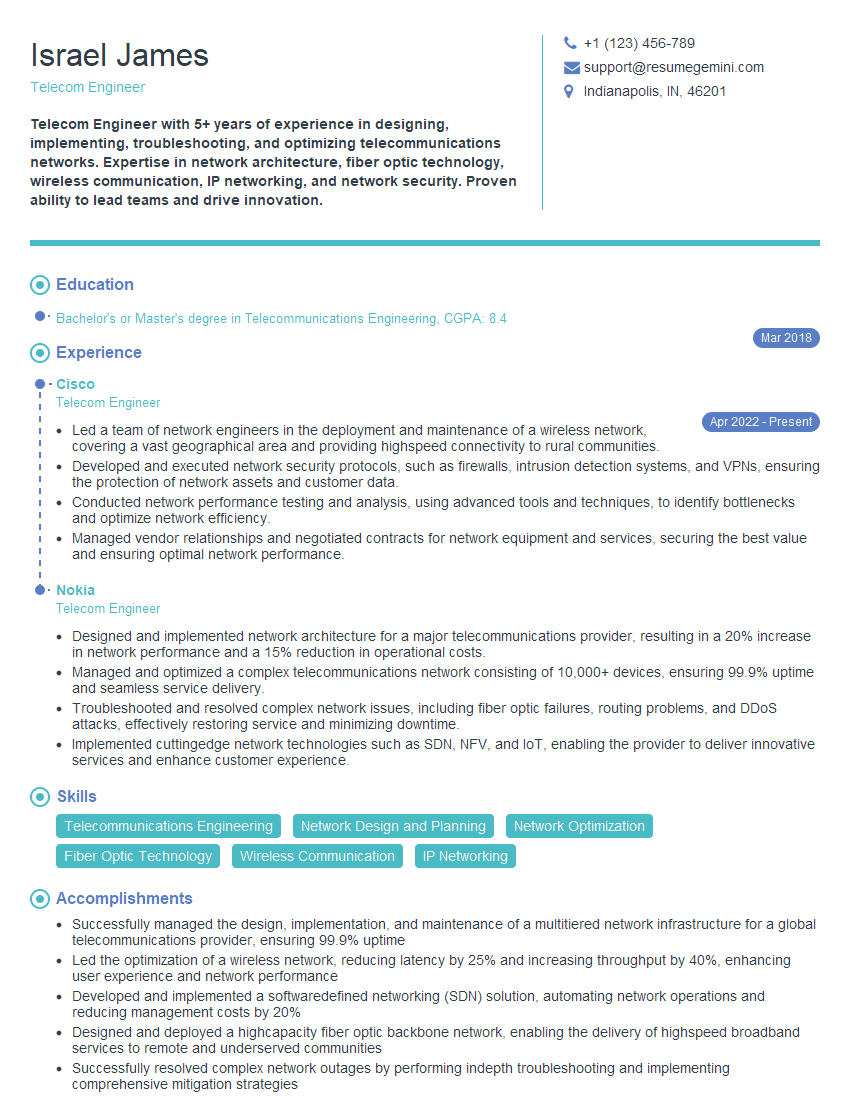
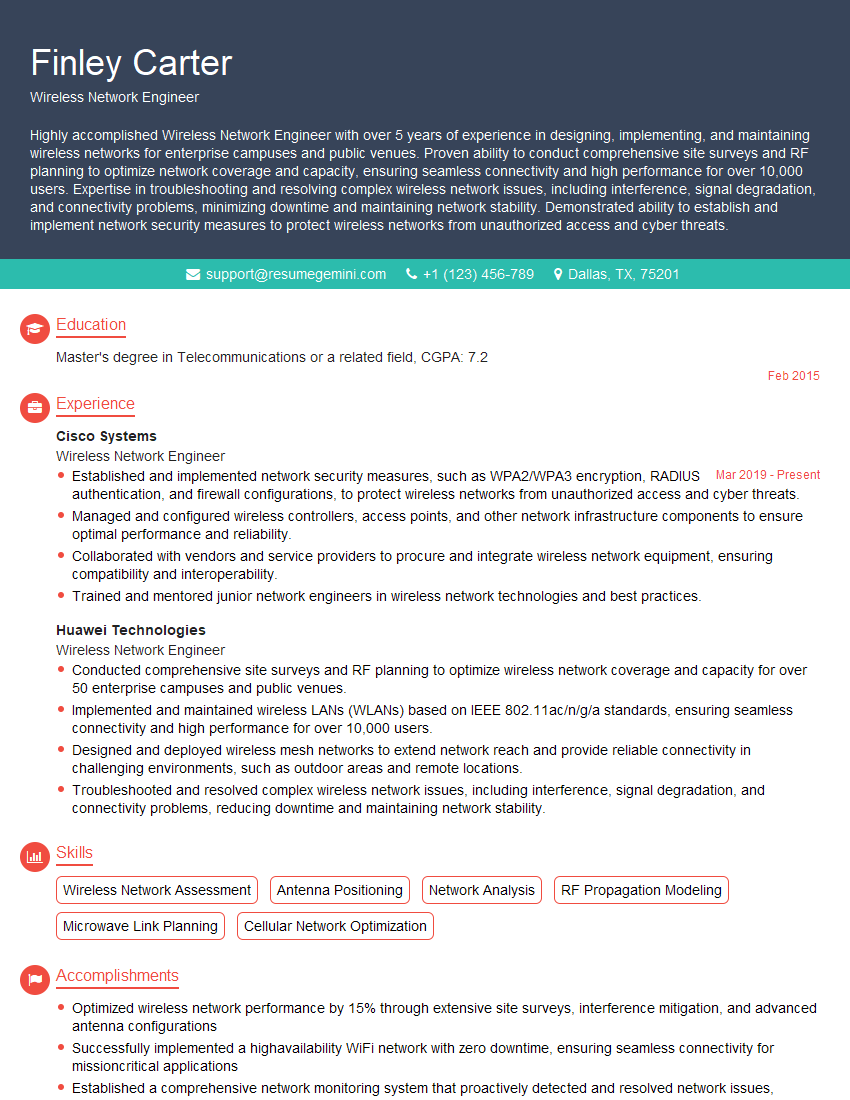
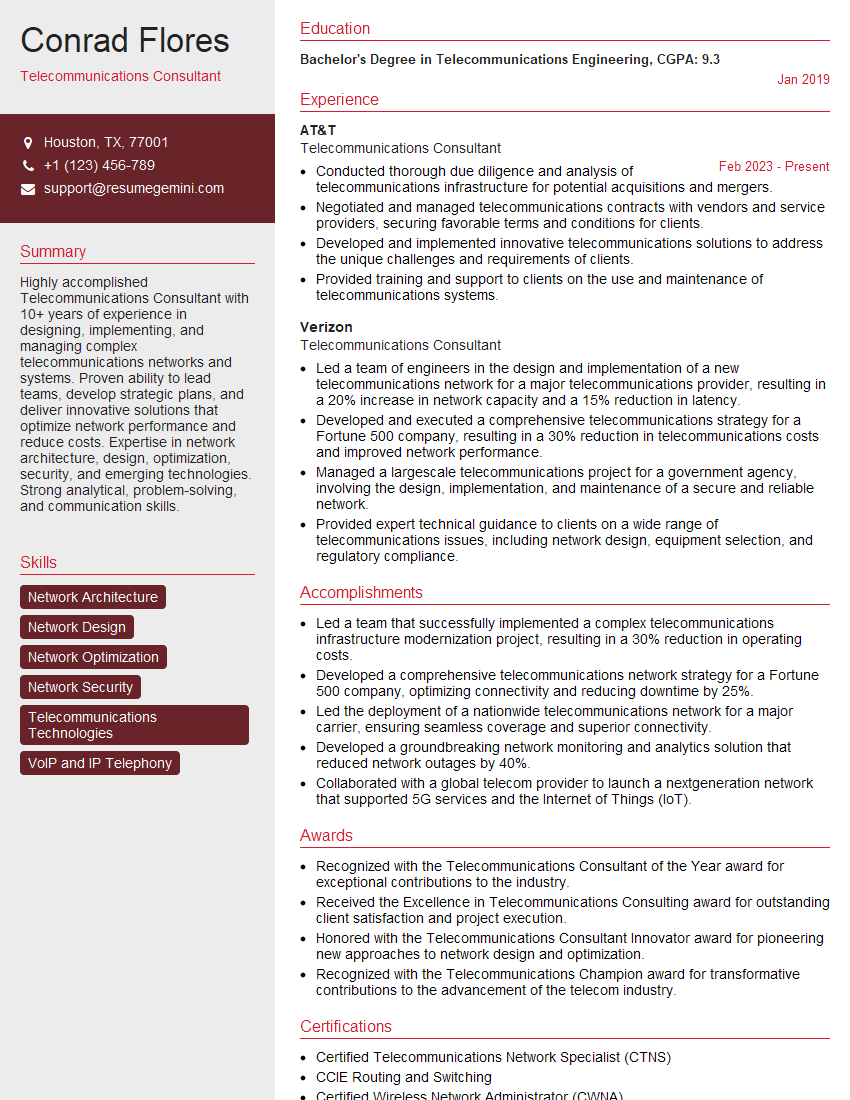
Mastering Cellular Connectivity opens doors to exciting career opportunities in a rapidly evolving field. Demonstrating expertise in this area significantly enhances your employability and allows you to contribute meaningfully to innovative projects. To maximize your job prospects, it’s crucial to present your skills effectively. Building an ATS-friendly resume is essential to get your application noticed by recruiters. ResumeGemini is a trusted resource that can help you craft a compelling and optimized resume, ensuring your qualifications shine. We offer examples of resumes tailored to Cellular Connectivity to guide you in building your own professional profile.
Explore more articles
Users Rating of Our Blogs
Share Your Experience
We value your feedback! Please rate our content and share your thoughts (optional).
What Readers Say About Our Blog
Really detailed insights and content, thank you for writing this detailed article.
IT gave me an insight and words to use and be able to think of examples