Are you ready to stand out in your next interview? Understanding and preparing for Soil Investigation interview questions is a game-changer. In this blog, we’ve compiled key questions and expert advice to help you showcase your skills with confidence and precision. Let’s get started on your journey to acing the interview.
Questions Asked in Soil Investigation Interview
Q 1. Explain the different types of soil classifications.
Soil classification systems categorize soils based on their physical properties and engineering behavior. Several systems exist, but two prominent ones are the Unified Soil Classification System (USCS) and the AASHTO Soil Classification System. The USCS is widely used in geotechnical engineering and broadly divides soils into coarse-grained (gravels and sands) and fine-grained (silts and clays) materials, further sub-classified based on grain size distribution, plasticity characteristics, and other properties. The AASHTO system, primarily used for highway construction, classifies soils based on their suitability for pavement design, focusing on factors like grain size, plasticity, and drainage properties. Imagine trying to build a house – you wouldn’t use the same type of soil for the foundation as you would for filling around the landscaping; soil classification guides material selection for optimal project performance.
For example, a well-graded gravel (GW in USCS) is strong and provides excellent support for foundations, while a highly plastic clay (CH in USCS) might require special treatment to ensure stability.
- Unified Soil Classification System (USCS): Employs symbols like GW (well-graded gravel), SM (silty sand), CL (lean clay), etc., to denote soil types.
- American Association of State Highway and Transportation Officials (AASHTO) System: Uses a group index (GI) to indicate the suitability of soil for pavement construction, with lower values indicating better suitability.
Q 2. Describe the process of conducting a Standard Penetration Test (SPT).
The Standard Penetration Test (SPT) is a common in-situ dynamic penetration test used to determine the geotechnical engineering properties of soil. It involves driving a split-barrel sampler into the ground using a hammer of known weight and drop height. The number of blows required to drive the sampler a certain distance (typically 12 inches) is recorded, providing the N-value (blow count). This N-value, along with other factors, provides an estimate of soil density and strength. Think of it like repeatedly hammering a nail into a piece of wood – harder wood (denser soil) will require more blows.
The process involves drilling a borehole to the desired depth, placing the sampler, and then repeatedly dropping the hammer. The number of blows for each 6-inch increment is recorded. The N-value usually refers to the number of blows required to penetrate the final 12 inches (two increments). Soil samples are retrieved from the split-barrel sampler for visual inspection and laboratory testing.
Q 3. What are the limitations of the SPT test?
While the SPT is widely used and relatively simple, it has limitations. The N-value can be influenced by several factors, leading to inaccurate estimations. These factors include:
- Sampler type and condition: A damaged or worn sampler can affect penetration resistance.
- Drilling method and borehole diameter: The drilling method can disturb the soil around the borehole, affecting the accuracy of the test.
- Overburden pressure: At high overburden pressure, the soil may become denser, leading to higher N-values.
- Soil type: The test is less reliable in very loose or very dense soils, particularly in very soft clays or gravelly soils.
- Rod length: Energy losses increase with rod length.
- Hammer efficiency: Variations in the hammer efficiency can significantly alter the results. It’s important to ensure proper hammer operation.
For instance, an SPT result in a gravelly soil may be significantly influenced by the presence of larger, harder particles, potentially yielding an N-value much higher than the actual soil strength would suggest.
Q 4. Explain the significance of the coefficient of consolidation (cv).
The coefficient of consolidation (cv) is a crucial parameter in soil mechanics that quantifies how quickly excess pore water pressure dissipates from a saturated soil under a load. It’s particularly important in assessing settlement behavior, especially in clay soils which can experience significant consolidation over time. Imagine squeezing a sponge – the rate at which water escapes depends on the sponge’s material. Similarly, cv determines the rate of settlement in a soil mass.
A higher cv value indicates faster consolidation, implying quicker settlement. This is crucial for designing structures; we need to predict how long a structure will take to settle and incorporate this information in design calculations to avoid potential issues like foundation cracking or uneven settlement.
The cv is usually determined through laboratory consolidation tests, such as the oedometer test, which measures the change in soil thickness under a controlled loading.
Q 5. How do you determine the shear strength of soil?
Soil shear strength represents the soil’s resistance to deformation under shear stresses. It is a crucial parameter in slope stability analysis, foundation design, and earth retaining structure design. Several methods exist to determine shear strength, ranging from direct shear tests, triaxial tests, and vane shear tests.
- Direct shear test: A simple laboratory test where a soil sample is subjected to a normal stress and a shear stress until failure.
- Triaxial test: A more complex laboratory test where a soil sample is subjected to confining pressure in all directions before a shear stress is applied until failure. This test provides a more realistic representation of shear strength behavior under various stress conditions.
- Vane shear test: An in-situ test used to determine the undrained shear strength of soft clays. A vane is rotated in the soil until failure, and the torque required is measured. This method is particularly useful in soft, sensitive clay soils.
The choice of method depends on the soil type, site conditions, and project requirements. Each test yields a shear strength value that is used in design calculations to ensure adequate stability and avoid potential failures.
Q 6. What are the different methods for determining soil permeability?
Soil permeability refers to the ease with which water can flow through the soil. This property is crucial for several geotechnical engineering applications, including groundwater flow analysis, seepage calculations, and landfill design. Several methods exist to determine soil permeability:
- Laboratory permeability tests: These tests involve using a permeameter to measure the flow rate of water through a soil sample under a known hydraulic gradient. Different types of permeameters, like constant head and falling head permeameters, are used depending on the soil’s permeability.
- In-situ permeability tests: These tests are conducted in the field to determine the permeability of the soil in its natural state. Common methods include pumping tests (where the groundwater level is monitored after pumping from a well) and slug tests (where a change in water level in a borehole is observed after introducing a slug of water or air). Pumping tests are more suitable for more permeable formations. Slug tests are preferred when dealing with less permeable strata.
For example, determining the permeability of a soil is essential for designing the drainage system of a highway embankment; low permeability can lead to excessive buildup of pore water pressure, potentially causing instability.
Q 7. Describe the process of conducting a cone penetration test (CPT).
The Cone Penetration Test (CPT) is an in-situ dynamic penetration test that measures the resistance of soil to penetration by a cone-shaped probe pushed into the ground at a constant rate. The cone’s tip resistance and the sleeve friction are continuously recorded as a function of depth, providing continuous profiles of soil density and strength. Imagine pushing a sharp cone into different types of soil – a dense, stiff soil will offer higher resistance than loose soil.
The CPT involves pushing a cone-shaped probe into the ground using a hydraulic system. Sensors within the cone measure the tip resistance (qc) and the friction on the sleeve (fs). The data obtained is used to estimate soil properties, such as density, strength, and stratigraphy. The CPT is faster and generally provides more continuous data compared to the SPT, making it a more efficient and effective method for site characterization.
The CPTu (piezocone penetration test) is a variation of the CPT that includes a pore water pressure sensor to measure pore pressure during penetration, providing additional information for more accurate soil classification and engineering property determination. This is particularly useful for determining the consolidation properties of clay soils.
Q 8. What are the advantages and disadvantages of CPT compared to SPT?
Both the Cone Penetration Test (CPT) and the Standard Penetration Test (SPT) are in-situ dynamic penetration tests used to characterize soil, but they differ significantly in methodology and the data they provide. The CPT uses a cone-shaped penetrometer pushed into the ground at a constant rate, measuring the resistance to penetration. The SPT, on the other hand, drives a split-barrel sampler into the ground using a hammer, recording the number of blows required for a set penetration depth.
- CPT Advantages: Continuous data providing detailed soil profiles, quicker testing process, less operator-dependent, better for identifying very soft soils, provides information about soil density and shear strength. It can also be used to identify layers with varying degrees of liquefaction potential.
- CPT Disadvantages: More expensive equipment, requires specialized interpretation software, not ideal for very coarse-grained soils or highly cemented materials.
- SPT Advantages: Relatively simple and inexpensive, widely used and accepted, provides samples for visual inspection and laboratory testing.
- SPT Disadvantages: Discontinuous data, more operator-dependent leading to variability in results, less precise than CPT, provides limited information about soil density and shear strength, heavily influenced by the energy imparted by the hammer.
In essence, CPT offers a more comprehensive and continuous picture of soil stratigraphy and geotechnical properties, while SPT is a more economical option providing valuable information, albeit with some limitations in accuracy and data resolution.
Q 9. Explain the concept of effective stress in soil mechanics.
Effective stress is the portion of the total stress acting on a soil element that is carried by the soil skeleton, not by the pore water. Imagine squeezing a sponge saturated with water. The total stress is the force applied, but the sponge itself (the soil skeleton) only carries part of that force; the rest is supported by the water within the pores.
Total stress (σ) = Effective stress (σ’) + Pore water pressure (u)
Effective stress is crucial in soil mechanics because it determines the shear strength and consolidation behavior of soils. High effective stress generally indicates a stronger soil, while a lower effective stress (often resulting from high pore water pressure) can lead to instability and failure, particularly during seismic events. For example, during an earthquake, the rapid shaking can increase pore water pressure, reducing effective stress, potentially triggering liquefaction.
Q 10. What is the difference between consolidation and settlement?
Consolidation and settlement are both processes that cause a reduction in the volume of a soil mass, but they operate on different timescales and mechanisms.
- Consolidation: A time-dependent process where the soil expels pore water under sustained loading. Imagine a wet sponge under pressure – the water gradually squeezes out, reducing the sponge’s volume. This is primarily a primary consolidation and time-dependent process relating to compressibility of the soil.
- Settlement: The overall vertical deformation of a soil mass due to various factors including consolidation, creep, and immediate settlement. Settlement can be immediate (elastic) or long-term (consolidation or creep).
Consolidation is a significant component of settlement, often the dominant contributor over the long term. However, settlement includes additional factors like immediate settlement from elastic compression of the soil and creep, which is a slow deformation under sustained load. For instance, a newly constructed building will experience immediate settlement followed by long-term consolidation settlement over several years. Understanding both processes is crucial for designing stable foundations.
Q 11. How do you interpret soil boring logs?
Interpreting soil boring logs requires a systematic approach combining field observations and lab test results. A typical log shows depth, soil type, and various engineering properties.
Interpretation Steps:
- Visual Inspection: Examine the soil descriptions, noting color, texture, moisture content, and the presence of any organic matter, gravel, or other inclusions. Soil classification symbols (like SM, CL, etc.) are used to denote the type.
- Laboratory Testing: Integrate lab test results (e.g., Atterberg limits, grain-size distribution, density) to refine soil classification and determine engineering properties (e.g., shear strength, compressibility).
- Identify Layers: Organize the data into distinct soil strata based on changes in soil properties. Each layer should be characterized with its thickness, type, and engineering properties.
- Groundwater Level: Note the groundwater level, as it impacts soil behavior and effective stress.
- Identify Anomalies: Look for unusual features like voids, soft lenses, or unusually high moisture content, which may signify potential risks.
For example, a log showing alternating layers of sand and clay suggests potential settlement issues and needs further assessment of consolidation characteristics. The log provides essential baseline data for foundation design and other geotechnical engineering decisions.
Q 12. Describe the various types of soil sampling methods.
Various soil sampling methods are used depending on the project needs and the type of soil. The choice involves trade-offs between sample quality, disturbance, and cost.
- Undisturbed Sampling: These methods aim to retrieve samples with minimal alteration of the soil’s natural structure, important for determining accurate consolidation and shear strength properties. Examples include Shelby tube samplers and block samplers.
- Disturbed Sampling: These methods recover samples that are somewhat or significantly altered, providing information about soil type, color, and grain size distribution. They are less suitable for precise geotechnical parameters. Examples include split-spoon samplers (used in SPT) and hand augers.
- Wash Borings: Useful for obtaining samples from softer soils and are generally considered disturbed sampling methods.
- Rotary Drilling with Core Barrels: These techniques, often used for hard rock, provide rock core samples suitable for detailed rock mechanical analysis.
The selection of an appropriate sampling method requires careful consideration of factors such as soil type, depth of investigation, project requirements, and budget. Undisturbed samples are generally preferred for laboratory testing that requires accurate determination of soil parameters like shear strength and consolidation properties.
Q 13. What are the common causes of soil liquefaction?
Soil liquefaction is the loss of shear strength in saturated, loose sandy soils during earthquake shaking. Imagine shaking a container of wet sand – the grains lose contact and the soil behaves like a liquid.
Common Causes:
- Earthquake Shaking: This is the primary trigger, generating excess pore water pressure that reduces the effective stress in the soil.
- Saturated Soil Conditions: The soil must be fully saturated with water for liquefaction to occur. The presence of groundwater at shallow depths is a key factor.
- Loose Soil Structure: Loosely packed, granular soils (sands and silts) are more susceptible to liquefaction than denser or well-graded soils.
- Cyclic Loading: The repetitive loading from seismic waves causes a build-up of pore water pressure exceeding the effective stress.
Areas with a history of earthquakes and loose, saturated sandy soils are at a higher risk of liquefaction. This phenomenon can lead to ground failure, settlement, and lateral spreading, causing significant damage to structures. Geotechnical engineers assess liquefaction potential using various methods, including CPT and SPT data analysis and empirical procedures.
Q 14. Explain the principles of slope stability analysis.
Slope stability analysis involves evaluating the likelihood of a slope failing. This is crucial for designing safe cuts, embankments, and other earthworks, as well as for mitigating hazards in natural slopes. The analysis considers the forces acting on the soil mass, including the weight of the soil and any external loads, such as water pressure or surcharge.
Principles:
- Factors of Safety: The analysis calculates a factor of safety (FOS), which is the ratio of resisting forces to driving forces. A FOS greater than 1 indicates a stable slope, while a FOS less than 1 suggests potential failure. Common methods to determine FOS include the method of slices.
- Shear Strength: The soil’s shear strength is a crucial parameter determining its resistance to sliding. This is impacted by factors such as soil type, density, and effective stress. Different soil models with varied soil strengths are used depending on the nature of the soil and its properties.
- Water Pressure: Water within the soil mass increases pore pressure, reducing effective stress and potentially triggering instability. Therefore, understanding groundwater conditions and water table effects is important in slope stability analyses.
- Geometrical Factors: The slope’s angle, height, and the presence of discontinuities (e.g., cracks, joints) significantly affect its stability. Steeper slopes tend to be more unstable.
Various methods are employed in slope stability analysis, ranging from simplified methods to advanced numerical modeling. The choice of method depends on the complexity of the problem and the level of accuracy required. The analysis ultimately helps engineers identify potential hazards and design appropriate mitigation measures, such as terracing, retaining walls, or drainage systems.
Q 15. How do you identify expansive soils and address their effects on foundations?
Identifying expansive soils involves a multi-pronged approach combining visual inspection, laboratory testing, and historical data. Expansive soils, primarily clays, exhibit significant volume changes in response to moisture content fluctuations. Think of it like a sponge: when it’s dry, it shrinks; when it’s wet, it swells. This swelling can exert tremendous pressure on foundations, leading to cracking and structural damage.
Identification: We begin with a visual site inspection, looking for signs like cracked pavements, tilted structures, or uneven ground surfaces. We then collect soil samples at various depths for laboratory testing. Key tests include Atterberg limits (liquid limit, plastic limit, shrinkage limit) which quantify the soil’s consistency and volume change potential. The plasticity index (PI) is particularly important; a high PI often indicates expansive potential. Additionally, we might use methods like the Proctor compaction test to understand the soil’s density and moisture characteristics.
Addressing the effects: Mitigation strategies depend on the severity of the expansion and the type of structure. These can include:
- Deep foundations: Piles or piers extend below the zone of significant volume change, transferring loads to more stable strata.
- Shallow foundations with modifications: This might involve designing wider footings to distribute loads, using reinforced concrete to withstand expansion forces, or incorporating geosynthetic materials to limit soil movement.
- Soil stabilization: Methods such as lime or cement stabilization can reduce the soil’s plasticity and expansion potential.
- Moisture control: Techniques like installing drainage systems or using impermeable membranes can help regulate soil moisture levels and minimize swelling.
For example, I once worked on a project where a house foundation showed significant cracking due to underlying expansive clay. We employed a combination of deeper footings and a perimeter drainage system to effectively address the problem and prevent further damage.
Career Expert Tips:
- Ace those interviews! Prepare effectively by reviewing the Top 50 Most Common Interview Questions on ResumeGemini.
- Navigate your job search with confidence! Explore a wide range of Career Tips on ResumeGemini. Learn about common challenges and recommendations to overcome them.
- Craft the perfect resume! Master the Art of Resume Writing with ResumeGemini’s guide. Showcase your unique qualifications and achievements effectively.
- Don’t miss out on holiday savings! Build your dream resume with ResumeGemini’s ATS optimized templates.
Q 16. What are the factors influencing soil erosion?
Soil erosion is the process of soil detachment and transport by natural agents like wind and water, and is accelerated by human activities. Imagine a river carving its way through a landscape; that’s erosion in action, but it happens on a much smaller scale too.
Several factors influence the rate and extent of soil erosion:
- Climate: Rainfall intensity and frequency, wind speed, and temperature all affect the erodibility of soil. Heavy rainfall can create significant runoff, whereas strong winds can easily lift loose particles.
- Soil properties: Soil texture, structure, and organic matter content play crucial roles. Fine-textured soils, like silt and clay, are more easily eroded than coarser-textured soils like sand. A well-structured soil with high organic matter is more resistant to erosion.
- Topography: Steeper slopes lead to faster water runoff, increasing erosive forces. The length and gradient of slopes significantly impact erosion rates.
- Vegetation cover: Plant roots bind soil particles together, reducing detachment and offering protection from wind and rain. Deforestation and land clearing increase soil vulnerability.
- Human activities: Agricultural practices like intensive tillage, overgrazing, and deforestation are major contributors to soil erosion. Construction activities and urbanization further exacerbate the problem.
Understanding these factors is critical for implementing effective erosion control measures, such as contour farming, terracing, and planting vegetation cover.
Q 17. Explain the significance of groundwater levels in geotechnical engineering.
Groundwater levels significantly impact geotechnical engineering projects because they influence the effective stress and strength of soils. Imagine a sponge submerged in water; it’s much weaker than when it’s dry. Similarly, the presence of groundwater affects the soil’s behavior.
Significance:
- Effective stress: Groundwater pressure reduces the effective stress (the stress that’s actually carried by the soil skeleton), leading to reduced shear strength and increased soil compressibility. This is crucial for foundation design.
- Buoyancy: Submerged soils experience upward buoyant forces, affecting the bearing capacity of foundations. The effective weight of the soil decreases, impacting stability calculations.
- Seepage: Groundwater flow can cause erosion and piping, leading to instability in earth structures like embankments and dams. This necessitates careful seepage analysis and design of drainage systems.
- Soil consolidation: Changes in groundwater levels can cause soil consolidation, which is the gradual compression of saturated soils. This can lead to settlement of structures over time.
During site investigations, accurate determination of the groundwater table and its fluctuation is essential. We employ methods like piezometers or observation wells to monitor groundwater levels, and this information directly informs foundation design and slope stability assessments.
Q 18. How do you assess the bearing capacity of soil?
Assessing soil bearing capacity is a crucial step in geotechnical engineering, as it determines the maximum load a soil can support without excessive settlement or failure. Think of it as finding the maximum weight a table can hold before collapsing.
Assessment methods: Several methods exist, ranging from simplified empirical equations to sophisticated numerical analyses:
- In-situ testing: Methods like the standard penetration test (SPT) and cone penetration test (CPT) provide valuable information on soil strength and density directly in the field. These tests help determine the soil’s resistance to penetration, which is correlated to its bearing capacity.
- Laboratory testing: Undisturbed soil samples are subjected to shear strength tests (like triaxial or direct shear tests) in the laboratory to directly measure their strength parameters. These parameters are then used in bearing capacity calculations.
- Empirical methods: Simplified equations, often based on SPT or CPT data, are used to estimate bearing capacity for simpler foundation types.
- Numerical analysis: Finite element analysis (FEA) is employed for complex foundation geometries or soil conditions, enabling a more refined assessment of bearing capacity and potential settlement.
The choice of method depends on project complexity and available resources. For simple projects, empirical methods might suffice, while complex structures may require laboratory testing and numerical analysis for accurate bearing capacity estimation. Safety factors are always applied to account for uncertainties and ensure adequate design strength.
Q 19. Describe the methods used for soil remediation.
Soil remediation aims to improve soil conditions for various purposes, including construction, environmental protection, and agricultural use. Think of it as cleaning and restoring contaminated or unsuitable soil to a usable state.
Methods: Remediation methods vary depending on the type of contamination or problem:
- Excavation and disposal: Contaminated soil is removed and disposed of in a licensed landfill, a straightforward but potentially expensive approach.
- Bioremediation: Using microorganisms to break down pollutants, a cost-effective and environmentally friendly method particularly effective for organic contaminants.
- Phytoremediation: Employing plants to absorb or stabilize pollutants in the soil. It’s a natural, aesthetically pleasing method, but it’s slow and best suited for specific contaminants.
- Soil washing: Washing the soil with water or chemical solutions to remove contaminants. This approach is efficient but requires careful management of wastewater.
- Soil stabilization: Improving soil strength and stability through the addition of binding agents like cement or lime. Often used for expansive soils or weak foundations.
- In-situ vitrification: Melting contaminated soil to form a glass-like solid, effectively immobilizing pollutants. Suitable for highly contaminated areas.
Selecting the appropriate remediation method involves a thorough site investigation, risk assessment, and cost-benefit analysis. The choice often depends on the nature and extent of contamination, regulatory requirements, and environmental considerations.
Q 20. What are the environmental considerations in soil investigation?
Environmental considerations are paramount in soil investigation. Responsible practice minimizes environmental disruption and protects ecological systems. This is crucial for ensuring sustainable development.
Key considerations:
- Waste generation: Minimizing the volume of soil excavated and properly managing waste disposal, adhering to all relevant environmental regulations.
- Groundwater protection: Implementing measures to prevent contamination of groundwater during investigation and remediation activities, like using appropriate drilling techniques and handling contaminated materials.
- Air quality: Controlling dust generation during excavation and other activities to prevent air pollution, using dust suppression methods where necessary.
- Habitat disruption: Minimizing disturbance to existing flora and fauna during site exploration, particularly in sensitive ecological areas.
- Noise pollution: Taking measures to minimize noise pollution generated by construction activities and heavy machinery.
- Compliance with regulations: Adhering to all applicable environmental permits and regulations, ensuring that the investigation and remediation activities are legally sound and environmentally responsible.
Environmental impact assessments (EIAs) are often required for large-scale projects to evaluate potential environmental effects and develop mitigation strategies. Ethical and sustainable practices are essential for minimizing the footprint of soil investigation activities.
Q 21. Explain the role of geophysics in soil investigation.
Geophysics plays a significant role in soil investigation by providing subsurface information non-destructively. Think of it as using advanced imaging techniques to ‘see’ beneath the ground surface without extensive excavation.
Role of geophysics: Geophysical methods employ various techniques to measure physical properties of subsurface materials. These methods include:
- Seismic refraction/reflection: Using sound waves to delineate subsurface layers and identify variations in soil properties, like density and stiffness. Useful for mapping bedrock depth and identifying potential cavities.
- Electrical resistivity tomography (ERT): Measuring the electrical conductivity of the subsurface to map soil layers and identify areas of high moisture content or contamination.
- Ground-penetrating radar (GPR): Using electromagnetic waves to image the subsurface, detecting buried objects, voids, and changes in soil stratigraphy.
- Magnetic surveys: Detecting variations in the Earth’s magnetic field caused by subsurface materials with magnetic properties. Helpful in locating buried objects or identifying geological features.
Geophysical methods are cost-effective, relatively quick, and can cover large areas efficiently. They provide valuable preliminary data to optimize the location and extent of more invasive investigations, such as drilling and sampling. Integration of geophysical data with other site investigation techniques leads to a more comprehensive understanding of the subsurface conditions.
Q 22. What is the difference between in-situ and laboratory testing?
In-situ testing and laboratory testing are both crucial parts of a soil investigation, but they differ significantly in how and where the tests are conducted. In-situ testing involves performing tests directly on the soil at its natural location, providing a more realistic representation of the soil’s behavior in situ. This avoids the potential for sample disturbance during transportation and preparation. Examples include Standard Penetration Tests (SPTs), Cone Penetration Tests (CPTs), and vane shear tests. These tests give quick, on-site results, helping to guide further investigations.
Laboratory testing, on the other hand, involves collecting soil samples from the site and transporting them to a lab for more detailed analysis. This allows for a wider range of tests to be performed, including grain-size analysis, Atterberg limits, consolidation tests, and direct shear tests, providing more precise data on the soil’s properties. This approach is more time-consuming and potentially more expensive but delivers a higher level of detail.
Think of it like this: in-situ testing is like getting a quick snapshot of the soil’s condition, while laboratory testing is like getting a detailed medical report after a thorough examination. Often, both methods are used in combination to provide a complete understanding of the soil profile.
Q 23. How do you manage risks associated with soil contamination?
Managing risks associated with soil contamination requires a multi-faceted approach. It starts with a thorough understanding of the potential sources of contamination – past industrial activities, landfills, leaking underground storage tanks (LUSTs), etc. We use historical records, site reconnaissance, and preliminary environmental site assessments (ESAs) to identify potential risks. If contamination is suspected, we implement a phased approach.
Phase 1 involves non-invasive investigations such as reviewing historical records and conducting visual inspections. Phase 2 includes more invasive methods like soil sampling and groundwater monitoring. Phase 3 involves remediation if contamination is confirmed. This could involve excavation and disposal of contaminated soil, bioremediation, or other treatment methods.
Risk management also includes proper handling and disposal of contaminated samples, adhering to all relevant environmental regulations, and employing qualified personnel trained in handling hazardous materials. Documentation is critical, keeping detailed records of all testing, findings, and remediation activities. This careful process ensures that the project not only meets regulatory requirements but also protects human health and the environment.
Q 24. Describe your experience with different types of foundation design.
My experience with foundation design encompasses a wide range of types, chosen based on the specific soil conditions and the structural demands of the project. I’ve worked extensively with shallow foundations like spread footings and strip footings, suitable for stable, well-drained soils where the load is not excessively high. I’ve also designed deep foundations such as piles (driven, bored, and helical) for projects where shallow foundations are unsuitable due to weak or compressible soils, or where high loads need to be transferred to deeper, stronger strata.
I am also proficient in the design of raft foundations (mat foundations) for large structures where the soil conditions are poor and extensive underpinning would be needed. The choice of foundation type depends heavily on geotechnical investigation results. For instance, soil bearing capacity, settlement characteristics, and groundwater conditions all heavily influence the design parameters. Each project demands careful consideration of load transfer mechanisms and potential issues such as settlement, uplift, and lateral movement.
Q 25. What software packages are you proficient in for geotechnical analysis?
I’m proficient in several software packages used for geotechnical analysis. My expertise includes Plaxis for finite element analysis of complex geotechnical problems like slope stability and retaining wall design. I also utilize Rocscience software, including Slide and Dips, for slope stability analysis and design. GeoStudio is another valuable tool in my arsenal, used for seepage analysis and other geotechnical simulations. I’m also experienced with ABAQUS for more advanced finite element modeling. Finally, I am familiar with various spreadsheet software such as Microsoft Excel and Google Sheets for data processing, calculation, and report generation.
Q 26. Explain your experience with preparing geotechnical reports.
Preparing geotechnical reports is a crucial aspect of my role. My reports are structured to be clear, concise, and easily understandable by engineers and non-specialists alike. They typically include a detailed description of the site investigation methodology, a summary of the site conditions, a presentation and interpretation of the laboratory and field testing results, an assessment of the soil’s engineering properties, and recommendations for foundation design and construction.
I’ve prepared hundreds of these reports, ranging from small residential projects to large-scale infrastructure projects. I pay close attention to detail, ensuring that all findings are accurately reflected, and the language used is appropriate for the intended audience. The reports always include supporting data, tables, figures, and photos to enhance clarity and provide visual context. I take pride in producing reports that are not only technically sound but also easy to navigate and understand.
Q 27. How do you handle conflicting data from different soil investigation methods?
Handling conflicting data from different soil investigation methods requires a careful and systematic approach. It’s important to first review the methodologies used for each test, and check data quality and consistency. Sometimes, the discrepancies may arise from limitations of each method – for example, a CPT might provide a continuous profile, but an SPT may give only discrete data points. The differences might reflect variations in soil conditions within the tested volume or even errors in the testing procedure.
I would usually examine the soil stratigraphy and try to correlate the data across different testing methods. It might also involve additional investigation to resolve uncertainties, such as collecting more samples or using complementary testing methods. A thorough understanding of soil mechanics principles allows me to weigh the evidence from each method and reach a reasonable interpretation, often using statistical methods to analyze the data and identify outliers. In some cases, a conservative approach is necessary to account for uncertainties and ensure the safety of the design.
Q 28. Describe a challenging soil investigation project you’ve worked on and how you overcame the challenges.
One challenging project involved a site with highly variable soil conditions – layers of soft clay, dense sand, and weathered rock. The project required the design of a large retaining wall, and the initial investigation suggested far more challenging conditions than the client and design team were prepared for. The initial designs were based on less conservative parameters and did not consider potential slope instability issues.
To overcome these challenges, I implemented a more rigorous investigation, including additional boreholes and advanced in-situ tests like CPTu. This provided a more accurate representation of the soil strata and its strength characteristics. I used finite element analysis software (Plaxis) to model the soil behavior under various loading scenarios and to optimize the retaining wall design, resulting in a stable and cost-effective solution. This involved incorporating a robust drainage system to reduce pore water pressure and mitigate potential instability issues. Through careful analysis and innovative design solutions, the project was successfully completed on time and within budget.
Key Topics to Learn for Soil Investigation Interview
- Soil Classification Systems: Understand the Unified Soil Classification System (USCS) and other relevant systems. Be prepared to discuss the implications of different soil types on engineering projects.
- In-situ Testing Methods: Describe your experience with common field tests like Standard Penetration Test (SPT), Cone Penetration Test (CPT), and Vane Shear Test. Explain how the data obtained is used to characterize soil properties.
- Laboratory Testing: Discuss various laboratory tests used to determine soil properties such as grain size distribution, Atterberg limits, and shear strength. Be ready to interpret test results and explain their significance.
- Soil Mechanics Principles: Demonstrate a firm grasp of fundamental concepts like effective stress, consolidation, shear strength, and seepage. Be prepared to apply these concepts to practical scenarios.
- Site Investigation Procedures: Outline the typical stages of a soil investigation, from initial site reconnaissance to report writing. Discuss the importance of proper planning and documentation.
- Foundation Design Considerations: Explain how soil investigation results inform the design of different foundation types (e.g., shallow foundations, deep foundations). Discuss the implications of soil conditions on foundation stability.
- Geoenvironmental Issues: Discuss your understanding of potential geoenvironmental concerns, such as contamination and remediation strategies. Explain the role of soil investigation in environmental site assessments.
- Data Analysis and Interpretation: Showcase your ability to analyze soil investigation data, identify trends, and draw meaningful conclusions. Be prepared to discuss potential sources of error and uncertainty.
- Report Writing and Communication: Demonstrate your skills in preparing clear, concise, and well-organized geotechnical reports. Explain the importance of effective communication with engineers and clients.
Next Steps
Mastering Soil Investigation is crucial for a successful and rewarding career in geotechnical engineering. A strong understanding of these principles opens doors to diverse and challenging projects, contributing significantly to your professional growth. To maximize your job prospects, creating an ATS-friendly resume is essential. ResumeGemini is a trusted resource that can help you build a professional and impactful resume, ensuring your qualifications stand out to potential employers. Examples of resumes tailored to Soil Investigation are available to guide you through this process.
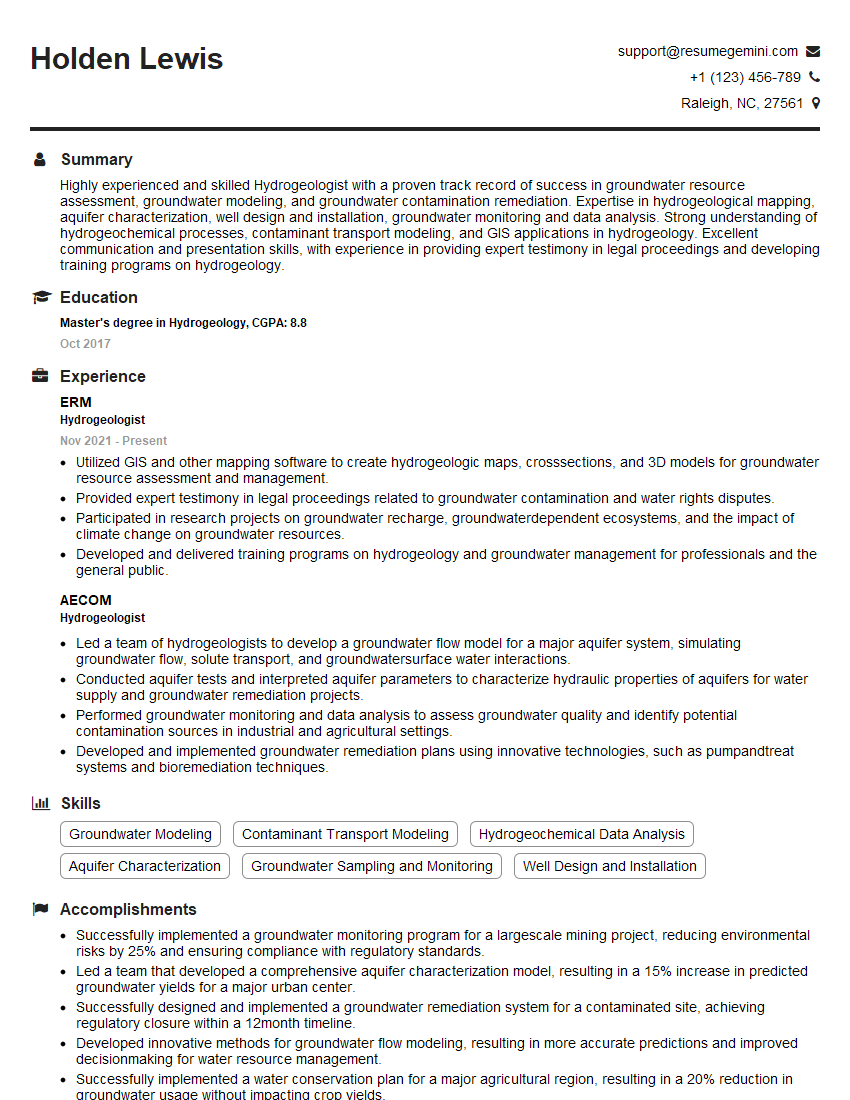
Hydrogeologist Resume Sample

Foundation Engineer Resume Sample

Geotechnical Engineer Resume Sample

Environmental Consultant Resume Sample

Environmental Engineer Resume Sample

Soil Engineer Resume Sample

Soil Scientist Resume Sample

Engineering Geologist Resume Sample

Project Geologist Resume Sample
Explore more articles
Users Rating of Our Blogs
Share Your Experience
We value your feedback! Please rate our content and share your thoughts (optional).
What Readers Say About Our Blog
Really detailed insights and content, thank you for writing this detailed article.
IT gave me an insight and words to use and be able to think of examples