Are you ready to stand out in your next interview? Understanding and preparing for Operating Train Yard Equipment interview questions is a game-changer. In this blog, we’ve compiled key questions and expert advice to help you showcase your skills with confidence and precision. Let’s get started on your journey to acing the interview.
Questions Asked in Operating Train Yard Equipment Interview
Q 1. Describe your experience operating various types of yard locomotives.
Throughout my career, I’ve operated a variety of yard locomotives, ranging from smaller switchers like the EMD SW1500, ideal for tight spaces and precise maneuvering within the yard, to larger units such as the GE AC4400CW, used for heavier switching operations and longer moves between classification yards. My experience encompasses both diesel-electric and, more recently, some experience with battery-electric locomotives, highlighting my adaptability to evolving technologies within the industry. I’m proficient in understanding the unique characteristics of each locomotive type, including their horsepower, traction motors, braking systems, and control mechanisms, which allows me to adjust my operating techniques for optimal performance and efficiency in diverse yard environments.
For instance, operating an SW1500 requires more delicate throttle control and precise maneuvering around curves and tight clearances, whereas the AC4400CW demands a more strategic approach to managing momentum and braking forces due to its significantly higher weight and power. Understanding these nuances is critical for both safety and efficiency.
Q 2. Explain the process of coupling and uncoupling railcars.
Coupling and uncoupling railcars is a fundamental yet critical process in yard operations, requiring precision and safety awareness. It begins with carefully positioning the locomotive and cars, ensuring sufficient slack in the couplings to prevent damage. Then, using the locomotive’s controls, I carefully approach the cars until the knuckle of the coupler on the locomotive aligns with the knuckle on the car. For coupling, I apply a gentle amount of force to engage the knuckles; a successful coupling will produce a solid ‘clunk’ and the coupler locking mechanism will engage. Uncoupling involves activating the uncoupling mechanism (often a lever or remote control) on the coupler to release the connection. After uncoupling, it’s crucial to visually verify that the cars are separated and clear of any obstruction.
Safety is paramount. Before coupling or uncoupling, I always check for obstructions, ensure the area is clear of personnel, and confirm that the cars are properly aligned and properly braked. This process is further enhanced by using visual indicators and communication with ground personnel, confirming the completion of the process before initiating any further yard movements.
Q 3. How do you ensure the safety of personnel and equipment while operating in a train yard?
Safety is my top priority in all yard operations. This involves adhering to strict safety protocols, utilizing proper communication systems, and maintaining constant vigilance. I routinely check the locomotive and railcars for any defects, ensuring all components are functional and safe for operation. Before commencing any movement, I ensure a clear visual path is confirmed, and always communicate my intentions to ground personnel and other locomotive operators using two-way radios or yard signaling systems.
I rigorously adhere to speed restrictions within the yard, and use caution while navigating curves and crossings. Maintaining awareness of personnel working in the yard is vital – I always sound the locomotive’s horn as appropriate to warn individuals of my approach and movements. In addition, I’m trained to respond effectively to emergency situations, understanding the procedures for reporting accidents, providing first aid if needed, and cooperating with emergency responders.
Q 4. What are the different types of railcar couplings and their functionalities?
Train yard operations utilize several types of railcar couplings, each designed for specific purposes. The most common is the Janney coupler, a knuckle-type coupler that uses a knuckle and locking pin to connect cars. This is the standard for most North American freight cars. Its primary function is to automatically couple and uncouple cars, providing a relatively simple and reliable connection.
There are also variations of the Janney coupler, such as those designed for specific types of cargo (e.g., tank cars) or those with additional safety features. Less common but still relevant are other coupling types like the buffer coupler, primarily seen in older rolling stock or international operations. These often require manual coupling or uncoupling procedures.
Understanding the differences in these coupling mechanisms is crucial for proper operation and safety. For instance, applying excessive force during coupling can damage a Janney coupler, while attempting to uncouple a buffer coupler without following the prescribed procedure can lead to injury.
Q 5. How do you handle unexpected situations, such as equipment malfunctions or track obstructions?
Unexpected situations are a part of yard operations. When encountering equipment malfunctions, my first step is to secure the scene, bringing the locomotive and cars to a complete stop in a safe location. Then, I follow established reporting procedures, contacting dispatch or maintenance personnel to report the issue and request assistance. I will not attempt repairs beyond my training and authorization, focusing instead on ensuring the safety of personnel and equipment until professional help arrives.
Track obstructions require a different approach. If a minor obstruction (like a piece of debris) is identified, I would follow established protocols for removing it safely, typically after first reporting it to the appropriate personnel. However, for more significant obstructions or any situation where safety is questionable, I would immediately stop operations, report the issue, and await instructions from dispatch or the yardmaster before any attempts to resume movement.
Ultimately, maintaining a calm and methodical approach, clear communication, and adherence to established procedures are vital for effectively addressing these unforeseen challenges.
Q 6. Describe your knowledge of train yard signaling systems and procedures.
My knowledge of train yard signaling systems extends to both traditional color-light signals and newer systems employing computer-based technologies. I understand the significance of each signal aspect and how they relate to authorized movements within the yard. For instance, a red signal indicates a complete stop, a green signal allows proceed, and a yellow signal indicates caution and a prepared stop.
I am proficient in interpreting wayside signals, interpreting track diagrams and switching lists, and ensuring that all movements comply with signal indications. I’m also familiar with the procedures for reporting signal malfunctions or inconsistencies to the appropriate authorities. My experience also includes using various signaling technologies, including modern digital systems that integrate with centralized train control systems, demonstrating my adaptability and competency in keeping operations efficient and safe.
Q 7. Explain your experience with train yard communication protocols and systems.
Effective communication is the cornerstone of safe and efficient yard operations. I’m proficient in using two-way radios, utilizing clear and concise language to communicate with dispatchers, ground crews, and other locomotive operators. This includes relaying information about my location, intended movements, and any potential issues or delays.
Beyond radios, I understand and use other communication protocols, including written switching lists and other documentation methods. This demonstrates the breadth of my communication skills, ensuring information exchange is consistent and understandable to everyone involved in the yard operations. This multi-faceted communication approach, both verbal and written, is essential in preventing misunderstandings and ensuring that all personnel are informed and working collaboratively for a seamless operation.
Q 8. How do you prioritize tasks and manage your time effectively in a busy train yard environment?
Prioritizing tasks in a train yard demands a systematic approach. I use a combination of techniques, starting with understanding the yard’s operational priorities. This often involves looking at the manifest—the list of trains scheduled for departure and arrival. High-priority tasks are those directly impacting on-time departures of crucial freight, such as perishable goods or shipments with tight deadlines. I also consider the urgency of incoming trains needing processing and the potential for bottlenecks. For example, if a train carrying hazardous materials is due, its processing becomes top priority.
Time management relies on efficient planning and execution. Before starting my shift, I review the schedule, noting potential conflicts or delays. I break down larger tasks into smaller, manageable units, focusing on one at a time to avoid getting overwhelmed. For instance, instead of thinking ‘process train X’, I might break it into steps: ‘couple the engine,’ ‘inspect brakes,’ ‘uncouple cars for sorting,’ etc. This allows for better tracking of progress and identification of potential slowdowns. I use checklists to ensure all critical steps are completed. Real-time adjustments are crucial; if an unexpected delay occurs, I re-evaluate priorities and communicate changes to the team. My experience allows me to anticipate potential issues and proactively adjust my schedule to mitigate delays. This proactive approach minimizes disruptions and ensures maximum efficiency.
Q 9. Describe your understanding of train yard safety regulations and procedures.
Safety is paramount in a train yard. My understanding of safety regulations and procedures is comprehensive, covering all aspects from personal safety to equipment maintenance and operational protocols. I am well-versed in FRA (Federal Railroad Administration) regulations and company-specific safety guidelines. This includes strict adherence to rules governing speed limits, signaling systems, and proper coupling and uncoupling techniques. I am thoroughly trained in the use of personal protective equipment (PPE) such as high-visibility vests, safety glasses, gloves and steel-toe boots, and I enforce their correct use amongst my team.
Crucially, I understand the procedures for handling hazardous materials, including proper identification, segregation and emergency response protocols. I am also trained in lockout/tagout procedures to prevent accidental equipment start-up during maintenance or repairs. Regular safety meetings and training sessions help keep my knowledge up-to-date, and I actively participate in reporting and investigating any near misses or accidents to identify areas for improvement and prevent future incidents. Safety is not just a set of rules, it’s a mindset; a constant awareness and proactive approach to identify and mitigate risk.
Q 10. What is your experience with different types of railcar switching maneuvers?
My experience encompasses a wide range of railcar switching maneuvers, from simple cuts and adds to complex re-arrangements of large train sets. I am proficient in various switching techniques, including using various track configurations to efficiently move and organize railcars. For example, I am skilled in performing ‘running switches,’ where a moving engine quickly uncouples and recouplings cars, maximizing efficiency, and ‘flying switches’, where the engine passes through the train to couple to a car at the opposite end. These maneuvers demand precision and coordination, requiring a deep understanding of train dynamics and the physical limitations of the equipment.
I am also experienced in dealing with different types of railcars, understanding the unique challenges presented by tank cars (requiring careful handling due to hazardous material content), refrigerated cars (needing precise temperature monitoring), and specialized cars designed for specific cargo. My skills include managing the challenges presented by different coupler types and understanding the nuances of weight distribution within a train to prevent derailments. I am proficient in using modern switching technology such as remote-controlled locomotives and computerized yard management systems.
Q 11. How do you maintain accurate records of your work and activities?
Maintaining accurate records is essential for accountability and efficient yard operations. I use a combination of methods to ensure complete and accurate record-keeping. This starts with detailed pre-trip inspections recorded on standardized forms. These forms capture the condition of locomotives and equipment, any necessary repairs, and any unusual observations. During operations, I use digital logging systems or manual forms to note the movement of each railcar, including its identification number, origin, destination, and any relevant issues encountered. This data is crucial for tracking train composition, verifying the completion of switching tasks, and providing real-time updates to dispatchers and management. At the end of my shift, I thoroughly review and reconcile my records, ensuring accuracy and completeness before submitting them.
I am also adept at using yard management systems (YMS) which electronically track and manage the location and movement of railcars. These systems streamline the entire process and minimise the risk of human error. My understanding of these systems ensures accurate data entry and retrieval whenever necessary. Accuracy in record-keeping is not just about compliance, it’s also about facilitating efficient operations and ensuring the integrity of the entire rail network.
Q 12. Explain your experience with conducting pre-trip inspections on locomotives and equipment.
Pre-trip inspections are a non-negotiable part of my routine and are performed meticulously before each shift. I follow a standardized checklist which covers all critical aspects of locomotive and equipment condition. This includes a visual inspection of the exterior for any damage, leaks, or loose parts; a check of the undercarriage for potential issues; and verification of proper functioning of lighting, wipers and brakes. I also carefully inspect the engine compartment checking fluids levels (oil, coolant, fuel), gauges and belts. For the couplers, I verify proper alignment and locking mechanisms.
I pay particular attention to details such as air pressure levels (essential for braking), fuel levels, and the functionality of safety mechanisms. Any issues or defects, no matter how minor, are meticulously documented in the inspection reports. This thorough approach prevents potential operational failures that could lead to accidents or delays. Proactive maintenance identified through pre-trip inspections is crucial for safety and cost-effectiveness, avoiding more extensive repairs down the line. I am well-versed in using diagnostic tools to assess the condition of the equipment and identifying potential problems.
Q 13. How do you identify and report potential safety hazards in the train yard?
Identifying and reporting potential safety hazards is a critical responsibility. I maintain a vigilant awareness of my surroundings, constantly scanning for potential risks such as track defects, damaged equipment, or unsafe work practices. This includes checking for obstructions on tracks, loose materials, damaged signals, and ensuring proper lighting in low-visibility conditions. I am also trained to spot potential environmental hazards like spills of hazardous materials. My experience enables me to quickly assess the potential impact of these risks.
Upon identifying a hazard, I immediately report it through the appropriate channels, using the designated reporting systems within the company. This may involve informing my supervisor, dispatch, or using electronic reporting systems. The urgency of the report is determined by the severity of the potential risk. For example, a broken rail requires immediate action and halting train operations on that section of track. I also actively participate in safety discussions and meetings, sharing my observations and helping to develop and improve safety procedures. A safe working environment is a shared responsibility, and proactive reporting is key.
Q 14. Describe your experience working with different types of freight cars.
My experience encompasses a broad range of freight car types, and I am knowledgeable about their specific characteristics and handling requirements. This includes hopper cars for bulk materials like grain or coal; tank cars for liquids, including hazardous materials; boxcars for general cargo; flatcars for oversized loads; and refrigerated cars for perishable goods. Each type presents unique handling considerations. For example, tank cars require special attention to ensure proper loading and unloading procedures to prevent spills and maintain structural integrity. Refrigerated cars necessitate careful monitoring of temperature and humidity.
Understanding the physical characteristics of different car types is also crucial for efficient switching. Weight distribution, coupler types, and the overall dimensions need to be considered when planning maneuvers to prevent damage and maintain safe operating conditions. This experience extends to specialized cars for transporting automobiles, livestock, or other unique cargo. My ability to handle diverse freight cars is key to maintaining efficient and safe operations in a busy train yard, ensuring smooth handling of a wide array of goods.
Q 15. What is your understanding of the weight and capacity limits of various railcars?
Railcar weight and capacity limits are critical for safety and operational efficiency. They vary significantly depending on the type of railcar and its intended use. For example, a hopper car designed for carrying grain will have a different weight capacity than a tank car carrying hazardous materials. These limits are clearly marked on the railcar itself and documented in its specifications.
Weight Limits: These refer to the maximum gross weight a railcar can handle, including its own weight (tare weight) and the weight of the cargo. Exceeding these limits can lead to structural damage, derailments, and safety hazards. We need to consider the axle load limits as well – the weight distributed on each axle can’t exceed the track’s capacity.
Capacity Limits: These specify the maximum volume of cargo the railcar can safely carry. For liquid cargo, this involves ensuring that the tank doesn’t overflow and considering the liquid’s density. For bulk solids, it’s about ensuring proper loading to prevent shifting and overfilling.
Examples: A typical grain hopper car might have a capacity of around 100 tons, while a heavy-haul coal car could have a capacity exceeding 200 tons. A tank car transporting propane would have specific volume limits and would be subject to stringent regulations regarding its gross weight.
Career Expert Tips:
- Ace those interviews! Prepare effectively by reviewing the Top 50 Most Common Interview Questions on ResumeGemini.
- Navigate your job search with confidence! Explore a wide range of Career Tips on ResumeGemini. Learn about common challenges and recommendations to overcome them.
- Craft the perfect resume! Master the Art of Resume Writing with ResumeGemini’s guide. Showcase your unique qualifications and achievements effectively.
- Don’t miss out on holiday savings! Build your dream resume with ResumeGemini’s ATS optimized templates.
Q 16. How do you handle emergency situations, such as derailments or accidents?
Emergency response in a train yard is paramount. My approach focuses on immediate safety, damage control, and thorough investigation. In the event of a derailment or accident, the first step is always to secure the area, ensuring the safety of personnel and preventing further incidents. This means immediately contacting emergency services, activating the yard’s emergency response plan, and establishing a safe perimeter.
Derailment Procedure: After securing the area, we would assess the extent of the damage. This includes checking for leaks, broken lines, and potential hazards. We would then initiate a careful recovery procedure, often involving specialized equipment such as cranes and derailing gear. The damaged track would require inspection and repair before being brought back into service.
Accident Procedure: If an accident involved injuries, we would prioritize first aid and transport to medical facilities. Thorough documentation of the scene is essential, and we’d work closely with regulatory agencies and investigators to understand the root cause of the accident to prevent future occurrences.
Example: In a past incident involving a minor derailment due to a broken rail, our immediate response was to isolate the affected section of track using switches and signal systems. We alerted the appropriate authorities, ensured the safety of nearby personnel, and proceeded with careful track repair and the recovery of the affected railcar.
Q 17. Explain your experience with using yard management software and systems.
Yard management software is essential for efficient train yard operations. My experience encompasses using systems that manage train schedules, track assignments, car movements, and inventory tracking. These systems provide real-time updates on the location and status of railcars, improving operational visibility and reducing delays.
Software Features: I am proficient in using software with features such as:
- Train Planning and Scheduling: Optimizing routes and schedules to minimize delays.
- Track Allocation and Switching: Managing track assignments and switch operations for efficient car movements.
- Inventory Management: Tracking the location and status of individual railcars.
- Reporting and Analytics: Generating reports on yard performance, identifying bottlenecks, and improving operational efficiency.
Example: In my previous role, we utilized a yard management system that integrated with our signal system and automated many of the manual tasks involved in routing and switching railcars, greatly reducing the potential for human error.
Q 18. What is your understanding of the role of a yardmaster or supervisor?
The yardmaster or supervisor is the central figure in coordinating train yard operations. They are responsible for the safe and efficient movement of railcars, ensuring compliance with safety regulations, and managing the team of switchers and other yard personnel. They act as a crucial link between train crews, dispatchers, and maintenance personnel.
Responsibilities: These include:
- Supervising Yard Personnel: Ensuring the team adheres to safety protocols and performs tasks efficiently.
- Managing Train Schedules: Coordinating the arrival and departure of trains, assigning tracks, and optimizing yard flow.
- Track Switching and Routing: Directing the movement of railcars using track switches and signals.
- Maintaining Safety and Security: Ensuring compliance with all relevant safety regulations and maintaining a secure yard environment.
- Troubleshooting and Problem-Solving: Addressing operational issues and resolving conflicts.
They are essentially the air traffic controllers of the rail yard, ensuring smooth operations and safety.
Q 19. How do you work effectively as part of a team in a train yard environment?
Effective teamwork is crucial in a train yard environment. Safety and efficiency depend on clear communication, cooperation, and mutual respect among all team members. I have always prioritized fostering positive relationships and open communication channels within my teams.
Teamwork Strategies: I utilize these strategies for effective teamwork:
- Clear Communication: Using precise and unambiguous language, ensuring everyone understands their roles and responsibilities.
- Collaboration: Working together to solve problems and overcome challenges, sharing knowledge and experience.
- Mutual Respect: Valuing the contributions of each team member, regardless of their role or experience.
- Safety Focus: Prioritizing safety in all operations and actively identifying and mitigating potential hazards.
Example: In a particularly busy period, our team worked collaboratively to manage a high volume of railcars efficiently, coordinating efforts to ensure smooth operations and avoid bottlenecks, demonstrating effective communication and mutual support.
Q 20. Describe your experience with using radio communication systems in the train yard.
Radio communication is the lifeblood of a train yard. It’s essential for coordinating the movement of railcars, providing instructions to switchers, and responding to emergencies. I have extensive experience using various types of radio systems, including two-way radios and dispatch systems.
Radio Communication Skills: My skills include:
- Clear and Concise Communication: Using standard terminology and clear instructions to avoid confusion.
- Active Listening: Paying close attention to instructions and responding appropriately.
- Emergency Procedures: Using proper radio protocols to communicate emergencies effectively.
- Radio Etiquette: Following established procedures for radio use, ensuring clear communication channels.
Example: I regularly use radio communications to coordinate the placement of railcars, ensuring they are positioned accurately for loading or unloading, and communicate with other teams to avoid conflicts in track usage.
Q 21. What are the different types of track switches and how do they function?
Track switches, also known as points or turnouts, are crucial components of railway infrastructure, enabling trains to switch from one track to another. Different types of switches exist, each with its own design and functionality.
Types of Track Switches:
- Point Switches: These are the most common type, using a movable set of points to redirect the train’s path. They can be manually operated or controlled electronically via signaling systems.
- Slip Switches: These allow a train to cross over from one track to another without changing direction. They use a set of moving rails to permit the passage of a train from one track to another.
- Crossovers: These allow trains to switch between two parallel tracks in both directions.
- Trailing Point Switches: This type has a unique arrangement that allows a train to change tracks from the rear rather than the leading point.
Functionality: All track switches use a set of moving rails to guide the train onto the desired track. The position of the switch points is precisely controlled to ensure the safety and integrity of train movements. Malfunctions can lead to derailments, hence their regular maintenance is critical.
Q 22. Explain your understanding of train yard layout and track configurations.
Train yard layouts are meticulously designed to efficiently handle the sorting, assembling, and storage of railcars. The configuration varies depending on the yard’s purpose and size, but common elements include receiving and departure tracks, classification tracks (for sorting cars), hump yards (for gravity-assisted switching), repair tracks, and storage tracks. Track configurations use a combination of parallel tracks, ladder tracks (connecting main tracks to classification tracks), and various switches (points) to direct railcar movement. Think of it like a complex, giant switchboard for trains.
For instance, a large classification yard might utilize a hump, where cars are pushed over a hill and then routed down various tracks using gravity and switches controlled by a yardmaster. Smaller yards might rely on more manual switching using locomotives. The layout optimizes flow to minimize conflicts and maximize throughput. The arrangement is crucial for efficiency and safety; a poorly designed yard can quickly lead to bottlenecks and accidents.
Q 23. How do you calculate the appropriate speed and distance for safe maneuvering?
Calculating safe speed and distance for train yard maneuvering is critical and involves several factors. Speed is determined by track curvature, track conditions (e.g., switches, gradients), visibility, and the type of locomotive and cars being moved. Distance calculations consider stopping distances, including reaction time, braking distance, and the length of the train itself, plus buffer zones for safety. This is where experience plays a huge role.
For example, navigating a sharp curve at high speed risks derailment, while approaching a switch requires a slower speed to ensure smooth transition. Similarly, longer trains require greater stopping distances. We often use a combination of rule-of-thumb calculations and real-time assessment, constantly adapting to changing conditions.
In practice, we use a combination of physical observation, track diagrams, and sometimes specialized software to aid calculations. The goal is always to maintain a safe margin, avoiding sudden stops or overly aggressive maneuvering that could lead to accidents.
Q 24. Describe your experience with using various train yard tools and equipment.
My experience encompasses a wide range of train yard tools and equipment. This includes operating various types of locomotives – from powerful road switchers to smaller yard engines – and using specialized switching equipment like retarders (on hump yards) to control the speed of cars as they roll down classification tracks. I’m proficient in using radio communication systems for coordinating movements with other yard personnel, and I’m familiar with the use of hand-held track inspection tools to identify potential hazards.
I’ve also worked extensively with automated switching systems where computer-aided dispatching and remote switch control enhance efficiency and safety. This includes understanding and troubleshooting systems to resolve malfunctions and ensure that the equipment functions correctly. For example, I’ve been responsible for ensuring that retarders are calibrated correctly to prevent damage to equipment and ensure the safe and efficient movement of cars.
Q 25. What are the common causes of railcar damage and how to prevent them?
Railcar damage in train yards stems from several causes, including improper coupling procedures (leading to broken couplers or draft gear damage), collisions from misjudged speed or distance, derailments due to track defects or excessive speed, and impacts from poor handling during switching maneuvers. Environmental factors like extreme temperatures and weathering also contribute to deterioration.
Prevention strategies focus on proper training and adherence to safety protocols. Regular track inspections are crucial to identify and repair defects promptly. Careful attention to coupling procedures, maintaining appropriate speed, and employing effective communication are paramount to avoid collisions. Regular maintenance and inspections of railcars themselves are essential to prevent damage from mechanical failures. A proactive approach focusing on prevention is significantly cheaper than dealing with the consequences of damage.
Q 26. How familiar are you with the various types of track gauges?
I’m highly familiar with various track gauges, including standard gauge (4 ft 8.5 in), narrow gauge (less than standard gauge), and broad gauge (wider than standard gauge). Understanding track gauge is fundamental to ensuring compatibility of rolling stock and preventing derailments. Different gauges require specific equipment and operational procedures. For example, a train built for standard gauge will not fit on a narrow-gauge track, and attempting to operate it will almost certainly lead to derailment.
My experience includes working with yards that may handle trains from different regions with varying gauges, requiring careful planning and coordination to ensure safe and efficient transfer between lines. This often involves the use of specialized equipment or transfer procedures to change between different gauges.
Q 27. What is your experience with managing train yard traffic flow?
Managing train yard traffic flow involves coordinating the arrival, departure, and movement of trains and railcars to optimize efficiency and safety. This is a complex process relying on effective scheduling, communication, and the use of various technologies. It’s like orchestrating a massive symphony of steel.
My experience includes developing and implementing traffic flow plans, using software to monitor real-time movements, and resolving conflicts or delays efficiently. This involves communicating with train crews, dispatchers, and other yard personnel to ensure that all movements are synchronized and that trains are routed correctly. I’ve worked in both manual and automated systems and am proficient at adapting to changing circumstances, resolving unexpected issues and ensuring continuous, safe operations.
Q 28. How do you maintain situational awareness in a complex train yard environment?
Maintaining situational awareness in a busy train yard requires constant vigilance and a systematic approach. This involves using a combination of visual observation, radio communication, and monitoring of train movements through the yard’s control system (if applicable).
I’m trained to continuously scan my surroundings, paying close attention to the position and movement of trains, locomotives, and other personnel. Clear communication through radios and other means is vital to staying informed about other activities within the yard. Familiarity with the yard layout, procedures, and the current operational plan is critical for understanding the context of every movement. I regularly check for potential conflicts or hazards and take proactive measures to mitigate risks. The goal is to anticipate potential problems before they arise, reducing the likelihood of accidents and ensuring a safe working environment for everyone.
Key Topics to Learn for Operating Train Yard Equipment Interview
- Safety Procedures and Regulations: Understanding and adhering to all relevant safety protocols, including signaling systems, emergency procedures, and hazard identification within the train yard environment. Practical application: Describe scenarios where you’ve prioritized safety in a similar role.
- Train Yard Equipment Operation: Proficiency in operating various equipment, including locomotives, switch engines, and other yard machinery. Practical application: Detail experience with specific equipment types and your ability to troubleshoot malfunctions.
- Coupling and Uncoupling Techniques: Mastering the safe and efficient coupling and uncoupling of rail cars, understanding different coupling mechanisms and their limitations. Practical application: Explain your approach to efficient and safe car handling in various weather conditions.
- Switching and Classification Procedures: Knowledge of the principles and techniques involved in efficiently organizing and sorting rail cars within the train yard. Practical application: Describe your experience with optimizing car flow and minimizing delays.
- Yard Track Layout and Signaling: Understanding the physical layout of the train yard, including track configurations, and the interpretation of signals and communications systems. Practical application: Illustrate your ability to navigate a complex yard layout efficiently and safely.
- Maintenance and Troubleshooting: Basic understanding of train yard equipment maintenance and common troubleshooting procedures. Practical application: Describe your experience identifying and addressing minor equipment issues to prevent major disruptions.
- Communication and Teamwork: Effective communication with dispatchers, other operators, and maintenance personnel. Practical application: Provide examples showcasing your ability to collaborate effectively in a team environment.
Next Steps
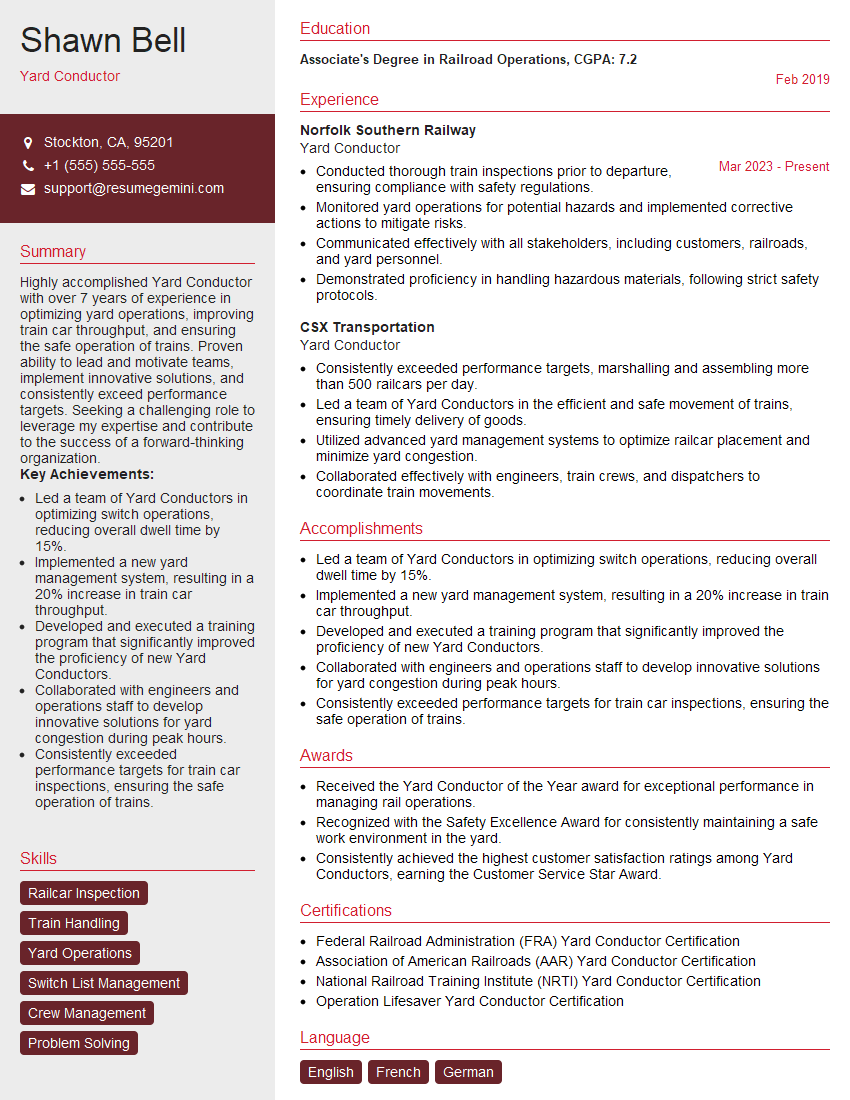
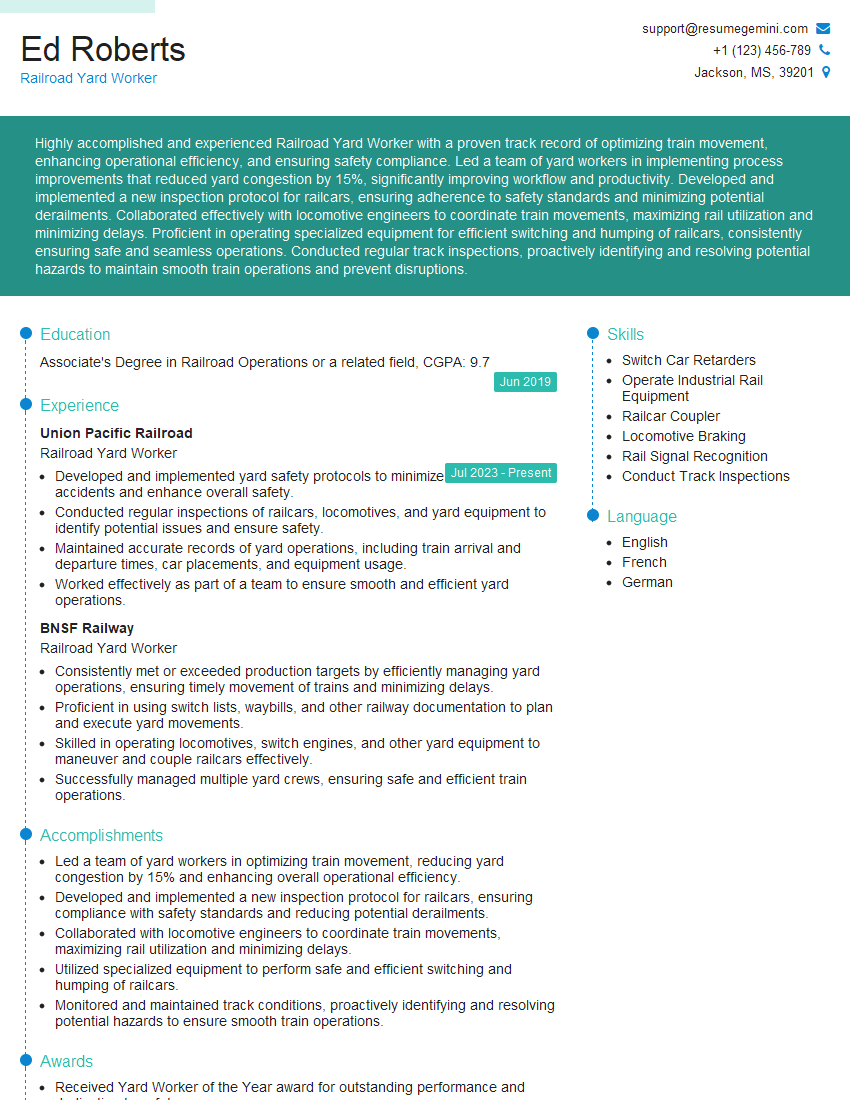
Mastering the operation of train yard equipment is crucial for a successful and rewarding career in the rail industry. It opens doors to advancement opportunities and positions of increased responsibility. To maximize your job prospects, it’s essential to create a compelling and ATS-friendly resume that highlights your skills and experience effectively. ResumeGemini is a trusted resource that can help you build a professional resume that stands out. They provide examples of resumes tailored to Operating Train Yard Equipment to guide you through the process. Invest the time to build a strong resume; it’s your first impression on potential employers.

Explore more articles
Users Rating of Our Blogs
Share Your Experience
We value your feedback! Please rate our content and share your thoughts (optional).
What Readers Say About Our Blog
Really detailed insights and content, thank you for writing this detailed article.
IT gave me an insight and words to use and be able to think of examples