Every successful interview starts with knowing what to expect. In this blog, we’ll take you through the top Automation System Integration interview questions, breaking them down with expert tips to help you deliver impactful answers. Step into your next interview fully prepared and ready to succeed.
Questions Asked in Automation System Integration Interview
Q 1. Explain the difference between a PLC and a PAC.
While both PLCs (Programmable Logic Controllers) and PACs (Programmable Automation Controllers) are used for industrial automation, they differ significantly in their capabilities and applications. Think of a PLC as a specialized, highly reliable muscle car – excellent for repetitive tasks and precise control in a defined environment. A PAC, on the other hand, is more like a versatile SUV – capable of handling various tasks, integrating diverse systems, and operating in more complex environments.
Specifically, PLCs excel at discrete control – switching things on and off, managing machinery with precise timing and sequencing. They are typically optimized for fast I/O (input/output) processing and deterministic real-time operation. PACs, however, incorporate advanced features like integrated motion control, embedded networking, and sophisticated data processing capabilities. They often include operating systems with more extensive programming options and can handle complex control algorithms and data analysis. A PLC might control a single machine on a factory floor, while a PAC might orchestrate an entire production line, integrating vision systems, robotics, and sophisticated data analytics.
- PLC: Optimized for speed and deterministic real-time control, limited processing power, focused on discrete I/O.
- PAC: More powerful processing, open architecture, integrated motion control, advanced communication capabilities, suitable for complex applications and integration.
Q 2. Describe your experience with various communication protocols (e.g., Modbus, Profibus, Ethernet/IP).
Throughout my career, I’ve worked extensively with a variety of communication protocols, each suited for different needs and applications. My experience spans from older, fieldbus protocols like Modbus and Profibus to modern Ethernet-based protocols like Ethernet/IP and PROFINET. Let’s delve into each:
- Modbus: A simple, widely adopted serial communication protocol, known for its ease of implementation and compatibility across various vendors. I’ve utilized it in many projects involving simple data acquisition and control, particularly with older equipment where Ethernet-based solutions weren’t feasible or cost-effective.
- Profibus: A more robust fieldbus protocol, especially suited for demanding industrial applications that require high speed and reliability. In a past project involving a large automated packaging line, Profibus provided the backbone for seamless communication between various PLCs, sensors, and actuators. Its deterministic nature was crucial for maintaining synchronized operation.
- Ethernet/IP: An increasingly popular Ethernet-based protocol, particularly in North American industrial settings. It’s highly flexible and scalable, offering advanced features like integrated diagnostics and CIP (Common Industrial Protocol) for seamless device integration. I’ve used it in several projects involving sophisticated SCADA systems, integrating multiple PLCs, HMIs, and other intelligent devices.
My proficiency extends to configuring and troubleshooting these protocols, handling issues like addressing, baud rates, and network configurations.
Q 3. How do you troubleshoot communication issues in an automation system?
Troubleshooting communication issues requires a systematic approach. I typically start with the most straightforward checks and progressively delve deeper if needed. Think of it like diagnosing a medical issue: you start with simple tests before moving to more complex ones. My approach is structured as follows:
- Visual Inspection: Check cables, connectors, and hardware for physical damage. A loose wire or a bad connector is often the culprit.
- Network Diagnostics: Use network analyzers or built-in diagnostics to check for network connectivity, signal strength, and error rates. Identifying packet loss or high latency can pinpoint communication bottlenecks.
- Protocol-Specific Tests: Utilize protocol-specific tools to verify communication between devices. For example, for Modbus, I might use a Modbus scanner to check if the devices respond correctly. For Ethernet/IP, I’d employ tools like a network analyzer to examine traffic and identify faulty nodes.
- Device-Specific Diagnostics: Consult device manuals and utilize built-in diagnostic tools to check for errors or faults within individual devices, like a PLC or sensor.
- Software Review: If hardware is functioning correctly, check the software configuration for any mismatches in settings (addressing, baud rate, protocol parameters).
This methodical process has consistently helped me efficiently identify and resolve communication issues in diverse automation systems. For instance, in one project, a seemingly complex network problem boiled down to a misconfigured IP address on a single sensor, which only became clear following the above systematic steps.
Q 4. What are your experiences with different HMI software packages?
My experience encompasses a range of HMI (Human-Machine Interface) software packages, including Rockwell Automation FactoryTalk View SE/ME, Siemens WinCC, and Schneider Electric Vijeo Designer. Each package possesses strengths tailored to specific needs and system architectures.
- FactoryTalk View SE/ME: I’ve extensively used FactoryTalk View for its seamless integration with Rockwell Automation PLCs. Its intuitive interface and powerful scripting capabilities make it suitable for complex visualization and control applications. I especially appreciate its alarm management and historical data logging features.
- Siemens WinCC: WinCC is a robust and scalable solution commonly found in large-scale industrial applications. I’ve used it in projects involving complex process visualization and control, leveraging its powerful database connectivity and reporting capabilities.
- Schneider Electric Vijeo Designer: Vijeo Designer is a user-friendly package, ideal for smaller to medium-sized applications. Its ease of use and compatibility with Schneider Electric PLCs make it a good option for projects requiring quicker implementation.
My experience also includes developing custom HMI applications, tailoring them to specific client needs and integrating them seamlessly with the underlying automation system.
Q 5. Describe your experience with SCADA system design and implementation.
SCADA (Supervisory Control and Data Acquisition) system design and implementation involves a holistic approach, covering every aspect from initial requirements gathering to ongoing maintenance. It’s like building a complex house, needing detailed blueprints, carefully selected materials, and skilled craftsmanship.
My experience encompasses the entire SCADA lifecycle:
- Requirements Gathering and System Design: I work closely with clients to understand their needs and develop functional specifications, choosing appropriate hardware and software components.
- Database Design: I design and implement relational or historical databases for storing and managing critical process data. This ensures reliable data logging and historical analysis capabilities.
- HMI Development: I develop custom HMIs providing clear visualizations of process parameters, allowing operators to monitor and control the system effectively.
- PLC Programming and Integration: I program PLCs to interact with field devices, implementing control logic and communication protocols. This involves creating robust, reliable code that meets safety and performance requirements.
- Testing and Commissioning: Thorough testing and commissioning are crucial to ensure the system operates as intended and meets performance requirements. This often involves simulation and real-world testing.
- Maintenance and Support: I’m involved in maintaining and supporting the SCADA system throughout its lifecycle, providing troubleshooting, upgrades, and ongoing support.
A recent project involved designing and implementing a SCADA system for a water treatment plant, requiring robust data logging, alarm management, and remote monitoring capabilities – a project that required close attention to detail and knowledge of regulatory requirements.
Q 6. Explain your understanding of safety standards in automation (e.g., IEC 61131-3).
Safety standards in automation are paramount, ensuring the safety of personnel and equipment. IEC 61131-3, a widely recognized standard, defines programming languages for PLCs, promoting code clarity, portability, and maintainability. It’s like having a standardized recipe for building reliable and safe automation systems.
My understanding of IEC 61131-3 extends to its various programming languages (Ladder Diagram, Function Block Diagram, Structured Text, Instruction List, Sequential Function Chart) and how to apply them effectively. In addition, I’m familiar with other crucial safety standards, including:
- IEC 61508: Focuses on functional safety, defining the processes for identifying hazards and implementing safety-related systems.
- ISO 13849: Covers safety requirements for machinery and related control systems.
I incorporate safety considerations at every stage of a project, from risk assessments during the design phase to implementing safety-related functions within the control system. For instance, in a robotic application, safety protocols are critically important, requiring emergency stops, safety light curtains, and interlocks to prevent accidents. Adherence to these standards is non-negotiable, guaranteeing the safety and reliability of the automation systems.
Q 7. How do you approach the integration of legacy systems into a modern automation system?
Integrating legacy systems into modern automation systems requires a careful, strategic approach. It’s akin to renovating an old house while preserving its historical charm while updating it for modern living. Here’s my approach:
- Assessment and Documentation: Thoroughly document the legacy system’s functionality, communication protocols, and hardware limitations. Understanding the existing system is crucial for successful integration.
- Communication Protocol Mapping: Determine how to map the legacy system’s communication protocols to the modern system. This may involve using gateways or protocol converters to bridge the communication gap.
- Data Conversion: If necessary, design a strategy to convert data formats between the legacy and modern systems, handling potential differences in data types and units.
- Interface Design: Design an interface to link the legacy system with the modern control system, which will involve careful selection of hardware (gateways, converters) and software (middleware, drivers).
- Testing and Validation: Thoroughly test the integration to ensure seamless communication and data transfer. This involves simulating various scenarios to verify the system’s behavior.
- Phased Implementation: Instead of a complete system replacement, consider a phased implementation. Replace parts of the system progressively, minimizing downtime and risk.
In one project, we successfully integrated a legacy PLC system using a gateway that translated the older Modbus RTU protocol into the modern Ethernet/IP protocol. This allowed for seamless integration with the new system without requiring a complete system overhaul.
Q 8. What are your experiences with different types of industrial sensors and actuators?
My experience encompasses a wide range of industrial sensors and actuators, from basic proximity switches and limit switches to sophisticated vision systems and robotic arms. I’ve worked extensively with various sensor technologies including:
- Temperature sensors: Thermocouples, RTDs (Resistance Temperature Detectors), and thermistors for monitoring process temperatures in applications like chemical reactors and ovens.
- Pressure sensors: Strain gauge, capacitive, and piezoelectric sensors used in pressure control systems for hydraulics and pneumatics.
- Flow sensors: Magnetic flow meters, ultrasonic flow meters, and Coriolis flow meters for monitoring and controlling fluid flow in pipelines and processing equipment.
- Level sensors: Ultrasonic, radar, and capacitive sensors for measuring the level of liquids and solids in tanks and silos.
- Vision systems: Cameras and image processing software for tasks such as part inspection, robotic guidance, and quality control.
On the actuator side, I’ve worked with:
- Pneumatic actuators: Cylinders and valves controlled by compressed air, commonly found in material handling and robotic systems.
- Hydraulic actuators: Cylinders and motors driven by hydraulic fluid, often used in heavy-duty machinery and robotics.
- Electric actuators: Motors, servos, and stepper motors for precise and controlled movement in various applications. This includes working with various motor control techniques, such as PID control.
In one project, I integrated a vision system with a robotic arm to automate the picking and placing of irregularly shaped parts, a task requiring precise calibration and sophisticated control algorithms. The project involved careful selection of sensors and actuators based on factors such as accuracy, speed, and environmental robustness.
Q 9. Explain your experience with version control systems in automation projects.
Version control is paramount in automation projects, ensuring collaboration, traceability, and preventing conflicts. My primary experience is with Git, using platforms like GitHub and GitLab. I’ve used Git to manage code for PLC programs, HMI (Human-Machine Interface) designs, and SCADA (Supervisory Control and Data Acquisition) system configurations. For example, in a recent project involving the migration of a legacy SCADA system, Git allowed multiple engineers to work concurrently on different aspects of the update while maintaining a complete history of changes. Branching and merging features were essential in this complex process. This ensured that any issues could be tracked and resolved efficiently, preventing significant downtime.
Beyond Git, I am familiar with other version control concepts such as Subversion (SVN) and understand their principles, although Git is my preferred system due to its distributed nature and flexibility.
Q 10. Describe your experience with different programming languages used in automation (e.g., Ladder Logic, Structured Text).
I’m proficient in several programming languages commonly used in automation, including:
- Ladder Logic (LD): This is my most widely used language for PLC programming, especially for simpler control logic. I’m adept at designing and debugging ladder logic diagrams for various industrial applications. For instance, I recently designed a ladder logic program to control a conveyor belt system with multiple sensors and actuators, ensuring efficient material flow.
- Structured Text (ST): I use structured text for more complex algorithms and data manipulation within PLCs. It allows for more readable and maintainable code compared to ladder logic for advanced control strategies. A recent example involved developing a sophisticated PID control algorithm in structured text for a temperature control system.
- Function Block Diagram (FBD): I also have experience with FBD, especially for visualizing and debugging complex control systems.
- Sequential Function Chart (SFC): I use SFC to program sequential processes effectively, improving readability and maintainability.
Furthermore, I have experience with scripting languages like Python for tasks such as data analysis, system integration, and testing of automation systems. This allows me to automate repetitive tasks and perform more complex data processing.
Q 11. How do you ensure the cybersecurity of an automation system?
Cybersecurity is a critical concern in automation systems. My approach involves a multi-layered strategy encompassing:
- Network Segmentation: Isolating different parts of the automation system to limit the impact of a potential breach.
- Firewall Implementation: Using firewalls to control network access and block unauthorized connections.
- Intrusion Detection/Prevention Systems (IDS/IPS): Monitoring network traffic for suspicious activity and automatically blocking threats.
- Regular Software Updates and Patching: Keeping all components of the system up-to-date with the latest security patches to address known vulnerabilities.
- Access Control: Implementing strict access control policies, using strong passwords and multi-factor authentication where appropriate, to limit access to sensitive system components. Role-Based Access Control (RBAC) is essential here.
- Security Audits and Penetration Testing: Regularly assessing the system’s security posture through audits and penetration testing to identify and address vulnerabilities.
- Vulnerability Management: Employing a system for tracking and addressing discovered security flaws.
A real-world example is implementing a VPN (Virtual Private Network) to secure remote access to a SCADA system, combined with regular security audits and penetration testing to ensure the system’s continuous protection.
Q 12. What is your experience with industrial network security protocols?
I have experience with several industrial network security protocols, including:
- PROFINET: A widely used industrial Ethernet protocol offering robust security features like authentication and encryption.
- EtherNet/IP: Another popular industrial Ethernet protocol with integrated security capabilities.
- Modbus TCP/IP: A common protocol that, while not inherently secure, can be secured through the implementation of additional security measures such as VPNs and firewalls.
- Profibus: A fieldbus protocol used widely in industrial automation. Security considerations involve physical security and proper network configuration.
In a recent project, we implemented PROFINET with secure authentication and encryption to protect communication between PLCs and the supervisory system. This prevented unauthorized access and ensured the integrity of the data transmitted across the network. The selection of the appropriate protocol is crucial, taking into account factors such as security needs, performance requirements, and existing infrastructure.
Q 13. Explain your approach to testing and validating an automation system.
My approach to testing and validating an automation system is systematic and follows a phased approach:
- Unit Testing: Individual components (sensors, actuators, software modules) are tested independently to verify their functionality.
- Integration Testing: Tested components are integrated and tested together to ensure seamless interaction.
- System Testing: The complete system is tested under simulated and real-world conditions to verify overall performance and compliance with specifications. This often includes factory acceptance testing (FAT) and site acceptance testing (SAT).
- User Acceptance Testing (UAT): End-users test the system to ensure it meets their requirements and is user-friendly.
Throughout the testing process, rigorous documentation is maintained, and any identified bugs or issues are tracked and resolved using a bug tracking system. Automated testing wherever possible helps accelerate the process and enhance reliability. For example, in a recent project, we used automated scripts to verify the performance of a robotic welding system under various operating conditions.
Q 14. How do you handle unexpected downtime or equipment failures in an automation system?
Handling unexpected downtime or equipment failures requires a proactive and reactive approach:
- Redundancy and Failover Mechanisms: Implementing redundant components and failover mechanisms to ensure system availability in case of failure. This might involve using dual PLCs or backup power supplies.
- Predictive Maintenance: Utilizing data analytics and sensor data to predict potential equipment failures and schedule maintenance proactively, preventing unplanned downtime.
- Remote Monitoring and Diagnostics: Implementing remote monitoring and diagnostic capabilities to quickly identify and diagnose problems. This might involve using SCADA systems with remote access and alarming.
- Emergency Procedures: Developing and regularly testing emergency procedures to quickly restore operations in case of unexpected failures.
- Root Cause Analysis: Conducting thorough root cause analysis after each failure to identify underlying issues and prevent future occurrences.
For instance, I once implemented a redundant PLC system for a critical process in a manufacturing plant. When one PLC failed, the other seamlessly took over control, minimizing production downtime. The failure was thoroughly analyzed, and improvements were made to prevent similar occurrences in the future. This involved identifying the component failure and evaluating whether improvements to equipment maintenance or design would prevent similar incidents in the future.
Q 15. Describe your experience with project management methodologies in automation projects.
Throughout my career, I’ve extensively utilized various project management methodologies in automation projects, adapting my approach based on project scope, complexity, and client needs. I’m proficient in Agile, Scrum, and Waterfall methodologies. For instance, in a recent project involving the automation of a packaging line, we employed Scrum’s iterative approach. This allowed us to deliver incremental value quickly, adapt to changing requirements, and maintain close collaboration with the client throughout the process. Each sprint focused on a specific deliverable, from PLC programming to HMI development and robotic integration. Regular sprint reviews and retrospectives ensured continuous improvement and timely issue resolution. In larger, more complex projects, a hybrid approach combining Agile and Waterfall elements might be more suitable, leveraging Waterfall’s structured approach for the initial phases and Agile for ongoing development and adaptation.
In smaller, less complex projects, a simpler Waterfall approach might suffice, providing a clear and linear path from requirements gathering to implementation and testing. Regardless of the methodology used, I prioritize clear communication, risk management, and meticulous documentation throughout the project lifecycle to ensure successful delivery and client satisfaction.
Career Expert Tips:
- Ace those interviews! Prepare effectively by reviewing the Top 50 Most Common Interview Questions on ResumeGemini.
- Navigate your job search with confidence! Explore a wide range of Career Tips on ResumeGemini. Learn about common challenges and recommendations to overcome them.
- Craft the perfect resume! Master the Art of Resume Writing with ResumeGemini’s guide. Showcase your unique qualifications and achievements effectively.
- Don’t miss out on holiday savings! Build your dream resume with ResumeGemini’s ATS optimized templates.
Q 16. Explain your experience with different types of industrial robots and their integration.
My experience encompasses a wide range of industrial robots, including articulated robots (like those from Fanuc and ABB), SCARA robots (for assembly applications), and delta robots (for high-speed picking and placing). I’ve integrated these robots into various systems using different communication protocols such as EtherCAT, Profinet, and Modbus TCP. For example, in one project, we integrated a six-axis articulated robot from ABB into a palletizing system. This involved programming the robot’s control unit (the robot controller) to interact with a PLC (Programmable Logic Controller) that managed the overall system flow, including conveyor belts and sensors. The PLC acted as the brains of the operation, coordinating the movements of the robot with the other components. The robot’s precise movements were programmed using robot-specific programming languages such as RAPID (for ABB robots).
Another project involved integrating several SCARA robots into a high-speed assembly line. Here, the challenge was optimizing the robots’ movements to maximize throughput and minimize cycle times. This required careful consideration of factors such as robot kinematics, path planning algorithms, and synchronization with other machines on the line. We used simulation software to optimize the robot trajectories before deploying them on the actual production line, reducing the time spent on site commissioning and troubleshooting.
Q 17. What is your understanding of cloud-based automation systems?
Cloud-based automation systems offer significant advantages such as scalability, remote accessibility, and data analytics capabilities. They leverage cloud computing resources to host automation software, data storage, and processing functionalities. This allows for flexible scaling of resources based on demand and reduces the need for on-site infrastructure. For example, a manufacturing company can use a cloud-based platform to monitor and control their production line remotely, accessing real-time data and making adjustments as needed. This also enables predictive maintenance by analyzing sensor data from the machines in the cloud.
Security is a paramount concern in cloud-based automation systems. Robust security measures, including encryption, access controls, and regular security audits, are essential to protect sensitive data and prevent unauthorized access. Choosing a reputable cloud provider with strong security credentials is crucial. The integration of cloud-based systems with on-premise equipment requires careful planning and implementation to ensure secure communication and data exchange. Often this involves VPNs and other secure network configurations.
Q 18. Describe your experience with data acquisition and analysis in automation systems.
Data acquisition and analysis are fundamental aspects of automation systems. I have experience using various methods to collect data from different sources, including PLCs, sensors, and robots. This data is then processed and analyzed to optimize system performance, detect anomalies, and provide valuable insights into production processes. We often use Supervisory Control and Data Acquisition (SCADA) systems to collect and visualize real-time data from various points within an automation system.
For example, in a recent project involving a water treatment plant, we collected data from various sensors (pressure, flow rate, pH levels) using a SCADA system. This data was then analyzed to identify patterns and anomalies. We utilized statistical analysis and machine learning techniques to predict equipment failures and optimize the plant’s operational efficiency. Data visualization tools were used to present the data in a user-friendly format, enabling operators to easily monitor the plant’s performance and identify any issues. The insights derived from data analysis enabled us to improve the overall reliability and efficiency of the water treatment plant.
Q 19. How do you ensure the scalability and maintainability of an automation system?
Ensuring scalability and maintainability is crucial for the long-term success of any automation system. Scalability refers to the system’s ability to handle increased workloads or expand its functionality without significant performance degradation. Maintainability refers to the ease with which the system can be repaired, upgraded, or modified. Modular design is a key principle for achieving both scalability and maintainability. By breaking down the system into independent modules, it’s easier to replace, upgrade, or modify individual components without affecting the entire system.
Using standardized components and protocols also improves maintainability. This makes it easier to find replacement parts and integrate new technologies. Comprehensive documentation, including design specifications, code comments, and operational procedures, is essential for effective maintenance and troubleshooting. Regular system backups and disaster recovery planning are also crucial for ensuring business continuity. We also utilize version control systems for software and configuration files, allowing us to track changes and revert to previous versions if necessary. This ensures that the system can be easily maintained and updated over its lifetime.
Q 20. Explain your experience with different types of industrial control systems.
My experience spans a variety of industrial control systems (ICS), including Programmable Logic Controllers (PLCs) from various manufacturers such as Siemens, Allen-Bradley, and Schneider Electric, Distributed Control Systems (DCS) frequently used in process industries, and Supervisory Control and Data Acquisition (SCADA) systems used for monitoring and controlling large-scale industrial processes. I’m familiar with their different architectures, communication protocols, and programming languages.
For example, in one project involving a large-scale manufacturing facility, we used a DCS to control and monitor numerous interconnected processes. The DCS’s distributed architecture ensured high reliability and fault tolerance. In another project, we employed PLCs to automate a smaller-scale assembly line, programming them using ladder logic. The selection of the appropriate ICS is based on various factors, including the complexity of the process, the required level of control, and the budget. Understanding the strengths and limitations of different ICS architectures is essential for choosing the most suitable solution for a given application. Expertise in various communication protocols (like Modbus, Profibus, Ethernet/IP) is crucial for successful integration and interoperability between different components within the automation system.
Q 21. Describe your experience with simulation and virtual commissioning of automation systems.
Simulation and virtual commissioning are invaluable tools in the development and testing of automation systems. Simulation software allows us to create a virtual model of the automation system, enabling us to test and optimize the system’s design and functionality before deploying it in the real world. This reduces the risk of errors and delays during commissioning and startup. Virtual commissioning involves testing the control software in a simulated environment, validating its performance and functionality against the design specifications.
For example, in a robotics project, we used simulation software to test the robot’s movements and interactions with other system components before installing the robot on the production floor. This ensured that the robot’s movements were optimized for efficiency and safety. Virtual commissioning allowed us to identify and correct potential issues in the control software early in the development process, minimizing costly rework and delays during the actual commissioning phase. This approach reduces the time required for on-site commissioning, minimizes the risk of unexpected issues, and significantly improves the overall efficiency and cost-effectiveness of the project. Software like Rockwell Automation’s FactoryTalk Simulation, Siemens PLCSIM, and ABB RobotStudio are frequently used in virtual commissioning.
Q 22. How do you manage risks and uncertainties during the implementation of an automation system?
Managing risks and uncertainties in automation system implementation is crucial for project success. My approach involves a proactive, multi-stage process starting with a thorough risk assessment. This involves identifying potential problems—everything from equipment failures and software bugs to delays in vendor delivery and changes in client requirements.
We use a structured methodology like Failure Mode and Effects Analysis (FMEA) to categorize risks by likelihood and impact. High-risk items are then addressed through mitigation strategies. For example, if a critical component has a long lead time, we might order it early or explore alternative suppliers. Contingency planning is key—we develop backup plans for potential problems, such as having alternative software solutions ready or establishing clear escalation paths for resolving issues.
Regular monitoring and reporting are essential. We track progress against the baseline schedule and budget, flagging any deviations early on. This allows us to make timely adjustments and prevent minor problems from escalating into major crises. Finally, post-implementation reviews help us learn from our experiences and improve our risk management processes for future projects.
Q 23. Explain your experience with documentation and maintenance of automation systems.
Documentation and maintenance are paramount for the long-term success of any automation system. I believe in comprehensive, well-structured documentation that includes system architecture diagrams, hardware specifications, software code, configuration files, and operating procedures. This isn’t just about creating documents; it’s about creating a living, breathing repository of knowledge.
We use version control systems like Git to manage documentation revisions, ensuring traceability and facilitating collaboration among team members. The documentation includes detailed explanations of each system component, its function, and its interactions with other parts of the system. We also develop user manuals and training materials that are readily accessible to end-users and maintenance personnel.
Maintenance is equally important. We establish a preventive maintenance schedule, performing regular checks and calibrations to ensure the system’s continued reliable operation. We also have procedures in place for handling unexpected breakdowns and troubleshooting system issues. A key aspect is using a CMMS (Computerized Maintenance Management System) to track maintenance activities, parts inventory, and scheduled work, ensuring all this vital information is easily accessible.
Q 24. Describe your approach to training and supporting end-users on an automation system.
Training and support are critical to the successful adoption of any automation system. My approach focuses on providing tailored training programs designed to meet the specific needs of the end-users. We start with a needs assessment to understand the users’ existing skills and knowledge levels and tailor the training to address any skill gaps.
Training methods typically involve a mix of classroom sessions, hands-on workshops, and online tutorials. We use a phased approach, starting with basic training covering the fundamental aspects of the system and then progressing to more advanced topics as the users become more proficient. We also provide comprehensive user manuals and online help resources to complement the training.
Post-training support is equally important. We provide ongoing technical assistance through various channels such as email, phone, and on-site visits. We often establish a help desk system to handle user inquiries efficiently. Regular feedback sessions with users help us identify areas where improvements to the training or the system itself can be made.
Q 25. What is your understanding of different automation architectures?
Automation architectures vary greatly depending on the application and scale. I have experience with several, including:
- Centralized Architecture: All control logic resides in a central PLC (Programmable Logic Controller) or control system. Simple, but a single point of failure.
- Distributed Architecture: Control is distributed among multiple PLCs or controllers, reducing the risk of a single point of failure and increasing scalability. This is common in large-scale systems.
- Client-Server Architecture: A server manages data and control logic, while clients provide user interfaces and data acquisition. This provides centralized data management and remote access capabilities.
- Modular Architecture: The system is divided into independent modules that can be easily added, removed, or replaced. This enhances flexibility and maintainability.
- Cloud-Based Architecture: Control and data management are hosted in the cloud, offering remote access and scalability advantages. Requires robust security considerations.
Choosing the right architecture requires careful consideration of factors such as system complexity, scalability requirements, safety considerations, and budget constraints.
Q 26. Explain your experience with different types of industrial networks (e.g., fieldbus, Ethernet).
My experience encompasses a range of industrial networks, including both fieldbus and Ethernet-based systems. Fieldbus technologies, such as Profibus, Modbus, and Foundation Fieldbus, are widely used for connecting field devices like sensors and actuators. They’re known for their robustness and suitability for harsh industrial environments.
Ethernet-based networks, such as Industrial Ethernet (PROFINET, EtherCAT, Ethernet/IP), offer higher bandwidth and greater flexibility. They’re ideal for applications requiring high data throughput, such as vision systems or complex control algorithms. I’m proficient in configuring and troubleshooting both types of networks, understanding their protocols and limitations. For instance, I’ve used PROFINET in a large-scale manufacturing facility, leveraging its ability to handle real-time data communication effectively across a large network. For smaller, simpler systems, Modbus’ simplicity and broad compatibility have proved highly effective.
The selection of the appropriate industrial network depends heavily on factors like the number of devices, data rates required, budget, and the existing infrastructure.
Q 27. Describe a challenging automation integration project and how you overcame the challenges.
One challenging project involved integrating a new automated packaging line into an existing, legacy system in a food processing plant. The challenge was integrating the new line’s control system with the plant’s existing, outdated PLC system—a system which lacked comprehensive documentation and had evolved organically over decades. There were communication protocol mismatches, and the lack of proper documentation made troubleshooting extremely difficult.
To overcome this, we first meticulously mapped out the existing system’s functionality, creating detailed diagrams and documentation to replace the missing information. This involved reverse-engineering parts of the system, painstakingly analyzing signal flows and data exchanges. We then developed a gateway system to translate between the new line’s communication protocols and those of the legacy system. This required a deep understanding of both systems and careful programming to ensure seamless data transfer.
Through rigorous testing and phased implementation, we successfully integrated the new line, minimizing downtime and ensuring the plant’s continued operation. The project highlighted the importance of thorough planning, problem-solving skills, and a systematic approach to handling complex legacy systems.
Q 28. How do you stay up-to-date with the latest trends and technologies in automation?
Staying current in the rapidly evolving field of automation requires a multi-pronged approach. I actively participate in industry conferences and workshops, attending seminars and networking with other professionals. This provides valuable insights into the latest trends and technological advancements.
I regularly read industry publications, journals, and online resources, focusing on areas like advanced process control, artificial intelligence (AI) in automation, Industrial Internet of Things (IIoT), and cybersecurity for industrial control systems. I also actively participate in online communities and forums, engaging in discussions and learning from the experiences of others.
Furthermore, I actively seek out opportunities for professional development, including taking online courses and pursuing certifications to keep my skillset updated with new technologies and methodologies. Continuous learning is crucial in this constantly evolving field.
Key Topics to Learn for Automation System Integration Interview
- System Architecture and Design: Understanding different architectures (e.g., client-server, distributed systems) and their implications for automation system integration. Practical application: Designing an integration solution for a manufacturing plant’s SCADA system.
- Communication Protocols: Mastery of various communication protocols (e.g., OPC UA, Modbus, MQTT, AMQP) and their strengths and weaknesses. Practical application: Troubleshooting communication issues between a PLC and a cloud-based monitoring system.
- Data Integration and Transformation: Techniques for extracting, transforming, and loading (ETL) data from diverse sources. Practical application: Building a data pipeline to integrate data from multiple legacy systems into a central data warehouse.
- Security Considerations: Implementing robust security measures to protect automation systems from cyber threats. Practical application: Designing a secure integration solution using authentication and authorization mechanisms.
- Testing and Validation: Developing and executing comprehensive test plans to ensure the reliability and performance of integrated systems. Practical application: Implementing unit, integration, and system tests for an automation project.
- Troubleshooting and Problem-solving: Developing strategies for identifying and resolving issues in complex automation systems. Practical application: Diagnosing and fixing communication errors in a real-time industrial control system.
- Industry Standards and Best Practices: Familiarity with relevant industry standards and best practices for automation system integration. Practical application: Applying ISA-95 standards in a manufacturing automation project.
Next Steps
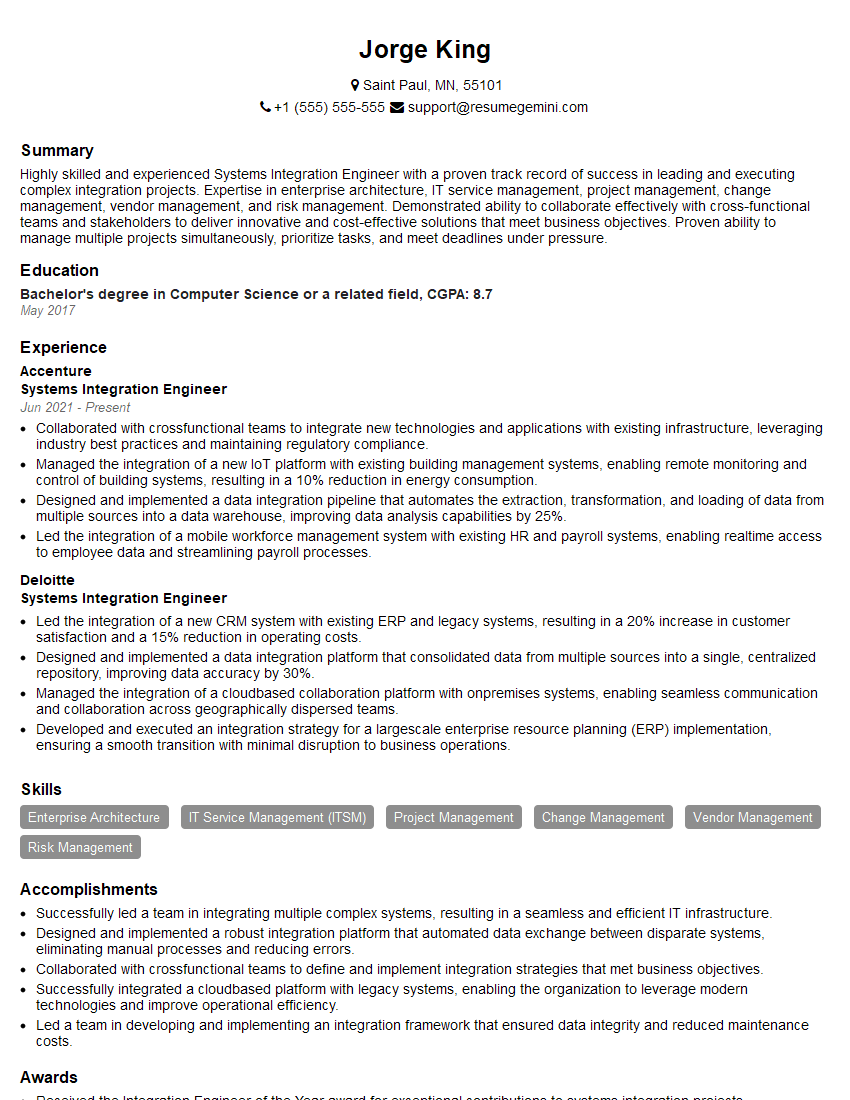
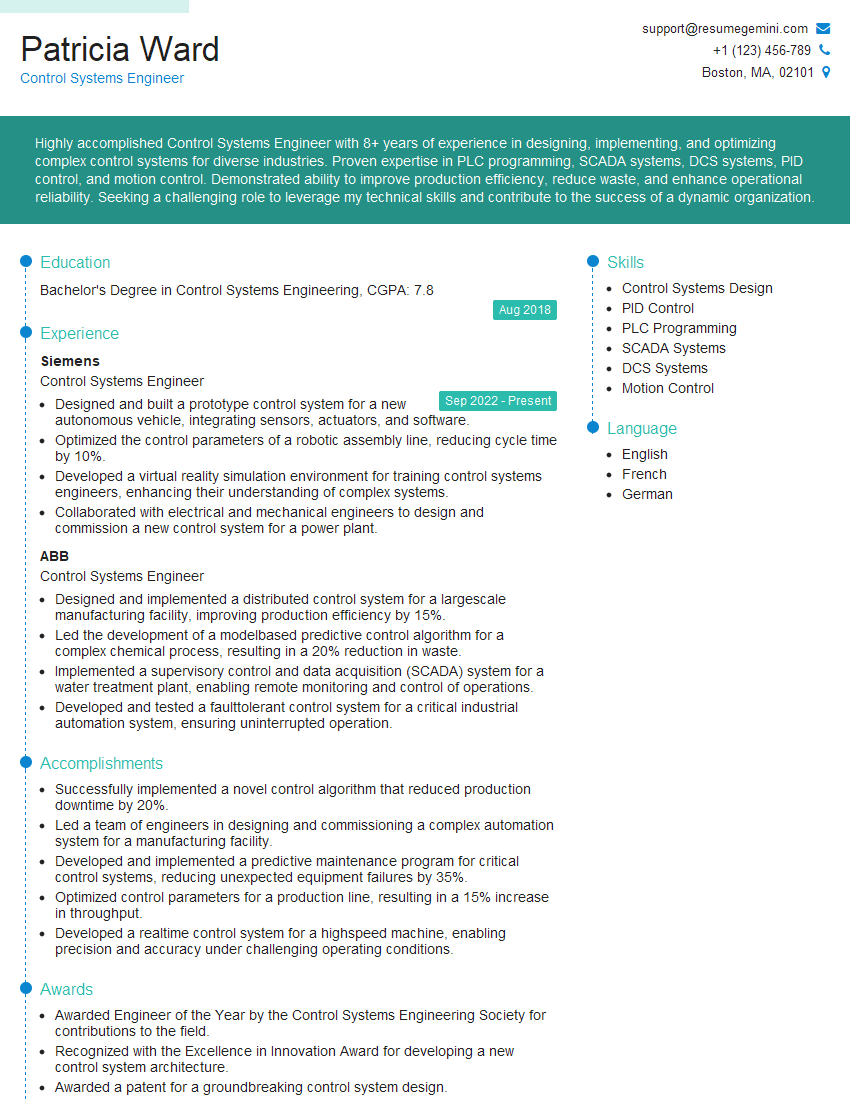
Mastering Automation System Integration opens doors to exciting and rewarding career opportunities in various industries. A strong understanding of these concepts significantly enhances your employability and positions you for advancement in this rapidly growing field. To maximize your job prospects, focus on crafting an ATS-friendly resume that showcases your skills and experience effectively. We highly recommend using ResumeGemini to build a professional and impactful resume. ResumeGemini offers a user-friendly platform and provides examples of resumes tailored to Automation System Integration, helping you present yourself in the best possible light to potential employers.
Explore more articles
Users Rating of Our Blogs
Share Your Experience
We value your feedback! Please rate our content and share your thoughts (optional).
What Readers Say About Our Blog
I Redesigned Spongebob Squarepants and his main characters of my artwork.
https://www.deviantart.com/reimaginesponge/art/Redesigned-Spongebob-characters-1223583608
IT gave me an insight and words to use and be able to think of examples
Hi, I’m Jay, we have a few potential clients that are interested in your services, thought you might be a good fit. I’d love to talk about the details, when do you have time to talk?
Best,
Jay
Founder | CEO