Unlock your full potential by mastering the most common Materials Science and Analysis interview questions. This blog offers a deep dive into the critical topics, ensuring you’re not only prepared to answer but to excel. With these insights, you’ll approach your interview with clarity and confidence.
Questions Asked in Materials Science and Analysis Interview
Q 1. Explain the difference between crystalline and amorphous materials.
The key difference between crystalline and amorphous materials lies in the arrangement of their constituent atoms or molecules. Crystalline materials exhibit a highly ordered, three-dimensional arrangement of atoms or molecules forming a repeating pattern extending over long distances. Think of it like a perfectly stacked box of oranges – each orange (atom) sits in a precise location relative to its neighbors. This ordered structure gives rise to distinct crystallographic planes and directions, impacting their properties significantly.
Amorphous materials, on the other hand, lack this long-range order. Their atoms or molecules are randomly arranged, much like a pile of oranges dumped haphazardly. Examples include glass, rubber, and many polymers. This disordered structure results in isotropic properties – meaning properties are the same in all directions.
Examples: Quartz (crystalline) has a well-defined melting point and displays anisotropic properties (different properties along different axes). Glass (amorphous), however, softens gradually over a temperature range and shows isotropic behavior.
Q 2. Describe the process of tensile testing and its significance in materials characterization.
Tensile testing is a fundamental materials characterization technique where a specimen is subjected to a controlled tensile force (pulling force) until it breaks. A machine meticulously measures the applied force and the resulting elongation of the specimen. This data is used to construct a stress-strain curve, which reveals crucial information about the material’s mechanical behavior.
The significance lies in its ability to determine key mechanical properties, including:
- Yield Strength: The stress at which the material begins to deform plastically (permanently).
- Tensile Strength (Ultimate Tensile Strength): The maximum stress the material can withstand before failure.
- Elongation: The extent of plastic deformation before fracture.
- Young’s Modulus (Elastic Modulus): A measure of the material’s stiffness or resistance to elastic deformation.
These properties are essential for selecting materials suitable for specific applications. For instance, a structural component needs high tensile strength and yield strength to resist breaking under load, while a component requiring flexibility might require high elongation.
Q 3. What are the different types of microscopy used in materials analysis, and what are their respective advantages and limitations?
Several microscopy techniques are employed in materials analysis, each with unique strengths and limitations:
- Optical Microscopy: Uses visible light to produce images. It’s relatively simple and inexpensive, ideal for observing surface features and larger microstructures. However, its resolution is limited by the wavelength of light (around 200 nm).
- Scanning Electron Microscopy (SEM): Employs a focused beam of electrons to scan the surface, generating high-resolution images. It offers excellent surface detail and can perform elemental analysis using Energy-Dispersive X-ray Spectroscopy (EDS). However, samples usually require special preparation and are viewed in vacuum.
- Transmission Electron Microscopy (TEM): Uses a beam of electrons transmitted through a very thin specimen to achieve atomic-level resolution. It’s exceptionally powerful for studying crystal structure and defects, but sample preparation is extremely challenging and expensive.
- Atomic Force Microscopy (AFM): A scanning probe microscopy technique that uses a sharp tip to scan the surface, creating images with atomic resolution. AFM can be used in various environments (air, liquids) and doesn’t require extensive sample preparation, but imaging speed is usually slower than SEM.
The choice of microscopy depends on the specific material, the scale of features of interest, and the information required.
Q 4. Explain the concept of phase diagrams and their application in materials selection.
A phase diagram is a graphical representation of the equilibrium relationships between phases (solid, liquid, gas) in a material system as a function of temperature, composition, and pressure (most commonly, temperature and composition). It’s like a map guiding us through the various states a material can exist in under different conditions.
Their application in materials selection is crucial. For instance, understanding the phase diagram of a steel alloy allows us to predict the microstructure (e.g., austenite, ferrite, pearlite) at different temperatures. This microstructure directly impacts mechanical properties. We can select a specific composition and heat treatment to achieve the desired combination of strength, ductility, and toughness. Phase diagrams are invaluable in the development of new materials and processing techniques.
Example: The iron-carbon phase diagram helps engineers design various steels with tailored properties by controlling the carbon content and heat treatment.
Q 5. How does grain size affect the mechanical properties of a material?
Grain size, the average size of the crystallites (grains) in a polycrystalline material, significantly influences its mechanical properties. Smaller grains generally lead to higher strength and hardness but lower ductility (ability to deform before fracturing). This is due to the Hall-Petch effect: grain boundaries act as obstacles to dislocation movement (crystal defects that cause plastic deformation). More grain boundaries in fine-grained materials impede dislocation motion, requiring a greater stress to initiate plastic deformation.
Conversely, larger grains result in lower strength and hardness, and increased ductility because dislocations can move more easily through the fewer grain boundaries.
Example: A fine-grained steel will be stronger and harder than a coarse-grained steel of the same composition.
Q 6. Describe the different types of bonding in materials (ionic, covalent, metallic, etc.).
Materials are held together by various types of chemical bonding, each with distinct characteristics:
- Ionic Bonding: Involves the electrostatic attraction between oppositely charged ions formed by the transfer of electrons from one atom (typically a metal) to another (typically a non-metal). Example: Sodium chloride (NaCl), where sodium loses an electron to become a positive ion and chlorine gains it to become a negative ion.
- Covalent Bonding: Characterized by the sharing of electrons between atoms. This type of bond is commonly found in non-metallic materials. Example: Diamond, where carbon atoms share electrons to form a strong, three-dimensional network.
- Metallic Bonding: Involves a ‘sea’ of delocalized electrons surrounding positively charged metal ions. The electrons are not associated with a specific atom but are free to move throughout the material. This accounts for the high electrical and thermal conductivity of metals. Example: Copper, where valence electrons are free to move within the copper lattice.
- Van der Waals Bonding: Weak interatomic forces resulting from temporary fluctuations in electron distribution. This type of bond is important in some polymers and molecular crystals. Example: interactions between molecules in a plastic.
The type of bonding dictates many material properties, including melting point, hardness, electrical conductivity, and thermal conductivity.
Q 7. What is the difference between hardness and toughness?
Hardness and toughness are both important mechanical properties but represent different aspects of a material’s ability to resist deformation and fracture.
Hardness refers to a material’s resistance to localized plastic deformation (indentation or scratching). A hard material is difficult to scratch or dent. Think of a diamond – it’s exceptionally hard.
Toughness represents a material’s ability to absorb energy and plastically deform before fracturing. A tough material can withstand significant impact or deformation without breaking. Consider a ductile metal like steel, which can undergo significant plastic deformation before failure.
A material can be hard but not tough (e.g., brittle ceramics are hard but have low toughness). Conversely, a tough material doesn’t necessarily have to be hard (e.g., some polymers are tough but relatively soft). The ideal combination depends on the application: a cutting tool needs high hardness, while a structural component requires high toughness.
Q 8. Explain the concept of fatigue failure in materials.
Fatigue failure is a progressive and localized structural damage that occurs when a material is subjected to cyclic loading. Imagine repeatedly bending a paperclip back and forth – eventually, it will break, not because of the force of a single bend, but because of the cumulative effect of many cycles. This is fatigue. The stress levels involved in each cycle are often well below the material’s ultimate tensile strength (the maximum stress it can withstand before breaking in a single application). The process initiates with microscopic crack formation at stress concentrations (like surface imperfections or inclusions), which propagate slowly over many cycles, ultimately leading to catastrophic failure. The number of cycles to failure depends heavily on the material’s properties, the magnitude of the cyclic stress, and the environment.
Factors influencing fatigue failure:
- Material Properties: Yield strength, tensile strength, ductility, and microstructure significantly impact fatigue life.
- Stress Level: Higher stress amplitudes lead to faster crack propagation and shorter fatigue life.
- Cycle Frequency: Higher frequencies can accelerate fatigue damage.
- Surface Finish: Surface roughness and defects act as stress concentrators, initiating cracks.
- Environment: Corrosive environments can accelerate crack growth.
Real-world example: Fatigue failure is a major concern in aircraft design, where components experience thousands of stress cycles during flight. Regular inspections and careful material selection are crucial to prevent catastrophic failures.
Q 9. What are the common causes of corrosion and how can it be prevented?
Corrosion is the deterioration of a material, usually a metal, due to a chemical or electrochemical reaction with its environment. Think of rust on a car – that’s corrosion in action. It’s a significant concern in many industries, leading to equipment failure, safety hazards, and economic losses.
Common causes of corrosion:
- Exposure to oxygen and moisture: This is the most common cause, leading to oxidation (like rust).
- Exposure to acids or bases: These chemicals can react with metals, causing significant damage.
- Electrochemical corrosion: This occurs when two dissimilar metals are in contact in the presence of an electrolyte (like saltwater). One metal acts as an anode (corroding) and the other as a cathode.
- Stress corrosion cracking: A combination of tensile stress and a corrosive environment can lead to crack formation and failure.
Corrosion prevention methods:
- Protective Coatings: Painting, plating (e.g., galvanizing), and anodizing create a barrier between the metal and the environment.
- Corrosion Inhibitors: Chemicals added to the environment to slow down the corrosion rate.
- Material Selection: Choosing corrosion-resistant materials (e.g., stainless steel) is a crucial preventative measure.
- Cathodic Protection: A technique where a more active metal is connected to the protected metal, acting as a sacrificial anode.
- Design Modifications: Avoiding sharp corners and crevices where corrosion can concentrate.
Example: Bridges are often protected from corrosion by galvanizing (coating with zinc), which acts as a sacrificial anode, protecting the steel structure.
Q 10. Describe different techniques used for surface analysis (e.g., XPS, Auger, SEM).
Surface analysis techniques provide information about the elemental composition, chemical state, and morphology of a material’s surface. These techniques are vital in many fields, from materials science and engineering to biology and chemistry.
X-ray Photoelectron Spectroscopy (XPS): XPS uses X-rays to excite core-level electrons in the surface atoms. By measuring the kinetic energy of these emitted electrons, we can identify the elements present and determine their chemical states. It’s highly surface-sensitive, probing only the top few nanometers.
Auger Electron Spectroscopy (AES): Similar to XPS, AES also uses an electron beam to excite core-level electrons. However, it detects Auger electrons, which provide complementary information about the surface composition. It offers higher spatial resolution than XPS.
Scanning Electron Microscopy (SEM): SEM uses a focused electron beam to scan the surface of a material. The interactions of the electrons with the sample generate signals (secondary electrons, backscattered electrons) that are used to create high-resolution images of the surface topography and morphology. It can also be combined with energy-dispersive X-ray spectroscopy (EDS) to obtain elemental information.
In summary: XPS provides chemical state information, AES offers high spatial resolution, and SEM provides high-resolution images of surface morphology. They are often used together for a comprehensive surface characterization.
Q 11. Explain the principle behind X-ray diffraction (XRD) and its applications in materials science.
X-ray diffraction (XRD) is a powerful technique based on the constructive interference of X-rays scattered from a crystalline material. When X-rays of a specific wavelength are incident on a crystalline sample, they diffract according to Bragg’s Law: nλ = 2d sinθ, where n is an integer, λ is the X-ray wavelength, d is the interplanar spacing of the crystal lattice, and θ is the angle of incidence.
Constructive interference occurs only at specific angles, resulting in diffraction peaks in the XRD pattern. The positions and intensities of these peaks provide information about the crystal structure, lattice parameters, phase composition, and crystallite size of the material.
Applications in materials science:
- Phase identification: Comparing the XRD pattern to a database of known materials can identify the phases present in a sample.
- Crystal structure determination: The positions and intensities of the diffraction peaks can be used to determine the crystal structure.
- Lattice parameter determination: Precise measurements of peak positions can determine the lattice parameters.
- Crystallite size determination: The width of the diffraction peaks can be used to estimate the average crystallite size.
- Residual stress measurement: Slight shifts in peak positions can indicate the presence of residual stresses.
Example: XRD is commonly used to identify different polymorphs of a material (different crystal structures of the same chemical composition) or to confirm the formation of a new phase after a heat treatment.
Q 12. What are the common techniques used for thermal analysis (e.g., DSC, TGA)?
Thermal analysis techniques measure the physical and chemical changes that occur in a material as a function of temperature. These methods provide valuable insights into material properties and behavior at different temperatures.
Differential Scanning Calorimetry (DSC): DSC measures the heat flow associated with phase transitions (melting, crystallization, glass transition) and chemical reactions in a material as a function of temperature. It can be used to determine melting points, glass transition temperatures, and heat capacities.
Thermogravimetric Analysis (TGA): TGA measures the weight change of a material as a function of temperature. This is useful for determining the amount of volatile components in a material (e.g., water, organic solvents), studying decomposition reactions, and analyzing the thermal stability of materials.
Other techniques: Other thermal analysis methods include Thermomechanical Analysis (TMA), which measures dimensional changes, and Dilatometry, which measures volume changes.
Example: TGA is often used to determine the moisture content of a polymer or to study the decomposition of a composite material.
Q 13. How would you determine the composition of an unknown material?
Determining the composition of an unknown material requires a multi-pronged approach using several analytical techniques. The specific methods depend on the suspected nature of the material (metal, polymer, ceramic, composite) and the level of detail required.
Step-by-step approach:
- Visual Inspection: Start with a visual examination – color, texture, shape, etc. can provide clues.
- Density Measurement: A simple density measurement can narrow down possibilities.
- Elemental Analysis: Techniques like Energy-Dispersive X-ray Spectroscopy (EDS), coupled with SEM, or Inductively Coupled Plasma Optical Emission Spectrometry (ICP-OES) are excellent for determining elemental composition.
- X-ray Diffraction (XRD): This can identify crystalline phases present, revealing both the elemental composition and crystal structure.
- Spectroscopic Techniques: Infrared (IR) spectroscopy, Raman spectroscopy, or Nuclear Magnetic Resonance (NMR) can provide information about the chemical bonds and functional groups present, especially useful for polymers and organic materials.
- Thermal Analysis: Techniques like DSC and TGA can provide information about phase transitions, decomposition, and volatile content.
The choice of techniques will depend on the specific information needed and the nature of the unknown material. Often, a combination of techniques is required for a complete characterization.
Example: If you suspect a metallic alloy, EDS and XRD would be excellent starting points. For an unknown polymer, IR and NMR spectroscopy along with TGA would be more appropriate.
Q 14. Describe different types of polymers and their properties.
Polymers are large molecules composed of repeating structural units called monomers. Their properties vary dramatically depending on the type of monomer, the arrangement of monomers in the chain, and the degree of polymerization (the number of monomers in the chain).
Types of polymers and their properties:
- Thermoplastics: These polymers soften upon heating and can be repeatedly molded without undergoing chemical change. Examples include polyethylene (PE), polypropylene (PP), and polystyrene (PS). They are generally flexible and relatively low in strength.
- Thermosets: These polymers undergo irreversible chemical changes upon heating, forming a rigid, cross-linked network. Examples include epoxy resins and phenolic resins. They are typically strong, rigid, and have high heat resistance.
- Elastomers: These polymers exhibit high elasticity and can be stretched to several times their original length. Examples include natural rubber and silicone rubber. They have low strength but high elasticity.
- Addition Polymers: Formed by the addition of monomers without the loss of any atoms. Polyethylene (PE) is a prime example.
- Condensation Polymers: Formed by the reaction of monomers with the elimination of a small molecule, like water. Nylon and polyester are common examples.
Examples of properties: The properties of polymers can be tailored by modifying their structure, such as adding fillers, plasticizers, or cross-linking agents. This allows for the creation of polymers with specific properties for various applications.
Example: High-density polyethylene (HDPE) is a strong, rigid thermoplastic used in bottles and pipes, while low-density polyethylene (LDPE) is a more flexible thermoplastic used in plastic bags.
Q 15. Explain the concept of diffusion in materials.
Diffusion in materials is the movement of atoms or molecules from a region of high concentration to a region of low concentration. Think of it like a drop of food coloring spreading out in a glass of water. This process is driven by the second law of thermodynamics, which favors increased entropy (disorder). The rate of diffusion depends on several factors, including temperature, the type of material, and the concentration gradient.
- Temperature: Higher temperatures increase atomic/molecular kinetic energy, leading to faster diffusion.
- Material Type: Crystalline materials typically exhibit slower diffusion than amorphous materials due to the ordered arrangement of atoms in the crystal lattice. The presence of defects like grain boundaries also significantly affects diffusion rates.
- Concentration Gradient: A steeper concentration gradient leads to faster diffusion, as there’s a larger driving force for the atoms or molecules to move.
Diffusion is crucial in many material processes, including solid-state reactions, doping semiconductors, and the heat treatment of metals. For instance, the hardening of steel involves the diffusion of carbon atoms into the iron lattice.
Career Expert Tips:
- Ace those interviews! Prepare effectively by reviewing the Top 50 Most Common Interview Questions on ResumeGemini.
- Navigate your job search with confidence! Explore a wide range of Career Tips on ResumeGemini. Learn about common challenges and recommendations to overcome them.
- Craft the perfect resume! Master the Art of Resume Writing with ResumeGemini’s guide. Showcase your unique qualifications and achievements effectively.
- Don’t miss out on holiday savings! Build your dream resume with ResumeGemini’s ATS optimized templates.
Q 16. How do you interpret a stress-strain curve?
A stress-strain curve graphically depicts the relationship between the applied stress (force per unit area) and the resulting strain (deformation) in a material. It provides valuable information about the material’s mechanical properties. A typical curve shows several regions:
- Elastic Region: In this initial region, the material deforms elastically, meaning it returns to its original shape once the stress is removed. The slope of this region represents the Young’s modulus (a measure of stiffness).
- Yield Point: This point marks the transition from elastic to plastic deformation. Beyond this point, the material will experience permanent deformation even after the stress is removed. The yield strength is a crucial design parameter.
- Plastic Region: In this region, the material undergoes permanent deformation. The curve may show strain hardening (increased strength with increasing strain) followed by necking (localization of deformation).
- Ultimate Tensile Strength: This is the maximum stress the material can withstand before failure.
- Fracture Point: This is the point where the material breaks.
By analyzing the stress-strain curve, engineers can determine a material’s suitability for a given application. For example, a material with high yield strength is desirable for structural components requiring high load-bearing capacity.
Q 17. What are the challenges in designing and manufacturing nano-materials?
Designing and manufacturing nanomaterials present several unique challenges:
- Synthesis and Control: Precisely controlling the size, shape, and composition of nanomaterials is extremely challenging. Techniques like chemical vapor deposition (CVD) and sol-gel methods are used, but achieving uniform properties across large quantities remains a hurdle.
- Characterization: Characterizing the structure and properties of nanomaterials requires sophisticated techniques like transmission electron microscopy (TEM), scanning probe microscopy (SPM), and X-ray diffraction (XRD). Analyzing these materials at the nanoscale is complex and demands specialized expertise.
- Scalability: Scaling up the production of nanomaterials from laboratory quantities to industrial levels is often difficult and costly. Maintaining consistency in quality and properties during scaling-up is crucial.
- Toxicity and Environmental Impact: The potential toxicity and environmental impact of certain nanomaterials are still under investigation. Ensuring safe handling and disposal of nanomaterials is paramount.
- Self-Assembly and Aggregation: Controlling the self-assembly of nanomaterials into desired structures and preventing unwanted aggregation is a significant challenge.
Overcoming these challenges is critical for realizing the full potential of nanomaterials in various applications, such as electronics, medicine, and energy.
Q 18. Describe different types of composites and their applications.
Composites are materials made from two or more constituent materials with significantly different properties. The combination results in a material with enhanced properties compared to the individual components. Some common types include:
- Fiber-reinforced polymers (FRP): These consist of fibers (e.g., carbon, glass, aramid) embedded in a polymer matrix (e.g., epoxy, polyester). They are lightweight, strong, and stiff, finding applications in aerospace, automotive, and construction industries. Carbon fiber reinforced polymers (CFRP) are used extensively in high-performance applications.
- Particle-reinforced composites: These have particles (e.g., ceramic, metal) dispersed in a matrix. Examples include concrete (aggregate in cement) and metal matrix composites (MMC) used in high-temperature applications.
- Laminates: These are made by bonding together layers of different materials, such as plywood (layers of wood veneer) or composite laminates used in aircraft structures.
- Cermet composites: These combine ceramic and metallic components to combine the advantages of both material classes, often featuring high hardness and strength at elevated temperatures.
The choice of composite type depends on the desired properties and application. For example, high-strength, lightweight components would necessitate an FRP, while high-temperature applications might require a MMC or cermet.
Q 19. How would you select a material for a specific application (e.g., high-temperature use)?
Selecting a material for a specific application, such as high-temperature use, requires a systematic approach. Consider these factors:
- Operating Temperature: The material must retain its desired properties (strength, stability, etc.) at the operating temperature. High-temperature materials often include refractory metals (e.g., tungsten, molybdenum), superalloys (nickel-based alloys), and ceramics (e.g., silicon carbide, alumina).
- Oxidation Resistance: At high temperatures, materials can oxidize, degrading their properties. Coatings or alloying additions can enhance oxidation resistance.
- Creep Resistance: Creep is the time-dependent deformation at elevated temperatures. Materials with high creep resistance are essential for high-temperature applications. Superalloys are known for superior creep strength.
- Thermal Shock Resistance: The ability to withstand rapid temperature changes is crucial in certain applications. Ceramics generally exhibit better thermal shock resistance than metals.
- Cost and Availability: The cost and availability of the material must be considered, particularly for large-scale applications.
A systematic selection process involves comparing the properties of candidate materials against the requirements and selecting the material that best meets all criteria. Software tools and databases can assist in this process.
Q 20. Explain the concept of creep and its effect on materials.
Creep is the time-dependent permanent deformation of a material under sustained stress at elevated temperatures. Imagine a metal wire slowly stretching over time under a constant weight at high temperature. It’s different from plastic deformation, which occurs relatively quickly. Creep occurs because atoms can migrate more easily at high temperatures, allowing for slow, continuous deformation.
The rate of creep is affected by several factors:
- Temperature: Higher temperatures accelerate creep.
- Stress: Higher applied stress leads to faster creep.
- Material Properties: The microstructure and composition of the material greatly influence its creep resistance. Materials with fine grain sizes and high melting points typically exhibit better creep resistance.
Creep can have detrimental effects on materials, leading to component failure in high-temperature applications such as gas turbines and power plants. Careful material selection and design considerations are essential to mitigate the effects of creep.
Q 21. Discuss the importance of material selection in product design.
Material selection plays a critical role in product design. The choice of material directly impacts the product’s:
- Performance: The material’s mechanical, thermal, electrical, and chemical properties determine the product’s functionality and performance. For example, selecting a high-strength steel for a bridge ensures its load-bearing capacity.
- Cost: Material costs contribute significantly to the overall product cost. Balancing performance requirements with cost-effectiveness is crucial.
- Durability: The material’s resistance to corrosion, wear, and degradation impacts the product’s lifespan. Choosing corrosion-resistant materials for outdoor applications is essential for longevity.
- Manufacturing: The material’s processability (ease of fabrication) influences the manufacturing process and cost. Materials that are difficult to machine or weld increase manufacturing complexity.
- Sustainability: The environmental impact of material extraction, processing, and disposal should be considered. Choosing recyclable or biodegradable materials promotes sustainability.
A well-informed material selection process leads to optimized product design, enhancing performance, reducing costs, and minimizing environmental impact. This process often involves using material property databases, design tools, and life-cycle assessments.
Q 22. Explain the difference between elastic and plastic deformation.
Elastic and plastic deformation describe how a material responds to an applied force. Think of it like bending a paperclip: initially, you can bend it and it springs back to its original shape – that’s elastic deformation. The material deforms but recovers its original shape once the stress is removed. This is reversible, governed by Hooke’s Law (stress is proportional to strain within the elastic limit). However, if you bend it too far, it remains bent even after you release the force – that’s plastic deformation. This is permanent deformation, causing a change in the material’s microstructure. The elastic limit, or yield strength, marks the transition point between these two types of deformation. Beyond the yield strength, the material undergoes permanent changes, including dislocation movement, which leads to the irreversible shape change.
Example: A rubber band exhibits significant elastic deformation, returning to its original length after stretching. In contrast, a metal bar bent beyond its yield point will show permanent plastic deformation and remain bent.
Q 23. What are the different types of defects in crystalline materials?
Crystalline materials, unlike amorphous materials, have a regular, repeating atomic arrangement. Defects disrupt this perfect order, significantly influencing material properties. These defects can be classified into several categories:
- Point Defects: These are localized imperfections involving a few atoms. Examples include:
- Vacancies: Missing atoms from their lattice sites.
- Interstitials: Extra atoms squeezed into the lattice structure.
- Substitutional: An atom of a different element occupying a lattice site.
- Line Defects (Dislocations): These are one-dimensional defects, essentially irregularities in the atomic arrangement along a line. The most common are edge and screw dislocations, which profoundly affect a material’s ductility and strength.
- Planar Defects: These are two-dimensional defects, including:
- Grain Boundaries: Interfaces between different crystal grains in a polycrystalline material.
- Stacking Faults: Errors in the stacking sequence of atomic planes.
- Twin Boundaries: Regions where the crystal structure is mirrored across a plane.
- Volume Defects: These are three-dimensional defects, such as voids, cracks, or inclusions (foreign particles).
Understanding these defects is crucial because they affect mechanical properties like strength, ductility, and fracture toughness. For example, dislocations facilitate plastic deformation in metals.
Q 24. Describe the role of grain boundaries in material properties.
Grain boundaries are interfaces separating individual crystal grains in a polycrystalline material. They act as barriers to dislocation movement, impacting mechanical properties. The size and orientation of the grains influence the overall material behavior.
- Strength: Grain boundaries impede dislocation motion, increasing the material’s strength. Smaller grains mean more grain boundaries, leading to higher strength (Hall-Petch relationship).
- Ductility: Grain boundaries can act as crack initiation sites, reducing ductility. However, controlled grain size can improve ductility by providing alternative paths for dislocation movement.
- Corrosion Resistance: Grain boundaries can be preferential sites for corrosion, since they represent higher energy regions.
- Electrical Conductivity: Grain boundaries can scatter electrons, thereby reducing electrical conductivity in some materials.
Example: Annealing, a heat treatment process, can control grain size. Larger grains lead to lower strength and higher ductility, whereas smaller grains increase strength and reduce ductility. This principle is exploited in manufacturing to tailor material properties for specific applications.
Q 25. How would you analyze a failed component to determine the cause of failure?
Analyzing a failed component requires a systematic approach. It involves a combination of visual inspection, material characterization techniques, and fracture analysis to pinpoint the cause of failure. The steps typically include:
- Visual Inspection: Observe the fracture surface for clues such as crack initiation points, direction of crack propagation, and evidence of overload or fatigue.
- Macroscopic Examination: Examine the overall dimensions, shape, and any visible defects on the component.
- Microscopic Analysis: Use optical microscopy, scanning electron microscopy (SEM), or transmission electron microscopy (TEM) to investigate the microstructure, identify defects, and analyze the fracture surface at higher magnification.
- Chemical Analysis: Employ techniques like energy-dispersive X-ray spectroscopy (EDS) or X-ray diffraction (XRD) to determine the chemical composition and identify any phase changes or corrosion products.
- Mechanical Testing: Conduct tensile tests, hardness tests, or impact tests on the remaining material to assess its mechanical properties and compare them to the specified values.
- Fracture Analysis: Interpret the fracture surface features to determine the type of fracture (ductile, brittle, fatigue) and the underlying cause.
By combining these analytical techniques, we can identify the root cause of the failure, whether it’s due to material defects, design flaws, manufacturing issues, or environmental factors.
Q 26. What is the significance of material testing standards (e.g., ASTM)?
Material testing standards, such as those published by ASTM International (American Society for Testing and Materials), are crucial for ensuring consistency, reliability, and comparability in material testing and characterization. These standards provide detailed procedures and specifications for various testing methods, ensuring that results are reproducible across different laboratories and organizations.
Significance:
- Standardization: ASTM standards define standard test methods, sample preparation, and data reporting, guaranteeing consistent results worldwide.
- Quality Control: They are essential for quality control and quality assurance in manufacturing processes, enabling manufacturers to verify that their materials meet specific requirements.
- Comparability: ASTM standards allow engineers and scientists to compare material properties obtained from different sources and using different equipment.
- Legal Compliance: Adherence to ASTM standards is often necessary for legal compliance and product certification.
Example: ASTM E8/E8M standard defines the standard test methods for tensile testing of metallic materials, providing detailed specifications on sample dimensions, testing machine requirements, and data analysis procedures.
Q 27. Describe your experience with specific materials characterization techniques.
My experience encompasses a wide range of materials characterization techniques. I am proficient in using:
- Scanning Electron Microscopy (SEM): Used extensively for microstructural analysis, surface morphology studies, and elemental composition analysis (using EDS).
- X-ray Diffraction (XRD): For phase identification, crystal structure determination, and residual stress measurement.
- Transmission Electron Microscopy (TEM): For high-resolution imaging of microstructure, including crystal defects and interfaces. I’ve used TEM extensively to study nanomaterials.
- Mechanical Testing: I’m experienced in performing tensile testing, hardness testing, and impact testing to evaluate mechanical properties.
- Thermal Analysis: Including Differential Scanning Calorimetry (DSC) and Thermogravimetric Analysis (TGA), for studying phase transitions and thermal stability.
For instance, in a recent project involving the failure analysis of a turbine blade, I utilized SEM-EDS to identify the presence of oxide layers that contributed to the crack initiation and propagation. In another project, XRD was crucial in confirming the desired crystalline structure of a newly developed alloy.
Key Topics to Learn for Materials Science and Analysis Interview
- Crystallography and Diffraction: Understanding crystal structures, diffraction techniques (XRD, etc.), and their application in material characterization. Consider exploring different crystal systems and their properties.
- Mechanical Properties of Materials: Familiarize yourself with concepts like stress, strain, elasticity, plasticity, fracture toughness, and fatigue. Be prepared to discuss how these properties relate to material microstructure and processing.
- Phase Diagrams and Transformations: Mastering phase diagrams (e.g., iron-carbon diagram) and understanding phase transformations (e.g., solidification, precipitation hardening) is crucial. Be ready to interpret and apply these concepts to real-world scenarios.
- Material Selection and Design: Learn how to choose appropriate materials based on required properties and application constraints. Discuss factors such as cost, availability, and environmental impact.
- Materials Characterization Techniques: Go beyond XRD; explore techniques like SEM, TEM, AFM, and various spectroscopy methods (e.g., XPS, AES). Understand their principles and applications in analyzing material structure and composition.
- Thermodynamics and Kinetics of Materials: A strong understanding of these principles is vital for explaining material behavior at different temperatures and timescales. Focus on how these principles influence processing and properties.
- Polymer Science (if applicable): Depending on your specialization, brush up on polymer chemistry, polymer morphology, and the mechanical and thermal properties of polymers.
- Computational Materials Science (if applicable): If relevant to your experience, be prepared to discuss your familiarity with computational techniques used to predict and analyze material properties.
Next Steps
Mastering Materials Science and Analysis opens doors to exciting and impactful careers in various industries. A strong foundation in these areas significantly enhances your problem-solving abilities and makes you a highly sought-after candidate. To further strengthen your job prospects, creating a compelling and ATS-friendly resume is essential. ResumeGemini is a trusted resource to help you build a professional resume that highlights your skills and experience effectively. Examples of resumes tailored to Materials Science and Analysis are available, providing you with valuable templates and inspiration to craft your own standout application.

Corrosion Engineer Resume Sample

Materials Engineer Resume Sample

Metallurgist Resume Sample

Spectroscopist Resume Sample

Electron Microscopist Resume Sample

Analytical Chemist Resume Sample

Materials Scientist Resume Sample

Senior Materials Scientist Resume Sample
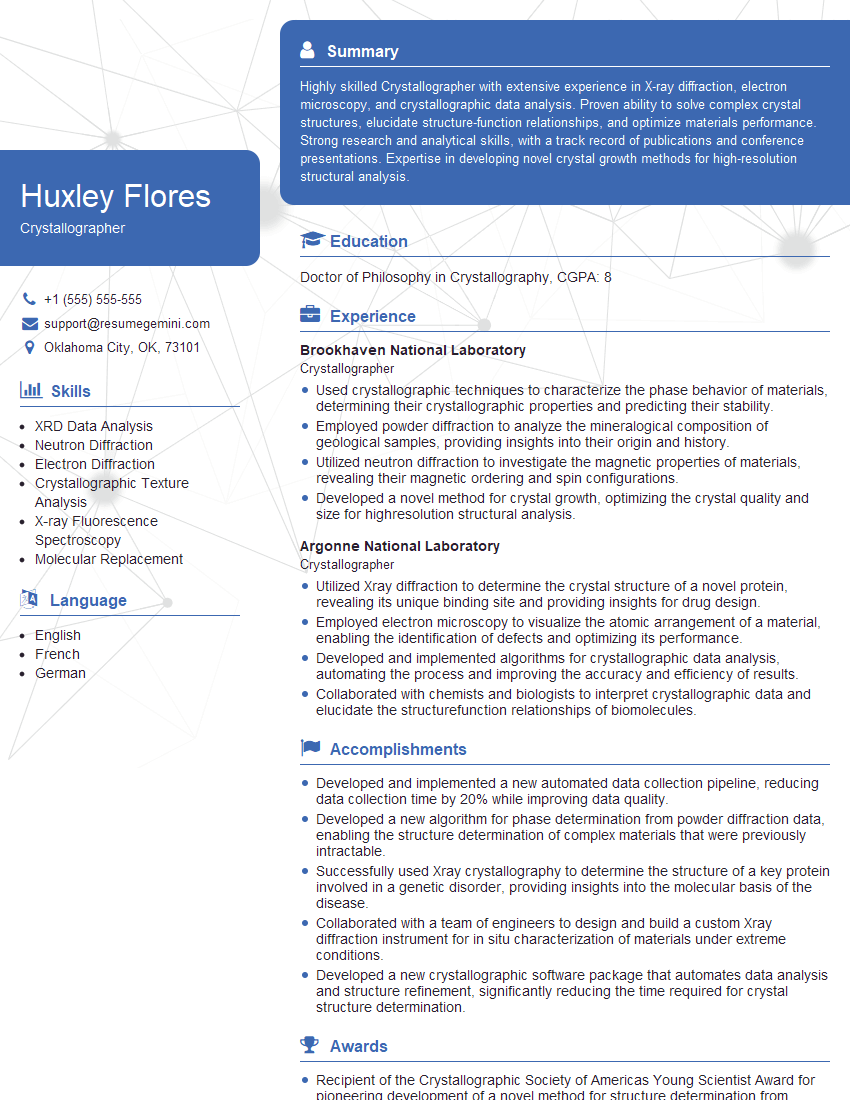
Crystallographer Resume Sample
Explore more articles
Users Rating of Our Blogs
Share Your Experience
We value your feedback! Please rate our content and share your thoughts (optional).
What Readers Say About Our Blog
Really detailed insights and content, thank you for writing this detailed article.
IT gave me an insight and words to use and be able to think of examples