The right preparation can turn an interview into an opportunity to showcase your expertise. This guide to Exam Evaluation interview questions is your ultimate resource, providing key insights and tips to help you ace your responses and stand out as a top candidate.
Questions Asked in Exam Evaluation Interview
Q 1. Explain the difference between norm-referenced and criterion-referenced testing.
Norm-referenced and criterion-referenced tests serve vastly different purposes. Imagine a race: a norm-referenced test is like ranking runners against each other – who finished first, second, etc. It focuses on comparing individual performance to the performance of a larger group (the norm group). The score reflects an individual’s relative standing within that group, often expressed as percentiles or standard scores. Think of standardized achievement tests like the SAT or ACT. Your score is compared to the scores of all other students who took the test.
A criterion-referenced test, on the other hand, is like measuring whether a runner met a specific time goal, regardless of the other runners’ performance. It focuses on assessing an individual’s mastery of specific skills or knowledge, defined by a predetermined standard or criterion. The score reflects the extent to which the individual has met that standard, often expressed as a percentage of items answered correctly. A driver’s license exam is a good example – you need to demonstrate competency regardless of how others perform.
In short: norm-referenced tests compare individuals to a group; criterion-referenced tests compare individuals to a predetermined standard.
Q 2. Describe the process of item analysis for multiple-choice questions.
Item analysis for multiple-choice questions is a crucial step in evaluating test quality. It helps identify which questions are effective and which need improvement. The process typically involves calculating two key indices for each item: difficulty and discrimination.
Difficulty Index: This measures the proportion of examinees who answered the item correctly. A difficulty index of 0.5 indicates that 50% of the test-takers got the item right. An index closer to 1 means the item was too easy; closer to 0 means it was too difficult. Ideally, you want a balance of item difficulties across the test.
Discrimination Index: This measures how well the item differentiates between high-performing and low-performing examinees. It often involves comparing the performance of the top 27% and the bottom 27% of students. A higher discrimination index (closer to 1) signifies that the item effectively separates those who understand the concept from those who don’t. A negative discrimination index suggests the item may be flawed, possibly with a misleadingly worded question or wrong answer key.
Process:
- Collect data: Gather the responses of all examinees for each item.
- Calculate the difficulty index for each item: Divide the number of correct answers by the total number of examinees.
- Calculate the discrimination index for each item: Common methods include comparing the proportion of correct answers in the top and bottom groups, using point-biserial correlation, or other statistical techniques.
- Analyze the results: Items with low difficulty or discrimination indices need review and potential revision.
For example, an item with a difficulty index of 0.9 and a discrimination index of 0.2 suggests the item is too easy and doesn’t effectively distinguish between high and low achievers. It might need to be made more challenging or replaced.
Q 3. What are some common methods for assessing test reliability?
Test reliability refers to the consistency of a test’s results. A reliable test will produce similar scores if administered multiple times under similar conditions. Several methods exist to assess reliability:
Test-Retest Reliability: The same test is administered to the same group on two separate occasions. High correlation between the two sets of scores indicates high test-retest reliability. This method is suitable for measuring stable traits but is vulnerable to practice effects or changes over time.
Parallel Forms Reliability: Two equivalent versions of the test are administered to the same group. High correlation between the scores on the two forms indicates high parallel forms reliability. This method avoids practice effects but requires creating two equivalent forms, which can be challenging.
Internal Consistency Reliability: This assesses the consistency of items within a single test administration. Common methods include Cronbach’s alpha, which measures the overall consistency of items in a test, and split-half reliability, which correlates scores on two halves of the test. High internal consistency indicates that the items are measuring the same underlying construct.
Inter-rater Reliability: When subjective scoring is involved (e.g., essay exams), inter-rater reliability assesses the consistency of scores among different raters. High inter-rater reliability indicates that different raters would give similar scores to the same responses.
The choice of method depends on the nature of the test and the resources available.
Q 4. How do you ensure test validity?
Test validity refers to the extent to which a test measures what it is intended to measure. Ensuring validity is paramount, as an invalid test, no matter how reliable, is useless. Several strategies enhance test validity:
Content Validity: This involves ensuring that the test content adequately represents the domain being measured. Experts in the field review the test items to judge their relevance and comprehensiveness.
Criterion-Related Validity: This examines the relationship between test scores and an external criterion. Concurrent validity assesses the relationship between test scores and a criterion measured at the same time. Predictive validity assesses how well the test predicts future performance on a related criterion (e.g., using a college entrance exam to predict college GPA).
Construct Validity: This involves establishing evidence that the test measures the theoretical construct it’s designed to measure. This is often done through convergent and discriminant validity studies, examining the relationships between the test scores and other measures that should (convergent) or should not (discriminant) be related.
Establishing validity is an ongoing process involving careful planning, item selection, and rigorous evaluation. For example, a test designed to assess problem-solving skills needs to include items that genuinely require problem-solving abilities, not just rote memorization. Additionally, the test’s scores should correlate with other measures of problem-solving skills (convergent validity) and not correlate with measures of unrelated constructs (discriminant validity).
Q 5. Explain the concept of standard error of measurement.
The standard error of measurement (SEM) quantifies the amount of error inherent in a test score. It reflects the variability you would expect to see if the same individual took the test multiple times. A smaller SEM indicates higher precision, while a larger SEM indicates greater uncertainty.
Imagine shooting arrows at a target. The SEM is like the spread of the arrows around the bullseye. A tight grouping indicates low SEM (high precision), while a scattered grouping indicates high SEM (low precision). A test score is just an estimate of a person’s true score; the SEM helps understand the margin of error around that estimate.
The SEM is calculated using the test’s reliability coefficient (e.g., Cronbach’s alpha) and the test’s standard deviation. It is used to construct confidence intervals around an obtained score, giving a range within which the true score likely lies. For instance, a student gets a score of 80 on a test with an SEM of 3. A 95% confidence interval might be 74-86, indicating that we are 95% confident the student’s true score falls within that range.
Q 6. What are some strategies for minimizing test bias?
Test bias occurs when a test unfairly disadvantages certain groups of examinees due to factors unrelated to the construct being measured. Minimizing bias requires careful attention to several aspects of test development and administration:
Item analysis: Conduct thorough item analysis to identify items that show differential item functioning (DIF), meaning the item performs differently for different groups (e.g., males vs. females, different ethnic groups) even when controlling for overall ability.
Content review: Use diverse review panels representing the target population to scrutinize items for potential bias. Ensure items are free from culturally specific references, gender stereotypes, or other factors that could disadvantage specific groups.
Language use: Use clear and concise language that is accessible to all examinees. Avoid idioms, jargon, or culturally loaded terms.
Format and administration: Ensure the test format and administration procedures are fair and equitable for all examinees. Consider providing accommodations for individuals with disabilities.
Equating: Use statistical methods to equate different forms of the test if parallel versions are used, making sure different versions are genuinely comparable.
Ongoing monitoring and evaluation of test performance across different groups are essential to identify and address potential sources of bias.
Q 7. How do you interpret item difficulty and discrimination indices?
Item difficulty and discrimination indices, as discussed earlier, are key indicators of item quality.
Item Difficulty Index: A higher difficulty index (closer to 1) indicates an easier item; a lower index (closer to 0) indicates a harder item. An index of 0.5 indicates that 50% of test-takers answered correctly. Ideally, you want a range of difficulty levels to adequately assess different skill levels, although a balanced spread is more important than a strict target for each item’s difficulty index.
Item Discrimination Index: This index reflects how well an item distinguishes between high and low achievers. A higher index (closer to 1) suggests good discrimination; the item is more likely to be answered correctly by high-achieving students. A low or negative index suggests a poor item – it may be ambiguous, poorly written, or actually measure something different than intended. A negative discrimination index suggests that low-performing students are more likely to answer correctly than high-performing students, indicating a serious problem with that item.
Together, these indices provide insights into item quality and inform decisions about item revision or replacement. For instance, an item with a high difficulty index (say, 0.9) and a low discrimination index (say, 0.1) suggests the item is too easy and doesn’t effectively differentiate between students. Conversely, an item with a low difficulty index and a low discrimination index might be too hard or poorly written. Ideally, you want items with a moderate difficulty and high discrimination.
Q 8. Discuss different methods for scoring essay questions.
Essay scoring methods vary in complexity, ranging from simple holistic scoring to more analytic approaches. Holistic scoring involves assigning a single overall score based on a general impression of the essay’s quality. Think of it like judging a cake—you consider the overall taste, texture, and presentation to arrive at a single score. This method is efficient but can be subjective. Analytical scoring, conversely, breaks down the essay into specific criteria, such as argumentation, organization, grammar, and style. Each criterion receives a separate score, and these are then summed or averaged to produce a final score. This is akin to grading different aspects of a cake separately (e.g., taste, presentation, creativity) and then combining the scores. A rubric, a detailed scoring guide outlining specific expectations for each criterion, is often used to ensure consistency and fairness in analytical scoring. For example, a rubric might award points for a clear thesis statement, effective use of evidence, and logical argument structure. Some scoring methods even incorporate a combination of holistic and analytical approaches, allowing for a general impression alongside detailed criterion-based evaluation.
Q 9. What are some ethical considerations in exam evaluation?
Ethical considerations in exam evaluation are paramount. Fairness and impartiality are key. Evaluators must avoid bias based on factors such as student identity (gender, race, religion), handwriting quality (irrelevant to content), or prior knowledge of the student. Maintaining anonymity throughout the evaluation process is crucial. Imagine a teacher unintentionally grading a student’s essay more leniently because they know the student personally. This breaches the ethical code of fair and objective evaluation. Another ethical concern involves the proper handling of academic dishonesty. If suspicion of plagiarism or cheating arises, established institutional protocols must be followed, which usually involve investigation and documented reporting. Confidentiality is another key aspect; student scores and evaluations must be treated as confidential information. Furthermore, evaluators have a responsibility to use standardized, reliable scoring methods, ensuring that all students are evaluated according to the same criteria, which minimizes the chances of subjective biases impacting scores.
Q 10. Explain the concept of test fairness.
Test fairness means that all students have an equal opportunity to demonstrate their knowledge and skills on an exam. It’s about ensuring the test itself doesn’t disadvantage any specific group of students. This involves several aspects. First, the content of the test should be relevant to the curriculum and accessible to all students, regardless of their background or learning styles. Imagine a history exam that focuses exclusively on events relevant to a single cultural group; this wouldn’t be fair to students unfamiliar with that context. Second, the language used should be clear and unambiguous, avoiding jargon or overly complex sentence structures that could disadvantage students with weaker language skills. Third, the format of the exam should accommodate different learning styles. For example, offering a variety of question types (multiple-choice, essay, problem-solving) caters to diverse learning preferences. Finally, ensuring equal access to resources and appropriate accommodations (e.g., extra time for students with disabilities) is vital for test fairness. Test fairness isn’t just about the test itself; it’s about creating an environment where all students can perform to their best ability.
Q 11. Describe different types of test formats (e.g., multiple-choice, essay, performance-based).
Exam formats are selected based on the specific learning objectives and assessment needs. Multiple-choice questions are efficient for assessing factual knowledge and are easy to score objectively. However, they may not effectively assess higher-order thinking skills like analysis or synthesis. Essay questions allow for in-depth exploration of a topic, facilitating the assessment of critical thinking, argumentation, and writing skills. However, they are time-consuming to score and can be subjective. Performance-based assessments require students to demonstrate skills through practical application, such as conducting an experiment or creating a presentation. These assess real-world application of knowledge but require more resources and careful planning. Other formats include short-answer questions, fill-in-the-blank, true/false, and matching questions, each with its own strengths and weaknesses. The choice of format depends on the specific learning outcomes and the level of cognitive skills being assessed.
Q 12. What software or tools are you familiar with for exam development and analysis?
I’m familiar with several software tools for exam development and analysis. For example, ExamView is a popular software that allows for the creation of multiple-choice, true/false, and essay exams, with features for randomizing questions and generating answer keys. Respondus is another widely used platform known for its lockdown browser capabilities that enhance exam security and integrity by preventing cheating. For analyzing exam results, statistical software packages such as SPSS or R can provide detailed analysis of student performance, including item analysis (identifying difficult or discriminatory questions), reliability estimates, and correlation analysis. Learning Management Systems (LMS) like Canvas or Blackboard also offer features for creating, administering, and grading online exams, frequently including tools for automated grading of multiple-choice questions and providing feedback to students.
Q 13. How do you handle discrepancies in exam scores?
Discrepancies in exam scores necessitate careful investigation. First, a review of the scoring process is needed. Were consistent scoring rubrics used? Were there any procedural errors during the marking? If the discrepancy is between two different graders, a third, independent evaluator might be needed to provide an objective assessment. For example, if two graders score the same essay significantly differently, a third grader’s score can help determine a more reliable mark. Examining the specific questions involved in the discrepancy can reveal if there is ambiguity in the question wording or if the marking scheme needs clarification. In cases of suspected cheating, the institution’s academic integrity policy would guide further action. Clear documentation of the process, including all scoring records and justifications for adjustments, is crucial for maintaining transparency and accountability. The goal is to resolve the discrepancy fairly and accurately, ensuring all students are treated equitably.
Q 14. How do you ensure the security and integrity of exams?
Ensuring exam security and integrity requires a multi-faceted approach. Secure storage of exam materials, both physical and digital, is critical. Access should be strictly controlled and limited to authorized personnel. During the administration of exams, proctoring plays a crucial role in preventing cheating. This can involve physical supervision in a controlled environment or the use of proctoring software for online exams. The use of different versions of the exam can minimize the chance of copying. Techniques like question randomization can also help reduce the likelihood of cheating. Furthermore, robust methods of plagiarism detection should be implemented if essays or other written assignments are part of the assessment. Finally, regularly updating and reviewing security protocols are essential to address emerging threats and maintain the integrity of the assessment process. A breach of exam security undermines the validity of the results and can have serious academic and ethical implications.
Q 15. Explain the process of developing a rubric for evaluating essays or performance tasks.
Developing a rubric for evaluating essays or performance tasks involves clearly defining the criteria for success. Think of it like a recipe for a perfect essay – it lists all the ingredients (criteria) and how much of each is needed (scoring levels). The process typically involves these steps:
- Identify the key criteria: What are the most important aspects of the essay or task you want to assess? For example, for a history essay, criteria might include historical accuracy, argumentation, use of evidence, and clarity of writing.
- Define scoring levels for each criterion: Establish distinct levels of performance for each criterion, often using a descriptive scale (e.g., Excellent, Good, Fair, Poor). Each level should have a clear definition to reduce scorer bias. For example, ‘Excellent’ for ‘historical accuracy’ might be defined as ‘all facts presented are accurate and appropriately sourced’.
- Develop clear descriptions for each scoring level: For each criterion and scoring level, provide specific examples of student work that would exemplify that level. This helps ensure consistent scoring across different essays.
- Pilot test the rubric: Before using the rubric, have a small group of raters score a sample of essays to check for clarity and consistency in scoring. This iterative process helps refine the rubric for optimal performance.
Example: For an essay on the causes of the American Revolution, a rubric might have criteria like ‘Thesis Statement Clarity,’ ‘Evidence Use,’ and ‘Historical Accuracy,’ each with four levels (Excellent, Good, Fair, Poor) and detailed descriptions of what constitutes each level for each criterion.
Career Expert Tips:
- Ace those interviews! Prepare effectively by reviewing the Top 50 Most Common Interview Questions on ResumeGemini.
- Navigate your job search with confidence! Explore a wide range of Career Tips on ResumeGemini. Learn about common challenges and recommendations to overcome them.
- Craft the perfect resume! Master the Art of Resume Writing with ResumeGemini’s guide. Showcase your unique qualifications and achievements effectively.
- Don’t miss out on holiday savings! Build your dream resume with ResumeGemini’s ATS optimized templates.
Q 16. What is your experience with different types of item response theory (IRT) models?
My experience with Item Response Theory (IRT) models encompasses both 1-parameter (Rasch) and 2-parameter models. I’ve utilized these models extensively in exam analysis and development.
Rasch models are particularly useful for ensuring unidimensionality – that the exam measures only one underlying construct. I’ve applied these to create and analyze exams designed to measure a single skill or knowledge area, such as reading comprehension or basic math skills. They are excellent for identifying poorly functioning items that don’t fit the overall construct.
2-parameter models offer greater flexibility, allowing for variation in both item difficulty and discrimination. I’ve used these in situations where items might vary in their ability to differentiate between high- and low-performing students. For instance, a challenging problem-solving question might discriminate well between top students but be too difficult for lower-performing students. A 2-parameter model helps account for such differences.
My work with IRT extends to adapting and calibrating existing item banks, ensuring that newly created items align with the existing scale and maintain consistent measurement properties over time.
Q 17. Describe your experience with test equating and scaling.
Test equating and scaling are crucial for ensuring fairness and comparability across different exam forms. My experience includes both linear and non-linear equating methods.
I’ve used linear equating when comparing parallel forms of exams, where items are similar in content and difficulty. This method involves a simple linear transformation to align scores across forms. For example, if two tests measure the same construct, a linear transformation allows us to directly compare the scores obtained on each test.
Non-linear equating, which is often more complex, has been applied when dealing with non-parallel forms, where item content and difficulty may differ significantly. In such cases, I’ve employed methods like equipercentile equating to ensure that equivalent raw scores represent the same level of ability across different exam versions. This could be necessary if different versions of a test are administered to different cohorts of students.
Scaling methods, such as IRT-based scaling, are often integrated into the equating process to ensure that scores are placed on a common scale, regardless of the specific exam form or administration. This ensures consistency in score interpretation across various contexts.
Q 18. How do you identify and address potential issues with test instructions or format?
Identifying issues with test instructions or format is critical for ensuring exam validity and fairness. My approach involves a multi-stage process:
- Cognitive walkthroughs: I simulate the test-taker experience, carefully reviewing instructions and format from the student’s perspective. This can reveal ambiguities or confusing wording.
- Pilot testing: Small-scale pilot tests are indispensable. Observing students taking the exam provides invaluable feedback, revealing areas of confusion, unexpected difficulties, or unintended interpretations of instructions. Student feedback is directly solicited and analyzed.
- Item analysis: Analyzing response patterns can highlight problematic items. For example, unexpectedly high or low success rates on a specific item, or a disparity in performance between different groups of students, might indicate problems with clarity or fairness.
- Expert review: Having other subject matter experts or assessment specialists review the exam provides an external perspective and helps to identify potential issues overlooked during individual review.
Addressing identified issues involves revising instructions to enhance clarity, simplifying complex formatting, or replacing confusing items. The goal is to create an exam that is clear, accessible, and easily understood by all test-takers.
Q 19. What is your approach to reviewing and revising exam questions?
My approach to reviewing and revising exam questions is systematic and rigorous. It involves:
- Content review: Ensuring the questions are aligned with the learning objectives and accurately reflect the intended curriculum content.
- Cognitive complexity analysis: Verifying that the questions assess the appropriate level of cognitive skills (e.g., recall, application, analysis). I ensure a balanced distribution of question types to cover various cognitive levels.
- Bias and fairness review: Checking for any potential biases in language, content, or imagery that could disadvantage certain groups of students.
- Technical review: Examining the questions for ambiguity, clarity, and technical accuracy (e.g., correct calculations, appropriate use of terminology).
- Statistical analysis: Conducting item analysis on pilot test data to identify problematic items that show low discrimination or are unexpectedly difficult or easy.
Revisions range from minor edits to wording to complete replacement of items. The ultimate goal is to ensure that the exam is both valid and reliable, providing a fair and accurate assessment of student learning.
Q 20. How do you ensure that an exam accurately measures the intended learning outcomes?
Ensuring that an exam accurately measures the intended learning outcomes requires careful alignment between the exam’s content and the learning objectives. This is achieved through a process of:
- Clearly defined learning outcomes: Starting with clear, measurable, and achievable learning objectives is paramount. These objectives should explicitly state what students should know and be able to do after completing the course or unit.
- Blueprinting: Creating a test blueprint that maps each learning outcome to specific exam questions. This blueprint helps ensure that all learning outcomes are adequately represented and that the exam has appropriate weighting for each outcome.
- Item writing: Developing exam questions that directly assess the skills and knowledge specified in the learning outcomes. Each question should target a specific learning outcome.
- Review and validation: Having multiple subject-matter experts and assessment specialists review the exam questions to ensure alignment with the learning outcomes and to check for any flaws or biases.
- Post-test analysis: After administering the exam, analyzing student performance to confirm that the exam effectively measures the intended learning outcomes. A strong correlation between student performance on the exam and their demonstrated understanding of the learning objectives would validate the exam’s effectiveness.
This systematic approach ensures that the exam is not just a test of memorization, but a true reflection of the student’s ability to apply learned concepts and skills.
Q 21. What are the key considerations for designing accessible exams for diverse learners?
Designing accessible exams for diverse learners requires considering a wide range of factors and employing several strategies:
- Alternative formats: Providing options such as large print, Braille, audio recordings, or digital versions with text-to-speech capabilities caters to learners with visual or auditory impairments.
- Universal design principles: Incorporating universal design principles from the outset makes the exam accessible to the widest range of learners. This includes using clear and concise language, providing ample white space, and avoiding complex sentence structures.
- Assistive technology compatibility: Ensuring the exam is compatible with various assistive technologies (e.g., screen readers, magnifiers) used by learners with disabilities.
- Time extensions: Providing extra time for learners who require it, either due to a disability or learning difference.
- Alternative assessment methods: Considering the use of alternative assessment methods, such as oral examinations or performance-based tasks, for learners who may struggle with traditional written exams.
- Clear and concise instructions: Use simple and unambiguous language in all exam instructions.
- Well-organized layout: Use a clear, uncluttered format for the exam. Separate sections clearly.
Careful consideration of these factors, combined with consultation with relevant disability services, ensures a fair and inclusive assessment experience for all students.
Q 22. Describe your experience with analyzing exam data to inform instructional improvements.
Analyzing exam data to inform instructional improvements is a crucial part of ensuring effective teaching and learning. It involves more than just calculating averages; it’s about understanding why students performed the way they did. My approach begins with a thorough examination of item analysis, looking at statistics like item difficulty, discrimination index, and distractor analysis. For instance, a high difficulty index on a particular question might indicate that the concept wasn’t adequately covered in the instruction, or the question itself was poorly worded. A low discrimination index suggests that the question doesn’t effectively differentiate between high- and low-achieving students. Analyzing distractor effectiveness tells us if students are choosing incorrect answers randomly or consistently picking a specific wrong option, highlighting areas of misconception.
I then correlate these item analyses with student performance on the entire exam and across different subgroups (e.g., by gender, prior knowledge levels). This helps identify trends and patterns that illuminate strengths and weaknesses in both teaching and student learning. For example, consistent low scores on questions related to a specific topic would suggest a need for revised instruction or additional support in that area. This data-driven approach allows for targeted interventions, leading to more effective teaching strategies and improved student outcomes.
In one particular instance, I analyzed exam data revealing consistently low scores on questions related to a specific chapter in a physics course. Further investigation showed the chapter’s complex diagrams were poorly explained in the lectures. Based on this, the instructor incorporated interactive simulations and small group problem-solving sessions, resulting in a significant improvement in student performance on subsequent assessments.
Q 23. How do you communicate exam results and feedback to stakeholders?
Communicating exam results and feedback effectively is essential for transparency and improvement. My approach involves tailoring the communication to the specific audience and the context. For students, feedback should be specific, actionable, and focused on learning. I avoid simply providing a grade; instead, I offer detailed comments on individual answers, pointing out areas of strength and areas needing improvement. This feedback is not just about correcting errors, but about helping students understand the underlying concepts.
For instructors, I provide a comprehensive summary of the exam results, including item analysis data, overall performance statistics, and any significant trends. This allows instructors to evaluate the effectiveness of their teaching methods and identify areas for improvement in their curriculum or pedagogy. I typically use visually appealing charts and graphs to make complex statistical data accessible and understandable. For example, I might show them a distribution of scores, showing where the majority of students are clustered. This could indicate whether the test was too easy or too difficult.
Finally, for administrators, the focus is on high-level summaries of overall performance and comparisons with previous years’ data. This provides valuable insights into the effectiveness of programs and informs resource allocation decisions. This communication employs clear, concise language, avoiding jargon, to keep the audience informed and involved.
Q 24. What are the limitations of different testing methods?
Different testing methods have various limitations. Multiple-choice questions (MCQs), while efficient for large-scale assessment, can sometimes lack depth and fail to assess higher-order thinking skills. Students can guess correctly, and well-designed distractors are crucial. Furthermore, MCQs may not accurately reflect a student’s true understanding because they only measure recall or recognition.
Essay questions, on the other hand, allow for in-depth analysis and evaluation of critical thinking but are time-consuming to grade and can be subjective, leading to potential bias in scoring. The reliability of scoring can also be an issue unless clear rubrics are implemented.
Performance-based assessments, which require students to demonstrate skills through practical application, can be highly valuable in assessing complex abilities, but they are resource-intensive, demanding specialized equipment and expertise for evaluation. Standardized tests, while offering comparability across large groups, can lack contextual relevance and may not accurately reflect the learning that occurs in diverse environments.
Understanding these limitations is vital for selecting appropriate assessment methods and interpreting the results accurately. Often, a mixed-methods approach, combining several types of assessment, offers the most comprehensive view of student learning.
Q 25. How do you stay current with best practices in exam evaluation?
Staying current with best practices in exam evaluation is an ongoing process. I regularly engage in professional development activities, including attending conferences and workshops focusing on educational measurement and assessment. This allows me to learn about the latest advancements in testing methodologies, statistical techniques, and best practices for feedback and reporting.
I also actively read peer-reviewed journals and research articles on assessment and psychometrics, keeping abreast of the latest research findings and innovations in the field. Following relevant professional organizations and online communities provides access to discussions, webinars, and online resources. This helps stay updated on current trends, challenges, and solutions in exam evaluation.
For example, recently I explored the use of technology-enhanced items in assessments, which offer dynamic and engaging ways to assess student learning. I also investigated the use of automated essay scoring software to improve the efficiency and reliability of essay grading, balancing the speed of the technology with the potential for subjective bias.
Q 26. Describe your experience with different types of adaptive testing.
Adaptive testing tailors the difficulty of questions presented to the test-taker’s performance. This creates a more efficient and precise assessment. I have experience with several types, including computer-adaptive testing (CAT) and branching test designs. CAT uses sophisticated algorithms to adjust the difficulty of questions based on the individual’s responses in real-time, providing a highly personalized assessment experience.
Branching tests, while simpler than CAT, adapt the assessment pathway based on previous answers. For example, if a student answers a question incorrectly, they might be directed to a remedial section focusing on the related concepts before continuing with the main test. The benefit here is that the assessment focuses on the student’s specific knowledge gaps.
In a project involving a large-scale language proficiency test, we implemented a CAT system to optimize testing time and improve the precision of score estimates. This resulted in a significant reduction in testing time without compromising accuracy, improving the overall test-taking experience. The adaptive nature of the test ensured that each student received questions that were appropriately challenging, maximizing the information gained from the assessment.
Q 27. How do you balance the need for rigor and practicality in exam design?
Balancing rigor and practicality in exam design requires careful consideration of several factors. Rigor ensures the exam accurately measures the intended learning outcomes and produces reliable and valid results. This involves using well-defined learning objectives, appropriate question types, and robust statistical analysis. Practicality, on the other hand, considers the constraints of time, resources, and feasibility. This involves selecting assessment methods that are efficient, cost-effective, and manageable within the given timeframe and context.
Finding the right balance often involves making informed compromises. For example, while ideal assessments might encompass various question types to capture a wide range of cognitive skills, practical considerations might necessitate prioritizing specific methods due to time limitations or resource availability. It often involves using a mix of question types: some providing a broader coverage and others focusing on deeper understanding. A well-designed exam is not merely a collection of questions; it is a carefully constructed instrument for measuring learning outcomes effectively and efficiently.
In one project, we needed to assess students’ understanding of a complex scientific concept. A fully rigorous approach might have involved extensive lab work and detailed analysis. However, due to time constraints, we opted for a combination of MCQs to test factual recall and short-answer questions to assess comprehension and application, offering a balance between thoroughness and feasibility.
Q 28. Explain your experience in using statistical software for exam analysis (e.g., SPSS, R).
I have extensive experience utilizing statistical software packages like SPSS and R for comprehensive exam analysis. SPSS provides a user-friendly interface for conducting various statistical analyses, including descriptive statistics, correlation analyses, and reliability analyses (Cronbach’s alpha for internal consistency, for example). I use SPSS extensively for item analysis, generating reports on item difficulty, discrimination indices, and distractor effectiveness. This helps to identify problematic questions and refine future assessments.
R, on the other hand, offers greater flexibility and customization options for more complex analyses. I employ R for advanced statistical modeling, such as Item Response Theory (IRT) modeling, which provides a more sophisticated approach to analyzing the difficulty and discrimination of items. IRT models allow us to estimate the ability of students and the difficulty of items on a common scale, going beyond simple percentages. This allows for more accurate interpretation of student performance and more refined item selection for future tests. Furthermore, R’s extensive libraries support visualization, enabling the creation of insightful charts and graphs for communicating findings to stakeholders.
# Example R code for calculating Cronbach's alpha:library(psych)alpha(mydata)
In one particular instance, I used IRT modeling in R to analyze data from a high-stakes licensing exam. The results provided crucial insights into the psychometric properties of the items, leading to improvements in test fairness and reliability, and allowing us to identify questions that were not measuring the intended constructs as effectively as others.
Key Topics to Learn for Exam Evaluation Interview
- Reliability and Validity of Assessments: Understand the theoretical frameworks behind creating reliable and valid exams, including different types of validity (content, criterion, construct) and reliability measures (test-retest, internal consistency).
- Item Analysis and Question Writing: Learn practical techniques for analyzing individual test items to identify strengths and weaknesses, focusing on difficulty, discrimination, and distractor effectiveness. Master principles of effective question writing across various formats (multiple choice, essay, etc.).
- Test Design and Development: Explore the process of designing and developing exams, from defining learning objectives to selecting appropriate question types and structuring the overall exam format for optimal assessment.
- Standard Setting and Score Interpretation: Understand various standard-setting methods and how to interpret scores in context. This includes understanding the implications of different scoring scales and norm-referenced vs. criterion-referenced grading.
- Data Analysis and Reporting: Develop skills in analyzing exam data to identify areas of student strength and weakness. Learn how to generate informative reports for stakeholders, communicating findings clearly and effectively.
- Ethical Considerations in Exam Evaluation: Explore the ethical dimensions of exam evaluation, including fairness, bias, and the responsible use of assessment data. Understand potential sources of bias and strategies for mitigating them.
- Technology in Exam Evaluation: Familiarize yourself with the use of technology in exam creation, delivery, and evaluation. This includes computerized adaptive testing (CAT), item banking systems, and automated scoring software.
Next Steps
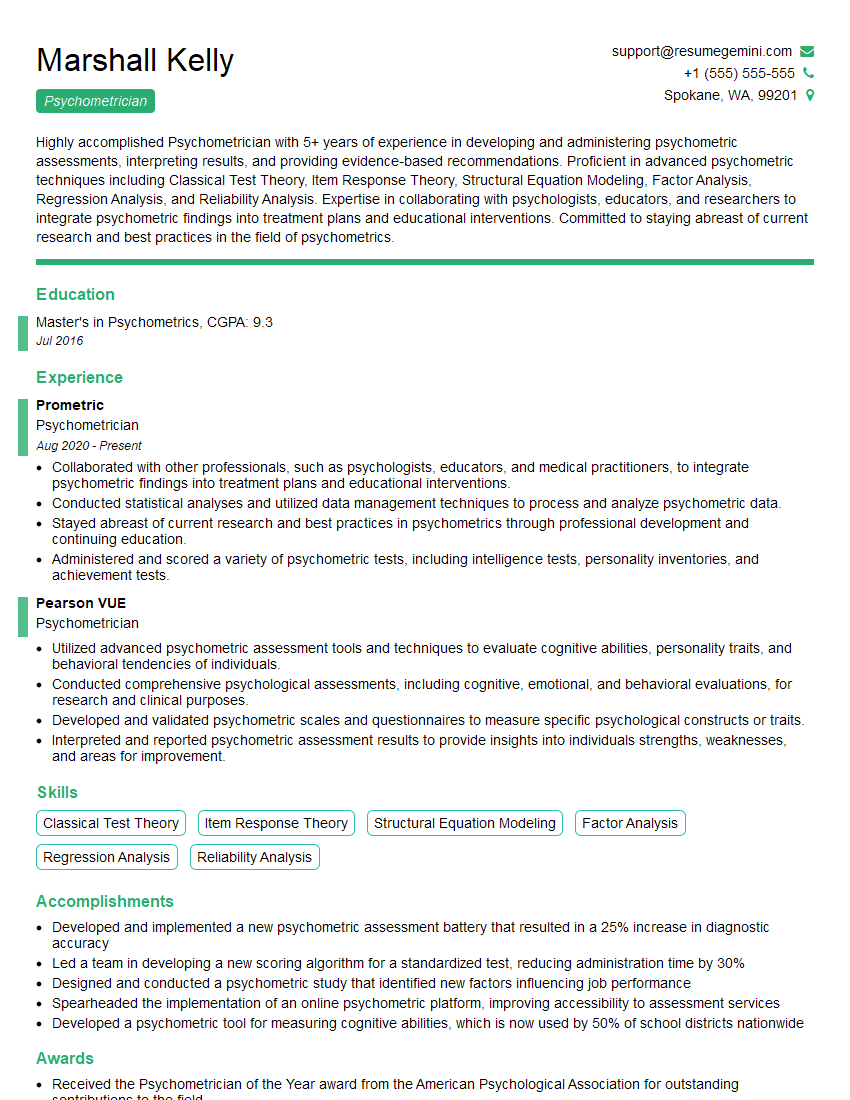
Mastering exam evaluation opens doors to exciting career opportunities in education, assessment development, and research. A strong understanding of these principles demonstrates crucial skills highly valued by employers. To significantly boost your job prospects, focus on crafting an ATS-friendly resume that highlights your relevant skills and experience. ResumeGemini is a trusted resource that can help you build a professional and impactful resume tailored to the specific demands of the Exam Evaluation field. Examples of resumes tailored to Exam Evaluation roles are available to guide your process.
Explore more articles
Users Rating of Our Blogs
Share Your Experience
We value your feedback! Please rate our content and share your thoughts (optional).
What Readers Say About Our Blog
Really detailed insights and content, thank you for writing this detailed article.
IT gave me an insight and words to use and be able to think of examples