Unlock your full potential by mastering the most common GIS Data Collection and Processing interview questions. This blog offers a deep dive into the critical topics, ensuring you’re not only prepared to answer but to excel. With these insights, you’ll approach your interview with clarity and confidence.
Questions Asked in GIS Data Collection and Processing Interview
Q 1. Explain the difference between vector and raster data.
Vector and raster data are two fundamental ways to represent geographic information in GIS. Think of it like this: vector data is like drawing a map with precise lines and points, while raster data is like a mosaic of pixels forming an image.
Vector Data: Represents geographic features as points, lines, and polygons. Each feature has its own defined coordinates. This allows for precise representation of boundaries and detailed attributes. Examples include roads (lines), buildings (polygons), and wells (points). Vector data is best for representing discrete features where precise location and shape are crucial.
Raster Data: Represents geographic features as a grid of cells or pixels, each cell having a value representing a specific attribute. This is similar to a digital image. Examples include satellite imagery, aerial photographs, and elevation models (DEMs). Raster data is best for representing continuous phenomena like temperature or elevation, where the attribute changes smoothly across space.
Key Differences Summarized:
- Representation: Vector uses points, lines, polygons; Raster uses a grid of cells.
- Storage: Vector stores coordinates and attributes; Raster stores cell values and associated spatial metadata.
- Data Types: Vector is ideal for discrete features; Raster is ideal for continuous features.
- File Formats: Common vector formats include Shapefiles (.shp), GeoJSON, and Geodatabases; common raster formats include GeoTIFF (.tif), JPEG, and ERDAS Imagine (.img).
Q 2. Describe your experience with various GIS software (e.g., ArcGIS, QGIS).
I have extensive experience with both ArcGIS and QGIS, leveraging their capabilities for diverse GIS projects. My ArcGIS proficiency encompasses data management, spatial analysis, geoprocessing, and map production using ArcMap, ArcGIS Pro, and the ArcGIS Online platform. I’ve utilized tools like the Spatial Analyst extension for raster analysis, and the Geostatistical Analyst extension for interpolation and surface modeling. For example, in a recent project involving soil erosion modeling, I used ArcGIS Pro to process DEM data, run hydrological models, and create thematic maps to visualize erosion risk.
My QGIS experience centers around its open-source capabilities, especially for tasks involving data visualization, processing large datasets, and performing custom scripting using Python. I appreciate its flexibility and the extensive community support. A particular project involved analyzing open-street-map data in QGIS to assess urban green space accessibility. I leveraged QGIS’s processing toolbox and its ability to handle large vector files effectively.
Q 3. How do you ensure data accuracy and quality in GIS data collection?
Ensuring data accuracy and quality is paramount in GIS. It’s a multi-step process that starts before data collection and continues throughout the entire workflow. My approach focuses on:
- Careful Planning: Defining clear objectives, identifying appropriate data sources, selecting suitable data collection methods, and establishing quality control procedures at the outset of any project. For instance, I would specify the accuracy requirements for GPS data collection before commencing fieldwork.
- Data Validation: Employing techniques like field checks, comparing data from different sources, and using consistency checks within the data itself to identify and correct errors. I regularly utilize attribute queries and spatial queries in GIS software to identify discrepancies.
- Metadata Management: Maintaining comprehensive metadata documenting data sources, collection methods, limitations, and processing steps. This ensures transparency and traceability, facilitating easier data validation and interpretation by others.
- Error Detection and Correction: Using GIS tools to detect and address spatial inconsistencies, attribute errors, and topological errors. This often involves identifying and fixing gaps, overlaps, and slivers in polygon data. This may involve manual editing or automated tools.
- Data Cleaning: Removing duplicate or irrelevant data, handling missing values, and employing spatial interpolation or other data imputation techniques to fill in gaps in the data while minimizing bias.
Ultimately, it’s a combination of careful planning, rigorous procedures, and the use of various GIS tools and techniques that ensures high-quality data.
Q 4. What are the different methods for georeferencing data?
Georeferencing is the process of assigning geographic coordinates (latitude and longitude) to data that doesn’t inherently have them. Several methods exist, each with its strengths and weaknesses:
- Control Points: This is the most common method. Identifying points with known coordinates (from maps, surveys, or GPS) on both the unreferenced image/data and a reference layer (usually a map with a known coordinate system). The software then uses these control points to mathematically transform the unreferenced data into the correct coordinate system. The accuracy depends on the number and distribution of control points.
- Direct Georeferencing: Using GPS data or other directly measured coordinates during data acquisition to directly assign coordinates to the data. This method eliminates the need for post-processing georeferencing, resulting in potentially higher accuracy.
- Automatic Georeferencing: Some software packages offer automated georeferencing features that use image recognition and other algorithms to automatically find and match control points. This is helpful for quick processing but may require manual verification to ensure accuracy.
The choice of method depends on the data type, availability of reference data, and required accuracy level. For instance, historical maps might require manual control point selection, whereas imagery collected using a GPS-equipped drone could employ direct georeferencing.
Q 5. Explain the process of data cleaning and preprocessing in GIS.
Data cleaning and preprocessing are critical steps to ensure the accuracy and reliability of GIS analyses. This involves several stages:
- Data Editing: Correcting errors in geometry (e.g., fixing overlapping polygons, smoothing lines), and attribute data (e.g., correcting typos, resolving inconsistencies).
- Data Transformation: Converting data from one format to another (e.g., converting a Shapefile to GeoJSON), or changing coordinate systems (discussed in the next answer).
- Data Projection: Ensuring all data layers are in the same coordinate system before analysis. This prevents misalignment and erroneous results.
- Attribute Cleaning: Handling missing values (using imputation techniques, removing records), standardizing attribute values (using consistent units and naming conventions), and identifying and removing duplicate records.
- Topology Checking: Verifying spatial relationships between features (e.g., ensuring polygons are closed, lines connect properly). This helps detect and fix spatial errors that are not immediately obvious.
- Spatial Interpolation: Creating continuous surfaces from discrete data points (e.g., creating an elevation model from spot heights). This requires careful consideration of interpolation methods and potential for introducing errors.
The specific preprocessing steps needed will vary depending on the data quality, the intended analysis, and the GIS software used. For example, when processing a shapefile of land parcels with missing attribute values, I would use a combination of data imputation and manual edits to complete the data to ensure analysis validity.
Q 6. How do you handle spatial data projection and coordinate systems?
Spatial data projection and coordinate systems are crucial aspects of GIS. A coordinate system defines how locations on the Earth’s surface are represented numerically. Projections are mathematical transformations that represent the 3D spherical Earth onto a 2D plane, introducing inevitable distortion. Handling these properly is essential for accurate spatial analysis.
I typically use the following approaches:
- Understanding Projections: I am familiar with various map projections (e.g., UTM, Albers Equal Area, Geographic), understanding their strengths and limitations and selecting the most appropriate projection for a given project and geographic area. The choice is critical as different projections cause varying amounts of distortion to distances, areas, and shapes. For instance, a UTM projection is best suited for areas spanning small longitudinal extents but may be inadequate for global analysis.
- Coordinate System Definition: I carefully define and set the coordinate system for all data layers using the appropriate parameters (datum, units, projection). Inconsistency is a major source of error, which I actively mitigate.
- Data Reprojection: I utilize GIS software to reproject data layers to a common coordinate system prior to analysis. This crucial step aligns datasets and ensures that spatial operations are performed correctly. Most modern GIS systems handle this automatically.
- On-the-Fly Projection: I leverage the ‘on-the-fly’ projection capabilities of GIS software where possible. This allows working with data in different coordinate systems without explicitly reprojecting each layer, saving processing time and reducing potential errors. However, I always ensure that the ‘on-the-fly’ settings are clearly documented and understood.
Incorrect handling of projections can lead to significant errors in spatial analysis, so careful consideration is crucial.
Q 7. Describe your experience with GPS data collection and post-processing.
My experience with GPS data collection and post-processing involves both field data acquisition and office-based processing to improve accuracy and reliability. My work includes:
- Field Data Collection: Using various GPS receivers (handheld, rover, etc.) to collect spatial data. I’m proficient in various data collection methods, including waypoint recording, track logging, and continuous data acquisition. Careful attention to equipment setup, signal quality, and environmental conditions (e.g., tree cover, multipath interference) is critical for high-quality data.
- Post-Processing: This phase is essential to correct for errors introduced by atmospheric effects, satellite clock errors, and receiver noise. Software such as RTKPost or other specialized post-processing software is used to process raw GPS data, determining the precise location of each point. Techniques such as differential GPS (DGPS) and real-time kinematic (RTK) GPS are frequently used to improve accuracy.
- Quality Control: I meticulously check processed GPS data to identify and correct outliers or errors. Visual inspection of the data within the GIS software is often a first step. This is followed by further analysis to detect inaccuracies or anomalies. Statistical analysis of the data might be necessary to identify and correct errors.
- Data Integration: Integrating GPS data with other spatial datasets for analysis. This often involves aligning the coordinate systems and ensuring consistency across different data sources.
The specific techniques and level of post-processing depend heavily on the required accuracy. For example, for high-accuracy mapping, RTK GPS post-processing is employed. For less demanding tasks, DGPS or even basic GPS may suffice.
Q 8. What are the common errors in GIS data and how do you address them?
GIS data, like any other data, is susceptible to errors. These errors can broadly be classified into positional inaccuracies (errors in location), attribute errors (errors in data values), and topological errors (errors in the spatial relationships between features).
- Positional inaccuracies can arise from imprecise measurement techniques, such as using outdated GPS devices or manual digitization from maps. Addressing this involves using high-accuracy GPS, employing appropriate coordinate reference systems, and applying quality control checks such as error ellipses and root mean square error (RMSE) analysis. For example, if we’re mapping pipelines, a small positional error could lead to costly excavation in the wrong location.
- Attribute errors include inconsistencies in data entry, missing values, or incorrect data types. We can mitigate this using data validation rules, regular audits, and employing techniques such as data imputation to fill in missing values based on neighboring data. For instance, if we have a dataset on population density, inconsistent population counts for the same area will lead to inaccurate analysis.
- Topological errors involve inconsistencies in the spatial relationships between features, like overlaps or gaps in polygon boundaries. This can be addressed using topological checks within GIS software, and tools for cleaning geospatial data, ensuring features meet specific spatial relationships. This could involve resolving sliver polygons or self-intersecting lines.
Identifying and correcting errors requires a multifaceted approach incorporating rigorous data collection protocols, quality control checks throughout the workflow, and employing appropriate data editing techniques. Regular audits and data validation are essential for long-term data integrity.
Q 9. Explain the concept of spatial analysis and its applications.
Spatial analysis involves the application of analytical techniques to spatial data to understand patterns, relationships, and processes. It’s like using a magnifying glass on geographical data to discover hidden insights.
Imagine you’re a city planner. You wouldn’t just look at a map of your city; you’d analyze it to identify areas with high crime rates, proximity to schools, and access to public transportation. This allows you to make data-driven decisions for resource allocation and policy implementation.
- Applications are extensive and include:
- Crime mapping: Identifying crime hotspots to optimize police patrols.
- Environmental modeling: Predicting the spread of wildfires or pollutants.
- Urban planning: Analyzing population density and infrastructure needs.
- Business analytics: Optimizing store locations based on customer proximity and demographics.
- Public health: Identifying disease outbreaks and planning healthcare resource distribution.
The core of spatial analysis lies in understanding spatial relationships – proximity, contiguity, containment – and employing techniques such as buffering, overlay analysis, and interpolation to extract meaningful information from geographic data.
Q 10. How do you perform spatial joins and overlay analysis?
Spatial joins and overlay analysis are fundamental spatial analysis operations used to integrate information from different spatial datasets.
Spatial joins combine attributes from one layer (the ‘target’ layer) with attributes from another layer (the ‘join’ layer) based on spatial relationships between their features. For example, let’s say you have a polygon layer representing census tracts and a point layer representing crime incidents. A spatial join will add crime statistics for each census tract, linking the crime locations to their respective census tract polygons.
Overlay analysis combines the geometries and attributes of multiple layers to create a new layer reflecting the spatial relationships. There are different types of overlay operations:
- Intersect: Creates a new layer containing only the areas where the input layers overlap (think of finding the area where two polygons intersect).
- Union: Creates a new layer including all areas from both input layers. Overlapping areas retain attributes from both. Imagine merging two maps – all areas will appear in the final map.
- Erase: Removes the areas of one layer that are covered by another.
- Clip: Extracts a portion of one layer based on the extent of another layer.
Both spatial joins and overlay analysis are performed using GIS software such as ArcGIS, QGIS, or others. The specific tools and workflows might vary depending on the software used, but the underlying concepts remain the same.
Q 11. What are the different types of spatial interpolation methods?
Spatial interpolation estimates the values of a variable at unsampled locations based on known values at sampled locations. It’s like filling in the blanks on a map where you have data points but need a continuous surface.
Common methods include:
- Inverse Distance Weighting (IDW): This method assigns weights to known data points based on their distance from the unsampled location. Closer points receive higher weights. It’s simple but can be sensitive to outliers.
- Kriging: A geostatistical technique that considers both the distance and spatial autocorrelation (similarity) among data points. It provides estimates with associated uncertainties. Kriging offers a more sophisticated approach than IDW, and it provides estimations of errors.
- Spline interpolation: This fits a smooth surface through the known data points. It’s good for creating visually appealing surfaces but may not accurately reflect underlying patterns if the data is noisy.
- Nearest Neighbor: The simplest method. The value at the unsampled location is assigned the value of the nearest sampled location. This is very simple but only suitable if the spatial variation is very small.
The choice of method depends on the characteristics of the data, the desired level of accuracy, and the nature of the spatial variation. For instance, if dealing with elevation data and having limited sample points, Kriging may be a better choice than IDW, as it addresses spatial autocorrelation.
Q 12. Describe your experience with remote sensing data processing.
My experience with remote sensing data processing is extensive, encompassing various stages from data acquisition to analysis and interpretation. I’m proficient in using software like ENVI, ERDAS Imagine, and QGIS to process imagery from different sensors, including Landsat, Sentinel, and aerial photography.
My workflow typically involves:
- Pre-processing: This includes atmospheric correction (removing atmospheric effects), geometric correction (geo-referencing the imagery), and radiometric calibration (standardizing the brightness values). I’ve handled issues like cloud cover and sensor artifacts effectively, for example using cloud masking techniques in Landsat imagery.
- Image Classification: I have expertise in both supervised (using training data to classify pixels) and unsupervised (letting the algorithm group pixels) classification methods. I’ve worked with various classification algorithms like maximum likelihood, support vector machines, and decision trees. I’ve applied this to land cover classification projects, distinguishing between urban areas, forests, and agricultural lands.
- Image Enhancement: Techniques like filtering, sharpening, and contrast stretching enhance the visibility of features and improve the interpretability of the imagery. For instance, I’ve used principal component analysis (PCA) for enhancing spectral information in multispectral imagery.
- Data Integration: I frequently integrate remote sensing data with other GIS datasets, such as topographic data and vector data, to generate more comprehensive analyses. For instance, integrating Landsat data with ground truth data to refine land cover classification accuracy.
Through these processes, I generate valuable information for applications in land use change analysis, environmental monitoring, and resource management.
Q 13. How do you create thematic maps and cartographic representations?
Creating effective thematic maps and cartographic representations is crucial for communicating spatial information clearly and efficiently. This involves careful consideration of several factors.
Thematic maps show the spatial distribution of a particular theme or attribute, like population density or temperature. For example, a choropleth map uses color shading to show variations in a variable across geographic regions.
Cartographic representations involve the principles of map design including:
- Data selection and classification: Choosing the appropriate data and classifying it into meaningful categories for visual representation. For example, using natural breaks classification method for population data to reflect the distribution of population into different groups.
- Color scheme selection: Employing colors that are both visually appealing and effectively convey the information. This means considering color blindness and ensuring sufficient color contrast.
- Symbol design: Using appropriate symbols to represent features. For example, using different sized circles for population.
- Map layout and labeling: Organizing map elements effectively and labeling features clearly and concisely. This should include legends and scale bars.
- Projection choice: Selecting a suitable map projection to minimize distortion.
Software like ArcGIS, QGIS, and even tools such as Mapbox provide functionalities for design and layout. I leverage them for creating aesthetically pleasing yet effective maps that are easily interpreted.
Q 14. What is your experience with LiDAR data processing and analysis?
LiDAR (Light Detection and Ranging) data processing and analysis involves extracting valuable three-dimensional information from point cloud data. My experience encompasses the entire workflow, from data acquisition planning to detailed analysis.
Processing steps generally include:
- Data Filtering: Removing noise and unwanted points (like those from vegetation) to improve data quality using techniques like classification and noise removal filters.
- Ground Classification: Identifying ground points from non-ground points, crucial for creating Digital Terrain Models (DTMs).
- DTM Generation: Creating a surface model representing the bare earth’s elevation.
- DSM Generation: Creating a Digital Surface Model (DSM) which includes vegetation and buildings.
- Feature Extraction: Extracting features of interest from the point cloud, such as buildings, roads, and trees. Algorithms for feature extraction are employed, such as segmentation and classification.
- Analysis and Applications: Using the processed data for various applications, such as volumetric analysis (volume calculations for earthwork), change detection (monitoring landscape changes over time), and hydrological modeling (simulating water flow).
I’m proficient in using software such as LAStools, PDAL, and ArcGIS Pro for LiDAR data processing. I’ve worked on projects involving terrain modeling, forest inventory, and infrastructure mapping, demonstrating a practical understanding of LiDAR data’s capabilities.
Q 15. Explain your knowledge of different data formats (Shapefile, GeoTIFF, GeoJSON).
Geospatial data comes in various formats, each with its strengths and weaknesses. Let’s explore three common ones: Shapefile, GeoTIFF, and GeoJSON.
- Shapefile: This is a widely used vector data format. Think of it like a collection of individual geometric features (points, lines, polygons) stored in a set of related files. Each feature can have associated attributes, like the name of a city or the population of a country. For example, a shapefile might represent roads, buildings, or administrative boundaries. It’s simple yet powerful, but it’s not a single file; it’s a collection of files (.shp, .shx, .dbf, .prj, etc.) that must be kept together.
- GeoTIFF: This is a raster data format. Imagine a satellite image or a digital elevation model; these are raster datasets—grids of pixel values. GeoTIFF adds geospatial metadata to a standard TIFF image, so you know exactly where each pixel is located on the Earth. This is crucial for integrating it with other geospatial data. This format is excellent for storing continuous data such as elevation, temperature, or satellite imagery.
- GeoJSON: This is a lightweight vector data format that’s based on JSON (JavaScript Object Notation). This makes it incredibly easy to work with in web applications and programming languages like JavaScript or Python. It’s human-readable and supports points, lines, polygons, and their associated attributes. Imagine using GeoJSON to display a map of earthquake locations on a web-based map service.
Choosing the right format depends on the type of data and its intended use. Vector formats (Shapefile, GeoJSON) are great for discrete features, while raster formats (GeoTIFF) are ideal for continuous data.
Career Expert Tips:
- Ace those interviews! Prepare effectively by reviewing the Top 50 Most Common Interview Questions on ResumeGemini.
- Navigate your job search with confidence! Explore a wide range of Career Tips on ResumeGemini. Learn about common challenges and recommendations to overcome them.
- Craft the perfect resume! Master the Art of Resume Writing with ResumeGemini’s guide. Showcase your unique qualifications and achievements effectively.
- Don’t miss out on holiday savings! Build your dream resume with ResumeGemini’s ATS optimized templates.
Q 16. How do you manage and organize large datasets in a GIS environment?
Managing large datasets in GIS requires a strategic approach. It’s not just about storage; it’s about efficient access, processing, and analysis. My strategies include:
- Data partitioning: Breaking down large datasets into smaller, manageable chunks. This allows for parallel processing and reduces the strain on resources. Think of slicing a large pizza into smaller pieces for easier consumption.
- Data compression: Using lossless or lossy compression techniques to reduce storage space and improve performance. For example, using a format like GeoTIFF with compression, or employing specialized compression algorithms for shapefiles.
- Database management systems (DBMS): Utilizing spatial DBMSs like PostGIS (with PostgreSQL) or Oracle Spatial for efficient storage and querying of geospatial data. This allows complex spatial queries and analyses to be performed much faster than with simple file-based systems.
- File organization: Implementing a logical folder structure to keep files neatly organized by project, data type, and date. A clear structure is essential for easy retrieval and sharing of data.
- Cloud storage: Utilizing cloud-based storage solutions such as AWS S3, Azure Blob Storage, or Google Cloud Storage for scalability and accessibility. This helps handle extremely large datasets easily.
These methods, used in conjunction, ensure efficient management, regardless of the dataset size.
Q 17. Describe your experience with database management systems (DBMS) for GIS.
My experience with spatial DBMSs is extensive. I’m proficient with PostGIS, a powerful extension for PostgreSQL that adds spatial capabilities. It allows me to perform complex spatial queries, such as finding all points within a certain radius, or calculating the area of intersecting polygons, with incredible efficiency. For example, I’ve used PostGIS to build a spatial database for a city’s infrastructure, allowing engineers to quickly access information about water pipes, power lines, and other utilities, and analyze their spatial relationships.
I’m also familiar with other spatial DBMSs, such as Oracle Spatial and ArcGIS Server. The choice of DBMS often depends on the specific project requirements and existing infrastructure. The key is understanding how to leverage the strengths of each system to efficiently store, retrieve, and analyze geospatial data.
Q 18. What is your understanding of spatial statistics?
Spatial statistics involves applying statistical methods to spatially referenced data. It’s about understanding patterns, relationships, and trends that are influenced by location. This contrasts with traditional statistics, which usually ignore spatial aspects.
For instance, spatial autocorrelation measures the degree to which nearby locations are similar. If there is high spatial autocorrelation in crime rates, it means that crime tends to cluster in specific areas. This information can be useful for law enforcement.
Other common techniques include spatial regression (e.g., geographically weighted regression), point pattern analysis, and spatial interpolation. These tools help us understand spatial relationships and make predictions based on location. I have used these techniques extensively in various projects, from disease mapping to analyzing urban growth patterns.
Q 19. How do you create and maintain metadata for geospatial data?
Metadata is essential for ensuring the discoverability, usability, and understandability of geospatial data. It’s like a detailed description of your data; it’s not the data itself, but information *about* the data.
Creating and maintaining metadata involves documenting aspects such as data source, projection, coordinate system, date of creation, accuracy, and any relevant processing steps. This is usually done using metadata standards like ISO 19115. The quality of your metadata directly affects the reliability of your analysis, and allows others to understand and use your data properly. I use both manual and automated methods to ensure high-quality metadata is created and kept current.
For example, I would ensure a dataset includes metadata describing the accuracy of the GPS data used to create it, the date of acquisition, and any processing steps it has undergone.
Q 20. Explain your experience with data visualization and presentation.
Effective data visualization is crucial for communicating insights derived from geospatial analysis. My experience encompasses creating a wide variety of maps and charts using tools like ArcGIS Pro, QGIS, and other mapping software.
I create maps showcasing spatial patterns and relationships—choropleth maps for showing variations in a variable across an area, point maps for showing the locations of individual features, and network maps for visualizing transportation or utility networks.
Beyond maps, I also utilize charts and graphs to present statistical summaries and trends, often combined with interactive map interfaces. In previous roles, I’ve created compelling presentations to stakeholders showcasing results using a blend of visual communication techniques.
The goal is always clarity and impact; a well-designed visualization should immediately convey the main insights without needing complex explanations.
Q 21. Describe your experience with GIS project planning and management.
Successful GIS projects require careful planning and management. My approach follows a structured methodology, encompassing these key steps:
- Project definition: Clearly defining project goals, objectives, and scope. What questions are we trying to answer? What data is needed?
- Data acquisition and processing: Planning the data acquisition process, including the methods used for collecting, cleaning, and processing the data. What is the most cost-effective method? What kind of data is required?
- Analysis and modeling: Defining the spatial analysis techniques that will be used to address the project goals. What type of analyses need to be performed?
- Visualization and reporting: Developing suitable ways to communicate findings to stakeholders—maps, charts, and reports.
- Project monitoring and evaluation: Regularly monitoring progress and evaluating the success of the project against its defined objectives.
Using project management software (such as Jira or Asana) is critical for tracking tasks, deadlines, and resources. Effective communication and collaboration among team members are also paramount for successful project delivery. I’ve successfully managed several large-scale GIS projects, from urban planning to environmental impact assessment, leveraging these strategies to deliver high-quality results on time and within budget.
Q 22. How do you ensure the security and confidentiality of geospatial data?
Ensuring the security and confidentiality of geospatial data is paramount. It involves a multi-layered approach encompassing technical, procedural, and legal measures. Think of it like protecting a valuable treasure – you need multiple locks and guards!
Access Control: Implementing robust access control systems, such as role-based access control (RBAC), is crucial. Only authorized personnel should have access to sensitive data, with different levels of permission based on their roles.
Data Encryption: Encrypting data both in transit (during transfer) and at rest (when stored) significantly reduces the risk of unauthorized access. This is like using a strong lockbox for your valuable items.
Data Anonymization and Generalization: For publicly shared data, techniques like anonymization (removing personally identifiable information) and generalization (reducing the precision of location data) can protect individuals’ privacy. Think of blurring a photo to make someone unrecognizable.
Regular Security Audits: Periodic security audits are essential to identify vulnerabilities and ensure the effectiveness of security measures. This is like regularly checking your security system to ensure everything works as intended.
Compliance with Regulations: Adhering to relevant data protection regulations, such as GDPR or CCPA, is legally mandatory and ensures responsible data handling. Think of it as following established rules and laws.
Q 23. How do you handle conflicting data sources or inconsistencies?
Handling conflicting data sources or inconsistencies is a common challenge in GIS. It’s like trying to assemble a jigsaw puzzle with some missing or mismatched pieces. A systematic approach is crucial.
Data Source Assessment: First, assess the reliability and accuracy of each data source. Consider factors like the source’s reputation, data collection methods, and potential biases.
Data Cleaning and Preprocessing: Clean the data by identifying and resolving errors, inconsistencies, and duplicates. This might involve using tools to identify spatial inconsistencies or attribute errors.
Spatial and Attribute Reconciliation: Use spatial analysis techniques (e.g., overlay, spatial join) to identify overlaps or conflicts between datasets. For attribute inconsistencies, you may need to manually review and reconcile the differences or develop rules for conflict resolution.
Data Fusion and Integration: Employ data fusion techniques to integrate consistent and reliable data from multiple sources. Weighted averaging or other statistical methods can help combine data while accounting for varying levels of uncertainty.
Metadata Management: Maintaining detailed metadata (information about the data) is crucial for tracking data sources, resolving conflicts, and ensuring data quality. This acts as a detailed ‘instruction manual’ for the data.
Q 24. What are some ethical considerations in geospatial data handling?
Ethical considerations in geospatial data handling are critical. It’s about using this powerful technology responsibly and avoiding harm. We must consider the potential impact on individuals and communities.
Privacy and Confidentiality: Protecting the privacy of individuals whose locations or attributes are included in geospatial data is paramount. Avoid publishing data that could directly or indirectly identify individuals without their informed consent.
Bias and Fairness: Be aware of potential biases in data collection and analysis. For instance, using incomplete or biased data can perpetuate inequalities and lead to unfair outcomes. This requires careful consideration of data sources and methods.
Transparency and Accountability: Be transparent about data sources, methodologies, and limitations. This builds trust and allows for scrutiny and accountability.
Data Security and Integrity: Securely store and manage geospatial data to prevent unauthorized access and modification. Ensure data accuracy and integrity throughout the entire lifecycle.
Social and Environmental Impact: Consider the potential social and environmental impact of geospatial applications. Responsible use of GIS can facilitate informed decision-making and contribute to positive societal outcomes.
Q 25. Describe a challenging GIS project you worked on and how you solved it.
One challenging project involved creating a real-time flood forecasting system for a coastal city prone to hurricanes. The challenge was integrating diverse data sources – weather forecasts, elevation models, hydrological data – with limited processing power in a time-sensitive environment.
Our solution involved a three-pronged approach:
Data Optimization: We simplified complex datasets using techniques like raster generalization to reduce processing time without significant accuracy loss.
Cloud Computing: Leveraging cloud computing resources allowed us to handle the significant data volume and processing demands of real-time forecasting.
Model Calibration and Validation: We rigorously calibrated and validated our hydrological model using historical flood data to improve prediction accuracy. This involved extensive testing and refinement.
The project successfully improved the city’s flood warning system, leading to more effective evacuations and reduced damage.
Q 26. What are your strengths and weaknesses in GIS data collection and processing?
My strengths lie in data integration and analysis. I’m proficient in various GIS software and programming languages, allowing me to process and analyze large datasets effectively. I also have strong problem-solving skills and the ability to visualize complex spatial patterns. My experience in diverse projects has given me a broad understanding of the field.
A weakness I’m actively working on is staying current with the ever-evolving advancements in deep learning and AI for geospatial analysis. While I understand the core concepts, actively enhancing my practical application of these technologies is a continuous learning process.
Q 27. Where do you see the future of GIS data collection and processing?
The future of GIS data collection and processing will be defined by several key trends:
Increased Automation: Automation will play a larger role, with technologies like drones, autonomous vehicles, and AI facilitating data acquisition and processing.
Big Data and Cloud Computing: The increasing availability of big data, coupled with the power of cloud computing, will enable more sophisticated analyses and models.
Integration with other technologies: GIS will integrate more seamlessly with other technologies like IoT, machine learning, and virtual reality, leading to more innovative applications.
Focus on Data Ethics and Privacy: Ethical concerns regarding data privacy and bias will be central, necessitating more robust data governance frameworks.
3D and 4D GIS: The adoption of 3D and 4D GIS (incorporating time as a dimension) will allow for more comprehensive and dynamic spatial analyses.
Key Topics to Learn for Your GIS Data Collection and Processing Interview
- Data Acquisition Methods: Understand the strengths and weaknesses of various data collection techniques, including GPS surveying, remote sensing (aerial imagery, LiDAR), and crowdsourcing. Consider the accuracy, cost, and time implications of each method.
- Data Preprocessing and Cleaning: Master techniques for handling errors, inconsistencies, and outliers in your datasets. Familiarize yourself with spatial data formats (shapefiles, GeoTIFFs, GeoJSON) and data cleaning tools.
- Spatial Data Analysis: Demonstrate your understanding of fundamental spatial analysis techniques such as buffer analysis, overlay analysis (intersection, union), and proximity analysis. Be ready to discuss real-world applications of these techniques.
- Geodatabase Management: Showcase your knowledge of creating, managing, and maintaining geodatabases. Discuss your experience with different database models (e.g., relational, object-oriented) and data versioning.
- Data Visualization and Cartography: Explain your ability to create clear, informative, and visually appealing maps using GIS software. Discuss map design principles and the importance of effective communication through visualization.
- GPS Technology and Principles: Demonstrate a strong understanding of GPS technology, including its limitations (e.g., signal interference, multipath errors) and how to mitigate these challenges.
- Quality Assurance and Control (QA/QC): Explain your experience implementing QA/QC procedures to ensure the accuracy and reliability of your GIS data. This includes error detection and correction strategies.
- Programming and Scripting (Python, ArcGIS Pro, etc.): Highlight your skills in automating GIS tasks using scripting languages. Discuss your experience with relevant tools and libraries.
- Data Modeling and Schema Design: Discuss your experience with designing efficient and effective data models for spatial data. This includes understanding data structures and relationships.
- Ethical Considerations in GIS: Be prepared to discuss ethical considerations related to data privacy, accuracy, and responsible use of GIS technology.
Next Steps
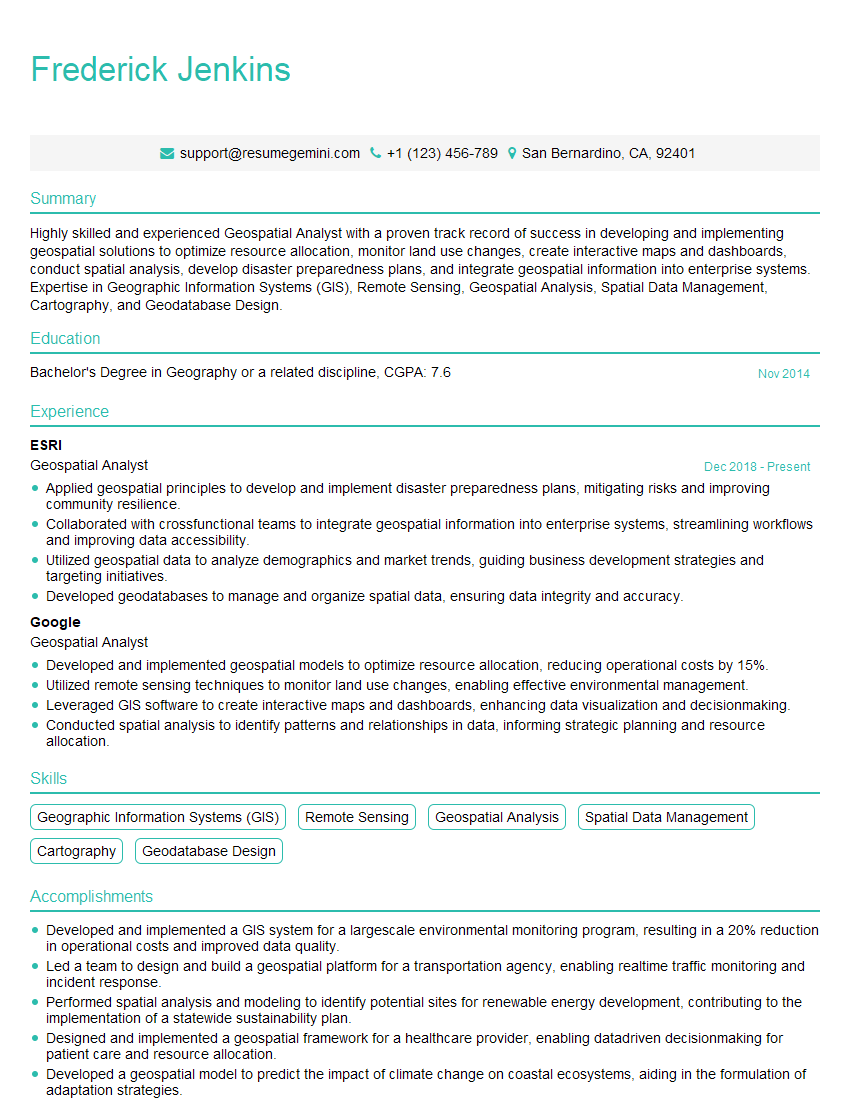
Mastering GIS Data Collection and Processing is crucial for a successful and rewarding career in this rapidly growing field. It opens doors to exciting opportunities in various sectors, from environmental management to urban planning. To maximize your job prospects, creating an ATS-friendly resume is paramount. ResumeGemini is a trusted resource that can help you craft a compelling and effective resume tailored to highlight your GIS skills. Examples of resumes tailored to GIS Data Collection and Processing are available to help guide your process.

Explore more articles
Users Rating of Our Blogs
Share Your Experience
We value your feedback! Please rate our content and share your thoughts (optional).
What Readers Say About Our Blog
Really detailed insights and content, thank you for writing this detailed article.
IT gave me an insight and words to use and be able to think of examples