Preparation is the key to success in any interview. In this post, we’ll explore crucial Molding Process Documentation interview questions and equip you with strategies to craft impactful answers. Whether you’re a beginner or a pro, these tips will elevate your preparation.
Questions Asked in Molding Process Documentation Interview
Q 1. Explain the importance of accurate molding process documentation.
Accurate molding process documentation is the cornerstone of consistent product quality, efficient production, and regulatory compliance. Think of it as the recipe for your product – without it, you risk inconsistency and errors. It provides a clear, standardized set of instructions that ensures everyone involved, from operators to engineers, understands and performs each step correctly. This reduces defects, minimizes waste, improves traceability, and ultimately saves time and money.
Inaccurate documentation, conversely, can lead to significant problems. Imagine a critical parameter being recorded incorrectly; this could result in defective parts, production downtime, and even safety hazards. The importance of accuracy cannot be overstated.
Q 2. Describe your experience with different types of molding process documentation (e.g., SOPs, work instructions).
Throughout my career, I’ve extensively worked with various types of molding process documentation. Standard Operating Procedures (SOPs) are crucial for defining the overall process flow. They provide a high-level overview, encompassing all the steps involved, from material preparation to quality inspection. Work instructions, on the other hand, offer detailed, step-by-step guidance for individual tasks within the molding process, like setting up the molding machine or inspecting the finished parts. I’ve also created and utilized process flowcharts, diagrams illustrating the sequence of operations, making it easy to visualize the entire process. Finally, I’ve worked with detailed material specifications, which ensure consistent quality of raw materials used throughout production.
For example, in one project, we developed SOPs for injection molding processes encompassing machine setup, cycle time optimization, and quality control checks. We then created separate work instructions detailing the precise procedures for each of these steps, including specific measurements, tolerances, and corrective actions.
Q 3. How do you ensure your molding process documentation is up-to-date and accurate?
Maintaining up-to-date and accurate documentation requires a proactive and systematic approach. We use a version control system – I’ve used both shared drives with controlled access and dedicated document management systems – to track changes and revisions. A key component is regular audits and reviews. At least annually, we conduct a thorough review of all process documentation, comparing it with current practices and making necessary updates. Furthermore, any modifications to the molding process, whether due to equipment upgrades or material changes, immediately trigger a review and update of relevant documents. Finally, we actively encourage feedback from the operators and engineers involved, as they are often the first to identify areas for improvement or inconsistencies in the existing documentation.
Imagine a scenario where a new material is introduced. We wouldn’t just start using it; the material specification document would be updated, along with relevant sections of the SOPs and work instructions to reflect the new material’s properties and handling requirements.
Q 4. What are the key elements of a well-written molding process document?
A well-written molding process document should be clear, concise, and unambiguous. Key elements include:
- Title and Version Number: Clearly identifies the document and its revision level.
- Purpose and Scope: Defines the objective and what the document covers.
- Materials and Equipment List: Specifies the necessary materials and equipment with specific details.
- Step-by-Step Procedures: Clear, sequential instructions with detailed descriptions and visuals.
- Safety Precautions: Highlights potential hazards and safety procedures.
- Quality Control Checks: Outlines the inspection procedures and acceptance criteria.
- Corrective Actions: Defines the actions to be taken in case of non-conformances.
- Approval Signatures: Shows who has reviewed and approved the document.
- Revision History: Records all changes and their dates.
Think of it like a well-written recipe: each ingredient (material) is clearly listed, the steps (procedures) are easy to follow, and the expected outcome (finished product) is defined.
Q 5. How do you handle changes and revisions to molding process documentation?
Handling changes and revisions is a critical aspect of maintaining accurate documentation. We follow a formal change control process. Any proposed change must be documented, reviewed by relevant personnel (including operators and engineers), and approved before implementation. The revision history section of the document is then updated to reflect the change, including the date, author, and a description of the modification. The new version is then distributed to all affected parties, and the old version is archived. This controlled process ensures traceability and accountability for all changes.
For instance, if a machine upgrade necessitates a change in the molding cycle, the work instructions reflecting the machine operation are updated, the SOP is reviewed for any consequential changes, and all relevant personnel are notified of the changes through a formal change notification. The old version of the documentation is then archived.
Q 6. How do you ensure your documentation is easily accessible to all relevant personnel?
Accessibility is paramount. We utilize a centralized document management system, allowing all relevant personnel access to the most up-to-date versions of the molding process documentation. Access is controlled through user permissions, ensuring only authorized personnel can access and modify documents. Documents are also organized using a logical folder structure, making it easy to locate specific documents. In addition, we provide training to all personnel on how to access and use the document management system. We also consider providing printed copies for those who may not have easy computer access in the production floor, always ensuring these are clearly labeled with the version number.
This approach eliminates confusion caused by outdated or incorrect information and ensures everyone is working with the same, current information.
Q 7. Explain your experience with document control systems for molding processes.
My experience with document control systems for molding processes is extensive. I’ve used various systems ranging from simple shared network drives with controlled access and version numbering to sophisticated Enterprise Content Management (ECM) systems. The ideal system offers features like version control, audit trails, workflow management, and access control. It enables efficient document storage, retrieval, and revision tracking. The key is to select a system that meets the organization’s specific needs and integrates well with other business systems.
In a previous role, we implemented an ECM system to manage all manufacturing documentation. This improved version control significantly, reduced errors related to outdated documents, and increased efficiency in finding and sharing critical information across the organization.
Q 8. Describe a time you identified a problem with molding process documentation.
During a routine audit of our injection molding process documentation, I discovered inconsistencies in the parameters for cycle time optimization. Specifically, the documentation for cavity pressure profiles differed significantly between the written procedure and the actual machine settings used on the shop floor. This discrepancy wasn’t immediately apparent because the older documentation was partially handwritten and lacked version control. The potential consequence was inconsistent part quality, increased scrap rates, and potential machine damage.
Q 9. How did you resolve this issue?
To resolve this, I implemented a multi-step approach. First, I convened a meeting with the production team and engineering to compare the documented parameters with the actual machine settings. We identified the source of the discrepancy – a previous, undocumented modification made to improve cycle time without updating the official documentation. Next, I created a revised, digitally managed document using a version control system (e.g., SharePoint or a dedicated document management system). This system allowed for easy tracking of revisions, clear version numbers, and approval workflows to prevent future discrepancies. Finally, I conducted comprehensive retraining for all shift operators, emphasizing the importance of adhering to the updated documentation and reporting any deviations immediately.
Q 10. What are some common challenges in maintaining accurate molding process documentation?
Maintaining accurate molding process documentation faces several common challenges. One significant hurdle is keeping documentation updated as processes evolve. Machine settings, material properties, and even environmental factors can influence the molding process, necessitating frequent revisions. Another challenge is ensuring that all relevant personnel have access to the most current version of the documentation. Handwritten notes, scattered files, and lack of a centralized system can easily lead to confusion and errors. Furthermore, the sheer volume of data involved in a complex molding operation – from material specifications to quality control checklists – can be overwhelming to manage effectively.
- Version control: Lack of a system to track revisions.
- Accessibility: Difficulty accessing the latest version.
- Data volume: Managing the large amount of information.
- Training: Ensuring personnel understand updates.
Q 11. How do you ensure consistency in your molding process documentation across different shifts or teams?
Consistency across shifts and teams is crucial. We achieve this through a centralized, digitally managed documentation system. This system ensures everyone accesses the same, up-to-date version. Furthermore, we hold regular training sessions, focusing on standardized operating procedures and best practices. We use clear visuals, like flowcharts and diagrams, alongside written instructions. A key element is incorporating regular audits and quality checks to identify any deviations from the documented procedures. This feedback loop is crucial for maintaining consistency and improving the overall process. We also employ standardized naming conventions and file organization for easy retrieval of documents.
Q 12. What are your preferred methods for training employees on new or updated molding process documentation?
Our training methods prioritize hands-on experience coupled with theoretical knowledge. For new or updated documentation, we begin with a classroom session outlining the key changes and reasons behind them. This session uses presentations with visual aids and interactive elements to ensure understanding. We then move to the shop floor for practical training, where employees work alongside experienced trainers to apply what they’ve learned. The training includes practical exercises and real-time scenarios to reinforce their learning. Finally, we implement a mentorship program where experienced operators guide newer employees and provide on-the-job support. Regular quizzes and feedback sessions ensure retention of the information.
Q 13. How do you incorporate feedback into your molding process documentation?
Feedback is integrated through several channels. We regularly solicit feedback from operators through surveys, informal discussions, and formal meetings. We also encourage them to report any difficulties or ambiguities encountered while following the documentation. This feedback is reviewed by the engineering and production teams and used to revise and improve the documentation. We use a feedback form that provides a structured way to communicate concerns and suggestions. The updates are then documented as revisions, along with the rationale for change and the date of implementation.
Q 14. Describe your experience with different file formats for molding process documentation.
My experience encompasses various file formats, each with its advantages and disadvantages. We primarily use PDF for archiving and distribution because of its wide compatibility and security features. However, for active processes, we utilize Microsoft Word or specialized software for creating interactive documents, which can include embedded videos and interactive elements to enhance training and understanding. For data-heavy aspects such as machine parameters, we utilize spreadsheet software (e.g., Excel) or dedicated database systems to ensure data integrity and easy analysis. We avoid proprietary or less common formats to ensure accessibility to all team members.
Q 15. How do you ensure your molding process documentation complies with regulatory requirements?
Ensuring regulatory compliance in molding process documentation is paramount. We achieve this through a multi-faceted approach. First, we meticulously identify all relevant regulations, including those related to safety (OSHA), environmental protection (EPA), and product quality (e.g., ISO 9001, FDA guidelines, depending on the industry and product). We then develop a documentation system that explicitly addresses each regulatory requirement. This includes detailed Standard Operating Procedures (SOPs) for every stage of the molding process, from material handling and machine operation to quality control and waste disposal. We use a document control system to track revisions and ensure that everyone is using the most up-to-date versions. Finally, regular audits are conducted to verify compliance and identify areas for improvement. For example, if we’re producing medical devices, our documentation would meticulously detail sterilization processes and material traceability, referencing the specific FDA guidelines applicable to our product.
Think of it like building a house – the regulations are the building codes. We not only build the house to meet those codes but also keep detailed plans and inspection records to prove it.
Career Expert Tips:
- Ace those interviews! Prepare effectively by reviewing the Top 50 Most Common Interview Questions on ResumeGemini.
- Navigate your job search with confidence! Explore a wide range of Career Tips on ResumeGemini. Learn about common challenges and recommendations to overcome them.
- Craft the perfect resume! Master the Art of Resume Writing with ResumeGemini’s guide. Showcase your unique qualifications and achievements effectively.
- Don’t miss out on holiday savings! Build your dream resume with ResumeGemini’s ATS optimized templates.
Q 16. What are the key performance indicators (KPIs) you monitor to assess the effectiveness of your molding process documentation?
Key Performance Indicators (KPIs) for molding process documentation effectiveness are crucial for continuous improvement. We monitor several metrics, including:
- Defect Rate: A lower defect rate directly indicates clear and effective documentation, ensuring consistent process execution.
- Cycle Time: Reduced cycle times suggest efficient and well-understood processes, reflecting well-written and easily accessible documentation.
- Training Time: Shorter training times for new operators imply clear and concise documentation that is easy to understand and follow.
- Document Revision Frequency: Frequent revisions might point to ambiguities or inconsistencies in the initial documentation, prompting updates for better clarity.
- Number of Non-conformances: A low number of reported non-conformances related to process documentation reinforces the efficacy of the system.
For instance, a high defect rate despite having trained operators could signal a need to revisit and clarify specific sections of the documentation pertaining to the problematic step. We would analyze the data to identify root causes and update the documentation accordingly.
Q 17. How do you use data analysis to improve molding process documentation?
Data analysis plays a vital role in refining our molding process documentation. We use data collected from various sources, including machine sensors, quality control checks, and operator feedback. This data is analyzed to identify trends, patterns, and anomalies related to the molding process. For example, if we see a spike in defects related to a specific parameter (like injection pressure), we can analyze the corresponding documentation section to see if there’s an area for improvement in the instructions or process parameters.
We often employ statistical process control (SPC) charts to visualize process stability and identify areas of concern. This visual representation helps us understand where the documentation needs enhancement, whether it’s through adding more detail, clarifying instructions, or highlighting critical control points. This iterative approach, driven by data, leads to more effective and error-proof documentation.
Q 18. How do you integrate molding process documentation with other manufacturing systems (e.g., ERP, MES)?
Integration with Enterprise Resource Planning (ERP) and Manufacturing Execution Systems (MES) is critical for seamless data flow and efficient process management. We typically use APIs or other data exchange methods to link our document management system with the ERP and MES. This allows for:
- Automated updates: Process changes reflected in the ERP (e.g., new material specifications) are automatically reflected in the relevant documentation within the MES.
- Real-time data access: Operators can access the most up-to-date documentation directly through the MES interface, eliminating reliance on outdated paper copies.
- Improved traceability: The link between production data (from MES) and the relevant process documentation allows for comprehensive traceability of each molded part, vital for quality control and regulatory compliance.
Imagine a scenario where a raw material is changed in the ERP. With integration, the corresponding SOPs in the MES would automatically update, notifying operators of the changes and ensuring that everyone is working with the current, accurate instructions.
Q 19. Describe your experience with version control for molding process documentation.
Version control is crucial for maintaining the integrity of our molding process documentation. We use a dedicated document management system (DMS) that incorporates version control features. This ensures that every revision of a document is tracked, allowing us to easily revert to previous versions if necessary, compare changes, and audit the evolution of our processes. Each revision is clearly identified with a version number, date, author, and a description of the changes made. This provides a complete audit trail, ensuring accountability and traceability.
We utilize a system similar to Git, but tailored for document management. Think of it like a collaborative writing project where everyone can contribute, but all changes are tracked and approved before being released as the ‘official’ version. This prevents conflicting versions and ensures everyone works from a single source of truth.
Q 20. What are the benefits of using a centralized system for molding process documentation?
A centralized system for molding process documentation offers numerous advantages:
- Single source of truth: Eliminates confusion caused by multiple versions of documents scattered across different locations.
- Improved accessibility: Authorised personnel can easily access the latest version of any document from any location.
- Enhanced collaboration: Facilitates collaborative editing and review, improving document quality.
- Better version control: Keeps track of all revisions, ensuring traceability and auditability.
- Reduced errors: Using a single, well-maintained source reduces errors due to outdated or conflicting information.
For example, imagine the chaos if operators relied on individually printed copies of SOPs that may not be up to date. A centralized system streamlines the process and prevents such situations. It’s like having a central library for all your molding procedures, accessible and up-to-date.
Q 21. How do you ensure the security and confidentiality of your molding process documentation?
Security and confidentiality of molding process documentation are ensured through a combination of measures:
- Access control: We implement a robust access control system to restrict access to sensitive documents based on roles and responsibilities. Only authorized personnel can view, edit, or download specific documents.
- Data encryption: Documents are encrypted both in transit and at rest to protect against unauthorized access.
- Regular security audits: We conduct regular security audits to identify and address any vulnerabilities in our system.
- Secure document storage: Our DMS utilizes secure cloud storage or on-premise servers with robust security measures.
- Employee training: Employees are trained on data security best practices and their responsibilities in protecting confidential information.
Protecting our intellectual property and ensuring the integrity of our processes are paramount. We treat this as seriously as securing any other critical company asset. The analogy is simple: imagine our documentation as a recipe for a unique product. Protecting it ensures our competitive advantage and prevents its misuse.
Q 22. Describe your experience with different types of molding processes (injection, compression, etc.) and their associated documentation.
My experience encompasses a wide range of molding processes, primarily injection molding, compression molding, and blow molding. Each process requires a unique documentation strategy, focusing on parameters crucial for consistent, high-quality output.
- Injection Molding: Documentation here centers on machine settings (injection pressure, melt temperature, holding time), mold parameters (cavity temperature, cooling time), material specifications, and quality control checks (dimensional accuracy, surface finish). I’ve worked extensively with documenting process parameters for various thermoplastic materials, creating detailed process capability studies (e.g., Cp, Cpk) to ensure consistent product quality. For example, I’ve documented the entire process flow for creating a complex automotive part, including detailed diagrams of the injection mold itself.
- Compression Molding: This process focuses on the cure cycle, including press pressure, temperature profiles, and dwell times. Documentation often includes material rheological data and detailed descriptions of the mold’s design and maintenance. I recall a project where we meticulously documented the compression molding process for a high-precision thermoset component, focusing on optimizing the cure cycle to minimize warping and maximize strength.
- Blow Molding: Documentation emphasizes air pressure parameters, parison programming (controlling the extruded tube’s shape and size before blowing), mold temperature, and cooling times. I have experience in documenting the process for creating hollow plastic containers, paying special attention to ensuring consistent wall thickness and avoiding defects like sink marks.
In all cases, my documentation follows a structured approach, using clear diagrams, flowcharts, and tables to ensure clarity and easy understanding for operators and engineers across all levels of expertise.
Q 23. How do you troubleshoot issues related to molding process documentation inconsistencies?
Inconsistencies in molding process documentation can lead to significant quality problems and production inefficiencies. My troubleshooting approach is systematic and involves:
- Identifying the Source: I begin by pinpointing the exact nature of the inconsistencies – are there conflicting process parameters, outdated information, missing data, or variations in procedures? This often involves reviewing documentation from multiple sources (e.g., machine logs, operator records, engineering specifications).
- Data Verification: I validate the conflicting information by comparing it with actual process data (if available) and performing physical measurements on the molded parts. This ensures I’m addressing actual inconsistencies, rather than perceived ones.
- Root Cause Analysis: I utilize tools such as 5 Whys or Fishbone diagrams to determine the underlying reasons for the inconsistencies. This helps prevent recurrence of the issues.
- Documentation Update and Standardization: Once the root cause is identified, I work with the relevant teams to update the documentation, ensuring clarity, consistency, and adherence to established standards (e.g., ISO 9001). This often involves creating standard operating procedures (SOPs).
- Training and Communication: I ensure that updated documentation is effectively communicated and training is provided to relevant personnel to prevent future inconsistencies.
For example, I once discovered inconsistencies in the mold temperature settings across different operators. Through investigation, we found that the digital display on the machine was malfunctioning. This led to an immediate machine repair, updated documentation reflecting the corrected temperature settings, and a renewed emphasis on regular machine calibration.
Q 24. What software or tools do you use for creating and managing molding process documentation?
I’m proficient in various software and tools for creating and managing molding process documentation. My experience includes:
- Microsoft Office Suite (Word, Excel, PowerPoint): I use these extensively for creating reports, documenting process parameters, and presenting findings. Excel is particularly useful for analyzing process data and creating charts.
- Specialized Molding Software: I have experience with software packages that simulate molding processes (e.g., Moldex3D), enabling accurate prediction and optimization of molding parameters. The results from these simulations are integrated into the overall process documentation.
- Document Management Systems (DMS): I am familiar with DMS platforms like SharePoint, which are critical for version control and collaborative document editing. This ensures everyone works with the most up-to-date information and avoids conflicts.
- Data Acquisition Systems (DAQ): These systems capture real-time process data directly from molding machines. I utilize this data for process monitoring, troubleshooting, and documentation verification. This real-time data is then crucial for validating documentation accuracy and identifying areas needing improvement.
I am adept at choosing the appropriate tools for a given task and integrating data from different sources to create a comprehensive and accurate process record.
Q 25. Describe your experience working with cross-functional teams to update molding process documentation.
Collaborating with cross-functional teams is essential for effective molding process documentation. My approach involves:
- Establishing Clear Communication Channels: I ensure open and regular communication with engineers, operators, quality control personnel, and management. This might involve regular meetings, email updates, and shared online documents.
- Defining Roles and Responsibilities: I work with the team to define who is responsible for creating, updating, and reviewing specific sections of the documentation. This avoids redundancy and ensures accountability.
- Utilizing Collaborative Tools: I leverage collaborative software platforms that allow multiple users to simultaneously access and edit documents, making the process more efficient and streamlined.
- Facilitating Consensus: I often act as a facilitator, helping resolve disagreements or conflicting viewpoints. This may involve presenting data, analyzing the impacts of different approaches, and reaching a mutually agreeable solution.
- Providing Training and Support: I provide training to team members on using the chosen documentation tools and ensuring they understand their responsibilities in maintaining accurate and up-to-date information.
For example, in a recent project, I worked closely with the engineering team to update the material specifications in the documentation, ensuring it aligned with the latest industry standards and testing results from the quality control team.
Q 26. How do you handle conflicting information or different interpretations of molding process documentation?
Conflicting information necessitates a structured approach to resolution. My process involves:
- Identifying and Documenting the Conflict: I clearly identify the conflicting information, noting the source of each version and the discrepancies.
- Investigating the Discrepancies: I investigate the reasons behind the conflicting information. This may involve reviewing historical data, conducting experiments, or consulting with experts.
- Determining the Accuracy: I use verifiable data and evidence to determine which version of the information is most accurate. This may involve physical measurements, machine data analysis, or expert consultation.
- Updating the Documentation: I update the documentation to reflect the accurate and consistent information. This updated version is then reviewed and approved by relevant stakeholders.
- Communicating the Changes: I clearly communicate the changes to all affected personnel and ensure they understand the rationale behind the updates.
Imagine a scenario where two versions of a molding process document exist – one showing a specific injection pressure and another showing a different pressure. I would investigate both sources, potentially checking machine logs and production records. Once the discrepancies are explained (e.g., one document was outdated), the correct pressure would be used, and the older document would be archived.
Q 27. Explain your understanding of quality management systems (QMS) and their role in molding process documentation.
Quality Management Systems (QMS) like ISO 9001 are critical for ensuring consistent product quality and efficiency. Molding process documentation plays a central role in a QMS by:
- Providing a Record of Processes: Detailed documentation provides a comprehensive record of all molding processes, enabling traceability and facilitating audits.
- Ensuring Consistency and Repeatability: Standardized documentation ensures consistent execution of processes, minimizing variations and improving product quality.
- Supporting Continuous Improvement: Well-maintained documentation facilitates continuous improvement efforts by enabling the identification of areas for optimization and the tracking of improvements over time.
- Meeting Regulatory Requirements: Comprehensive documentation helps organizations meet various regulatory requirements and industry standards.
- Facilitating Problem-Solving: Thorough documentation supports effective root cause analysis when problems occur, facilitating prompt and effective solutions.
In a QMS context, I ensure that all molding process documentation is aligned with the organization’s quality policy and procedures, is readily accessible to authorized personnel, and undergoes regular reviews and updates. This ensures the documentation remains current, accurate, and effective in supporting the organization’s quality objectives.
Key Topics to Learn for Molding Process Documentation Interview
- Process Flow & Diagrams: Understanding and creating detailed process flow diagrams, including material flow, equipment utilization, and quality control checkpoints. Practical application: Illustrating the manufacturing sequence for a specific molded part.
- Material Selection & Properties: Knowledge of various molding materials (thermoplastics, thermosets, elastomers), their properties, and selection criteria based on part requirements. Practical application: Justifying the choice of a specific resin for a given application, considering factors like cost, strength, and durability.
- Mold Design & Construction: Familiarity with mold components (cavity, core, runner system, gates), their function, and common design considerations. Practical application: Analyzing a mold design for potential weaknesses or areas for improvement.
- Process Parameters & Optimization: Understanding and controlling key process parameters such as injection pressure, temperature, cycle time, and clamping force. Practical application: Troubleshooting issues related to short shots, sink marks, or warping.
- Quality Control & Inspection: Implementing and interpreting quality control procedures, including dimensional inspection, visual inspection, and material testing. Practical application: Developing a quality control plan for a new molded part.
- Troubleshooting & Problem Solving: Identifying and resolving common molding defects (e.g., flash, sink marks, weld lines). Practical application: Diagnosing the root cause of a recurring molding defect and proposing solutions.
- Documentation Standards & Procedures: Adherence to industry standards and company-specific documentation procedures (e.g., creating detailed process specifications, maintaining accurate records). Practical application: Creating clear and concise documentation for a new molding process.
- Safety Procedures & Regulations: Understanding and complying with relevant safety regulations and procedures in a molding environment. Practical application: Identifying and mitigating potential safety hazards in a molding operation.
Next Steps
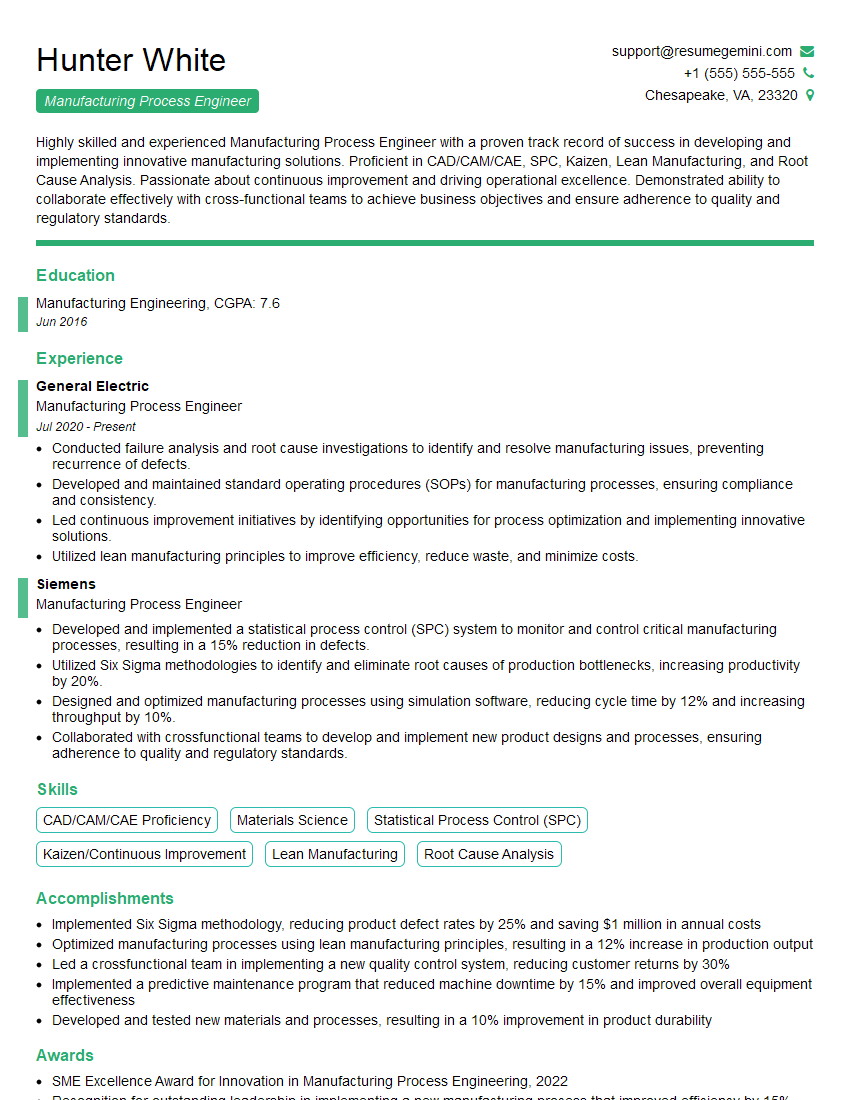
Mastering Molding Process Documentation is crucial for career advancement in manufacturing and engineering. A strong understanding of these concepts showcases your technical skills and problem-solving abilities, making you a highly valuable asset. To significantly boost your job prospects, create an ATS-friendly resume that highlights your relevant experience and skills. ResumeGemini is a trusted resource for building professional resumes tailored to your specific industry and experience. Examples of resumes tailored to Molding Process Documentation are available to help guide you.
Explore more articles
Users Rating of Our Blogs
Share Your Experience
We value your feedback! Please rate our content and share your thoughts (optional).
What Readers Say About Our Blog
Really detailed insights and content, thank you for writing this detailed article.
IT gave me an insight and words to use and be able to think of examples