Unlock your full potential by mastering the most common Grading According to USDA Standards interview questions. This blog offers a deep dive into the critical topics, ensuring you’re not only prepared to answer but to excel. With these insights, you’ll approach your interview with clarity and confidence.
Questions Asked in Grading According to USDA Standards Interview
Q 1. Describe the different USDA grades for beef.
The USDA grades beef based on several factors, primarily marbling (intramuscular fat), maturity (age of the animal), and firmness, texture, and color (FTC). This results in a tiered system. The highest grade is Prime, followed by Choice, Select, Standard, Commercial, Utility, Cutter, and Canner. The grades descend in quality and tenderness, with Prime having the most marbling and thus, typically, the richest flavor and juiciest texture. Lower grades are often used for ground beef or processed meats.
- Prime: Abundant marbling, excellent flavor and tenderness.
- Choice: Moderate marbling, very good flavor and tenderness.
- Select: Small amount of marbling, acceptable flavor and tenderness.
- Standard, Commercial, Utility, Cutter, Canner: These grades have less marbling and are generally less tender, often used for ground beef or processed meats.
Q 2. Explain the factors considered when grading poultry.
Poultry grading, while not as detailed as beef, assesses the quality and condition of the bird. The USDA grades poultry based on its conformation (shape and structure), fleshing (amount of meat on the carcass), and freedom from blemishes and defects. Grades include A, B, and C, with ‘A’ representing the highest quality. Factors considered include the bird’s overall appearance, presence of bruises or cuts, and the condition of the skin and feathers. For example, an ‘A’ grade chicken will have a well-fleshed breast and drumsticks, a smooth and clean skin, and no significant deformities. ‘B’ and ‘C’ grades will have more defects and may be used for processed products.
Q 3. What are the key differences between USDA Prime and Choice grades of beef?
The primary difference between USDA Prime and Choice beef lies in the amount of marbling. Prime beef has significantly more intramuscular fat (marbling) than Choice beef. This increased marbling translates to a richer, more flavorful, and more tender eating experience. Prime is typically more expensive due to its higher quality and limited availability. Choice beef still delivers excellent flavor and tenderness but is a more readily available and cost-effective option. Think of it like this: Prime is the equivalent of a gourmet restaurant experience, while Choice is a consistently excellent, reliable meal at a slightly more affordable price point.
Q 4. How does USDA grading impact consumer pricing?
USDA grading directly impacts consumer pricing. Higher grades, such as Prime and Choice beef, command higher prices because of their superior quality, tenderness, and flavor. Consumers are generally willing to pay more for the enhanced eating experience. Conversely, lower grades are typically less expensive because they may have less marbling, potentially resulting in a less tender or flavorful product. This price difference reflects the market demand and perceived value associated with each grade. Restaurants, for example, may choose Prime for their menu because it enhances their image and justifies higher menu prices.
Q 5. Explain the process of grading dairy products according to USDA standards.
USDA grading for dairy products focuses primarily on the composition and quality of the milk, butter, and cheese. For milk, tests determine the fat content, solids-not-fat content, and bacterial count. These factors directly impact shelf life and overall quality. Butter quality is assessed through factors like flavor, aroma, texture, and salt content. Cheese grading examines various aspects including texture, body, flavor, and appearance. Grading standards are highly specific for each dairy product and reflect the established criteria of quality. For instance, the ‘Grade A’ milk has to meet specific bacterial counts and fat content to ensure consumer safety and palatability.
Q 6. What are the visual and tactile characteristics of a high-quality grade of pork?
High-quality pork, typically corresponding to the highest USDA grades, exhibits several visual and tactile characteristics. Visually, it should have a firm, pinkish-red color with a good amount of marbling. There should be no excessive discoloration or bruising. Tactilely, the meat should feel firm and moist. It should not feel slimy or excessively dry. A high-quality cut of pork will have a good fat-to-lean ratio, with the fat appearing firm and white or creamy. The overall appearance should be attractive and indicative of freshness and proper handling.
Q 7. Describe the role of USDA inspectors in maintaining food safety.
USDA inspectors play a crucial role in ensuring the safety and quality of our nation’s meat and poultry supply. Their role extends beyond grading. They oversee the entire process, from the slaughterhouse to the processing plant. Inspectors verify that processing plants adhere to strict sanitary standards, preventing contamination and the spread of disease. They monitor food handling procedures, ensuring proper temperature control and preventing cross-contamination. By continuously monitoring and inspecting, they help maintain the safety of the food supply, protecting consumers from potentially harmful products. Their presence is a critical component of public health and consumer trust in the food industry.
Q 8. How do you identify and handle non-compliant products during a grading process?
Identifying and handling non-compliant products is crucial for maintaining the integrity of the USDA grading system. We use a multi-step process. First, visual inspection is paramount. Trained graders meticulously examine each product, looking for defects that fall outside the established standards for size, shape, color, blemishes, and other quality attributes. For example, an apple with significant bruising might be downgraded or rejected altogether, depending on the severity.
Second, we use standardized grading tools. These might include calipers for measuring size, color charts for assessing hue and intensity, and standardized defect charts. For produce like fruits and vegetables, we might use a grading chart that shows the acceptable percentage of blemishes allowed per grade.
Third, if a product doesn’t meet the standards, it’s segregated immediately. Non-compliant products are clearly marked to prevent them from being mixed with compliant ones. This is essential for preventing contamination and ensuring that only products meeting the specified quality standards are labeled and sold accordingly. The disposition of the non-compliant products depends on the severity of the defects; some may be downgraded to a lower grade, while others are rejected for sale. Detailed records are kept for traceability and quality control.
Q 9. What are the common defects found in produce during grading?
Common defects in produce vary depending on the type of product, but some frequent issues include:
- Bruising and Cuts: Physical damage to the produce, often resulting in discoloration and reduced shelf life.
- Discoloration: Unnatural coloring indicating decay or other problems.
- Insect or Disease Damage: Holes, scarring, or other signs of pest or disease infestation.
- Deformities: Unusual shapes or sizes that deviate from the standards.
- Decay or Rot: Spoilage affecting the product’s edibility and quality.
- Mechanical Damage: Damage incurred during harvesting, handling, or transportation (e.g., punctures, compression).
For example, a significant bruise on an apple would be considered a major defect, impacting its grade. Minor surface blemishes may be acceptable depending on the type of fruit and the established grade specifications.
Q 10. Explain the USDA grading standards for eggs.
The USDA grades eggs based on interior and exterior quality. The grades are AA, A, and B.
- AA Grade: Eggs have a firm, high yolk, a small amount of thick white around the yolk, and a very clean and unbroken shell.
- A Grade: These eggs are very similar to AA, but have slightly less firm whites.
- B Grade: The yolks are more spread and the whites are thinner. There may be some minor shell defects.
The grading process involves candling, a method where eggs are passed over a light source to check for internal defects such as blood spots, cracks in the yolk, and air cells. The size of the air cell is also a factor affecting the grade; a larger air cell generally indicates older eggs. Shell quality, including cleanliness and the presence of cracks or other defects, is also a key determinant. Eggs that fail to meet even B grade standards are typically not sold to consumers.
Q 11. How do you ensure accuracy and consistency in your grading procedures?
Accuracy and consistency in USDA grading are maintained through rigorous training and standardization. Graders undergo extensive training, learning to identify and assess defects consistently according to the established standards. Regular calibration checks ensure that grading tools, such as color charts and calipers, are providing accurate readings.
In addition, periodic audits are conducted by USDA inspectors to ensure graders are adhering to the established protocols and maintaining consistent grading standards. These audits also assess the accuracy of grading tools and procedures to identify any issues that may lead to inconsistencies. Internal quality control procedures, including regular re-grading of samples, help maintain accuracy and identify potential discrepancies among graders. This ensures a consistent approach across the entire grading process.
Q 12. Describe the documentation required for USDA grading.
Documentation for USDA grading is crucial for traceability and accountability. It includes the following:
- Grading Certificates: Official documents issued by certified USDA graders, indicating the grade of the product, quantity, and date of grading.
- Inspection Reports: Detailed reports documenting the grading process, noting any defects or issues encountered.
- Lot Identification: Clear identification of the product lot, including relevant information such as the producer, date of production, and lot number. This allows for tracing the product through the entire supply chain.
- Grading Records: Detailed records maintained by the grader detailing the quantity graded, number of products rejected, and any other pertinent information.
This documentation ensures transparency and allows for tracking and resolving any issues or disputes that may arise related to the grade of the product. Proper documentation helps maintain the integrity of the USDA grading system and protects both producers and consumers.
Q 13. What are the penalties for non-compliance with USDA grading standards?
Penalties for non-compliance with USDA grading standards can vary significantly depending on the nature and severity of the infraction. Mislabeling or fraudulent representation of a product’s grade is a serious offense. Consequences can range from:
- Financial Penalties: Fines imposed by the USDA for violations.
- Suspension or Revocation of Licenses: Graders who consistently fail to meet standards can lose their certification or face suspension.
- Product Seizure: Non-compliant products may be seized and destroyed.
- Legal Action: In extreme cases, more serious legal action may be taken.
The seriousness of the penalties reflects the importance of maintaining the integrity of the USDA grading system, which protects consumers and ensures fair trading practices within the agricultural industry.
Q 14. Explain the impact of temperature on the quality of perishable goods during grading.
Temperature significantly impacts the quality of perishable goods during grading. Maintaining the proper temperature is critical for preventing spoilage and ensuring that the grader is assessing the product in its optimal condition. Products stored at temperatures that are too high can deteriorate quickly, leading to accelerated decay, discoloration, and other quality issues. For example, produce left at room temperature will lose moisture and freshness much faster than produce stored under refrigeration.
Conversely, freezing temperatures can also negatively affect quality, especially for certain products. Freezing can damage cell structures and lead to a loss of texture and flavor upon thawing. Therefore, careful temperature control is essential throughout the grading process, with the specific temperature requirements varying depending on the type of product. Cold storage and appropriate transportation are vital to ensure the product maintains its quality during handling and grading.
Q 15. How do you maintain impartiality and objectivity while grading products?
Maintaining impartiality and objectivity in USDA grading is paramount. It’s about applying the established standards consistently, regardless of the producer, product origin, or personal biases. Think of it like being a referee in a game – you apply the rules fairly to every player. We achieve this through rigorous training, adherence to standardized procedures, and regular calibration checks of our equipment. For example, if I’m grading apples, I strictly follow the size, color, and blemish guidelines outlined in the USDA’s fruit and vegetable grading standards. Any deviation from these standards, no matter how minor, is documented and graded according to the pre-defined scale. We also undergo regular internal audits and quality control checks to ensure consistent application of these standards.
A key aspect is the use of standardized grading tools and equipment. This removes any subjective interpretation. For instance, using a calibrated colorimeter ensures consistent measurement of color, preventing personal judgement from influencing the grade.
Career Expert Tips:
- Ace those interviews! Prepare effectively by reviewing the Top 50 Most Common Interview Questions on ResumeGemini.
- Navigate your job search with confidence! Explore a wide range of Career Tips on ResumeGemini. Learn about common challenges and recommendations to overcome them.
- Craft the perfect resume! Master the Art of Resume Writing with ResumeGemini’s guide. Showcase your unique qualifications and achievements effectively.
- Don’t miss out on holiday savings! Build your dream resume with ResumeGemini’s ATS optimized templates.
Q 16. How do you handle disagreements with producers regarding grading decisions?
Disagreements with producers are handled professionally and transparently. The first step is always a review of the grading process itself. We meticulously re-examine the product against the official USDA standards, using the same equipment and procedures used initially. This ensures there’s no mistake in the application of grading rules. If the initial grading is confirmed, I explain the reasons behind the grade clearly and calmly, showing the producer the specific aspects of the product that led to that particular grade, citing specific sections of the USDA standards. I utilize visual aids like photos and samples to enhance understanding. If the producer still disagrees, we can utilize the USDA’s official appeal process. This involves a higher-level review by a more senior grader, offering the producer a fair and impartial second opinion.
It’s crucial to remember that building a positive relationship with producers is essential. Even when disagreeing, maintaining professional courtesy and open communication are key to resolving the issue constructively.
Q 17. Describe your experience with different grading equipment and technology.
My experience encompasses a wide range of grading equipment and technology. I’m proficient in using various instruments like colorimeters, diameter gauges, and moisture meters for measuring the physical characteristics of products. For example, when grading poultry, we use specialized scales to determine weight accurately and assess conformation. In grading grains, I’m experienced in using devices that measure moisture content, which significantly affects grain quality and storage life. I’m also familiar with newer technologies, such as image analysis systems that can automatically assess defects and classify products based on pre-programmed criteria. This automated approach enhances efficiency and consistency, especially during peak periods.
I’m also comfortable using handheld devices for data entry and record-keeping, ensuring accurate traceability of each batch of products. The integration of this technology into grading ensures efficiency and data integrity. My skills extend to the effective maintenance and calibration of all these instruments.
Q 18. How do you stay updated on changes and revisions to USDA grading standards?
Staying updated is crucial in this field. I regularly consult the USDA’s official website for updates to grading standards. They frequently release revised guidelines, reflecting changes in industry best practices, technological advancements, or consumer preferences. I also attend industry conferences, workshops, and training sessions. These events provide insights from other graders, specialists, and USDA representatives about changes, clarifications, and best practices. Furthermore, I subscribe to relevant industry publications and newsletters to stay informed about new research, techniques, and emerging trends that may influence grading procedures. This ensures I’m always applying the most current and accurate standards in my work.
Continuous professional development is essential to maintain my competency and credibility as a USDA grader.
Q 19. What are the ethical considerations involved in USDA grading?
Ethical considerations are central to USDA grading. Maintaining integrity and impartiality is non-negotiable. This includes avoiding any conflict of interest, such as accepting gifts or favors from producers. Accurate and truthful grading is crucial; misrepresentation can have severe economic consequences for producers and consumers. Data security and confidentiality of producer information are also essential, ensuring that grading information is handled responsibly and used only for its intended purpose. Adhering to the USDA’s code of conduct and reporting any ethical breaches I witness are part of my professional responsibility.
The ethical dimension goes beyond just the standards; it shapes how I interact with producers and colleagues, ensuring fair treatment and transparency in all grading activities.
Q 20. How do you manage your workload and prioritize tasks during peak periods?
During peak periods, efficient workload management is critical. I utilize various techniques to prioritize tasks effectively. This starts with a detailed schedule that prioritizes urgency and importance. High-volume items or products with tight deadlines are handled first. Furthermore, I make effective use of technology – leveraging digital record-keeping and automated systems to speed up the process. If necessary, I work collaboratively with other graders, delegating tasks when feasible. This prevents bottlenecks and ensures timely processing of all products. Regular breaks and efficient organization of my workspace are also crucial to maintain productivity and prevent errors caused by fatigue.
Effective communication with supervisors and colleagues is essential to ensure workload is managed fairly and efficiently during these intense periods.
Q 21. Explain your understanding of HACCP principles and their relevance to grading.
HACCP (Hazard Analysis and Critical Control Points) principles are vital in food safety and are indirectly relevant to grading. While grading itself doesn’t directly address HACCP’s specific control points, the quality standards assessed during grading often overlap with HACCP’s focus on preventing hazards. For instance, detecting spoilage or contamination during grading can alert producers to potential HACCP violations within their production process. A grade reflecting defects, such as bruises or discoloration in produce, might indicate inadequate handling or storage conditions, highlighting potential hazards. Although I am not responsible for implementing HACCP measures, my grading process provides valuable feedback which indirectly supports the overall aim of producing safe and wholesome food. My observations can inform producers about potential areas where they need to improve their HACCP plan.
Therefore, my role in grading contributes, indirectly, to food safety by highlighting potential quality issues that might relate to food safety hazards.
Q 22. Describe your experience working within a team environment in a grading setting.
In my experience, teamwork in a grading setting is crucial for efficiency and accuracy. We often work in teams of two or three, each grader specializing in certain aspects, like size, color, and defect assessment. For instance, one grader might focus on the size and weight of apples while another checks for bruises or blemishes. This division of labor ensures thoroughness. Effective communication is key; we constantly discuss borderline cases to ensure consistency and reach consensus. Regular team meetings help us refine our grading techniques, address any inconsistencies, and stay updated on changes to USDA standards. A collaborative environment encourages knowledge sharing and improves overall grading accuracy.
One specific example was when we were grading a large shipment of potatoes. One grader noticed a higher-than-average number of minor blemishes on a particular batch. By collaborating and discussing the severity of these blemishes based on the USDA standards, we were able to accurately categorize the potatoes, avoiding any misclassification that could affect pricing.
Q 23. How do you resolve conflicts or discrepancies in grading interpretations?
Discrepancies in grading interpretations are addressed through a multi-step process prioritizing consistency and adherence to USDA standards. First, we revisit the relevant sections of the grading manual and the specific criteria for the product in question. If uncertainty persists, we engage in open discussion, reviewing the physical characteristics of the product together. We may use calibrated instruments (like colorimeters) to objectively assess characteristics. If consensus still isn’t reached, we escalate the matter to a senior grader or supervisor who is an expert in the relevant produce. This ensures fair and accurate grading, regardless of individual interpretations.
A practical example involves grading bell peppers. One grader might consider a slightly discolored spot a minor defect, while another deems it major. We then jointly review the USDA guidelines on discoloration for bell peppers to determine whether it falls under a “US No. 1” or “US No. 2” grade. By referencing the standards, we consistently enforce the same grading criteria.
Q 24. Describe a time you had to deal with a challenging grading situation. How did you resolve it?
One challenging situation involved a shipment of strawberries arriving late and showing signs of significant temperature abuse. Many berries were significantly softened and some were moldy. The initial assessment was difficult due to the varying degrees of spoilage across the shipment. Applying the USDA standards strictly would have resulted in a significant portion being graded as culls (unacceptable for market). However, simply discarding everything wasn’t feasible either. To resolve this, we meticulously sorted the strawberries into three categories: those still within USDA standards, those showing minor deterioration (suitable for processing), and those clearly spoiled. We documented every step, taking pictures, and ensuring the separation was thoroughly transparent. This detailed record allowed the client to make informed decisions regarding pricing and product usage while ensuring accuracy and transparency in the grading process.
Q 25. What are the key differences between grading different types of fruits and vegetables?
Grading different fruits and vegetables involves variations in criteria due to the inherent differences in their characteristics. For example, grading apples emphasizes factors like size, color, firmness, and the presence of bruises or defects. However, grading tomatoes may focus on color uniformity, firmness, and the absence of cracks or decay. Leafy greens, on the other hand, are judged based on their color, texture, and the absence of wilting or disease. The USDA standards specify precise parameters for each type of produce, taking into account their specific attributes and susceptibility to damage or spoilage. This requires extensive training and a thorough understanding of the particular standards for each type of produce.
For example, a minor bruise on an apple might result in a lower grade, while a comparable blemish on a potato might be acceptable depending on its depth and extent. The standards are crafted to reflect the market demands and processing requirements for each product.
Q 26. How familiar are you with the USDA grading standards for grains?
I am very familiar with the USDA grading standards for grains. These standards encompass factors like moisture content, test weight, damaged kernels, foreign material, and other quality factors specific to the grain type (wheat, corn, barley, oats, etc.). Each grain has specific standards, reflecting its unique characteristics and uses. The grading process utilizes sophisticated equipment such as moisture meters, and careful visual inspection. Understanding these standards is crucial for ensuring the quality and market value of grain shipments.
For instance, the percentage of damaged kernels in a shipment of wheat directly impacts its grade and suitability for various applications like milling. Similarly, the presence of foreign materials like weed seeds or other grains impacts the grade. My experience includes working with various grain types and applying the relevant standards.
Q 27. Explain the process of verifying the identity of a product prior to grading.
Verifying product identity before grading is a critical step to ensure accuracy and prevent mislabeling or fraud. This involves a thorough check of accompanying documentation, such as invoices and certificates of origin, which should clearly specify the product’s type, variety, and origin. We visually inspect the product to confirm that it matches the documentation. In some cases, laboratory tests may be required to verify variety or detect the presence of contaminants or genetically modified organisms (GMOs), particularly for grains. This rigorous verification process protects the integrity of the grading process and the reputation of the USDA standards.
An example would be checking the label of a shipment of “Red Delicious” apples. We would match the label to the contents of the shipment by visually inspecting the apples and ensuring they align with the description. If there are significant discrepancies (e.g., a large percentage are not Red Delicious), then further investigation is required.
Q 28. How do you ensure traceability of products throughout the grading process?
Traceability is ensured through detailed record-keeping throughout the entire grading process. Each lot of produce receives a unique identification number, which is recorded at every stage, from receiving the product to issuing the final grade certificate. We use specialized software to track this information, including details like the date, time, grader’s identification, and any specific comments or observations. This comprehensive tracking system enables us to pinpoint the origin and history of any specific lot, ensuring accountability and allowing for prompt investigation if any issues arise. This traceability is crucial for efficient recall procedures should a problem with a specific lot be discovered.
This digital record-keeping system provides an audit trail, allowing for detailed analysis of grading practices and identification of any potential areas for improvement. It also aids in responding to customer inquiries regarding the origin and quality of a given product.
Key Topics to Learn for Grading According to USDA Standards Interview
- Understanding USDA Grades: Learn the different grade categories for various agricultural products (e.g., meat, poultry, eggs, fruits, vegetables) and the criteria defining each grade.
- Grading Procedures and Techniques: Familiarize yourself with the practical steps involved in grading, including visual inspection, measurement, and the use of standardized tools. Understand the importance of accuracy and consistency.
- Quality Factors and Attributes: Master the key factors that determine a product’s grade, such as size, shape, color, texture, defects, and maturity. Be prepared to explain the relative importance of each factor for different products.
- Regulatory Compliance: Understand the regulations and standards surrounding USDA grading and the potential consequences of non-compliance. This includes proper documentation and record-keeping.
- Practical Application: Be ready to discuss scenarios where you’ve applied grading knowledge or had to solve problems related to grading discrepancies or inconsistencies. Think about real-world examples from your experience.
- Technological Aspects: Explore the role of technology in modern grading processes, including automated grading systems and data analysis. This showcases adaptability and forward-thinking.
- Food Safety and Quality: Understand the connection between USDA grading and food safety. How does grading contribute to ensuring safe and high-quality products reach consumers?
Next Steps
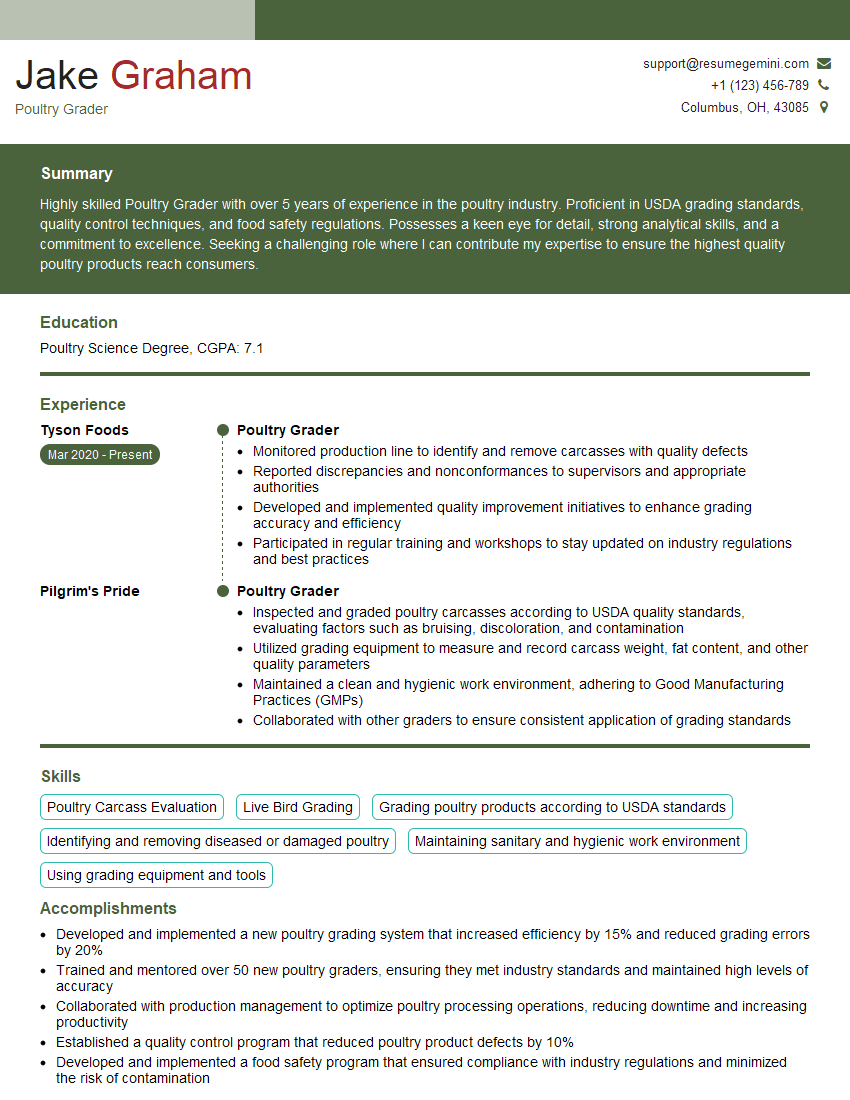
Mastering USDA grading standards opens doors to rewarding careers in the agricultural and food industries, offering opportunities for advancement and specialization. A strong resume is crucial for showcasing your skills and experience to potential employers. Building an ATS-friendly resume increases your chances of getting noticed by recruiters. ResumeGemini is a trusted resource to help you create a professional and effective resume that highlights your expertise in Grading According to USDA Standards. Examples of resumes tailored to this field are available through ResumeGemini to help guide your own creation. Invest time in crafting a compelling resume – it’s your first impression on a potential employer.



Explore more articles
Users Rating of Our Blogs
Share Your Experience
We value your feedback! Please rate our content and share your thoughts (optional).
What Readers Say About Our Blog
Really detailed insights and content, thank you for writing this detailed article.
IT gave me an insight and words to use and be able to think of examples