Preparation is the key to success in any interview. In this post, we’ll explore crucial Surveying Environmental interview questions and equip you with strategies to craft impactful answers. Whether you’re a beginner or a pro, these tips will elevate your preparation.
Questions Asked in Surveying Environmental Interview
Q 1. Explain the difference between plane surveying and geodetic surveying in an environmental context.
The key difference between plane surveying and geodetic surveying lies in how they handle the Earth’s curvature. Plane surveying assumes the Earth is flat within the survey area, which is a reasonable approximation for small areas. Geodetic surveying, on the other hand, accounts for the Earth’s curvature, crucial for larger areas or high-precision work. In an environmental context, this translates to different approaches for mapping and monitoring.
For example, surveying a small wetland for vegetation mapping might suffice with plane surveying techniques. The resulting error from ignoring the Earth’s curvature would be negligible. However, mapping a large-scale deforestation event, requiring precise location data covering a vast region, necessitates geodetic surveying. Failure to account for the Earth’s curvature in such cases would lead to significant positional errors and impact the accuracy of environmental analysis. We use different coordinate systems and datums relevant to the scale and accuracy required – State Plane Coordinate Systems are often employed in plane surveys while geographic coordinate systems (latitude and longitude) are used in geodetic surveys.
Q 2. Describe your experience with various surveying technologies (e.g., GPS, total stations, LiDAR).
My experience encompasses a wide range of surveying technologies. I’m proficient in using:
- GPS (Global Positioning System): I’ve extensively used GPS receivers, both static and kinematic, for precise point positioning in environmental projects. For instance, I used RTK-GPS to monitor the movement of a landslide for a stability assessment, achieving centimeter-level accuracy.
- Total Stations: I’m skilled in operating total stations for detailed topographic surveys, boundary surveys, and construction layout in environmental settings. I’ve used total stations to create detailed 3D models of contaminated sites to guide remediation efforts.
- LiDAR (Light Detection and Ranging): I have experience processing and analyzing LiDAR data for high-resolution terrain modeling and vegetation analysis. For example, I used LiDAR data to generate a digital elevation model (DEM) for a watershed study, allowing for precise volume calculations and hydrological modeling.
This breadth of experience enables me to select the most appropriate technology depending on the project’s scale, accuracy requirements, and budget.
Q 3. How do you ensure accurate data collection and processing in environmental surveying projects?
Ensuring accurate data collection and processing involves a multi-faceted approach that begins even before fieldwork. It involves meticulous planning and quality control at every step.
- Pre-fieldwork planning: This includes defining project objectives clearly, selecting appropriate surveying technologies based on project specifications, and developing a robust data collection plan including quality control procedures.
- Fieldwork procedures: This includes employing rigorous techniques for instrument calibration and maintenance, performing regular checks during data acquisition (e.g., checking instrument stability), and implementing redundant measurements to identify and minimize errors.
- Data processing and analysis: This involves employing appropriate software, implementing quality control checks for outliers and errors during data processing, and employing independent checks, like comparing data from different instruments or methods. We regularly utilize least squares adjustment techniques for the highest data accuracy.
- Documentation: Maintaining comprehensive field notes, instrument calibrations, and processing steps in meticulous and clearly organized reports is critical for traceability and accountability.
By adhering to these principles, I ensure high-quality, reliable data that forms the foundation of accurate environmental assessments and decision-making.
Q 4. What are the common sources of error in environmental surveying, and how do you mitigate them?
Environmental surveying encounters various error sources. These include:
- Instrumental errors: These stem from imperfections in surveying instruments, such as miscalibration or malfunctions. Regular instrument calibration and maintenance mitigate this.
- Personal errors: These result from human mistakes in data recording or instrument operation. Careful data recording practices and proper training are key.
- Natural errors: These are caused by environmental factors, including atmospheric refraction (affecting GPS and total station measurements) and changes in temperature, which can affect the accuracy of measurements. Using appropriate atmospheric correction models minimizes these errors.
- Systematic errors: These are consistent errors that follow a pattern, such as improper instrument setup or biases in data processing algorithms. Careful planning, proper techniques, and rigorous data processing procedures are important for identification and mitigation.
Mitigation involves rigorous quality control procedures, redundant measurements, and the use of advanced data processing techniques to identify and correct errors.
Q 5. Explain your understanding of coordinate systems and datums used in environmental surveying.
Understanding coordinate systems and datums is fundamental. A datum defines a reference surface for geographic coordinates (latitude and longitude), while a coordinate system is the mathematical framework used to express locations. In environmental surveying, the choice of datum and coordinate system is crucial for ensuring data consistency and accuracy.
Common datums include NAD83 (North American Datum of 1983) and WGS84 (World Geodetic System 1984). Coordinate systems can be geographic (latitude/longitude) or projected (e.g., UTM, State Plane Coordinate Systems). For instance, a project involving multiple states might require using the State Plane Coordinate System for each state to minimize distortions from projecting a large area onto a flat surface. Failure to properly define and transform coordinates can lead to significant positional errors impacting environmental assessments and analysis.
Q 6. Describe your experience with GIS software and its application in environmental projects.
GIS (Geographic Information Systems) software is an indispensable tool in environmental surveying. I’m proficient in using various GIS software packages like ArcGIS and QGIS. My experience involves:
- Data integration: Integrating various environmental data sets, such as surveying data, satellite imagery, and environmental monitoring data, within a GIS framework.
- Spatial analysis: Performing spatial analysis functions, such as buffer analysis to define areas of influence around pollution sources, overlay analysis to identify areas of overlap between different environmental features (e.g., wetlands and floodplains), and network analysis for modeling contaminant transport.
- Map creation and visualization: Generating clear and informative maps for various environmental applications, such as habitat maps, pollution risk assessments, and environmental impact assessments.
- Data management: Effectively organizing, managing, and archiving geospatial data in a GIS environment.
GIS allows for comprehensive visualization and analysis of environmental data, leading to better informed decision-making.
Q 7. How do you handle challenging fieldwork conditions (e.g., extreme weather, difficult terrain)?
Challenging fieldwork conditions are a reality in environmental surveying. My approach is based on preparation, safety, and adaptability.
- Planning and preparation: Thorough pre-fieldwork planning, including weather forecasting, site assessment, and risk assessment, is vital. I ensure adequate safety equipment, appropriate clothing, and backup plans are in place.
- Safety protocols: Safety is paramount. I strictly adhere to safety regulations and protocols, including the use of appropriate personal protective equipment (PPE) and risk mitigation strategies. For instance, working near water bodies requires life jackets and awareness of water currents.
- Adaptability: Flexibility is key. I’m adept at adapting my fieldwork methods to different conditions, such as employing alternative surveying techniques in dense vegetation or using specialized equipment for work in challenging terrains. For example, using drones for surveying inaccessible areas is a tool I utilize when necessary.
- Contingency planning: Having backup plans in place for unforeseen circumstances, such as equipment malfunction or inclement weather, is essential for timely project completion. This includes having secondary data collection methods and strategies for dealing with potential delays.
A combination of careful planning, strict safety procedures, and adaptability allows me to overcome challenging fieldwork conditions effectively and safely.
Q 8. What are the legal and regulatory requirements for environmental surveying in your region?
Legal and regulatory requirements for environmental surveying vary significantly by region, but generally revolve around protecting natural resources and human health. In my region, key legislation includes the [Insert relevant regional environmental acts/regulations here, e.g., National Environmental Policy Act (NEPA) in the US, Environmental Protection Act in the UK]. These acts often mandate environmental impact assessments (EIAs) for projects impacting the environment, require permits for handling hazardous materials encountered during surveying, and dictate the procedures for handling and reporting findings. Specific regulations often cover areas like protected species surveys (requiring licenses and adherence to strict protocols), wetland delineation (following specific methodologies), and the management of contaminated land. Non-compliance can lead to significant fines, project delays, and legal action.
For example, a project involving construction near a known nesting area for an endangered bird would require a detailed survey conducted by a licensed professional, adhering to strict protocols to avoid disturbance, and obtaining necessary permits before any construction begins. Failure to follow these regulations would result in serious legal ramifications.
Q 9. Explain your knowledge of environmental regulations and their impact on surveying practices.
Environmental regulations significantly influence surveying practices, primarily by dictating the scope, methodology, and reporting requirements of surveys. Regulations concerning endangered species, for example, necessitate the integration of species-specific survey protocols during site investigations. Similarly, regulations regarding water quality demand precise measurement techniques and adherence to strict sampling protocols. The increasing awareness of climate change also affects our practices. We’re integrating climate-related risk assessments into our project planning, considering factors such as sea-level rise and extreme weather events during site analysis. Failure to comply with environmental regulations can lead to project delays, substantial fines, and potential legal action. A key aspect is understanding the regulations relevant to a specific project – this understanding forms the bedrock of responsible and compliant survey practice.
Q 10. How do you ensure the confidentiality and security of environmental survey data?
Confidentiality and security of environmental survey data are paramount. We utilize several strategies to protect this sensitive information. Firstly, all data is encrypted both in transit and at rest. We use secure cloud storage services with robust access controls, limiting access to authorized personnel only. Secondly, we implement rigorous data management protocols. This includes clear version control, audit trails tracking all data access and modifications, and secure data backup and recovery plans. Thirdly, we adhere to strict confidentiality agreements with clients, outlining permissible uses of the data. Finally, all staff receive regular training on data security best practices and legal obligations concerning data privacy. Data breaches can have severe consequences, damaging client trust and potentially leading to legal repercussions. Our layered approach to security ensures the protection of this sensitive information.
Q 11. Describe your experience with environmental impact assessments (EIAs).
I have extensive experience in conducting and contributing to EIAs. My role typically involves collecting and analyzing baseline environmental data (flora, fauna, water quality, air quality, etc.) to predict the potential impacts of proposed projects. This involves field surveys, data analysis using GIS software, and report writing. For example, on a recent highway construction project, I conducted topographic surveys, identified potential habitat impacts, and assessed water quality in nearby streams. This data was incorporated into the EIA to predict and mitigate potential negative effects on the environment. The EIA was used to inform project design and secure necessary permits. Successfully navigating the EIA process often involves collaborating with other specialists like ecologists and hydrologists.
Q 12. How do you incorporate environmental considerations into surveying project planning?
Environmental considerations are integrated into project planning from the outset. This involves a thorough review of relevant environmental regulations and conducting preliminary site assessments to identify potential environmental sensitivities. For instance, if a project is near a wetland, we would incorporate wetland delineation and jurisdictional determination into the planning phase to ensure compliance and avoid potential delays. We would also incorporate potential mitigation strategies into the survey design – for instance, choosing surveying methods that minimize ground disturbance to protect sensitive habitats. This proactive approach helps avoid conflicts and ensures the project adheres to environmental regulations and best practices.
Q 13. Describe your experience with various types of environmental monitoring (e.g., water quality, air quality).
My experience encompasses various environmental monitoring techniques. For water quality monitoring, I’ve utilized techniques such as water sampling, analysis of parameters like pH, dissolved oxygen, and nutrient levels. For air quality monitoring, we use specialized equipment to measure pollutants like particulate matter and ozone. We also conduct noise level monitoring using calibrated sound level meters, which is crucial near sensitive areas. Data collected through these methods is analyzed to assess compliance with environmental standards and detect any environmental degradation. For example, during a remediation project at a former industrial site, I was involved in long-term monitoring of groundwater quality to track the effectiveness of the remediation measures. The results were crucial in demonstrating compliance with regulatory requirements.
Q 14. How do you interpret and analyze environmental survey data?
Interpreting and analyzing environmental survey data involves a multi-step process. It begins with data cleaning and validation – identifying and correcting errors in the dataset. Next, we apply statistical analyses to identify trends and patterns in the data. GIS software plays a crucial role here in visualizing spatial data and identifying relationships between different environmental parameters. Finally, we synthesize this information into comprehensive reports and visualizations, making conclusions about the environmental state of the surveyed area. For example, identifying a correlation between increased nutrient levels in a river and the location of agricultural runoff using GIS would highlight a potential pollution source. The conclusions drawn from the data analysis directly inform environmental management decisions and guide mitigation strategies.
Q 15. Explain your experience with preparing reports and presentations based on environmental survey data.
Preparing reports and presentations based on environmental survey data is a crucial part of my work. It involves not only compiling the raw data but also interpreting it, drawing meaningful conclusions, and communicating those findings clearly and concisely. My approach typically involves several steps:
- Data Analysis: I begin by thoroughly analyzing the collected data, identifying trends, anomalies, and significant findings. This often involves using statistical software and GIS tools to visualize spatial patterns and relationships.
- Report Structure: I then structure the report logically, typically starting with an executive summary that highlights key findings for a non-technical audience. Subsequent sections provide more detailed analyses, methodology explanations, and supporting data. For presentations, I create a narrative flow, starting with the problem, highlighting the methods and results, and concluding with recommendations.
- Visualizations: Clear and effective visualizations are essential. I use charts, graphs, maps, and images to present complex data in an easily understandable format. I choose the best visualization method for each piece of data to maximize clarity and impact.
- Quality Control: Before finalizing any report or presentation, I rigorously review it for accuracy, completeness, and clarity. I seek feedback from colleagues to ensure the information is presented effectively and meets the client’s needs.
For example, in a recent project assessing soil contamination at an industrial site, I prepared a report detailing the extent and nature of the contamination, including maps showing the spatial distribution of contaminants and tables summarizing the analytical results. The presentation to stakeholders included interactive maps and easily digestible charts highlighting the key findings and risk mitigation strategies.
Career Expert Tips:
- Ace those interviews! Prepare effectively by reviewing the Top 50 Most Common Interview Questions on ResumeGemini.
- Navigate your job search with confidence! Explore a wide range of Career Tips on ResumeGemini. Learn about common challenges and recommendations to overcome them.
- Craft the perfect resume! Master the Art of Resume Writing with ResumeGemini’s guide. Showcase your unique qualifications and achievements effectively.
- Don’t miss out on holiday savings! Build your dream resume with ResumeGemini’s ATS optimized templates.
Q 16. How do you communicate technical information effectively to both technical and non-technical audiences?
Communicating technical information effectively to diverse audiences is paramount in environmental surveying. My strategy involves tailoring my communication style to the audience’s technical expertise.
- Technical Audiences: When communicating with fellow scientists or engineers, I use precise technical language, delve into methodological details, and focus on data accuracy and statistical significance. Discussions often involve in-depth analysis and interpretation of complex datasets.
- Non-Technical Audiences: For non-technical audiences, such as project managers, clients, or community members, I simplify the technical jargon, focus on the key findings and their implications, and use clear, concise language and visual aids (charts, graphs, infographics). I avoid technical terms unless absolutely necessary, explaining them simply if used. Analogies and real-world examples are highly effective here.
For instance, when explaining groundwater contamination levels to a community group, I would avoid using terms like ‘ppm’ and instead use relatable comparisons, such as ‘imagine a drop of contaminant in a bucket of water’ to explain the concentration. For engineers, I would discuss the precise chemical composition and remediation strategies in detail.
Q 17. Describe your experience with working collaboratively within a multidisciplinary team.
Collaboration is integral to successful environmental surveying projects. My experience involves working effectively within multidisciplinary teams, including geologists, hydrologists, chemists, engineers, and regulatory specialists. I value open communication, shared responsibility, and respect for diverse expertise.
- Open Communication: I actively participate in team meetings, share information openly, and contribute my expertise to discussions. I actively listen to others’ perspectives and am comfortable expressing my own views constructively.
- Shared Responsibility: I understand the importance of teamwork and contribute to collective problem-solving. I am comfortable taking on various roles and responsibilities, depending on project needs.
- Respect for Expertise: I value the contributions of all team members, respecting their unique skill sets and knowledge bases. I am adept at integrating information from multiple disciplines to create a holistic understanding of the environmental system.
For example, in a project involving site remediation, I worked closely with a team of geologists to identify subsurface conditions, chemists to analyze soil and water samples, and engineers to design the remediation plan. Effective communication and collaboration were key to successfully completing this complex project.
Q 18. How do you manage time effectively and prioritize tasks in a fast-paced environment?
Effective time management and prioritization are crucial in the fast-paced world of environmental surveying. My approach combines planning, task management, and proactive problem-solving.
- Project Planning: I begin each project with a detailed work plan, outlining tasks, timelines, and responsibilities. This involves breaking down large projects into smaller, manageable tasks.
- Prioritization: I use a prioritization matrix to identify high-impact tasks that need immediate attention. This helps me focus my efforts on activities that will deliver the greatest value and meet deadlines.
- Task Management: I utilize project management software to track progress, manage deadlines, and identify potential delays. Regularly reviewing my schedule and adjusting my priorities helps me adapt to unexpected changes.
- Proactive Problem-Solving: I proactively identify and address potential problems before they escalate. This involves anticipating potential roadblocks and developing contingency plans.
In a recent project with tight deadlines, I successfully managed my time by breaking down the project into smaller, manageable tasks, utilizing project management software to track progress, and prioritizing high-impact activities. This allowed me to deliver the project on time and within budget despite unexpected field challenges.
Q 19. Describe a challenging environmental surveying project and how you overcame the challenges.
One challenging project involved surveying a brownfield site with highly variable subsurface conditions and limited access. The site had a history of industrial activity, resulting in complex contamination patterns and unstable soil conditions.
- Challenge 1: Subsurface Variability: The unpredictable subsurface conditions made traditional drilling methods difficult and inefficient. We needed to adapt our approach to overcome this challenge.
- Challenge 2: Limited Access: The site’s location presented significant access limitations. Heavy equipment could not easily access certain areas, requiring us to utilize smaller, more maneuverable equipment.
Solution: To overcome these challenges, we employed a multi-phased approach. First, we used geophysical methods, such as ground-penetrating radar (GPR), to obtain a preliminary understanding of the subsurface conditions before deploying drilling methods. Second, we utilized smaller, more mobile drilling rigs to access difficult-to-reach areas. Third, we employed innovative sampling techniques to minimize ground disturbance and maximize data collection efficiency. Through careful planning, creative problem-solving, and effective communication within the team, we successfully completed the survey, delivering accurate and reliable data within the project constraints.
Q 20. What are your strategies for managing risk and uncertainty in environmental surveying projects?
Risk and uncertainty management are crucial in environmental surveying. My strategies focus on proactive identification, assessment, and mitigation of potential risks.
- Risk Identification: I begin by identifying potential risks, including those related to environmental conditions, site access, regulatory compliance, and data quality. This often involves reviewing historical site information, conducting site reconnaissance, and consulting with relevant stakeholders.
- Risk Assessment: Once risks are identified, I assess their likelihood and potential impact on the project. This allows us to prioritize our efforts in addressing the most critical risks.
- Risk Mitigation: Based on the risk assessment, I develop and implement strategies to mitigate the identified risks. This may involve contingency planning, using alternative methodologies, engaging specialized consultants, and obtaining necessary permits and approvals.
For example, in a project involving wetland surveying, I anticipated the risk of encountering unexpected weather conditions. To mitigate this risk, we developed a contingency plan that included alternative data collection methods and rescheduling options if necessary. This proactive approach allowed us to complete the project despite encountering several days of inclement weather.
Q 21. Explain your understanding of different types of environmental contamination and their impact on surveying.
Understanding different types of environmental contamination and their impact on surveying is fundamental to my work. Different contaminants require different sampling and analytical methods, impacting the survey’s design and execution.
- Soil Contamination: This can include heavy metals, petroleum hydrocarbons, pesticides, and other organic compounds. The type and extent of soil contamination influence the sampling strategy (e.g., the number and location of samples), the analytical methods employed, and the health and safety precautions needed during the survey.
- Groundwater Contamination: Contaminants can leach into groundwater, requiring specialized techniques for sampling and analysis. The depth and flow direction of groundwater are critical considerations in survey design.
- Air Contamination: Air quality surveys are necessary for projects near industrial facilities or other sources of air pollution. These surveys require specialized equipment and sampling techniques.
Contamination significantly impacts survey design. For example, in a site with suspected heavy metal contamination, we would use specialized sampling equipment to avoid cross-contamination and send samples to a laboratory with the capability to analyze for heavy metals. The presence of volatile organic compounds (VOCs) would require different sampling methods and safety precautions, highlighting the need for comprehensive risk assessments and tailored survey designs.
Q 22. How familiar are you with different remediation techniques for environmental contamination?
Remediation techniques for environmental contamination vary greatly depending on the type and extent of the contamination. My experience encompasses a wide range of approaches, from in-situ (on-site) methods to ex-situ (off-site) techniques.
- In-situ bioremediation: This involves using microorganisms to break down contaminants. For example, we’ve successfully used this method to remediate soil contaminated with petroleum hydrocarbons. We monitor the microbial activity and adjust conditions (e.g., oxygen levels, nutrient addition) to optimize the remediation process.
- Pump and treat: This involves extracting groundwater, treating it to remove contaminants, and then reinjecting the cleaned water. This is effective for dissolved contaminants in aquifers. A recent project involved using this technique for chlorinated solvent remediation, requiring careful monitoring of the plume’s movement and treatment effectiveness.
- Soil vapor extraction (SVE): This is used to remove volatile organic compounds (VOCs) from the soil by applying vacuum pressure. We’ve utilized SVE in conjunction with bioventing (enhancing microbial activity in the vadose zone) for effective remediation of a dry-cleaning site.
- Excavation and disposal: This involves physically removing contaminated soil and disposing of it in a licensed landfill. While less environmentally friendly than in-situ methods, it is sometimes the most effective option for highly contaminated areas. This was necessary for a project involving heavy metal contamination.
The choice of remediation technique is critically dependent on site-specific factors, regulatory requirements, and cost-effectiveness. A thorough site characterization is always the first step, followed by the development of a detailed remediation plan.
Q 23. Describe your experience using specialized software for environmental data analysis (e.g., ArcGIS, AutoCAD Civil 3D).
I’m proficient in several environmental data analysis software packages. My experience with ArcGIS includes creating and managing geodatabases, performing spatial analysis (e.g., interpolation, buffering), and generating maps and reports for visualizing environmental data. I’ve used it extensively for visualizing contaminant plumes, analyzing land cover changes, and creating environmental impact assessments.
AutoCAD Civil 3D is another key tool in my arsenal. I use it for designing and modeling environmental infrastructure projects, such as stormwater management systems and erosion control measures. For instance, I’ve used it to model the impact of a proposed development on local hydrology.
Beyond ArcGIS and AutoCAD Civil 3D, I have experience with other specialized software such as Leapfrog Geo for 3D geological modelling and various statistical packages for data analysis and interpretation. The specific software used depends on the project’s needs.
Q 24. How do you ensure the accuracy and precision of environmental survey measurements?
Ensuring accuracy and precision in environmental survey measurements is paramount. This involves a multi-pronged approach:
- Calibration and maintenance of equipment: Regularly calibrating instruments like total stations, GPS receivers, and levels is crucial. This ensures their accuracy within specified tolerances. We meticulously maintain detailed calibration logs.
- Appropriate survey techniques: Employing suitable survey techniques for the specific environmental conditions is critical. For example, using precise leveling techniques on relatively flat terrain, while using RTK GPS in challenging terrain. Proper control networks and redundancy are also essential.
- Quality control and quality assurance (QA/QC): Implementing robust QA/QC procedures throughout the survey process—from data acquisition to data processing—is vital. This includes independent checks, data validation, and error analysis to detect and rectify any inconsistencies.
- Environmental considerations: Environmental factors such as temperature, humidity, and atmospheric pressure can affect measurements. We account for these by employing appropriate correction methods and documenting environmental conditions during data acquisition.
- Data processing and analysis: Rigorous data processing using appropriate software is essential. We utilize software to check for outliers and apply necessary corrections based on established QA/QC procedures.
By implementing these measures, we maintain a high level of confidence in the accuracy and reliability of our environmental survey data.
Q 25. Explain your understanding of the principles of photogrammetry and its application in environmental surveying.
Photogrammetry is the science of making measurements from photographs. In environmental surveying, it’s a powerful tool for creating detailed 3D models of landscapes and environments. This is particularly useful for monitoring erosion, deforestation, or changes in land cover.
The process typically involves taking overlapping photographs from various angles (using drones or airplanes), then employing specialized software to stitch these images together, creating a dense point cloud. This point cloud is then used to generate accurate digital elevation models (DEMs), orthomosaics, and 3D models.
For instance, we used photogrammetry to monitor the erosion of a riverbank after a flood. By comparing 3D models created before and after the flood, we were able to quantify the extent of erosion and inform mitigation strategies. The detailed imagery also allowed us to identify areas requiring immediate attention.
Q 26. Describe your experience with using LiDAR data for environmental applications.
LiDAR (Light Detection and Ranging) data provides highly accurate and detailed 3D representations of the Earth’s surface. My experience with LiDAR data includes processing, analyzing, and interpreting point cloud data for various environmental applications.
For example, we used LiDAR to create high-resolution DEMs for hydrological modeling. The detailed elevation data allowed us to accurately simulate water flow and predict areas prone to flooding. In another project, we used LiDAR to map vegetation density and height in a forest, providing crucial data for biodiversity assessments and forest management.
LiDAR’s ability to penetrate vegetation makes it especially valuable for generating accurate ground surface models in forested areas or areas with dense vegetation, something that traditional photogrammetry struggles with. I am proficient in using various software packages to process and analyze LiDAR point cloud data, extracting relevant information to support project objectives.
Q 27. How do you stay updated with the latest advancements in environmental surveying technologies and techniques?
Staying current in this rapidly evolving field is critical. I actively participate in professional development activities, including:
- Attending conferences and workshops: I regularly attend conferences like the ASPRS (American Society for Photogrammetry and Remote Sensing) annual meeting, learning about the newest technologies and techniques.
- Reading industry publications and journals: I subscribe to relevant journals and keep abreast of the latest research through online resources and professional publications.
- Participating in online courses and webinars: Many online platforms offer advanced courses on environmental surveying technologies, which I utilize to expand my knowledge base.
- Networking with colleagues and professionals: Engaging with colleagues and experts in the field allows for knowledge sharing and staying informed on current trends.
Continuous learning ensures I remain at the forefront of the profession and can leverage the most effective and efficient techniques for my work.
Q 28. What are your career goals in the field of environmental surveying?
My career goals involve combining my expertise in environmental surveying with a strong focus on sustainability and environmental protection. I aspire to lead projects that address pressing environmental challenges, using advanced technologies and techniques to provide solutions. I envision myself as a leader in the field, mentoring younger professionals, and contributing to the development of innovative solutions for environmental monitoring and remediation.
Specifically, I’m interested in pursuing opportunities in projects involving climate change adaptation and mitigation, such as using remote sensing to monitor carbon sequestration in forests, or utilizing advanced modeling techniques to predict and manage the impacts of rising sea levels. Ultimately, I aim to contribute to a more sustainable and environmentally responsible future.
Key Topics to Learn for Surveying Environmental Interview
- Environmental Regulations and Compliance: Understanding relevant legislation (e.g., Clean Water Act, Endangered Species Act) and their implications for surveying projects.
- GIS and Spatial Analysis: Applying Geographic Information Systems (GIS) software to analyze environmental data, create maps, and model spatial relationships for environmental impact assessments.
- Topographic Surveying for Environmental Projects: Mastering techniques for accurate elevation data acquisition crucial for site analysis, drainage design, and environmental modeling.
- Hydrographic Surveying: Understanding methods for surveying underwater environments, essential for projects involving wetlands, rivers, or coastal zones.
- Remote Sensing and LiDAR: Utilizing technologies like aerial photography and LiDAR for large-scale environmental data acquisition and analysis.
- Environmental Site Assessments (ESAs): Knowledge of Phase I, II, and III ESAs and their role in identifying and mitigating environmental hazards.
- Data Analysis and Interpretation: Developing skills in interpreting survey data, identifying patterns, and drawing meaningful conclusions for environmental decision-making.
- Problem-Solving and Critical Thinking: Demonstrating the ability to approach environmental challenges creatively, using data to inform solutions, and adapting to unexpected site conditions.
- Health and Safety Regulations: Understanding and adhering to safety protocols in diverse environmental settings to ensure both personal and team safety.
- Communication and Teamwork: Effectively communicating technical information to both technical and non-technical audiences, and collaborating effectively within a team.
Next Steps
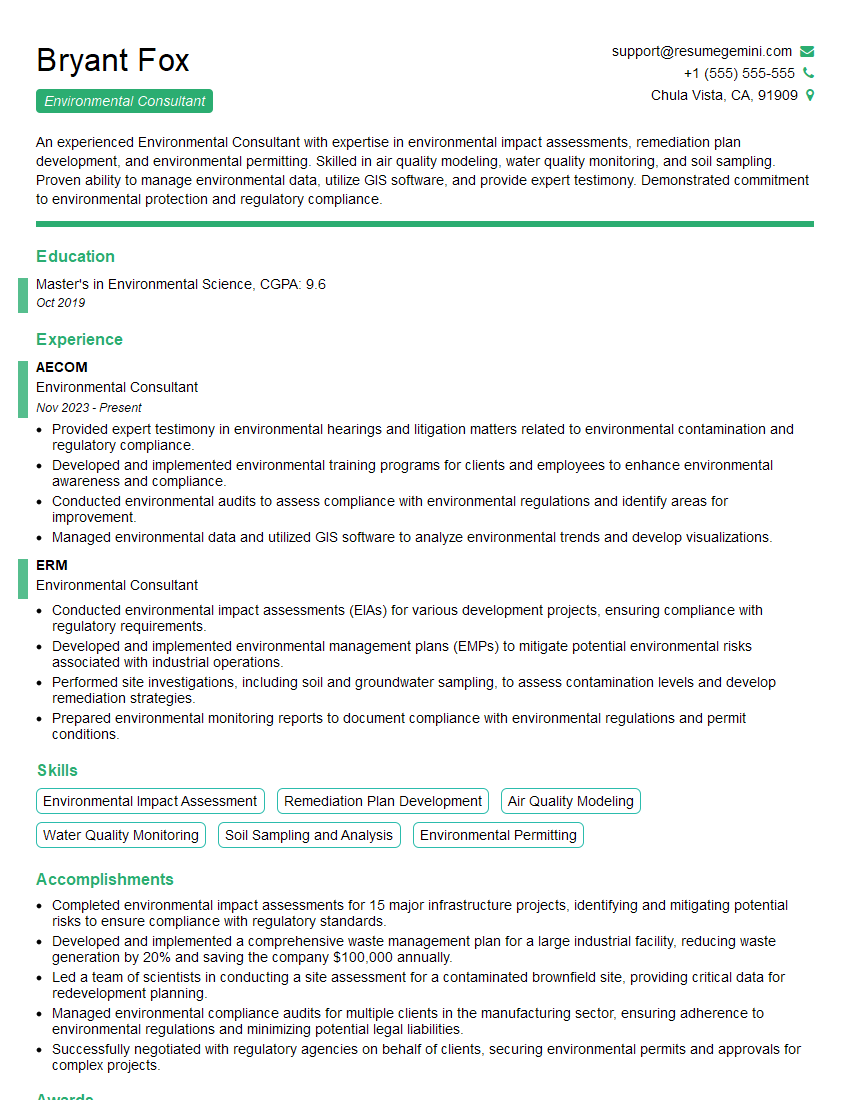
Mastering Surveying Environmental principles opens doors to exciting career opportunities in environmental consulting, construction, and government agencies. A strong understanding of these concepts will significantly enhance your interview performance and career prospects. To maximize your chances, focus on crafting an ATS-friendly resume that highlights your skills and experience effectively. ResumeGemini is a trusted resource to help you build a professional and impactful resume. Examples of resumes tailored to Surveying Environmental are available to help you get started.
Explore more articles
Users Rating of Our Blogs
Share Your Experience
We value your feedback! Please rate our content and share your thoughts (optional).
What Readers Say About Our Blog
Really detailed insights and content, thank you for writing this detailed article.
IT gave me an insight and words to use and be able to think of examples