Interviews are opportunities to demonstrate your expertise, and this guide is here to help you shine. Explore the essential Roll Manipulation interview questions that employers frequently ask, paired with strategies for crafting responses that set you apart from the competition.
Questions Asked in Roll Manipulation Interview
Q 1. Explain the difference between cold and hot roll forming.
The key difference between cold and hot roll forming lies in the temperature of the metal during the process. Hot roll forming involves shaping the metal at elevated temperatures, typically above its recrystallization temperature. This allows for greater deformation with less strain hardening, enabling the creation of more complex shapes and potentially leading to higher production rates. However, it requires specialized furnaces and handling equipment, and dimensional accuracy might be slightly lower due to thermal expansion and contraction. Think of it like molding clay – it’s much easier to shape when warm.
Cold roll forming, conversely, shapes the metal at room temperature. While it generally requires more passes and higher tooling precision, the resulting product boasts superior dimensional accuracy, smoother surface finish, and enhanced strength due to work hardening. Cold roll forming is akin to shaping a hardened piece of metal; it requires more force and careful technique. The choice between hot and cold roll forming depends on factors such as material properties, desired shape complexity, tolerances, and cost considerations.
Q 2. Describe the various types of roll forming machines.
Roll forming machines are broadly categorized based on their configuration and functionality. Some common types include:
- Standard Roll Forming Machines: These are the most common type, utilizing a series of rolls to gradually shape the metal. They are versatile and suitable for a wide range of applications.
- High-Speed Roll Forming Machines: Designed for high-volume production, these machines offer faster processing speeds, often incorporating features like automatic roll changes and integrated quality control systems. Imagine an assembly line for metal shaping.
- Precision Roll Forming Machines: These machines prioritize accuracy and tight tolerances, commonly used in the production of components requiring stringent dimensional requirements, such as parts for aerospace or automotive applications.
- Multi-Stage Roll Forming Machines: Often found in complex profiles, these machines incorporate several independent roll stands to create intricate shapes requiring multiple forming stages. They work like a multi-step assembly line, each step refining the shape.
- Automated Roll Forming Machines: Many modern systems include automated features like feeding, cutting, and stacking mechanisms to enhance efficiency and minimize manual intervention. These require less human input and are better suited to large-scale operations.
The choice of machine depends on factors like production volume, profile complexity, required tolerances, and budget.
Q 3. What are the common materials used in roll forming?
A wide variety of materials are used in roll forming, each with its own properties and suitability for specific applications. Some of the most common include:
- Mild Steel: Widely used for its cost-effectiveness and formability. Excellent for various structural applications.
- Stainless Steel: Popular for its corrosion resistance and hygienic properties. Often found in food processing and medical equipment.
- Aluminum: Lightweight and corrosion-resistant, suitable for applications where weight reduction is crucial, such as aerospace and automotive components.
- Galvanized Steel: Offers corrosion protection, making it suitable for outdoor applications.
- Copper: Used for its electrical conductivity and thermal properties.
- Other Alloys: Various other metal alloys are used depending on specific requirements for strength, corrosion resistance, or other properties.
The material selection critically depends on the intended application of the formed product.
Q 4. How do you calculate the roll forming process parameters?
Calculating roll forming process parameters is a complex task, often requiring specialized software and extensive experience. Key parameters include:
- Roll Diameter and Pitch: These determine the rate of deformation and the final shape. Accurate calculation is critical for dimensional accuracy.
- Roll Speed: Affects the production rate and the amount of heat generated during the process.
- Roll Force: Crucial for successful metal deformation. Too little force results in incomplete shaping, too much causes breakage.
- Reduction per Pass: Determines the amount of metal deformation in each pass. Overly aggressive reduction can lead to defects.
- Material Properties: The material’s yield strength, tensile strength, and ductility significantly influence the required parameters.
The calculation often involves iterative simulations and experimental validation, guided by empirical data and expertise. The process utilizes advanced formulas and finite element analysis (FEA) to predict stress and strain distributions during the rolling.
Q 5. Explain the concept of roll pass design.
Roll pass design is the meticulous process of defining the shape and sequence of the rolls to achieve the desired final profile. It’s the blueprint for the metal’s transformation. Imagine it like a series of sculpting steps, each roll shaping the metal incrementally toward the final form.
The design considers factors such as:
- Final Profile Geometry: The desired shape and dimensions of the finished product dictate the roll profiles.
- Material Properties: The chosen material’s mechanical properties influence the design to avoid defects like cracking or tearing.
- Roll Diameter and Pitch: Appropriate choices prevent excessive stress and ensure uniform deformation.
- Reduction per Pass: Incremental reduction prevents defects and ensures controlled deformation.
- Bend Radius: Determines the curvature of bends and prevents sharp creases.
Experienced designers use specialized software and their deep understanding of metal forming to create efficient and reliable roll pass designs. Mistakes in design can lead to significant problems, including product defects, damaged tooling, and production delays.
Q 6. How do you troubleshoot common roll forming defects?
Troubleshooting roll forming defects requires a systematic approach and a thorough understanding of the process. Common defects include:
- Wrinkling: Often caused by insufficient roll force or improper roll design. It is addressed by increasing roll force, adjusting roll geometry, or optimizing the roll pass design.
- Fracturing: Typically occurs due to excessive roll force, insufficient lubrication, or poor material quality. Requires reducing roll force, improving lubrication, or using better material.
- Edge Cracking: Often caused by excessive bending radius or poor edge preparation. Adjustment of the bend radius and better edge treatment are necessary.
- Dimensional Inaccuracy: Can result from worn rolls, incorrect roll settings, or variations in material properties. Addressing this requires roll maintenance, accurate parameter setting, and material quality control.
- Surface Defects: Scratches, marks, or other surface imperfections can arise from damaged rolls, insufficient lubrication, or contamination. Regular roll maintenance and lubrication are crucial.
A thorough inspection of the rolls, the material, and process parameters is vital. Root-cause analysis can uncover underlying issues that contribute to these defects.
Q 7. What are the safety precautions involved in roll manipulation?
Roll forming involves heavy machinery and moving parts, necessitating strict adherence to safety precautions:
- Lockout/Tagout Procedures: Essential before any maintenance or repair work on the machinery to prevent accidental startup.
- Personal Protective Equipment (PPE): Safety glasses, hearing protection, steel-toed boots, and gloves are essential to prevent injuries from flying debris, noise, or moving parts.
- Machine Guards: Ensuring all machine guards are in place and functioning correctly is crucial to prevent accidental contact with moving parts.
- Proper Training: Operators must receive thorough training on the safe operation and maintenance of roll forming equipment.
- Emergency Shutdown Procedures: All personnel should be familiar with emergency shutdown procedures in case of accidents or malfunctions.
- Regular Maintenance: Preventative maintenance reduces the risk of malfunctions and accidents. Regular inspections and timely repairs prevent equipment failure.
A safe work environment is paramount in roll forming, minimizing the risk of injury and maximizing productivity.
Q 8. How do you ensure the accuracy of roll forming dimensions?
Ensuring the accuracy of roll forming dimensions is crucial for producing high-quality parts. It’s a multi-faceted process that begins even before the roll forming process itself. We start with precise design and engineering, using CAD software to meticulously model the desired profile. This digital model is then used to create the roll tooling, which requires extremely high precision in manufacturing. The slightest deviation in the tooling can lead to significant errors in the final product.
During the roll forming process itself, we employ several quality control measures. This includes regular checks of the formed part using precision measuring tools like calipers, micrometers, and coordinate measuring machines (CMMs). These tools allow us to compare the actual dimensions to the specifications laid out in the design. Furthermore, we monitor the roll stand pressures and speeds to ensure consistent forming conditions, preventing variations in the final product dimensions. Any deviation is analyzed, and adjustments are made to the roll tooling, machine settings, or even the input material properties if needed. Finally, statistical process control (SPC) charts are used to monitor the process over time and to predict potential issues before they lead to significant deviations in dimensions. Think of it like baking a cake – you need the right recipe (design), the right tools (roll tooling), the right oven temperature (machine settings), and regular checks to ensure it’s baking correctly (quality control).
Q 9. What are the different types of roll tooling used in roll forming?
Roll tooling in roll forming is the heart of the process. Different types of tooling are used depending on the complexity of the profile being formed.
- Standard Rolls: These are the most basic type, used for forming simpler shapes. They’re typically made from hardened steel and have a specific curvature designed to gradually shape the material.
- Profile Rolls: These rolls are shaped to create the specific cross-sectional profile of the final product. They are more complex and may incorporate multiple sections to create curves, bends, and other features.
- Puncher Rolls: Used to punch holes or other cutouts directly into the material during the forming process, increasing efficiency.
- Bending Rolls: Used to bend the material into more complex three-dimensional forms.
- Forming Rolls: These rolls shape the initial stages of the part. This involves more gradual shaping and setting the basic shape.
- Finishing Rolls: These rolls come at the end of the forming process and are used for smoothing and precision adjustments.
The selection of roll tooling depends heavily on factors like material properties, final product design, and production volume. For instance, forming a simple U-channel requires less complex tooling than forming a highly intricate automotive component.
Q 10. Explain the significance of lubrication in roll forming.
Lubrication is absolutely vital in roll forming. It serves multiple critical functions and significantly impacts both product quality and machine lifespan. Think of it like oiling a bicycle chain; without it, the process would be incredibly difficult and lead to damage.
- Reduces Friction: Lubrication significantly reduces friction between the material and the rolls, preventing excessive wear on both. This results in longer tool life and less energy consumption.
- Improves Surface Finish: A good lubricant helps to create a smoother surface finish on the final product, minimizing scratching and other imperfections.
- Prevents Material Sticking: Lubrication prevents the material from sticking to the rolls, which can lead to tearing or uneven forming.
- Increases Production Speed: Reduced friction allows for higher production speeds without compromising quality.
The type of lubricant used depends on the material being formed, the roll material, and the forming environment. Some common types include oil-based lubricants, water-based lubricants, and specialized lubricant-coolant mixtures.
Q 11. How do you maintain and repair roll forming equipment?
Maintaining and repairing roll forming equipment is a continuous process requiring a proactive approach. Regular preventative maintenance is key to preventing costly downtime. This involves:
- Regular Inspections: Daily and weekly inspections of all components are essential. This includes checking for wear on the rolls, bearings, and other moving parts.
- Lubrication: Consistent lubrication, as discussed earlier, is vital for reducing wear and tear. Lubrication schedules should be strictly followed.
- Roll Changes: Worn or damaged rolls need to be replaced promptly to maintain dimensional accuracy. Having spare rolls on hand is a great preventative measure.
- Bearing Maintenance: Bearings are critical components, and their condition must be monitored closely. Regular lubrication and replacement are necessary.
- Hydraulic System Maintenance: For hydraulically powered equipment, regular checks of the fluid levels and condition are essential. Fluid changes need to be performed as per the manufacturer’s recommendations.
- Electrical System Checks: Regular inspection and maintenance of the electrical system, including motors and controls, are critical for safe operation.
When repairs are necessary, they should be carried out by trained technicians using high-quality parts. Improper repairs can lead to safety hazards and further damage to the equipment.
Q 12. Describe the process of roll alignment and adjustment.
Roll alignment and adjustment are crucial for maintaining dimensional accuracy in roll forming. Misaligned rolls can lead to inaccurate profiles, damaged material, and increased wear on the tooling. The process typically involves these steps:
- Initial Setup: The rolls are initially positioned according to the design specifications, using precision measuring tools for accurate placement.
- Trial Run: A small trial run is conducted to assess the initial alignment and identify any issues.
- Adjustment: Based on the trial run, adjustments are made to the roll positions using fine-tuning mechanisms on each roll stand. This often requires specialized tools and expertise.
- Measurement: After each adjustment, the formed part is measured and compared to the specifications to verify the accuracy of the adjustments.
- Iteration: This process of adjustment, measurement, and iteration is repeated until the desired accuracy is achieved.
- Final Verification: Once the alignment is satisfactory, a final verification run is performed to confirm that the process is consistently producing parts within tolerance.
Think of it like adjusting a guitar; small adjustments to the strings (rolls) can greatly impact the final sound (formed product). Precision and patience are key to this process.
Q 13. What is the role of roll crowning in roll forming?
Roll crowning is a crucial technique used to compensate for the inherent tendency of rolls to produce unevenly formed parts due to material deflection under pressure. Rolls aren’t perfectly cylindrical; instead, they have a slight convex curvature – the crown. This crown is carefully designed and controlled.
During roll forming, the material is subjected to significant pressure, causing it to deform slightly. Without crowning, the material would contact the rolls most heavily at the edges, resulting in an uneven profile. The crown ensures that the pressure distribution across the material is more even, leading to a more consistent final shape and reducing the risk of material defects.
The degree of crowning depends on several factors including the material being formed, the roll diameter, and the desired profile. In some cases, crowned rolls are used to address problems like ‘waviness’ in the final product.
Q 14. How do you optimize roll forming processes for efficiency?
Optimizing roll forming processes for efficiency involves a holistic approach focusing on several key areas:
- Tooling Design: Optimizing the design of the roll tooling for the specific application is essential. This may involve streamlining the forming process, reducing the number of rolls, and improving material flow.
- Material Selection: Choosing the right material for the application can have a major impact on efficiency. Selecting a material that is easily formed can reduce production time and energy consumption.
- Process Parameters: Optimizing parameters like roll speed, pressure, and lubrication can significantly improve efficiency. This often requires careful experimentation and data analysis.
- Automation: Implementing automation can dramatically improve efficiency, particularly in high-volume production. This can include automated material handling, roll changing systems, and quality control checks.
- Predictive Maintenance: Utilizing predictive maintenance techniques helps reduce downtime by anticipating potential equipment failures. This might involve using sensors to monitor the condition of various components.
- Waste Reduction: Carefully managing scrap and optimizing material utilization can improve efficiency and reduce costs. This can involve designing parts for minimal waste and implementing recycling programs.
By focusing on these key areas, companies can significantly improve the efficiency of their roll forming operations, reducing costs and increasing productivity.
Q 15. What are the common causes of roll wear and tear?
Roll wear and tear is an inevitable part of roll forming, but understanding its causes is crucial for preventative maintenance and maximizing roll lifespan. Common causes can be broadly categorized into material-related issues, process-related issues, and operational factors.
- Material Degradation: Abrasion from the workpiece material is a primary culprit. Harder materials or those with inclusions cause more aggressive wear. Adhesive wear, where material from the workpiece sticks to the roll and is then torn away, also contributes significantly. Chemical reactions between the roll material and the workpiece can also lead to corrosion and pitting.
- Process Parameters: Incorrect roll gap settings lead to excessive pressure and friction, accelerating wear. High rolling speeds can also exacerbate wear, as can improper lubrication. The presence of contaminants in the lubrication system can act as abrasives, causing rapid wear.
- Operational Factors: Improper handling and storage of rolls can introduce scratches and damage. Vibrations during operation can induce fatigue and cracking. Lack of regular inspections and maintenance allows small problems to escalate into major wear issues. For example, a seemingly minor scratch can become a significant gouge over time, especially in high-speed operations.
Think of it like a car tire – driving on rough roads, over-inflation, and ignoring wear indicators will dramatically shorten its life. Similarly, neglecting these factors in roll forming leads to premature roll failure and increased production costs.
Career Expert Tips:
- Ace those interviews! Prepare effectively by reviewing the Top 50 Most Common Interview Questions on ResumeGemini.
- Navigate your job search with confidence! Explore a wide range of Career Tips on ResumeGemini. Learn about common challenges and recommendations to overcome them.
- Craft the perfect resume! Master the Art of Resume Writing with ResumeGemini’s guide. Showcase your unique qualifications and achievements effectively.
- Don’t miss out on holiday savings! Build your dream resume with ResumeGemini’s ATS optimized templates.
Q 16. Explain the concept of roll pass sequence optimization.
Roll pass sequence optimization is the strategic design of the roll pass sequence to achieve the desired final product shape and dimensions with minimal material defects, energy consumption, and roll wear. It involves carefully considering the reduction in each pass, the shape of the rolls, and the material properties. The goal is to create a smooth and efficient deformation process.
Imagine shaping clay on a potter’s wheel. You wouldn’t drastically change the shape in one go; you’d gradually refine it pass by pass. Similarly, a well-optimized roll pass sequence gradually reduces the material thickness and shapes it to the desired profile without inducing cracks or other defects. Poor optimization can lead to excessive strain, material cracking, or uneven thickness in the final product.
Optimization often involves sophisticated software simulations that predict the material flow and stress distribution during the rolling process. These simulations help engineers fine-tune the roll pass sequence, minimizing defects and improving efficiency. Factors like bend radius, friction, and material yield strength are considered to arrive at the best possible sequence.
Q 17. How do you address material variations during roll forming?
Material variations are a significant challenge in roll forming, as they can lead to inconsistencies in the final product. These variations can be in the form of thickness fluctuations, variations in tensile strength, or differences in surface finish. To address these challenges, several strategies are employed.
- Adaptive Control Systems: These systems monitor material properties in real-time using sensors and adjust process parameters accordingly (e.g., roll gap, speed) to compensate for variations. This ensures consistent product quality despite material fluctuations.
- Pre-Processing: Before entering the roll forming line, materials can undergo pre-processing, such as leveling or annealing, to minimize thickness variations. This creates a more uniform starting material, simplifying the roll forming process.
- Roll Design: Rolls can be designed with features that are less sensitive to material variations. For instance, the use of crowned rolls can help accommodate thickness fluctuations across the material width.
- Process Monitoring and Feedback: Constant monitoring of the process, through sensors measuring parameters such as thickness, tension, and speed, helps to detect and react to material variations quickly. Feedback loops help operators adjust parameters, minimizing the impact of material inconsistency.
For example, if the incoming material is thicker in one section, the adaptive control system might automatically reduce the roll gap in that section to maintain the desired final thickness. This proactive approach ensures consistent output.
Q 18. What quality control measures are implemented in roll forming?
Quality control in roll forming is paramount to ensure the production of consistent, high-quality products. A comprehensive quality control system incorporates several key measures:
- Incoming Material Inspection: Thorough inspection of incoming raw materials for thickness, width, surface finish, and mechanical properties. This ensures the starting material meets the required specifications.
- In-Process Monitoring: Continuous monitoring of critical process parameters such as roll gap, speed, temperature, and lubricant flow. Sensors and data acquisition systems play a vital role here.
- Dimensional Checks: Regular measurements of the final product to ensure that it conforms to the specified dimensions. This often involves using precision measuring instruments and automated gauging systems.
- Surface Finish Inspection: Visual inspection and surface roughness measurements to ensure the product’s surface is free from defects like scratches, dents, or other imperfections.
- Mechanical Testing: Periodic testing of the product’s mechanical properties, such as tensile strength, yield strength, and elongation, to verify it meets the required specifications.
- Statistical Process Control (SPC): Utilizing statistical methods to monitor process variability and identify potential problems before they lead to significant defects. Control charts are frequently used in this context.
A robust quality control system minimizes defects, improves product consistency, and enhances customer satisfaction. It’s not just about detecting defects; it’s about preventing them in the first place.
Q 19. How do you use different types of sensors in roll manipulation?
Sensors play a crucial role in modern roll manipulation, enabling real-time monitoring and control of the process. Different types of sensors are employed to measure various parameters.
- Thickness Gauges: These sensors measure the thickness of the material as it passes through the rolls, providing essential feedback for adaptive control systems. X-ray gauges and laser gauges are commonly used.
- Strain Gauges: These sensors measure the strain on the rolls, helping to optimize roll pressure and reduce wear. This data is also crucial for detecting potential roll failures.
- Temperature Sensors: Monitoring roll and material temperatures is critical to ensure the process operates within the optimal range. Thermocouples and infrared thermometers are often used.
- Displacement Sensors: These measure the position and movement of the rolls, ensuring precise control of the roll gap and minimizing variations in the final product.
- Vibration Sensors: These detect vibrations in the rolls and the rolling mill, providing early warning of potential mechanical problems or imbalances.
- Force Sensors: Measure the forces acting on the rolls, which is useful for determining the optimal rolling parameters and identifying potential issues with the process.
The data from these sensors is typically fed into a control system, allowing for real-time adjustments to maintain consistent product quality and prevent defects. This data-driven approach is essential for modern high-speed roll forming.
Q 20. Describe your experience with various roll forming software applications.
My experience with roll forming software applications is extensive. I’ve worked with several leading software packages, including RollFormPro, AutoForm, and Pam-Form. These software packages offer different strengths but share the common goal of simulating and optimizing the roll forming process.
RollFormPro, for instance, excels in its intuitive interface and detailed visualization capabilities, allowing for easy design and optimization of roll pass sequences. AutoForm is particularly powerful for complex simulations, involving advanced material models and precise predictions of material behavior. Pam-Form is well-suited for large-scale industrial applications, offering robust simulation capabilities and seamless integration with production systems.
My proficiency extends beyond simply using these packages; I understand the underlying principles of the simulations and can critically evaluate the results. This understanding allows me to effectively utilize these tools to optimize roll designs, improve process efficiency, and minimize material waste. I am also comfortable adapting my approach to different software packages based on project requirements.
Q 21. Explain the process of roll refurbishment.
Roll refurbishment is a crucial aspect of maintaining efficient and cost-effective roll forming operations. It’s a systematic process that aims to restore worn rolls to their original specifications or even improve their performance. The process usually involves several stages.
- Inspection and Assessment: A thorough inspection of the rolls to identify the extent of wear, damage, and the type of wear mechanisms involved. This assessment determines the necessary refurbishment techniques.
- Cleaning and Preparation: Removing any dirt, debris, or adhered material from the roll surfaces. This often involves specialized cleaning agents and techniques.
- Machining: This is the core of the refurbishment process. Worn areas are machined to restore the rolls’ original profile and dimensions. This may involve grinding, turning, or polishing, depending on the extent of wear.
- Surface Treatment: Applying a protective surface treatment to improve the roll’s durability and resistance to wear. This may include chrome plating, nitriding, or other specialized coatings.
- Inspection and Testing: After refurbishment, a thorough inspection and testing are carried out to verify that the rolls meet the required specifications. This ensures the refurbished rolls perform as expected.
- Storage and Handling: Proper storage and handling procedures are crucial to prevent damage to the refurbished rolls before they are reinstalled.
Refurbishing rolls is significantly more cost-effective than replacing them, contributing to significant cost savings in the long run. A well-maintained refurbishment program ensures high uptime, reduces downtime due to roll failures, and ultimately improves profitability.
Q 22. How do you handle different types of roll forming defects like buckling and wrinkling?
Buckling and wrinkling are common defects in roll forming, stemming from instability during the bending process. Buckling manifests as a wavy deformation along the length of the formed part, while wrinkling appears as smaller, localized waves typically on the compression side. Handling these requires a multi-pronged approach.
- Material Properties: Using a material with higher yield strength and lower strain hardening exponent can mitigate buckling. Thinner gauges are more prone to buckling, so selecting the appropriate gauge is crucial.
- Roll Design: The roll radius, the number of passes, and the spacing between rolls all influence buckling. Smaller radii increase the bending stress, making buckling more likely. A gradual bending process using multiple passes helps to reduce stress concentrations. Incorrect roll spacing can create uneven bending leading to both buckling and wrinkling.
- Roll Lubrication: Sufficient lubrication reduces friction, thus lessening the chance of wrinkles. The right lubricant will also improve material flow, minimizing stress concentrations. Insufficient lubrication or the wrong type of lubricant can exacerbate wrinkling.
- Roll Speed and Feed Rate: An improperly synchronized roll speed and feed rate can cause significant issues. Too fast a feed rate, for instance, will lead to excessive compression and wrinkling. Finding the sweet spot through iterative adjustments is key.
- Process Adjustments: Sometimes, simply adjusting the tension of the strip entering the roll forming process can alleviate buckling. Proper tension control ensures consistent material flow and avoids stress build-up.
For example, I once encountered severe buckling in a long, thin aluminum profile. By reducing the feed rate, slightly increasing the roll radius, and optimizing the lubrication, we managed to eliminate the buckling. Each adjustment was carefully monitored, and the process was iteratively refined until the optimal conditions were reached.
Q 23. What are the different types of roll forming lubricants and when do you use them?
Roll forming lubricants are crucial for reducing friction, wear, and tear on the rolls and the material being formed. Different applications require different lubricants.
- Water-Based Lubricants: These are environmentally friendly and cost-effective, suitable for many materials and applications. However, they may not be effective in extreme conditions or with certain high-strength materials.
- Oil-Based Lubricants: Offer superior lubrication and can handle higher pressures and temperatures. They are often chosen for difficult-to-form materials or when high surface finish is required. However, they can have environmental concerns and require careful handling.
- Grease-Based Lubricants: Used for applications requiring thick lubrication film to minimize friction and prevent galling. Useful in applications with intermittent contact or slow speeds.
- Emulsions: These are mixtures of oil and water, offering a balance between the properties of oil and water-based lubricants. They are often tailored to specific material and processing requirements.
The choice of lubricant depends heavily on the material being formed (steel, aluminum, stainless steel, etc.), the complexity of the profile, the desired surface finish, and environmental concerns. For instance, when forming high-strength steel, an oil-based lubricant with extreme-pressure additives might be necessary. For aluminum, a water-based lubricant would be a common and effective choice.
Q 24. Describe your experience with different types of roll materials.
My experience encompasses a wide range of roll materials, each with its strengths and weaknesses.
- Steel Rolls: The most common choice, offering good hardness, wear resistance, and cost-effectiveness. However, they can be susceptible to wear and require periodic maintenance like grinding and polishing.
- Chilled Cast Iron Rolls: Provide excellent wear resistance and durability, making them suitable for high-volume applications and abrasive materials. Their higher cost is offset by their longer lifespan.
- Hardened Steel Rolls: Offer even higher hardness and wear resistance than standard steel rolls, ideal for forming high-strength materials and complex profiles. They require precise manufacturing and are expensive.
- Tungsten Carbide Rolls: Exhibit exceptional hardness and wear resistance, enabling them to withstand extreme pressures and temperatures. They are suitable for specialized applications involving very hard materials or extremely high production volumes. However they are extremely costly.
Selecting the right roll material involves considering factors like the material being formed, the roll’s diameter and length, the operating speed, and the desired lifespan. A high-volume production line might justify the higher cost of tungsten carbide rolls for their unmatched durability while a lower-volume operation may use steel rolls. Each situation requires careful analysis to find the most cost-effective solution.
Q 25. How do you determine the optimal roll speed and feed rate?
Determining the optimal roll speed and feed rate requires a careful balancing act. Too high a speed or feed rate can lead to buckling, wrinkling, or even breakage, while too low a speed can reduce production efficiency.
The optimal values are interdependent and influenced by several factors, including:
- Material Properties: Yield strength, tensile strength, and ductility all affect the optimal speed and feed rate.
- Roll Geometry: Roll radius, the number of passes, and the spacing between rolls directly impact the bending stress and therefore the ideal speed and feed rate.
- Profile Complexity: More complex profiles usually require slower speeds and potentially lower feed rates to avoid defects.
- Lubricant Type and Quantity: Sufficient lubrication will allow slightly higher speeds.
Often, a trial-and-error approach, guided by experience and careful monitoring of the formed part, is employed. We often use Finite Element Analysis (FEA) simulations to predict the optimal values before real-world testing. This significantly reduces the need for iterative adjustments in the actual production line. The process involves starting with conservative values, incrementally increasing the speed and feed rate while continuously monitoring for defects. Data logging and process monitoring software are crucial for collecting real-time data to refine the settings.
Q 26. What is your experience with automated roll change systems?
My experience with automated roll change systems is extensive, having worked with both hydraulic and robotic systems. These systems significantly reduce downtime associated with manual roll changes, leading to increased productivity and reduced labor costs.
Hydraulic systems are simpler and more common in some applications, relying on hydraulic cylinders to move rolls into position. Robotic systems offer greater precision and flexibility, often integrated with advanced control systems to automate the entire process. They can also handle heavier rolls, making them beneficial for large scale operations.
Key considerations in selecting an automated system include:
- Production Volume: High-volume production lines benefit more from automation.
- Roll Size and Weight: The system needs to handle the physical dimensions and weight of the rolls.
- Roll Change Frequency: Frequent changes justify a more sophisticated automated system.
- Integration with Existing Equipment: The system should integrate seamlessly into the current production line and control systems.
I’ve witnessed firsthand the efficiency gains realized through automation. In one project, implementing a robotic roll change system reduced downtime by over 60%, resulting in a significant increase in throughput and a considerable return on investment.
Q 27. Describe a challenging roll forming problem you solved and how you approached it.
One particularly challenging project involved producing a highly complex, thin-walled stainless steel profile with intricate curves and tight tolerances. The initial attempts resulted in significant edge cracking and inconsistent dimensions.
My approach involved a systematic troubleshooting process:
- Detailed Analysis: We thoroughly analyzed the process parameters, including roll speed, feed rate, lubrication, and material properties.
- Finite Element Analysis (FEA): We used FEA simulations to model the stress distribution during the forming process. This highlighted areas of high stress concentration, which were contributing to the edge cracking.
- Roll Design Optimization: Based on the FEA results, we redesigned the rolls to reduce stress concentrations in the critical areas. This involved modifying the roll radii and adding intermediate passes to distribute the bending stress more evenly.
- Material Selection: We explored different grades of stainless steel with improved ductility to reduce the susceptibility to cracking.
- Lubrication Optimization: We experimented with different lubricants to find the one that minimized friction and provided adequate lubrication during the entire forming process. We even considered using a different lubrication method.
Through this systematic approach, we were able to significantly reduce the edge cracking and improve the dimensional accuracy of the formed profile. The project highlighted the importance of a thorough understanding of the forming process, advanced simulation techniques, and iterative refinement to overcome complex roll forming challenges.
Key Topics to Learn for Roll Manipulation Interview
- Roll Forming Fundamentals: Understanding the principles of roll forming, including material properties, roll geometry, and the forming process itself. This includes knowledge of different types of roll forming machines and their applications.
- Roll Design and Optimization: Learn how to design and optimize roll configurations for specific material and product requirements. This includes considerations for minimizing defects, maximizing production rates, and achieving desired product tolerances.
- Material Science and Properties: A strong grasp of the mechanical properties of different materials used in roll manipulation (e.g., steel, aluminum, etc.) and how these properties influence the forming process. This includes understanding material behavior under stress and strain.
- Process Simulation and Modeling: Familiarity with simulation software and techniques used to predict the outcome of roll manipulation processes and optimize the design before physical implementation.
- Troubleshooting and Defect Analysis: Understanding common defects encountered in roll forming (e.g., wrinkles, buckles, tears) and the strategies to identify and solve them. This involves analysis of process parameters and material properties.
- Automation and Control Systems: Knowledge of automated roll forming systems and the control mechanisms used to maintain precision and efficiency in the process. This includes understanding PLC programming and process monitoring techniques.
- Safety Procedures and Regulations: Familiarity with relevant safety regulations and procedures for operating and maintaining roll forming equipment. This includes understanding potential hazards and mitigation strategies.
Next Steps
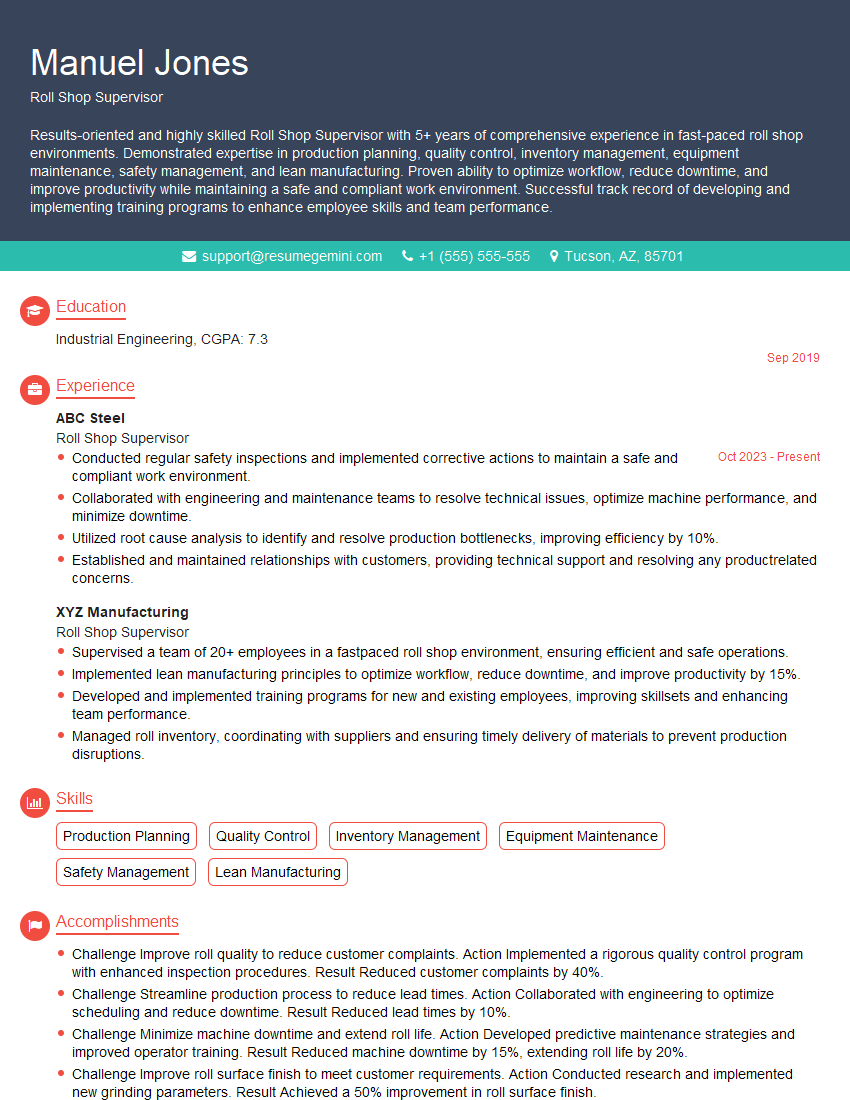
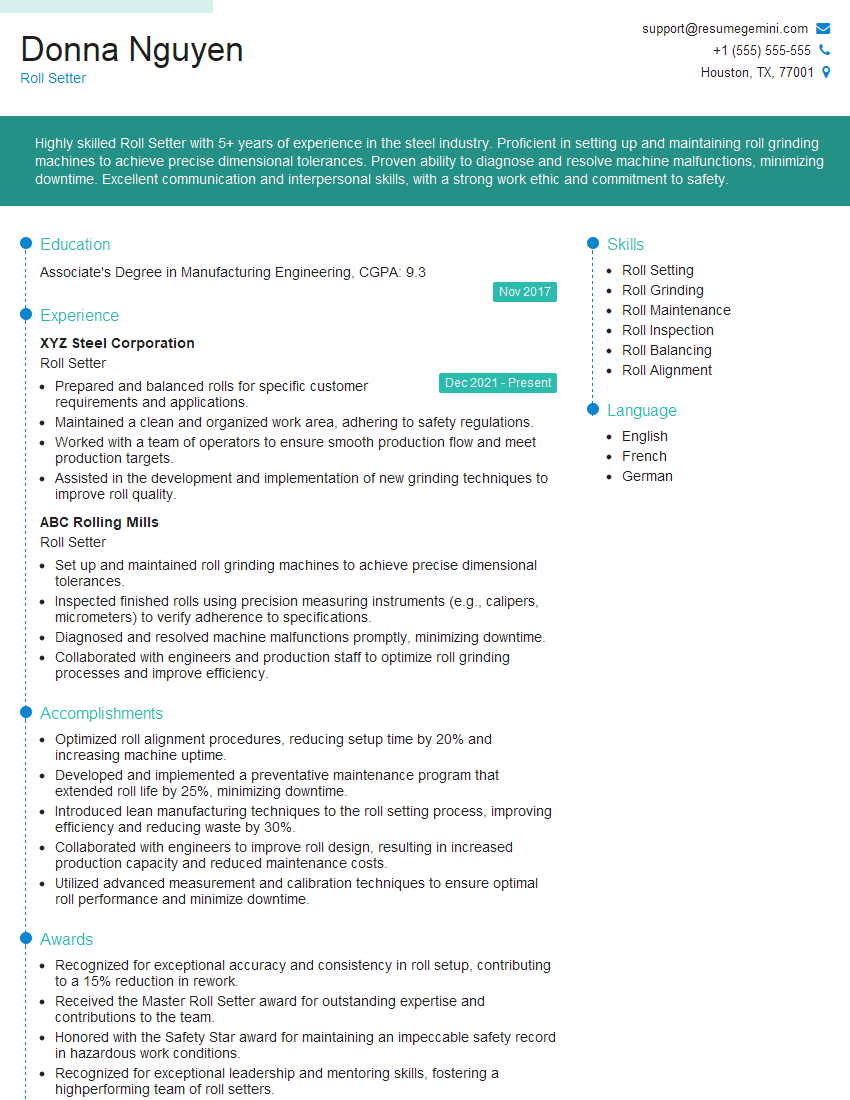
Mastering roll manipulation opens doors to exciting career opportunities in manufacturing and engineering, offering excellent growth potential and competitive salaries. To maximize your job prospects, crafting a compelling and ATS-friendly resume is crucial. ResumeGemini can help you build a professional and effective resume that highlights your skills and experience in roll manipulation. Examples of resumes tailored to the Roll Manipulation field are available to help guide your resume creation process within ResumeGemini. Take the next step in your career journey by investing in your resume – it’s your first impression to potential employers.
Explore more articles
Users Rating of Our Blogs
Share Your Experience
We value your feedback! Please rate our content and share your thoughts (optional).
What Readers Say About Our Blog
Really detailed insights and content, thank you for writing this detailed article.
IT gave me an insight and words to use and be able to think of examples