Every successful interview starts with knowing what to expect. In this blog, we’ll take you through the top Arranging and Orchestration interview questions, breaking them down with expert tips to help you deliver impactful answers. Step into your next interview fully prepared and ready to succeed.
Questions Asked in Arranging and Orchestration Interview
Q 1. Explain the difference between arranging and orchestrating.
While both arranging and orchestrating involve adapting musical material for a specific ensemble, they differ significantly. Arranging is a broader term encompassing the adaptation of a piece for any ensemble, potentially changing the melody, harmony, rhythm, and overall character. Think of it as a creative reimagining of a piece. Orchestration, on the other hand, is a specialized subset of arranging specifically focused on writing for an orchestra. It emphasizes exploiting the unique timbral qualities of each orchestral instrument to create a rich and colorful sonic tapestry. So, all orchestration is arranging, but not all arranging is orchestration.
For example, arranging a pop song for a string quartet requires careful consideration of the harmonic texture and voicing possibilities within the quartet’s limited range. Orchestrating the same song for a full orchestra, however, would involve assigning specific melodic and harmonic lines to different instrument sections (strings, woodwinds, brass, percussion) to maximize the overall musical impact. This demands a far deeper understanding of each instrument’s capabilities and limitations.
Q 2. Describe your experience with various orchestral instruments and their ranges.
My experience spans a wide range of orchestral instruments. I have a deep understanding of the idiomatic writing styles for each section. For strings, I’m familiar with the rich textures possible from the full string section, as well as the subtle nuances of solo violin writing. I’m aware of the different ranges: violins spanning a wide range (G3-A7), violas (C3-E6), cellos (C2-C6), and double basses (E1-E5). In the woodwind section, I understand the versatility of flutes, oboes, clarinets, and bassoons, from their delicate high registers to their powerful low notes. The brass section, with its powerful and majestic sounds, requires careful balancing, and I’m proficient in writing for trumpets, horns, trombones, and tuba, understanding their unique sonic characteristics and ranges. Finally, I understand the versatility of percussion, from delicate cymbal rolls to powerful timpani blasts, incorporating them effectively.
Years of experience and detailed study of orchestral scores have cemented this knowledge, enabling me to write idiomatically and effectively for each section. I often refer to instrument range charts and listen to numerous recordings to refine my understanding and ensure accuracy.
Q 3. How do you approach arranging for different ensembles (e.g., string quartet vs. full orchestra)?
Approaching arrangements for different ensembles requires a completely different mindset. Arranging for a string quartet, for instance, necessitates a focus on counterpoint, close voice leading, and a refined harmonic language. The limited number of players requires careful consideration of each part’s melodic and harmonic contribution. Every note counts! Conversely, arranging for a full orchestra allows for greater sonic density and textural possibilities. You can layer instruments to create rich harmonic textures and dramatic swells. The challenge here lies in balancing the individual sections, preventing any one section from overpowering the others.
For example, a simple melody might be beautifully arranged for a string quartet with each instrument playing a significant melodic line. The same melody, orchestrated for a full orchestra, might see the melody shared between the first violins, with the other sections providing harmonic support and countermelodies. It becomes a question of building a tapestry of sound.
Q 4. Discuss your process for creating a compelling arrangement from an existing melody.
My process for arranging an existing melody begins with deep listening. I analyze the melody’s harmonic implications, rhythmic structure, and emotional character. I identify key phrases and explore how to expand upon them. This involves harmonizing the melody, creating countermelodies, adding rhythmic variations, and developing the harmonic progression. Next, I conceptualize how the arrangement will unfold. Will it be a gradual build? A sudden burst of energy? A reflective and introspective piece? This dictates the overall structure.
Then, I select the instrumentation based on the desired sonic palette. The instrumentation greatly influences the arrangement’s overall character. I sketch out the arrangement, experimenting with different instrumental combinations and textures. I continually refine the arrangement, ensuring a cohesive and compelling narrative. This iterative process involves numerous revisions and adjustments until I achieve the desired effect.
Q 5. How do you balance individual instrumental parts within a larger orchestral arrangement?
Balancing individual instrumental parts within a larger orchestral arrangement is crucial. It’s a delicate dance between showcasing individual instrumental voices and creating a cohesive overall sound. Overlapping parts can create a richer texture, but too much overlapping can lead to a muddy sound. Careful attention to dynamics, articulation, and the frequency range of each instrument is essential.
I use techniques like strategic use of dynamics (pianos and fortes) to create contrast and balance, emphasizing certain parts at specific moments. Careful attention to the register of each instrument ensures that no one section drowns out another. For instance, I might use lower strings to provide a warm harmonic foundation while violins carry the melody in a higher register. Ultimately, it’s about creating a sense of unity while preserving the individual voices’ distinct contributions.
Q 6. What software and notation programs are you proficient in?
I’m proficient in several software and notation programs, including Sibelius, Finale, and Dorico. These programs offer powerful tools for creating professional-quality scores. My skills encompass score creation, editing, printing, and playback capabilities. I’m comfortable utilizing the advanced features these programs offer for creating complex orchestral arrangements.
I also have experience using audio editing software such as Pro Tools and Logic Pro X, which are useful for creating demos and mock-ups during the arrangement process. This enables me to hear the arrangement come to life before committing to the final notation.
Q 7. Describe your approach to writing for specific instruments, considering their unique timbral characteristics.
Writing for specific instruments requires a deep understanding of their unique timbral characteristics. For example, writing for the oboe necessitates recognizing its expressive capabilities in lyrical melodies and its melancholic tone color. Conversely, trumpets can be used to convey brilliance and power, while trombones offer a warm, mellow sound. The clarinet’s versatility allows for both virtuosic passages and subtle harmonic shading.
I consider the instrument’s range, technical capabilities, and expressive potential when composing. I might emphasize the flute’s agility in rapid passages or exploit the tuba’s depth in powerful low notes. Ultimately, the aim is to write idiomatically, utilizing the instruments’ unique qualities to enhance the overall musical expression.
Q 8. How do you ensure your arrangements are both musically expressive and technically feasible for the performers?
Balancing musical expressiveness and technical feasibility in arrangements is a crucial aspect of my work. It’s like building a bridge – it needs to be both beautiful and strong. I start by deeply understanding the capabilities of the instruments and performers involved. This involves considering their individual technical skills, the ensemble’s overall sound, and the limitations of their instruments. For example, a complex passage requiring rapid fingerwork might be perfectly suitable for a virtuoso pianist but impossible for a beginner. My process involves:
- Careful Instrumentation: Choosing instruments that best suit the musical texture and expression I aim for. A soaring melody might be best suited for a flute or violin, while a powerful rhythm section might utilize electric bass and drums.
- Range and Register Considerations: Ensuring that melodic lines and harmonies stay within the comfortable range of each instrument. A low-register melody for a piccolo would be pointless!
- Iterative Refinement: I often create multiple versions of passages, trying different voicings and rhythms until I find a solution that is both expressive and playable. This involves collaboration with the performers, incorporating their feedback and making adjustments as needed.
- Articulation and Phrasing: Using articulations (e.g., legato, staccato) to shape the musical phrases and make the arrangement more expressive without adding undue technical difficulty. A simple change in articulation can greatly influence the feel and ease of performance.
For instance, while arranging a piece for a string quartet, I might initially write a passage that is harmonically rich but technically challenging. Through iterative refinement and consultation with the quartet, I might simplify certain rhythms or adjust the voicing to make the passage more accessible without sacrificing the overall harmonic effect.
Q 9. How do you handle revisions and feedback during the arranging process?
Revisions and feedback are fundamental to the arranging process. It’s a collaborative endeavor, not a solo performance! I embrace feedback as an opportunity to improve the arrangement and make it even better. My approach involves:
- Clear Communication: Maintaining open and consistent communication with the client or ensemble throughout the process. I provide regular updates, solicit feedback early and often, and make myself available for discussions.
- Structured Feedback Sessions: Scheduling dedicated sessions to discuss the arrangement, going through specific sections and addressing any concerns or suggestions.
- Organized Revision Tracking: Implementing a version-control system (either a simple numbering system or a dedicated software) to keep track of revisions and ensure that everyone is working with the latest version.
- Responsive Implementation: I actively consider all feedback, whether it’s about musicality, technical aspects, or stylistic preferences. I strive to find a balance between implementing suggestions and maintaining my artistic vision.
For example, a feedback session might reveal that a certain section is too dense rhythmically. I would then address this by simplifying the rhythm, redistributing rhythmic activity among the instruments, or even removing some notes altogether – all while ensuring the overall musical intention is preserved.
Q 10. Explain your understanding of harmonic principles and their application in arrangement.
Harmonic principles are the foundation of any arrangement. They determine the overall tonal color, emotional impact, and structural coherence of the music. My understanding encompasses:
- Functional Harmony: A deep understanding of chord functions (tonic, dominant, subdominant) and how they create harmonic movement and tension/release. Knowing how to use secondary dominants, borrowed chords, and other harmonic devices to add color and interest is crucial.
- Voice Leading: The art of smoothly moving voices between chords, ensuring that the lines are melodically interesting and that there are no awkward voice crossings or parallel fifths/octaves. This contributes significantly to the clarity and listenability of the arrangement.
- Chord Progressions: Skill in crafting effective and engaging chord progressions that support the melody and create a satisfying harmonic journey. This might involve experimenting with different chord types, inversions, and rhythmic variations.
- Modal Interchange and Chromaticism: Using techniques like modal interchange (borrowing chords from parallel keys) and chromaticism to add harmonic color and sophistication, while maintaining harmonic coherence.
Imagine arranging a simple folk tune. By skillfully applying functional harmony, I could transform a basic chord progression into a rich and expressive arrangement by adding 7th chords, secondary dominants, and carefully considering voice leading. This could elevate the emotional impact significantly.
Q 11. Discuss your experience with counterpoint and its role in arranging.
Counterpoint is the art of combining independent melodic lines to create a rich and interesting texture. In arranging, it’s a powerful tool for creating depth and complexity without sacrificing clarity. My approach involves:
- Understanding Different Counterpoint Techniques: Familiarity with various counterpoint styles, including two-part invention, three-part counterpoint, and canons, allows me to choose the most appropriate technique for the specific musical context.
- Melodic Independence: Ensuring that each melodic line has its own character and interest, avoiding monotony or simple imitation.
- Voice Leading: Careful consideration of voice leading to maintain smoothness and avoid clashes or parallel intervals.
- Rhythmic interplay: Using rhythmic variation to enhance the interplay between the melodic lines and to prevent rhythmic monotony.
For instance, when arranging a Baroque piece, I might employ two-part counterpoint to create a rich and textured arrangement while maintaining the style’s characteristics. In contrast, when arranging a contemporary piece, I might use more free and improvisational counterpoint to create a more spontaneous and less structured feel.
Q 12. How do you create rhythmic interest and variety in your arrangements?
Rhythmic interest and variety are essential for keeping an arrangement engaging. Monotony is the enemy of a good arrangement! My techniques include:
- Syncopation: Strategically placing off-beat accents to create rhythmic surprise and energy.
- Rhythmic Variation: Alternating between simple and complex rhythms, and using rhythmic motives to create unity and coherence.
- Polyrhythms: Combining different rhythmic patterns simultaneously to create a complex and exciting texture (especially effective in world music arrangements).
- Rhythmic Displacement: Shifting rhythmic patterns slightly to create a sense of movement and unpredictability.
- Use of rests: Employing rests strategically to create pauses and build anticipation.
Imagine arranging a pop song. I might use syncopation in the drums and bass to create a groovy feel, while using rhythmic variation in the melody to prevent it from sounding repetitive. The interplay of rhythmic patterns keeps the listener engaged and adds excitement.
Q 13. Explain your approach to texture and dynamics in your arrangements.
Texture and dynamics are vital for shaping the emotional arc of an arrangement. They dictate how the music feels and sounds at any given moment. My approach focuses on:
- Textural Variety: Moving between different textures, such as sparse textures (e.g., solo passages), dense textures (e.g., tutti sections), and homophonic textures (e.g., chordal passages) to create contrast and interest.
- Dynamic Contrast: Employing a wide range of dynamics (pianissimo to fortissimo) to create dramatic impact and emotional expression. This can include using crescendos, diminuendos, and sudden dynamic changes to emphasize specific moments.
- Textural Layering: Building layers of sound by adding instruments or vocal parts gradually to create a sense of growth and complexity.
- Balance: Careful consideration of the balance between different instrumental parts to ensure that no instrument overpowers others.
For example, in arranging a classical piece, I might start with a quiet, sparse texture to set a contemplative mood, then gradually build to a more dense and powerful texture for a climactic moment, all the while using dynamic contrast to heighten the emotional impact.
Q 14. Describe your experience working with composers and other musicians.
Collaboration is at the heart of my work. I’ve had the pleasure of working with numerous composers, instrumentalists, and vocalists, and each experience has enriched my understanding of the arranging process. This collaboration involves:
- Understanding the Composer’s Vision: Closely communicating with the composer to understand their musical goals, stylistic preferences, and emotional intentions for the piece.
- Respect for Musical Individuality: Working with performers to understand their strengths, preferences, and limitations, and tailoring the arrangement accordingly to maximize their contribution.
- Creative Brainstorming: Engaging in open discussions with musicians to explore different musical ideas, experiment with different arrangements, and find innovative solutions.
- Constructive Feedback: Providing and receiving constructive feedback in a respectful and professional manner to ensure that the final arrangement meets the needs of both the composer and the performers.
One memorable experience involved arranging a piece for a jazz ensemble. Through collaborative discussions with the bandleader and individual musicians, we were able to craft an arrangement that showcased the band’s unique sound and the individual talents of each player, resulting in a truly exceptional performance.
Q 15. How do you manage your time effectively when working on multiple arrangements?
Effective time management is crucial when juggling multiple arrangements. I employ a project management approach, starting with a detailed breakdown of each project. This includes defining deadlines, outlining tasks (e.g., sketching, instrumentation, MIDI editing, mixing), and assigning estimated timeframes to each. I utilize tools like task management software or even a simple spreadsheet to track progress and prioritize tasks based on urgency and deadlines.
For instance, if I have three projects – a pop song, a classical piece, and a jazz arrangement – I’ll create separate timelines for each, identifying key milestones. I might dedicate specific days to working on one genre to maintain focus and avoid mental switching costs. Regularly reviewing my schedule helps me adapt to unexpected delays or changes in priority, ensuring I stay on track for all projects. This proactive approach prevents feeling overwhelmed and allows me to deliver high-quality work consistently.
Career Expert Tips:
- Ace those interviews! Prepare effectively by reviewing the Top 50 Most Common Interview Questions on ResumeGemini.
- Navigate your job search with confidence! Explore a wide range of Career Tips on ResumeGemini. Learn about common challenges and recommendations to overcome them.
- Craft the perfect resume! Master the Art of Resume Writing with ResumeGemini’s guide. Showcase your unique qualifications and achievements effectively.
- Don’t miss out on holiday savings! Build your dream resume with ResumeGemini’s ATS optimized templates.
Q 16. What are some common challenges you face when arranging music?
Arranging presents unique challenges. One common hurdle is balancing creative freedom with the constraints of the source material. Sometimes, a song’s melody might not lend itself easily to a particular instrumentation or harmonic progression, requiring creative solutions to make it work. Another challenge involves achieving a cohesive sonic landscape, ensuring all instruments blend well and contribute to the overall emotional impact of the arrangement. This requires careful consideration of timbre, dynamics, and rhythmic interplay.
Another difficulty lies in managing the technical aspects. Ensuring proper voicing (the arrangement of notes across different instruments), avoiding clashes, and creating engaging rhythmic patterns requires a strong grasp of music theory and orchestration techniques. Finally, meeting client expectations or stylistic demands while still maintaining artistic integrity can also be a challenge.
Q 17. How do you adapt your arranging style to different musical genres?
Adapting my arranging style to different genres is a key skill. It involves understanding the conventions and expectations associated with each genre. For example, arranging a pop song requires a focus on catchy melodies, strong rhythmic grooves, and often, a prominent role for synthesized instruments. The harmonic language might be simpler, aiming for immediate accessibility. Conversely, a classical arrangement demands a deeper understanding of counterpoint, harmonic complexity, and the unique capabilities of orchestral instruments.
For jazz, I’d focus on improvisation, chord voicings that emphasize the harmonic subtleties, and incorporating swung rhythms. I achieve this adaptation by immersing myself in the specific genre’s musical literature, studying the works of leading arrangers in that style, and focusing on the distinct instrumental combinations and harmonic patterns commonly used. The process involves a constant learning curve, embracing new techniques and conventions with each genre I explore.
Q 18. Discuss your understanding of music theory and its application to arranging.
Music theory is the bedrock of arranging. My understanding encompasses harmony, counterpoint, rhythm, form, and orchestration. Harmony guides my choice of chords and progressions, ensuring a cohesive and emotionally resonant piece. Counterpoint informs my approach to writing independent melodic lines that intertwine effectively without muddying the texture. Rhythmic understanding allows me to create engaging rhythmic patterns that propel the music forward and complement the melodic content.
For example, a strong grasp of Roman numeral analysis allows me to understand the underlying harmonic structure of a piece, enabling me to create variations and extensions that enhance the harmonic interest. Knowledge of different musical forms (e.g., sonata form, rondo) enables me to construct well-structured and satisfying arrangements. Orchestration involves understanding the timbral characteristics of different instruments and how they interact, resulting in well-balanced and vibrant textures. I constantly apply these theoretical concepts throughout the arranging process, from initial sketches to final mixing.
Q 19. Explain your experience using MIDI and virtual instruments in the arrangement process.
MIDI and virtual instruments are indispensable tools in my arranging workflow. I use Digital Audio Workstations (DAWs) like Logic Pro X or Ableton Live to create and manipulate MIDI data. I sketch initial arrangements using MIDI, quickly experimenting with different melodies, harmonies, and rhythms. Virtual instruments allow me to quickly audition various instrument sounds without the constraints of a physical recording studio, speeding up the experimentation phase significantly.
For example, I might use a virtual string section to quickly explore different string arrangements for a passage. I can easily modify parameters such as articulation, vibrato, and dynamics, allowing me to refine the sound to my liking. The ability to easily edit and experiment with MIDI and virtual instruments is crucial for exploring diverse sonic palettes and refining arrangements quickly and efficiently. Once satisfied with the MIDI arrangement, I can then focus on finer details like mixing and mastering.
Q 20. How do you ensure the overall balance and clarity of your arrangements?
Achieving balance and clarity is paramount in arranging. This requires meticulous attention to detail throughout the entire process. Careful instrumentation plays a crucial role; selecting instruments with complementary timbres and avoiding excessive layering in the mix. I constantly monitor the stereo image and frequency spectrum using EQ and other mixing tools to identify potential areas where instruments clash or where certain frequencies become muddy or overpowering.
Specific techniques I employ include strategic panning (placing instruments in different positions in the stereo field), using EQ to carve out space for individual instruments, and applying compression to control dynamics and prevent harsh peaks. I regularly employ reference tracks – high-quality recordings of similar genres – to compare my work against industry standards and ensure the arrangement meets a professional level of quality in terms of balance and clarity.
Q 21. Describe your experience with conducting or working with conductors.
While my primary role is arranging, I’ve had opportunities to collaborate closely with conductors. This typically involves preparing detailed scores and parts, clarifying any ambiguities, and ensuring all musicians have the necessary information to perform the arrangement accurately. Open communication is essential, and I find that regular meetings, rehearsals, and feedback sessions are crucial for refining the interpretation of the piece and addressing any performance-related challenges.
In one instance, I worked with a conductor on a symphonic arrangement. We had several meetings before rehearsals to discuss interpretive choices, phrasing, and dynamics. The conductor’s expertise in bringing the musical ideas to life was invaluable, and his feedback helped fine-tune aspects of the arrangement I hadn’t initially considered, resulting in a richer and more compelling performance. The collaborative aspect of this process enriched the final product significantly.
Q 22. How do you approach creating arrangements for specific performance venues?
Approaching arrangement for a specific venue involves a deep understanding of its acoustics and the overall performance context. It’s not just about the size; it’s about the reverberation time, the natural amplification, and the audience’s expected listening experience. For example, a large concert hall with long reverberation times might require a more spacious and less dense arrangement, allowing the sound to breathe and develop naturally. In contrast, a smaller, more intimate venue might benefit from a tighter, more focused arrangement, avoiding potential muddiness caused by overlapping instruments. I always start by visualizing the space and considering how the different instrumental sections will interact with the room’s acoustics. I might adjust the orchestration to compensate for the venue’s characteristics. A particularly resonant hall might necessitate a reduction in the lower registers to prevent overwhelming low-frequency build-up, whereas a drier space might welcome a richer, fuller sound palette.
For instance, arranging a string quartet piece for a large orchestra in a cathedral requires a significantly different approach than arranging the same piece for a small ensemble in a club. In the cathedral, I’d likely focus on creating a vast, resonant texture, utilizing the hall’s natural acoustics to enhance the piece’s grandeur. In the club, the arrangement would be much more intimate and focused, aiming for clarity and precision within a smaller sonic footprint.
Q 23. How do you deal with limitations in instrumentation or budget when arranging?
Budget and instrumentation limitations are challenges that every arranger faces. My approach involves creative problem-solving and resourcefulness. If the budget is restricted, I might explore using less expensive instruments or substituting certain sections with others. For instance, instead of a full brass section, I might opt for a smaller brass ensemble or even cleverly use synthesizers to emulate the desired sound. Regarding instrumentation limitations, I find it beneficial to thoroughly understand the capabilities of the available instruments. I focus on highlighting their strengths and compensating for their weaknesses. This might involve rewriting certain passages to be more idiomatic to the available instruments or cleverly doubling parts to create a fuller sound.
For example, if I only have access to a limited string section, I might rely more on harmonic textures and counterpoint rather than relying on sheer volume. Or, I might use instrumental doubling to create a richer sound, perhaps using the oboe to double certain flute melodies to create a lusher texture. It’s a balancing act between artistic vision and practical constraints, where understanding the potential of the available resources is key. The most successful arrangements, even with limitations, often reveal a thoughtful, creative response to the limitations themselves.
Q 24. What are some of your favorite orchestral arrangements and why?
Choosing favorites is always difficult, but a few orchestrations consistently stand out. Gustav Mahler’s symphonies are masterful examples of orchestral writing, particularly his Symphony No. 2, ‘Resurrection.’ The way he builds and releases tension, the sheer scope and emotional depth achieved through meticulous orchestration is inspiring. His ability to create a vast sonic landscape while maintaining a sense of unity and coherence is unparalleled. Another great example is the suite from Igor Stravinsky’s The Rite of Spring. The innovative rhythmic complexity and unconventional instrumental combinations are groundbreaking and incredibly effective in creating a primal, visceral listening experience. Finally, many arrangements by John Williams for film scores, particularly those from the Star Wars and Harry Potter series, are excellent examples of effective use of orchestral resources to create memorable and emotionally potent scores. They masterfully blend traditional orchestral techniques with cinematic flair and modern scoring techniques.
These arrangements, while diverse in style and era, all share a common thread: a deep understanding of the instruments and their expressive possibilities, as well as a clear vision for the overall emotional impact of the music.
Q 25. Describe your workflow for creating an arrangement from a demo or sketch.
My workflow begins with a careful listening to the demo or sketch, analyzing its harmonic structure, melodic contours, rhythmic elements, and overall emotional character. This initial stage is crucial to understanding the composer’s intent and style. Next, I create a detailed score plan, outlining which instruments will play which parts and how the arrangement will develop. This often involves sketching out ideas on paper or using notation software. I’ll consider the overall dynamics, textures, and harmonic progressions, deciding which sections to emphasize or de-emphasize. I then begin to write the individual parts, carefully considering the idiomatic qualities of each instrument and ensuring the balance between different sections. I’ll iterate, making adjustments and refinements along the way, listening repeatedly to check the balance and overall coherence of the arrangement. I heavily rely on my music theory skills to ensure smooth transitions and effective harmonic movement. The process concludes with proofreading and final adjustments before delivering the final score.
Consider a demo that’s primarily guitar and vocals. My process would involve determining the ideal instrumentation to complement the existing elements—perhaps adding strings for lush textures during the verses, brass for dynamic climaxes, and percussion to enhance the rhythmic feel. This involves careful consideration of how each addition complements and enhances the original material, not simply adding notes for the sake of it.
Q 26. How do you incorporate your creative vision into your arrangements while also respecting the original composition?
Incorporating creative vision while respecting the original composition is a delicate balancing act. It’s about enhancing the original, not replacing it. My approach involves careful analysis of the original material to identify its core elements and emotional essence. My creative vision then becomes a tool to build upon that foundation, rather than overwriting it. I might add countermelodies, harmonies, or rhythmic variations to enrich the textures and add depth, but these additions should always serve to highlight the original composition’s core strengths.
For example, if the original has a melancholic melody, I might add a low, somber string accompaniment to underscore that mood, while subtly adding a woodwind countermelody to create contrast and interest, rather than overshadowing the original melody. The key is to retain the emotional core of the piece while expanding its sonic palette and dramatic possibilities. It’s a matter of subtle enhancements and creative additions that enhance the impact of the original without altering its fundamental character.
Q 27. What steps do you take to ensure the musical integrity of the original composition during the arrangement process?
Maintaining the musical integrity of the original composition is paramount. I start by deeply understanding the piece’s structure, harmony, and melodic character. I carefully analyze the composer’s intentions and style, focusing on not only the notes but also the emotional impact and expressive nuances. Throughout the arrangement process, I constantly refer back to the original, ensuring that my additions and alterations don’t compromise the essence of the music. I avoid making significant changes to the core melody or harmonic structure without a compelling musical reason. I might add ornamentation or embellishments, but they’re always done in a way that complements and enhances the original, not alters its character.
For instance, I might use subtle rhythmic variations or dynamic adjustments to add excitement or drama, but I’ll never modify the core melody in a way that distorts the original intention. Similarly, I might introduce new harmonies, but they’ll always be closely related to the existing harmonies to maintain a sense of consistency and cohesion. The process is essentially one of expansion and enhancement, not modification or distortion.
Q 28. Describe your experience with creating arrangements that incorporate both traditional and contemporary musical elements.
I have extensive experience blending traditional and contemporary elements in my arrangements. This often involves a careful selection of instrumentation and harmonic techniques. I might use traditional orchestral instruments in unconventional ways, perhaps incorporating elements of jazz harmony or rock rhythms. Conversely, I might use contemporary instruments or electronic sounds to complement traditional orchestral textures. The key is to find a balance that creates a cohesive and engaging listening experience, avoiding jarring juxtapositions. It’s about creating a dialogue between the old and the new, not simply a collision.
For example, I might arrange a classical piece by adding a driving drum beat or a bass line inspired by funk music. Conversely, I might arrange a contemporary pop song using a full string orchestra, creating a lush, cinematic texture that elevates the emotional impact of the original. In each case, the focus is on creating a unified whole where the different elements complement and enhance one another, enriching the overall musical experience.
Key Topics to Learn for Arranging and Orchestration Interview
- Orchestral Instrumentation: Understanding the capabilities and limitations of each instrument family (strings, woodwinds, brass, percussion) is paramount. Consider timbre, range, and technical possibilities.
- Harmony and Voice Leading: Demonstrate a strong grasp of harmonic principles and how to effectively voice chords for different instrumental combinations. Practice writing clear and functional voice leading.
- Form and Structure: Be prepared to discuss various musical forms (sonata, rondo, theme and variations) and how they are applied in orchestral works. Understanding how to build and maintain structural integrity is crucial.
- Texture and Orchestration Techniques: Explore different textural possibilities, including homophony, polyphony, and heterophony. Learn about specific orchestration techniques like doubling, unison, and counterpoint.
- Scoring Software Proficiency: Familiarity with notation software (Sibelius, Finale, Dorico) is essential. Be ready to discuss your workflow and proficiency in using these tools.
- Analysis of Orchestral Scores: Practice analyzing existing orchestral scores to understand compositional choices and techniques. This demonstrates your analytical skills and understanding of the craft.
- Practical Application: Be prepared to discuss past projects, highlighting your problem-solving skills in overcoming arranging challenges, such as balancing instrumental textures or achieving a specific sonic effect.
- Aural Skills: Demonstrate a strong understanding of musical elements through aural exercises, including recognizing intervals, chords, and melodic patterns.
Next Steps
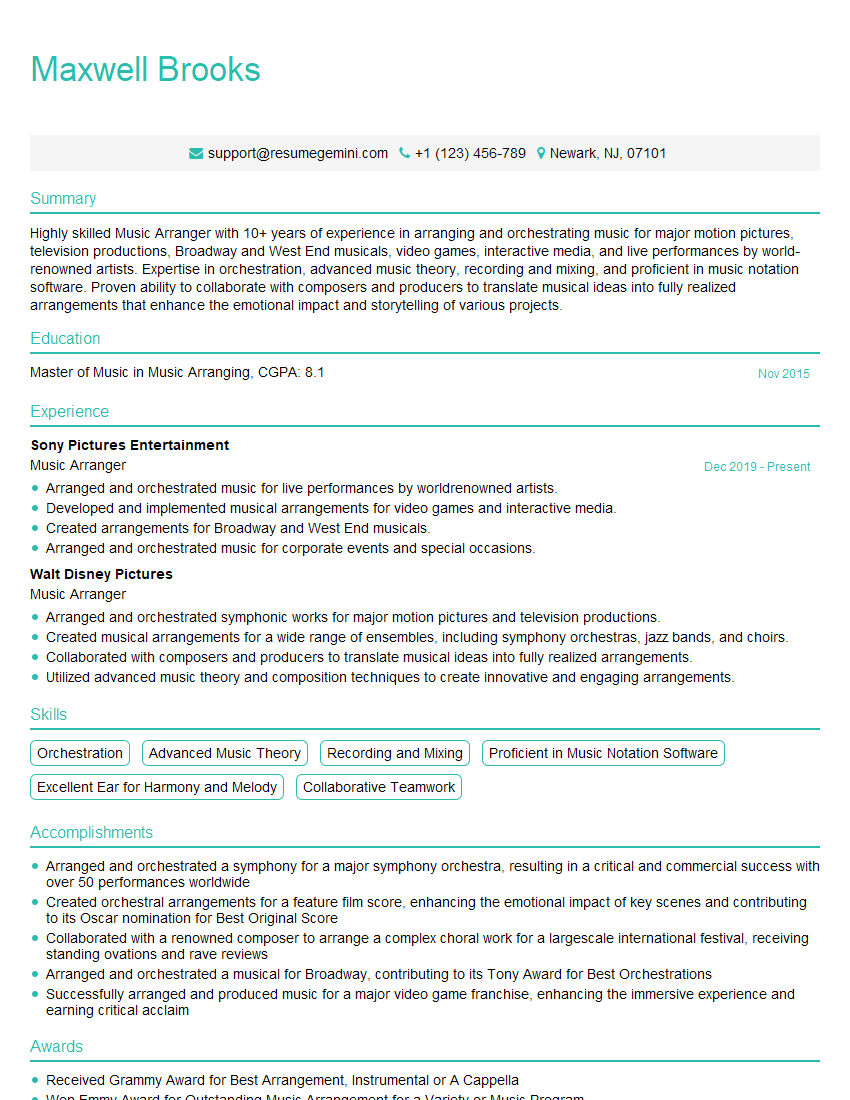
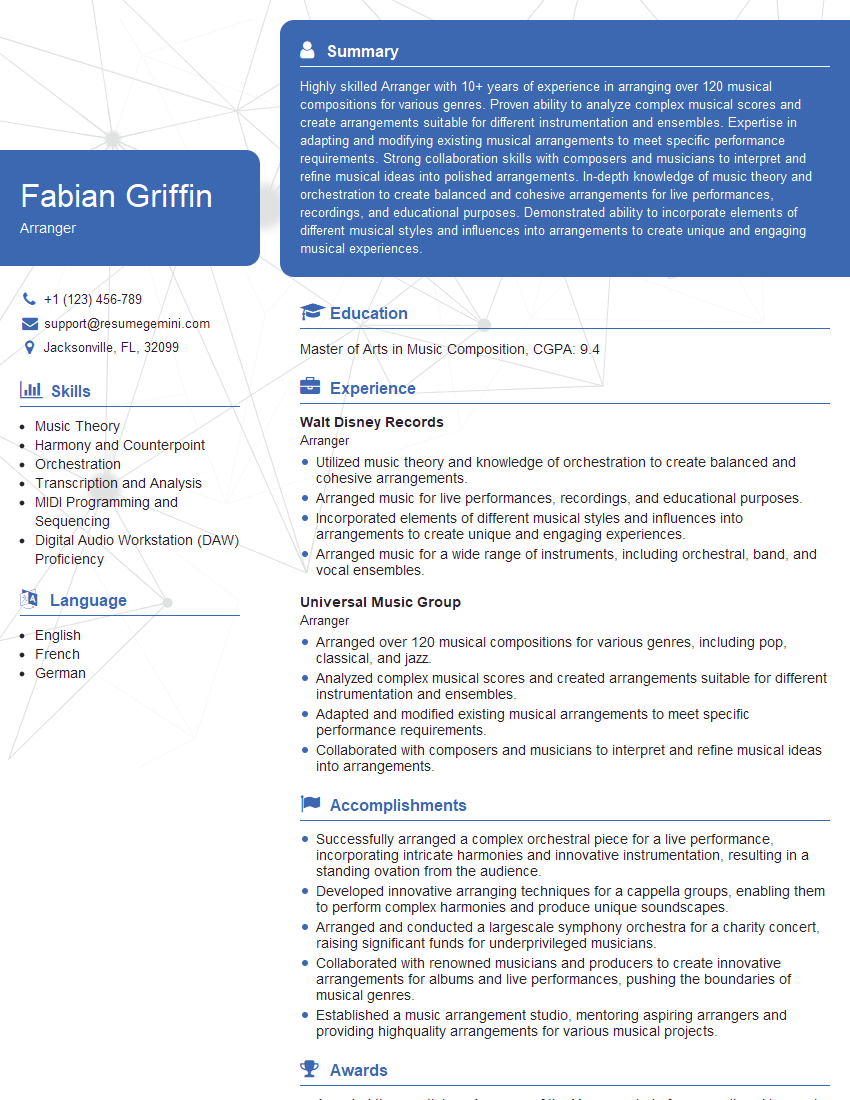
Mastering arranging and orchestration opens doors to exciting career opportunities in film scoring, video game music, orchestral composition, and more. Your ability to craft compelling and nuanced musical scores will be highly valued. To maximize your chances of securing your dream role, invest time in creating an ATS-friendly resume that highlights your skills and experience effectively. ResumeGemini is a trusted resource that can help you build a professional resume tailored to the specifics of the arranging and orchestration field. Examples of resumes specifically designed for Arranging and Orchestration professionals are provided to help guide you. Take the next step towards a successful career; craft a compelling resume that showcases your unique talents.
Explore more articles
Users Rating of Our Blogs
Share Your Experience
We value your feedback! Please rate our content and share your thoughts (optional).
What Readers Say About Our Blog
Really detailed insights and content, thank you for writing this detailed article.
IT gave me an insight and words to use and be able to think of examples