Cracking a skill-specific interview, like one for Geodetic Modeling, requires understanding the nuances of the role. In this blog, we present the questions you’re most likely to encounter, along with insights into how to answer them effectively. Let’s ensure you’re ready to make a strong impression.
Questions Asked in Geodetic Modeling Interview
Q 1. Explain the difference between a geoid and an ellipsoid.
Imagine the Earth as a bumpy potato (the geoid) and a perfect, smooth egg (the ellipsoid). The ellipsoid is a mathematical approximation of the Earth’s shape, a simplified, symmetrical model. It’s a rotated ellipse with a defined semi-major and semi-minor axis. We use it as a reference surface for calculations because it’s mathematically convenient. The geoid, on the other hand, represents mean sea level extended globally. It’s a complex, irregular surface influenced by gravity variations caused by uneven mass distribution within the Earth. Think of it as the equipotential surface – every point on the geoid has the same gravitational potential. The key difference is that the ellipsoid is a smooth, defined shape, while the geoid is irregular and represents the true shape of the Earth’s gravitational field.
In essence, the ellipsoid provides a simplified framework for calculations, while the geoid represents the true shape of the Earth’s mean sea level, accounting for gravitational anomalies.
Q 2. Describe the various coordinate systems used in Geodetic Modeling.
Geodetic modeling uses several coordinate systems, each with its strengths and weaknesses. The most common are:
- Geographic Coordinate System (GCS): Uses latitude and longitude to define points on the Earth’s surface. It’s intuitive and widely understood but depends on the chosen datum (more on that later).
- Projected Coordinate System (PCS): Transforms the curved surface of the Earth onto a flat plane, enabling distance and area calculations. Examples include UTM (Universal Transverse Mercator), State Plane Coordinate Systems, and Lambert Conformal Conic. The choice depends on the area of interest and the type of analysis.
- Geocentric Coordinate System (Cartesian): Uses three-dimensional Cartesian coordinates (X, Y, Z) with an origin at the Earth’s center of mass. It’s particularly useful for satellite positioning and global-scale analyses.
The choice of coordinate system is critical. For example, using a UTM zone appropriate for your region avoids significant distortions in distance measurements compared to using a global system like latitude/longitude.
Q 3. What are the different types of geodetic datums and their applications?
A geodetic datum defines the origin and orientation of a coordinate system. It’s essentially a reference frame for all geodetic measurements. There are several types:
- Horizontal Datums: Define the location and shape of the reference ellipsoid, crucial for accurate positioning on the Earth’s surface. Examples include WGS84 (World Geodetic System 1984), NAD83 (North American Datum 1983), and ED50 (European Datum 1950). The choice of datum significantly impacts positional accuracy, especially over large areas.
- Vertical Datums: Define the height or elevation of points relative to a reference surface, often mean sea level. Examples include NAVD88 (North American Vertical Datum of 1988) and the various national vertical datums. Inconsistent vertical datums can lead to errors in hydrological modelling, topographic mapping, and engineering projects.
Applications: The choice of datum depends on the application. For global navigation, WGS84 is standard. For local applications, a local or regional datum might be more accurate. For example, NAD83 is commonly used in North America, while ED50 is used in parts of Europe. Inconsistency in datum usage can lead to significant errors, particularly in large-scale projects or across national boundaries.
Q 4. Explain the concept of datum transformation and its importance.
Datum transformation is the process of converting coordinates from one geodetic datum to another. It’s crucial because different datums use different ellipsoids and orientations, leading to coordinate discrepancies. For instance, a point with identical latitude and longitude in NAD83 and WGS84 will have slightly different Cartesian coordinates. Ignoring this difference can lead to significant errors, for example, in overlaying maps or integrating datasets from different sources.
Importance: Datum transformation ensures consistent spatial referencing across datasets, irrespective of their original datum. Without it, accurate integration of geospatial data would be impossible. It’s essential for projects involving multiple datasets, different mapping agencies, or large geographical areas. Various transformation methods exist, including grid-based methods (like NTv2) and parameter-based transformations (like Molodensky-Badekas). The choice depends on the accuracy required and the specific datums involved.
Q 5. How do you handle coordinate system conversions in your workflow?
In my workflow, I use dedicated geospatial software packages (like ArcGIS Pro or QGIS) that offer robust coordinate system conversion tools. These tools use established transformation models (e.g., 7-parameter Helmert transformation) and grid-based methods (e.g., using geoid grids to convert ellipsoidal heights to orthometric heights). I always document the transformations applied to ensure reproducibility and traceability. For instance, I might use a script or a log file to keep track of the input and output coordinate systems and the transformation method employed. Furthermore, I verify the results visually by comparing the transformed data to reference layers in the correct coordinate system. This step is crucial to identify any potential errors that may arise from the transformation process itself. The accuracy of the conversion depends strongly on the quality and appropriateness of the transformation parameters and grids for the specific region and application.
Q 6. Describe your experience with GPS data processing and analysis.
I have extensive experience processing and analyzing GPS data. This includes:
- Data acquisition: Planning and executing GPS surveys using various equipment, ensuring optimal satellite geometry.
- Data processing: Using software (like RTKLIB or Bernese GNSS Software) to perform precise point positioning (PPP) or differential GPS (DGPS) computations. This involves dealing with satellite ephemeris, atmospheric corrections (ionospheric and tropospheric delays), and multipath effects.
- Data analysis: Evaluating the quality of GPS solutions, assessing uncertainties, and identifying potential errors. This includes statistical analysis of residuals and assessing the impact of various error sources.
- Application: Using the processed GPS data for various applications, such as deformation monitoring, geodetic surveying, and precise positioning.
I’m proficient in handling various GPS data formats (RINEX, etc.) and employing various error mitigation techniques. A recent project involved using GPS data to monitor the deformation of a large dam, where high accuracy and reliability were critical.
Q 7. What are the sources of error in GPS measurements, and how are they mitigated?
GPS measurements are susceptible to several error sources:
- Atmospheric delays: Ionospheric and tropospheric delays affect signal propagation speed.
- Satellite ephemeris errors: Inaccuracies in the satellite’s orbital information.
- Multipath effects: Signal reflections from buildings or other surfaces.
- Receiver noise: Electronic noise in the receiver equipment.
- Cycle slips: Loss of signal lock, resulting in jumps in the pseudorange measurements.
Mitigation Techniques: These errors are mitigated through various techniques:
- Differential GPS (DGPS): Utilizing a known reference station to correct for atmospheric delays and other systematic errors.
- Precise Point Positioning (PPP): Using precise ephemeris and atmospheric models to achieve centimeter-level accuracy.
- Antenna and receiver calibration: Ensuring the equipment is properly calibrated.
- Data filtering: Removing outliers and noisy data points.
- Careful site selection: Minimizing multipath effects by selecting an open sky location.
The choice of mitigation technique depends on the application’s required accuracy and the resources available.
Q 8. Explain the principles of least squares adjustment in geodetic surveying.
Least squares adjustment is a fundamental technique in geodetic surveying used to reconcile discrepancies between observed measurements and a mathematical model of the Earth’s surface. It’s based on the principle of minimizing the sum of the squares of the residuals – the differences between observed and computed values. Imagine trying to fit a straight line through a scatter plot of points; least squares finds the line that minimizes the total squared vertical distance between the points and the line.
In geodetic surveying, we have many measurements (distances, angles, heights) that are subject to errors. Least squares helps us find the ‘best-fit’ solution, a set of adjusted coordinates that optimally represent the surveyed area while considering all measurements and their associated uncertainties. This involves solving a system of equations that minimizes a cost function, often using matrix algebra. The result provides not only adjusted coordinates but also estimates of their uncertainties, indicating the reliability of the solution.
For example, in a triangulation network, we measure angles between survey points. Due to instrument limitations and atmospheric effects, these angles won’t perfectly add up to the expected 180° (or 360° for a closed polygon). Least squares adjustment distributes these discrepancies in a statistically optimal way, providing the most likely values for the angles and the coordinates of the points.
Q 9. How do you assess the accuracy and precision of geodetic measurements?
Assessing the accuracy and precision of geodetic measurements is crucial for ensuring the quality of any geospatial project. Accuracy refers to how close the measured value is to the true value, while precision refers to the repeatability of measurements – how clustered the measurements are around their mean. Both are vital; high precision without accuracy is meaningless.
We assess accuracy by comparing our measurements to known, highly accurate control points or using independent verification methods, such as comparing GPS measurements with highly accurate leveling data. Precision is determined by analyzing the statistical properties of the measurements, such as the standard deviation. For example, a series of repeated distance measurements with a small standard deviation is precise, but its accuracy depends on how well the measuring device was calibrated.
In practice, we use statistical measures like root mean square error (RMSE) to quantify the accuracy and precision of our data. Analyzing error ellipsoids in coordinate estimations helps to visualize the uncertainty in position. We also consider the impact of systematic errors (biases) and random errors (noise) on the overall uncertainty of the result. Careful planning of the survey, rigorous quality control procedures, and appropriate data processing are essential for minimizing errors and maximizing accuracy and precision.
Q 10. Describe your experience with different geodetic software packages (e.g., ArcGIS, AutoCAD Civil 3D).
Throughout my career, I have extensively used various geodetic software packages. My experience includes using ArcGIS for geospatial data management, analysis, and visualization. I’m proficient in creating and manipulating geodatabases, performing spatial analysis tasks, and generating high-quality maps. I’ve also used AutoCAD Civil 3D for designing and modeling civil engineering projects, integrating geodetic data into 3D models, and performing calculations related to earthworks and infrastructure.
Specific examples include using ArcGIS to process GPS data to create accurate topographic models for construction projects, and using AutoCAD Civil 3D to design road alignments using precise geodetic measurements from RTK GPS. I’m also familiar with other software packages like Leica GeoOffice, and have experience with programming languages like Python for automating geospatial tasks. My proficiency in these packages allows me to efficiently manage, process and analyze large datasets, ultimately improving the accuracy and efficiency of geodetic projects.
Q 11. Explain the concept of geospatial referencing.
Geospatial referencing defines the location of geographic features on the Earth’s surface using a coordinate system. This allows us to precisely locate and represent any point, line, or polygon on a map or in a 3D model. Think of it as the Earth’s address system.
It involves choosing an appropriate datum (a reference surface approximating the Earth’s shape), a projection (a method to represent the 3D Earth on a 2D surface), and a coordinate system (e.g., latitude/longitude, UTM). The choice of these components depends on the specific application and geographic area. For example, latitude/longitude is ideal for global positioning, whereas UTM is often preferred for regional mapping due to its reduced distortion.
Understanding geospatial referencing is critical for integrating data from different sources, ensuring compatibility, and avoiding errors. Inaccurate referencing can lead to misalignments, inaccurate measurements, and incorrect analysis. Therefore, employing consistent and appropriate referencing schemes is crucial for the reliable management and utilization of geospatial information.
Q 12. What are the key differences between different types of satellite positioning systems (GPS, GLONASS, Galileo)?
GPS (USA), GLONASS (Russia), and Galileo (EU) are global navigation satellite systems (GNSS) providing positioning, navigation, and timing (PNT) services. While they all operate on similar principles using satellite signals, there are key differences:
- Constellations: GPS uses approximately 30 satellites, GLONASS around 24, and Galileo aims for 30. The number and distribution of satellites affect the availability and accuracy of positioning.
- Frequencies: Each system operates on different frequencies, influencing signal propagation and susceptibility to interference. The use of multiple frequencies allows for better accuracy and improved atmospheric correction.
- Accuracy: The accuracy of each system can vary depending on factors such as signal availability, atmospheric conditions, and multipath effects. Generally, all systems offer comparable levels of accuracy for civilian use, although some systems have higher accuracy military signals.
- Applications: While all three systems are used for various applications, some may have specific advantages in certain regions or for specific applications due to their satellite geometry or signal characteristics.
Using multiple GNSS constellations (multi-GNSS) simultaneously improves the accuracy and reliability of positioning due to redundancy and better geometry.
Q 13. How do you handle inconsistencies in geodetic data?
Inconsistencies in geodetic data are common due to various sources of error. Handling these inconsistencies requires a systematic approach.
First, the source of inconsistency needs to be identified. Is it due to measurement errors, different coordinate systems, or data processing issues? Once identified, the appropriate correction method can be implemented. This might involve:
- Data cleaning: Removing outliers or obviously erroneous data points using statistical methods.
- Coordinate transformations: Transforming data from one coordinate system or datum to another using appropriate parameters.
- Least squares adjustment: Using least squares methods to optimally reconcile conflicting measurements and obtain the best-fitting solution.
- Data fusion: Combining different datasets to improve coverage or accuracy while considering the uncertainties associated with each dataset.
It’s important to document all steps taken to address data inconsistencies and to assess the impact of these corrections on the overall quality and reliability of the results. A thorough understanding of error propagation is vital to properly weigh different sources of information and to quantify the uncertainty in the final product.
Q 14. Describe your experience with geodetic network design and optimization.
Geodetic network design and optimization is crucial for efficient and accurate surveying projects. It involves strategically planning the location and type of survey points to achieve the desired accuracy and reliability while minimizing costs and time. This involves careful consideration of:
- Network geometry: Optimizing the distribution of points to create a well-conditioned network, avoiding weak geometries that amplify errors.
- Measurement types: Selecting appropriate measurement types (distances, angles, heights) and techniques (e.g., GPS, total station) based on accuracy requirements and cost-effectiveness.
- Control points: Incorporating existing highly accurate control points to improve network reliability and accuracy.
- Error propagation analysis: Simulating the network and propagating errors through the adjustment to assess the impact of different design choices on the final accuracy.
Software packages are frequently used to simulate different network designs and assess their performance. The goal is to balance the cost of establishing and measuring points with the achieved accuracy and reliability. I have been involved in several projects where I designed and optimized geodetic networks, using both theoretical knowledge and specialized software, resulting in cost savings and improved data quality.
Q 15. Explain the concept of vertical datum and its importance in various applications.
A vertical datum defines the zero point for measuring elevation or height. Think of it like sea level, but it’s more complex than that. It’s a reference surface, often approximated by mean sea level (MSL), but can also be based on a specific geoid model. The importance of a consistent vertical datum is paramount across various applications.
- Engineering and Construction: Accurate elevations are crucial for designing and building structures, ensuring proper drainage, and preventing flooding. Imagine the consequences of a building’s foundation being incorrectly positioned due to inaccurate elevation data.
- Floodplain Mapping and Management: Defining flood zones and managing flood risks requires precise elevation data referenced to a common vertical datum. Inaccurate elevation data could lead to underestimation of flood risk and inadequate mitigation strategies.
- Hydrological Modeling: Studying water flow, water resource management, and predicting droughts requires consistent elevation data. Inconsistencies in vertical datums can create significant errors in hydrological models.
- Aviation: Accurate elevation data is crucial for safe air navigation, especially during take-off and landing. Incorrect vertical positioning data could lead to dangerous situations.
Different countries or regions might use different vertical datums, creating challenges for integrating data from multiple sources. Therefore, understanding and transforming between different vertical datums is vital for accurate geospatial analysis.
Career Expert Tips:
- Ace those interviews! Prepare effectively by reviewing the Top 50 Most Common Interview Questions on ResumeGemini.
- Navigate your job search with confidence! Explore a wide range of Career Tips on ResumeGemini. Learn about common challenges and recommendations to overcome them.
- Craft the perfect resume! Master the Art of Resume Writing with ResumeGemini’s guide. Showcase your unique qualifications and achievements effectively.
- Don’t miss out on holiday savings! Build your dream resume with ResumeGemini’s ATS optimized templates.
Q 16. What are the challenges in integrating various geospatial data sets?
Integrating various geospatial datasets is often challenging due to several factors:
- Different Coordinate Systems and Datums: Datasets might use different coordinate reference systems (e.g., UTM, geographic coordinates) and vertical datums, making direct comparison and integration difficult. Transformations are necessary, but they introduce further uncertainties.
- Data Formats and Structures: Datasets often come in various formats (e.g., shapefiles, GeoTIFF, GeoJSON), requiring conversion and standardization before integration. Inconsistent data structures further complicate the process.
- Data Quality and Accuracy: Datasets might have different levels of accuracy and precision, potentially leading to errors in the integrated product. Quality control and assessment are critical to ensure a reliable result.
- Temporal Differences: Data collected at different times might reflect changes in the landscape (e.g., due to construction or natural events), making direct integration problematic. Time-series analysis techniques might be needed.
- Scale Differences: Datasets might be at different scales, ranging from large-scale regional data to small-scale local data. Resampling and re-projection techniques are necessary to handle the scale differences.
Successful integration requires careful planning, data preprocessing, appropriate transformation techniques, and robust quality control measures. Software tools capable of handling different formats and coordinate systems are also indispensable.
Q 17. How do you ensure the quality and consistency of geodetic data?
Ensuring the quality and consistency of geodetic data is crucial for the reliability of any geospatial application. This involves a multi-faceted approach:
- Data Acquisition Methods: Employing high-precision surveying techniques (GPS, Total Stations, LiDAR) and appropriate quality control procedures during data collection.
- Data Processing and Validation: Utilizing robust processing software, applying appropriate error models, and performing rigorous quality checks (e.g., outlier detection, error analysis) at each stage of processing.
- Metadata Management: Maintaining comprehensive metadata, including details about data acquisition methods, coordinate systems, datums, accuracy assessments, and processing steps. This allows for transparency and traceability.
- Data Comparison and Validation: Comparing the data against independent datasets or using techniques like blunder detection and adjustment procedures to identify and correct errors.
- Regular Audits and Updates: Periodically auditing the data for consistency and accuracy and implementing updates as needed to account for changes in the earth’s surface or improved data sources.
For example, in a large-scale mapping project, we would employ independent checks using different techniques (GPS and total station measurements) and compare the results to identify and correct any discrepancies before finalizing the map.
Q 18. Explain your understanding of error propagation in geodetic computations.
Error propagation in geodetic computations refers to how errors in input data accumulate and affect the accuracy of the results. Geodetic calculations involve numerous steps and transformations, and each step introduces some level of error. These errors can propagate and amplify through the computation, potentially leading to significant inaccuracies in the final output.
Understanding error propagation is essential for assessing the reliability of geodetic solutions. We use various techniques to quantify and minimize the effects of error propagation:
- Least Squares Adjustment: This statistical method minimizes the effect of random errors by finding the best fit to a set of observations. It provides estimates of both the parameters and their associated uncertainties.
- Covariance Matrices: These matrices quantify the uncertainties and correlations between different parameters in a geodetic computation. They are crucial for understanding how errors propagate through the calculations.
- Error Ellipsoids: These geometrical representations visually depict the uncertainty in the position of a point, showing the confidence region around the estimated location.
Consider a simple example: calculating the distance between two points using coordinates obtained from GPS measurements. Each coordinate has an associated uncertainty (e.g., a few centimeters). These uncertainties propagate when calculating the distance, resulting in an uncertainty in the final distance calculation.
Q 19. Describe your experience with different types of surveying techniques (e.g., GPS, Total Station, Leveling).
I have extensive experience with various surveying techniques, including:
- GPS (Global Positioning System): I’m proficient in using both static and kinematic GPS techniques for precise point positioning, geodetic network surveying, and monitoring applications. I understand the intricacies of different GPS constellations (GPS, GLONASS, Galileo, BeiDou) and their impact on accuracy and availability. For example, in a recent project involving deformation monitoring of a dam, we utilized real-time kinematic (RTK) GPS to achieve centimeter-level accuracy.
- Total Station Surveying: I am experienced in using total stations for high-precision distance and angle measurements. I understand the principles of traversing, resectioning, and detailing, as well as the importance of proper instrument calibration and atmospheric correction. In a land surveying project, I used a total station to create a detailed topographic map of a construction site.
- Leveling: I’m familiar with various leveling techniques, including precise leveling and trigonometric leveling, for determining elevation differences with high accuracy. I understand the importance of proper instrument setup, procedures for eliminating systematic errors, and error analysis. Leveling is crucial for establishing benchmarks and building height models.
My experience extends beyond the use of these individual techniques to include integrated surveying projects combining different techniques for optimal results. For example, we may use GPS to establish control points, followed by total station and leveling surveys to create highly detailed spatial data.
Q 20. How do you manage large geospatial datasets effectively?
Managing large geospatial datasets effectively requires a strategic approach encompassing several key aspects:
- Data Storage and Management Systems: Utilizing robust database management systems (DBMS) like PostGIS (PostgreSQL extension for geospatial data) or cloud-based solutions (e.g., AWS S3, Google Cloud Storage) optimized for storing and managing large volumes of spatial data. Proper database design is crucial for efficient data retrieval and analysis.
- Data Compression and Optimization: Employing data compression techniques (e.g., lossless compression for preserving data integrity) and optimized data structures to reduce storage requirements and enhance processing speeds.
- Data Indexing and Query Optimization: Implementing appropriate spatial indexes (e.g., R-trees, quadtrees) and optimizing database queries to speed up data retrieval. This is essential for interactive analysis and visualization of large datasets.
- Data Processing Frameworks: Leveraging parallel processing and distributed computing frameworks (e.g., Hadoop, Spark) to efficiently handle computationally intensive tasks like data processing, analysis, and visualization. These frameworks allow for distributing the processing across multiple machines.
- Data Visualization and Analysis Tools: Utilizing Geographic Information Systems (GIS) software such as ArcGIS, QGIS, or specialized visualization tools to efficiently explore, analyze, and visualize large geospatial datasets.
For example, in a project involving processing satellite imagery covering a large area, we utilized a cloud-based storage solution and parallel processing techniques to manage and process terabytes of data in a reasonable timeframe.
Q 21. Explain your experience with geodetic boundary determination.
Geodetic boundary determination involves precisely defining and marking the boundaries of land parcels or administrative regions using geodetic principles and surveying techniques. This is a critical aspect of land administration and often involves complex legal and technical considerations.
My experience includes:
- Establishing Geodetic Control Networks: Creating a network of precisely positioned points to serve as a reference framework for boundary surveys. This network might use GPS, total stations, or a combination of techniques.
- Boundary Surveys: Conducting detailed surveys to establish the location of boundaries using appropriate methods, considering legal descriptions, historical evidence, and on-the-ground features.
- Coordinate Transformations and Datum Conversions: Transforming coordinates between different coordinate systems and datums to ensure compatibility with existing data and legal requirements.
- Boundary Disputes Resolution: Assisting in resolving boundary disputes through careful analysis of survey data, legal documents, and historical evidence. This often involves a combination of technical expertise and legal understanding.
- Legal and Regulatory Compliance: Ensuring that all surveying and mapping activities are conducted in accordance with relevant legal and regulatory frameworks.
A challenging project involved resolving a boundary dispute between two landowners where conflicting survey data and historical records existed. Using advanced surveying techniques and careful analysis of available evidence, we were able to establish a clear and legally defensible boundary solution acceptable to both parties.
Q 22. Describe your understanding of the role of geodetic modeling in infrastructure development.
Geodetic modeling plays a crucial role in infrastructure development by providing the accurate spatial framework necessary for planning, design, construction, and maintenance. Imagine building a bridge – you need precise coordinates to know where the foundations should go, how long the span needs to be, and where the connecting roads will meet. Geodetic models provide this positional accuracy, ensuring components fit together seamlessly.
Specifically, geodetic models are used to:
- Establish control networks: These networks of precisely surveyed points serve as a reference for all other spatial data.
- Define coordinate systems and datums: Choosing the appropriate system (like WGS84 or NAD83) ensures consistency and compatibility across different datasets.
- Create digital elevation models (DEMs): DEMs are essential for terrain analysis, enabling engineers to assess slopes, drainage patterns, and potential hazards.
- Support 3D modeling and BIM (Building Information Modeling): Geospatial data integrates seamlessly with BIM platforms, providing crucial context for complex infrastructure projects.
- Monitor deformation and subsidence: Repeated GPS measurements and other geodetic techniques allow engineers to track movements in structures over time, aiding in preventative maintenance.
Without accurate geodetic models, infrastructure projects risk costly errors, delays, and potential safety issues. A simple miscalculation in positioning can lead to structural instability or incompatible components. Therefore, expertise in geodetic modeling is critical for successful infrastructure development.
Q 23. Explain your understanding of the impact of atmospheric effects on GPS measurements.
Atmospheric effects significantly impact GPS measurements by delaying the signal’s travel time. Think of it like light bending as it passes through a dense medium. The ionosphere and troposphere, layers of the Earth’s atmosphere, affect GPS signals in different ways:
- Ionospheric Delay: The ionosphere, a layer of charged particles, causes a delay proportional to the signal frequency and the total electron content (TEC) along the signal path. This delay can be significant, affecting the accuracy of positioning by several meters.
- Tropospheric Delay: The troposphere, the lower layer of the atmosphere, causes a delay primarily due to the refraction of the signal as it passes through water vapor and other atmospheric constituents. This delay is more predictable than ionospheric delay but still needs to be accounted for in precise positioning.
These delays are modeled using various techniques, including:
- Ionospheric models: These models utilize data from ionospheric sounding stations and satellites to estimate TEC and predict delays.
- Tropospheric models: These models employ meteorological data (temperature, pressure, humidity) to estimate the refractive index of the troposphere and calculate the delay.
Sophisticated GPS processing software incorporates these models to mitigate the effects of atmospheric delays, improving the accuracy of GPS measurements. Ignoring these effects can result in significant errors, particularly in applications requiring high precision.
Q 24. How do you handle multipath errors in GPS data?
Multipath errors occur when GPS signals reflect off surfaces like buildings, water bodies, or even the ground before reaching the receiver. This creates multiple copies of the same signal, arriving at the receiver at slightly different times. The receiver, not knowing which signal is the true one, averages them, leading to inaccurate position estimations. Imagine trying to find your way using echoes – you’d likely end up in the wrong place.
Handling multipath errors requires a multi-pronged approach:
- Careful antenna placement: Positioning the antenna in an open area, away from potential reflectors, is crucial. This minimizes the chance of multipath signals.
- Advanced receiver techniques: Modern GPS receivers employ techniques like signal processing algorithms to identify and filter out multipath signals based on signal strength, arrival time, and other characteristics. These algorithms often involve sophisticated signal correlation and filtering techniques.
- Data editing and outlier rejection: After data collection, we can review the data and remove outliers that are highly suspicious. This could include unusually high standard deviations.
- Multipath mitigation software: Specialized software incorporates advanced signal processing techniques to improve the accuracy of GPS measurements and reduce the effects of multipath.
In some scenarios, more extensive techniques may be needed, such as using multiple antennas and employing methods such as carrier phase differencing to reduce the effect of multipath signals. The effectiveness of the chosen method largely depends on the specific application and the level of accuracy required.
Q 25. Describe your experience with different types of map projections and their applications.
Map projections are crucial for representing the Earth’s curved surface on a flat map. No projection can perfectly preserve all properties of the Earth, leading to distortions in distance, area, shape, or direction. The choice of projection depends on the specific application.
My experience includes working with various projections, including:
- Universal Transverse Mercator (UTM): A cylindrical projection widely used for its relatively low distortion over smaller areas. Ideal for mapping regional or national-level data. I’ve used UTM extensively in cadastral mapping projects.
- Lambert Conformal Conic: A conic projection commonly used for mapping areas with significant east-west extent. Useful for mapping large areas with minimal distortion near the central meridian, suitable for countries spanning a vast geographical range.
- Albers Equal-Area Conic: Preserves area accurately, making it ideal for applications requiring accurate area calculations, like land-use planning or resource management.
- Geographic Coordinate System (Latitude and Longitude): A spherical coordinate system based on the Earth’s surface. While not a true projection, it’s the foundation for all other projections.
The choice of projection is not arbitrary. A UTM projection works well for a small country, while an Albers Equal-Area Conic might be better for a continent. Incorrect projection selection leads to significant errors in measurements and analysis.
Q 26. What are your preferred methods for visualizing and analyzing geodetic data?
Visualizing and analyzing geodetic data requires a combination of software and techniques. My preferred methods include:
- Geographic Information Systems (GIS) software: ArcGIS and QGIS are powerful tools for visualizing and analyzing spatial data. I use them to create maps, analyze spatial relationships, and perform geoprocessing tasks.
- Programming languages (Python with libraries like GeoPandas and Matplotlib): These allow for customized data analysis, visualization, and automation. For example, I can automate the processing of large datasets and generate custom visualizations.
- 3D visualization software: Software like Global Mapper is used for visualizing three-dimensional geospatial data, allowing me to gain a better understanding of complex terrain and spatial relationships.
- Statistical software (R or MATLAB): These are beneficial for sophisticated statistical analysis of geodetic data, assessing the accuracy and precision of measurements, and identifying patterns and trends.
The choice of visualization method depends on the specific type of data and the analysis being performed. A simple map might suffice for visualizing point locations, while a 3D model is better for visualizing terrain or infrastructure.
Q 27. Explain your experience with quality control and quality assurance in geodetic modeling.
Quality control (QC) and quality assurance (QA) are paramount in geodetic modeling. Inaccurate data can have significant consequences, leading to errors in infrastructure development, resource management, and many other applications. My approach involves a multi-stage process:
- Pre-processing QC: This includes verifying the quality of raw data, checking for outliers, and applying appropriate corrections (e.g., atmospheric corrections for GPS data).
- In-processing QC: During the modeling process, I continuously monitor the results, ensuring that the model meets the required accuracy standards. I look for inconsistencies, unexpected results, and significant deviations from expected values.
- Post-processing QC: This involves rigorous validation of the final model using independent data sources or comparing results with established benchmarks. This ensures that the model accurately reflects reality.
- Data redundancy and consistency checks: I frequently incorporate redundancy in my data acquisition and processing, allowing for cross-checking and error detection. Consistency checks ensure the harmonization of datasets from multiple sources. For example, verifying that coordinate systems are consistent across datasets.
- Documentation: Thorough documentation of all procedures, assumptions, and results is critical for transparency and traceability. This documentation ensures that the work can be easily reviewed and replicated by others.
In one project, we discovered a significant error in a DEM used for road design through rigorous QC. The early identification of this error prevented potential safety hazards and significant cost overruns.
Key Topics to Learn for Geodetic Modeling Interview
- Geodetic Datum Transformations: Understanding different datum types (e.g., WGS84, NAD83), their implications, and the methods used for accurate coordinate transformations between them. Practical application: Converting coordinates from one datum to another for seamless integration of data from various sources.
- Ellipsoid Models and Their Properties: Grasping the concept of ellipsoids, their mathematical representation, and how different ellipsoid choices affect geodetic calculations. Practical application: Selecting the appropriate ellipsoid for a specific project and understanding the resulting accuracy implications.
- Coordinate Systems and Projections: Familiarizing yourself with various coordinate systems (geographic, projected) and map projections (e.g., UTM, Lambert). Practical application: Choosing the optimal coordinate system and projection for a given geographic area and application.
- Geospatial Data Handling and Analysis: Developing proficiency in handling geospatial data formats (shapefiles, GeoTIFF, GeoJSON), using GIS software, and performing spatial analysis techniques. Practical application: Analyzing spatial relationships between different datasets and extracting meaningful insights.
- Error Propagation and Uncertainty Analysis: Understanding the sources of error in geodetic measurements and applying appropriate methods to quantify and mitigate their impact on the final results. Practical application: Assessing the reliability and accuracy of geodetic models and incorporating uncertainty into decision-making.
- Global Navigation Satellite Systems (GNSS): Understanding the principles of GNSS positioning, error sources, and data processing techniques. Practical application: Using GNSS data to determine precise locations and contribute to geodetic network adjustments.
- Geodetic Network Adjustments: Familiarizing yourself with the mathematical methods used to adjust geodetic networks and ensure consistency and accuracy. Practical application: Improving the overall accuracy and reliability of a geodetic network.
Next Steps
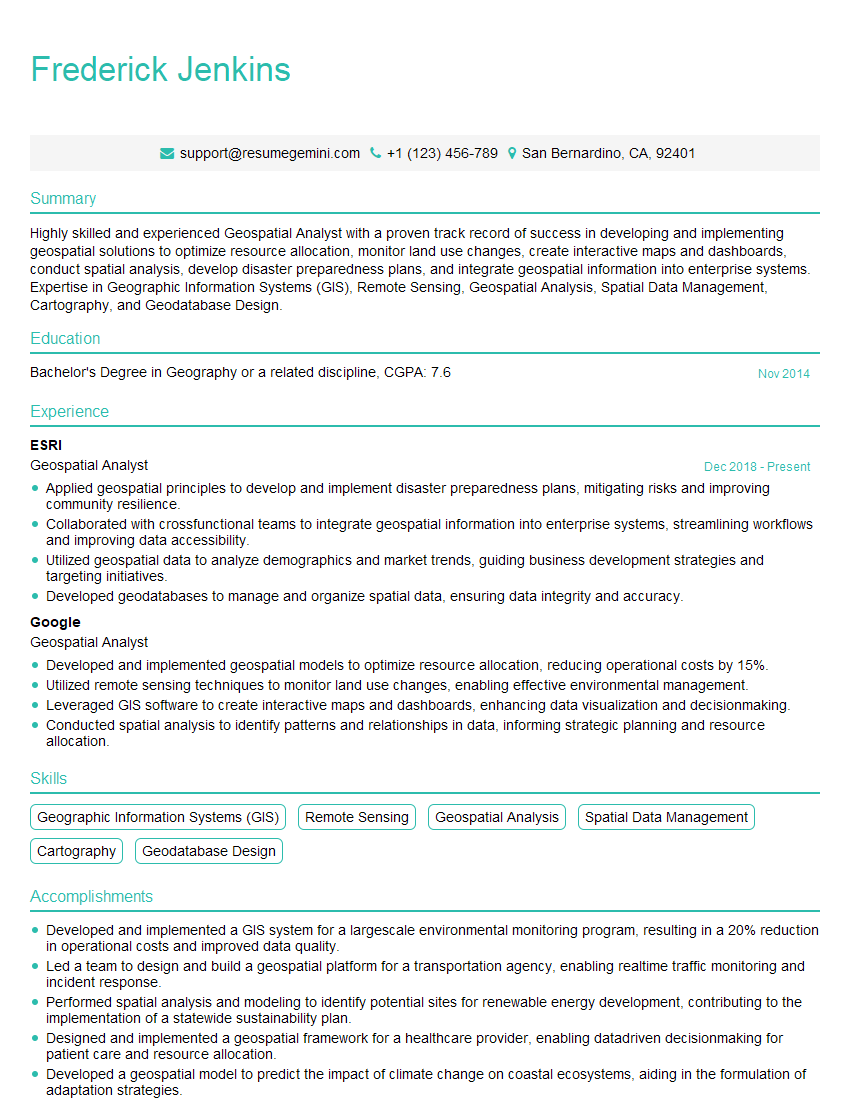
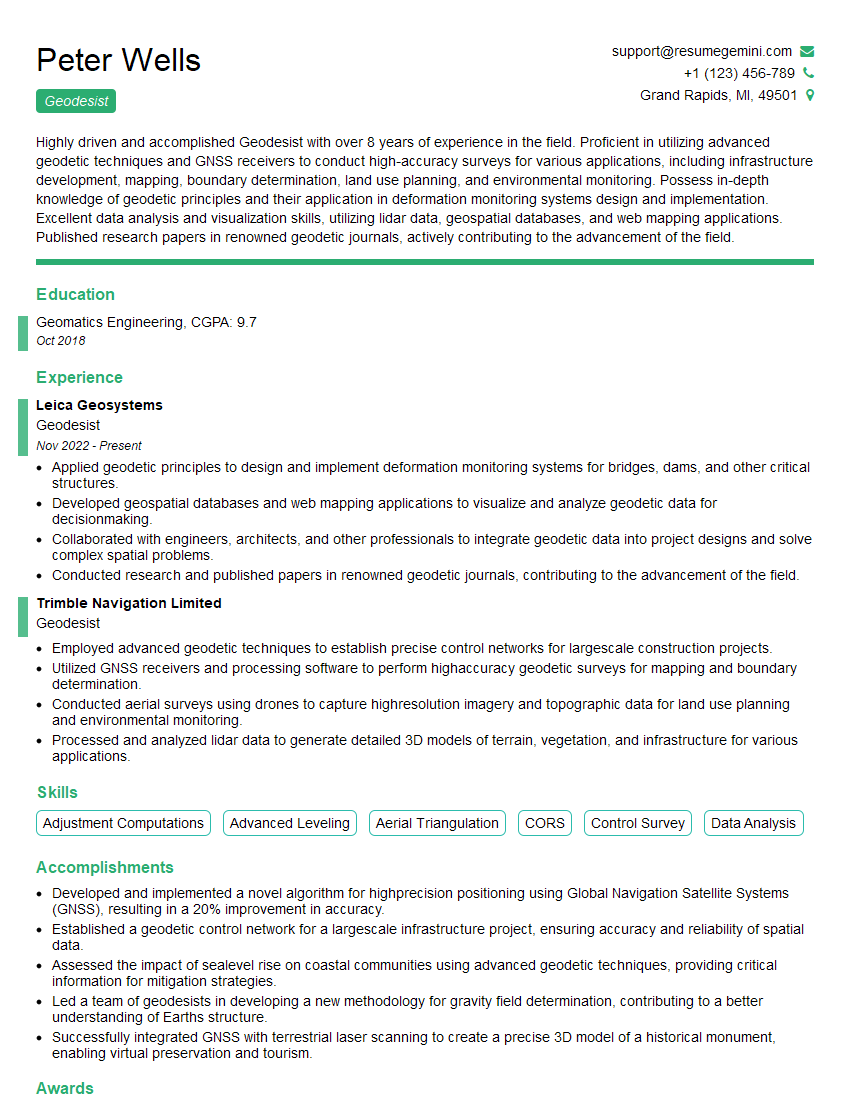
Mastering Geodetic Modeling opens doors to exciting career opportunities in surveying, mapping, GIS, and various other geospatial fields. A strong understanding of these concepts will significantly enhance your interview performance and future career prospects. To stand out, create an ATS-friendly resume that effectively highlights your skills and experience. We recommend using ResumeGemini to build a professional and impactful resume. ResumeGemini provides examples of resumes tailored to Geodetic Modeling, helping you showcase your expertise effectively and increase your chances of landing your dream job.




Explore more articles
Users Rating of Our Blogs
Share Your Experience
We value your feedback! Please rate our content and share your thoughts (optional).
What Readers Say About Our Blog
Really detailed insights and content, thank you for writing this detailed article.
IT gave me an insight and words to use and be able to think of examples