Interviews are more than just a Q&A session—they’re a chance to prove your worth. This blog dives into essential Precision Agriculture Applications interview questions and expert tips to help you align your answers with what hiring managers are looking for. Start preparing to shine!
Questions Asked in Precision Agriculture Applications Interview
Q 1. Explain the principles of variable rate technology (VRT).
Variable Rate Technology (VRT) is the application of inputs like fertilizers, seeds, or pesticides at varying rates across a field, based on the specific needs of each area. Instead of a uniform application across the entire field, VRT tailors input application to optimize resource use and improve efficiency. Imagine painting a house – instead of using the same amount of paint everywhere, VRT is like using more paint on areas that need more coverage and less where it’s already sufficient.
The principles behind VRT rely on precise mapping of field conditions. This involves using sensors and GPS to collect data on soil properties (nutrient levels, pH), crop health (vigor, stress), and yield variations. This data is then analyzed to create prescription maps that guide the application equipment. The equipment itself is often GPS-guided and equipped with control systems to adjust input rates in real-time, ensuring that the correct amount of input is applied to each zone of the field.
For example, an area of a field showing low nitrogen levels might receive a higher rate of nitrogen fertilizer, while a healthier area might require less. This targeted approach reduces waste, minimizes environmental impact, and maximizes profitability by optimizing resource use.
Q 2. Describe different types of sensors used in precision agriculture and their applications.
Precision agriculture utilizes a wide array of sensors to collect crucial data. These can be broadly categorized:
- Soil Sensors: These measure soil properties like moisture content, temperature, pH, electrical conductivity (EC), and nutrient levels. Examples include electromagnetic induction (EMI) sensors for mapping soil properties and capacitance probes for measuring soil moisture. These data are essential for optimizing irrigation, fertilization, and planting practices.
- Plant Sensors: These assess plant health and vigor. Examples include multispectral or hyperspectral cameras mounted on drones or aircraft, measuring the reflectance of light from plants to detect stress, nutrient deficiencies, and disease. These sensors provide insights into crop growth and development, allowing for timely interventions.
- Environmental Sensors: These monitor environmental conditions such as temperature, humidity, rainfall, and wind speed. Weather stations, coupled with GPS, provide valuable information for scheduling irrigation, applying pesticides, and predicting potential risks like frost.
- Yield Sensors: These measure the yield during harvest. Yield monitors collect data on grain mass or volume, typically integrated with GPS, creating yield maps that help identify high- and low-yielding areas for future management decisions.
The application of these sensors varies. For instance, soil sensors are often integrated into tractors or used in independent surveys, while plant sensors are frequently deployed using drones or satellites for broader coverage. The choice depends on the specific application and budget constraints.
Q 3. How does GPS/GNSS technology contribute to precision agriculture?
GPS (Global Positioning System) and GNSS (Global Navigation Satellite System) technologies are the backbone of precision agriculture, providing the precise location information necessary for all aspects of data acquisition and application. Without accurate positioning, VRT and other precision agriculture techniques would be ineffective. Imagine trying to paint a detailed picture blindfolded – impossible!
GPS/GNSS enables:
- Precise Field Mapping: Creating accurate maps of fields, delineating boundaries, and identifying areas with specific characteristics.
- Guidance Systems: Steering agricultural machinery along pre-planned paths, minimizing overlaps and ensuring even coverage during operations like planting, spraying, and fertilizing. This significantly improves efficiency and reduces input costs.
- Geo-referencing Data: Linking sensor data to specific geographic locations, enabling the creation of spatially explicit maps that showcase variations across the field.
- Auto-steering: Advanced systems that use GPS/GNSS to automatically steer tractors and other machinery, improving operator comfort and efficiency, particularly in large fields.
The accuracy of GPS/GNSS is crucial, with RTK (Real-Time Kinematic) GPS providing centimeter-level accuracy for the most demanding applications.
Q 4. Explain the concept of yield mapping and its benefits.
Yield mapping involves creating maps that show the yield variation across a field during harvest. Yield monitors on combines collect data on yield (e.g., bushels per acre) and its location using GPS. This data is then processed to generate a yield map, a visual representation of yield variability across the field.
Benefits of yield mapping include:
- Identifying High- and Low-Yielding Areas: Helps pinpoint areas needing improvement or those exhibiting exceptional performance. This allows farmers to focus their efforts on optimizing the less productive parts of their fields.
- Improving Management Decisions: Yield maps provide valuable insights into the factors influencing yield variations, enabling better decisions on fertilizer application, irrigation scheduling, and seed selection.
- Evaluating Management Practices: Comparing yield maps from different years and under different management strategies helps assess the effectiveness of different farming practices.
- Optimizing Resource Allocation: Targeted application of inputs based on yield map data leads to reduced input costs and environmental impact.
For instance, consistently low-yielding areas might indicate soil compaction, nutrient deficiencies, or pest problems, prompting appropriate corrective actions in the following season.
Q 5. Describe different data analysis techniques used in precision agriculture.
Data analysis in precision agriculture involves diverse techniques aimed at extracting meaningful insights from the vast amounts of data collected. These techniques include:
- Descriptive Statistics: Calculating summary statistics (mean, median, standard deviation) to characterize the data and identify patterns. This is a fundamental step in understanding the overall field conditions.
- Spatial Analysis: Analyzing the spatial patterns and relationships in the data. Techniques like geostatistics are used to create interpolated maps that predict values in areas where data is sparse. This is essential for creating prescription maps for VRT.
- Regression Analysis: Investigating relationships between variables to identify factors influencing yield or other key parameters. For example, correlating yield with soil nutrient levels helps determine nutrient requirements.
- Machine Learning (ML): Utilizing algorithms to identify complex patterns and make predictions. ML is used to develop models that predict crop yield, detect diseases, or optimize irrigation schedules based on historical data and sensor information.
- Remote Sensing Image Processing: Analyzing images from satellites or drones to extract information on crop health, growth, and stress levels. Techniques like vegetation indices (NDVI) are used to assess crop vigor.
The choice of analysis method depends on the specific objectives and the type of data available. A combination of these techniques is often employed to gain a comprehensive understanding of the farming system.
Q 6. What are the challenges associated with data integration in precision agriculture?
Data integration in precision agriculture presents several challenges. The data comes from various sources – sensors, GPS devices, yield monitors, weather stations, and management software – often in different formats and with varying levels of accuracy.
Key challenges include:
- Data Heterogeneity: Integrating data from various sources with different formats (e.g., CSV, databases, image files) requires careful data cleaning, standardization, and transformation.
- Data Volume and Velocity: The volume and speed of data generation from modern precision agriculture systems is immense, requiring powerful computing resources and efficient data management strategies.
- Data Quality: Ensuring data accuracy and reliability is critical. Sensor malfunctions, GPS errors, or data entry mistakes can lead to inaccurate insights and flawed decisions.
- Data Security and Privacy: Protecting the confidentiality and integrity of farm data is crucial, requiring robust security measures and adherence to data privacy regulations.
- Lack of Interoperability: Different software and hardware systems may not be compatible, hindering seamless data exchange and integration.
Addressing these challenges requires a well-planned data management strategy, including the use of data standardization protocols, cloud-based data storage, and robust data processing pipelines.
Q 7. How can remote sensing data improve crop management decisions?
Remote sensing data, primarily from satellites or drones, significantly improves crop management decisions by providing a broader perspective on field conditions that ground-based measurements alone cannot offer. Imagine trying to assess the health of a large forest by only checking a few individual trees – you’d miss the big picture!
Remote sensing improves crop management by:
- Monitoring Crop Health and Stress: Multispectral and hyperspectral imagery allows for early detection of nutrient deficiencies, diseases, and pest infestations. This enables timely interventions, preventing widespread crop damage.
- Estimating Crop Yield: Vegetation indices derived from satellite or drone imagery can be used to predict crop yield potential with reasonable accuracy, aiding in planning for harvest and marketing.
- Mapping Field Variability: Remote sensing can map variations in soil properties, topography, and other factors affecting crop growth. This information is crucial for optimizing input application and managing variability across the field.
- Improving Irrigation Scheduling: Remotely sensed data on soil moisture and plant water stress helps determine irrigation needs, preventing water overuse or underuse.
- Supporting Precision Spraying: Remote sensing can be integrated with precision spraying systems to target pesticide or herbicide applications, reducing chemical use and protecting the environment.
The integration of remote sensing data with other precision agriculture technologies enhances decision-making, allowing farmers to adopt a data-driven approach to crop management.
Q 8. Explain the use of GIS in precision agriculture.
Geographic Information Systems (GIS) are invaluable in precision agriculture because they provide a spatial framework for managing and analyzing agricultural data. Imagine a farm as a complex puzzle; GIS helps assemble the pieces by overlaying different data layers onto a map.
For instance, we can integrate soil maps showing nutrient levels (e.g., nitrogen, phosphorus, potassium), yield maps from previous harvests, and even satellite imagery indicating plant health. By overlaying these layers, we can identify specific areas within the field needing different management practices. A low-yield area with low nitrogen levels might require targeted fertilizer application, while a healthy area could receive less.
GIS also helps with field planning and logistics. We can use it to optimize machinery routes, minimizing fuel consumption and soil compaction. It allows for precise application of inputs like seeds, fertilizers, and pesticides, leading to resource optimization and cost savings.
Finally, GIS enables effective data visualization and communication. Generating maps and reports allows easy sharing of information with stakeholders, facilitating informed decision-making.
Q 9. Describe your experience with agricultural software and data management platforms.
I have extensive experience with a variety of agricultural software and data management platforms, including ArcGIS for spatial data analysis, farm management software like AgLeader and Climate FieldView for data collection and analysis from in-field sensors and machinery, and cloud-based platforms such as Microsoft Azure and Google Cloud for data storage and processing.
For example, I’ve used AgLeader to manage variable rate fertilizer applications, where fertilizer application rates are adjusted based on real-time soil nutrient levels detected by sensors mounted on the equipment. The data collected is then stored and analyzed within the platform, allowing for adjustments to the application map in real time.
In another project, I utilized Climate FieldView and satellite imagery to monitor crop health across a large farm. This allowed us to identify areas affected by stress factors like drought or disease early, enabling timely interventions and preventing significant yield losses. Integrating this data with weather forecasts through APIs improved predictive capabilities, allowing proactive management decisions.
My experience encompasses data cleaning, validation, analysis, and reporting, ensuring the accuracy and reliability of the information used for decision-making.
Q 10. What are the key factors influencing the selection of appropriate precision agriculture technologies?
Selecting the right precision agriculture technology depends on several key factors. It’s like choosing the right tools for a specific job – a hammer isn’t ideal for sawing wood.
- Farm size and type: A small vineyard will have different needs than a large-scale corn operation. Smaller farms might opt for simpler, less expensive technologies, while larger farms can invest in more sophisticated systems.
- Crop type: The specific requirements of the crop will dictate the choice of sensors, machinery, and software. For example, monitoring water stress in vineyards requires different sensors compared to monitoring nitrogen levels in corn.
- Available infrastructure: Reliable internet connectivity, power supply, and existing farm management systems influence technology choices. Cloud-based platforms require good connectivity, while systems without internet dependency might be suitable for regions with limited infrastructure.
- Budget: Precision agriculture technologies vary significantly in cost. A cost-benefit analysis is crucial to determine the right balance between investment and return.
- Farmer’s expertise and willingness to adopt new technologies: The farmer’s comfort level with technology and their capacity to manage and interpret data are important factors. Training and support are crucial for successful implementation.
A holistic approach, considering all these factors, is crucial for selecting the most effective and sustainable precision agriculture strategy.
Q 11. Discuss the role of soil sensors in optimizing fertilizer application.
Soil sensors play a critical role in optimizing fertilizer application by providing real-time information about soil conditions, preventing both under-fertilization and over-fertilization. This approach leads to improved nutrient use efficiency, reduced environmental impact, and enhanced profitability.
These sensors measure various soil parameters such as moisture content, nutrient levels (nitrogen, phosphorus, potassium), pH, and electrical conductivity. This data is then used to create variable rate fertilizer application maps, tailoring the application rate to the specific needs of each area of the field. For example, areas with low nitrogen levels will receive a higher application rate compared to areas with sufficient nitrogen.
Several types of sensors exist, including optical sensors, electromagnetic sensors, and electrochemical sensors. Data from these sensors is often integrated with GPS data to create precise location-specific information. This approach improves yield, reduces environmental pollution from fertilizer runoff, and lowers fertilizer costs. This translates to better environmental sustainability and economic benefits for the farmer.
Q 12. How do you ensure data accuracy and reliability in precision agriculture applications?
Ensuring data accuracy and reliability in precision agriculture is paramount. It’s like building a house – a weak foundation will lead to collapse. We employ several strategies to maintain high data quality.
- Sensor calibration and validation: Regular calibration of sensors is crucial to minimize drift and ensure accurate measurements. We also cross-validate sensor readings with laboratory analyses to identify potential discrepancies.
- Data cleaning and preprocessing: Raw data often contains errors or outliers. We use various techniques to identify and remove these anomalies, ensuring data integrity. This includes using statistical methods to identify and remove outliers, and implementing data quality checks within the software.
- Data redundancy: Using multiple sensors to measure the same parameter helps identify and correct errors. If readings differ significantly, we investigate the cause of the discrepancies.
- Data validation and verification: We regularly compare sensor data with ground truth data (e.g., soil samples analyzed in a lab) to ensure the accuracy of the measurements. This can involve regularly taking soil samples and comparing them to the sensor data. This provides a baseline for validating the sensor data.
- Secure data storage and management: Using secure cloud platforms and robust data management systems helps maintain data integrity and prevent unauthorized access.
By adhering to rigorous quality control procedures, we ensure the data used for decision-making is reliable and accurate.
Q 13. Explain the principles of precision irrigation.
Precision irrigation involves applying water only where and when it’s needed, maximizing water use efficiency and minimizing waste. It’s like watering a plant – giving it just the right amount at the right time, neither overwatering nor underwatering.
Several technologies support precision irrigation:
- Variable rate irrigation: Water application rate is adjusted based on the actual needs of the crop, as determined by soil moisture sensors or evapotranspiration models. Areas experiencing drought stress receive more water. This differs from traditional irrigation, which applies the same amount of water to the entire field.
- Drip irrigation: Water is delivered directly to the plant roots, minimizing evaporation and runoff. This targeted application is particularly useful in arid and semi-arid regions.
- Satellite and aerial imagery: Monitoring crop water stress through remote sensing techniques allows timely irrigation scheduling. Changes in plant color and leaf temperature can be used to indicate water stress.
- Soil moisture sensors: Sensors embedded in the soil provide real-time information about soil moisture content, allowing for precise irrigation scheduling. This reduces water waste and enhances water use efficiency.
Precision irrigation leads to reduced water consumption, improved crop yields, and reduced environmental impact from over-irrigation.
Q 14. Describe your experience with different types of agricultural drones and their applications.
My experience includes working with various agricultural drones, including multirotor UAVs (Unmanned Aerial Vehicles) and fixed-wing drones. Each type offers unique advantages depending on the application.
Multirotor drones are versatile and excellent for detailed imagery over smaller areas. I’ve used these extensively for:
- High-resolution imagery: Capturing detailed images for creating orthomosaics (georeferenced mosaics of aerial images) and digital elevation models (DEMs) of fields.
- NDVI (Normalized Difference Vegetation Index) mapping: Assessing crop health and stress levels by analyzing plant reflectance using multispectral cameras.
- Precision spraying: Applying pesticides or fertilizers with small, targeted applications.
Fixed-wing drones are suitable for covering large areas quickly and efficiently but offer lower resolution imagery compared to multirotors. I have utilized these for:
- Large-area surveys: Mapping large fields and creating precise maps for planning and management decisions.
- Crop monitoring: Tracking crop growth and development across large areas.
Data processing from drone imagery involves using photogrammetry software to stitch images together, creating orthomosaics, 3D models, and other valuable data products. These are then integrated with other precision agriculture data to make informed decisions regarding field management.
Q 15. How can precision agriculture contribute to sustainable farming practices?
Precision agriculture significantly contributes to sustainable farming by optimizing resource use and minimizing environmental impact. Instead of a blanket approach, it allows farmers to tailor inputs like water, fertilizers, and pesticides to the specific needs of each part of the field. This targeted approach reduces waste, lowers costs, and protects the environment.
- Reduced Fertilizer Use: By using sensors and data analysis to identify areas needing fertilizer, we avoid over-application, reducing runoff into waterways and minimizing greenhouse gas emissions from excess nitrogen.
- Efficient Irrigation: Soil moisture sensors help determine precisely when and where irrigation is needed, conserving water in drought-prone areas.
- Targeted Pesticide Application: Precision spraying systems apply pesticides only where needed, reducing the impact on beneficial insects and minimizing pesticide residues in harvested crops.
- Improved Soil Health: By optimizing nutrient management and reducing tillage through techniques like variable rate technology, we maintain soil health and improve its carbon sequestration capacity.
For instance, a farmer using a variable rate fertilizer system might apply higher concentrations of nitrogen to areas showing nitrogen deficiency as determined by NDVI (Normalized Difference Vegetation Index) imagery, leading to healthier crops and lower environmental impact compared to uniform application.
Career Expert Tips:
- Ace those interviews! Prepare effectively by reviewing the Top 50 Most Common Interview Questions on ResumeGemini.
- Navigate your job search with confidence! Explore a wide range of Career Tips on ResumeGemini. Learn about common challenges and recommendations to overcome them.
- Craft the perfect resume! Master the Art of Resume Writing with ResumeGemini’s guide. Showcase your unique qualifications and achievements effectively.
- Don’t miss out on holiday savings! Build your dream resume with ResumeGemini’s ATS optimized templates.
Q 16. What are the economic benefits of precision agriculture?
Precision agriculture offers substantial economic benefits by increasing efficiency and profitability. By optimizing resource use, reducing waste, and improving yields, farmers can significantly boost their bottom line.
- Increased Yields: Targeted input application leads to healthier plants and higher yields, directly impacting revenue.
- Reduced Input Costs: Precision agriculture minimizes waste by applying inputs only where needed, reducing expenditure on fertilizers, pesticides, water, and fuel.
- Improved Crop Quality: Uniform application of inputs contributes to consistent crop quality, potentially commanding higher prices in the market.
- Enhanced Decision-Making: Data-driven insights empower farmers to make more informed decisions, optimizing resource allocation and minimizing risks.
- Reduced Labor Costs: Automation through technologies like autonomous tractors and drones can reduce labor costs and improve operational efficiency.
A concrete example would be a vineyard using GPS-guided machinery for targeted herbicide application. This eliminates the need for broad-spectrum spraying, reducing herbicide costs and protecting beneficial ground cover. The cost savings can then be reinvested in other areas of the business.
Q 17. How do you address data security concerns in precision agriculture?
Data security is paramount in precision agriculture. The vast amounts of sensitive data collected, ranging from farm location to yield maps and financial information, are vulnerable to cyber threats. Addressing these concerns requires a multi-pronged approach.
- Data Encryption: Encrypting data both in transit and at rest is crucial to protect against unauthorized access.
- Access Control: Implementing strict access control measures, including role-based permissions, ensures that only authorized personnel can access sensitive data.
- Secure Cloud Storage: Utilizing reputable cloud providers with robust security protocols protects data from physical damage and cyberattacks.
- Regular Software Updates: Keeping software and hardware updated patches vulnerabilities that could be exploited by malicious actors.
- Data Backup and Disaster Recovery: Implementing robust data backup and recovery plans minimizes data loss in case of system failures or cyberattacks.
- Regular Security Audits: Conducting regular security audits helps identify vulnerabilities and strengthen security protocols.
For example, a farm using a cloud-based platform for data management should ensure that the platform complies with relevant data protection regulations (e.g., GDPR) and utilizes strong encryption methods to protect farm data.
Q 18. What are the ethical considerations related to data usage in precision agriculture?
Ethical considerations in precision agriculture data usage revolve around transparency, consent, and data ownership. The collection and use of data raise questions about who owns the data, how it’s used, and who benefits from its analysis.
- Data Ownership: Clearly defining data ownership between farmers, service providers, and technology companies is vital. Contracts should clearly specify data usage rights and limitations.
- Informed Consent: Farmers should have full transparency about data collection practices and provide informed consent before their data is collected and used.
- Data Privacy: Strict adherence to data privacy regulations (e.g., GDPR, CCPA) is crucial to protect farmer information from unauthorized access or misuse.
- Data Security: Robust security measures are needed to protect data from unauthorized access, breaches, and misuse.
- Bias and Fairness: Algorithms used in precision agriculture should be carefully vetted to avoid biases that could disproportionately affect certain farmers or farming communities.
- Transparency and Accountability: Mechanisms for transparency and accountability are needed to ensure ethical data usage and address concerns regarding potential misuse.
Imagine a scenario where a company collects yield data from numerous farms to develop a new fertilizer product. Ethical considerations demand the company anonymizes the data, secures it properly, and obtains consent from farmers before utilizing their data for this purpose.
Q 19. Describe your experience with machine learning applications in precision agriculture.
My experience with machine learning (ML) in precision agriculture involves developing and deploying ML models for various tasks, including yield prediction, disease detection, and weed identification.
I’ve worked extensively with:
- Predictive Modeling: Using historical weather data, soil conditions, and farming practices to predict crop yields with high accuracy. This enables farmers to optimize resource allocation and manage risk effectively.
- Image Recognition: Implementing convolutional neural networks (CNNs) to analyze aerial and drone imagery for identifying diseased plants or weeds. This allows for early detection and targeted intervention, minimizing crop damage.
- Precision Irrigation Management: Developing ML models to predict optimal irrigation schedules based on soil moisture, weather forecasts, and crop water requirements.
For example, I recently worked on a project using a combination of drone imagery and weather data to develop a model for predicting the likelihood of blight in potato fields. The model accurately identified high-risk areas, allowing farmers to apply fungicides only where needed, saving costs and reducing environmental impact.
# Example code snippet (Python):from sklearn.model_selection import train_test_splitfrom sklearn.linear_model import LinearRegression# ... model training and prediction code ...
Q 20. How can precision agriculture improve crop yields and quality?
Precision agriculture significantly improves crop yields and quality through optimized resource management and targeted interventions. By tailoring inputs to the specific needs of each part of the field, farmers can maximize productivity while minimizing waste and environmental impact.
- Optimized Nutrient Management: Variable rate fertilization ensures plants receive the precise amount of nutrients they need, promoting healthy growth and maximizing yields.
- Targeted Pest and Disease Control: Precision spraying systems apply pesticides only where needed, minimizing environmental impact while effectively controlling pests and diseases.
- Efficient Irrigation: Soil moisture sensors help determine when and where irrigation is needed, reducing water waste and maximizing water use efficiency.
- Improved Planting and Harvesting: GPS-guided machinery enables precise planting and harvesting, optimizing resource allocation and minimizing crop damage.
- Data-Driven Decision Making: Data analysis and predictive modeling empower farmers to make informed decisions that optimize resource use and maximize productivity.
Consider a corn farmer using variable rate fertilization based on soil nutrient maps generated from soil sensors. This approach results in higher yields in nutrient-deficient areas compared to uniform fertilizer application, optimizing the use of fertilizers and resulting in a better return on investment.
Q 21. Explain the concept of variable rate fertilization.
Variable rate fertilization (VRF) is a precision agriculture technique that involves applying different amounts of fertilizer to different areas of a field based on site-specific needs. Unlike traditional methods that apply a uniform rate of fertilizer across the entire field, VRF uses data and technology to tailor fertilizer application to optimize plant growth and minimize environmental impact.
The process typically involves:
- Site-Specific Data Collection: Data on soil nutrient levels, topography, and previous yield data are collected using soil sensors, remote sensing (e.g., NDVI), and GPS.
- Data Analysis and Mapping: This data is analyzed to create a prescription map showing variable fertilizer rates for different zones within the field. These zones often reflect variations in soil fertility or topography.
- Variable Rate Application: A GPS-guided fertilizer spreader applies fertilizer according to the prescription map, ensuring that different rates are applied to different zones within the field.
VRF not only improves fertilizer use efficiency and minimizes environmental impact, but it also increases profitability by maximizing yield and reducing input costs. For instance, a farmer may apply higher nitrogen rates in areas of the field with poor soil fertility while applying lower rates in areas with higher inherent soil fertility, leading to better growth and optimized resource usage.
Q 22. How do you evaluate the ROI of precision agriculture investments?
Evaluating the Return on Investment (ROI) of precision agriculture investments requires a multifaceted approach, going beyond simply comparing initial costs to immediate yield increases. It’s crucial to consider both short-term and long-term impacts.
Step 1: Quantify Costs: This includes equipment purchase or lease, software licenses, sensor costs, labor for data collection and analysis, and any training required.
Step 2: Quantify Benefits: This is more complex. Identify all potential benefits, including:
- Increased yields: Calculate the increased yield per hectare due to optimized inputs (fertilizer, water, pesticides).
- Reduced input costs: Determine savings from using fewer resources based on precise application.
- Improved crop quality: Quantify the premium achieved for higher-quality produce.
- Reduced labor costs: Calculate the savings from automated tasks.
- Risk mitigation: Estimate the reduction in losses from pests, diseases, or weather events.
Step 3: Calculate ROI: A simple ROI calculation is (Total Benefits – Total Costs) / Total Costs. However, for a more thorough analysis, consider using techniques like Net Present Value (NPV) or Internal Rate of Return (IRR) to account for the time value of money, especially for long-term investments.
Example: A farmer invests $10,000 in a drone and software for variable-rate fertilizer application. In the first year, they see a 10% increase in yield and a 5% reduction in fertilizer costs, resulting in a net profit increase of $5,000. Their ROI is ($5,000 / $10,000) = 50%. However, a more robust analysis would factor in the drone’s lifespan and potential future benefits across multiple years.
Q 23. Describe your experience with different types of agricultural sensors (e.g., multispectral, hyperspectral).
My experience encompasses a wide range of agricultural sensors, focusing on their application in precision agriculture. I’ve worked extensively with both multispectral and hyperspectral sensors, understanding their strengths and limitations in different contexts.
Multispectral sensors, like those found in many drones and satellites, capture images at a limited number of specific wavelengths (e.g., red, green, blue, near-infrared). They’re cost-effective for large-area monitoring and provide valuable information on vegetation indices like NDVI (Normalized Difference Vegetation Index), which is crucial for assessing plant health and vigor. For example, we used a multispectral drone to monitor a large cornfield, identifying areas with nutrient deficiencies based on NDVI variations.
Hyperspectral sensors capture images across a much broader and continuous range of wavelengths, providing significantly more detailed spectral information. This allows for the detection of subtle variations in plant physiology and the identification of specific stresses or diseases. Hyperspectral data is computationally intensive and requires specialized software for analysis but offers superior accuracy compared to multispectral data. For instance, in a vineyard, hyperspectral imagery helped us identify early signs of fungal infections, enabling timely intervention and preventing significant yield loss.
Beyond these, I also have experience with other sensors like soil moisture probes, which provide valuable real-time information for irrigation management, and yield monitors, which quantify harvest yields to inform future planting decisions.
Q 24. How can you use predictive modeling in precision agriculture?
Predictive modeling in precision agriculture leverages historical data and various machine learning techniques to forecast future outcomes, assisting in optimizing resource allocation and maximizing farm productivity. These models can predict various factors, leading to informed decision-making.
Examples of Predictive Modeling Applications:
- Yield Prediction: Using historical weather data, soil properties, and planting practices, models can estimate expected yields, enabling better planning for harvest and marketing.
- Disease and Pest Prediction: By incorporating weather patterns, historical disease incidence, and sensor data (e.g., from cameras detecting early signs of disease), models can predict outbreaks, allowing for preventative actions like targeted pesticide application or crop adjustments.
- Irrigation Scheduling: Models can combine soil moisture data, weather forecasts, and crop water requirements to determine optimal irrigation timing and amount, reducing water waste and improving water-use efficiency.
- Nutrient Management: By integrating soil test data, crop needs, and weather patterns, models can predict fertilizer requirements at specific locations in the field, leading to precise fertilizer application and reduced fertilizer costs and environmental impact.
Model Types: Various techniques such as linear regression, support vector machines (SVMs), and random forests are frequently used. The choice of the best method depends on the specific application and the nature of the data available.
Example Code Snippet (Conceptual):
# Using a simple linear regression model to predict yield (conceptual example) from sklearn.linear_model import LinearRegression # ... load data, preprocess data ... model = LinearRegression() model.fit(X_train, y_train) # X_train = features (e.g., rainfall, temperature); y_train = yield yield_prediction = model.predict(X_test)Q 25. What are the limitations of precision agriculture technologies?
While precision agriculture offers significant advantages, it’s essential to acknowledge its limitations:
- High initial investment costs: The technology can be expensive, requiring significant upfront investment in equipment, software, and training.
- Data management challenges: Generating and managing large datasets from numerous sensors can be complex, requiring substantial computing power and expertise in data analysis.
- Technical expertise required: Proper implementation and interpretation of data require specialized knowledge and skills, which may necessitate hiring additional personnel or outsourcing.
- Connectivity issues: Reliable internet connectivity is crucial for data transmission and cloud-based analysis. Challenges in connectivity in remote or rural areas can limit the effectiveness of the technology.
- Accuracy limitations: Sensor data and models are not always perfectly accurate. Environmental factors, sensor malfunctions, and model limitations can affect the reliability of the predictions.
- Weather dependency: Many precision agriculture technologies rely on favorable weather conditions for proper operation. Inclement weather can delay or hinder data collection and processing.
These limitations highlight the importance of careful planning, realistic expectations, and a thorough assessment of the farm’s specific needs and resources before adopting precision agriculture technologies.
Q 26. Describe a time you had to troubleshoot a technical issue related to precision agriculture equipment.
During a project involving variable-rate irrigation, we experienced unexpected sensor malfunctions in multiple soil moisture probes. This resulted in inaccurate irrigation recommendations and the potential for both under-watering and over-watering in different parts of the field.
My troubleshooting steps involved:
- Systematic Examination: I first checked the obvious—power supply, cable connections, and sensor integrity. Some probes showed signs of physical damage, likely from rodent activity.
- Data Validation: I reviewed the historical data to pinpoint when the anomalies started. This helped to narrow down the potential causes.
- Sensor Calibration: I recalibrated the functioning probes and replaced the damaged ones. This involved comparing readings against reference values and adjusting the sensor settings accordingly.
- Software Review: I checked the data logging software for any errors or inconsistencies in data processing. There was a minor software glitch impacting data interpretation, which was rectified with a software update.
- Communication: Throughout this process, I communicated regularly with the farmer, explaining the issues, the troubleshooting steps, and the revised irrigation plan.
This experience reinforced the importance of regular maintenance, data validation, and having backup systems to avoid potential production losses. The collaboration with the farmer was critical in mitigating the impact of this technical problem.
Q 27. Explain how you would manage a large dataset in a precision agriculture application.
Managing large datasets in precision agriculture requires a structured approach involving efficient data storage, processing, and analysis. The scale of data generated from various sensors (e.g., drones, satellites, ground sensors) can be immense.
My approach typically includes:
- Cloud-based storage: Utilizing cloud platforms (like AWS or Azure) enables scalable storage and easy access to the data.
- Data preprocessing: This critical step involves cleaning, filtering, and formatting data to ensure data quality and consistency. This includes handling missing values, outliers, and data inconsistencies.
- Database management systems: Employing relational databases (e.g., PostgreSQL) or NoSQL databases (e.g., MongoDB) enables efficient data organization and querying.
- Data visualization tools: Tools like QGIS, ArcGIS, or specialized agricultural data visualization platforms aid in interpretation and insightful reporting.
- Big data analytics techniques: For truly massive datasets, techniques like Hadoop and Spark can help parallelize processing and improve efficiency.
- Data security: Implementing proper security measures is paramount to protect sensitive farm data from unauthorized access and breaches.
Example: For a large-scale project involving multiple farms and sensor types, a well-designed relational database would be created with tables for different sensor types, geospatial data, weather data, and management practices. Cloud storage ensures scalability. Data preprocessing routines handle the cleaning and formatting before moving into analysis with tools like R or Python.
Q 28. What are your preferred methods for communicating data-driven insights to farmers?
Communicating data-driven insights effectively to farmers is crucial for the successful adoption of precision agriculture. I favor a multi-faceted approach that tailors communication to the farmer’s specific needs and understanding.
Methods I employ include:
- Visualizations: Using maps, charts, and graphs to illustrate key findings in an easily understandable manner is essential. For example, a color-coded map showing variations in soil nutrient levels is far more effective than a raw data table.
- On-farm demonstrations: Showing farmers directly how the data translates into real-world changes (e.g., increased yield in areas with optimized fertilization) significantly increases their confidence and buy-in.
- Simple and clear reports: Avoid technical jargon and focus on the practical implications of the findings. Reports should highlight key recommendations and their potential benefits in terms that farmers can readily grasp.
- Interactive dashboards: Online dashboards allow farmers to access data at their convenience, enabling them to explore information and monitor progress over time.
- One-on-one consultations: Personalized explanations and discussions help address specific concerns and tailor recommendations to each farmer’s unique circumstances.
The key is to build trust and ensure farmers understand not just the numbers, but also the practical actions they can take to improve their farming operations. Effective communication leads to better adoption rates and tangible benefits for the farm.
Key Topics to Learn for Precision Agriculture Applications Interview
- GPS and GNSS Technology: Understanding different GPS systems, accuracy levels (RTK, PPK), and their applications in precision farming.
- Remote Sensing and Data Acquisition: Familiarize yourself with techniques like multispectral and hyperspectral imaging, LiDAR, and their role in crop monitoring and yield prediction. Practical application: Analyzing drone imagery to assess crop health.
- Data Management and Analysis: Learn about data storage, processing, and analysis techniques. Explore GIS software and spatial statistics for interpreting agricultural data. Practical application: Creating maps of nutrient deficiencies based on sensor data.
- Variable Rate Technology (VRT): Understand the principles of VRT for fertilizer, pesticide, and seed application. Practical application: Optimizing fertilizer application based on soil variability maps.
- Precision Irrigation and Water Management: Explore techniques like soil moisture sensors, drip irrigation systems, and their role in efficient water use. Practical application: Implementing a smart irrigation system to reduce water waste.
- Yield Monitoring and Crop Modeling: Learn about yield mapping, sensor-based yield monitoring, and crop growth models. Practical application: Using yield data to optimize planting strategies in subsequent seasons.
- Precision Livestock Farming: Explore applications of technology in animal monitoring, feeding, and health management. Practical application: Utilizing sensors to track animal location and behavior.
- Data Interpretation and Decision-Making: Develop your ability to analyze data, draw conclusions, and make informed decisions based on precision agriculture data. This is crucial for problem-solving during interviews.
- Ethical and Environmental Considerations: Understand the environmental impact of precision agriculture technologies and ethical implications related to data privacy and security.
Next Steps
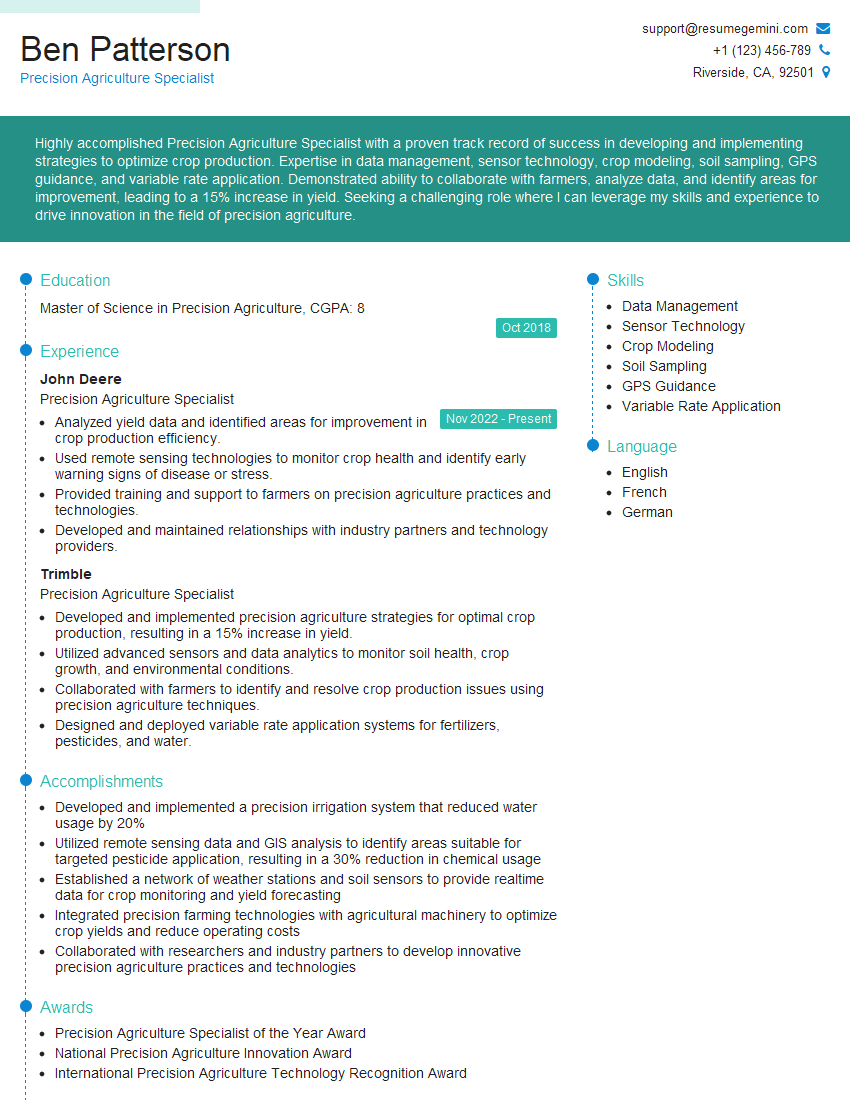
Mastering Precision Agriculture Applications is crucial for a successful career in this rapidly evolving field. It demonstrates your understanding of cutting-edge technology and its impact on sustainable and efficient food production. To maximize your job prospects, focus on building an ATS-friendly resume that highlights your skills and experience effectively. ResumeGemini is a trusted resource that can help you create a professional and impactful resume. They provide examples of resumes tailored to Precision Agriculture Applications to guide you through the process. Invest time in crafting a strong resume – it’s your first impression on potential employers.
Explore more articles
Users Rating of Our Blogs
Share Your Experience
We value your feedback! Please rate our content and share your thoughts (optional).
What Readers Say About Our Blog
Really detailed insights and content, thank you for writing this detailed article.
IT gave me an insight and words to use and be able to think of examples