Are you ready to stand out in your next interview? Understanding and preparing for Soldering Safety Practices interview questions is a game-changer. In this blog, we’ve compiled key questions and expert advice to help you showcase your skills with confidence and precision. Let’s get started on your journey to acing the interview.
Questions Asked in Soldering Safety Practices Interview
Q 1. What are the main hazards associated with soldering?
Soldering, while a crucial skill in electronics and various other fields, presents several hazards. The primary concerns revolve around:
- Thermal Burns: Soldering irons operate at high temperatures, posing a direct risk of burns to skin and eyes. Imagine accidentally touching a 400°C iron – that’s serious!
- Fume Inhalation: Soldering fluxes and the materials being joined release fumes containing potentially harmful substances like lead, cadmium, and various organic compounds. These fumes can irritate the respiratory system and, in the long term, cause more serious health problems.
- Eye Injuries: Spattering solder, hot flux, and even bright light from the soldering iron can damage your eyes. A small piece of molten solder in the eye is a very serious injury.
- Electrical Shock: When working with live circuits, there’s a risk of electrical shock. Even seemingly ‘dead’ circuits can retain a charge.
- Fire Hazard: Flammable materials near the soldering station, like solvents or packaging, pose a fire risk, especially when combined with high temperatures.
Understanding these hazards is the first step to mitigating them. We’ll delve into safety measures next.
Q 2. What safety equipment is mandatory when soldering?
Mandatory safety equipment for soldering includes:
- Safety Glasses or Goggles: These protect your eyes from flying solder, flux spatter, and intense light. Think of them as your essential first line of defense.
- Well-Ventilated Workspace or Fume Extractor: This removes harmful fumes produced during soldering. A simple fan might suffice for small jobs, but a dedicated fume extractor is best for frequent or intensive soldering.
- Heat-Resistant Gloves: These protect your hands from burns while handling hot components and soldering irons. Think about protecting your hands the same way you’d protect your eyes.
- Appropriate Clothing: Wear flame-resistant or non-flammable clothing to minimize the risk of fire or burns. Loose clothing should be avoided.
- First-Aid Kit: A basic first-aid kit should always be close by to deal with minor injuries like burns or cuts.
Depending on the specific application, additional protective equipment might be necessary, such as respirators for lead-free soldering or insulated tools for working with live circuits. Always prioritize your safety!
Q 3. Explain the importance of proper ventilation when soldering.
Proper ventilation is crucial during soldering because it removes the harmful fumes produced. These fumes can contain lead, cadmium, and other toxic substances that can cause respiratory problems, long-term health issues, and even cancer. Imagine breathing in tiny particles of metal – not something you want to do regularly.
Ventilation can be achieved through:
- Working in a well-ventilated area: A room with open windows and good airflow can help.
- Using a fume extractor: This device is specifically designed to capture and filter soldering fumes, providing a much more effective solution than relying solely on natural ventilation.
Without proper ventilation, you’re significantly increasing your risk of exposure to these harmful substances. Your health is worth the investment in a good ventilation system.
Q 4. Describe the risks associated with lead-based solder.
Lead-based solder, while less common now due to environmental regulations, presents significant health risks. Lead is a neurotoxin, meaning it can damage the nervous system. Exposure can occur through inhalation of fumes or ingestion of contaminated food or drink.
Risks associated with lead-based solder include:
- Neurological damage: Lead can affect brain development and function, particularly in children.
- Reproductive problems: Lead exposure is linked to reduced fertility and birth defects.
- Kidney damage: Lead can accumulate in the kidneys and lead to long-term damage.
- Cardiovascular problems: Studies suggest a link between lead exposure and cardiovascular disease.
The use of lead-free solder is strongly recommended to minimize these risks. Even with lead-free solder, proper ventilation and safety measures are still crucial to minimize exposure to other potential hazards.
Q 5. What are the different types of solder and their applications?
There are various types of solder, each with specific applications:
- Lead-based solder: (e.g., 60/40 tin-lead) Offers excellent wetting properties and ease of use, but its toxicity has led to its decreased use. It was a common choice for many years because of its ease of use, but safety concerns have heavily reduced its usage.
- Lead-free solder: (e.g., SAC305 – 96.5% tin, 3.0% silver, 0.5% copper) Environmentally friendly and increasingly common, though it may require higher temperatures and different techniques than lead-based solder. This type is now the standard in many applications and is becoming the dominant choice.
- Silver-bearing solder: Contains silver for improved strength and conductivity, often used in high-reliability applications. This type is more expensive but also more durable.
- Different Alloys: Various alloys are available with varying melting points and properties suited to specific materials and applications. The specific alloy used depends heavily on the application requirements.
Choosing the right type of solder is critical for ensuring a strong, reliable, and safe connection. The choice depends heavily on the application, material properties, and environmental considerations.
Q 6. How do you prevent burns while soldering?
Preventing burns while soldering requires consistent attention to safety protocols.
- Use heat-resistant gloves: This should be considered an absolute necessity.
- Avoid touching hot components or the soldering iron itself: Let the components cool down before handling them. Always assume the soldering iron is hot even when you’ve just finished using it.
- Use a soldering iron stand: This prevents accidental burns from a misplaced iron.
- Be aware of the hot air from the soldering iron: Avoid directing this hot air towards your skin or clothing.
- Take breaks: Prolonged soldering can lead to fatigue and potentially increase the risk of accidents. Short regular breaks prevent fatigue and increase focus.
Remember, prevention is far better than cure when it comes to burns. A moment’s carelessness can lead to a significant injury.
Q 7. What are the correct procedures for handling soldering irons?
Correct handling of soldering irons is essential for both safety and producing quality solder joints.
- Always use a soldering iron stand: Never leave a hot iron unattended. It’s too easy to brush against it by accident.
- Ensure the iron is properly grounded: This helps prevent electrical shocks.
- Use appropriate wattage for the job: A higher wattage iron is usually unnecessary and can increase the risk of damage to components and burns.
- Allow the iron to cool down completely before storage or cleaning: This is critical to prevent accidents.
- Clean the tip regularly: A clean tip ensures better heat transfer and cleaner solder joints. A wet sponge is usually adequate.
- Unplug the iron when not in use: It’s the simplest way to ensure that the iron isn’t a risk.
- Do not leave the soldering iron plugged in while you are not using it: This is the single most significant way to prevent accidental burns.
Treating the soldering iron with respect and care is vital. It’s a tool that can cause serious harm if not treated correctly.
Q 8. How do you dispose of soldering waste responsibly?
Responsible disposal of soldering waste is crucial for environmental protection and worker safety. Solder, fluxes, and cleaning solvents often contain hazardous materials. My approach involves a multi-step process:
- Segregation: I meticulously separate different waste types. This includes spent solder, flux residue-soaked wipes, and used cleaning solvents. Mixing them can compromise proper disposal and potentially create harmful chemical reactions.
- Containerization: Each waste type is placed in clearly labeled, sealed containers. This prevents spills, leaks, and accidental mixing, improving safety and facilitating proper disposal.
- Recycling/Specialized Disposal: Spent solder can often be recycled through specialized e-waste recycling facilities. These facilities have the equipment and expertise to safely reclaim valuable metals. Flux residues and solvents require disposal according to local regulations, often involving hazardous waste disposal companies. Never put these materials in regular trash.
- Documentation: Maintaining thorough records of waste generation, disposal methods, and the companies used ensures compliance with environmental regulations and provides an audit trail. This is particularly important in industrial settings.
For example, in a recent project involving the repair of several circuit boards, I carefully collected the spent solder in a designated container and sent it to a certified e-waste recycling center. The flux-contaminated wipes were disposed of through a licensed hazardous waste disposal service following all local regulations.
Q 9. What is the significance of using a fume extractor?
A fume extractor is vital for soldering safety because soldering fumes contain potentially harmful substances, such as lead (in lead-based solder, though this is less common now), metal oxides, and organic compounds from fluxes. These fumes can cause respiratory problems, headaches, and even long-term health issues if inhaled regularly.
A fume extractor works by capturing these fumes at their source, preventing them from entering the breathing zone. It usually involves a small fan that pulls the air over the work area towards a filter that traps the particles. More sophisticated models might use activated carbon filters to absorb harmful gases as well.
Think of it like a mini-ventilation system specifically designed for soldering. Using a fume extractor reduces the risk of solder fume inhalation significantly, protecting both the individual doing the soldering and anyone else nearby.
Q 10. Explain the importance of grounding while soldering.
Grounding is crucial for soldering, particularly when working with electronic components and circuits. It prevents the buildup of static electricity, which can damage sensitive components or even cause a shock.
Static electricity can discharge unexpectedly, creating enough voltage to damage transistors, integrated circuits, and other sensitive components. This can lead to malfunctions, requiring costly repairs or replacements. Grounding provides a path for static charges to dissipate safely, protecting the components from damage.
In practice, grounding involves connecting the soldering iron’s tip, the workbench, and the work piece itself to a common ground point, often through a grounding wrist strap and a grounded workbench mat. This ensures a continuous path for static electricity to flow to earth, protecting your work and preventing potential harm.
Q 11. What are the fire safety precautions to take while soldering?
Fire safety is paramount when soldering. The high temperatures involved, coupled with flammable materials, create a significant fire risk. Here’s a breakdown of precautions:
- Keep a fire extinguisher nearby: A Class B or ABC fire extinguisher should be readily available and easily accessible. Know how to use it correctly.
- Use a fire-resistant work surface: Avoid flammable materials like wood or cardboard. Use a non-combustible surface like ceramic tile or steel.
- Keep the workspace clean and organized: Clutter increases the risk of accidental ignition. Remove flammable materials from the immediate vicinity.
- Avoid working near flammable materials: Don’t solder near solvents, cleaning agents, or other potentially combustible substances.
- Proper ventilation: Good ventilation helps dissipate heat and prevent the buildup of flammable gases.
- Never leave a heated soldering iron unattended: Turn off and unplug the iron when not in use.
Imagine this: I was once soldering near a container of isopropyl alcohol. Fortunately, I had taken the precaution of keeping my fire extinguisher nearby. A small fire started due to a stray spark, but I was able to quickly extinguish it, preventing a potentially dangerous situation.
Q 12. Describe your experience with different soldering techniques (e.g., through-hole, surface mount).
My experience encompasses both through-hole and surface mount soldering techniques. Through-hole soldering involves inserting component leads through holes in a printed circuit board (PCB) and soldering the leads on the other side. This technique is simpler and requires less specialized equipment but is less suitable for high-density boards. I’m proficient in using various soldering irons, including those with adjustable temperature control, which is critical for consistent and high-quality soldering.
Surface mount soldering, on the other hand, involves placing components directly onto the surface of the PCB and soldering them using finer soldering irons or specialized equipment like hot air rework stations. This technique demands precision and skill. I’ve extensively worked with different surface mount components, from tiny 0402 resistors to larger integrated circuits (ICs), ensuring that my soldering is clean and consistent.
For example, in a recent project, I successfully soldered numerous tiny surface mount components onto a complex PCB using a hot air rework station. The project required great precision due to the density of the components, and the end result was a functional and aesthetically pleasing circuit board.
Q 13. How do you identify and address soldering defects?
Identifying and addressing soldering defects is critical for ensuring the reliability of electronic circuits. Common defects include:
- Cold solder joints: These are weak connections caused by insufficient heat or improper technique. They appear dull and lack a shiny, concave meniscus (the characteristic shape of a good solder joint).
- Dry joints: These are joints where the solder fails to adequately wet the component lead and PCB pad. This usually results in a poor electrical connection and reduced heat transfer.
- Solder bridges: These occur when excess solder creates unintended connections between adjacent leads or pads.
- Excess solder: While not always a defect, excessive solder can impede heat dissipation and potentially cause shorts.
To address these defects, I use a combination of visual inspection and, if necessary, specialized tools like a microscope or multimeter. Cold or dry joints need re-soldering with proper heat and technique. Solder bridges require careful removal of excess solder using desoldering braid or a solder sucker. Excessive solder can be removed with a soldering iron and braid. Proper cleaning is crucial after correcting defects.
Q 14. What are the symptoms of solder fume inhalation, and what should be done?
Solder fume inhalation can lead to various symptoms, ranging from mild to severe. Mild symptoms may include headaches, dizziness, nausea, and eye irritation. More serious effects can involve respiratory issues like coughing, shortness of breath, and chest tightness. Long-term exposure can result in more serious health problems, including metal fume fever (a flu-like illness) and chronic respiratory diseases.
If you suspect solder fume inhalation, immediately move to a well-ventilated area or outdoors. Fresh air is crucial. If symptoms are mild, they usually subside with rest and adequate ventilation. However, for more severe symptoms like persistent coughing, difficulty breathing, or chest pain, seek immediate medical attention. It’s essential to inform medical professionals about your exposure to solder fumes for proper diagnosis and treatment. In industrial settings, appropriate respiratory protection (such as respirators) is vital to minimize the risk of such problems.
Q 15. Explain the difference between rosin and water-soluble flux.
The key difference between rosin and water-soluble flux lies in their cleaning requirements after soldering. Rosin flux, a common type, is a natural resin that leaves a sticky residue after soldering. This residue is generally harmless to most electronics, but it’s often aesthetically undesirable and can sometimes interfere with certain tests. Cleaning is typically done with isopropyl alcohol (IPA).
Water-soluble flux, on the other hand, dissolves easily in water. This makes post-soldering cleaning much simpler and faster, especially beneficial when working on sensitive components or in applications where even minimal rosin residue is unacceptable. However, water-soluble flux can sometimes be more corrosive than rosin flux and require thorough rinsing to avoid potential long-term damage.
Think of it like this: rosin flux is like a stubborn glue – it needs a special solvent (IPA) to remove. Water-soluble flux is like sugar – it easily dissolves and washes away with water.
Career Expert Tips:
- Ace those interviews! Prepare effectively by reviewing the Top 50 Most Common Interview Questions on ResumeGemini.
- Navigate your job search with confidence! Explore a wide range of Career Tips on ResumeGemini. Learn about common challenges and recommendations to overcome them.
- Craft the perfect resume! Master the Art of Resume Writing with ResumeGemini’s guide. Showcase your unique qualifications and achievements effectively.
- Don’t miss out on holiday savings! Build your dream resume with ResumeGemini’s ATS optimized templates.
Q 16. What is the proper way to clean a soldering iron tip?
Maintaining a clean soldering iron tip is crucial for consistent, high-quality solder joints. A dirty tip leads to poor heat transfer, resulting in cold solder joints (weak and unreliable connections). My preferred method involves a multi-step approach:
- Initial Cleaning: While the iron is still hot (but not excessively so), use a damp sponge or wet brass wire brush to remove excess solder and debris. This is the most effective way to eliminate burnt flux and oxidation.
- Solder Removal: Touch the hot tip to a solder sponge or wet brass wire brush to remove any stubborn solder build-up. Be sure to use the correct surface to avoid damaging your iron tip.
- Tinning: Apply a small amount of fresh solder to the tip while it’s still hot. This creates a protective layer, preventing oxidation and further build-up of residue. The tinned tip is more even in its heat distribution and results in cleaner soldering.
- Regular Maintenance: For really stubborn buildup, a tip cleaner can be used, however frequently cleaning with a wet sponge and re-tinning is highly recommended during use. Don’t forget to turn off the iron and let it cool down before storing.
Q 17. How do you maintain a clean and organized soldering workstation?
A well-organized soldering workstation is essential for both efficiency and safety. It should be a dedicated space, free from clutter and potential hazards.
- Layout: Arrange your tools in an ergonomic manner, placing frequently used items within easy reach. This minimizes unnecessary movement and prevents accidents.
- Storage: Store solder, flux, and other consumables in clearly labeled containers. Small parts can be organized in compartmentalized trays to avoid loss and confusion.
- Ventilation: Ensure adequate ventilation to remove soldering fumes. A fume extractor is highly recommended for regular soldering work, and at minimum, working in a well-ventilated area.
- Safety Equipment: Keep a fire extinguisher readily accessible, as well as safety glasses and gloves. A soldering mat can protect your workbench from heat damage.
- Cleanliness: Regularly clean your workstation to remove solder splatter, flux residue, and other debris. This prevents accidental contact with hazardous materials and maintain the highest standards of professionalism.
Maintaining a clean workspace helps you stay focused, and the tidiness improves the consistency of your work.
Q 18. What are the common causes of solder bridges, and how can they be prevented?
Solder bridges, unwanted connections between adjacent pads, are a common soldering defect. They often arise from:
- Excess Solder: Applying too much solder can easily cause it to flow between nearby pads, creating a bridge.
- Improper Technique: Not providing enough time for the solder to properly flow and settle before removing the iron can also lead to bridges, especially when dealing with surface mount devices (SMDs).
- Overheating: Excessive heat can cause the solder to spread excessively, again increasing the risk of bridging.
- Poor Component Placement: If the components are not properly placed or positioned too close to each other, bridging becomes more likely.
Preventing solder bridges involves careful technique and attention to detail. Use the correct amount of solder, ensure proper component placement, and use a clean, well-maintained soldering iron. Using a magnifying glass, particularly while working with SMDs, can drastically reduce the incidence of bridges.
Q 19. How do you ensure proper temperature control during soldering?
Proper temperature control is vital for creating strong, reliable solder joints. Too low a temperature results in cold solder joints, while too high a temperature can damage components and create other defects. The ideal temperature depends on the type of solder and the components being soldered. For example, lead-free solder generally requires a higher temperature.
- Temperature-Controlled Irons: Use a soldering iron with adjustable temperature control, enabling you to fine-tune the heat according to the specific needs of the task.
- Solder Type: Choose the appropriate solder based on your application and working temperature. Lead-free solder, which melts at a higher temperature, might require a more powerful soldering iron.
- Monitoring: Observe the solder’s flow and the reaction of the components during the soldering process. If the solder doesn’t flow smoothly or the components are being affected, adjust the temperature accordingly. Consider a temperature monitoring tool for more accurate management.
- Practice: Experience is key in mastering temperature control. The more you solder, the more intuitive it becomes.
Q 20. What are the potential health effects of prolonged exposure to soldering fumes?
Prolonged exposure to soldering fumes can have several adverse health effects. These fumes contain various metallic compounds that are respiratory irritants and potentially toxic. Common concerns include:
- Respiratory Problems: Inhalation of fumes can cause irritation to the lungs, leading to coughing, shortness of breath, and in severe cases, more serious respiratory illnesses.
- Metal Fume Fever: Exposure to metal oxide fumes, particularly zinc oxide, can result in metal fume fever, characterized by flu-like symptoms.
- Long-Term Health Risks: Long-term exposure to soldering fumes has been linked to an increased risk of various health problems, including neurological issues and potentially other systemic effects depending on the types of metal oxides included in the solder.
To mitigate these risks, always work in a well-ventilated area. Use a fume extractor whenever possible, wear appropriate respiratory protection (like a respirator with appropriate cartridges), and take frequent breaks.
Q 21. Describe your experience with different types of solder paste.
My experience encompasses several types of solder paste, each with its own characteristics and applications. I’ve worked extensively with:
- Lead-Free Solder Paste: This is becoming increasingly prevalent due to environmental regulations. Lead-free solder pastes typically require higher soldering temperatures and may exhibit different wetting properties compared to lead-containing pastes. I’ve found that careful temperature control and the right flux are essential for successful results.
- Lead-Containing Solder Paste: While less common now, I have experience with various lead-based solder pastes. They generally exhibit superior wetting behavior and lower melting points, making them easier to use in certain applications. However, careful handling and disposal are essential due to lead’s toxicity.
- No-Clean Solder Paste: This type of paste leaves minimal residue after soldering, reducing the need for extensive cleaning. This saves time but necessitates higher standards of cleanliness and attention to detail to prevent residue issues.
- Different Alloy Compositions: Solder paste alloys vary in their composition (e.g., tin-lead, tin-silver-copper). I have experience adapting my soldering techniques to different alloy compositions and their respective melting points and rheological properties.
Understanding the characteristics of various solder pastes and their behavior under different conditions is crucial for achieving high-quality solder joints.
Q 22. How do you determine the appropriate solder type for a specific application?
Choosing the right solder depends heavily on the application’s specifics. Think of it like choosing the right glue – you wouldn’t use superglue for delicate paper crafting! We consider several factors:
- Material Compatibility: The solder must be compatible with the metals being joined. For instance, lead-free solder is often preferred for electronics due to environmental regulations, but it might require a different flux than lead-containing solder.
- Temperature Requirements: The solder’s melting point should be appropriate for the components and the soldering process. High-temperature solders are needed for applications with high operating temperatures, whereas low-temperature solders are better for heat-sensitive components.
- Joint Strength & Conductivity: The desired mechanical strength and electrical conductivity of the joint dictate the solder alloy. High-reliability applications might need a specific alloy for superior performance.
- Flux Type: The flux’s activity (how well it cleans the joint) and residue type (whether it’s no-clean or needs cleaning) are crucial. No-clean flux is convenient, but excessive residue can cause long-term issues.
For example, in high-vibration environments, a higher-strength solder alloy might be necessary. Conversely, working with delicate surface-mount components demands a lower-temperature solder to prevent damage.
Q 23. What safety measures should be taken when working with high-voltage components?
Safety with high-voltage components is paramount. Think of it like handling a loaded weapon – respect is key. Here’s a systematic approach:
- Power Down & Discharge: Always completely disconnect the power source and discharge any stored energy using a proper discharge tool. Never rely on visual inspection alone.
- Protective Equipment: Insulated tools, safety glasses, and appropriate gloves are essential. High-voltage work might require specialized protective clothing.
- Proper Grounding: Ensure yourself and your workbench are properly grounded to prevent static electricity buildup and potential shocks.
- Safety Signage & Lockout/Tagout Procedures: Clear signage warning of high voltage and adherence to lockout/tagout procedures to prevent accidental power restoration are critical.
- Work Area Precautions: Maintain a clean, organized workspace to prevent accidental contact with other components. Avoid working in damp or humid environments.
Always follow established safety protocols specific to the high voltage involved, potentially consulting with safety experts or electrical engineers before proceeding.
Q 24. How do you handle spills of soldering materials?
Solder spills need immediate and careful attention. Think of it like cleaning up a chemical spill – containment is priority one.
- Immediate Containment: Prevent further spread by using absorbent materials like spill pads or diatomaceous earth.
- Personal Protective Equipment (PPE): Wear appropriate PPE, including gloves and eye protection, to avoid direct contact.
- Proper Disposal: Dispose of contaminated materials according to local regulations. Solder and flux can be hazardous waste.
- Thorough Cleaning: After containment and disposal, thoroughly clean the affected area. This might involve vacuuming, wiping with a damp cloth, and proper ventilation.
Improper handling can lead to environmental contamination and health hazards. Always refer to the Safety Data Sheets (SDS) for specific handling instructions.
Q 25. What is your experience with IPC-A-610 (or similar soldering standards)?
IPC-A-610 is the industry standard for the acceptability of electronic assemblies. It’s my bible! My experience includes extensive training and practical application of IPC-A-610 Class 2 and Class 3 standards, ensuring consistently high-quality soldering work. I understand the criteria for solder joint appearance, workmanship, and overall reliability as defined in the standard. I have used this standard to guide inspections, train others, and improve our soldering processes.
I’m familiar with the various acceptance criteria, including those related to solder joint profile, wetting, and the absence of defects like bridging, cold solder joints, and tombstoning. I also understand the importance of documentation and traceability according to IPC-A-610 requirements.
Q 26. Describe your knowledge of ESD (Electrostatic Discharge) safety procedures.
ESD (Electrostatic Discharge) is a silent killer of sensitive electronics. It’s invisible, but the damage it causes can be devastating. My approach emphasizes prevention:
- Grounding: I always use an anti-static wrist strap connected to a properly grounded surface. This is the cornerstone of ESD protection.
- ESD Mats & Workstations: Working on an ESD mat within a grounded workstation is critical for preventing static buildup.
- ESD-Safe Tools and Packaging: I use only ESD-safe tools and containers to prevent damage during handling and storage.
- Proper Handling Techniques: I avoid unnecessary movements and maintain a grounded connection at all times when working with sensitive components.
- Ionizing Devices: In particularly sensitive environments, I use ionizing air guns to neutralize static electricity in the air.
A single spark can ruin a thousand-dollar circuit board. Prevention is far more effective than cure when it comes to ESD.
Q 27. How do you ensure the quality and reliability of your soldering work?
Quality and reliability in soldering aren’t just about good technique; it’s a holistic process. My approach includes:
- Proper Tooling and Maintenance: Using clean, well-maintained soldering irons, tips, and other equipment is fundamental. Regular tip cleaning and replacement are essential.
- Appropriate Soldering Techniques: Mastering techniques such as proper heat application, time management, and flux application are crucial for creating strong, reliable joints.
- Visual Inspection: Thorough visual inspection under magnification is necessary to identify any defects like cold joints, bridging, or insufficient solder wetting.
- Testing and Verification: Following soldering, appropriate electrical testing is conducted to ensure proper connectivity and functionality.
- Process Documentation and Control: I meticulously document my processes and adhere to best practices to maintain consistency and traceability.
I always aim for perfection, but the beauty of a well-made solder joint is its understated reliability, silently working in the background, ensuring product success.
Q 28. What are your strategies for continuous improvement in soldering safety practices?
Continuous improvement is a mindset, not a one-time event. I actively pursue improvement in soldering safety through:
- Regular Training and Updates: Staying current with the latest safety standards, regulations, and best practices is paramount. This includes attending workshops and webinars.
- Incident Reporting and Analysis: Any incidents, even near-misses, are carefully reported, analyzed, and used to identify areas for improvement in processes or training.
- Peer Review and Collaboration: I regularly participate in peer reviews of soldering work to identify areas for improvement and share best practices.
- Process Optimization: I continuously evaluate our processes to identify efficiencies and improvements that enhance safety without compromising quality.
- Technology Adoption: Staying abreast of and adopting new technologies, such as improved soldering equipment or automated inspection systems, can greatly enhance safety and efficiency.
Safety isn’t static. It’s a dynamic process that requires constant vigilance and a commitment to improvement. The goal is to make our workspace a safe and efficient environment for everyone.
Key Topics to Learn for Soldering Safety Practices Interview
- Personal Protective Equipment (PPE): Understanding the crucial role of PPE, including safety glasses, gloves, and anti-static wrist straps, and their proper use and maintenance. Practical application: Explain scenarios where specific PPE is necessary and the consequences of not using it.
- Workplace Hazards: Identifying potential hazards associated with soldering, such as fumes, burns, and electrical shock. Practical application: Describe safe work practices to mitigate these risks, including proper ventilation and grounding techniques.
- Soldering Techniques and Best Practices: Mastering proper soldering techniques to minimize the risk of injury or damage. Practical application: Discuss the difference between various soldering techniques and how to select the appropriate method for different tasks. Explain how to avoid overheating components or damaging circuit boards.
- Safety Data Sheets (SDS): Understanding how to interpret SDS for soldering materials and the implications for safe handling and disposal. Practical application: Explain how to identify potential hazards from SDS information and implement appropriate safety measures.
- Emergency Procedures: Familiarity with emergency procedures in case of accidents, including fire safety and first aid. Practical application: Describe the steps to take in the event of a fire, electrical shock, or chemical spill related to soldering.
- Environmental Considerations: Understanding the environmental impact of soldering and proper disposal of materials. Practical application: Discuss responsible waste management procedures for lead-free and leaded solder, fluxes, and cleaning solvents.
- Regulatory Compliance: Awareness of relevant safety regulations and standards related to soldering in your specific industry. Practical application: Describe how to ensure compliance with these regulations in your daily work.
Next Steps
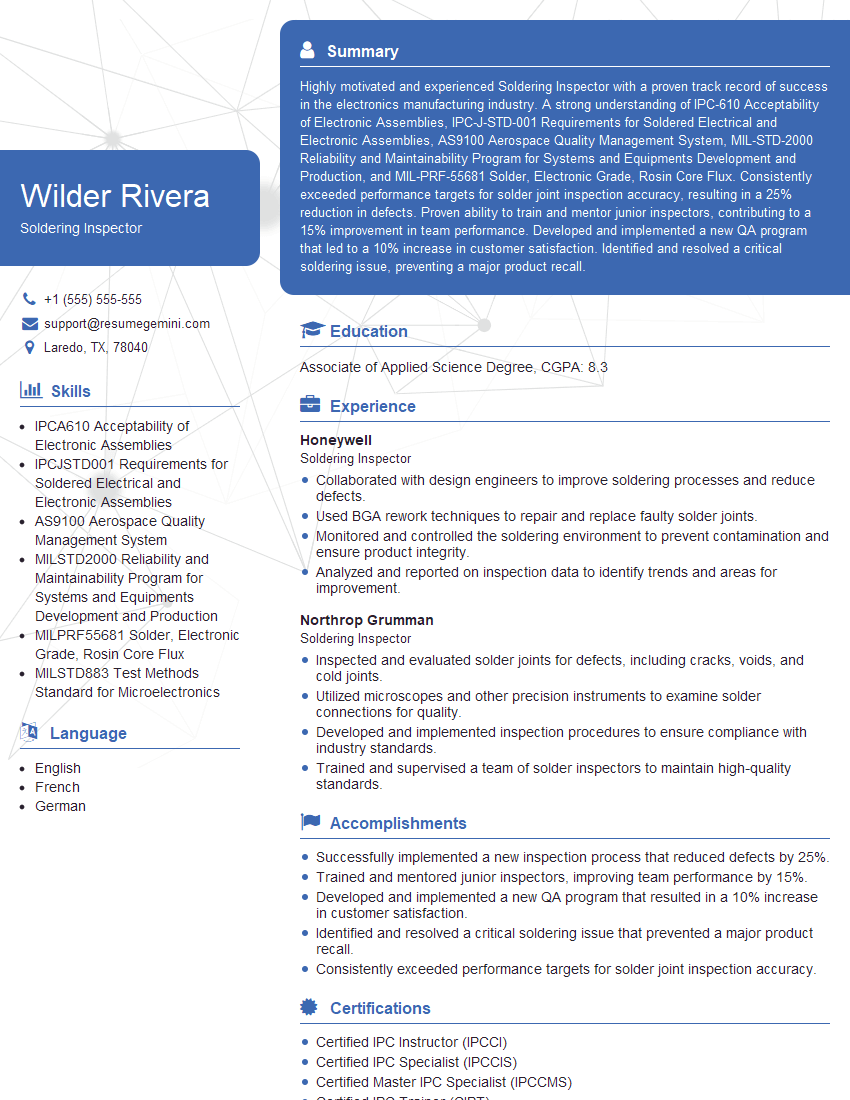
Mastering soldering safety practices is paramount for a successful and safe career in electronics and related fields. It demonstrates your commitment to professionalism and your ability to work responsibly and efficiently. To significantly improve your job prospects, focus on creating an ATS-friendly resume that highlights your skills and experience effectively. ResumeGemini is a trusted resource to help you build a powerful and impactful resume, showcasing your expertise in soldering safety. Examples of resumes tailored to Soldering Safety Practices are available to guide you.



Explore more articles
Users Rating of Our Blogs
Share Your Experience
We value your feedback! Please rate our content and share your thoughts (optional).
What Readers Say About Our Blog
Really detailed insights and content, thank you for writing this detailed article.
IT gave me an insight and words to use and be able to think of examples