Are you ready to stand out in your next interview? Understanding and preparing for High-speed aerodynamics interview questions is a game-changer. In this blog, we’ve compiled key questions and expert advice to help you showcase your skills with confidence and precision. Let’s get started on your journey to acing the interview.
Questions Asked in High-speed aerodynamics Interview
Q 1. Explain the differences between subsonic, transonic, supersonic, and hypersonic flows.
High-speed aerodynamic flows are categorized based on the Mach number (M), the ratio of the flow velocity to the speed of sound. Each regime presents unique challenges and characteristics:
- Subsonic (M < 1): The flow velocity is less than the speed of sound. Air behaves relatively predictably, and pressure disturbances propagate upstream, allowing for smooth airflow around an object. Think of a car driving down the road – its speed is far below the speed of sound.
- Transonic (M ≈ 1): This regime transitions from subsonic to supersonic flow. Mixed subsonic and supersonic regions exist, creating complex shock waves and flow separation. It’s a challenging regime for aircraft design because small changes can lead to dramatic performance shifts. Think of an aircraft approaching the speed of sound; unpredictable airflow patterns can occur.
- Supersonic (1 < M < 5): The flow velocity exceeds the speed of sound, resulting in the formation of strong shock waves which significantly impact drag and heat transfer. Concorde, a supersonic passenger jet, operated in this regime. The distinctive sonic boom is characteristic of supersonic flight.
- Hypersonic (M > 5): Extremely high velocities, typically above five times the speed of sound. Extreme heating due to air friction becomes a dominant factor, necessitating specialized materials and thermal protection systems. This regime is associated with space vehicles re-entering the atmosphere and advanced hypersonic weapons development. Imagine the intense heat generated upon a spacecraft’s re-entry – that’s the challenge of hypersonic flight.
Q 2. Describe the concept of shock waves and their impact on aerodynamic performance.
Shock waves are abrupt changes in flow properties (pressure, density, temperature, and velocity) that occur when the flow exceeds the speed of sound. They’re essentially highly compressed regions of air. Their formation is governed by the conservation laws of mass, momentum, and energy.
Impact on Aerodynamic Performance:
- Increased Drag: Shock waves cause a dramatic increase in drag, significantly impacting fuel efficiency and vehicle performance. The stronger the shock, the greater the drag.
- Heat Transfer: The high temperatures associated with shock waves can cause severe heating on the vehicle’s surface, requiring advanced thermal protection systems. This is particularly critical in supersonic and hypersonic flight.
- Flow Separation: Shock waves can trigger flow separation, leading to instability and loss of control. This is often encountered on the control surfaces of supersonic aircraft.
Understanding and managing shock waves is crucial for efficient and safe high-speed flight. Aerodynamic design strategies aim to minimize shock strength and manage their location to mitigate these negative effects.
Q 3. What are the key challenges in designing for high-speed flight?
Designing for high-speed flight presents several formidable challenges:
- Aerodynamic Heating: Friction between the vehicle and the air at high speeds generates significant heat, requiring advanced thermal protection systems. Materials must withstand extremely high temperatures without compromising structural integrity.
- Shock Waves and Drag: Managing shock waves is crucial to minimize drag and maintain stability. This requires sophisticated design optimization techniques and advanced computational tools.
- Material Selection: Materials must be strong, lightweight, and able to withstand the extreme temperatures and stresses of high-speed flight. Advanced composites and other high-temperature alloys are often employed.
- Propulsion Systems: Developing efficient and powerful propulsion systems capable of reaching and sustaining high speeds is a major hurdle. Scramjets and other advanced propulsion concepts are being explored.
- Control Systems: At high speeds, small changes in control surface angles can have dramatic effects. Robust and responsive control systems are critical for maintaining stability and maneuverability.
Q 4. Explain the role of Computational Fluid Dynamics (CFD) in high-speed aerodynamics.
Computational Fluid Dynamics (CFD) plays a vital role in high-speed aerodynamics by providing a powerful tool to simulate and analyze complex flow fields. It allows engineers to predict aerodynamic forces, heat transfer, and other critical parameters without the need for expensive and time-consuming wind tunnel testing.
CFD helps in:
- Design Optimization: CFD simulations allow for iterative design refinement, enabling engineers to optimize shapes and configurations to minimize drag, manage shock waves, and reduce heat transfer.
- Flow Visualization: CFD generates visualizations of the flow field, providing insights into complex flow phenomena like shock waves and boundary layer separation. This information is crucial for understanding and improving aerodynamic performance.
- Predicting Aerodynamic Loads: Accurate prediction of aerodynamic forces and moments is essential for designing a stable and controlled vehicle. CFD provides a powerful means of doing so.
- Reducing Development Costs: CFD reduces the reliance on extensive wind tunnel testing, leading to significant cost savings in the design process.
Q 5. What are different turbulence models used in high-speed CFD simulations and their applicability?
Several turbulence models are employed in high-speed CFD simulations, each with its own strengths and limitations. The choice depends on the specific flow regime and the desired accuracy level. Some prominent models include:
- k-ε models: These are two-equation models that solve for the turbulent kinetic energy (k) and its dissipation rate (ε). They are relatively simple and computationally efficient but may not accurately capture all the details of turbulent flows, especially at high speeds.
- k-ω SST (Shear Stress Transport): This model blends the advantages of k-ε and k-ω models, providing improved accuracy for both near-wall and free-stream flows. It’s widely used in high-speed CFD applications and balances accuracy and computational cost effectively.
- Reynolds Stress Models (RSM): These are more complex models that solve for the Reynolds stress tensor directly, offering higher accuracy but requiring significantly more computational resources. They are often preferred for highly complex turbulent flows.
- Detached Eddy Simulation (DES) and Large Eddy Simulation (LES): These are advanced techniques that directly resolve large-scale turbulent structures, providing the most accurate results but with a substantial computational cost. They are used when highly accurate turbulence prediction is critical.
The selection of an appropriate turbulence model is a critical aspect of high-speed CFD simulations, significantly influencing the accuracy and reliability of the results.
Q 6. How do you account for real-gas effects in high-speed flows?
Real-gas effects become significant at high speeds and temperatures, where the assumption of ideal gas behavior (e.g., constant specific heats) is no longer valid. These effects arise due to changes in molecular properties with temperature and pressure. To account for real-gas effects:
- Equation of State: Instead of using the ideal gas law (PV=nRT), an appropriate real-gas equation of state, such as the Peng-Robinson or Redlich-Kwong equations, is used. These equations better represent the behavior of gases at high pressures and temperatures.
- Thermodynamic Properties: Specific heat capacity, enthalpy, and other thermodynamic properties are modeled as functions of temperature and pressure, rather than being treated as constants. This is crucial for accurately predicting heat transfer and energy balance in high-speed flows.
- Chemical Reactions: At hypersonic speeds, high temperatures can lead to dissociation and ionization of air molecules. In such cases, the CFD simulation must include chemical reaction models to accurately represent the gas composition and its properties.
Including real-gas effects significantly increases the complexity of the CFD simulation, requiring more advanced numerical methods and greater computational resources. However, it’s essential for accurate prediction of flow behavior in high-speed flight scenarios.
Q 7. Discuss the importance of boundary layer transition in high-speed aerodynamics.
Boundary layer transition refers to the change in the flow regime from laminar (smooth and orderly) to turbulent (chaotic and disordered) within the boundary layer – a thin layer of fluid near the surface of an object. In high-speed aerodynamics, this transition is critically important because:
- Skin Friction Drag: Turbulent boundary layers generate significantly more skin friction drag than laminar boundary layers. Understanding and controlling transition can thus significantly impact the overall drag of a high-speed vehicle.
- Heat Transfer: Turbulent boundary layers have much higher heat transfer rates compared to laminar boundary layers. Accurate prediction of transition is thus crucial for designing effective thermal protection systems.
- Separation: Transition can influence boundary layer separation, which can lead to instability and loss of control. Managing transition is essential for maintaining stable flow over control surfaces.
Various methods are used to predict and control boundary layer transition, including computational models based on linear stability theory and empirical correlations, as well as surface modifications designed to promote or delay transition (e.g., surface roughness or suction). Accurate prediction of transition is a significant challenge and an active area of research in high-speed aerodynamics.
Q 8. Explain the concept of boundary layer separation and its consequences at high speeds.
Boundary layer separation occurs when the flow in the boundary layer (the thin layer of fluid near a surface) detaches from the surface. At high speeds, this is exacerbated by several factors. Imagine a river flowing smoothly; then it encounters a rock. The water might separate from the rock’s surface, creating turbulence and eddies. Similarly, in high-speed aerodynamics, adverse pressure gradients (pressure increasing in the flow direction) can cause the boundary layer to slow down, thicken, and eventually separate. This separation leads to a significant increase in drag, loss of lift, and potential buffeting or control surface ineffectiveness.
Consequences at high speeds are amplified because of the increased inertial forces. Separation can lead to a dramatic increase in drag, making the vehicle less efficient and potentially reducing its top speed. It can also cause a significant loss of lift, making flight control challenging and dangerous, sometimes even resulting in a stall. Furthermore, the separated flow can trigger shock waves, further increasing drag and creating unsteady forces that can lead to structural damage or vibrations.
For instance, a poorly designed aircraft wing at supersonic speeds might experience boundary layer separation on the upper surface. This would dramatically reduce lift, potentially resulting in a crash. Similarly, a high-speed missile with separated flow would suffer from significant drag, reducing its range and maneuverability.
Q 9. Describe different methods for controlling boundary layer separation at high speeds.
Controlling boundary layer separation at high speeds is crucial for aerodynamic performance and safety. Several methods exist, each with its own advantages and limitations:
- Boundary Layer Suction: This involves actively removing the slow-moving air from the boundary layer using suction slots or porous surfaces. This keeps the boundary layer thin and attached, delaying separation. It’s effective but mechanically complex and energy-intensive.
- Vortex Generators: These small, strategically placed devices create vortices that mix the high-energy outer flow with the slow-moving boundary layer. This energizes the boundary layer, preventing separation. They are relatively simple to implement but can increase drag if not designed carefully.
- Streamlining: Careful shaping of the body to minimize adverse pressure gradients can prevent separation. This is often the first approach to tackle the problem, involving clever design of leading and trailing edges, and overall geometry optimization.
- Blowing: Introducing high-pressure air into the boundary layer can also energize it, preventing separation. Similar to suction, this method needs carefully planned slots and high-pressure air supply.
- Passive Flow Control: Techniques like surface roughness or dimples can also affect the boundary layer and prevent separation. These methods are simple to implement but may be less effective than active methods.
The choice of method depends on the specific application, the severity of the separation, and other design considerations. For example, vortex generators might be preferred for a relatively simple solution on a high-speed aircraft wing, while boundary layer suction might be employed for critical components of a hypersonic vehicle where maximum performance is required.
Q 10. What are the limitations of using wind tunnel testing for high-speed aerodynamics?
Wind tunnel testing remains an essential tool in high-speed aerodynamics, but it has limitations, particularly at very high Mach numbers:
- Scaling effects: It’s difficult to accurately scale down real-world geometries to wind tunnel sizes while maintaining the same Reynolds number (a dimensionless number characterizing flow regime). Differences in Reynolds number can significantly affect boundary layer behavior and separation. Imagine trying to replicate ocean waves in a bathtub – it simply won’t capture the same dynamics.
- Wall interference: The wind tunnel walls can interact with the flow, distorting the results, especially in high-speed tests where the flow is highly sensitive to even small perturbations. This leads to inaccuracies in measured forces and moments.
- Test section size limitations: Large high-speed wind tunnels are expensive and difficult to build. This limitation restricts the size of the models tested, potentially affecting the accuracy of the results.
- High operating costs: Running high-speed wind tunnels requires substantial power, creating high operating costs. Testing time is often limited.
- High-speed flow generation difficulties: Achieving and maintaining precisely controlled high-speed flow, especially at hypersonic speeds, is challenging.
Despite these limitations, careful experimental design, sophisticated correction techniques, and advanced instrumentation can help mitigate some of these issues. High-speed wind tunnels are still invaluable for validating CFD simulations and providing crucial experimental data.
Q 11. How do you validate CFD results?
Validating CFD results is a critical step in ensuring their accuracy and reliability. This is typically done through a combination of methods:
- Comparison with experimental data: This is the gold standard. CFD results are compared with data obtained from wind tunnel tests or flight tests. This comparison should ideally cover a range of operating conditions. Discrepancies are analyzed to understand the sources of error in either the CFD model or the experiments.
- Grid independence study: This involves performing simulations with different mesh resolutions (finer meshes require more computational resources). If the results don’t change significantly with increasing mesh refinement, it suggests that the solution is grid-independent and therefore reliable.
- Code verification: This ensures that the CFD code itself is functioning correctly. This can involve simple test cases with known analytical solutions or comparisons to established benchmark solutions.
- Uncertainty quantification: This involves estimating the uncertainty associated with the CFD results due to factors such as numerical errors, model assumptions, and experimental uncertainties. This provides a measure of confidence in the predicted values.
- Comparison with other CFD solvers: Running the same case with different CFD solvers can provide additional validation. Consistent results across different solvers increase confidence in the overall accuracy of the simulation.
For example, when simulating the airflow over an aircraft wing at transonic speeds, we would compare the CFD-predicted lift and drag coefficients with those obtained from wind tunnel experiments. A grid independence study would ensure the solution is not excessively sensitive to mesh resolution. Discrepancies should then be carefully investigated to identify potential sources of errors, leading to refinement of the model or experimental setup. This iterative process is crucial for reliable validation of CFD results.
Q 12. Explain the concept of Mach number and its significance in high-speed aerodynamics.
The Mach number (M) is a dimensionless quantity representing the ratio of the speed of an object (such as an aircraft) to the speed of sound in the surrounding medium. It’s defined as:
M = V/a
where V is the object’s velocity and a is the speed of sound. The speed of sound varies with temperature and composition of the medium. At sea level and standard temperature (15°C), it’s approximately 340 m/s.
In high-speed aerodynamics, the Mach number is of paramount importance because it dictates the flow regime. Different flow regimes have different aerodynamic characteristics:
- Subsonic (M < 1): The flow is everywhere slower than the speed of sound. Compressibility effects are relatively small.
- Transonic (M ≈ 1): The flow contains both subsonic and supersonic regions. Compressibility effects become significant.
- Supersonic (1 < M < 5): The flow is everywhere faster than the speed of sound. Shock waves form, causing significant changes in pressure, temperature, and density.
- Hypersonic (M > 5): The flow is extremely fast, with extremely strong shock waves and high temperatures. Chemical reactions can become important.
Understanding the Mach number is essential for designing vehicles for high-speed flight, as it dictates the appropriate aerodynamic models and design considerations. For example, designing a supersonic aircraft requires a deep understanding of shock wave generation and their effects on lift and drag. Neglecting compressibility effects at high Mach numbers would lead to significant inaccuracies in the aerodynamic predictions.
Q 13. Describe different types of wind tunnels used for high-speed testing.
Several types of wind tunnels are used for high-speed testing, each suited for a different Mach number range:
- Transonic wind tunnels: Designed to test at Mach numbers near 1, these tunnels often incorporate sophisticated techniques to control the flow and minimize wall interference. They often use slotted or perforated walls to reduce the impact of the walls on the flow.
- Supersonic wind tunnels: Designed for testing at supersonic speeds (Mach 1.2 to 5), these typically employ a converging-diverging nozzle to accelerate the flow to the desired supersonic speed. A notable design consideration is the ability to handle significant heat generation due to aerodynamic heating.
- Hypersonic wind tunnels: Designed for testing at hypersonic speeds (Mach 5 and above), these tunnels usually utilize specialized techniques to generate extremely high velocities and high temperatures. They may use shock tunnels, expansion tubes, or arc-heated wind tunnels to achieve the required conditions. These tests are significantly more challenging and expensive due to the extreme conditions.
- Ludwieg tubes: These are intermittent facilities, where a long tube filled with high-pressure air is suddenly opened to a test section. This produces a short but high-speed flow, suitable for specific hypersonic testing scenarios.
The choice of wind tunnel depends heavily on the specific test requirements, the Mach number range of interest, and the available resources. Hypersonic wind tunnels are, for example, exceptionally complex and require specialized expertise and significant investment compared to transonic wind tunnels.
Q 14. What are the advantages and disadvantages of different numerical schemes used in CFD for high-speed flows?
Various numerical schemes are used in CFD for high-speed flows, each with its advantages and disadvantages:
- Finite Volume Method (FVM): This is a widely used method that conserves quantities like mass, momentum, and energy. It’s robust and relatively easy to implement on complex geometries. However, it can be computationally expensive for very fine meshes, especially in high-speed flows where sharp gradients exist.
- Finite Difference Method (FDM): This method approximates derivatives using differences between values at discrete points. It’s relatively simple to implement but is less flexible than FVM for handling complex geometries. It can struggle with accuracy near boundaries and discontinuities.
- Finite Element Method (FEM): This method uses elements to discretize the domain, offering flexibility in handling complex geometries and boundary conditions. It’s particularly useful for flows with significant discontinuities or complex boundaries. However, it can be computationally more expensive than FVM.
Regarding specific schemes for high-speed flows, the choice often depends on the flow regime and the level of accuracy required. Schemes capable of resolving shock waves accurately, like high-resolution shock-capturing schemes (e.g., total variation diminishing (TVD) schemes, essentially non-oscillatory (ENO) schemes), are often used for supersonic and hypersonic flows. These schemes minimize spurious oscillations near shock waves while accurately capturing the sharp changes in flow properties. However, these sophisticated schemes can be computationally more expensive than simpler schemes.
For example, a hypersonic flow simulation might benefit from using an ENO scheme to accurately resolve the strong shock waves, while a less demanding subsonic flow simulation might use a simpler, less computationally intensive scheme. The selection should always balance accuracy requirements with computational costs and available resources.
Q 15. Explain the concept of aerodynamic heating and its impact on aircraft design.
Aerodynamic heating is the phenomenon where the kinetic energy of air molecules impacting a high-speed vehicle is converted into thermal energy, leading to a significant rise in the vehicle’s surface temperature. Imagine rubbing your hands together quickly – the friction generates heat. At high speeds, this friction with the air becomes incredibly intense. This heating poses significant challenges to aircraft design because materials have temperature limits beyond which they lose structural integrity or fail completely. For example, at hypersonic speeds (five times the speed of sound and beyond), surface temperatures can reach thousands of degrees Celsius. This necessitates the use of specialized heat-resistant materials like ceramics and advanced alloys, often in combination with active cooling systems. Aircraft design must account for the thermal stresses induced by this heating, ensuring the airframe remains structurally sound and functional even under extreme conditions.
The impact on aircraft design is substantial. It dictates the choice of materials, the design of thermal protection systems (TPS), and the overall configuration of the vehicle. The TPS might involve ablative materials (those that erode to absorb heat), radiative cooling (where heat is radiated away from the surface), or even active cooling systems using onboard fluids to dissipate heat. The design must also consider the expansion and contraction of materials due to temperature changes, ensuring the aircraft doesn’t warp or crack under the thermal stress.
Career Expert Tips:
- Ace those interviews! Prepare effectively by reviewing the Top 50 Most Common Interview Questions on ResumeGemini.
- Navigate your job search with confidence! Explore a wide range of Career Tips on ResumeGemini. Learn about common challenges and recommendations to overcome them.
- Craft the perfect resume! Master the Art of Resume Writing with ResumeGemini’s guide. Showcase your unique qualifications and achievements effectively.
- Don’t miss out on holiday savings! Build your dream resume with ResumeGemini’s ATS optimized templates.
Q 16. How do you design for thermal management in high-speed vehicles?
Thermal management in high-speed vehicles involves strategies to control and mitigate the effects of aerodynamic heating. This is crucial to maintaining the structural integrity and functional performance of the vehicle. Effective thermal management strategies usually involve a combination of passive and active methods.
- Passive methods focus on designing the vehicle’s shape and using materials that naturally minimize heat absorption and maximize heat dissipation. This includes features like leading-edge extensions and the use of low-heat-capacity materials. For instance, carefully designing the leading edge of a wing to have a blunt shape can help reduce the severity of shock waves and hence heat generation.
- Active methods involve actively removing heat from the vehicle’s surfaces. This could include circulating coolant through internal channels within the structure, using transpiration cooling (injecting a coolant through porous surfaces), or employing heat pipes to transfer heat away from critical areas. The Space Shuttle, for example, used a complex TPS system with reusable tiles and internal coolant channels to manage the intense heat experienced during re-entry.
The selection of the appropriate thermal management system depends heavily on factors such as the vehicle’s speed, mission duration, and the constraints of weight and cost. A well-designed thermal management system ensures the vehicle’s structural integrity, electronic systems, and onboard equipment operate within their acceptable temperature ranges, even at extreme speeds.
Q 17. What are the different types of high-speed propulsion systems?
High-speed propulsion systems are broadly categorized based on their operating principles and speed regimes. Each has its own set of advantages and limitations.
- Ramjets: These operate by compressing incoming air using the vehicle’s forward motion. They are efficient at supersonic speeds but require a separate booster system (like a rocket) to reach their operating speeds.
- Scramjets: Similar to ramjets, but designed for hypersonic flight. They achieve combustion at supersonic speeds within the engine, offering significantly higher speeds than ramjets.
- Turbofans/Turbojets: These are commonly used in subsonic and supersonic flight. They employ rotating turbines to compress air and achieve combustion. While effective at lower speeds, their efficiency decreases at higher speeds.
- Rocket engines: These carry their own oxidizer, enabling propulsion in environments devoid of atmospheric oxygen, such as space or at very high altitudes. They are powerful but are generally less fuel-efficient than air-breathing engines like ramjets and scramjets.
The choice of propulsion system is critical for high-speed vehicle design, as it directly impacts the vehicle’s overall performance, speed capabilities, and mission profile. The design needs to account for factors like thrust-to-weight ratio, fuel efficiency, and operational altitude.
Q 18. Discuss the challenges of designing inlets for supersonic and hypersonic vehicles.
Designing inlets for supersonic and hypersonic vehicles presents significant challenges due to the complex shock waves and flow phenomena that occur at these speeds. The inlet’s primary function is to efficiently decelerate the incoming airflow, ensuring smooth and uniform flow into the engine for combustion. However, achieving this efficiently while minimizing energy losses is difficult.
- Shock wave formation: Supersonic and hypersonic flow creates strong shock waves that can cause significant pressure losses and boundary layer separation in the inlet. The design must aim to control the position and strength of these shocks to minimize pressure losses.
- Flow separation: The high-speed airflow can separate from the inlet walls, leading to flow instabilities and reduced efficiency. Inlet designs must incorporate strategies to prevent or manage flow separation.
- Thermal management: The high temperatures generated by shock waves and friction within the inlet require advanced thermal management techniques to prevent overheating of the inlet structure and the engine.
- Start-up and operational range: The inlet must efficiently operate over a wide range of flight speeds and altitudes, which requires complex mechanisms and control systems. The inlet must also smoothly transition from subsonic speeds to supersonic/hypersonic regimes.
Inlet design typically involves extensive computational fluid dynamics (CFD) simulations and wind tunnel testing to optimize the inlet shape and performance. Advanced inlet designs often employ multiple compression stages, variable geometry mechanisms (such as adjustable ramps or cones), and boundary layer control techniques to achieve optimal performance.
Q 19. Explain the concept of wave drag and its significance in high-speed flight.
Wave drag is a type of drag that arises from the formation of shock waves and expansion waves when an aircraft flies at supersonic or hypersonic speeds. Unlike friction drag, which is caused by the friction between the air and the aircraft’s surface, wave drag results from the energy lost in creating these shock waves, which are essentially disturbances in the airflow. Imagine throwing a stone into a calm pond; the resulting ripples represent the energy dissipated as waves. Similarly, a supersonic aircraft generates large waves (shock waves) in the air, and the energy used to create these waves is what accounts for the wave drag.
The significance of wave drag in high-speed flight is considerable. At supersonic and hypersonic speeds, wave drag becomes the dominant form of drag, significantly affecting the vehicle’s performance and fuel efficiency. Minimizing wave drag is crucial for achieving high speeds and long-range flight. The magnitude of wave drag is heavily dependent on the aircraft’s shape and speed. A slender, streamlined design generally minimizes wave drag compared to a blunt or bulky shape.
Q 20. How do you minimize wave drag in high-speed aircraft design?
Minimizing wave drag in high-speed aircraft design relies heavily on aerodynamic shaping and careful consideration of the airflow around the vehicle. The goal is to reduce the strength and number of shock waves generated. Several methods are employed:
- Area rule: This involves shaping the aircraft’s cross-sectional area along its length to minimize the disturbance created in the supersonic airflow. A smoothly varying cross-sectional area helps to reduce the formation of strong shock waves. Think of it as making the aircraft’s shape as ‘smooth’ as possible for the airflow.
- Fine-tuning the shape: Sophisticated computational fluid dynamics (CFD) and wind tunnel testing are used to optimize the aircraft’s shape for minimal wave drag. Small changes in the wing’s sweep angle, fuselage shape, and other geometric parameters can make a significant difference.
- Using advanced aerodynamics: Techniques like shock wave cancellation, where shock waves are strategically manipulated to weaken each other, are explored. Also, using inlets and other components optimized to reduce wave generation is important.
- Material selection: While not directly reducing wave drag, using lighter materials reduces the overall weight of the aircraft, thus mitigating the impact of wave drag on performance.
The process of minimizing wave drag is iterative and involves a significant amount of computational modeling and experimental testing to find the optimal shape for a given speed and flight conditions.
Q 21. Describe different methods for controlling shock waves.
Controlling shock waves is crucial for efficient high-speed flight, as their formation leads to energy losses and high temperatures. Several methods are used to manage shock waves:
- Area rule (as discussed above): This helps minimize the strength of the shock waves formed.
- Sweepback and other geometrical modifications: Sweeping back wings, for example, reduces the effective Mach number (the ratio of the aircraft’s speed to the speed of sound) seen by the wing, thus delaying the onset of strong shock waves.
- Shock wave boundary layer interaction control: Strategies are employed to manage the interaction between shock waves and the boundary layer (the thin layer of air close to the surface) to prevent flow separation. This could involve suction, blowing, or other boundary layer control techniques.
- Inlet design: Inlets are carefully designed to manage the shock waves created by the incoming airflow, ensuring efficient compression and minimizing pressure losses. Multiple oblique shock waves may be used instead of one strong normal shock wave.
- Computational Fluid Dynamics (CFD): Sophisticated CFD simulations are used to predict shock wave patterns and refine the vehicle’s design for better shock wave management. This allows for virtual experimentation and optimization of the design without the high cost of repeated physical prototypes.
The specific method or combination of methods employed for shock wave control depends heavily on the vehicle’s design, speed regime, and operational requirements. Effective shock wave control is vital for achieving high efficiency and safety in high-speed flight.
Q 22. What are the challenges in designing control surfaces for high-speed aircraft?
Designing control surfaces for high-speed aircraft presents unique challenges due to the extreme aerodynamic forces and heating encountered at these speeds. The primary challenges include:
- Increased aerodynamic heating: At hypersonic speeds, friction with the air generates intense heat, demanding the use of specialized, heat-resistant materials for the control surfaces. This adds significant weight and complexity to the design.
- High dynamic pressures: The force exerted by the airflow on the control surfaces increases dramatically with speed. This requires robust structural design to prevent failure under these extreme loads. We need to consider fatigue and potentially aeroelastic effects significantly.
- Re-entry and trajectory control: For re-entry vehicles, precise control surface actuation is paramount for a stable and controlled descent. This requires highly reliable and responsive actuators capable of functioning under extreme conditions.
- Shock wave interactions: Shock waves generated by the aircraft’s body can interact with the control surfaces, leading to unpredictable aerodynamic forces and potentially control surface buffeting. Careful design and computational fluid dynamics (CFD) analysis are crucial to mitigate these effects.
- Reduced effectiveness at high Mach numbers: The effectiveness of control surfaces can diminish at higher speeds because of the increasingly significant impact of compressibility effects. Innovative control surface designs, like deflected flaps, are often necessary to maintain controllability.
For instance, the design of the Space Shuttle’s elevons (a combination of elevator and aileron) exemplifies the intricate design challenges involved in managing these factors. The elevons were made of specialized materials to withstand re-entry heating and their design was optimized using CFD to minimize adverse interactions with the shock waves generated during hypersonic flight.
Q 23. Explain the concept of aeroelasticity in high-speed flight.
Aeroelasticity in high-speed flight refers to the interaction between aerodynamic forces, structural inertia, and elastic deformation of the aircraft. In simpler terms, it’s how the airflow affects the aircraft’s shape and how that changed shape, in turn, affects the airflow. At high speeds, these interactions become highly complex and potentially dangerous.
Imagine a wing flexing under aerodynamic load. At subsonic speeds, this might be a minor effect. However, at supersonic speeds, the increased aerodynamic forces coupled with high structural rigidity can lead to significant deformations. This can cause:
- Flutter: A self-excited oscillation where aerodynamic forces feed back into structural vibrations, leading to potentially catastrophic failure. It’s like a wind-induced resonance, but much more destructive.
- Divergence: A static instability where aerodynamic forces cause the structure to deform uncontrollably, leading to a collapse.
- Control surface effectiveness degradation: Wing or control surface deformation can reduce the effectiveness of control inputs, making the aircraft difficult to manage.
Aeroelastic phenomena are far more pronounced at high speeds because of the significantly increased dynamic pressures and the complexity of supersonic and hypersonic flows which involve shock waves.
Q 24. How do you account for aeroelastic effects in high-speed aircraft design?
Accounting for aeroelastic effects in high-speed aircraft design is crucial for safety and performance. We employ a multidisciplinary approach, integrating structural mechanics, aerodynamics, and control systems. Here’s a breakdown of the process:
- Finite Element Analysis (FEA): This technique is used to model the aircraft’s structure and predict its response to aerodynamic loads. This involves creating a complex mesh representing the aircraft’s components and solving equations based on material properties and load distribution.
- Computational Fluid Dynamics (CFD): CFD simulations predict the airflow around the aircraft, including the complex interactions with shock waves, and provide aerodynamic loads for the FEA model.
- Aeroelastic analysis: This combines FEA and CFD results to predict the coupled aeroelastic behavior of the aircraft. It often involves specialized software capable of performing coupled fluid-structure interaction (FSI) analyses.
- Wind tunnel testing: Wind tunnel tests, particularly those using specialized high-speed tunnels, are essential to validate the analytical predictions. These tests often involve models equipped with strain gauges to measure structural deformations under various flight conditions.
- Active control systems: Incorporating active control systems that sense and compensate for aeroelastic deformations can significantly enhance aircraft stability and control. This is especially important at high speeds where aeroelastic effects are most pronounced.
For example, in the design of a hypersonic aircraft, a sophisticated FSI analysis would be conducted to assess the risk of flutter, ensuring that the design margins are sufficient to prevent failure. Wind tunnel testing would then be used to verify that the analysis accurately predicts the observed behavior.
Q 25. Discuss the impact of atmospheric conditions on high-speed flight.
Atmospheric conditions significantly impact high-speed flight. The variations in temperature, pressure, density, and humidity can drastically affect aerodynamic forces, propulsion efficiency, and overall flight performance. Key considerations include:
- Density altitude: Higher altitudes have lower air density, reducing lift and increasing drag. This impacts the aircraft’s performance and requires careful consideration of thrust requirements and control surface effectiveness.
- Temperature variations: Temperature affects air density and the speed of sound. High temperatures reduce density, negatively impacting lift and increasing drag. Temperature also influences the strength of materials, affecting the aircraft’s structural integrity.
- Wind shear: Sudden changes in wind speed and direction can create unpredictable aerodynamic forces on the aircraft, particularly during takeoff and landing. These forces can impact handling and can be especially hazardous at high speeds.
- Humidity: High humidity can affect airflow over the aircraft, affecting aerodynamic characteristics and potentially leading to icing.
- Atmospheric turbulence: Turbulence increases the aerodynamic loads on the aircraft, which can create fatigue issues in addition to impacting passenger comfort.
For instance, a supersonic aircraft designed for cruise at a specific altitude and temperature will experience reduced performance at higher altitudes or temperatures due to the decreased air density. This needs to be accounted for during the design phase by providing additional thrust or other performance enhancements.
Q 26. What are the ethical considerations in the development of high-speed flight technology?
The development of high-speed flight technology raises several ethical considerations:
- Environmental impact: Supersonic and hypersonic flight generates sonic booms and significant greenhouse gas emissions, which could harm the environment. Mitigation strategies and sustainable propulsion methods require careful evaluation.
- Safety concerns: High-speed flight inherently involves high risks. Ensuring public safety during operations requires stringent safety standards, robust testing procedures, and fail-safe mechanisms.
- Military applications: High-speed flight technology has military applications, raising ethical concerns about its potential use in warfare and the escalation of conflict. International agreements and ethical guidelines regarding weapons development are crucial.
- Accessibility and equity: The high cost of developing and operating high-speed aircraft raises concerns about equitable access to this technology. The benefits should be shared fairly amongst different stakeholders and nations.
- Noise pollution: Sonic booms create significant noise pollution. Minimising this impact is critical, demanding technological innovations such as quieter supersonic designs. The potential disruption to communities near flight paths also necessitates careful consideration.
Responsible development requires careful consideration of these ethical dimensions, prioritizing safety, minimizing environmental impact, and ensuring equitable access to the benefits of high-speed flight.
Q 27. Describe your experience with specific high-speed aerodynamic software (e.g., ANSYS Fluent, XFOIL).
Throughout my career, I’ve extensively used ANSYS Fluent for high-speed aerodynamic simulations. I am also proficient with XFOIL for preliminary airfoil design and analysis. ANSYS Fluent’s capabilities for modeling complex flow phenomena, including shock waves, turbulence, and heat transfer, are essential for high-speed analyses. I’ve used it to analyze:
- Shock wave boundary layer interactions: Modeling the complex interactions between shock waves and the boundary layer is critical for predicting drag and heat transfer on high-speed vehicles. Fluent’s ability to accurately resolve these interactions is crucial.
// Example: Using Fluent's k-ω SST turbulence model to simulate flow over a hypersonic vehicle. - Hypersonic flow around blunt bodies: Fluent has been used to study the flow fields around blunt bodies, such as re-entry capsules, to assess the heat fluxes and aerodynamic loads.
- Control surface effectiveness: Simulating the airflow over control surfaces at high speeds to evaluate their effectiveness and potential interactions with shock waves.
XFOIL, while simpler, is invaluable for early-stage airfoil design. Its speed and ease of use allow for rapid exploration of different airfoil shapes and their performance characteristics before moving to more computationally intensive CFD simulations with Fluent. I have used it extensively for conceptual design phases, iterating on airfoil profiles to optimize lift-to-drag ratio at different Mach numbers.
Q 28. Explain a past project where you successfully applied your knowledge of high-speed aerodynamics to solve a problem.
In a recent project involving the design of a hypersonic scramjet inlet, we faced a significant challenge in achieving stable airflow and efficient combustion at supersonic speeds. The initial design suffered from significant flow separation and unsteady shock wave behavior, leading to poor combustion efficiency and potentially catastrophic engine instability.
To solve this, we implemented a multi-faceted approach:
- Advanced CFD simulations: We used ANSYS Fluent with advanced turbulence models and mesh refinement to accurately capture the complex flow features within the scramjet inlet.
- Optimization techniques: We employed optimization algorithms to iteratively adjust the inlet geometry, seeking the design that minimized flow separation and maximized airflow stability.
- Experimental validation: We conducted experiments in a supersonic wind tunnel to validate the CFD results and refine the design.
Through this iterative process of CFD simulation, optimization, and experimental validation, we successfully improved the inlet’s performance significantly. The refined design achieved stable airflow, significantly reduced flow separation, and a substantial increase in combustion efficiency. This resulted in a more efficient and stable scramjet engine, which was a critical step towards the successful development of the hypersonic vehicle.
Key Topics to Learn for High-Speed Aerodynamics Interview
Preparing for a high-speed aerodynamics interview requires a solid grasp of fundamental principles and their practical applications. Success hinges on demonstrating a deep understanding of both theoretical concepts and real-world problem-solving.
- Compressible Flow Fundamentals: Understanding shock waves, expansion fans, and isentropic flow relations is crucial. Consider exploring different flow regimes (subsonic, transonic, supersonic, hypersonic) and their distinct characteristics.
- Boundary Layer Theory in High-Speed Flows: Learn about the complexities of boundary layer separation, transition to turbulence, and the impact of compressibility on boundary layer behavior. Practical application includes understanding drag reduction techniques.
- Aerodynamic Heating: Master the principles of heat transfer in high-speed flows, including convective and radiative heating. Explore methods for thermal protection system design and analysis.
- Wave Drag and its Minimization: Understand the generation of wave drag and its significance in high-speed flight. Explore design strategies for minimizing wave drag, such as area ruling and airfoil optimization.
- Numerical Methods in Aerodynamics: Familiarity with Computational Fluid Dynamics (CFD) techniques, such as finite volume and finite element methods, is highly valuable. Be prepared to discuss their application in high-speed flow simulations.
- Experimental Techniques: Understanding wind tunnel testing, particularly for high-speed applications, including specialized facilities and data acquisition methods, demonstrates practical experience.
- Unsteady Aerodynamics: Explore the complexities of unsteady flows, such as flutter and buffeting, and their impact on high-speed vehicle design.
Next Steps
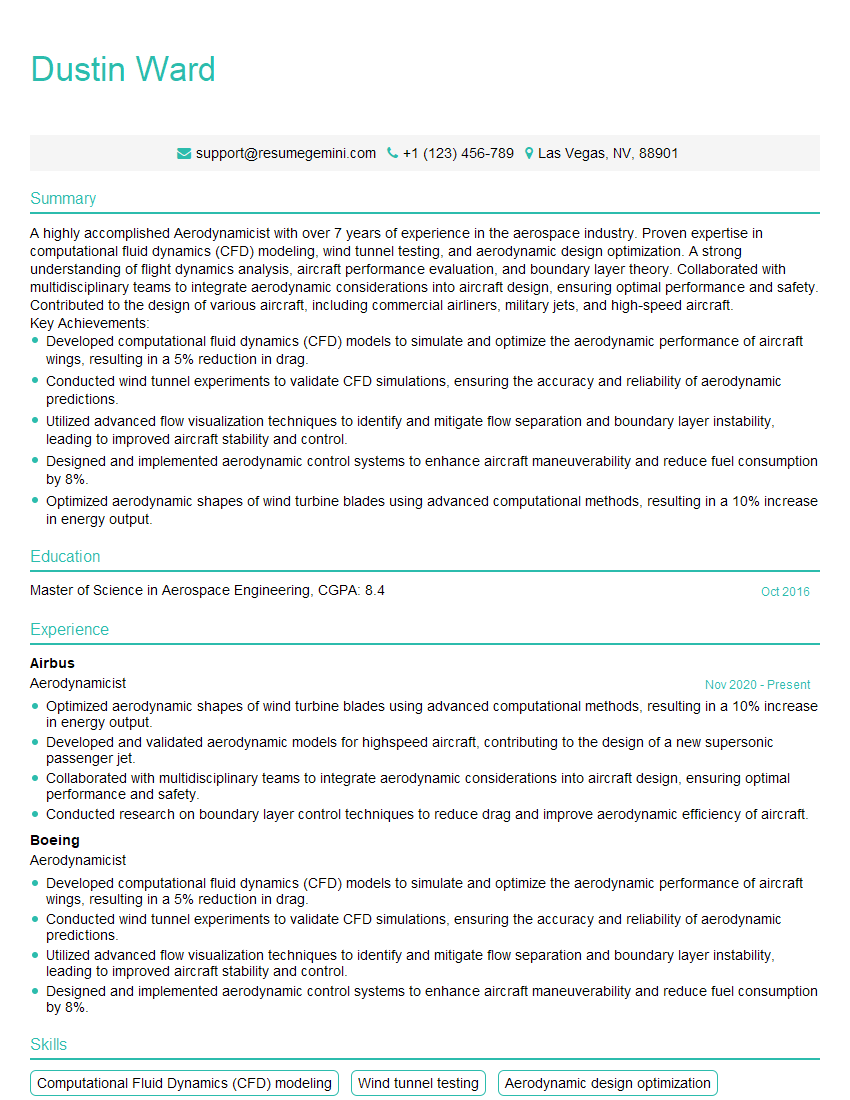
Mastering high-speed aerodynamics opens doors to exciting career opportunities in aerospace engineering, research, and development. To maximize your chances of securing your dream role, a well-crafted resume is essential. An ATS-friendly resume ensures your application gets noticed by recruiters and hiring managers. ResumeGemini is a trusted resource to help you build a professional, impactful resume that highlights your skills and experience effectively. Examples of resumes tailored to high-speed aerodynamics are available to guide you through the process. Take the next step towards your successful career in high-speed aerodynamics!

Explore more articles
Users Rating of Our Blogs
Share Your Experience
We value your feedback! Please rate our content and share your thoughts (optional).
What Readers Say About Our Blog
Really detailed insights and content, thank you for writing this detailed article.
IT gave me an insight and words to use and be able to think of examples