Feeling uncertain about what to expect in your upcoming interview? We’ve got you covered! This blog highlights the most important Tank Measurement interview questions and provides actionable advice to help you stand out as the ideal candidate. Let’s pave the way for your success.
Questions Asked in Tank Measurement Interview
Q 1. Explain the different methods used for tank level measurement.
Tank level measurement employs various methods, each with its strengths and weaknesses. The choice depends on factors like tank size, liquid properties, accuracy requirements, and budget. Common methods include:
- Hydrostatic Pressure Measurement: Measures pressure at the bottom of the tank, directly related to liquid height.
- Radar Level Measurement: Uses electromagnetic waves to measure the distance to the liquid surface.
- Ultrasonic Level Measurement: Employs sound waves to determine the distance to the liquid surface.
- Float and Tape/Dip Stick: A simple, mechanical method using a float to indicate level, or a marked dipstick for direct measurement.
- Capacitance Level Measurement: Measures the change in capacitance between a probe and the liquid.
- Guided Wave Radar (GWR): A type of radar that uses a guided wave to measure the level, suitable for challenging applications.
Each method offers a unique balance of accuracy, cost, and suitability for different tank types and liquids.
Q 2. Describe the principles of hydrostatic pressure measurement for tank gauging.
Hydrostatic pressure measurement relies on Pascal’s principle: pressure applied to a confined fluid is transmitted equally throughout the fluid. In a tank, the pressure at the bottom is directly proportional to the height of the liquid column above it. The formula is:
P = ρghWhere:
Pis the pressure at the bottom of the tank.ρis the density of the liquid.gis the acceleration due to gravity.his the height of the liquid column (level).
A pressure sensor at the tank bottom measures P. Knowing ρ and g, we can calculate h, thus determining the liquid level. This method is particularly useful for high-pressure applications or when other methods are impractical, though it requires accurate knowledge of the liquid density.
Q 3. What are the advantages and disadvantages of radar level measurement?
Radar level measurement uses high-frequency electromagnetic waves to measure the distance to the liquid surface. The sensor transmits a radar pulse, which reflects off the liquid surface. The time it takes for the pulse to return is used to calculate the distance.
Advantages:
- Non-contact measurement: No immersion of probes, reducing wear and tear.
- Suitable for various liquids: Works with most liquids, regardless of conductivity or dielectric properties.
- High accuracy: Can achieve excellent accuracy, especially with advanced radar technologies.
- Unaffected by temperature and pressure: Less susceptible to these factors than other methods.
Disadvantages:
- High cost: Radar sensors can be more expensive than other technologies.
- Susceptibility to interference: Strong electromagnetic fields can interfere with the signal.
- Challenges with foaming liquids or condensation: The radar signal might reflect off the foam or condensation, leading to inaccurate readings.
For example, in a large chemical storage tank, radar is preferred due to its accuracy and ability to withstand harsh conditions.
Q 4. How does ultrasonic level measurement work, and what are its limitations?
Ultrasonic level measurement uses sound waves to measure the distance to the liquid surface. A transducer emits ultrasonic pulses, which reflect off the liquid surface. The time of flight is measured, and the distance is calculated using the speed of sound.
How it works: The sensor sends out ultrasonic pulses; the time it takes for the pulse to bounce back is directly proportional to the distance to the surface. This time is measured, and the distance, hence the liquid level, is calculated.
Limitations:
- Affected by ambient conditions: Temperature, pressure, and humidity can affect the speed of sound, impacting accuracy.
- Limited range: The effective range is smaller compared to radar.
- Issues with foaming liquids: The sound waves may not reflect accurately from a foamy surface.
- Susceptible to obstacles: Obstructions in the path of the sound waves can lead to incorrect measurements.
For example, ultrasonic level measurement is often used in smaller tanks or applications where cost is a significant factor, but high accuracy may not be critical. However, one should always factor in environmental influences.
Q 5. Explain the concept of tank calibration and its importance.
Tank calibration is the process of establishing the relationship between the liquid level indicator’s reading and the actual volume of liquid in the tank. It’s crucial for accurate inventory management and process control.
Importance: Accurate tank calibration ensures that measurements of liquid volume are reliable. Inaccurate calibration can lead to significant errors in inventory calculations, resulting in financial losses, production inefficiencies, or safety hazards. For instance, an incorrectly calibrated fuel tank in a large aircraft could cause inaccurate fuel readings resulting in unforeseen operational difficulties.
Calibration involves creating a calibration curve, a chart or equation representing the relationship between the level reading and the corresponding volume. This curve often involves multiple data points, collected using precise measurements of liquid volume added/removed versus corresponding level readings.
Q 6. Describe the procedure for calibrating a tank using a dipstick and a known volume.
Calibrating a tank using a dipstick and a known volume is a simple, yet effective method, particularly suitable for smaller tanks. The procedure involves:
- Empty the tank: Ensure the tank is completely empty.
- Add a known volume: Add a precisely measured volume of liquid (e.g., 10 gallons, 50 liters). Use calibrated measuring devices for accuracy.
- Measure the liquid level: Use the dipstick to carefully measure and record the liquid level.
- Repeat steps 2 & 3: Add another known volume, measure and record the level. Repeat this process several times to cover the entire operational range of the tank.
- Plot the data: Create a graph with liquid volume on the x-axis and dipstick reading on the y-axis. The resulting curve is the tank’s calibration curve.
- Develop a calibration equation (optional): Fit a mathematical curve (e.g., polynomial) to the data to create an equation for determining volume from the dipstick reading.
This process establishes a direct correlation between dipstick reading and liquid volume. The dipstick becomes a calibrated measuring instrument specific to this tank, crucial for consistent and accurate measurements.
Q 7. How do you account for temperature effects on liquid level measurements?
Temperature affects liquid level measurements primarily through changes in liquid density. As temperature increases, most liquids expand, decreasing their density. This means a given volume will occupy a slightly larger space, leading to a seemingly lower level reading. Conversely, lower temperatures result in higher density and a seemingly higher level reading.
To account for temperature effects:
- Temperature Compensation: Use a temperature sensor alongside the level sensor. The level measurement system then uses the measured temperature and a known relationship between temperature and density to correct the level reading, providing a more accurate volume calculation. Many modern level sensors and measurement systems offer built-in temperature compensation.
- Density Correction: If the temperature compensation is not built-in, you will need to use the measured temperature, liquid’s known density-temperature relationship, to calculate the adjusted density and then use this value in the volume calculation formula (e.g., in hydrostatic pressure calculations).
- Calibration at Multiple Temperatures: During tank calibration, perform the procedure at several different temperatures. This creates a more comprehensive calibration curve that considers temperature effects explicitly.
Ignoring temperature effects can introduce significant errors, particularly in applications involving large volume tanks or liquids with high thermal expansion coefficients. Accurate temperature compensation is essential for precise volume determination.
Q 8. What are the common sources of error in tank measurement systems?
Errors in tank measurement systems can stem from various sources, broadly categorized into instrument error, environmental factors, and human error. Let’s break it down:
- Instrument Error: This includes inaccuracies in the sensor itself (e.g., drift in a pressure sensor, faulty electronics in a radar level gauge), calibration issues, and limitations in the measurement technology (e.g., the resolution of the instrument may not be sufficient for precise measurement).
- Environmental Factors: Temperature fluctuations significantly affect liquid density and the readings from some instruments. Similarly, pressure changes impact liquid level readings (especially with pressure-based sensors). Other environmental factors include vibrations, electromagnetic interference (EMI), and even the build-up of material on the sensor itself.
- Human Error: Incorrect installation, miscalibration, faulty data entry, and lack of proper maintenance are all examples of human error that significantly impact measurement accuracy. A simple thing like a misaligned float in a float-type level sensor can drastically affect readings.
For instance, I once worked on a project where inconsistent temperature readings caused significant errors in a large oil storage tank. Correcting the issue involved installing temperature sensors close to the level sensor, and then implementing temperature compensation in the data acquisition system.
Q 9. Explain how to compensate for vapor pressure in liquid level measurements.
Vapor pressure in a tank can significantly affect liquid level measurements, particularly with pressure-based sensors. The vapor pressure adds to the hydrostatic pressure, leading to an overestimation of the liquid level. Compensation is achieved through a couple of key methods:
- Static Pressure Correction: This involves measuring the vapor pressure within the tank using a separate pressure sensor. This measured vapor pressure is then subtracted from the total pressure reading obtained by the level sensor to get the true hydrostatic pressure and accurate liquid level.
- Calibration and Tables: The relationship between vapor pressure and temperature is well-known for various substances. Calibration tables or equations are used to incorporate temperature and corresponding vapor pressure compensation into the measurement calculation. This often involves using temperature sensors in conjunction with the level sensor.
Imagine a propane tank. At higher temperatures, propane’s vapor pressure increases. Without compensation, a pressure-based level sensor would indicate a higher liquid level than actually exists. A properly compensated system automatically subtracts the vapor pressure component.
Q 10. What are the safety precautions to observe while working with tank measurement systems?
Safety is paramount when working with tank measurement systems, particularly those involving hazardous materials. Key precautions include:
- Lockout/Tagout (LOTO) Procedures: Always follow strict LOTO procedures before accessing or working on any part of the tank measurement system. This prevents accidental activation of pumps or other equipment that could lead to leaks or explosions.
- Personal Protective Equipment (PPE): Wear appropriate PPE, including safety glasses, gloves, and protective clothing, depending on the substance stored in the tank.
- Confined Space Entry Procedures: If working inside a tank or confined space, ensure proper ventilation and atmospheric monitoring, and adhere to confined space entry procedures.
- Emergency Procedures: Familiarize yourself with the emergency procedures and have appropriate safety equipment (e.g., fire extinguishers, spill kits) readily available.
- Proper Training and Certification: Ensure all personnel involved have the necessary training and certifications to handle potentially hazardous materials and equipment.
I’ve witnessed incidents where neglecting these measures led to serious accidents. Always prioritize safety—it’s not just a rule, it’s a responsibility.
Q 11. Describe your experience with different types of tank level transmitters.
My experience encompasses a wide range of tank level transmitters, including:
- Hydrostatic Pressure Transmitters: These are cost-effective and reliable for simpler applications. They measure pressure at the bottom of the tank to determine the liquid level. I’ve used these extensively in water storage tanks.
- Radar Level Transmitters: These are non-contact, offering excellent accuracy and versatility in challenging environments. Their strength lies in the ability to measure through various materials. I’ve utilized radar level transmitters for measuring the level of highly corrosive chemicals in process tanks.
- Ultrasonic Level Transmitters: Also non-contact, they use sound waves to measure the level. They are suitable for many applications but can be susceptible to interference from foam or vapors. I used them in food processing applications where cleanliness was essential.
- Capacitance Level Transmitters: These utilize changes in capacitance to detect the liquid level. They are especially useful for measuring conductive liquids and are often found in smaller tanks. I employed these in wastewater treatment plants.
- Float-type Level Transmitters: These utilize a float which moves with the liquid level, driving a mechanism that sends a signal. They’re simple and reliable, especially for less demanding applications.
Each technology has its strengths and weaknesses, and the selection depends heavily on the specific application, tank properties, and required accuracy.
Q 12. Explain how to troubleshoot a malfunctioning tank level sensor.
Troubleshooting a malfunctioning tank level sensor involves a systematic approach:
- Verify Power and Connections: Check the power supply, cabling, and connectors for any damage or loose connections. A simple power failure or loose wire is often the culprit.
- Inspect the Sensor: Visually inspect the sensor for any physical damage, corrosion, or build-up of material. This is particularly important for sensors in harsh environments.
- Calibrate the Sensor: Follow the manufacturer’s instructions to calibrate the sensor. This often involves comparing the sensor reading to a known reference point.
- Check the Control System: Ensure the control system or data acquisition system is functioning correctly and receiving signals from the sensor.
- Check for Interference: Examine the area around the sensor for any potential sources of interference, such as electromagnetic fields or physical obstructions, especially in the case of radar or ultrasonic sensors.
- Review Historical Data: Examine historical data to identify any trends or patterns that might indicate a gradual sensor failure.
- Compare with Other Sensors: If multiple sensors are used for redundancy, compare their readings to identify inconsistencies.
Recently, I resolved a sensor malfunction by simply cleaning accumulated debris from a radar level transmitter—a quick fix that saved considerable downtime.
Q 13. How do you handle discrepancies between different tank measurement methods?
Discrepancies between different tank measurement methods require a careful investigation. Here’s how to handle them:
- Identify the Source of Discrepancy: Determine which measurement method is likely to be more accurate based on the specific application and the known limitations of each method.
- Check Calibration and Maintenance: Ensure all instruments are properly calibrated and well-maintained. Regular calibration is crucial for ensuring the accuracy and reliability of measurements.
- Investigate Environmental Factors: Consider environmental factors like temperature and pressure fluctuations that might be affecting the measurements differently.
- Analyze Historical Data: Examine historical data to identify any consistent biases or trends in the discrepancies.
- Consult with Experts: In complex situations, it’s important to consult with experienced metrologists or engineers who are knowledgeable about tank measurement systems.
- Use Redundancy and Averaging: Employ multiple measurement methods for redundancy and use data averaging techniques to minimize the impact of individual sensor errors.
In one instance, discrepancies between a pressure sensor and a radar level sensor were traced to a poorly maintained pressure sensor. Calibration resolved the issue.
Q 14. What is the significance of API (American Petroleum Institute) standards in tank measurement?
API (American Petroleum Institute) standards play a critical role in tank measurement, primarily within the petroleum industry. These standards define best practices for:
- Tank gauging procedures: API standards specify detailed procedures for accurately measuring liquid levels and volumes in storage tanks.
- Calibration methods: API standards provide guidance on proper calibration procedures for various tank measurement instruments.
- Data reporting and record-keeping: API standards outline the necessary information to be recorded and reported, ensuring consistency and accuracy in data management.
- Tank design and construction: While not directly related to measurement, API standards influence tank design and construction, impacting the overall accuracy of the gauging process.
Adherence to API standards is crucial for ensuring consistency, accuracy, and safety in tank measurement across the industry. These standards provide a framework for quality control and help prevent costly errors.
Q 15. Describe your experience with data acquisition and management systems for tank levels.
My experience with data acquisition and management systems for tank levels spans over a decade, encompassing various technologies and applications. I’ve worked extensively with systems ranging from simple point level sensors and pressure transmitters to sophisticated radar and ultrasonic level measurement devices. Data acquisition typically involves integrating these sensors with Programmable Logic Controllers (PLCs) or other data acquisition units (DAUs). This data is then transferred to a supervisory system, often a SCADA (Supervisory Control and Data Acquisition) system, or a cloud-based platform for centralized monitoring and analysis. I’m proficient in configuring these systems, troubleshooting communication issues, and ensuring data integrity. For example, in one project involving a large network of fuel storage tanks, I designed a system that not only monitored tank levels in real-time but also automatically generated alerts for low-level or high-level conditions, preventing potential hazards and improving operational efficiency.
Data management involves establishing robust databases to store historical tank level data. This data is crucial for inventory management, leak detection, and performance analysis. I have experience with various database systems, including relational databases and time-series databases, and I’m familiar with data visualization techniques to effectively present this information to stakeholders. This often includes generating reports on daily inventory, consumption rates, and potential anomalies.
Career Expert Tips:
- Ace those interviews! Prepare effectively by reviewing the Top 50 Most Common Interview Questions on ResumeGemini.
- Navigate your job search with confidence! Explore a wide range of Career Tips on ResumeGemini. Learn about common challenges and recommendations to overcome them.
- Craft the perfect resume! Master the Art of Resume Writing with ResumeGemini’s guide. Showcase your unique qualifications and achievements effectively.
- Don’t miss out on holiday savings! Build your dream resume with ResumeGemini’s ATS optimized templates.
Q 16. How do you ensure the accuracy and reliability of tank measurement data?
Ensuring the accuracy and reliability of tank measurement data is paramount. It involves a multi-pronged approach. Firstly, proper sensor selection is crucial; the choice of sensor depends on factors such as the tank’s geometry, the liquid’s properties (e.g., viscosity, dielectric constant), and the required accuracy. Regular calibration and maintenance of these sensors are essential. We establish a calibration schedule and maintain detailed records of these calibrations to track sensor performance over time. Secondly, data validation is key. We employ algorithms to detect and flag outliers and inconsistencies in the data. This might involve comparing readings from redundant sensors or using statistical process control (SPC) techniques. Thirdly, environmental factors can significantly affect accuracy, such as temperature fluctuations impacting the density of the liquid. We compensate for these effects through appropriate calculations or by using temperature-compensated sensors.
Finally, regular audits and verification of the entire measurement system – from sensors to data processing – are critical. This ensures the system’s overall integrity and provides confidence in the data’s reliability. Think of it like regularly servicing a car; ignoring maintenance leads to inaccurate readings and potential problems down the line. In one instance, we identified a consistent error in a radar level sensor due to a buildup of condensation inside the sensor housing; a simple cleaning resolved the issue and restored data accuracy.
Q 17. Explain your experience with different tank configurations (e.g., horizontal, vertical).
My experience encompasses various tank configurations, including horizontal cylindrical tanks, vertical cylindrical tanks, spherical tanks, and even irregularly shaped tanks. Each configuration presents unique challenges in terms of volume calculation and level measurement. Horizontal cylindrical tanks require specific calculations to account for the geometry, while vertical cylindrical tanks are relatively straightforward. Spherical tanks necessitate more complex calculations involving trigonometry. Irregularly shaped tanks might require more advanced techniques such as 3D scanning and computational fluid dynamics (CFD) modeling for accurate volume determination.
For example, I worked on a project involving a large network of horizontal cylindrical tanks storing crude oil. Accurately measuring the level in these tanks and converting it to volume was crucial for inventory control. We used a combination of pressure-based level sensors and ultrasonic level sensors for redundancy and improved accuracy. The data was then processed using a custom algorithm that accounted for the tank’s geometry and the oil’s temperature-dependent density.
Q 18. How do you calculate the volume of liquid in a horizontal cylindrical tank?
Calculating the volume of liquid in a horizontal cylindrical tank requires understanding its geometry. The formula isn’t straightforward; it involves trigonometric functions. We use the following formula:
V = L [r² cos⁻¹((r - h)/r) - (r - h)√(2rh - h²)]
Where:
Vis the volume of the liquidLis the length of the tankris the radius of the tankhis the height of the liquid in the tank
This formula calculates the segment area of a circle and then multiplies it by the tank’s length. Imagine slicing a circular cross-section of the tank at the liquid level; the formula calculates the area of that segment. Many software packages and even spreadsheets have built-in functions or readily available macros to simplify this calculation. The key is ensuring the consistent use of units throughout the calculation to avoid errors.
Q 19. How do you calculate the volume of liquid in a spherical tank?
Calculating the volume of liquid in a spherical tank is a bit more involved than with a cylindrical tank, again requiring trigonometric functions. The formula for the volume of a spherical cap (the portion of the sphere filled with liquid) is:
V = (πh²/6)(3r - h)
Where:
Vis the volume of the liquidris the radius of the spherehis the height of the liquid in the tank (measured from the bottom of the sphere)
This formula is derived from the integral calculus. It’s important to note that ‘h’ must be measured from the bottom of the sphere, not from the center. It’s also critical to ensure that the units used for radius and height are consistent (e.g., both in meters or both in feet) to ensure an accurate calculation. As with cylindrical tanks, specialized software can readily perform these calculations.
Q 20. Describe your experience with tank overfill prevention systems.
Tank overfill prevention systems are crucial for safety and environmental protection. These systems typically involve multiple layers of protection. A primary level is the high-level alarm. This is a basic sensor that triggers an alert when the liquid level reaches a predetermined threshold. More advanced systems incorporate high-level shut-off valves that automatically stop the filling process when the tank approaches its maximum capacity. Redundant sensors are employed to improve reliability; if one sensor fails, the others provide backup. In addition, systems often include independent verification of the level measurement from separate sources, like pressure transducers and radar level sensors. Data logging is critical to track level and filling events, providing information for auditing and identifying potential system problems.
Furthermore, many modern systems integrate with SCADA systems for remote monitoring and control, enabling operators to monitor tank levels from a central location and receive alerts in real-time. In my experience, proper design and implementation of overfill prevention systems require a thorough understanding of the specific hazards associated with overfilling each tank and the regulatory requirements for the industry.
Q 21. Explain the role of SCADA in tank monitoring and control.
SCADA (Supervisory Control and Data Acquisition) systems play a central role in tank monitoring and control. They provide a centralized platform for monitoring multiple tanks from a single location, displaying real-time data on tank levels, pressures, temperatures, and other relevant parameters. This allows operators to remotely monitor the status of the tanks and take corrective action if necessary. SCADA systems often integrate with tank overfill prevention systems, providing alerts and automatic control functions to prevent overfills and other critical situations. They also facilitate data logging and historical analysis, enabling operators to track tank performance over time and identify potential problems.
The data acquired and managed by a SCADA system can be used for a variety of purposes, including inventory management, performance analysis, predictive maintenance, and regulatory reporting. For instance, in a large refinery, a SCADA system would monitor numerous tanks storing different products, providing real-time visibility into the entire inventory. This enables efficient management of resources and helps to avoid stockouts or overstocking.
Q 22. How do you interpret and analyze tank level data to identify trends and anomalies?
Interpreting tank level data involves more than just looking at numbers; it’s about understanding the story they tell. We start by visualizing the data – often using charting software – to identify trends like consistent depletion, unusual spikes, or gradual increases. Anomalies are deviations from established patterns. For example, a sudden drop in level could indicate a leak, while a consistently slower-than-expected depletion might suggest a problem with the product transfer system. To analyze, I consider factors such as time of day (to account for filling/emptying schedules), weather (temperature changes affect liquid volume), and known maintenance activities. Statistical process control (SPC) charts can be invaluable in identifying statistically significant deviations from the norm, flagging potential anomalies for investigation.
For instance, in one project involving a large fuel storage tank, we noticed a small but consistent daily loss. Visual inspection revealed a hairline crack in a weld, a subtle anomaly that wouldn’t have been easily spotted without close monitoring and trend analysis.
Q 23. What are the different types of tank gauging systems you are familiar with?
Tank gauging systems fall into several categories. The most basic are manual methods: using a dipstick to measure the liquid level directly, or using a pressure gauge for closed tanks (calculating level based on pressure). These methods are less accurate and prone to human error.
- Float Gauges: These are mechanical systems where a float rises and falls with the liquid level, connected to a measuring device.
- Radar Gauges: Non-contacting systems that use radar pulses to measure the distance to the liquid surface. These are highly accurate and suitable for a variety of liquids.
- Ultrasonic Gauges: Similar to radar, but use ultrasonic waves. They are less expensive than radar but may be affected by foam or vapor on the surface.
- Capacitance Gauges: These systems measure the change in capacitance between a probe and the tank wall. This is affected by the dielectric constant of the liquid, so calibration is crucial.
- Hydrostatic Gauges: They measure pressure at the bottom of the tank, converting pressure to a liquid level reading.
The choice of system depends on factors like tank size, liquid properties, required accuracy, and budget.
Q 24. Describe your experience with automated tank gauging systems.
My experience with automated tank gauging systems is extensive. I’ve worked with systems ranging from simple, single-tank setups to large-scale networks monitoring hundreds of tanks across multiple sites. These systems typically involve a gauging device (radar, ultrasonic, etc.), a data logger, and software for data visualization and analysis. The software provides real-time data on tank levels, allowing for remote monitoring and early detection of problems. Data can be integrated with other systems, such as SCADA (Supervisory Control and Data Acquisition) for comprehensive facility management.
I’ve been involved in the design, installation, and troubleshooting of such systems. For example, at a chemical plant, I helped integrate a new radar gauging system into their existing SCADA network. This streamlined their operations, provided more accurate inventory data, and helped them meet stricter environmental reporting requirements.
Q 25. How do you ensure compliance with environmental regulations related to tank storage?
Ensuring compliance with environmental regulations related to tank storage is paramount. This involves adhering to specific requirements regarding leak detection, spill prevention, secondary containment, and proper reporting. We use a multi-pronged approach:
- Regular inspections: Visual inspections of tanks, piping, and secondary containment areas are vital to identify potential problems.
- Leak detection systems: Implementing and maintaining effective leak detection systems is crucial, which I’ll elaborate on in a later answer.
- Spill prevention and control plan: A detailed plan outlining procedures for handling spills, including containment, cleanup, and reporting to regulatory agencies.
- Record keeping: Meticulous record-keeping of inspections, maintenance activities, and any incidents are essential for demonstrating compliance.
- Training: Personnel must be adequately trained on safety procedures and emergency response protocols.
Non-compliance can result in substantial fines and reputational damage, making proactive compliance essential.
Q 26. Explain your experience with preventative maintenance of tank gauging equipment.
Preventative maintenance is key to ensuring the longevity and accuracy of tank gauging equipment. This involves a scheduled program of inspections, calibrations, and repairs. The frequency depends on the type of equipment and the environment, but generally includes:
- Regular inspections: Checking for corrosion, damage, and loose connections.
- Calibration: Periodic calibration ensures the accuracy of the readings. This often involves comparison against known standards or manual measurements.
- Cleaning: Cleaning sensors and probes to prevent buildup of material that can interfere with accurate readings. This is especially crucial for ultrasonic and radar gauges.
- Software updates: Ensuring the gauging system’s software is up-to-date and functioning correctly.
In one instance, we implemented a predictive maintenance program using data from the gauging system itself. By analyzing trends in sensor performance, we could predict potential failures and schedule maintenance before they impacted operations, minimizing downtime and maintaining data integrity.
Q 27. Describe your experience with tank leak detection systems.
Tank leak detection systems vary in complexity. Simple systems may involve visual inspections and monitoring for obvious leaks. More sophisticated systems include:
- Automatic Tank Gauging (ATG) with leak detection software: ATG systems can be programmed to alert operators to unusual drops in level, indicating a potential leak.
- Leak detection sensors: These sensors are placed within or around the tank to detect the presence of liquid outside the tank. Different technologies exist, such as fiber optic sensors that detect changes in light transmission due to the presence of liquids.
- Secondary containment monitoring: Systems that monitor the level of liquid in the secondary containment area. A rise in level signals a leak within the primary tank.
The selection of the appropriate system depends on several factors, including the type of liquid stored, the environmental sensitivity of the site, and the required level of detection sensitivity. A comprehensive system often incorporates multiple detection methods for redundancy and increased reliability.
Q 28. How do you handle emergency situations related to tank leaks or spills?
Handling emergency situations, such as tank leaks or spills, requires a swift and coordinated response. Our procedures prioritize safety and environmental protection:
- Immediate notification: Alerting relevant personnel, including emergency responders and regulatory agencies, as soon as a leak or spill is detected.
- Containment: Implementing immediate containment measures to prevent further spread of the spilled material.
- Cleanup: Initiating cleanup procedures according to established protocols and using appropriate equipment and personnel.
- Investigation: Conducting a thorough investigation to determine the cause of the incident, to prevent future occurrences.
- Reporting: Preparing detailed reports for regulatory agencies, outlining the incident, response, and corrective actions.
A well-rehearsed emergency response plan is critical. We conduct regular drills to ensure that personnel are prepared to handle such events effectively and efficiently. In one incident involving a minor leak, our rapid response minimized the environmental impact and prevented a more significant incident.
Key Topics to Learn for Tank Measurement Interview
- Fundamentals of Liquid Level Measurement: Understanding different measurement technologies (e.g., hydrostatic pressure, radar, ultrasonic, float, etc.), their principles, and limitations.
- Calibration and Verification: Practical application of calibration procedures, troubleshooting discrepancies, and ensuring accurate readings across various tank types and sizes.
- Tank Geometry and Volume Calculation: Mastering calculations for different tank shapes (cylindrical, conical, spherical) and understanding the impact of geometry on accuracy.
- Temperature Compensation: Understanding the effects of temperature on liquid density and volume, and implementing appropriate correction methods.
- Data Acquisition and Analysis: Working with different data acquisition systems, interpreting measurement data, identifying anomalies, and generating reports.
- Safety Procedures and Regulations: Familiarizing yourself with relevant safety protocols and industry regulations related to tank measurement and handling.
- Troubleshooting and Problem-Solving: Developing skills in diagnosing and resolving common issues encountered in tank measurement systems, including sensor malfunctions and data inconsistencies.
- Advanced Concepts (for Senior Roles): Exploring topics like API standards, statistical process control (SPC) in tank gauging, and automated tank management systems.
Next Steps
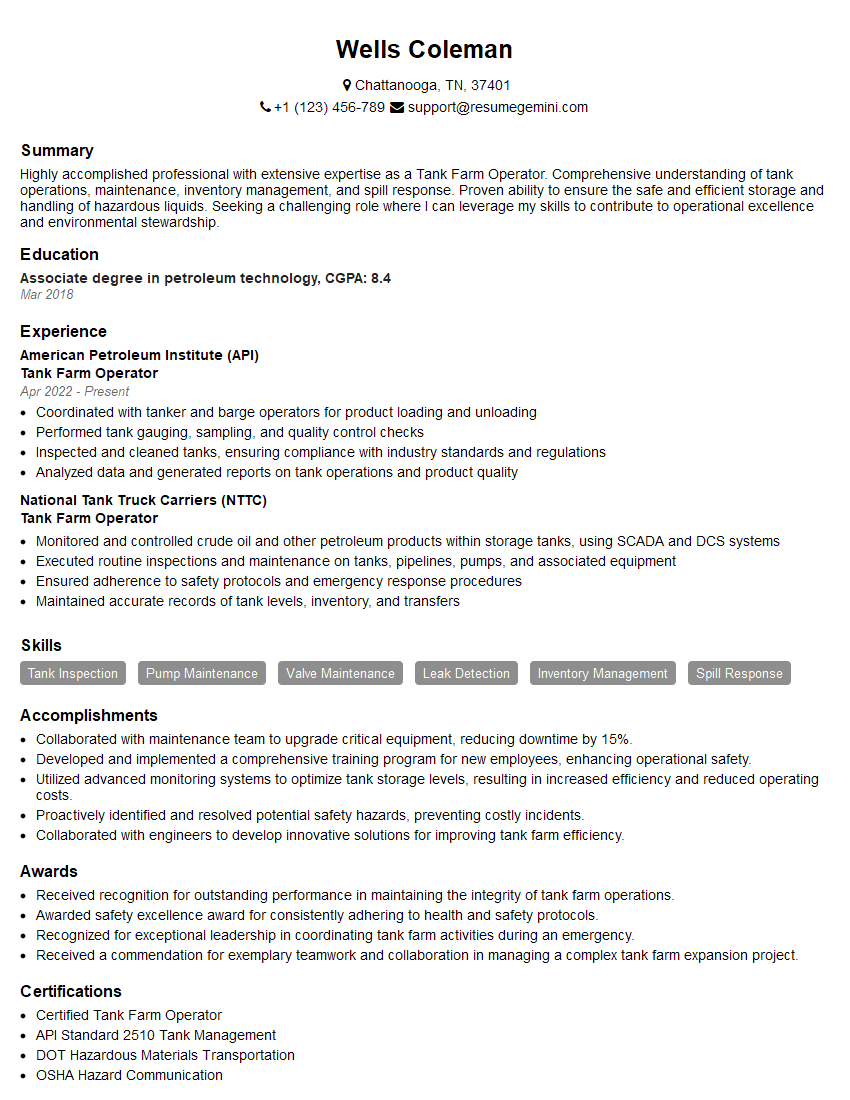
Mastering tank measurement principles is crucial for career advancement in the oil and gas, chemical processing, and other related industries. A strong understanding of these concepts opens doors to higher-level positions and greater responsibilities. To maximize your job prospects, it’s essential to create a resume that effectively communicates your skills and experience to Applicant Tracking Systems (ATS). We highly recommend using ResumeGemini to build a professional and ATS-friendly resume. ResumeGemini offers a streamlined process and provides examples of resumes tailored to the Tank Measurement field, ensuring your application stands out.
Explore more articles
Users Rating of Our Blogs
Share Your Experience
We value your feedback! Please rate our content and share your thoughts (optional).
What Readers Say About Our Blog
Really detailed insights and content, thank you for writing this detailed article.
IT gave me an insight and words to use and be able to think of examples