Are you ready to stand out in your next interview? Understanding and preparing for Brake Service interview questions is a game-changer. In this blog, we’ve compiled key questions and expert advice to help you showcase your skills with confidence and precision. Let’s get started on your journey to acing the interview.
Questions Asked in Brake Service Interview
Q 1. Explain the different types of brake systems.
Brake systems are broadly categorized into two main types: drum brakes and disc brakes. Each has its own advantages and disadvantages.
- Drum Brakes: These older systems use a cylindrical drum containing brake shoes that press against the drum’s inner surface when the brake pedal is applied. Think of it like a shoe pressing against the inside of a coffee can. They are relatively simple, inexpensive to manufacture, and provide good braking performance in wet conditions. However, they are less effective at high temperatures and are more prone to fading (reduced braking power) under heavy use.
- Disc Brakes: These more modern systems use a rotor (a spinning disc) and calipers containing brake pads that squeeze the rotor from both sides. Imagine a clamp squeezing a metal plate. Disc brakes offer superior braking performance, particularly at high speeds and temperatures, better fade resistance, and are generally easier to maintain. They are, however, more expensive to manufacture and typically require more complex designs.
- Other Systems: Beyond the basic drum and disc, we have variations and combinations. For instance, many vehicles use disc brakes on the front wheels (for better stopping power) and drum brakes on the rear (for cost-effectiveness). More sophisticated systems include Anti-lock Braking Systems (ABS) and Electronic Brakeforce Distribution (EBD), which enhance safety and control.
Q 2. Describe the process of bleeding brakes.
Bleeding brakes is the process of removing air from the brake lines. Air in the lines compresses, reducing braking effectiveness and potentially causing a spongy brake pedal. It’s a crucial step after brake work or fluid changes.
- Preparation: Gather necessary tools: a wrench for the bleed valves, a clear tube, a container to collect the fluid, and fresh brake fluid. Open the container’s cap.
- Partner Up: It’s much easier to bleed brakes with a helper who can pump the brake pedal. One person works the valve, the other the pedal.
- Bleed Valves: Locate the bleed valves on each caliper or wheel cylinder. These are usually small screws. Attach the clear tube to the valve, submerging the other end in the fluid container.
- Pumping and Bleeding: Have your assistant firmly pump the brake pedal several times. While the pedal is depressed, carefully open the bleed valve to release air bubbles and fluid. Close the valve before your assistant releases the pedal. Repeat this until no more air bubbles come out and the fluid runs clear.
- Repeat for Each Wheel: Repeat this process for each wheel, starting from the furthest wheel from the master cylinder and working your way closer.
- Top Off Fluid: Regularly top off the brake fluid reservoir during the bleeding process to prevent air from entering the system.
Always consult your vehicle’s repair manual for specific bleeding procedures, as they vary.
Q 3. How do you diagnose a brake system problem?
Diagnosing brake problems starts with a thorough visual inspection, followed by a road test and potentially more advanced diagnostic procedures.
- Visual Inspection: Check brake pads and shoes for wear, cracks, or damage. Inspect brake rotors and drums for scoring, wear, or warping. Look for leaks in the brake lines and hoses. Examine the brake fluid reservoir for the correct fluid level and signs of contamination.
- Road Test: Pay attention to brake pedal feel. A spongy pedal often indicates air in the lines. A hard pedal might suggest a master cylinder issue. Notice any pulling to one side during braking; this often indicates a problem with one brake caliper or wheel cylinder. Listen for any unusual noises, such as squealing, grinding, or thumping.
- Advanced Diagnostics: For more complex problems, diagnostic tools like brake testers can be used to measure brake pressure and efficiency at each wheel. A scan tool might be needed to check for ABS or electronic brake system fault codes.
For example, a soft pedal could mean air in the lines, worn pads, or a master cylinder problem. A pulsing pedal during braking usually indicates a problem with the ABS system.
Q 4. What are the common causes of brake squeal?
Brake squeal is a common nuisance, often caused by high-frequency vibrations as the brake pads rub against the rotor or drum.
- Worn Brake Pads: Thin brake pads can vibrate, causing squeal.
- Contamination: Dirt, grease, or other contaminants on the brake pads or rotor can create friction and squeal.
- Pad Wear Indicators: Many brake pads have metal wear indicators that make noise when the pads are nearing the end of their life.
- Defective Pads or Rotors: Sometimes, the pads themselves or the rotor surfaces might have irregularities that lead to squealing.
- Caliper Issues: A seized or sticky brake caliper can cause uneven pad contact and squealing.
Addressing squeal involves identifying the root cause: replacing worn pads, cleaning contaminants, or repairing caliper issues. Sometimes, anti-squeal shims or lubricant on the back of the brake pads can be effective solutions.
Q 5. How do you inspect brake rotors and drums?
Inspecting brake rotors and drums involves checking for wear, damage, and overall condition. Proper inspection ensures safety and optimal braking performance.
- Rotors: Visually inspect the rotor surfaces for scoring, cracks, rust, or excessive wear. Measure the thickness of the rotor with a caliper to ensure it’s within the manufacturer’s specified minimum thickness. A groove or warp could indicate that the rotor should be resurfaced or replaced.
- Drums: Inspect drum surfaces for scoring, cracks, or excessive wear. Check for scoring, which creates uneven braking surfaces. Measure the drum diameter with a caliper to ensure it meets specifications.
Always remember safety first. Wear safety glasses and gloves when performing brake inspections and repairs. If the rotors or drums are severely damaged or worn beyond specifications, they should be replaced rather than repaired.
Q 6. Explain the function of ABS (Anti-lock Braking System).
The Anti-lock Braking System (ABS) prevents wheel lockup during braking, allowing the driver to maintain steering control and avoid skidding. It’s a crucial safety feature.
ABS works by rapidly pumping the brakes, allowing the wheels to continue rotating even under hard braking. This prevents the tires from losing traction and improves stopping distance and steering control on slippery surfaces. Think of it as a rapid on/off switch for the brakes, happening many times per second. This pulsating action is what drivers usually feel when ABS is engaged. ABS sensors monitor wheel speed, and the ABS control unit adjusts brake pressure accordingly.
Q 7. Describe the components of a disc brake system.
A disc brake system consists of several key components working together to slow or stop a vehicle.
- Caliper: A clamping device that houses the brake pads and applies pressure to the rotor.
- Brake Pads: Friction material that creates the stopping force when pressed against the rotor.
- Rotor: A spinning disc that the brake pads grip.
- Brake Lines: Tubes that carry brake fluid from the master cylinder to the calipers.
- Brake Fluid: Hydraulic fluid that transmits pressure from the master cylinder to the calipers.
- Master Cylinder: The main component that converts pedal pressure into hydraulic pressure in the brake lines.
When the brake pedal is pressed, the master cylinder increases the brake fluid pressure, forcing the brake pads against the rotor, creating friction and slowing the wheel. The caliper is essential for applying this pressure evenly to both sides of the rotor.
Q 8. How do you replace brake pads?
Replacing brake pads is a relatively straightforward process, but safety is paramount. It involves removing the old pads and installing new ones, ensuring proper caliper piston retraction. Here’s a step-by-step approach:
- Secure the vehicle: Engage the parking brake and chock the wheels. This prevents accidental movement.
- Remove the wheel: Loosen the lug nuts before jacking up the vehicle and removing the wheel.
- Expose the caliper: Depending on the vehicle, you may need to remove caliper retaining pins or bolts. Some calipers require special tools.
- Compress the caliper piston: Use a C-clamp or specialized piston compression tool to push the caliper piston back into its bore. This creates space for the new, thicker pads.
- Remove the old brake pads: Carefully remove the old pads, noting their orientation for correct installation of the new pads.
- Install the new brake pads: Slide the new pads into place, ensuring they sit correctly in the caliper.
- Reassemble: Reinstall the caliper, retaining pins or bolts, and the wheel. Tighten lug nuts according to the vehicle’s specifications.
- Pump the brakes: Before driving, pump the brake pedal several times to ensure the pads make contact with the rotors.
Important Note: Always refer to your vehicle’s repair manual for specific instructions and torque specifications. Improper installation can lead to brake failure.
For example, I once helped a friend replace their brake pads on a Honda Civic. Following these steps precisely, we completed the job efficiently and safely. The vehicle’s braking performance was immediately improved.
Q 9. How do you replace brake calipers?
Replacing brake calipers is a more involved process than replacing pads, often requiring specialized tools and a deeper understanding of brake system mechanics. It’s crucial to follow precise steps to avoid complications.
- Secure the vehicle: As always, safety first! Engage the parking brake and chock the wheels.
- Remove the wheel: Loosen the lug nuts, jack up the vehicle, and remove the wheel.
- Disconnect brake lines and components: Carefully disconnect the brake lines from the caliper. You’ll likely need a wrench and a container to catch any residual brake fluid. Be prepared for some brake fluid spillage.
- Remove the caliper mounting bolts: Remove the bolts securing the caliper to the brake bracket. Note the position of the caliper and any associated components.
- Remove the caliper: Carefully remove the caliper from the bracket.
- Install the new caliper: Mount the new caliper onto the bracket, making sure everything lines up properly.
- Reconnect brake lines and components: Carefully reconnect the brake lines, ensuring tight connections to prevent leaks. Bleed the brakes afterwards.
- Reassemble: Reinstall the bolts, wheel, and lower the vehicle.
- Bleed the brakes: This is crucial to remove air bubbles from the brake lines. Improper bleeding can lead to spongy brakes or brake failure.
Example: I once had to replace a seized caliper on a customer’s SUV. The seized piston was causing the brake pad to drag, leading to uneven wear and reduced braking performance. Replacing the caliper completely resolved the issue, highlighting the importance of prompt caliper replacement when necessary.
Remember, always consult a repair manual specific to your vehicle’s make and model. Brake system repair requires precision and attention to detail.
Q 10. How do you inspect brake lines and hoses?
Inspecting brake lines and hoses is critical for ensuring a safe and reliable braking system. Look for signs of damage, corrosion, or leaks. Here’s what you should check:
- Visual Inspection: Carefully examine all brake lines and hoses for any signs of rust, corrosion, bulges, kinks, cracks, or abrasions. Pay close attention to areas where lines bend or are clamped.
- Leak Detection: Look for any signs of brake fluid leakage. Brake fluid is typically a dark, oily substance. Even small leaks can compromise braking performance.
- Pressure Testing (Optional): For a more thorough inspection, a pressure test can be performed to detect leaks under pressure. This usually requires specialized equipment.
- Hose Flexibility: Check the flexibility of rubber brake hoses. Brittle or cracked hoses should be replaced immediately.
Example: During a routine inspection, I once discovered a small crack in a brake line hidden beneath the vehicle’s undercarriage. Early detection prevented a potential brake failure and kept the driver safe.
Important: If any damage is found, replace the affected components immediately. Compromised brake lines can result in catastrophic brake failure.
Q 11. What are the signs of worn-out brake pads?
Worn brake pads pose a significant safety risk. Recognizing the signs of wear is crucial. Here are the key indicators:
- Thin brake pads: Visually inspect the thickness of the brake pads. Compare them to the minimum thickness specified in your vehicle’s repair manual. If they’re significantly worn, it’s time for replacement.
- Brake pad wear sensors: Many vehicles have wear sensors that trigger a warning light on the dashboard when the pads are worn thin. This is a critical warning sign.
- Squealing or grinding noises: A high-pitched squealing sound when braking usually indicates worn pads. A grinding sound indicates metal-to-metal contact – immediate replacement is necessary to avoid rotor damage.
- Increased braking distance: Noticeably longer stopping distances than usual indicate worn brake pads, as less friction material means reduced braking effectiveness.
- Vibrations during braking: Vibrations in the brake pedal or steering wheel during braking could indicate uneven pad wear or warped rotors.
Real-world example: I’ve seen instances where drivers ignored squealing brakes, resulting in severely damaged rotors, necessitating far more costly repairs. Regular brake inspections and timely replacement of worn pads are essential for safety and cost-effectiveness.
Q 12. What are the safety precautions when working on brakes?
Safety is paramount when working on brakes. Here are some crucial precautions:
- Secure the vehicle: Always engage the parking brake and chock the wheels to prevent accidental rolling.
- Use jack stands: Never rely solely on a jack to support the vehicle. Jack stands provide a stable and secure platform.
- Wear safety glasses: Protect your eyes from flying debris and brake fluid.
- Wear gloves: Brake fluid is corrosive and can irritate the skin. Gloves protect your hands.
- Proper ventilation: Work in a well-ventilated area, as brake dust can be harmful when inhaled.
- Proper tools: Use the correct tools for the job. Improper tools can damage components or cause injury.
- Brake fluid handling: Brake fluid is highly corrosive. If spilled, clean it up immediately. Avoid contact with painted surfaces.
- Bleeding the brakes: Once brake components are replaced, it is crucial to properly bleed the system to remove any air that has entered the brake lines. Air in the system will greatly reduce your braking power.
Example: I’ve witnessed situations where improper use of tools led to damaged brake components, highlighting the importance of using the correct tools.
Q 13. How do you troubleshoot a brake pedal that goes to the floor?
A brake pedal that goes to the floor indicates a serious problem in the braking system. This means there’s a significant loss of hydraulic pressure. Here’s a troubleshooting approach:
- Check for leaks: Inspect the brake lines, hoses, calipers, and master cylinder for any leaks. Brake fluid leaks are a common cause of a soft pedal.
- Check brake fluid level: A low brake fluid level indicates a leak somewhere in the system. Add fluid only if a leak is not immediately apparent.
- Inspect the master cylinder: A faulty master cylinder can cause a loss of hydraulic pressure. Check for leaks or signs of internal failure.
- Check for air in the system: Air in the brake lines will cause a spongy or soft pedal. If a leak is repaired, bleeding the brakes is crucial.
- Check the brake booster: A vacuum leak in the brake booster can also result in a low or soft pedal.
- Check the condition of brake components: Worn brake pads, calipers, or rotors can indirectly contribute to a loss of braking efficiency, making the pedal feel softer than usual.
Example: I once encountered a vehicle with a soft pedal due to a small but significant leak at a brake line connection. Repairing the leak and bleeding the brakes fully restored braking performance.
Important: A brake pedal that goes to the floor is a serious safety hazard. Do not drive the vehicle until the problem is resolved. Professional assistance is highly recommended.
Q 14. How do you test a brake master cylinder?
Testing a brake master cylinder requires specialized tools and knowledge. A visual inspection can identify obvious leaks or damage, but a functional test is necessary to confirm its operational integrity.
The most reliable method involves using a brake master cylinder tester. This tool applies pressure to the master cylinder and measures the pressure output. A pressure gauge monitors the system pressure, ensuring that the master cylinder is maintaining the correct pressure. Deviation from the specified values indicates internal leakage or malfunction.
Another, less precise method is observing the brake pedal response. If the pedal goes directly to the floor without resistance when initially pressed, this can indicate leakage in the master cylinder, needing replacement.
Important Considerations:
- A competent brake technician must perform testing procedures to ensure safety and accuracy.
- A faulty master cylinder should be replaced immediately, as it compromises the entire braking system.
Example: I utilized a master cylinder tester on a vehicle exhibiting spongy brakes. The test revealed internal leakage within the master cylinder, confirming the need for replacement. The improved braking efficiency after the replacement was significant.
Q 15. How do you inspect and replace brake fluid?
Inspecting and replacing brake fluid is crucial for maintaining safe and effective braking. Brake fluid absorbs moisture over time, which can lead to corrosion and reduced braking performance. Think of it like this: rusty pipes are less efficient at carrying water – the same applies to brake lines with contaminated fluid.
- Inspection: First, check the brake fluid level in the master cylinder reservoir. It should be between the minimum and maximum markings. Then, visually inspect the fluid; it should be clean and clear. Cloudy or dark brown fluid indicates contamination and needs immediate replacement. You can also use a brake fluid tester to check the moisture content.
- Replacement: Always consult your vehicle’s service manual for the specific procedure. Generally, it involves pumping the old fluid out of the system using a fluid extractor or by bleeding the brakes at each wheel. This is usually done in a specific order (front passenger, rear passenger, front driver, rear driver) to ensure proper bleeding. New brake fluid should be added to the master cylinder reservoir as the old fluid is removed. Remember to always use the correct type of brake fluid specified by the vehicle manufacturer.
Safety Note: Brake fluid is corrosive, so wear appropriate safety glasses and gloves during this process. Proper bleeding is essential to prevent air from entering the brake lines, which can lead to spongy brakes.
Career Expert Tips:
- Ace those interviews! Prepare effectively by reviewing the Top 50 Most Common Interview Questions on ResumeGemini.
- Navigate your job search with confidence! Explore a wide range of Career Tips on ResumeGemini. Learn about common challenges and recommendations to overcome them.
- Craft the perfect resume! Master the Art of Resume Writing with ResumeGemini’s guide. Showcase your unique qualifications and achievements effectively.
- Don’t miss out on holiday savings! Build your dream resume with ResumeGemini’s ATS optimized templates.
Q 16. What is the importance of proper brake fluid maintenance?
Proper brake fluid maintenance is paramount for several reasons. It directly impacts your safety and the longevity of your braking system. Neglecting this maintenance is like ignoring a warning light on your dashboard – it might seem fine now, but it could lead to a major problem later.
- Safety: Contaminated brake fluid can significantly reduce braking efficiency, leading to longer stopping distances and potentially dangerous situations. The moisture absorbed by the fluid can cause corrosion in the brake lines and components.
- Component Lifespan: Corrosion caused by moisture in the brake fluid can damage calipers, wheel cylinders, master cylinders, and even brake lines, requiring expensive repairs or replacements. Regular fluid changes prevent these problems.
- Performance: Fresh brake fluid ensures optimal braking feel and response. This means quicker, more reliable braking under various conditions. Old fluid can make the brake pedal feel spongy or require more pressure to stop the vehicle.
Generally, brake fluid should be changed every 2-3 years or according to the manufacturer’s recommendations.
Q 17. Explain the difference between drum brakes and disc brakes.
Drum brakes and disc brakes are two distinct types of braking systems. The main difference lies in how they generate braking force.
- Drum Brakes: These brakes utilize friction between brake shoes and a rotating drum. When the brake pedal is pressed, hydraulic pressure pushes the brake shoes outwards against the drum, creating friction and slowing the vehicle. They are generally less expensive to manufacture but offer less effective braking performance, especially when hot.
- Disc Brakes: Disc brakes use brake pads that squeeze a rotating disc (rotor) to generate braking force. This design offers better heat dissipation, resulting in consistent braking performance even under heavy use. They’re also generally more effective at higher speeds. Think of disc brakes as better at handling the heat generated by fast braking, like when coming to a sudden stop on the highway.
Many modern vehicles use a combination of both systems – disc brakes on the front wheels for better stopping power and drum brakes on the rear wheels to reduce cost.
Q 18. How do you diagnose a faulty wheel cylinder?
Diagnosing a faulty wheel cylinder involves a systematic approach. The wheel cylinder is part of a drum brake system. A faulty wheel cylinder is typically indicated by a brake system issue and would require proper diagnosis.
- Visual Inspection: Check for leaks around the wheel cylinder. Look for brake fluid stains or wet spots. A visual inspection may reveal damage, corrosion, or leaks.
- Brake Pedal Feel: A spongy or soft brake pedal can indicate a leak in the wheel cylinder or elsewhere in the brake system. This is a crucial indicator of a leak somewhere within the brake hydraulic system.
- Brake System Pressure Test: A pressure test using a brake system tester helps determine whether any particular area of the brake system is leaking. A major drop in pressure indicates a leak, which points to the culprit component, likely the wheel cylinder.
- Brake Fluid Level: Consistently low brake fluid levels even after recent topping off suggest a leak somewhere, such as the wheel cylinder. Low brake fluid is a warning sign that should never be ignored.
If any of these indications are present, further investigation and likely replacement of the wheel cylinder are necessary.
Q 19. How do you diagnose a leaking brake caliper?
A leaking brake caliper is a serious issue that requires immediate attention. The caliper houses the brake pads and pistons that clamp onto the brake rotor. A leak significantly compromises brake performance.
- Visual Inspection: Look for brake fluid leaks around the caliper piston seals, boots, or bleed screws. Fluid stains or dripping fluid are clear indicators of a leak.
- Brake Pad Wear: Uneven or excessive wear on one or both brake pads on a single wheel can be a symptom of a sticking or leaking caliper piston.
- Pulling to One Side: While driving, if you notice the vehicle pulling to one side during braking, this could be caused by a sticking or leaking caliper causing uneven braking forces.
- Overheated Rotors: Excessive heat in a single brake rotor can be indicative of a seized or leaking brake caliper causing increased friction.
If you suspect a leaking caliper, it’s crucial to have it inspected and repaired or replaced immediately to restore safe and effective braking.
Q 20. Describe the process of installing new brake rotors.
Installing new brake rotors is a relatively straightforward process, but it requires precision and proper tools to ensure safety and effective braking.
- Preparation: Loosen the lug nuts on the wheel before lifting the vehicle. Securely support the vehicle using jack stands. Remove the wheel and brake caliper, carefully supporting it to prevent damage to the brake lines. Remove the old rotor.
- Installation: Carefully clean the mounting surface of the hub and the new rotor. Ensure that no debris is preventing the rotor from seating properly. Install the new rotor, ensuring it is seated correctly and that it spins freely. Use anti-seize lubricant on the mounting studs to facilitate future removal and prevent seizing.
- Reassembly: Reinstall the brake caliper and ensure the brake pads are properly seated against the rotor. Torque the lug nuts to the manufacturer’s specified tightening sequence and torque values. Lower the vehicle and check for any unusual noises or vibrations during a test drive.
Important Note: Always refer to the vehicle’s service manual for specific instructions and torque specifications. Using the incorrect torque can damage the wheel studs or cause the rotor to become loose and potentially dangerous.
Q 21. How do you use a brake lathe?
A brake lathe is a specialized machine used to resurface brake rotors or drums to restore their flatness and ensure even braking. It’s a precision tool that requires training to operate safely and effectively.
The process involves securely mounting the rotor on the lathe, selecting the correct cutting tool and depth of cut, and carefully machining the rotor’s surface to remove imperfections and restore its flatness. The machine automatically controls the cutting depth and speed, ensuring an even surface. After resurfacing, the rotor should be inspected for any defects. It’s critical to follow the manufacturer’s instructions and safety guidelines when using a brake lathe. Improper operation can lead to damage of the rotors or injury.
Professional Use Only: Operating a brake lathe requires specific training and expertise. This is not a task suitable for DIY enthusiasts due to the precision and potential safety risks involved.
Q 22. What are the different types of brake pads?
Brake pads are friction materials that create the force needed to stop a vehicle. Different types cater to various driving styles and vehicle needs. They are broadly categorized by their material composition:
- Non-Asbestos Organic (NAO): These are the most common type, made from a blend of rubber, Kevlar, and other materials. They’re relatively quiet and offer good stopping power, but may wear faster than other types.
- Low-Metal (Semi-Metallic): Containing a mix of metallic and non-metallic materials, they provide better stopping power and longer lifespan than NAO pads, but can be more prone to squealing. They’re a good balance of performance and durability.
- Ceramic: These are made primarily of ceramic fibers and are known for their quiet operation, long lifespan, and resistance to fade at high temperatures. They are generally more expensive than other types.
- Sintered Metal: These are high-performance pads usually found in high-performance vehicles or heavy-duty applications. Composed of metallic materials, they provide exceptional stopping power and heat resistance, but can be noisy and wear down quickly if not used properly.
Choosing the right brake pad depends on factors such as driving style, vehicle weight, and budget. For instance, a city driver might opt for quieter NAO pads, while a performance enthusiast might prefer sintered metal pads.
Q 23. Explain the importance of proper torque specifications.
Proper torque specifications are absolutely critical for safe and reliable braking. Torque refers to the rotational force applied to a fastener, such as a lug nut or caliper bolt. Using an incorrect torque value can lead to:
- Loose fasteners: This can result in components coming loose during braking, potentially causing loss of control and accidents.
- Stripped threads: Over-tightening can damage threads, making future repairs more difficult and expensive.
- Component damage: Incorrect torque can warp brake components, leading to uneven braking, vibration, and premature wear.
Always refer to the vehicle’s service manual for the correct torque specifications for each component. Using a torque wrench is essential to ensure the right amount of force is applied. Think of it like this: too loose, and the parts won’t stay secure; too tight, and you risk damage. A torque wrench ensures you fall perfectly within the safe range.
Q 24. How do you diagnose an ABS malfunction?
Diagnosing an ABS (Anti-lock Braking System) malfunction requires a systematic approach. The first step is usually checking for the ABS warning light. If it’s illuminated, it indicates a potential issue.
Next, I’d check for common causes such as:
- Low brake fluid: Insufficient fluid can compromise the entire braking system, including ABS.
- Faulty wheel speed sensors: These sensors detect wheel speed, providing information to the ABS module. A malfunctioning sensor can trigger the ABS warning light and affect braking performance. I’d use a diagnostic scanner to check sensor readings.
- ABS module failure: The ABS module is the central control unit. A faulty module requires specialized tools and expertise for diagnosis and replacement.
- Wiring issues: Damaged or corroded wiring between sensors and the ABS module can cause malfunctions. A visual inspection of wiring harnesses is important.
I would use a brake scanner or OBD-II (On-Board Diagnostics II) code reader to obtain diagnostic trouble codes (DTCs). These codes provide valuable clues to pinpoint the exact cause of the problem. This will guide me to the precise faulty component requiring attention.
Q 25. How do you use a brake scanner or diagnostic tool?
Brake scanners and diagnostic tools are indispensable for modern brake system diagnostics. They allow access to data not visible during a basic visual inspection.
The process typically involves:
- Connecting the scanner: The scanner is connected to the vehicle’s OBD-II port, usually located under the dashboard.
- Selecting the correct protocol: The scanner needs to be set to the correct communication protocol for the vehicle’s make and model.
- Retrieving codes: The scanner retrieves DTCs (diagnostic trouble codes) which indicate areas of concern within the braking system.
- Data stream analysis: Many scanners can access real-time data, allowing me to observe sensor readings (like wheel speed sensors during ABS diagnostics), actuator performance, and other parameters. This real-time information provides a clearer picture of system operation under various conditions.
- Actuator testing: Some scanners allow for active testing of actuators, such as ABS pumps, to verify their proper functioning. This is invaluable for troubleshooting complex problems.
For example, I’ve used scanners from manufacturers like Autel, Snap-on, and Bosch. Each brand has its specific interface and software, but they all provide the core functionality of retrieving codes and analyzing live data. The information provided is crucial for effective diagnostics and precise repair.
Q 26. Describe your experience with different brake system manufacturers.
Throughout my career, I’ve worked extensively with various brake system manufacturers, including Bosch, Brembo, Akebono, and TRW. Each manufacturer has its own design philosophies, strengths, and weaknesses. For instance, I found Bosch systems generally reliable and easily diagnosable, while Brembo systems, often found in high-performance vehicles, may require more specialized knowledge for repair.
Understanding these manufacturer-specific nuances is key. I’ve seen slight differences in component design and diagnostic procedures, requiring attention to detail and consultation of manufacturer-specific documentation. Akebono systems, for example, are frequently used in hybrid vehicles and may have components that require different service techniques compared to traditional brake systems. This experience has broadened my understanding of the variety of brake systems on the market.
Q 27. How do you handle emergency brake situations?
Emergency brake situations require immediate and decisive action. My approach always prioritizes safety:
- Assess the situation: Quickly assess the danger and decide on the safest course of action.
- Controlled braking: If possible, gently apply the brakes to avoid skidding. Pumping the brakes might be needed in some scenarios.
- Steering control: Steer the vehicle away from obstacles while maintaining control. Never overcorrect.
- Hazard lights: Activate hazard lights to alert other drivers.
- Safe stopping location: Find a safe place to stop, away from traffic.
I’ve handled several situations where drivers encountered sudden brake failures. In one instance, a complete brake line rupture necessitated immediate and controlled stopping using the emergency brake, followed by calling emergency services. Experience has taught me that calm and decisive action is essential in emergency situations.
Q 28. What are your experience and skills related to brake system repair and maintenance?
My experience encompasses all aspects of brake system repair and maintenance. I am proficient in:
- Brake pad and rotor replacement: This includes proper caliper servicing and the correct application of anti-squeal lubricant.
- Brake caliper repair and replacement: I can diagnose and repair issues such as sticking calipers and rebuild or replace them as needed.
- Brake line and hose replacement: I am skilled in identifying leaks and replacing damaged lines and hoses, ensuring proper bleeding.
- ABS system diagnostics and repair: Using a variety of diagnostic tools, I can identify and address malfunctions within the ABS system.
- Brake system bleeding and fluid flushing: Proper bleeding ensures the system is free of air bubbles and performs optimally.
- Brake component inspection and diagnosis: I can thoroughly inspect all brake system components, identifying wear, corrosion, or damage.
I’m also adept at working with different vehicle makes and models, understanding the nuances of various brake system designs. My methodical diagnostic approach ensures accurate identification of problems and effective repairs, always prioritizing safety and compliance with industry best practices.
Key Topics to Learn for Brake Service Interview
- Brake System Fundamentals: Understanding the components of various braking systems (disc, drum, ABS), their functions, and interactions.
- Diagnosis and Troubleshooting: Practical application of diagnostic tools and techniques to identify brake system malfunctions, including identifying common brake problems like worn pads, leaking calipers, or faulty sensors.
- Repair and Maintenance Procedures: Safe and efficient procedures for brake pad replacement, rotor resurfacing, caliper servicing, and brake fluid flushing. Understanding the importance of proper torque specifications and safety precautions.
- Hydraulic Systems: Knowledge of brake fluid properties, pressure bleeding techniques, and understanding the importance of maintaining proper hydraulic pressure.
- Safety and Regulations: Awareness of relevant safety regulations and procedures related to brake service, including proper handling of hazardous materials.
- Electrical Systems (ABS, Electronic Brake Control): Understanding the basic principles of anti-lock braking systems (ABS) and other electronic brake control systems, including diagnostic procedures for common faults.
- Wheel Alignment and its impact on Brakes: Understanding how misalignment can affect brake wear and performance.
- Customer Service and Communication: Explaining complex technical issues to customers clearly and concisely.
Next Steps
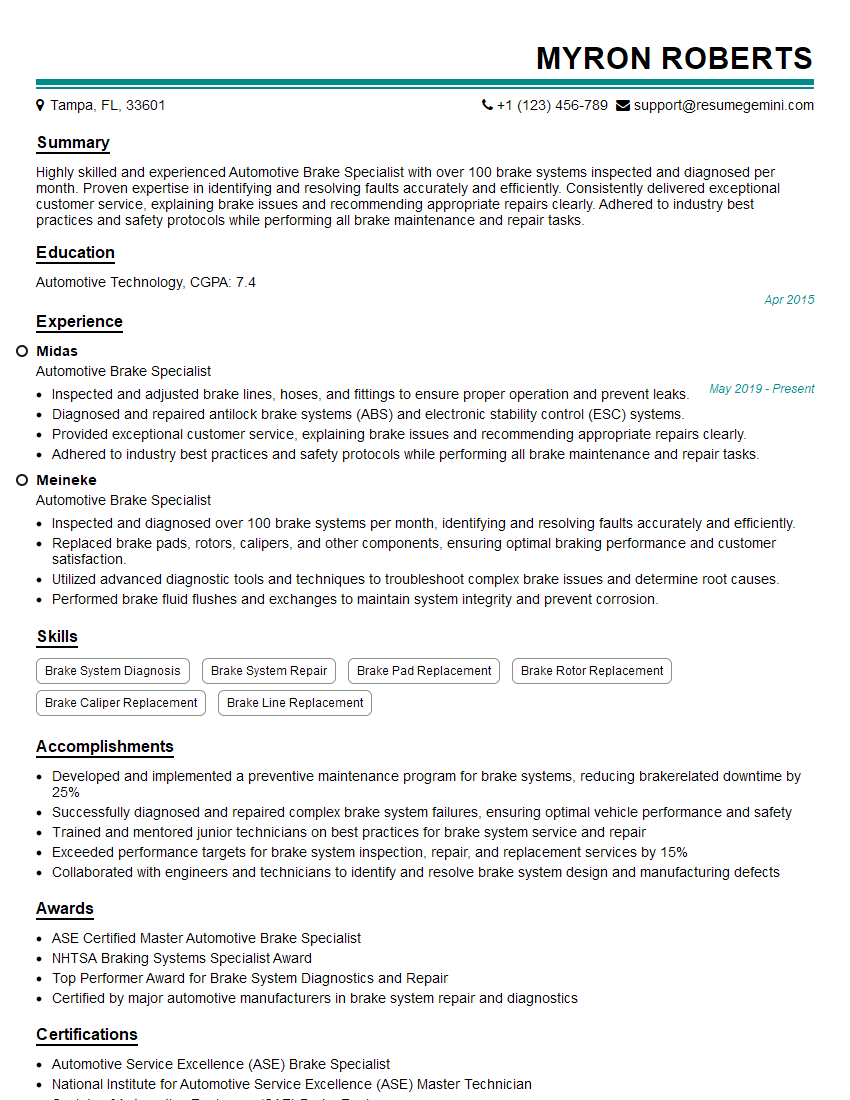
Mastering brake service skills opens doors to rewarding careers with excellent growth potential in the automotive industry. A strong understanding of brake systems is highly sought after, leading to increased job security and higher earning potential. To maximize your chances of landing your dream job, focus on crafting an ATS-friendly resume that highlights your skills and experience effectively. ResumeGemini is a trusted resource to help you build a professional and impactful resume. We offer examples of resumes tailored to the Brake Service field to guide you in creating a compelling application.
Explore more articles
Users Rating of Our Blogs
Share Your Experience
We value your feedback! Please rate our content and share your thoughts (optional).
What Readers Say About Our Blog
Really detailed insights and content, thank you for writing this detailed article.
IT gave me an insight and words to use and be able to think of examples