The right preparation can turn an interview into an opportunity to showcase your expertise. This guide to Avionics System Failure Investigation interview questions is your ultimate resource, providing key insights and tips to help you ace your responses and stand out as a top candidate.
Questions Asked in Avionics System Failure Investigation Interview
Q 1. Explain the process of conducting a preliminary investigation of an avionics system failure.
A preliminary investigation of an avionics system failure is crucial for understanding the immediate events and securing evidence. It’s like the first responders at an accident scene – they secure the area, gather initial information, and prevent further damage. The process typically involves these steps:
- Securing the Scene: This involves isolating the failed system to prevent further damage or data corruption. It might mean powering down specific components or the entire aircraft system.
- Data Acquisition: Collecting all available data is paramount. This includes reviewing flight logs, maintenance records, pilot reports, weather data, and any other relevant documentation. Think of it as assembling all the pieces of a puzzle before you try to put them together.
- Witness Interviews: Gathering information from pilots, maintenance personnel, and anyone who may have observed the incident is critical. Different perspectives can paint a clearer picture.
- Preliminary System Checks: Performing basic visual inspections of the failed system and its components. This helps identify any obvious physical damage, loose connections, or signs of overheating.
- Initial Hypothesis Formulation: Based on the collected data, a preliminary hypothesis regarding the cause of the failure is formed. This is not a definitive conclusion, but a working theory to guide further investigation.
- Preservation of Evidence: Properly securing and documenting all evidence is paramount to maintaining its integrity and admissibility in any subsequent investigation.
For example, in a case of a failed autopilot, the preliminary investigation might involve reviewing the autopilot’s flight data, checking for any error messages logged, and interviewing the pilot about the sequence of events leading to the failure.
Q 2. Describe your experience with different types of avionics systems and their common failure modes.
My experience encompasses a wide range of avionics systems, from older electromechanical systems to modern, highly integrated fly-by-wire systems. I’ve worked with:
- Flight Management Systems (FMS): Common failure modes include software glitches, GPS signal loss, and inertial navigation system (INS) errors. I’ve investigated instances where incorrect data input resulted in deviations from the planned flight path.
- Autopilot Systems: These can fail due to sensor malfunctions (e.g., air data, attitude), actuator problems (e.g., stuck servos), or software issues. One case involved a failure linked to a faulty altitude sensor, leading to an unexpected descent.
- Communication Systems: VHF, HF, and satellite communication systems are susceptible to interference, equipment malfunctions, or antenna problems. I’ve handled investigations where radio failure hampered communication with air traffic control.
- Navigation Systems: GPS, VOR, and ILS failures can stem from antenna problems, signal interference, or internal unit malfunction. A recent investigation involved a faulty GPS receiver causing inaccurate navigation data.
- Flight Data Recorders (FDR) and Cockpit Voice Recorders (CVR): The integrity and reliability of these crucial systems are vital, and failures can significantly hinder investigations. I’ve analyzed cases where data corruption or mechanical issues with the recorders hampered data retrieval.
Understanding the specific architecture and failure modes of each system is key to effectively analyzing any incident. This often requires a deep understanding of both hardware and software components.
Q 3. How do you utilize flight data recorders (FDRs) and cockpit voice recorders (CVRs) in your investigations?
FDRs and CVRs are indispensable tools in avionics failure investigations. They provide a factual record of the flight’s parameters and cockpit communications, acting as a black box for the investigation. My approach involves:
- Data Retrieval: Carefully retrieving data from the FDR and CVR, ensuring data integrity and avoiding data corruption during the process. This often involves specialized software and equipment.
- Data Analysis: Analyzing the retrieved data using specialized software to correlate different parameters, such as altitude, airspeed, engine parameters, and autopilot commands with the recorded conversations. This helps reconstruct the sequence of events leading to the failure.
- Correlation with other Evidence: Comparing data from the FDR and CVR with other evidence, such as maintenance records, witness statements, and physical findings from the aircraft, to build a comprehensive picture of the failure.
- Data Interpretation: Interpreting the data within its context and identifying any anomalies or discrepancies. This often requires significant experience and specialized knowledge to translate raw data into meaningful insights.
For example, a sudden drop in airspeed recorded by the FDR, coupled with a pilot’s statement about a loss of control, might point to a crucial piece of evidence within the CVR recordings which ultimately reveal the cause of the airspeed drop.
Q 4. What are the key safety regulations and standards relevant to avionics system failure investigations?
Several key safety regulations and standards govern avionics system failure investigations. These are essential for ensuring consistency, transparency, and the safety of future flights. Key regulations include:
- FAA regulations (in the US): The Federal Aviation Administration (FAA) sets numerous regulations related to aircraft maintenance, airworthiness, and accident investigation. These regulations dictate the procedures for conducting investigations and reporting findings.
- EASA regulations (in Europe): The European Union Aviation Safety Agency (EASA) has similar regulations and standards in Europe.
- ICAO Annex 13: The International Civil Aviation Organization (ICAO) Annex 13 outlines standards and recommended practices for aircraft accident and incident investigation. These are globally recognized and influence many national regulations.
- Industry Standards: Organizations like RTCA (Radio Technical Commission for Aeronautics) develop industry standards for avionics systems. Adherence to these standards is crucial for maintaining safety and interoperability.
These regulations dictate everything from the reporting process and investigation methodology to the documentation and dissemination of findings. Ignoring these standards can severely compromise the integrity of the investigation and potentially impact future safety.
Q 5. Explain your understanding of fault tree analysis and its application to avionics system failures.
Fault tree analysis (FTA) is a deductive, top-down approach used to identify the root causes of system failures. It starts with the undesired event (the top event) and works backward to determine the contributing factors. Imagine it like a tree, with the top event as the tree trunk and branches representing the events that could lead to the top event.
In avionics, FTA can be used to analyze the potential causes of a system malfunction. For instance, if the top event is ‘Loss of Navigation Data’, the branches might represent things like ‘GPS Receiver Failure’, ‘Antenna Fault’, ‘Software Glitch’, ‘Loss of Satellite Signal’, each leading further down to even more basic failure points.
Each branch of the fault tree is analyzed using Boolean logic (AND, OR gates) to determine the combinations of events leading to the top event. This helps to identify the most probable causes and develop mitigation strategies. For example, a 'GPS Receiver Failure' might require an 'AND' gate for both 'Internal Hardware Failure' AND 'Software Error' to occur.
Using FTA helps systematically investigate all potential contributors to a failure, reducing the chance of overlooking critical aspects.
Q 6. How do you identify the root cause of an avionics system failure?
Identifying the root cause requires a systematic approach that goes beyond simply identifying the immediate cause of the failure. It’s like peeling an onion – you have to peel back layer by layer until you get to the core problem. My process usually involves:
- Data Analysis: Thoroughly analyzing all collected data (FDR/CVR, maintenance logs, witness statements).
- Systemic Investigation: Analyzing the system’s architecture and interactions between components to understand how the failure propagated.
- Failure Mode and Effects Analysis (FMEA): A proactive approach that helps predict potential failures and their consequences. This should ideally be done before an incident as part of system design.
- Fault Tree Analysis (FTA): Used as described above, to systematically break down the failure.
- Human Factors Analysis: Assessing if pilot error, maintenance errors, or other human factors contributed.
- Testing and Verification: Testing components and performing simulations to validate the identified root cause. This might involve lab tests or flight simulations.
It’s crucial to eliminate possibilities until the most likely root cause is identified. For example, a GPS receiver failure might initially seem like the cause of a navigational issue. However, further investigation might reveal that the actual root cause was a faulty power supply that affected multiple systems, including the GPS receiver. The goal is to find the underlying weakness in the system that led to the failure, not just the immediate symptom.
Q 7. Describe your experience with using diagnostic tools and software for avionics troubleshooting.
My experience with diagnostic tools and software for avionics troubleshooting is extensive. These tools are essential for efficient and accurate investigations. I’ve used a variety of tools, including:
- Built-in Test Equipment (BITE): Many modern avionics systems have self-diagnostic capabilities. I’ve used BITE to identify and isolate faulty components, even on systems with complex architectures.
- Specialized Avionics Test Sets: These are dedicated hardware tools used for testing and troubleshooting specific avionics components. They allow for precise measurements and detailed diagnostics.
- Aircraft Maintenance Software: This software allows for accessing and analyzing data logs from various aircraft systems. It aids in identifying trends and patterns that might indicate developing failures.
- Flight Simulation Software: I’ve used flight simulation software to recreate the incident and test different scenarios to validate hypotheses and assess the impact of various contributing factors.
- Data Acquisition and Analysis Software: Specific software packages are used to capture, process and analyze data from FDRs and CVRs. This often involves advanced signal processing and data visualization techniques.
The effective use of these tools, combined with a deep understanding of avionics systems, is paramount for a comprehensive and accurate investigation. The choice of tools depends heavily on the specific avionics system and type of failure.
Q 8. How do you document and report your findings from an avionics system failure investigation?
Documenting and reporting avionics system failure investigations requires a meticulous and standardized approach. We utilize a structured format, often adhering to industry best practices like those outlined by regulatory bodies such as the FAA or EASA. This typically involves several key steps:
- Initial Report: A concise summary of the incident, including date, time, aircraft type, and preliminary observations.
- Data Collection: Gathering all relevant data, including flight data recorder (FDR) and cockpit voice recorder (CVR) data, maintenance logs, weather reports, witness statements, and any relevant technical publications.
- Analysis: Thorough analysis of collected data to identify potential causes and contributing factors. This often involves the use of specialized software for data interpretation and simulation.
- Findings: A clear and concise summary of the investigation’s findings, including identified causes, contributing factors, and the sequence of events leading to the failure. We use diagrams, flowcharts, and other visual aids to effectively communicate complex information.
- Safety Recommendations: Based on the findings, we propose specific recommendations to prevent similar failures in the future. These could involve design modifications, procedural changes, or enhanced training programs.
- Final Report: A comprehensive document detailing all aspects of the investigation, including methodology, findings, and safety recommendations. This report is meticulously reviewed and approved before dissemination to stakeholders.
For example, in investigating a GPS receiver failure, our documentation would include GPS data logs, comparisons with other navigation systems, analysis of any error messages, and the examination of the receiver’s internal components. The final report might highlight a specific hardware vulnerability or a software bug, leading to recommendations for improved redundancy or updated firmware.
Q 9. Explain your knowledge of different types of avionics system failures (e.g., hardware, software, human factors).
Avionics system failures can be broadly categorized into hardware, software, and human factors issues. Often, a failure involves a complex interplay of these elements.
- Hardware Failures: These involve physical components failing, such as a malfunctioning sensor, a damaged wire, or a faulty circuit board. Think of a gyroscope failing to provide accurate data, leading to incorrect flight instrument readings. These can stem from manufacturing defects, wear and tear, environmental factors (e.g., extreme temperatures or vibration), or improper maintenance.
- Software Failures: These can manifest as bugs in the software code, leading to incorrect calculations, unexpected behavior, or system crashes. For example, a glitch in the flight management system’s software could lead to incorrect flight path calculations. These failures can originate from coding errors, insufficient testing, or incompatibility issues.
- Human Factors: These are errors made by human operators, ranging from incorrect configuration of avionics systems to failure to follow proper procedures. A pilot inadvertently disabling a critical system or failing to notice a warning light are prime examples. Training deficiencies, fatigue, or distractions can be significant contributing factors.
It’s crucial to understand that these categories are not mutually exclusive. A hardware failure could trigger a software error, which could then lead to a pilot making a wrong decision. A thorough investigation must explore the interaction between these factors.
Q 10. How do you prioritize and manage multiple avionics system failure investigations simultaneously?
Managing multiple simultaneous investigations requires a structured and prioritized approach. We employ a system that combines urgency, impact, and resource allocation.
- Prioritization Matrix: We develop a matrix considering the severity of the potential consequences (e.g., loss of life, damage to aircraft), the urgency of resolving the issue (e.g., grounding of aircraft), and the resources required for the investigation.
- Resource Allocation: We assign team members based on their expertise and the specific needs of each investigation. We ensure that critical tasks have the necessary personnel and resources.
- Timeline Management: We establish realistic timelines for each investigation, incorporating milestones and regular progress reviews. This ensures we remain focused and efficiently manage our time.
- Communication and Coordination: Regular communication among the team members and stakeholders is critical to avoid duplication of effort and ensure everyone is aligned on the investigation’s progress.
For example, an incident resulting in a significant injury would be prioritized over a minor system anomaly. We would allocate experienced investigators and prioritize access to essential resources to expedite the critical investigation.
Q 11. What is your experience with working with different stakeholders (e.g., pilots, maintenance personnel, manufacturers)?
Effective collaboration with various stakeholders is crucial for a successful investigation. This involves clear communication, active listening, and building trust.
- Pilots: We interview pilots to understand their perspective on the events leading up to the failure. Their input on cockpit indications, system behaviour, and actions taken is invaluable.
- Maintenance Personnel: Maintenance logs and personnel interviews provide insights into the aircraft’s maintenance history, revealing any potential contributing factors related to repairs or servicing.
- Manufacturers: Collaboration with manufacturers is vital for accessing detailed technical information on the affected avionics systems, as well as design specifications and testing data.
- Regulatory Authorities: We maintain open communication with regulatory bodies to ensure compliance with safety regulations and reporting requirements.
For instance, if a particular sensor is suspected as a cause, we will actively engage with the manufacturer to understand its design, failure modes, and any reported issues. We also carefully review maintenance logs to determine if any recent servicing could have inadvertently introduced a fault.
Q 12. Describe your experience with conducting post-incident analyses and contributing to safety recommendations.
Post-incident analysis is critical for identifying systemic issues and developing effective safety recommendations. It’s more than just finding the immediate cause; it involves delving deeper to understand the underlying vulnerabilities and weaknesses that contributed to the incident.
- Data Analysis: We thoroughly analyze all collected data to understand the sequence of events leading to the failure, identifying not only the immediate cause but also contributing factors.
- System Analysis: We examine the broader system context to pinpoint systemic vulnerabilities or weaknesses that may have contributed to the failure.
- Human Factors Analysis: We assess human factors, such as pilot error, maintenance errors, or design flaws that made human error more likely.
- Safety Recommendations: Based on the analysis, we provide specific safety recommendations to prevent recurrence. This could involve design modifications, procedural changes, improved training, or enhanced safety oversight.
For instance, if a recurring software bug is identified, our analysis will determine its root cause, explore any similar incidents, and propose robust solutions such as software updates, improved testing procedures, and perhaps even a change in the design of the system.
Q 13. Explain your familiarity with aircraft maintenance manuals and technical publications.
Familiarity with aircraft maintenance manuals (MMs) and technical publications is fundamental to my work. These documents are our primary sources of information on system design, operation, maintenance procedures, and troubleshooting guides.
- System Schematics: MMs contain detailed diagrams and schematics that are crucial for understanding system architecture and tracing signal flows. This helps in identifying the physical pathways of failures.
- Maintenance Procedures: These manuals outline procedures for inspecting, testing, and repairing avionics components. This allows us to verify if maintenance procedures were properly followed.
- Troubleshooting Guides: These guides provide step-by-step instructions for diagnosing and resolving common system malfunctions. They aid in verifying whether proper troubleshooting steps were taken.
- Service Bulletins and Airworthiness Directives: We examine these publications to assess if any relevant service bulletins or airworthiness directives were issued addressing potential system vulnerabilities or related safety issues.
In a recent investigation, consulting the aircraft’s MM helped determine the correct calibration procedure for a specific sensor. This helped rule out calibration errors as a contributing factor, allowing us to focus on other potential causes.
Q 14. How do you handle conflicting information or evidence during an avionics system failure investigation?
Handling conflicting information during an investigation requires a systematic and objective approach. We use a combination of techniques to ensure a fair and unbiased analysis.
- Data Triangulation: We look for corroborating evidence from multiple sources. If multiple sources point to the same conclusion, it strengthens the validity of that finding. If there are discrepancies, it requires further investigation to reconcile the differences.
- Source Verification: We carefully scrutinize the reliability and credibility of each source of information. This involves considering the source’s expertise, potential biases, and the methods used to obtain the information.
- Expert Consultation: In cases of complex technical issues or conflicting expert opinions, we consult independent experts to provide impartial assessments.
- Documentation of Discrepancies: Any discrepancies or unresolved conflicts are clearly documented in the investigation report, along with a rationale for how they were considered and resolved. Transparency is vital.
For example, if pilot testimony differs from flight data recorder data, we would meticulously review both sources, considering potential memory lapses, interpretations, or limitations of the recording. Expert input might be necessary to understand the instrumentation and data accurately. The final report would detail both perspectives and the rationale for any conclusions drawn.
Q 15. Describe your experience with using statistical methods for analyzing avionics system reliability data.
Analyzing avionics system reliability hinges on statistical methods. We use various techniques to understand failure rates, identify trends, and predict future performance. For instance, I frequently employ Weibull analysis to model the time-to-failure distribution of components, revealing whether failures are random, wear-out related, or infant mortality issues. This helps determine the Mean Time Between Failures (MTBF) and Mean Time To Repair (MTTR), critical metrics for assessing system reliability and maintainability.
Another common technique is survival analysis, particularly useful when dealing with censored data – where we know a component has *not* failed by a certain time but its exact failure time is unknown. This is common in long-term studies. Furthermore, I utilize regression analysis to investigate relationships between different factors (e.g., temperature, altitude, usage cycles) and the probability of failure. This allows us to pinpoint potential contributing factors and identify areas for improvement in design or maintenance.
For example, in investigating a series of autopilot failures, I used Weibull analysis to determine the failure rate was significantly higher than expected, suggesting a potential design flaw or manufacturing defect. Subsequent regression analysis revealed a strong correlation between failure rate and ambient temperature, leading to design modifications that improved thermal management and reliability.
Career Expert Tips:
- Ace those interviews! Prepare effectively by reviewing the Top 50 Most Common Interview Questions on ResumeGemini.
- Navigate your job search with confidence! Explore a wide range of Career Tips on ResumeGemini. Learn about common challenges and recommendations to overcome them.
- Craft the perfect resume! Master the Art of Resume Writing with ResumeGemini’s guide. Showcase your unique qualifications and achievements effectively.
- Don’t miss out on holiday savings! Build your dream resume with ResumeGemini’s ATS optimized templates.
Q 16. What are some common human factors that contribute to avionics system failures?
Human factors play a surprisingly large role in avionics system failures. They often manifest as errors in design, operation, or maintenance.
- Design Errors: Poorly designed interfaces, confusing controls, or inadequate warnings can lead to operator errors. For example, an overly complex cockpit layout might increase the risk of pilot misinterpretation of crucial data, leading to incorrect actions.
- Operational Errors: Pilot fatigue, inadequate training, distractions, or stress can all contribute to errors. A pilot overlooking a warning light or misinterpreting an instrument reading because of fatigue is a classic example.
- Maintenance Errors: Incorrect procedures, poor workmanship, or inadequate oversight during maintenance can introduce errors that could manifest as component failures or system malfunctions. For instance, a technician failing to correctly secure a connection during maintenance could lead to a critical system failure.
- Procedural Errors: Failure to follow established procedures (checklists, SOPs) can increase the risk of incidents and accidents. For instance, a failure to follow the proper shutdown procedure before working on the avionics system could lead to the technician being seriously injured.
Addressing human factors requires a multi-faceted approach, including ergonomic design of avionics systems, rigorous training programs for pilots and maintenance personnel, and robust safety management systems.
Q 17. How do you assess the severity and potential impact of an avionics system failure?
Assessing the severity and potential impact of an avionics system failure involves a hierarchical approach. We use several tools, including Fault Tree Analysis (FTA) and Hazard Analysis and Critical Control Points (HACCP).
Severity is typically categorized based on the potential consequences: catastrophic (loss of life), hazardous (serious injury or substantial damage), major (minor injury or significant system impairment), or minor (no injury or minimal impairment).
Potential Impact considers the affected system’s function and its role in overall flight safety. For example, a failure in the primary flight control system is catastrophic, whereas a malfunction in the in-flight entertainment system is minor.
A robust investigation considers both severity and probability of failure. A low-probability, high-severity failure (e.g., complete engine failure) requires different mitigation strategies than a high-probability, low-severity failure (e.g., a minor malfunction in the navigation system).
We use tools such as safety assessment methodologies (e.g., ASIL levels in ISO 26262) to quantify the risk associated with different failures. These assessments help prioritize corrective actions and focus resources on the most critical issues.
Q 18. Explain your understanding of the different levels of aircraft maintenance and their impact on avionics systems.
Aircraft maintenance is typically structured into several levels, each with a different scope and impact on avionics systems.
- Line Maintenance: This involves routine checks, minor repairs, and troubleshooting conducted by line mechanics at the airport. It focuses on quick turnarounds and addresses minor issues. Impact on avionics may include replacing a faulty indicator light or resolving a minor software glitch.
- Base Maintenance: This is more extensive and includes scheduled checks, more complex repairs, and upgrades. It typically takes place at specialized maintenance facilities. Avionics impact can be significant, including component replacements, software updates, and calibration procedures.
- Heavy Maintenance: This is the most extensive level, involving major overhauls and significant modifications, often requiring specialized tools and equipment. Avionics systems may undergo complete inspections, repairs, or upgrades during heavy maintenance. The aircraft may be out of service for significant durations.
Proper maintenance at all levels is crucial for ensuring avionics system reliability. Inadequate maintenance can lead to premature failures, safety hazards, and increased operational costs.
Q 19. How do you ensure the integrity and confidentiality of data collected during an avionics system failure investigation?
Maintaining data integrity and confidentiality during an avionics system failure investigation is paramount. We adhere to strict protocols to ensure this.
- Chain of Custody: All data, including flight recorders, maintenance logs, and component samples, are meticulously documented and tracked throughout the investigation. This ensures the data’s authenticity and prevents tampering.
- Data Encryption: Sensitive data is encrypted during storage and transmission, protecting it from unauthorized access. This is particularly important when dealing with flight data recorders which hold sensitive and potentially crucial data about the aircraft’s parameters during the events leading to the incident.
- Access Control: Only authorized personnel with a legitimate need to access the data are given permission. This helps prevent accidental disclosure or misuse of information.
- Data Validation: Data quality is crucial. We employ thorough data validation techniques to ensure the accuracy and reliability of our findings. Any anomalies or inconsistencies are thoroughly investigated and documented.
We also strictly adhere to relevant regulations and guidelines, such as those set by the FAA or EASA, to maintain the confidentiality and legal integrity of the investigation.
Q 20. Describe your experience with presenting your findings to technical and non-technical audiences.
Presenting findings to both technical and non-technical audiences requires adapting communication styles.
Technical Audiences: I use precise technical language, detailed data analysis, and specialized diagrams to convey the investigation’s technical details. I ensure the information is clear and comprehensive to those familiar with the technical aspects of aviation systems.
Non-Technical Audiences: I translate technical findings into plain language, avoiding jargon and using visual aids such as charts and simple graphics. I focus on explaining the key findings and recommendations in an understandable way, so that decisions can be made on a well-informed basis.
In either case, I strive for clarity, accuracy, and completeness. I am comfortable tailoring my presentation to the specific audience and their level of understanding, using storytelling and analogies to make complex information easily accessible and more easily digested.
Q 21. How do you stay up-to-date on the latest advancements in avionics technology and safety regulations?
Staying current in avionics technology and safety regulations requires a proactive approach.
- Professional Organizations: I actively participate in professional organizations like the SAE International (Society of Automotive Engineers) and attend conferences and workshops to learn about the latest advancements and best practices. This ensures I stay abreast of any changes in technology, and how they affect the safety of aircraft, whether they are minor or substantial.
- Industry Publications: I regularly read industry publications and journals, keeping abreast of new technologies, research, and safety regulations. These sources often highlight the latest research and advancements.
- Regulatory Updates: I closely monitor regulatory updates from organizations like the FAA and EASA, ensuring compliance and applying the latest safety standards to my work. This means regularly reviewing published documents to ensure ongoing compliance.
- Continuing Education: I participate in continuing education courses and training programs to update my knowledge and skills in avionics technology and safety management.
This multi-pronged approach allows me to maintain a high level of expertise and ensure my work meets the highest standards of safety and professionalism.
Q 22. Explain your experience with using simulation tools for analyzing avionics system failures.
Simulation tools are indispensable in avionics system failure analysis. They allow us to recreate flight scenarios and system behavior under various conditions, including failures, without the risk and cost associated with real-world testing. My experience spans using several industry-standard simulation packages, such as MATLAB/Simulink and specialized avionics simulators. For example, I’ve used Simulink to model a flight control system, introducing simulated sensor failures (like a faulty gyroscope) to observe the system’s response and identify potential cascading effects. This allows for a systematic investigation of how specific faults propagate through the system, revealing vulnerabilities and informing design improvements. Another example involves using a hardware-in-the-loop simulator where a simulated aircraft interacts with real avionics components. This provides a realistic test environment for validating system responses to diverse failure modes. The detailed data logged during these simulations helps pinpoint the root causes of failures and assess the effectiveness of mitigation strategies.
Q 23. How would you handle a situation where a critical avionics system fails during flight?
A critical avionics system failure during flight is a high-stakes emergency requiring immediate and decisive action. The response follows a structured approach prioritizing safety. First, the immediate priority is to stabilize the aircraft and ensure the safety of passengers and crew. This might involve engaging backup systems, if available, or executing emergency procedures outlined in the aircraft’s flight manual. Simultaneously, the pilots would initiate communication with air traffic control to declare an emergency and seek immediate assistance and potential diversion to the nearest suitable airport. Following the safe landing, a thorough investigation would commence, utilizing flight data recorders (FDRs) and cockpit voice recorders (CVRs) to reconstruct the events leading up to the failure. Post-flight analysis would involve meticulously examining the FDR and CVR data, reviewing maintenance logs, and conducting interviews with the flight crew to understand the sequence of events. This detailed analysis is crucial for determining the root cause of the failure and implementing corrective actions to prevent recurrence.
Q 24. Describe your experience with working in a team environment during complex investigations.
Teamwork is paramount in complex investigations. I’ve been involved in numerous investigations requiring collaboration with pilots, maintenance personnel, engineers from different disciplines, regulatory bodies, and even external consultants. Effective communication is essential. We typically utilize a structured approach, assigning specific roles and responsibilities within the team. Regular meetings with clearly defined agendas ensure progress tracking and collaborative problem-solving. For instance, in one investigation of a navigation system anomaly, our team, including specialists in software, hardware, and human factors, employed a collaborative approach. Each member contributed their specific expertise, leading to a comprehensive understanding of the event’s contributing factors. This collaborative approach ensured a thorough investigation and identified the root cause, a software bug interacting with unusual atmospheric conditions. The diverse perspectives enriched the analysis and improved the accuracy of our findings.
Q 25. What is your understanding of the regulatory framework surrounding airworthiness and avionics safety?
The regulatory framework surrounding airworthiness and avionics safety is complex and stringent, designed to ensure the highest standards of safety in air travel. Key players include national aviation authorities (like the FAA in the US or EASA in Europe) and international organizations like ICAO. Regulations encompass design standards, certification processes, maintenance requirements, and operational procedures. Airworthiness certifications require extensive testing and documentation to demonstrate that an aircraft and its systems meet stringent safety criteria. The regulatory framework covers aspects such as fault tolerance, redundancy, and safety analysis methods. For example, DO-178C sets out the requirements for software development in airborne systems, ensuring a high level of software reliability. Non-compliance can lead to serious consequences, including grounding of aircraft and significant penalties. Staying abreast of these evolving regulations is critical for maintaining safe and reliable avionics systems.
Q 26. Explain your experience with different investigation methodologies (e.g., causal factor analysis, bow-tie analysis).
My experience encompasses various investigation methodologies. Causal factor analysis helps identify the chain of events leading to a failure, focusing on the ‘why’ behind each step. Bow-tie analysis provides a visual representation of hazards, outlining potential causes (threats), consequences, and mitigations. For example, in analyzing a recent incident involving an autopilot malfunction, we employed causal factor analysis to trace the sequence of events, starting from a minor software glitch to the eventual autopilot disengagement. This helped identify several contributing factors, such as inadequate software testing and insufficient pilot training on manual recovery procedures. Bow-tie analysis was particularly useful in visualizing the potential consequences of the autopilot failure, ranging from minor deviations to a catastrophic crash, and the preventative measures implemented to reduce these risks.
Q 27. How do you utilize data analytics to identify trends and patterns in avionics system failures?
Data analytics plays a significant role in identifying trends and patterns in avionics system failures. We use statistical methods and data mining techniques on large datasets extracted from FDRs, maintenance logs, and other relevant sources. This helps to identify recurring failure modes, potential weaknesses in system design, and environmental factors contributing to failures. For instance, by analyzing maintenance records and flight data, we can identify aircraft or component types prone to specific failures, allowing for targeted preventative maintenance strategies. Advanced techniques, such as machine learning, can predict potential failures before they occur, enabling proactive maintenance and improving overall system reliability. Data visualization tools allow us to present complex datasets effectively, enabling easier understanding of trends and patterns to relevant stakeholders.
Q 28. Describe your experience with conducting root cause analysis using techniques such as 5 Whys and fishbone diagrams.
Root cause analysis (RCA) is crucial to prevent future failures. The 5 Whys technique involves repeatedly asking ‘why’ to drill down to the root cause. Fishbone diagrams (Ishikawa diagrams) provide a structured way to visually represent potential causes, categorized by factors like people, machines, methods, materials, and environment. For example, in investigating a transponder failure, the 5 Whys might lead us from the initial failure (‘Why did the transponder fail?’) to a faulty component (‘Why did the component fail?’) to a manufacturing defect (‘Why was there a manufacturing defect?’) ultimately pinpointing a problem in the quality control process. A fishbone diagram would allow us to categorize the potential causes of the failure, allowing a more systematic and comprehensive investigation. These techniques, used in conjunction with data analysis, provide a robust approach to RCA, leading to effective corrective actions and preventing future recurrences.
Key Topics to Learn for Avionics System Failure Investigation Interview
- Fault Tree Analysis (FTA): Understanding the principles of FTA and its application in identifying root causes of avionics system failures. Practical application includes building and analyzing FTA diagrams for specific scenarios.
- Human Factors in Avionics Failures: Exploring the role of human error in system failures, including pilot error, maintenance errors, and design flaws. Practical application involves analyzing accident reports to identify human factors contributing to incidents.
- Data Acquisition and Analysis: Mastering techniques for collecting and interpreting data from various sources, such as flight data recorders (FDRs), maintenance logs, and sensor data. Practical application includes using data analysis tools to identify trends and patterns indicative of potential failures.
- System Safety and Reliability: Understanding the principles of system safety, including hazard identification, risk assessment, and mitigation strategies. Practical application involves evaluating the safety and reliability of avionics systems using various methods.
- Regulatory Compliance: Familiarity with relevant aviation regulations and standards related to avionics system safety and investigation procedures. Practical application includes applying these regulations to real-world investigation scenarios.
- Troubleshooting and Diagnostics: Developing effective troubleshooting strategies for complex avionics systems, including the use of diagnostic tools and techniques. Practical application includes simulating troubleshooting scenarios and developing effective solutions.
- Reporting and Communication: Effectively communicating findings and recommendations to stakeholders using clear and concise reports. Practical application includes structuring and presenting investigative findings in a professional manner.
Next Steps
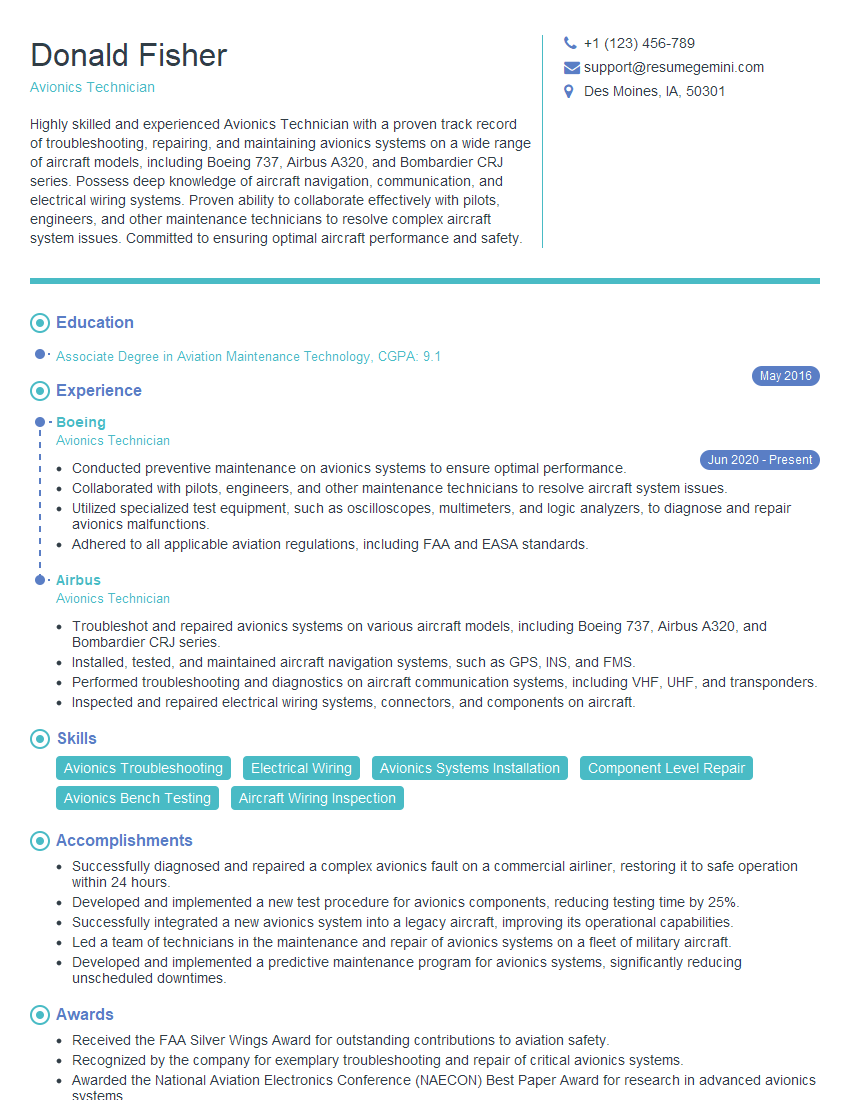
Mastering Avionics System Failure Investigation is crucial for career advancement in the aviation industry, opening doors to specialized roles and leadership opportunities. A strong resume is your key to unlocking these opportunities. Creating an ATS-friendly resume is essential to ensure your application gets noticed by recruiters. ResumeGemini is a trusted resource to help you build a professional and effective resume that highlights your skills and experience in this demanding field. Examples of resumes tailored to Avionics System Failure Investigation are available within ResumeGemini to guide your resume creation process. Invest time in crafting a compelling resume – it’s your first impression!
Explore more articles
Users Rating of Our Blogs
Share Your Experience
We value your feedback! Please rate our content and share your thoughts (optional).
What Readers Say About Our Blog
Really detailed insights and content, thank you for writing this detailed article.
IT gave me an insight and words to use and be able to think of examples