Interviews are opportunities to demonstrate your expertise, and this guide is here to help you shine. Explore the essential Knowledge of Six Sigma and Continuous Improvement interview questions that employers frequently ask, paired with strategies for crafting responses that set you apart from the competition.
Questions Asked in Knowledge of Six Sigma and Continuous Improvement Interview
Q 1. Explain the DMAIC methodology.
DMAIC is a data-driven methodology used in Six Sigma for improving processes. It’s an acronym for Define, Measure, Analyze, Improve, and Control. Think of it as a structured roadmap for systematically identifying, analyzing, and resolving process defects to achieve significant improvements in quality, efficiency, and customer satisfaction.
Q 2. Describe the five phases of DMAIC.
The five phases of DMAIC are:
- Define: Clearly define the project goals, scope, and customer requirements. This involves identifying the problem, setting measurable goals, and creating a project charter.
- Measure: Gather data to understand the current process performance. This involves identifying key process metrics, collecting data, and analyzing it to establish a baseline.
- Analyze: Identify the root causes of the process variation and defects. This uses various statistical tools to determine the factors driving the problem.
- Improve: Develop and implement solutions to address the root causes identified in the Analyze phase. This may involve process redesign, automation, or employee training.
- Control: Monitor the improved process to ensure that the gains are sustained over time. This uses control charts and other monitoring techniques to prevent the process from reverting to its previous state.
Q 3. What are the key tools used in the Define phase of DMAIC?
Key tools used in the Define phase include:
- SIPOC Diagram: Maps out the Suppliers, Inputs, Process, Outputs, and Customers involved in the process to understand its boundaries.
- Voice of the Customer (VOC): Techniques (surveys, interviews, focus groups) used to collect customer feedback and understand their needs and expectations.
- Project Charter: A formal document that defines the project goals, scope, timeline, resources, and team members.
- Process Map: A visual representation of the current process steps, showing how the work flows.
- CTQ Tree (Critical-to-Quality): A hierarchical structure that breaks down high-level customer requirements into specific, measurable characteristics.
For example, in a customer service context, the VOC might reveal long wait times are a major pain point. The CTQ tree might then break down ‘wait time’ into sub-components like call volume, agent handling time, and system processing speed, leading to more targeted improvement efforts.
Q 4. How do you measure process capability?
Process capability measures how well a process meets predetermined specifications. We assess this by comparing the process’s natural variation (spread of data) to the tolerance limits set by the customer or design requirements. This often involves calculating Cp and Cpk indices (explained further in the next answer).
The process involves collecting a sufficient amount of data from the process, typically 50-100 data points, and then using statistical software or tools to analyze the data. The data is typically analyzed to calculate the mean (average) and standard deviation (measure of spread) of the process output. This information, along with the upper and lower specification limits, is then used to calculate the process capability indices.
Q 5. Explain the concept of Cp and Cpk.
Cp and Cpk are process capability indices that quantify how well a process performs relative to its specifications. They are calculated using the process mean, standard deviation, and specification limits (USL – Upper Specification Limit, LSL – Lower Specification Limit).
- Cp (Process Capability): Measures the potential capability of the process, assuming the process is centered on the target. A Cp of 1 indicates the process spread is equal to one-third of the specification width. Higher Cp values indicate better capability.
Cp = (USL - LSL) / 6σwhere σ is the standard deviation. - Cpk (Process Capability Index): Considers both the potential capability (like Cp) and the process centering. It accounts for the process mean being offset from the target value. A Cpk of 1 indicates that the process is capable and centered. A higher value suggests better capability.
Cpk = min[(USL - μ) / 3σ, (μ - LSL) / 3σ]where μ is the mean.
Imagine a machine manufacturing bolts; Cp tells us if the machine *could* consistently make bolts within the specification, while Cpk tells us if it *actually is* consistently making bolts within the specification considering the machine might not be perfectly centered.
Q 6. What is a control chart and how is it used?
A control chart is a graphical tool used to monitor a process over time and identify any special causes of variation that might indicate the process is out of control. It plots data points over time, along with control limits that represent the expected variation of the process. Points consistently falling outside these limits suggest a problem needs attention.
Control charts help differentiate between common cause variation (inherent to the process) and special cause variation (due to assignable causes like machine malfunction or operator error). They are essential for identifying when corrective action is required and ensuring process stability. For example, a control chart might track the number of defects per batch of manufactured goods. If the points consistently stay within the control limits, the process is stable. If a point falls outside the limit or a pattern emerges, it indicates a need for investigation.
Q 7. Describe different types of control charts.
Several types of control charts exist, chosen based on the type of data being monitored:
- X-bar and R chart: Used for continuous data (e.g., weight, length, temperature) – X-bar tracks the average, R tracks the range within a subgroup.
- X-bar and s chart: Also for continuous data, but uses the standard deviation (s) instead of the range (R); generally preferred for larger subgroup sizes.
- Individuals and Moving Range (I-MR) chart: Used when data is collected individually rather than in subgroups.
- p-chart: Used for attribute data representing the proportion of nonconforming items (e.g., percentage of defective products).
- np-chart: Used for attribute data representing the number of nonconforming items in a sample of fixed size.
- c-chart: Used for attribute data representing the number of defects per unit (e.g., number of scratches on a car).
- u-chart: Used for attribute data representing the number of defects per unit of variable size (e.g., number of defects per square meter).
Q 8. What are the key principles of Lean methodology?
Lean methodology is all about maximizing customer value while minimizing waste. It’s a philosophy focused on continuous improvement and efficiency. The key principles revolve around understanding and meeting customer needs, identifying and eliminating waste, empowering employees, and continuously improving processes.
- Value: Defining value strictly from the customer’s perspective. What does the customer truly need and appreciate?
- Value Stream: Identifying all the steps in a process, from raw materials to finished product delivery, to see where value is added and where waste exists.
- Flow: Ensuring a smooth and efficient flow of materials and information throughout the process. Minimizing bottlenecks and interruptions.
- Pull: Producing only what is needed, when it is needed, in response to actual customer demand, rather than producing based on forecasts or predictions. Think ‘Just-in-Time’ manufacturing.
- Perfection: Striving for continuous improvement, constantly seeking ways to eliminate waste and improve efficiency. It’s an ongoing journey, not a destination.
For example, in a restaurant, Lean principles could mean streamlining order taking, optimizing kitchen workflow to reduce waiting time, and only preparing ingredients as needed to reduce spoilage (waste).
Q 9. Explain the concept of Value Stream Mapping.
Value Stream Mapping (VSM) is a visual tool used to analyze the flow of materials and information in a process. It’s like creating a detailed map of your entire process, highlighting both value-adding and non-value-adding activities. The goal is to identify bottlenecks, areas of waste, and opportunities for improvement.
Creating a VSM typically involves:
- Defining the scope: Clearly outlining the beginning and end of the process you’re mapping.
- Gathering data: Collecting data on process steps, lead times, inventory levels, and other relevant metrics.
- Drawing the map: Visually representing the process flow, using standard symbols to represent different activities.
- Analyzing the map: Identifying bottlenecks, waste, and areas for improvement.
- Developing improvements: Proposing and implementing changes to optimize the process.
For instance, in a manufacturing plant, VSM might reveal that a particular machine is a bottleneck, causing delays and increased inventory. This information can then be used to justify investment in a faster machine or improved process scheduling.
Q 10. How do you identify and eliminate waste in a process?
Identifying and eliminating waste is a core tenet of Lean. Waste, often referred to as ‘Muda’ in Japanese, encompasses various non-value-adding activities that consume resources without adding value for the customer. Common types of waste include:
- Transportation: Unnecessary movement of materials or information.
- Inventory: Excess stock that ties up capital and space.
- Motion: Unnecessary movement of people or equipment.
- Waiting: Delays in the process, such as waiting for materials or approvals.
- Overproduction: Producing more than is needed or demanded.
- Over-processing: Performing more work than necessary.
- Defects: Errors or flaws that require rework or scrap.
- Unused Talent (Non-Utilized Skills): Under-utilizing the skills and talents of the workforce.
Eliminating waste involves analyzing the process, using tools like VSM or 5S, to pinpoint areas where waste occurs. Then, implementing solutions such as streamlining processes, improving layout, implementing better quality control, and empowering employees to take ownership of waste reduction.
For example, in an office environment, reducing paper usage (inventory), optimizing email communication (transportation), and implementing better filing systems (motion) can significantly reduce waste.
Q 11. What is Kaizen and how is it implemented?
Kaizen, meaning ‘continuous improvement’ in Japanese, is a philosophy of making small, incremental changes to processes to improve efficiency and effectiveness over time. It’s about fostering a culture of continuous improvement where everyone is involved in identifying and implementing improvements.
Implementing Kaizen involves:
- Identifying problems: Using tools like brainstorming, data analysis, and process observation to pinpoint areas for improvement.
- Developing solutions: Generating ideas for improvement, focusing on simple, low-cost solutions.
- Implementing solutions: Testing and implementing the proposed changes, often on a small scale.
- Monitoring results: Tracking the impact of the changes and making adjustments as needed.
- Standardizing improvements: Documenting successful changes to prevent backsliding and ensure consistent application.
A real-world example could be a team in a call center noticing long hold times. Through Kaizen, they might implement a new system for routing calls, resulting in a slight reduction in wait times. Over time, a series of these small improvements can significantly reduce hold times and improve customer satisfaction.
Q 12. Explain the 5S methodology.
5S is a workplace organization method that uses a list of five Japanese words: Seiri, Seiton, Seisō, Seiketsu, and Shitsuke. It’s a structured approach to creating a clean, organized, and efficient workspace.
- Seiri (Sort): Eliminate unnecessary items from the workspace.
- Seiton (Set in Order): Arrange necessary items so they are easily accessible.
- Seisō (Shine): Clean and maintain the workspace.
- Seiketsu (Standardize): Establish standards for maintaining cleanliness and organization.
- Shitsuke (Sustain): Maintain the standards over time.
Imagine a cluttered desk. 5S would involve removing unnecessary papers (Sort), organizing files and supplies (Set in Order), cleaning the desk (Shine), creating a system for keeping it organized (Standardize), and making sure everyone follows the system (Sustain). This leads to a more efficient workspace with reduced waste and improved safety.
Q 13. Describe your experience with statistical process control (SPC).
Statistical Process Control (SPC) is a crucial tool for monitoring and controlling process variation. My experience with SPC involves using control charts (like X-bar and R charts, p-charts, c-charts etc.) to track key process parameters over time. I’ve used these charts to identify patterns, trends, and special cause variation in processes, enabling timely interventions to prevent defects and maintain consistent quality.
In a previous role, I implemented SPC to monitor the defect rate in a manufacturing process. By analyzing control charts, we identified a specific machine causing an increase in defects. This allowed us to address the root cause, preventing further defects and saving the company significant resources.
I’m proficient in using statistical software like Minitab to analyze data and generate control charts. I understand the importance of selecting appropriate control charts based on the type of data and the process being monitored. My experience also includes training teams on the interpretation and use of control charts, ensuring they can effectively use SPC to monitor and improve processes.
Q 14. How do you analyze data using statistical methods?
Analyzing data using statistical methods is a fundamental part of Six Sigma and continuous improvement. My approach typically involves the following steps:
- Define the problem: Clearly state the question or problem you’re trying to answer.
- Collect data: Gather relevant data using appropriate methods, ensuring data quality and integrity.
- Analyze data: Apply appropriate statistical techniques depending on the type of data and the research question. This might include descriptive statistics (mean, median, standard deviation), hypothesis testing (t-tests, ANOVA), regression analysis, or other advanced techniques.
- Interpret results: Draw conclusions based on the statistical analysis, considering the context and limitations of the data.
- Communicate findings: Clearly communicate the findings using visual aids such as charts and graphs, making it easy for stakeholders to understand.
For example, in a project aimed at reducing customer complaints, I might use regression analysis to identify the factors most strongly associated with customer dissatisfaction. This analysis would guide the development of targeted improvements to address the root causes of customer complaints.
I’m comfortable using various statistical software packages and possess a strong understanding of statistical concepts, including hypothesis testing, confidence intervals, and regression analysis. My analytical skills allow me to extract meaningful insights from data, facilitating informed decision-making and effective problem-solving.
Q 15. What is a Pareto chart and how is it used in problem-solving?
A Pareto chart, also known as the 80/20 rule chart, is a bar graph that ranks causes of problems from most to least significant. It visually represents the Pareto principle, which states that roughly 80% of effects come from 20% of causes. In problem-solving, it’s incredibly useful for focusing improvement efforts on the areas with the highest impact.
How it’s used: Imagine you’re a manufacturing manager dealing with product defects. You collect data on the different types of defects and their frequency. You then create a Pareto chart, where the x-axis lists the defect types, and the y-axis represents the frequency (or cost) of each defect. The bars are arranged in descending order of frequency, and a cumulative percentage line is added to highlight the impact of the top few defects. This clearly shows which defects are causing the most trouble, allowing you to prioritize your corrective actions.
Example: If the chart reveals that 80% of defects are caused by just two specific issues (e.g., faulty material and incorrect assembly), you know to focus your improvement projects on addressing these two primary root causes, rather than spreading resources thinly across all defect types.
Career Expert Tips:
- Ace those interviews! Prepare effectively by reviewing the Top 50 Most Common Interview Questions on ResumeGemini.
- Navigate your job search with confidence! Explore a wide range of Career Tips on ResumeGemini. Learn about common challenges and recommendations to overcome them.
- Craft the perfect resume! Master the Art of Resume Writing with ResumeGemini’s guide. Showcase your unique qualifications and achievements effectively.
- Don’t miss out on holiday savings! Build your dream resume with ResumeGemini’s ATS optimized templates.
Q 16. Explain the concept of root cause analysis.
Root cause analysis (RCA) is a systematic process for identifying the underlying causes of problems, rather than just treating the symptoms. It’s about digging deeper to find the ‘why’ behind the ‘what’. Instead of simply fixing a broken machine, RCA helps determine why it broke in the first place—perhaps due to lack of maintenance, operator error, or a design flaw. The goal is to prevent the problem from recurring.
Concept: RCA typically follows a structured approach, involving data gathering, brainstorming, and analysis to uncover the fundamental causes. It’s iterative, meaning you might need to repeat the process to reach the root.
Analogy: Think of an iceberg. The visible problem is just the tip, while the underlying causes are the much larger portion submerged beneath the surface. RCA aims to expose that hidden mass.
Q 17. What are some common root cause analysis techniques?
Several techniques are used for root cause analysis, each with its strengths and weaknesses. Some common methods include:
- 5 Whys: A simple yet effective method involving repeatedly asking ‘why’ to peel back layers of cause and effect. It’s particularly useful for straightforward problems.
- Fishbone Diagram (Ishikawa Diagram): A visual tool that maps out potential causes categorized by categories like manpower, machinery, materials, methods, measurement, and environment. It encourages brainstorming and collaborative problem-solving.
- Fault Tree Analysis (FTA): A deductive method used to analyze complex systems. It starts with an undesired event (top event) and works backward, identifying the events that could lead to it, creating a tree-like diagram.
- Failure Mode and Effects Analysis (FMEA): A proactive technique used to identify potential failure modes in a system and assess their severity, likelihood of occurrence, and detectability. It’s often used during the design phase.
The choice of technique depends on the complexity of the problem and the available resources.
Q 18. How do you prioritize improvement projects?
Prioritizing improvement projects requires a structured approach to ensure you focus on the initiatives that deliver the most value. A common framework uses a prioritization matrix based on factors like:
- Impact: How significant is the potential improvement? Will it reduce costs, improve quality, increase efficiency, or boost customer satisfaction?
- Feasibility: How realistic is it to implement the improvement? Are the necessary resources (time, budget, expertise) available?
- Urgency: How quickly does the problem need to be addressed? Are there significant risks or penalties associated with delaying action?
Prioritization Matrix: You can create a simple matrix with Impact on one axis and Feasibility on the other. Projects are plotted on the matrix, allowing you to easily visualize which projects offer the best combination of high impact and high feasibility. Urgency can be a tie-breaker.
Example: A project with high impact and high feasibility will be prioritized over a project with low impact, regardless of its feasibility.
Q 19. How do you measure the success of a Six Sigma project?
Measuring the success of a Six Sigma project involves quantifying the improvements achieved. Key metrics vary depending on the project’s goals, but common measures include:
- Defect Rate Reduction: The percentage decrease in defects or errors after implementing the improvements.
- Cycle Time Reduction: The reduction in the time taken to complete a process.
- Cost Savings: The monetary gains achieved through efficiency improvements or reduced waste.
- Customer Satisfaction: Improved ratings or feedback from customers on product quality or service.
- Return on Investment (ROI): The financial return generated by the project relative to its investment.
Data Collection: It’s crucial to collect baseline data before the project starts to accurately measure the improvement achieved. Regular monitoring and data analysis throughout the project are essential to track progress and make necessary adjustments.
Q 20. Describe a time you successfully implemented a process improvement project.
In a previous role, we faced significant delays in order fulfillment. Customer orders were taking an average of 10 days to process, resulting in lost sales and customer complaints. Using DMAIC (Define, Measure, Analyze, Improve, Control), a core Six Sigma methodology, we tackled the issue. We first defined the problem and established clear targets (reducing order fulfillment time to 5 days). Then we meticulously measured the current process, identifying bottlenecks such as manual data entry, inefficient inventory management, and poor communication between departments. Analysis revealed that 70% of delays were caused by inventory issues. We improved the process by implementing an automated inventory system, streamlining data entry, and improving inter-departmental communication. Finally, we put control measures in place to sustain the improvements, such as regular monitoring and process audits. We successfully reduced order fulfillment time to 4 days, exceeding our target, leading to a significant increase in customer satisfaction and a substantial boost to sales.
Q 21. What are the key differences between Lean and Six Sigma?
While both Lean and Six Sigma aim to improve processes and reduce waste, they differ in their focus and approach:
- Lean: Focuses on eliminating waste (muda) in all forms, including overproduction, waiting, transportation, over-processing, inventory, motion, and defects. It emphasizes streamlining processes and maximizing efficiency. Think of it as removing unnecessary steps to speed up the process.
- Six Sigma: Focuses on reducing variation and defects in processes to achieve near-perfection (six standard deviations from the mean). It utilizes statistical tools and methodologies to identify and eliminate root causes of variation. Think of it as making the process incredibly precise and consistent.
Key Differences Summarized:
- Lean: Speed and efficiency. Reduces waste. Uses tools like Value Stream Mapping, Kaizen.
- Six Sigma: Precision and quality. Reduces variation. Uses tools like DMAIC, control charts.
In practice, Lean and Six Sigma are often used together to achieve comprehensive process improvement. Lean can help identify areas for improvement, while Six Sigma can provide the tools to precisely measure and reduce variation in those areas.
Q 22. How do you handle resistance to change during a process improvement initiative?
Resistance to change is a common hurdle in any process improvement initiative. It stems from fear of the unknown, loss of control, or perceived extra effort. Addressing this requires a multi-pronged approach focusing on communication, engagement, and demonstrating value.
- Proactive Communication: Transparency is key. Explain the ‘why’ behind the changes, highlighting the benefits for individuals and the organization. This might include improved efficiency, reduced errors, or enhanced job satisfaction.
- Employee Involvement: Engage employees early and often. Involve them in the planning and implementation phases, allowing them to contribute ideas and suggestions. This fosters ownership and reduces resistance.
- Addressing Concerns: Actively listen to and address concerns. Acknowledge fears and offer training or support to help employees adapt to the changes. For instance, if a new software is introduced, provide comprehensive training and ongoing support.
- Demonstrating Success: Showcase early wins and celebrate milestones. This builds confidence and momentum, demonstrating the tangible benefits of the changes. A simple dashboard tracking key metrics can be a powerful visual tool.
- Championing Change: Identify and cultivate internal champions – individuals who enthusiastically support the initiative and influence their colleagues. These champions act as role models and advocates for the change.
For example, during a Lean Six Sigma project aimed at reducing order processing time, we encountered resistance from the shipping department who feared increased workload. By involving them in the process mapping and brainstorming sessions, we identified bottlenecks and streamlined their tasks, ultimately reducing their workload and improving their efficiency. This active participation transformed them into champions of the change.
Q 23. Describe your experience with project management methodologies.
My project management experience is rooted in Agile and Waterfall methodologies, tailored to the specific needs of each project. I’ve successfully managed projects using both approaches, leveraging the strengths of each.
- Waterfall: I’ve utilized Waterfall for projects with well-defined requirements and minimal anticipated changes. This structured approach is ideal for situations where clarity and predictability are paramount. The sequential phases – initiation, planning, execution, monitoring, and closure – allow for meticulous control.
- Agile (Scrum): For projects requiring flexibility and iterative development, I’ve effectively employed Agile methodologies like Scrum. The iterative sprints, daily stand-ups, and frequent feedback loops facilitate adaptability and responsiveness to changing requirements. This iterative approach minimizes risks and ensures continuous value delivery.
In practice, I often blend elements of both approaches, employing a hybrid methodology. For example, the initial phases of a project might utilize Waterfall for establishing a clear scope and plan, followed by Agile sprints for iterative development and testing.
My experience also includes proficiency in project management tools like Jira and MS Project, enabling effective task management, collaboration, and progress tracking.
Q 24. How do you ensure data accuracy and integrity in your analysis?
Data accuracy and integrity are paramount in any analysis. My approach involves a multi-step process to ensure reliable results:
- Data Source Verification: I meticulously verify the reliability and validity of data sources. This includes evaluating data collection methods, assessing potential biases, and confirming data consistency.
- Data Cleaning: Data cleaning is crucial. I address inconsistencies, outliers, and missing values using appropriate techniques. This might involve imputation for missing data, outlier removal, or transformation to normalize data.
- Data Validation: I perform rigorous validation checks to ensure data accuracy and consistency. This can involve cross-referencing data from multiple sources, employing statistical tests, and visualizing data to identify anomalies.
- Documentation: Comprehensive documentation of data sources, cleaning procedures, and validation steps is essential for transparency and reproducibility. This ensures that the analysis is auditable and the results are credible.
For instance, in an analysis of customer satisfaction, I meticulously checked data from surveys, ensuring proper sampling and addressing any response biases. I also validated the data against transactional data to identify potential discrepancies and ensure data integrity.
Q 25. Explain your understanding of Design of Experiments (DOE).
Design of Experiments (DOE) is a powerful statistical tool used to efficiently explore the relationship between multiple input factors and their impact on output variables. It helps determine which factors are most influential and optimize processes for improved results. Instead of experimenting randomly, DOE provides a structured approach to efficiently explore the factor space.
- Factorial Designs: These are widely used to study the main effects and interactions of multiple factors. Full factorial designs consider all possible combinations, while fractional factorial designs are more efficient for a large number of factors.
- Response Surface Methodology (RSM): RSM is employed to optimize a process by fitting a mathematical model to the experimental data. It helps identify optimal settings for the input factors to achieve the desired output.
- Taguchi Methods: Taguchi methods focus on minimizing the influence of noise factors on the process output. This robust design approach ensures that the process performs consistently even under varying conditions.
For example, in a manufacturing setting, DOE can be used to optimize the parameters of a machine to improve product quality. By systematically varying factors like temperature, pressure, and feed rate, DOE helps determine the optimal settings that minimize defects and maximize yield.
Q 26. What are some common metrics used to track process improvement?
Numerous metrics track process improvement, depending on the specific goals. Here are some common ones:
- Defect Rate (DPMO): Defects per million opportunities, measuring the number of defects per unit of output. A lower DPMO indicates better quality.
- Process Capability (Cp, Cpk): Measures the ability of a process to meet specified tolerances. Cp reflects inherent process variability, while Cpk accounts for process centering.
- Cycle Time: The time taken to complete a process. Reducing cycle time improves efficiency and throughput.
- Lead Time: The time between initiating a process and its completion, encompassing all steps.
- Cost Reduction: Tracking cost savings achieved through process improvements, showcasing financial benefits.
- Customer Satisfaction: Measuring customer satisfaction through surveys or feedback mechanisms. This reflects the impact of process improvements on customer experience.
- Throughput: The rate at which a process produces output. Improved throughput increases productivity.
The choice of metrics depends on the specific process and business objectives. A balanced scorecard approach often uses a combination of these metrics to provide a holistic view of process performance.
Q 27. How do you communicate your findings and recommendations to stakeholders?
Communicating findings and recommendations effectively is crucial for successful implementation. My approach involves tailored communication strategies for different stakeholders:
- Executive Summary: For senior management, I provide concise executive summaries highlighting key findings, recommendations, and anticipated benefits. Data is presented visually using charts and graphs.
- Detailed Report: For technical stakeholders, a detailed report provides a comprehensive analysis, including methodology, data, and statistical analysis. This ensures transparency and allows for thorough review.
- Visual Aids: Visual aids, such as dashboards, charts, and graphs, are essential for communicating complex data effectively to a broader audience. This helps avoid information overload and ensures clear understanding.
- Presentations: I conduct presentations to different stakeholder groups, tailoring the content and level of detail to their specific needs and understanding.
- Follow-up and Feedback: I ensure follow-up communication to address any questions or concerns. I actively solicit feedback to refine recommendations and improve future communication.
For example, when presenting findings from a process improvement project to the executive team, I focused on the financial impact of the recommendations, quantifying the cost savings and return on investment. For the project team, I provided a more detailed explanation of the statistical analysis and implementation plan.
Q 28. Describe your experience with different software tools used for Six Sigma and process improvement.
My experience encompasses several software tools for Six Sigma and process improvement:
- Minitab: Minitab is a powerful statistical software widely used for data analysis, statistical process control (SPC), and DOE. I’m proficient in using Minitab for various statistical analyses, including hypothesis testing, regression analysis, and capability analysis.
- JMP: JMP is another robust statistical software package ideal for data exploration, visualization, and modeling. Its interactive interface and powerful visualization tools enhance data understanding.
- Microsoft Excel: Excel is a versatile tool used for data management, basic statistical analysis, and report generation. I utilize Excel for data cleaning, formatting, and creating charts and graphs.
- Project Management Software (Jira, MS Project): These tools facilitate project planning, task management, and collaboration, crucial for effectively managing process improvement initiatives.
The choice of software depends on the project’s complexity and specific requirements. I’m adept at selecting and applying the most appropriate tools for each situation.
Key Topics to Learn for Knowledge of Six Sigma and Continuous Improvement Interview
- DMAIC Methodology: Understand the Define, Measure, Analyze, Improve, and Control phases, their applications, and how they contribute to process optimization. Consider practical examples from various industries.
- Lean Principles: Explore the connection between Lean and Six Sigma, focusing on waste reduction (Muda), value stream mapping, and Kaizen events. Be prepared to discuss how these principles are implemented in real-world scenarios.
- Statistical Process Control (SPC): Master the use of control charts (e.g., X-bar and R charts) to monitor process stability and identify potential sources of variation. Practice interpreting control chart data and drawing conclusions.
- Process Capability Analysis: Learn how to assess the capability of a process to meet specifications using Cp, Cpk, and Pp, Ppk indices. Be ready to explain the implications of different capability indices.
- Root Cause Analysis (RCA): Familiarize yourself with various RCA tools like the 5 Whys, Fishbone diagrams (Ishikawa diagrams), and Pareto charts. Practice applying these techniques to identify the root causes of process problems.
- Design of Experiments (DOE): Understand the basic principles of DOE and its use in identifying the key factors affecting process output. While in-depth knowledge may not always be required, a foundational understanding is beneficial.
- Metric Selection and Data Analysis: Demonstrate your ability to select relevant metrics, collect and analyze data, and draw meaningful conclusions. Focus on data visualization and clear communication of findings.
- Change Management and Implementation: Discuss the importance of effective change management strategies for successful implementation of Six Sigma projects and continuous improvement initiatives. Highlight the human element in driving change.
Next Steps
Mastering Six Sigma and Continuous Improvement methodologies significantly enhances your career prospects across numerous industries. It demonstrates your commitment to efficiency, problem-solving, and data-driven decision-making – highly valued skills in today’s competitive job market. To maximize your chances of securing your dream role, invest time in creating a strong, ATS-friendly resume that showcases your expertise. ResumeGemini is a trusted resource that can help you build a professional and impactful resume tailored to highlight your Six Sigma and continuous improvement skills. Examples of resumes specifically tailored to this field are available, making your job search significantly easier and more effective.
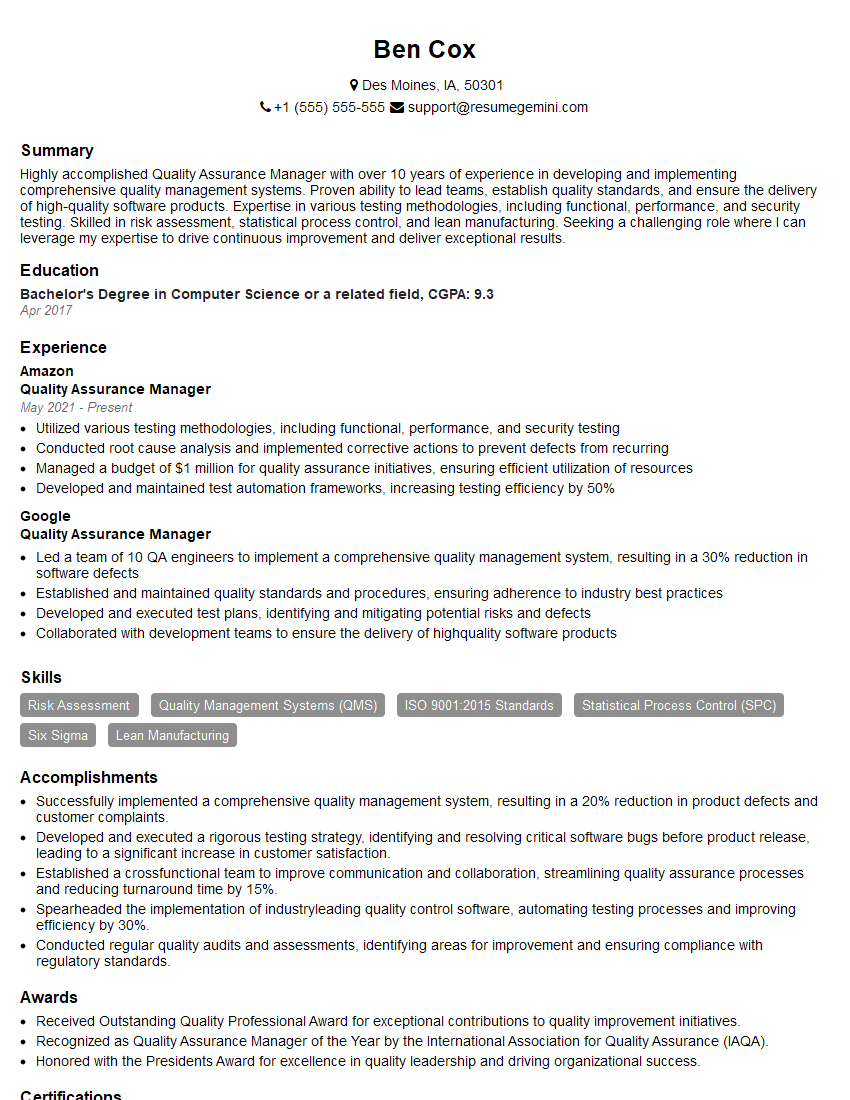
Quality Assurance Manager Resume Sample
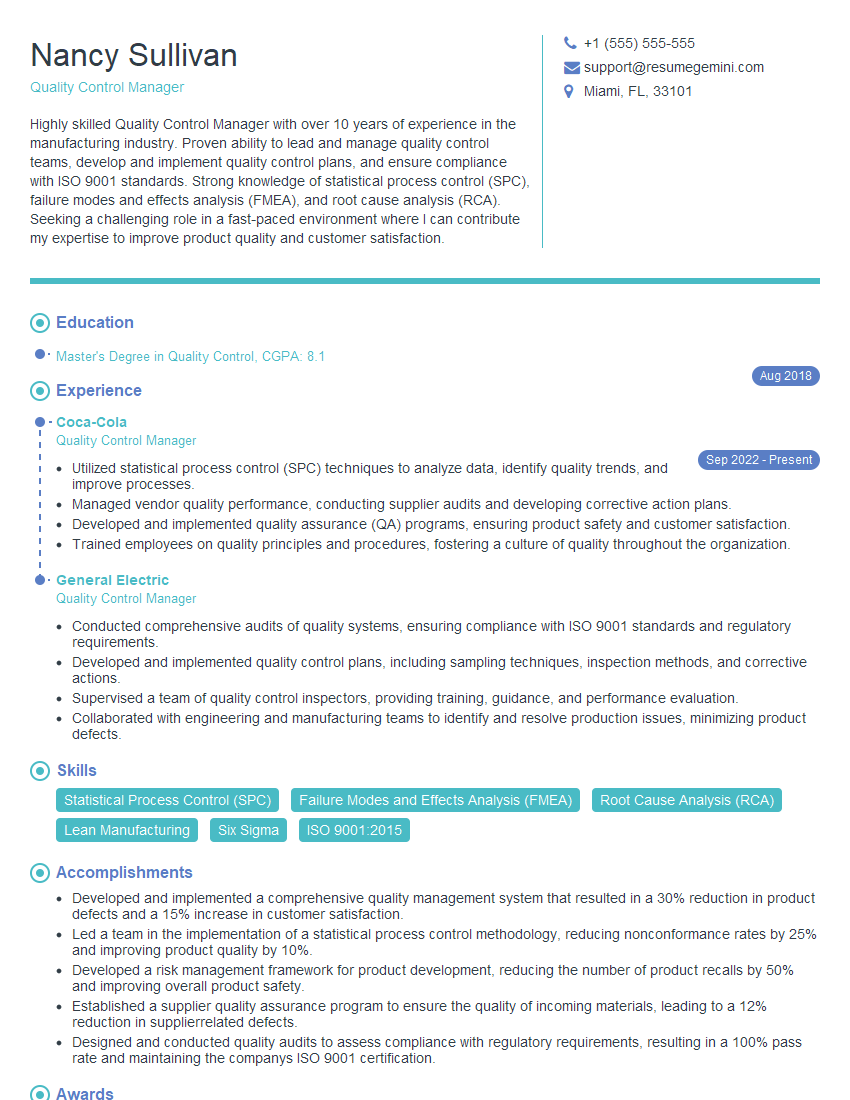
Quality Control Manager Resume Sample
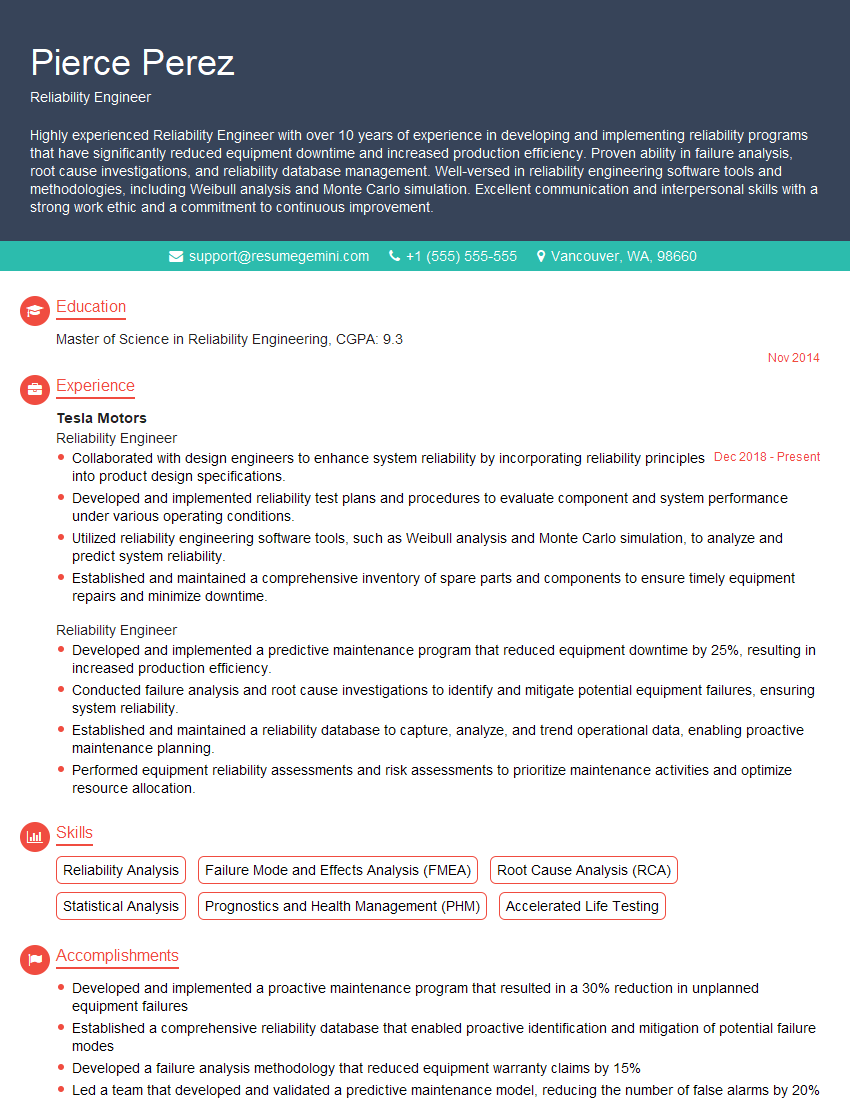
Reliability Engineer Resume Sample
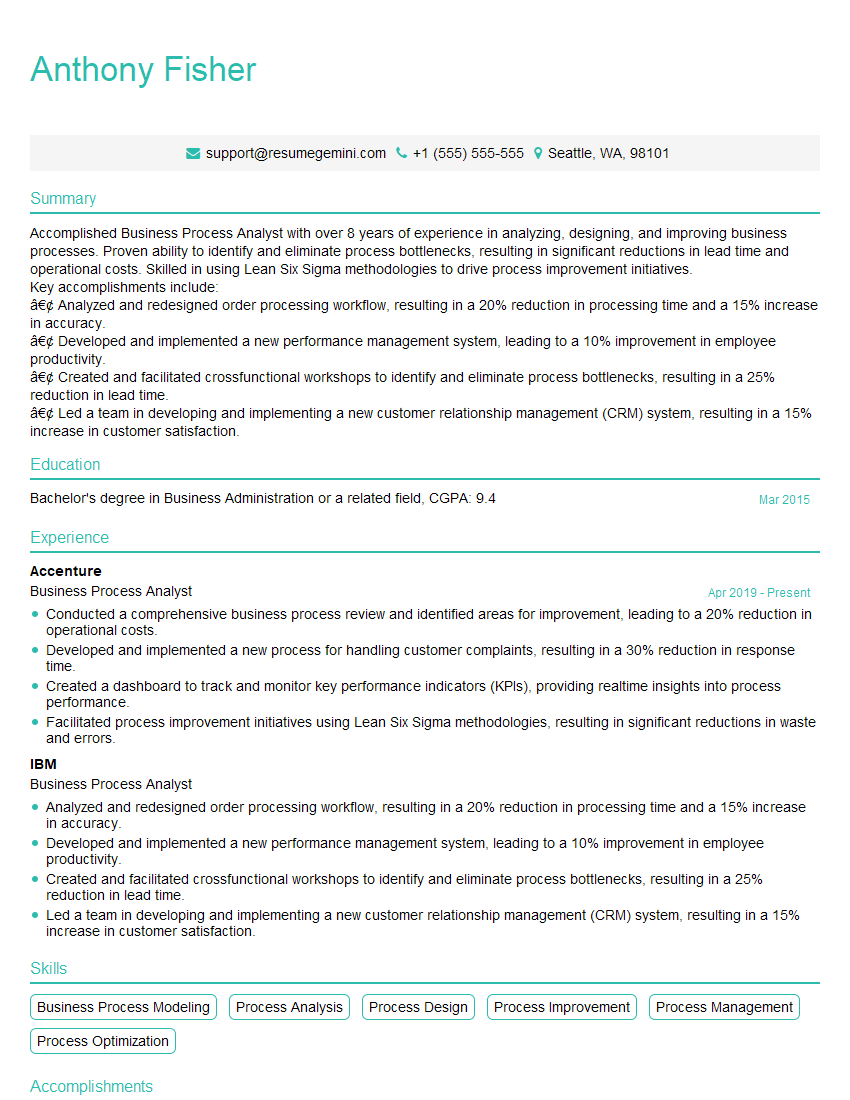
Business Process Analyst Resume Sample
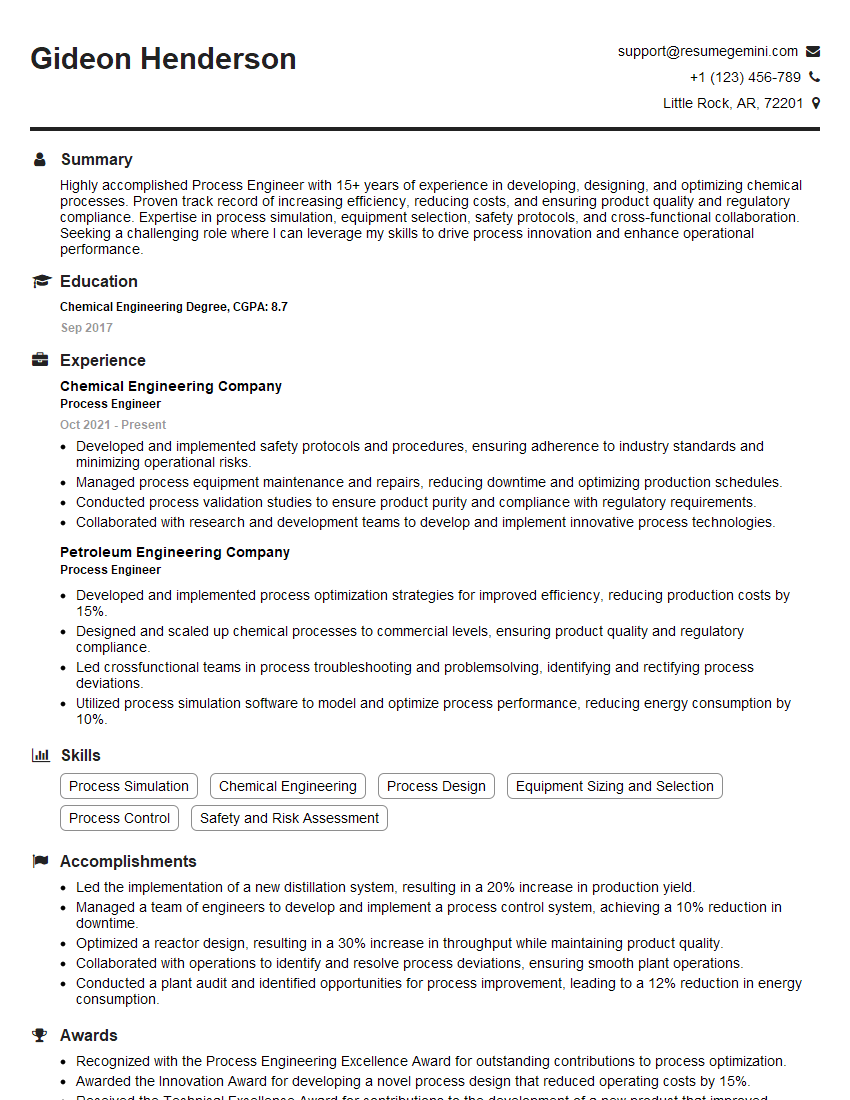
Process Engineer Resume Sample
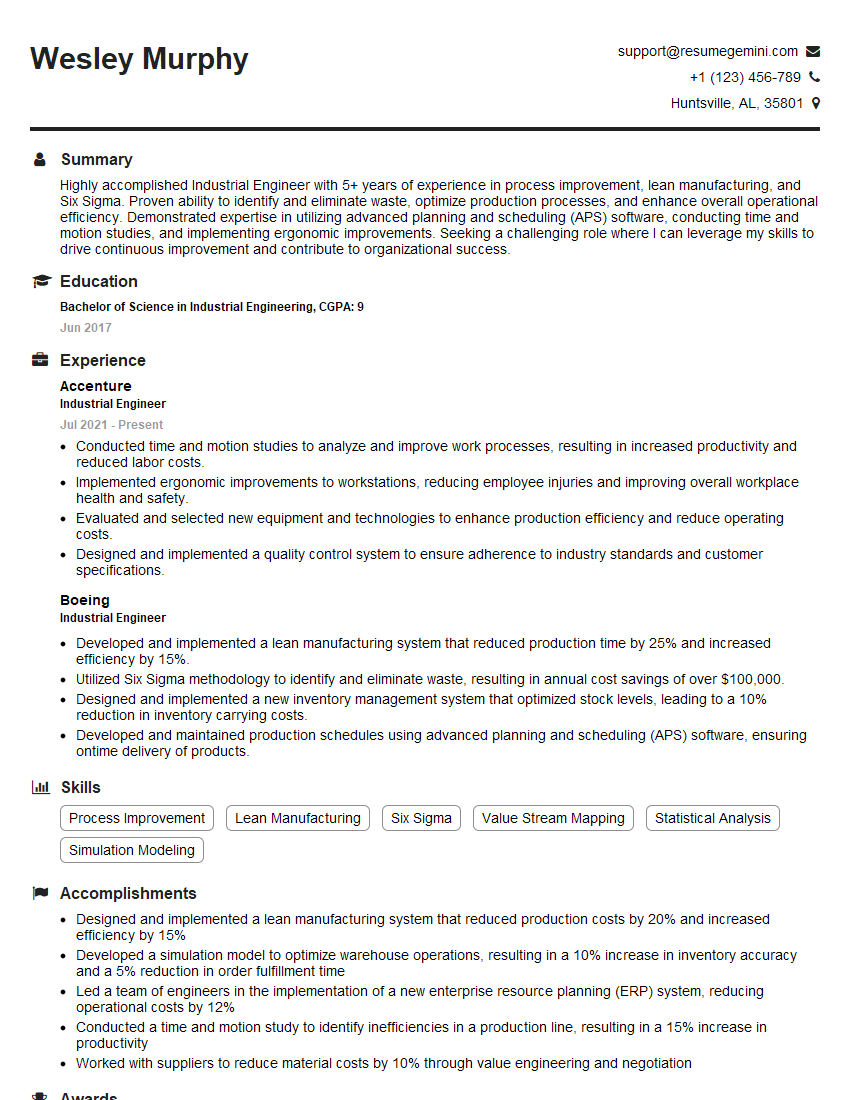
Industrial Engineer Resume Sample
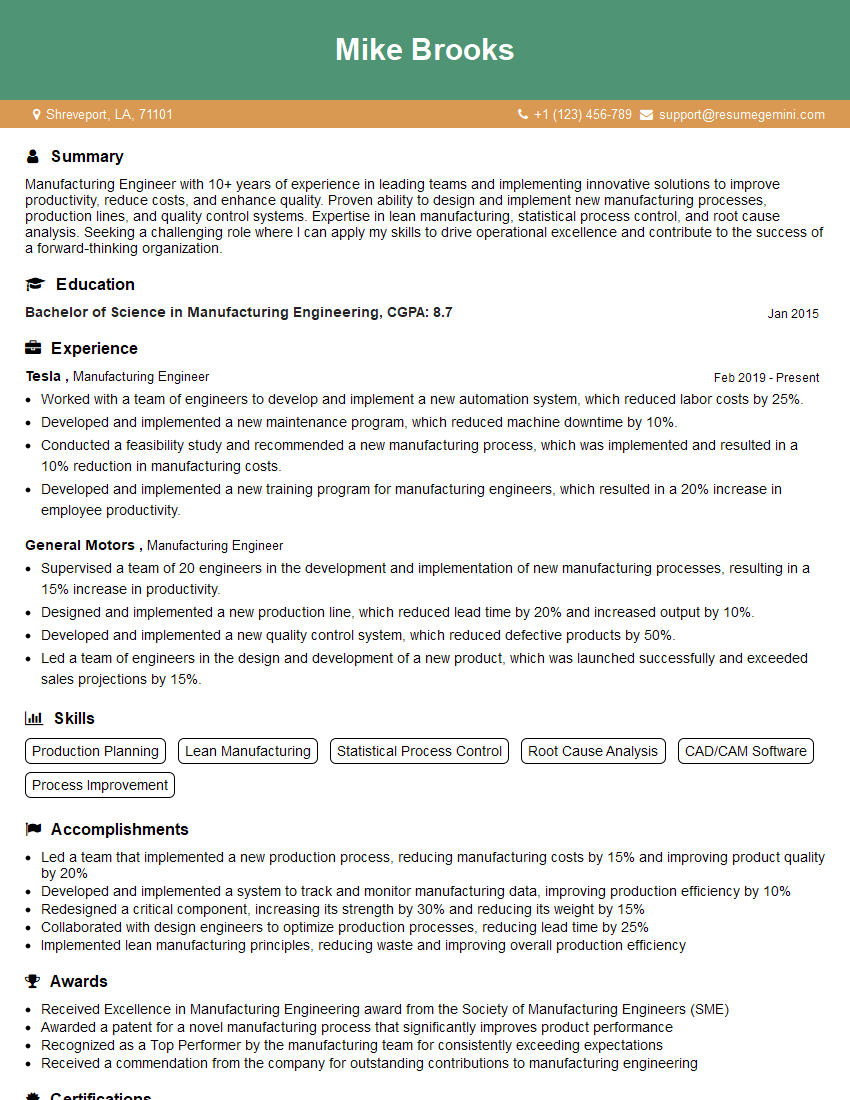
Manufacturing Engineer Resume Sample
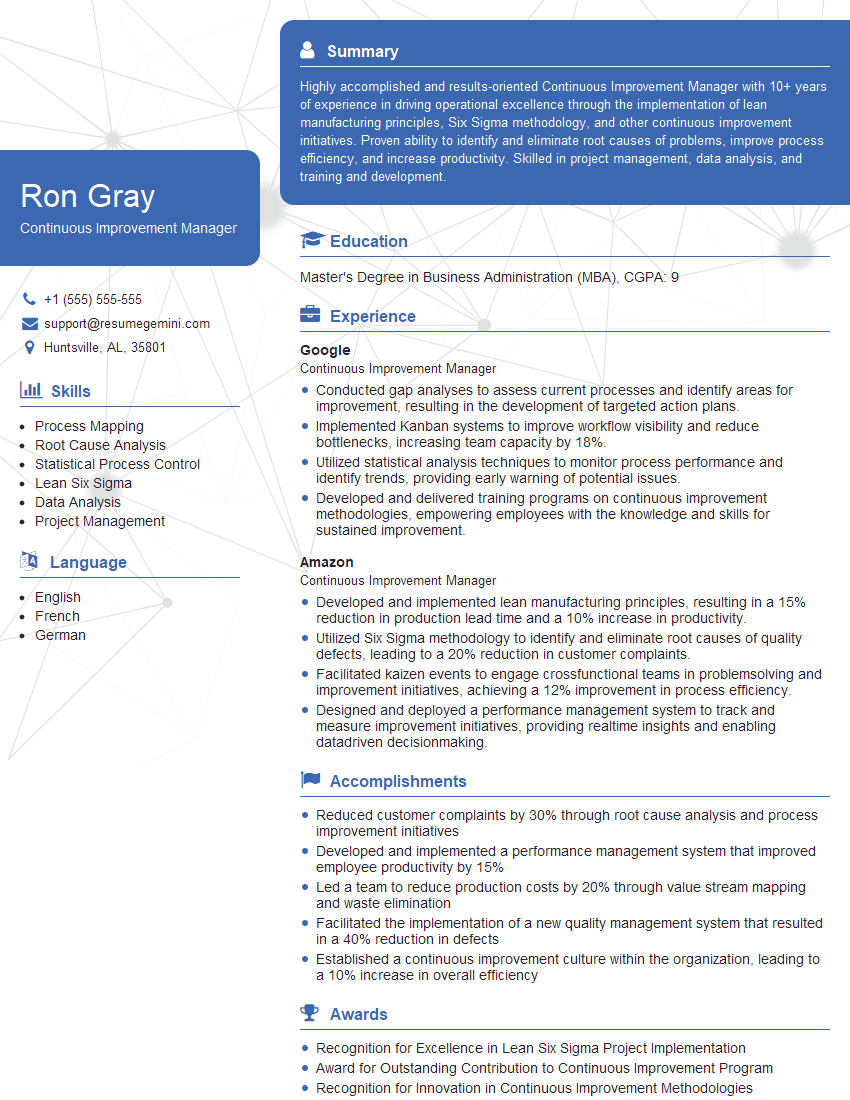
Continuous Improvement Manager Resume Sample
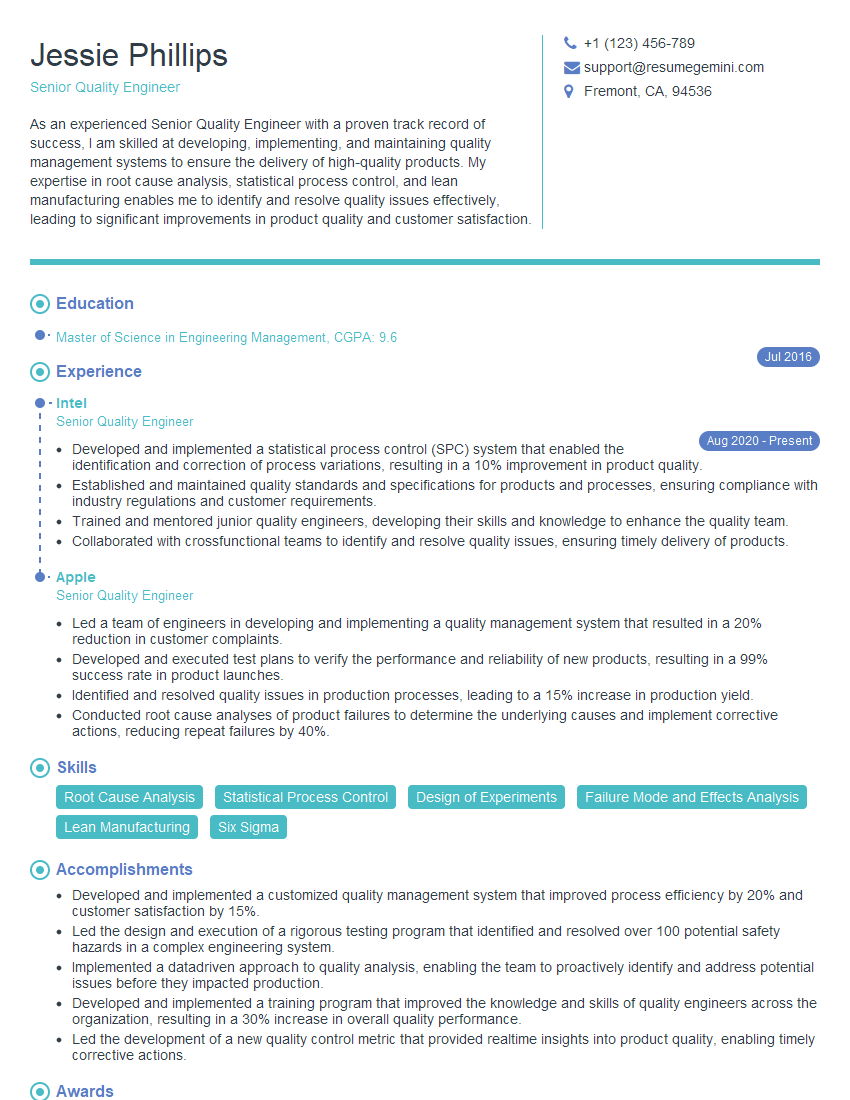
Senior Quality Engineer Resume Sample
Explore more articles
Users Rating of Our Blogs
Share Your Experience
We value your feedback! Please rate our content and share your thoughts (optional).
What Readers Say About Our Blog
Really detailed insights and content, thank you for writing this detailed article.
IT gave me an insight and words to use and be able to think of examples