Feeling uncertain about what to expect in your upcoming interview? We’ve got you covered! This blog highlights the most important Laser Optics interview questions and provides actionable advice to help you stand out as the ideal candidate. Let’s pave the way for your success.
Questions Asked in Laser Optics Interview
Q 1. Explain the concept of Gaussian beam propagation.
Gaussian beam propagation describes how the spatial profile of a laser beam, often modeled as a Gaussian function, evolves as it travels through space. Imagine throwing a perfectly round ball of clay – it won’t stay perfectly round forever, right? It’ll deform slightly due to air resistance. Similarly, a laser beam, even a perfectly Gaussian one initially, will change its shape and size as it propagates. This change is governed by the beam’s waist (its narrowest point), its wavelength, and the distance traveled.
A key parameter is the Rayleigh range (zR), which defines the distance over which the beam’s diameter roughly doubles. Beyond the Rayleigh range, the beam diverges significantly. The beam’s diameter (2w) at a distance z from the waist is given by:
2w(z) = 2w0√(1 + (z/zR)2)where w0 is the beam waist radius. This equation allows us to predict the beam size at any point along its propagation path, crucial for applications like laser machining or optical communication where precise beam focusing is paramount. Understanding Gaussian beam propagation is fundamental for designing optical systems and ensuring efficient laser energy delivery.
Q 2. Describe different types of laser cavities and their characteristics.
Laser cavities, also known as optical resonators, are essential components that provide feedback for laser operation. They ensure that light generated within the gain medium makes multiple passes, amplifying the light and creating coherent, monochromatic output. Several cavity types exist, each with unique characteristics:
- Fabry-Pérot Cavity: This is the most common type, consisting of two parallel mirrors that reflect light back and forth. The distance between mirrors determines the resonant frequencies, meaning only specific wavelengths will constructively interfere and amplify. The length of the cavity is a major determinant of the laser’s output wavelength. Think of it like a musical instrument – the length of the string dictates the pitch.
- Unstable Resonator: Unlike Fabry-Pérot, these cavities have mirrors with a geometry that causes the beam to expand significantly between reflections. They’re used to produce high-power lasers, as the diverging beam minimizes the chances of optical damage to the mirrors, even if the energy density is high.
- Ring Resonator: In this design, the light travels in a ring or loop path, which can offer advantages in terms of mode control and reducing back reflections.
- V-cavity: Using two mirrors oriented at an angle, offering a more compact cavity configuration compared to the Fabry-Pérot type. This configuration often results in better transverse mode stability.
The choice of cavity type depends on the specific application and desired laser characteristics, including output power, beam quality, and wavelength stability.
Q 3. What are the fundamental differences between HeNe, Nd:YAG, and CO2 lasers?
HeNe, Nd:YAG, and CO2 lasers represent distinct laser technologies with different characteristics, each suited for specific applications:
- HeNe Lasers: These gas lasers utilize a mixture of helium and neon gases. They are relatively low-power, produce visible red light (632.8 nm), and are known for their long coherence length – ideal for applications like holography and interferometry. They are simpler and less expensive but have lower power than other types.
- Nd:YAG Lasers: These solid-state lasers use a neodymium-doped yttrium aluminum garnet crystal as the gain medium. They can generate high power, either in continuous wave or pulsed modes, and operate in the near-infrared (1064 nm). Their high power and versatility make them suitable for applications like laser cutting, welding, and rangefinding.
- CO2 Lasers: These gas lasers use carbon dioxide as the gain medium. They produce high power in the infrared region (10.6 µm) and are well-suited for material processing applications like cutting, engraving, and welding, particularly of non-metallic materials. Their long wavelength leads to efficient interaction with many materials.
The key differences lie in their gain medium, operating wavelength, power capabilities, and application areas. The choice of laser depends entirely on the requirements of the task.
Q 4. Explain the concept of optical resonators and their importance in laser operation.
Optical resonators, or laser cavities, are crucial for laser operation because they provide positive feedback, leading to the amplification of light at specific wavelengths. Imagine a child on a swing – pushing at the right time enhances the swing’s amplitude. Similarly, the resonator ensures that light waves constructively interfere and amplify, leading to a laser beam.
The resonator consists of mirrors that reflect light back and forth through the gain medium (where light amplification occurs). Only certain wavelengths, determined by the resonator’s length and mirror reflectivity, will resonate effectively. These resonant wavelengths are amplified, leading to a coherent laser output. The resonator’s design significantly influences the laser’s characteristics, such as output power, beam quality, and wavelength stability. A well-designed resonator is crucial for creating a powerful and stable laser beam.
Q 5. How do you characterize the performance of a laser system?
Characterizing laser system performance involves measuring various parameters:
- Output Power: Measured in watts (W) or milliwatts (mW), this indicates the total energy emitted by the laser per unit time.
- Beam Quality: Expressed using the M2 factor (beam propagation factor), it describes how closely the beam resembles an ideal Gaussian beam. A lower M2 value indicates better beam quality.
- Wavelength/Frequency Stability: This refers to how consistently the laser emits light at a specific wavelength or frequency. Drift in wavelength can affect the laser’s applications.
- Beam Divergence: This describes how the beam spreads out as it propagates. A lower divergence means a more collimated beam.
- Temporal Characteristics: For pulsed lasers, this includes pulse duration, repetition rate, and pulse energy.
- Beam Profile: This shows the spatial distribution of the laser’s intensity. Ideally, a Gaussian profile is desired.
- Noise and Stability: Amplitude noise and intensity fluctuations can affect the performance of various systems.
The specific parameters to measure depend heavily on the application. For example, in precision laser surgery, beam quality and stability would be critical, while in laser cutting, output power might be the primary concern.
Q 6. Describe different types of optical fibers and their applications in laser systems.
Optical fibers play a critical role in transmitting laser light over long distances or guiding it within complex optical systems. Different fiber types exist, each optimized for specific applications:
- Single-Mode Fibers: These fibers have a core diameter small enough to only support a single transverse mode of light propagation, resulting in low dispersion and minimal signal distortion over long distances. Ideal for long-haul optical communication and applications demanding high bandwidth and low loss.
- Multi-Mode Fibers: These fibers have a larger core diameter, allowing multiple modes to propagate simultaneously. This leads to higher power-handling capacity, but also to increased signal distortion due to modal dispersion. Suitable for short-distance applications where bandwidth is less critical.
- Polarization-Maintaining Fibers: These fibers are designed to maintain the polarization state of the light, which is crucial for applications sensitive to polarization changes such as interferometry and certain types of optical sensing. They typically incorporate structural elements to minimize polarization scrambling.
- Specialty Fibers: This category encompasses fibers with customized properties, such as photonic crystal fibers, which offer unique light-guiding characteristics and applications in nonlinear optics and high-power laser delivery.
The choice of fiber type depends on factors like transmission distance, bandwidth requirements, and power levels.
Q 7. Explain the principles of optical beam shaping and its applications.
Optical beam shaping modifies the spatial intensity profile of a laser beam to match the requirements of a specific application. This is often necessary because lasers frequently emit beams with a Gaussian profile, which may not be optimal for all tasks. Imagine trying to use a magnifying glass with a very small spot to start a bonfire — it would be inefficient. Similarly, a laser beam needs appropriate shaping for optimal performance.
Techniques include using:
- Diffractive Optical Elements (DOEs): These elements, typically fabricated using micro-lithography, diffract the light to modify the beam’s shape. They can create flat-top beams, Gaussian beams with specific waists, or even custom beam profiles.
- Refractive Optical Elements (ROEs): These elements use lenses and other refractive components to shape the beam through refraction. This approach is usually less efficient than DOEs but can offer good flexibility.
- Micro-optical elements: Miniaturized lenses, mirrors, and other components are used to achieve more complex and intricate beam shaping, often for specialized applications like laser printing or medical imaging.
Applications of beam shaping include:
- Laser material processing: Creating uniform intensity profiles for efficient cutting or welding.
- Laser micromachining: Generating tightly focused beams for precise material ablation.
- Optical trapping: Creating specific intensity distributions to trap and manipulate microscopic particles.
- Laser scanning: Shaping the beam to optimize the scanning process.
The choice of beam shaping technique depends on factors such as desired beam profile, power handling, cost, and complexity.
Q 8. What are different types of optical modulators and their working principles?
Optical modulators are devices that control the intensity, phase, or polarization of a laser beam. Think of them as light switches or dimmer switches for lasers, allowing us to precisely manipulate the light’s properties. Different types achieve this modulation through various mechanisms:
- Electro-optic modulators (EOMs): These utilize the electro-optic effect, where an applied electric field changes the refractive index of a material (like lithium niobate or potassium dihydrogen phosphate). This alters the phase or polarization of the light passing through. A common example is a Mach-Zehnder interferometer used for intensity modulation.
- Acousto-optic modulators (AOMs): These rely on the acousto-optic effect, where sound waves (created by a piezoelectric transducer) create a periodic variation in the refractive index of a material (like fused silica or tellurium dioxide). This diffracts the light, allowing for intensity and frequency modulation. They are often used for fast switching and Q-switching in lasers.
- Magneto-optic modulators (MOMs): These use the Faraday effect, where an applied magnetic field rotates the polarization of light passing through a material (like terbium gallium garnet). This is frequently used in optical isolators to prevent unwanted reflections back into the laser source, preventing damage.
- Mechanical modulators: These are simpler devices, like rotating waveplates or shutters, which physically block or alter the light path. While less precise and fast than other types, they are often cost-effective for some applications.
The choice of modulator depends critically on the application. For high-speed modulation, EOMs or AOMs are preferred. For simpler on/off switching, a mechanical shutter might suffice. For example, in telecommunications, EOMs are crucial for high-speed data transmission; in laser scanning systems, AOMs enable precise beam deflection.
Q 9. How do you design an optical system for a specific laser application?
Designing an optical system for a specific laser application is an iterative process requiring a deep understanding of both laser physics and optical engineering. It begins with a thorough definition of the application’s requirements. Let’s consider designing an optical system for laser cutting:
- Define specifications: Determine the desired cutting speed, material thickness, required laser power, beam quality (M2), and focal spot size.
- Choose laser source: Select a laser type (CO2, fiber, or solid-state) based on material properties and cutting requirements. CO2 lasers are well-suited for many materials, while fiber lasers excel in metal cutting.
- Optical design: Select appropriate lenses and mirrors to achieve the desired spot size and working distance. Consider factors like focal length, numerical aperture, and chromatic aberrations. Ray tracing software (Zemax, Code V) is invaluable here to model and optimize the system.
- Beam delivery system: Design the beam path, including mirrors, beam expanders, and focusing lenses, considering alignment stability and potential thermal effects. For long-distance delivery, you might need specialized fiber optic delivery systems.
- Safety considerations: Implement safety measures like beam enclosures, safety interlocks, and appropriate laser safety eyewear, complying with all relevant regulations (e.g., ANSI Z136.1).
- Testing and optimization: Rigorously test the system, measuring spot size, power, and cutting performance. Fine-tune the design based on experimental results.
Designing an optical system is not just about choosing components; it’s about understanding how these components interact, addressing potential challenges, and iteratively refining the design for optimal performance and safety.
Q 10. Explain the concept of laser safety and relevant safety regulations.
Laser safety is paramount. Lasers emit coherent and monochromatic light, which can cause serious eye and skin damage. The severity depends on factors such as wavelength, power, exposure time, and beam divergence. Laser safety regulations, like ANSI Z136.1 in the US and IEC 60825 internationally, provide guidelines for safe laser use. These regulations categorize lasers based on their hazard potential (Class 1 to Class 4), with Class 4 representing the most hazardous. Key safety aspects include:
- Laser classification and labeling: Proper labeling of lasers is essential to identify their hazard class and potential risks.
- Eye protection: Using appropriate laser safety eyewear specific to the laser’s wavelength and power is critical to prevent eye injury.
- Beam enclosure and shielding: Enclosing the laser beam path with appropriate barriers helps prevent accidental exposure.
- Control measures: Implementing safety interlocks, key switches, and warning signs to prevent unauthorized access and accidental activation.
- Training and procedures: Providing proper training to personnel handling lasers on safe operating procedures and emergency response is crucial.
- Environmental considerations: Ensuring that laser radiation does not pose a risk to the surrounding environment.
Ignoring laser safety can lead to severe consequences, from temporary blindness to permanent eye damage. Adherence to safety regulations is not merely a recommendation; it’s a necessity.
Q 11. What are the common laser damage mechanisms in optical components?
Laser damage in optical components is a significant concern, often leading to performance degradation or catastrophic failure. The mechanisms are complex and depend on laser parameters (wavelength, pulse duration, fluence) and material properties. Common mechanisms include:
- Linear absorption: The light’s energy is absorbed by the material, causing heating and potentially melting or cracking. Impurities or defects in the material increase the susceptibility to this type of damage.
- Nonlinear absorption (multiphoton absorption): At high intensities, multiple photons are simultaneously absorbed, leading to a rapid increase in energy deposition, causing damage even in materials that are transparent at lower intensities.
- Avalanche ionization: Free electrons generated by initial absorption gain energy and create more free electrons through collisions, resulting in a cascade effect and rapid damage.
- Self-focusing: Intense laser beams can change the refractive index of the material, causing self-focusing and increased intensity at the focal point, leading to localized damage.
- Thermal stress fracture: Rapid heating of the material can cause thermal expansion and create stress, leading to cracking or fracture.
To mitigate laser damage, one must choose materials with high damage thresholds at the relevant wavelength and pulse duration, carefully control laser fluence, and maintain excellent optical surface quality. Techniques such as anti-reflection coatings and surface treatments can enhance durability.
Q 12. How do you align and test an optical system using laser interferometry?
Laser interferometry is a powerful technique for aligning and testing optical systems with high precision. It uses the interference pattern created by two beams of light to measure extremely small distances and angles. Here’s how it’s applied:
- Setup: A stable laser source (e.g., HeNe laser) is used. The beam is split into two paths: one reflecting off a reference mirror and the other reflecting off the component being aligned or tested.
- Interference pattern observation: The two beams are recombined, creating an interference pattern (fringes). The position and spacing of these fringes depend on the relative path lengths of the two beams.
- Alignment: By observing the interference pattern, small adjustments are made to the component’s position until the desired alignment is achieved (e.g., maximizing constructive interference or minimizing fringe spacing). Piezoelectric actuators often provide the fine adjustments needed.
- Testing: Once aligned, the interferometer can measure the flatness of optical surfaces, the parallelism of components, and the stability of the optical system. The fringe pattern provides a quantitative measure of deviations from the ideal.
- Data analysis: Software can analyze the interferograms to extract quantitative data on surface quality, wavefront distortions, and other relevant parameters.
Laser interferometry is crucial in high-precision applications such as lithography, metrology, and gravitational wave detection, enabling sub-nanometer alignment accuracy.
Q 13. Describe different types of optical detectors and their sensitivities.
Optical detectors convert light into an electrical signal. Various types exist, each with its own sensitivity characteristics and suitability for different applications:
- Photodiodes: These semiconductor devices generate a current proportional to the incident light intensity. They offer good sensitivity across a broad range of wavelengths and are widely used in many applications. Silicon photodiodes are common for visible and near-infrared light.
- Photomultiplier tubes (PMTs): These extremely sensitive detectors amplify the signal generated by a single photon, making them ideal for low-light applications like fluorescence microscopy or astronomy. However, they are more expensive and require high voltage.
- Charge-coupled devices (CCDs): These are arrays of photodiodes that capture an image. They provide high spatial resolution and are used in imaging systems, spectroscopy, and astronomical observations.
- Avalanche photodiodes (APDs): These are highly sensitive photodiodes that use internal gain to amplify the signal, offering improved performance in low-light conditions compared to standard photodiodes.
- Bolometers: These are thermal detectors that measure the heat generated by absorbed light. They have a slower response time than other detectors but can operate over a wide spectral range, including far-infrared.
The sensitivity of a detector is usually expressed as responsivity (current or voltage per unit optical power) or detectivity (a measure of signal-to-noise ratio). The choice of detector depends on factors like required sensitivity, spectral range, response time, and cost.
Q 14. Explain the concept of optical aberrations and how to mitigate them.
Optical aberrations are imperfections in the image formed by an optical system. They cause distortions and blurring, reducing the quality and resolution of the image. Common aberrations include:
- Spherical aberration: Rays passing through different zones of a spherical lens do not converge at a single point.
- Chromatic aberration: Different wavelengths of light are refracted differently, leading to color fringes.
- Coma: Off-axis points are imaged as comet-shaped blur.
- Astigmatism: Different orientations of light rays are focused at different points.
- Field curvature: The image plane is curved rather than flat.
- Distortion: The magnification varies across the field of view.
Mitigation strategies include:
- Careful lens design: Aspheric lenses, which have non-spherical surfaces, can correct spherical aberration. Achromatic doublets, consisting of lenses made of different materials, can correct chromatic aberration.
- Optical design software: Ray tracing programs help optimize lens designs to minimize aberrations.
- Aperture stops: Reducing the aperture (diameter of the beam) can reduce the severity of some aberrations, but at the cost of reduced light throughput.
- Holographic optical elements (HOEs): HOEs can be designed to correct for a wide range of aberrations.
Understanding and correcting for optical aberrations is vital for achieving high-quality images in a wide array of applications, from microscopy to telescopes.
Q 15. What are different types of laser scanning techniques and their applications?
Laser scanning techniques involve moving a laser beam across a surface to acquire data. Different methods exist, each suited to specific applications.
- Raster Scanning: Similar to how a television displays an image, the laser beam systematically sweeps across the target area line by line. This is commonly used in laser printers, barcode scanners, and medical imaging (like retinal scans).
- Vector Scanning: The laser beam directly follows the contours of the object being scanned. This is more efficient for scanning complex shapes and is used in 3D laser scanners for rapid prototyping and reverse engineering.
- Spinning Polygon Scanners: A rotating polygon with mirrored facets reflects the laser beam, creating a rapidly moving scan line. This is a cost-effective solution frequently used in laser shows and large-format laser printing.
- Resonant Scanners: These utilize galvanometric mirrors vibrating at high frequencies to achieve high-speed scanning, particularly useful in laser marking and high-resolution imaging applications.
- Time-of-Flight Scanning: This technique measures the time it takes for a laser pulse to travel to a surface and return, providing 3D information about the target’s geometry. It finds application in autonomous vehicles and robotics.
The choice of technique depends heavily on the required speed, resolution, accuracy, and the nature of the object being scanned.
Career Expert Tips:
- Ace those interviews! Prepare effectively by reviewing the Top 50 Most Common Interview Questions on ResumeGemini.
- Navigate your job search with confidence! Explore a wide range of Career Tips on ResumeGemini. Learn about common challenges and recommendations to overcome them.
- Craft the perfect resume! Master the Art of Resume Writing with ResumeGemini’s guide. Showcase your unique qualifications and achievements effectively.
- Don’t miss out on holiday savings! Build your dream resume with ResumeGemini’s ATS optimized templates.
Q 16. Describe different techniques for laser beam diagnostics.
Laser beam diagnostics are crucial for ensuring optimal performance and safety in laser systems. Several techniques exist to characterize a laser beam’s properties:
- Power Measurement: Using power meters or calorimeters to measure the total optical power emitted by the laser.
- Beam Profiling: Techniques like knife-edge scanning, CCD cameras, and other beam profilers capture the spatial distribution of the beam’s intensity. This reveals the beam’s shape, size, and quality (e.g., Gaussian, top hat). These are used to identify irregularities like astigmatism or higher-order modes.
- Beam Divergence Measurement: Determining the rate at which the beam spreads out as it propagates. This is important for applications requiring long propagation distances, like laser communication.
- Wavelength Measurement: Using spectrometers or optical spectrum analyzers to determine the precise wavelength and spectral width of the laser emission. Critical for applications sensitive to spectral purity, like laser spectroscopy.
- M2 Factor Measurement: This parameter quantifies the deviation of a beam from an ideal Gaussian beam. A lower M2 value indicates a higher-quality beam, crucial for precise applications like laser surgery or material processing.
- Polarization Measurement: Analyzing the polarization state of the laser beam using polarizers and analyzers, relevant for applications requiring specific polarization states, such as optical fiber communication.
The specific diagnostic techniques employed depend heavily on the application and the characteristics of the laser source.
Q 17. Explain the principle of holography and its applications.
Holography is a technique for recording and reconstructing a three-dimensional image of an object using coherent light, usually a laser. It captures both the amplitude and phase information of the light wave scattered from the object.
The process involves creating an interference pattern between a reference beam and an object beam. The interference pattern is recorded on a photosensitive medium (e.g., holographic film). When illuminated by the reference beam (or a similar one), the recorded interference pattern diffracts the light, reconstructing the original wavefront and thus generating a three-dimensional image of the object.
- Applications: Holography finds use in various fields:
- Security: Holographic labels and security features on credit cards and documents.
- Data Storage: High-density data storage.
- Microscopy: Holographic microscopy for high-resolution imaging.
- Art and Displays: Creating striking 3D displays and art pieces.
- Non-destructive Testing (NDT): Holographic interferometry to detect minute changes in the shape or displacement of an object.
Think of it like capturing a ‘fingerprint’ of the light wave scattered by the object, allowing us to recreate the wave and ‘see’ the object even if it’s no longer present.
Q 18. What are different types of optical coatings and their applications in laser systems?
Optical coatings are thin layers of materials deposited on optical components (lenses, mirrors, windows) to modify their optical properties. These coatings are essential for optimizing laser systems’ performance and durability.
- Anti-reflection (AR) Coatings: Reduce unwanted reflections at surfaces, maximizing transmission and minimizing losses. These are crucial for laser cavities and beam delivery systems. Example: A single-layer AR coating on a lens reduces reflection from ~4% to ~1%.
- High-reflection (HR) Coatings: Maximize reflectivity at a specific wavelength, crucial for laser cavities and creating optical resonators. These are designed to achieve >99% reflectivity at a certain wavelength. Many layers are typically used to achieve this high reflectivity.
- Dichroic Coatings: Reflect specific wavelengths while transmitting others, commonly used in laser systems to separate different wavelengths or filter unwanted radiation. They find applications in lasers that generate multiple wavelengths.
- Polarizing Coatings: Transmit or reflect light based on its polarization state. These are crucial in polarization-sensitive optical systems. Applications include optical isolators and polarization controllers.
- Protective Coatings: Shield optical components from environmental factors (dust, moisture, scratches) and extend their lifespan. These are particularly important in harsh industrial or outdoor environments.
The specific type of coating used depends on the application’s needs. For instance, a high-power laser system might require highly durable protective coatings along with high-reflection coatings for the cavity mirrors.
Q 19. How do you calculate the spot size of a Gaussian beam?
The spot size of a Gaussian beam is defined by its 1/e2 diameter (or radius), which is the diameter at which the intensity falls to 1/e2 (approximately 13.5%) of its peak value.
The spot size (ω) at a distance z from the beam waist (ω0) is given by:
ω(z) = ω0√[1 + (z/zR)2]Where:
- ω(z) is the spot size at distance z
- ω0 is the beam waist radius (spot size at the beam’s narrowest point)
- z is the distance from the beam waist
- zR is the Rayleigh range, given by zR = πω02/λ, where λ is the wavelength of the laser.
To calculate the spot size, you need to know the beam waist radius (ω0) and the distance from the beam waist (z). The Rayleigh range helps determine how quickly the beam expands as it propagates.
For example, if ω0 = 1 mm, λ = 633 nm (He-Ne laser), and z = 1 meter, you can calculate zR and then use the formula to find ω(z).
Q 20. Explain the concept of laser speckle and its reduction techniques.
Laser speckle is a granular interference pattern that appears when coherent laser light is scattered from a rough surface. It’s a random interference pattern caused by the superposition of many scattered waves with varying phases.
The appearance of speckle can be detrimental to many applications requiring uniform illumination or high-quality imaging. For example, in laser scanning microscopy, speckle noise can obscure subtle details in the sample. In laser projection systems, it reduces image quality.
- Speckle Reduction Techniques: Several methods can mitigate speckle:
- Spatial Filtering: Using a rotating diffuser or ground glass to randomize the phase of the laser light before it interacts with the object.
- Temporal Speckle Reduction: Employing techniques like rapidly moving the laser beam, shifting the frequency of the laser, or using a multimode laser to average out the speckle pattern over time.
- Enhancing Surface Roughness: Increasing the roughness of the surface scattering the laser light can reduce the coherence of the scattered waves, thereby reducing speckle.
- Digital Speckle Pattern Interferometry (DSPI): Using image processing techniques to subtract speckle patterns captured under slightly different conditions, enabling accurate measurements of object deformation or displacement.
The choice of speckle reduction technique depends on the application’s constraints and the specific characteristics of the laser and the scattering surface.
Q 21. Describe the working principle of a fiber optic gyroscope.
A fiber optic gyroscope (FOG) measures angular rotation using the Sagnac effect. This effect describes the phase shift experienced by light traveling in opposite directions around a closed loop as the loop rotates.
In an FOG, a light source (typically a laser) is split into two beams, which travel in opposite directions through a coil of optical fiber. When the coil rotates, the beams experience a different path length due to the Sagnac effect, leading to a phase difference between them. This phase difference is proportional to the rotation rate.
A photodetector measures the interference between the two beams. The phase difference is extracted from the interference signal, allowing determination of the rotation rate. FOGs are highly sensitive, compact, and robust, making them suitable for various applications, including navigation systems (in aircrafts, ships, and automobiles), inertial measurement units (IMUs), and stabilization systems for cameras and telescopes.
Compared to traditional mechanical gyroscopes, FOGs offer advantages in terms of size, weight, reliability, and precision. The sensitivity and accuracy of FOGs are determined by factors such as the length of the fiber coil, the wavelength of the laser, and the signal processing techniques used.
Q 22. Explain the concept of optical coherence tomography (OCT) and its applications.
Optical Coherence Tomography (OCT) is a non-invasive imaging technique that uses low-coherence interferometry to acquire high-resolution, cross-sectional images of internal microstructure. Think of it like an ultrasound, but using light instead of sound waves. A light source, typically a superluminescent diode (SLD), emits a broad spectrum of light. This light is split into two beams: one that travels to a reference mirror and another that travels into the sample. The reflected light from both paths is then recombined. Because the light source has a short coherence length (meaning it only interferes constructively over short distances), only light reflected from corresponding depths within the sample and reference arm will interfere constructively. By varying the path length of the reference arm, we can scan through the sample depth and build up a cross-sectional image.
OCT’s applications are diverse and span various fields. In ophthalmology, it’s used to image the retina and anterior segment of the eye, allowing for early detection of diseases like macular degeneration and glaucoma. In cardiology, OCT can visualize plaque buildup in arteries, assisting in the diagnosis and treatment of coronary artery disease. Other applications include dermatology (skin imaging), dentistry (imaging of teeth and gums), and even material science (characterization of microstructure). The ability to obtain high-resolution, three-dimensional images without tissue damage makes OCT an invaluable tool in these fields.
Q 23. How do you design an experiment to measure the wavelength of a laser?
Measuring a laser’s wavelength can be done using several techniques, but a classic and highly accurate method is diffraction grating spectroscopy. The experiment involves shining the laser beam onto a diffraction grating, which is a component with many closely spaced parallel slits. The grating diffracts the light into multiple orders, creating a diffraction pattern on a screen or detector. The angular position of the diffracted beams is directly related to the wavelength of the light, following the grating equation: d sinθ = mλ, where ‘d’ is the grating spacing, ‘θ’ is the diffraction angle, ‘m’ is the diffraction order (an integer), and ‘λ’ is the wavelength.
Experiment setup:
1. Set up a stable optical bench with a laser source and a diffraction grating mounted on a rotatable stage.
2. Place a screen or a position-sensitive detector at a known distance from the grating.
3. Carefully align the laser beam to be incident normally onto the grating.
4. Observe the diffraction pattern and measure the angular positions of the diffracted beams (typically the first order, m=1, is sufficient).
5. Knowing the grating spacing ‘d’, calculate the wavelength ‘λ’ using the grating equation.
Multiple measurements and averaging should be performed to reduce error. The accuracy of the measurement depends on the accuracy of the grating spacing, the angular measurement, and the distance to the screen.
Q 24. What are the different types of nonlinear optical effects?
Nonlinear optical effects arise when the response of a material to an intense light field is no longer proportional to the strength of the field. These effects typically require high light intensities, often achieved using pulsed lasers. Some key examples include:
- Second-Harmonic Generation (SHG): Two photons of the same frequency combine to create a single photon with double the frequency (and half the wavelength). This is only allowed in non-centrosymmetric materials. Used in frequency doubling lasers and microscopy.
- Third-Harmonic Generation (THG): Three photons combine to create a photon with triple the frequency. Used in microscopy and high-order harmonic generation (HHG).
- Sum-Frequency Generation (SFG): Two photons of different frequencies combine to generate a photon with a frequency equal to the sum of the two input frequencies. Used for surface characterization and spectroscopy.
- Difference-Frequency Generation (DFG): Similar to SFG, but the output frequency is the difference between the input frequencies. Used in tunable infrared light sources.
- Stimulated Raman Scattering (SRS): Light interacts with molecular vibrations, resulting in a shift in the frequency of the light. Used in spectroscopy and microscopy.
- Optical Kerr Effect: The refractive index of a material changes in response to an intense electric field. Used in optical modulators and switches.
These are just some examples. The specific nonlinear effect observed depends on the material’s properties, the laser’s wavelength and intensity, and the experimental setup.
Q 25. Explain the principles of laser induced breakdown spectroscopy (LIBS).
Laser-Induced Breakdown Spectroscopy (LIBS) is an analytical technique that uses a pulsed laser to ablate a small amount of material from a sample. The resulting plasma is then analyzed spectroscopically to determine the elemental composition of the sample. Imagine a tiny controlled explosion on the sample’s surface generating light that reveals the chemical fingerprints of the material.
Principles:
1. Ablation: A high-intensity pulsed laser interacts with the sample, leading to rapid heating and the formation of a plasma plume containing ionized atoms and molecules.
2. Plasma Emission: The excited atoms and ions in the plasma relax to their ground state, emitting light at characteristic wavelengths specific to each element.
3. Spectroscopic Analysis: This emitted light is collected and analyzed using a spectrometer to identify the elements present and determine their concentrations. The intensity of the emitted light at a particular wavelength is directly proportional to the concentration of the corresponding element.
LIBS finds application in various fields like environmental monitoring (soil and water analysis), material science (compositional analysis of alloys), art conservation (analysis of pigments), and even planetary exploration (analysis of geological samples).
Q 26. How do you choose the appropriate laser source for a specific application?
Choosing the appropriate laser source for a specific application requires careful consideration of several factors:
- Wavelength: Different wavelengths interact differently with materials. UV lasers are often used for photolithography, while infrared lasers are suitable for laser surgery or remote sensing.
- Pulse duration: Continuous-wave (CW) lasers are ideal for applications requiring continuous illumination, whereas pulsed lasers are better suited for high-intensity processes like LIBS or material processing. The choice depends on the timescale of the interaction.
- Power and energy: The required power or energy depends on the application. High-power lasers are needed for material processing, while low-power lasers are sufficient for optical sensing or microscopy.
- Beam quality: The quality of the beam determines the precision and focusability of the laser. High beam quality is crucial for applications requiring fine focusing or precise material processing.
- Cost and maintainability: Different laser types have varying costs and maintenance requirements. The choice should balance performance with budget constraints and technical expertise.
For example, a high-power pulsed Nd:YAG laser might be appropriate for cutting metal, while a low-power HeNe laser could be sufficient for a simple alignment task in an optical system. Careful consideration of these factors ensures the selection of the optimal laser for the given task.
Q 27. Explain the concept of stimulated emission and population inversion.
Stimulated emission is the process where an incoming photon interacts with an excited atom, causing the atom to release a second photon with the same frequency, phase, polarization, and direction as the incoming photon. This is in contrast to spontaneous emission, where an excited atom releases a photon randomly. Imagine it like a perfectly synchronized choir: the incoming photon acts as the conductor, causing all the excited atoms to sing in unison.
Population inversion is a necessary condition for lasing. It refers to a state where the number of atoms in an excited state exceeds the number of atoms in the ground state. This is not a natural state; energy needs to be pumped into the system to achieve it. Only when population inversion exists can stimulated emission dominate over absorption, leading to amplification of light and the generation of a laser beam. Without population inversion, more photons would be absorbed than emitted, resulting in attenuation rather than amplification.
Q 28. Describe your experience with laser safety protocols and procedures.
Throughout my career, I have consistently adhered to strict laser safety protocols and procedures. My experience encompasses all aspects of laser safety, from risk assessment and hazard control to the implementation of safety measures and the training of personnel. I am familiar with various laser safety standards such as ANSI Z136.1.
This includes:
• Risk assessments: Conducting thorough risk assessments to identify potential laser hazards based on factors like laser class, power, wavelength, and application.
• Engineering controls: Implementing safety measures such as beam enclosures, interlocks, and safety eyewear appropriate to the laser class and potential hazards.
• Administrative controls: Establishing standard operating procedures (SOPs), creating laser safety signage, and providing comprehensive training to all personnel working with lasers.
• Personal protective equipment (PPE): Ensuring that appropriate eye protection and other PPE are utilized, and that they are properly maintained and inspected.
• Emergency procedures: Developing and practicing emergency procedures for laser-related incidents, including protocols for emergency shutdown and first aid.
I have personally overseen the implementation of these protocols in various laser labs and research settings, and I am confident in my ability to ensure a safe working environment for everyone around lasers.
Key Topics to Learn for Laser Optics Interview
- Laser Fundamentals: Understand laser principles, including stimulated emission, population inversion, and different types of lasers (e.g., gas, solid-state, semiconductor).
- Optical Resonators: Learn about the design and characteristics of optical resonators, their impact on laser beam quality (e.g., TEM modes), and stability analysis.
- Laser Beam Propagation: Master the concepts of Gaussian beam propagation, beam divergence, and focusing techniques, including the use of lenses and optical components.
- Nonlinear Optics: Explore nonlinear optical effects relevant to laser systems, such as frequency doubling, harmonic generation, and optical parametric oscillation.
- Laser Applications: Familiarize yourself with practical applications of laser optics in various fields, including telecommunications, materials processing, medicine, and sensing. Be prepared to discuss specific examples and their underlying principles.
- Optical Design and Instrumentation: Gain a solid understanding of optical design software and common optical instruments used in laser systems, such as optical spectrometers and interferometers.
- Laser Safety and Regulations: Understand laser safety regulations and protocols to ensure safe handling and operation of laser systems.
- Problem-Solving in Laser Optics: Practice solving problems related to laser beam parameters, optical system design, and troubleshooting common laser-related issues.
Next Steps
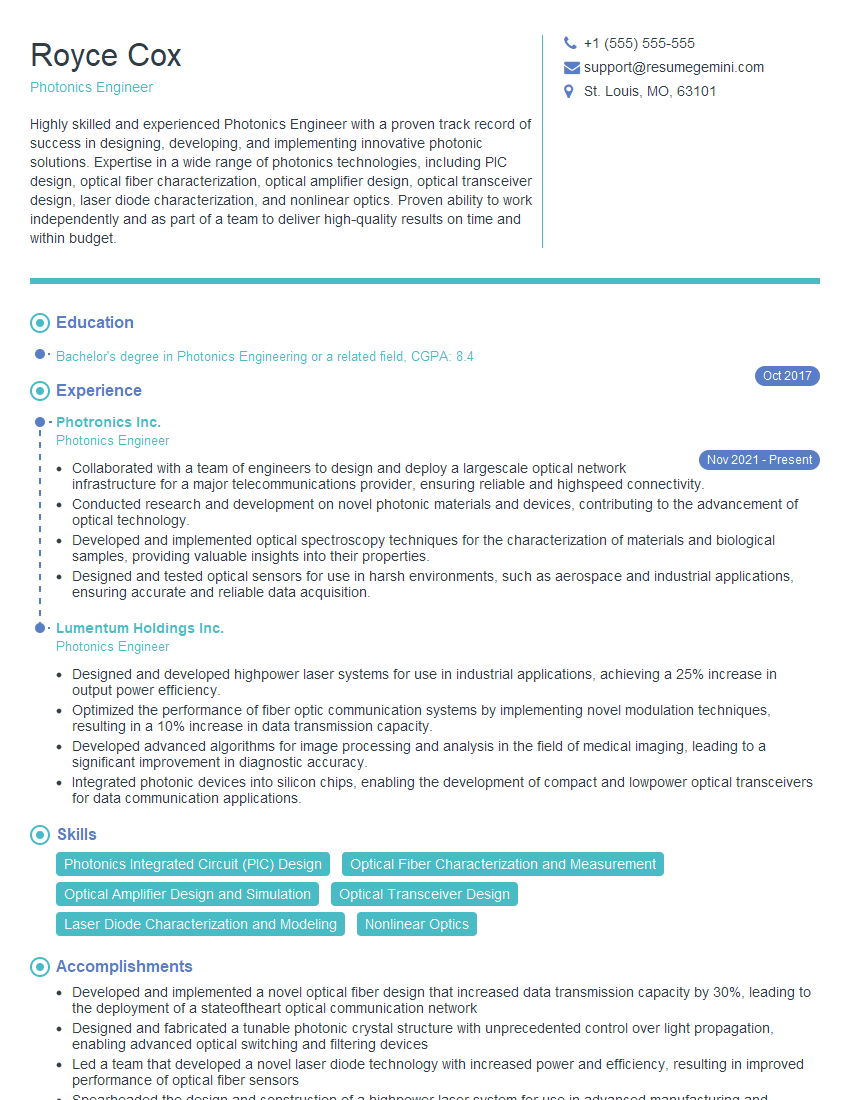
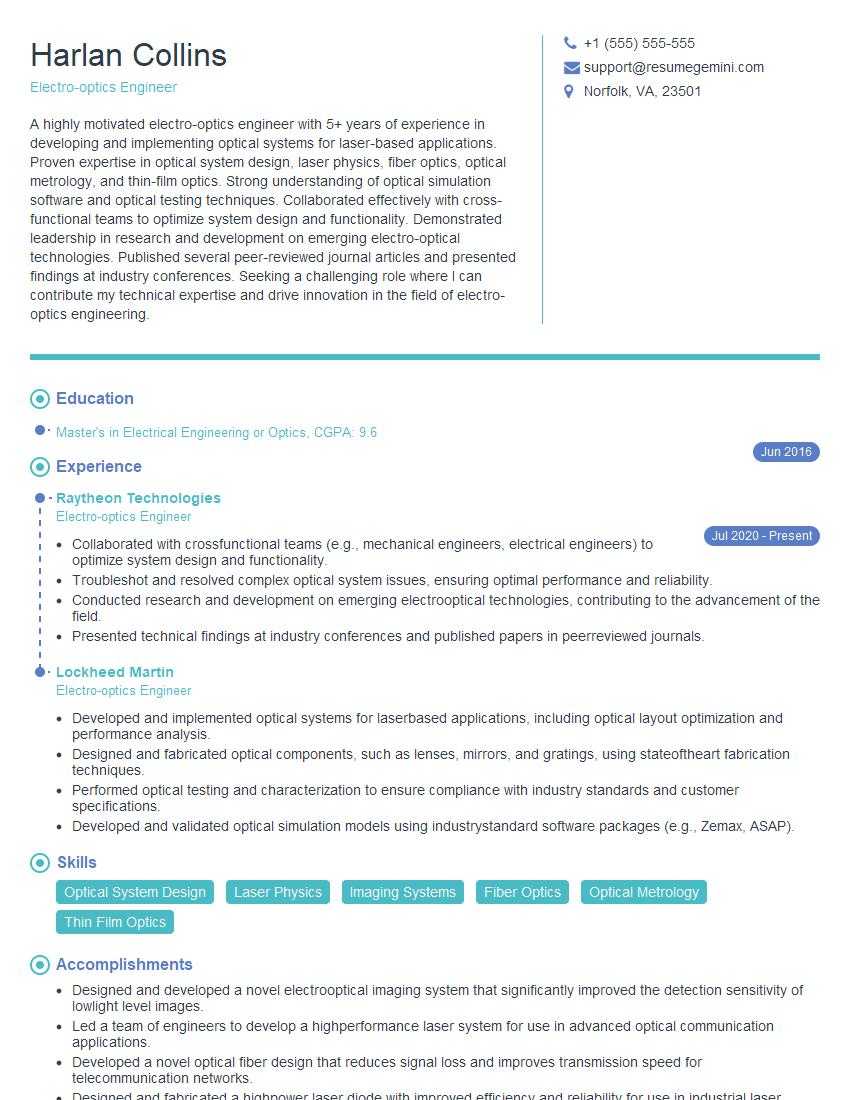
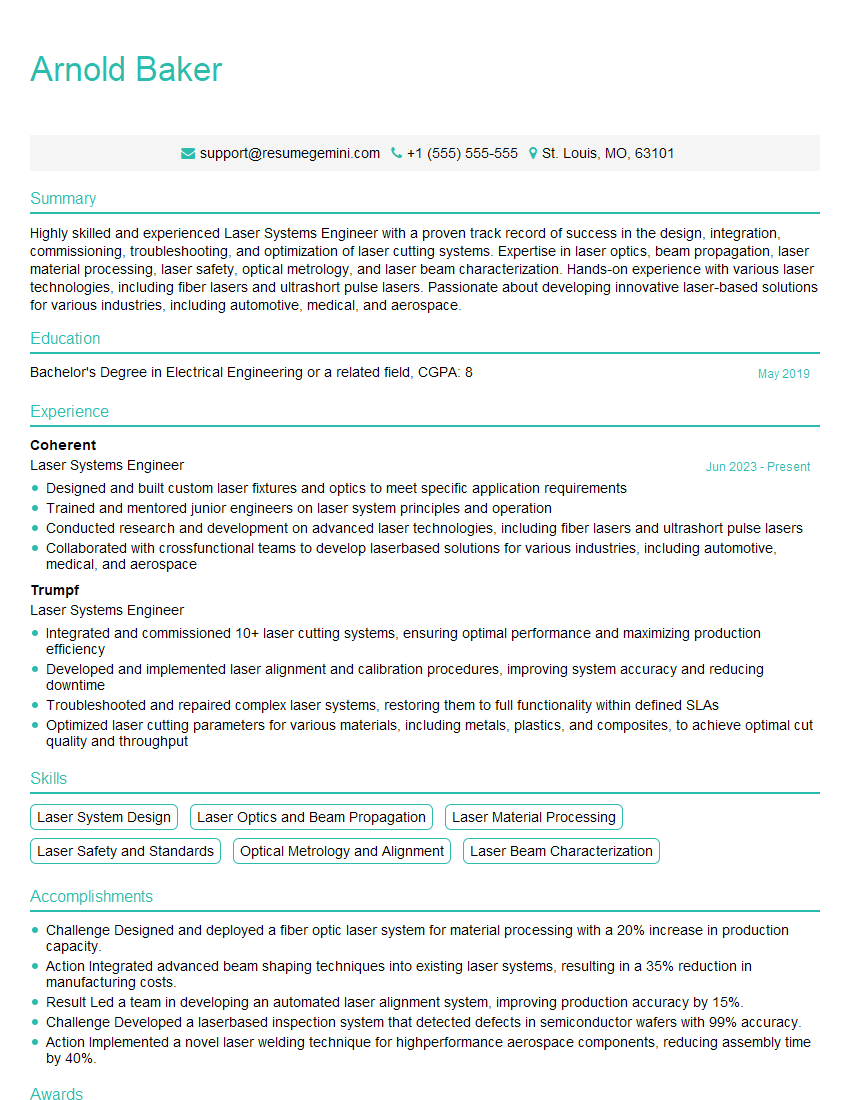
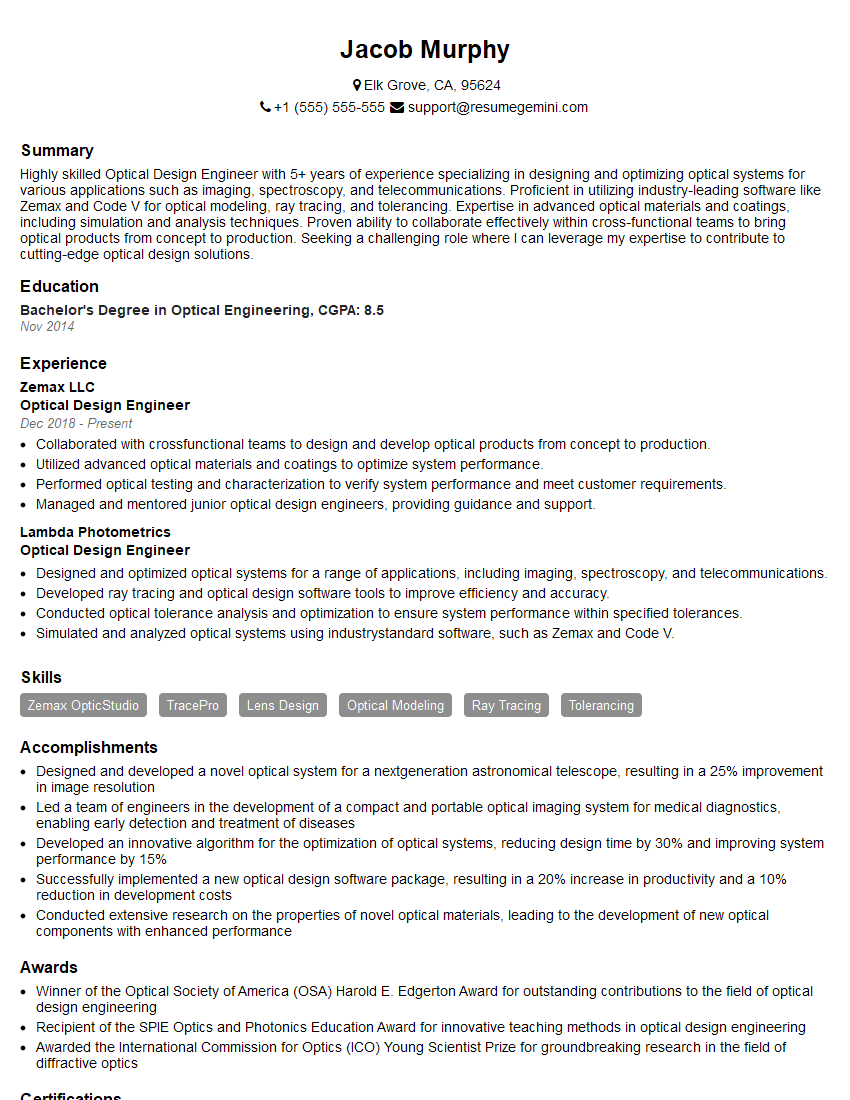
Mastering Laser Optics opens doors to exciting and rewarding careers in cutting-edge technologies. A strong foundation in this field is highly sought after, leading to significant career growth and advancement opportunities. To maximize your job prospects, creating a compelling and ATS-friendly resume is crucial. ResumeGemini is a trusted resource to help you build a professional and effective resume that highlights your skills and experience. We provide examples of resumes tailored to Laser Optics to help you showcase your expertise effectively. Take the next step towards your dream career – build your resume with ResumeGemini today!


Explore more articles
Users Rating of Our Blogs
Share Your Experience
We value your feedback! Please rate our content and share your thoughts (optional).
What Readers Say About Our Blog
Really detailed insights and content, thank you for writing this detailed article.
IT gave me an insight and words to use and be able to think of examples