Unlock your full potential by mastering the most common Wind Energy Assessment interview questions. This blog offers a deep dive into the critical topics, ensuring you’re not only prepared to answer but to excel. With these insights, you’ll approach your interview with clarity and confidence.
Questions Asked in Wind Energy Assessment Interview
Q 1. Explain the difference between Weibull and Rayleigh distributions in wind resource assessment.
Both Weibull and Rayleigh distributions are statistical models used to describe the probability of wind speeds at a given location. They are crucial in wind resource assessment because they allow us to predict the frequency and duration of different wind speeds, ultimately estimating the energy potential of a site. The key difference lies in their complexity and accuracy.
The Rayleigh distribution is a simpler model, assuming that wind speed follows a specific pattern with only one parameter – the scale parameter (often represented as c), which is related to the average wind speed. It’s a good approximation for locations with relatively consistent wind patterns. Imagine a perfectly smooth hill – a Rayleigh distribution might reasonably describe the wind flow over it.
However, real-world wind speeds are often more complex. The Weibull distribution is a more versatile model, using two parameters: a shape parameter (k) and a scale parameter (c). The shape parameter accounts for variations in wind speed fluctuations and provides a more accurate representation of real-world wind data, particularly in sites with turbulent or gusty winds. Think of a rugged mountain range – a Weibull distribution would more accurately capture the varying wind speeds experienced due to complex terrain.
In practice, the Weibull distribution is preferred because of its superior accuracy, even though it requires slightly more complex calculations. We use statistical methods to fit the measured wind speed data to either distribution, and the goodness-of-fit is assessed to select the most appropriate model for a given site.
Q 2. Describe the various methods used for measuring wind speed and direction at potential wind farm sites.
Measuring wind speed and direction at potential wind farm sites requires a combination of sophisticated instruments and careful methodology. The primary methods include:
- Anemometers: These measure wind speed. Cup anemometers are common, using rotating cups to measure the speed. Sonic anemometers use ultrasonic sound waves to measure wind speed and direction with higher accuracy.
- Wind Vanes: These measure wind direction by aligning with the prevailing wind.
- Meteorological Towers (Met Masts): These tall structures, often 50-100 meters high, hold multiple anemometers and wind vanes at various heights to capture the vertical wind profile. This is crucial for understanding how wind speed changes with altitude, a key factor in wind turbine placement.
- Lidar (Light Detection and Ranging): Lidar systems use lasers to remotely measure wind speed and direction in a three-dimensional volume of air. This is increasingly common for its efficiency and ability to cover large areas.
Data collected from these instruments are usually logged at high frequency (e.g., 10 Hz) and then processed to obtain statistical distributions like the Weibull distribution we discussed earlier. The location of measurement is also crucial, avoiding obstacles and ensuring representativeness of the entire potential wind farm area. Proper siting and instrument calibration are vital to obtain reliable data.
Q 3. What are the key factors to consider when selecting a wind turbine for a specific site?
Selecting the right wind turbine for a site is critical for maximizing energy production and minimizing operational costs. Key factors to consider include:
- Capacity: The rated power output of the turbine must align with the available wind resource. Oversized turbines might be inefficient in low-wind areas, while undersized turbines won’t fully exploit high-wind resources.
- Hub Height: This determines the height of the turbine’s rotor above the ground. Higher hub heights generally access stronger and more consistent winds, due to reduced ground friction effects. However, this must be balanced against increased tower cost and maintenance.
- Rotor Diameter: Larger rotors capture more energy from the wind, but may require more space and may not be suitable for all sites due to potential wake effects (downstream wind speed reduction).
- Cut-in, Rated, and Cut-out Wind Speeds: These define the range of wind speeds in which the turbine operates efficiently. The cut-in speed is the minimum wind speed for the turbine to start generating power; rated speed is where it reaches its maximum power output; and cut-out speed is the maximum safe wind speed at which the turbine shuts down to prevent damage.
- Turbulence Intensity: High turbulence can affect turbine performance and fatigue loads, so selecting a turbine designed to handle the specific turbulence intensity of the site is essential.
- Terrain Characteristics: The terrain will dictate suitable turbine heights, spacing, and access requirements.
A thorough site assessment, including wind resource modeling and analysis, will provide the data needed to select the most appropriate turbine technology and configuration for the given site’s characteristics.
Q 4. How do you account for terrain effects in wind resource assessments?
Terrain effects significantly influence wind speed and direction, making their accurate consideration crucial in wind resource assessments. Complex terrain can cause wind acceleration or deceleration, affecting the power output of a wind farm. Several methods exist for accounting for these effects:
- Wind flow modeling: Using Computational Fluid Dynamics (CFD) models to simulate wind flow over complex terrains and predict wind speeds and turbulence at different locations across the site. This allows for detailed assessments of wind resource variations due to topographic features.
- Wind Farm Simulation Software: Dedicated wind farm simulation software packages use advanced models to incorporate detailed terrain information, generating realistic estimations of overall wind farm energy production.
- Empirical Models: Simpler models such as the flow-over-hills and valley models based on empirical formulations based on local topography.
- Terrain Classification Systems: Categorizing terrain into different classes, (e.g. flat, gently rolling, hilly, mountainous) allows for the application of appropriate adjustment factors to compensate for wind speed variations.
The selection of an appropriate method depends on the complexity of the terrain, the required level of accuracy, and the available resources. Often a combination of models and field measurements are used to validate and refine the assessment.
Q 5. Explain the concept of capacity factor and its significance in wind energy projects.
The capacity factor is a crucial metric in evaluating the performance and economic viability of a wind energy project. It represents the actual energy generated by a wind turbine or wind farm over a specific period, relative to its maximum possible output if it were to operate at full capacity continuously. It’s expressed as a percentage.
Capacity Factor = (Actual energy produced / (Rated capacity * Operating time)) * 100%
For example, a wind turbine with a rated capacity of 2 MW operating for a year (8760 hours) might produce 7.8 million kWh of electricity. Its capacity factor would be:
Capacity Factor = (7,800,000 kWh / (2 MW * 8760 h)) * 100% ≈ 44.5%
A higher capacity factor indicates better efficiency and profitability, as the turbine is making better use of the available wind resource. Capacity factors for wind farms vary depending on location and turbine technology, generally ranging from 20% to 60%, with higher values being more desirable.
Understanding the capacity factor allows investors, developers, and utility companies to accurately estimate energy production and evaluate the overall investment and economic return. It’s a key element in financial modeling and project risk assessment.
Q 6. What are the common challenges in wind resource assessment and how can they be overcome?
Wind resource assessment faces several challenges:
- Data Scarcity: Obtaining long-term, high-quality wind data is essential but can be expensive and time-consuming, especially in remote locations. This is particularly challenging in developing countries.
- Data Quality: Ensuring the accuracy and reliability of wind data is crucial. Instrument errors, maintenance issues, and data gaps can all affect the results.
- Spatial Variability: Wind resources can vary significantly across a site, even over short distances. Accurate assessment requires capturing this variability through careful measurement and modeling.
- Temporal Variability: Wind resources are highly variable over time due to weather patterns and seasonal changes. Long-term data are essential to account for this variability.
- Terrain Complexity: Complex terrain makes wind resource assessment difficult, requiring advanced modeling techniques to account for its influence on wind flow.
Overcoming these challenges involves:
- Employing advanced measurement techniques (like lidar) to capture detailed wind profiles efficiently.
- Utilizing sophisticated modeling tools (like CFD) to simulate wind flow over complex terrains and predict resource variability.
- Implementing rigorous data quality control procedures to ensure data accuracy and reliability.
- Integrating data from multiple sources (e.g. meteorological stations, reanalysis datasets, numerical weather prediction) to compensate for data gaps.
- Investing in long-term data collection programs to get a more accurate picture of the site’s wind resource.
Q 7. Describe different types of wind LiDAR and their applications in wind resource assessment.
Wind lidar uses lasers to remotely measure wind speed and direction. Different types exist, each with its specific applications:
- Scanning Lidar: These systems scan a wide area, creating a three-dimensional map of wind speed and direction. This provides a comprehensive overview of the wind resource across a large region, enabling efficient wind farm layout optimization and resource assessment across extensive areas.
- Scanning Lidar (Doppler): These systems use the Doppler effect to measure wind speed with high accuracy. The Doppler shift in the frequency of the returned laser light is directly proportional to the wind speed, enabling precise wind speed measurements, crucial for turbine placement and resource assessment in complex terrains.
- Fixed-point Lidar: These systems measure wind speed at a single point, typically used to validate data from other measurements (like anemometers) and complement met masts. These can be lower cost and are particularly valuable for long-term, continuous monitoring.
- Range-resolved Lidar: These systems measure wind speed at multiple points along the laser beam’s path and are beneficial to detect the vertical profile of wind resources, crucial for turbine hub height selection and overall wind farm design.
In wind resource assessment, lidar is invaluable for:
- Reducing the cost and time associated with traditional anemometer measurements, especially over large areas or challenging terrains.
- Providing high-resolution data on wind speed and direction, enhancing the accuracy of resource assessments.
- Enabling better wind farm site planning and layout optimization.
- Improving the accuracy of wind farm power production forecasts.
Q 8. How do you analyze wind data to determine the suitability of a site for wind energy development?
Analyzing wind data for site suitability involves a multi-step process focusing on assessing the wind resource’s strength, consistency, and direction. We don’t just look at average wind speed; we need to understand the entire wind distribution.
First, we examine long-term historical wind data, typically from meteorological sources like weather stations or reanalysis datasets. This data provides a picture of the average wind speed at various heights, but also the frequency of calm periods and the occurrence of extreme gusts. We use statistical methods to characterize the wind speed distribution, often using Weibull or Rayleigh distributions to model the probability of finding wind speeds within specific ranges. This allows us to estimate the energy production potential of a wind turbine at that location.
Next, we analyze the wind direction data. The consistency of wind direction is crucial. A site with highly variable wind direction might not be ideal, as turbines are designed to operate most efficiently at certain wind angles. We’ll also consider factors like wind shear (the increase in wind speed with height) and turbulence, both of which affect turbine performance and lifespan. For instance, a site with high turbulence intensity could lead to increased mechanical stress on the turbine components.
Finally, we incorporate other factors into our analysis, including terrain features (hills can accelerate or channel the wind), proximity to obstacles (buildings or trees can disrupt wind flow), and land-use restrictions. A thorough analysis requires carefully examining the interaction between these elements.
Imagine trying to sail a boat. You need consistent wind, ideally from a favorable direction, and not too much turbulence that would make the journey difficult. Wind energy assessment is similar – we need the right wind ‘conditions’ to power a turbine effectively and safely.
Q 9. What software and tools are commonly used for wind resource assessment?
Many powerful software tools and resources are employed in wind resource assessment. These range from specialized commercial software packages to open-source tools and freely available datasets.
Commercial Software: Packages like WindPRO, WAsP (Wind Atlas Analysis and Application Program), and Windographer are widely used. These programs offer sophisticated capabilities for processing wind data, simulating wind flow over complex terrain, and estimating energy production. They often incorporate advanced features like lidar data integration and uncertainty analysis.
Open-Source Tools: Several open-source tools are available for specific tasks within the workflow. For instance, R (with packages like ‘OpenWind’) can be used for statistical analysis of wind data. Python (with libraries like ‘NumPy’ and ‘Pandas’) is also popular for data manipulation and analysis.
Data Sources: Apart from software, access to reliable data is critical. We utilize data from meteorological masts, as well as publicly available datasets like those provided by national meteorological agencies or reanalysis projects (e.g., ERA5). Remote sensing technologies, such as lidar and sodar, are becoming increasingly important for collecting detailed wind data, particularly in areas with limited historical measurements.
The choice of tools depends on the project’s scale, budget, and specific requirements. A smaller project might rely on simpler tools and readily available datasets, while a larger, more complex project will likely need more advanced software and potentially specialized data acquisition techniques.
Q 10. Explain the importance of meteorological masts in wind energy projects.
Meteorological masts are tall towers equipped with anemometers (to measure wind speed) and wind vanes (to measure wind direction) at various heights. They are crucial for gathering accurate, on-site wind data needed for a reliable wind resource assessment.
The data collected from meteorological masts provides a detailed profile of the wind resource at the specific location, including variations in wind speed and direction with height. This information is essential for selecting the optimal turbine model, estimating energy production, and designing the wind farm layout. Simply relying on nearby weather stations might not provide the necessary level of detail and accuracy for a project’s specific location, since local topography significantly influences wind patterns.
For instance, the presence of a hill nearby could significantly alter wind speeds and patterns compared to the surrounding plain; a meteorological mast will directly measure the altered wind at the site, ensuring the chosen turbine model fits perfectly and that the energy production forecasts are realistic. The data from the mast also helps identify wind shear and turbulence profiles, influencing critical design aspects, including the turbine’s hub height. In essence, the mast gives us a “ground truth” of the wind at the chosen site.
Q 11. Describe the process of conducting a wind resource assessment, from initial site selection to final report.
A wind resource assessment is a comprehensive process. It begins with initial site selection, based on preliminary screening using available wind data and geographic information system (GIS) analysis. Promising sites are then investigated in more detail.
- Phase 1: Preliminary Assessment: This involves gathering existing wind data, analyzing terrain, and identifying potential environmental constraints. This initial screening helps narrow down potential sites.
- Phase 2: Site Selection: Detailed on-site wind measurements are conducted using meteorological masts. This data is used to create a detailed wind resource characterization.
- Phase 3: Wind Resource Modeling: Sophisticated software packages are used to model the wind flow over the terrain, considering complex factors like topography, vegetation, and obstacles. This creates a more accurate picture of the wind resource.
- Phase 4: Energy Production Assessment: Using the wind resource data and turbine performance curves, the potential energy output of the wind farm is estimated. This involves considering factors like turbine availability, wake effects (the impact of one turbine’s wake on downwind turbines), and transmission losses.
- Phase 5: Environmental Impact Assessment: This is a crucial step, evaluating potential impacts on wildlife, noise pollution, visual impact, and other aspects. Mitigation strategies are developed to minimize adverse effects.
- Phase 6: Regulatory Compliance: The assessment must meet all relevant regulatory requirements and obtain necessary permits. This usually requires interaction with local and national authorities.
- Phase 7: Final Report: A comprehensive report summarizes the findings, including the wind resource characterization, energy production estimates, environmental impact assessment, and regulatory compliance status.
This methodical approach ensures a sound basis for decision-making on whether a site is suitable for wind energy development and guides all subsequent stages of the project.
Q 12. How do you assess the environmental impact of a proposed wind farm?
Assessing the environmental impact of a wind farm is a critical part of the development process. We must carefully evaluate several potential impacts. This often involves detailed ecological surveys and modeling of potential disturbances.
Wildlife Impacts: We assess potential impacts on birds and bats, particularly through collision risk assessments. This involves studying bird and bat migration patterns, flight altitudes, and wind turbine fatality rates. Mitigation strategies such as careful turbine placement and operational adjustments can reduce these risks. For example, adjusting turbine operations during critical migration periods or using bird-deterrent technologies can be implemented.
Noise Pollution: Noise levels are modeled and predicted using specialized software, considering factors like turbine noise characteristics and ambient sound levels. These predictions must comply with relevant noise regulations and standards. Careful turbine placement and noise barriers can reduce potential noise impacts on nearby communities.
Visual Impact: The visual impact on the landscape is assessed, often using visual simulations and public surveys to gauge community perception. The size, color, and placement of the turbines are considered, aiming to minimize visual intrusion.
Habitat Fragmentation: We analyze the potential for habitat fragmentation due to the construction and operation of the wind farm, which could lead to negative effects on wildlife populations. Mitigation strategies could include habitat restoration or creation of wildlife corridors.
Other Impacts: Potential impacts on water resources, soil erosion, and cultural heritage sites are also considered and addressed through mitigation measures.
A comprehensive environmental impact assessment is essential for securing environmental permits and ensuring the sustainable development of the wind farm, minimizing adverse environmental effects.
Q 13. What are the key regulations and standards relevant to wind energy assessment in your region?
(Note: Specific regulations vary significantly by region. The following is a general overview, and you should always consult the relevant authorities for the specific regulations in your area.)
Regulations related to wind energy assessment typically cover aspects like environmental impact assessment, grid connection requirements, safety standards, and permitting processes. These can involve national, regional, and local regulations.
Environmental Regulations: These often stipulate the methods and procedures for assessing the environmental impacts of wind farms, including wildlife assessments and noise impact studies. These regulations might dictate the format and content of the environmental impact statement.
Grid Connection Requirements: Regulations govern the technical specifications for connecting wind farms to the electricity grid, ensuring safe and reliable operation. These might include standards for voltage levels, frequency stability, and protection schemes.
Safety Standards: Safety regulations pertain to the design, construction, operation, and maintenance of wind turbines and the wind farm infrastructure to ensure worker and public safety. These might encompass standards for turbine design, emergency shutdown systems, and access control.
Permitting Processes: Detailed procedures for obtaining necessary permits and approvals are specified. This process usually involves consultation with various government agencies and public stakeholders.
It’s crucial to work closely with regulatory bodies throughout the wind energy assessment and development process to ensure compliance and avoid potential delays or project cancellation.
Q 14. What are the limitations of using historical wind data for future predictions?
Using historical wind data for future predictions has inherent limitations. While historical data provides a valuable baseline, it’s not a perfect predictor of future conditions.
Climate Change: Climate change is altering global wind patterns. Historical data may not fully capture these changes, leading to underestimation or overestimation of future wind speeds. This needs to be considered by either incorporating climate change projections into the analysis or acknowledging a degree of uncertainty in the prediction.
Data Limitations: Historical wind data may have gaps or uncertainties, especially in areas with limited measurement infrastructure. The accuracy of older data may also be questionable due to limitations in measurement technology. The use of more recent and high-quality data from more advanced measurement equipment, like Lidar, are crucial in reducing the uncertainties of predictions.
Local Changes: Local changes to the landscape, such as deforestation or urbanization, can affect wind patterns. Historical data may not reflect these changes. For example, the construction of a large building nearby could significantly alter wind speeds and patterns compared to what has been observed in the past.
Statistical Uncertainty: Statistical methods used to analyze wind data always involve a degree of uncertainty. The longer the time-series of the wind data, the more reliable the statistical analysis will be and the more precise future prediction can be. However, it is crucial to conduct uncertainty analysis to quantify this uncertainty in predictions.
To address these limitations, advanced techniques like climate change scenario analysis, uncertainty quantification, and data assimilation are incorporated to enhance the accuracy of predictions. We must always acknowledge the inherent uncertainties and limitations of relying solely on historical data.
Q 15. Explain the concept of energy yield assessment and its importance.
Energy yield assessment is the process of predicting the amount of electricity a wind farm or a single wind turbine will generate over a specific period, typically a year. It’s the cornerstone of any wind energy project’s financial viability. A thorough assessment considers various factors, ensuring investors and developers have a realistic expectation of the project’s return on investment.
The importance lies in its direct impact on project feasibility. Accurate predictions are crucial for:
- Financial Modeling: Yield estimates directly feed into loan applications, investor pitches, and profitability analysis.
- Project Siting: Comparing energy yield from different potential locations helps in selecting the optimal site.
- Turbine Selection: Yield assessment informs the choice of turbine model best suited for the specific wind resource.
- Risk Mitigation: Understanding potential variations in yield helps in planning for financial contingencies.
Imagine trying to build a house without knowing how much material you need – that’s how crucial a robust yield assessment is for a wind energy project. A flawed assessment could lead to financial losses and project failure.
Career Expert Tips:
- Ace those interviews! Prepare effectively by reviewing the Top 50 Most Common Interview Questions on ResumeGemini.
- Navigate your job search with confidence! Explore a wide range of Career Tips on ResumeGemini. Learn about common challenges and recommendations to overcome them.
- Craft the perfect resume! Master the Art of Resume Writing with ResumeGemini’s guide. Showcase your unique qualifications and achievements effectively.
- Don’t miss out on holiday savings! Build your dream resume with ResumeGemini’s ATS optimized templates.
Q 16. How do you interpret and present the results of a wind resource assessment to stakeholders?
Presenting wind resource assessment results effectively requires tailoring the communication to the audience. For technical stakeholders like engineers, detailed data in the form of graphs (e.g., Weibull distributions, power curves, capacity factors), maps showing wind speeds and directions, and statistical summaries are essential.
For non-technical stakeholders (investors, community members), the focus shifts to clear, concise visualizations and summaries. Key metrics such as average annual energy production (AEP), capacity factor (the ratio of actual output to maximum possible output), and return on investment (ROI) become paramount. Using maps with easy-to-understand color-coding to illustrate wind resource potential is highly effective.
Effective communication also involves addressing uncertainties openly. It’s vital to discuss the range of possible outcomes and the factors contributing to uncertainty (e.g., meteorological modeling limitations, turbine performance variations). Transparency builds trust and ensures informed decision-making.
For example, I’ve presented results using interactive dashboards that allow stakeholders to explore the data at different levels of detail, catering to varying levels of technical expertise. This participatory approach enhances understanding and fosters collaboration.
Q 17. What are the different types of wind turbines and their characteristics?
Wind turbines are broadly categorized by their axis of rotation:
- Horizontal-axis wind turbines (HAWTs): These are the most common type, with the rotor shaft aligned horizontally. They’re further classified by the number of blades (typically 3) and their design characteristics (e.g., upwind or downwind orientation). HAWTs are generally more efficient at higher wind speeds.
- Vertical-axis wind turbines (VAWTs): In VAWTs, the rotor shaft is vertical. They’re often less efficient than HAWTs but can capture wind from any direction, making them suitable for urban environments or locations with less consistent wind direction. Darrieus and Savonius are two prominent VAWT designs.
Other classifications include:
- Gearless vs. Geared: Geared turbines use a gearbox to increase rotational speed, while gearless designs use a direct-drive system.
- Rated Power: This signifies the maximum power output at rated wind speed. Turbines range from megawatt-scale installations in large wind farms to smaller kilowatt-scale units for distributed generation.
- Tower Height: Taller towers access higher wind speeds with less turbulence.
The choice of turbine depends on factors like wind resource characteristics, site constraints, and project economics. For instance, a high-wind site might favor a large-capacity HAWT, while a site with inconsistent wind direction might be better suited for a VAWT.
Q 18. Describe the concept of wake effect and its impact on wind farm performance.
The wake effect refers to the turbulent airflow downstream of a wind turbine. As the wind passes through the rotor blades, it loses some of its energy and forms a turbulent wake, which reduces the wind speed available for downstream turbines in a wind farm. This reduction in wind speed results in lower energy production for turbines in the wake of others.
The impact on wind farm performance can be significant. The wake effect leads to a decrease in overall energy yield, potentially reducing the return on investment. The extent of the wake effect depends on various factors, including:
- Turbine spacing: Closer spacing leads to stronger wake effects.
- Atmospheric stability: Stable atmospheric conditions tend to result in longer and stronger wakes.
- Wind shear: Wind shear (variations in wind speed with height) can influence wake development.
- Turbine characteristics: Different turbine designs have varying wake characteristics.
Effective wind farm layout optimization techniques (like computational fluid dynamics (CFD) simulations) are used to mitigate the wake effect by strategically spacing turbines to minimize overlap of wakes and thus maximize energy output. It’s like strategically planting crops to ensure optimal sunlight for each plant.
Q 19. How do you incorporate uncertainty and variability into your wind resource assessments?
Uncertainty and variability are inherent in wind resource assessments. We use several methods to incorporate them:
- Probabilistic Modeling: Instead of relying on single-point estimates, we use statistical distributions (like Weibull distributions for wind speed) to represent the uncertainty in wind resource data. This allows us to assess the likelihood of different energy yield outcomes.
- Sensitivity Analysis: We systematically vary key input parameters (wind speed, turbine performance, availability) to determine their impact on energy yield. This helps identify the most critical sources of uncertainty.
- Monte Carlo Simulations: These simulations involve generating numerous random samples of input parameters and running the energy yield model for each sample. The resulting distribution of energy yield estimates provides a robust picture of the uncertainty.
- Ensemble Forecasting: This utilizes outputs from multiple meteorological models to improve the accuracy of wind resource predictions and account for forecast uncertainties.
For example, we might use Monte Carlo simulations to generate a probability distribution of AEP, showing not just the expected value but also the likelihood of the AEP falling within a certain range (e.g., there is a 90% probability that the AEP will be between X and Y MWh). This approach provides a more realistic picture than a single deterministic estimate and helps stakeholders make informed decisions considering the inherent uncertainty of the wind resource.
Q 20. What is the role of GIS in wind energy assessment?
Geographic Information Systems (GIS) are indispensable in wind energy assessment. They provide a powerful platform for integrating and analyzing various spatial datasets relevant to wind farm development.
GIS is used for:
- Mapping Wind Resources: GIS software visualizes wind speed and direction data, allowing for identification of areas with suitable wind resources.
- Site Suitability Analysis: GIS integrates various spatial layers (e.g., topography, land use, vegetation, proximity to roads and transmission lines) to assess the suitability of different sites for wind turbine placement.
- Turbine Siting and Layout Optimization: GIS facilitates optimal placement of turbines to maximize energy capture while minimizing wake effects and environmental impacts.
- Environmental Impact Assessment: GIS helps analyze potential environmental impacts, including visual impacts, noise pollution, and effects on wildlife habitats.
- Stakeholder Engagement: GIS-based visualizations (maps, 3D models) effectively communicate project plans to stakeholders.
Imagine trying to plan a wind farm without a map showing wind speeds, terrain, and existing infrastructure – GIS provides that essential spatial context for informed decision-making throughout the project lifecycle.
Q 21. How do you assess the grid connection capacity for a proposed wind farm?
Assessing grid connection capacity for a proposed wind farm is crucial to ensure the farm can effectively integrate with the existing electricity grid. This involves several steps:
- Determine the wind farm’s power output: The total power generated by the wind farm is determined based on the energy yield assessment and the number of turbines.
- Identify the connection point: The location where the wind farm will connect to the grid needs to be determined. This is usually a substation or a transmission line.
- Analyze the grid’s capacity: This involves examining the existing transmission lines’ and substations’ capacity, considering factors such as voltage levels, current carrying capacity, and stability limits. Data is usually obtained from the grid operator.
- Assess potential upgrades: If the existing grid infrastructure cannot accommodate the wind farm’s power output, upgrades might be necessary. This could involve building new transmission lines, expanding substations, or implementing grid reinforcement measures.
- Conduct grid stability studies: Studies are conducted to ensure the wind farm’s integration doesn’t negatively impact the grid’s stability and reliability. These studies often involve power flow analysis and transient stability analysis.
- Secure interconnection agreements: Formal agreements with the grid operator are required, outlining the terms and conditions for connecting the wind farm to the grid, including any upgrade responsibilities and costs.
Grid connection studies are complex and often require specialized engineering expertise. Neglecting this crucial aspect can lead to significant delays and cost overruns in the wind farm project.
Q 22. Explain the significance of power curves in wind turbine performance assessment.
Power curves are fundamental in wind turbine performance assessment because they graphically represent the relationship between wind speed and the power output of a turbine. Think of it as a turbine’s ‘performance report’ – it shows how much electricity the turbine generates at different wind speeds.
The curve typically starts at a ‘cut-in’ speed (the minimum wind speed for power generation), increases to a peak power output at rated wind speed, and then levels off until it reaches the ‘cut-out’ speed (wind speed too high for safe operation). Analyzing power curves helps us understand:
- Turbine efficiency: A steeper curve indicates better efficiency at harnessing wind energy.
- Capacity factor estimation: By combining the power curve with wind speed data from the location, we can predict how much energy the turbine will generate annually, expressed as the capacity factor (the actual power output divided by the maximum possible output).
- Performance comparison: Power curves allow direct comparison of different turbine models under the same wind conditions.
For instance, comparing two turbines’ power curves at a specific site helps determine which model would yield higher energy production, allowing informed decision-making during project development.
Q 23. Describe different methods for estimating the cost of energy (COE) for a wind project.
Estimating the cost of energy (COE) for a wind project involves a detailed financial analysis considering various factors over the project’s lifetime (typically 20-25 years). Several methods exist, and the choice often depends on the project’s stage and available data.
- Levelized Cost of Energy (LCOE): This is the most common method. It calculates the average cost of electricity generation over the project’s lifetime, taking into account all capital costs (turbines, land, infrastructure), operational and maintenance costs, and the total energy produced. The formula involves discounting future costs back to the present value.
- Discounted Cash Flow (DCF) analysis: This method projects future cash flows from the project (revenue from electricity sales minus expenses) and discounts them back to present value using a discount rate that reflects the project’s risk. The net present value (NPV) helps determine profitability.
- Simple payback period: This is a simpler approach that calculates the time it takes for the cumulative income from the project to equal the initial investment. This method doesn’t consider time value of money.
Each method requires detailed input data, including turbine specifications, capital expenditures, operating expenses, financing costs, electricity price projections, and projected energy production (often derived from wind resource assessments and turbine power curves).
Q 24. How do you assess the economic viability of a wind energy project?
Assessing the economic viability of a wind energy project relies heavily on the COE and other financial metrics. A project is considered economically viable if it generates a positive return on investment (ROI) and satisfies the financial objectives of investors.
Here’s a step-by-step approach:
- Conduct a thorough wind resource assessment: This establishes the project’s potential energy generation.
- Estimate the COE: Using one or more of the methods described above.
- Analyze project costs: This includes capital expenditure (CAPEX), operating expenditure (OPEX), financing costs, and other potential costs like environmental mitigation.
- Project electricity revenue: Based on electricity price forecasts and energy production estimates.
- Calculate key financial indicators: Such as NPV, internal rate of return (IRR), payback period, and ROI.
- Perform sensitivity analysis: Assess how changes in key parameters (e.g., electricity prices, wind resource, capital costs) affect the financial outcomes.
- Compare with alternative investment options: Assess whether the project provides a competitive return compared to other investment opportunities.
If the financial indicators show a positive return and the project’s risk profile is acceptable, then the project is likely considered economically viable.
Q 25. What are some emerging trends in wind resource assessment technology?
Emerging trends in wind resource assessment technology are significantly improving the accuracy and efficiency of site characterization. Some key trends include:
- LiDAR (Light Detection and Ranging): LiDAR systems, both terrestrial and mounted on aircraft, provide high-resolution wind speed measurements over large areas, offering superior spatial coverage compared to traditional anemometer masts. This helps reduce the number of measurement sites needed.
- Advanced meteorological modeling: Sophisticated numerical weather prediction (NWP) models and wind flow simulation tools are increasingly capable of simulating wind conditions with greater accuracy, particularly in complex terrains. This reduces reliance solely on measured data.
- Machine learning and AI: Machine learning algorithms are being used to analyze large datasets from various sources (LiDAR, anemometers, NWP models) to improve wind resource prediction accuracy and reduce uncertainties.
- Satellite remote sensing: Advances in satellite technology are enabling more accurate estimation of wind characteristics over larger areas, providing cost-effective preliminary assessments before deploying more expensive measurement techniques.
These advancements are leading to more reliable wind resource assessments, reducing uncertainty in project planning and increasing the confidence of investors.
Q 26. Discuss the importance of stakeholder engagement in wind energy projects.
Stakeholder engagement is crucial for the successful development and acceptance of wind energy projects. It involves proactively engaging with all parties potentially affected or interested in the project, including:
- Local communities: Addressing their concerns about visual impact, noise pollution, and potential effects on wildlife is essential for gaining their support.
- Landowners: Negotiating land leases and ensuring fair compensation are key for securing land access.
- Government agencies: Securing necessary permits and approvals, complying with environmental regulations, and collaborating on grid connection.
- Environmental organizations: Minimizing environmental impact through careful planning and mitigation measures and demonstrating commitment to environmental stewardship.
Effective stakeholder engagement builds trust, addresses potential conflicts, and ensures projects are socially and environmentally responsible, ultimately increasing the likelihood of project success. Ignoring stakeholder concerns can lead to delays, increased costs, and even project cancellation.
Q 27. How do you manage risks associated with wind resource assessment and wind farm development?
Managing risks in wind resource assessment and wind farm development is crucial to ensure project success. Risks can be broadly categorized as:
- Wind resource uncertainty: The actual wind resource may differ from the assessed resource, affecting energy production and project profitability. Mitigation involves using robust assessment techniques (LiDAR, advanced modeling) and including uncertainty margins in financial analysis.
- Technical risks: Equipment failures, grid connection issues, and construction delays can impact project schedules and costs. Mitigation includes careful equipment selection, rigorous quality control, and contingency planning.
- Financial risks: Fluctuations in electricity prices, financing difficulties, and cost overruns can affect project profitability. Mitigation involves developing realistic financial models, securing reliable financing, and implementing robust cost control measures.
- Environmental and regulatory risks: Permitting delays, environmental concerns, and legal challenges can hinder project development. Mitigation involves thorough environmental impact assessments, proactive engagement with regulatory agencies, and compliance with all applicable laws and regulations.
- Social and community risks: Opposition from local communities and social conflicts can significantly delay or even derail projects. Mitigation involves proactive community engagement, transparent communication, and addressing community concerns.
A comprehensive risk management plan should identify potential risks, assess their likelihood and impact, develop mitigation strategies, and monitor risks throughout the project lifecycle.
Key Topics to Learn for Wind Energy Assessment Interview
- Resource Assessment: Understanding wind resource characterization techniques, including data collection (mast, lidar, sodar), analysis (statistical methods, Weibull distribution), and GIS applications. Practical application: Evaluating the suitability of a site for wind energy development based on wind speed and turbulence intensity data.
- Wind Turbine Technology: Familiarizing yourself with various wind turbine designs (horizontal-axis, vertical-axis), components (blades, gearbox, generator), and their operational characteristics. Practical application: Explaining the advantages and disadvantages of different turbine technologies in specific wind regimes.
- Energy Yield Assessment: Mastering the process of estimating energy production from a wind farm, considering factors like turbine performance curves, wake effects, and atmospheric conditions. Practical application: Calculating the expected annual energy production (AEP) for a proposed wind farm project.
- Site Suitability Analysis: Understanding the factors influencing site selection for wind energy projects, including wind resource, land availability, environmental impact, grid connection, and regulatory constraints. Practical application: Evaluating potential environmental impacts and mitigating risks associated with a wind farm development.
- Financial Analysis & Project Planning: Understanding the economic aspects of wind energy projects, including capital costs, operating expenses, revenue projections, and return on investment (ROI). Practical application: Developing a preliminary financial model for a small wind farm project.
- Data Analysis & Modeling: Proficiency in using software and tools for data analysis and modeling, including statistical software packages and specialized wind energy assessment software. Practical application: Interpreting complex datasets and making informed decisions based on quantitative analysis.
- Environmental Impact Assessment: Understanding the environmental impacts of wind energy projects and the methods used to assess and mitigate those impacts (e.g., noise, visual impact, avian mortality). Practical application: Discussing strategies for minimizing the environmental footprint of a wind farm.
Next Steps
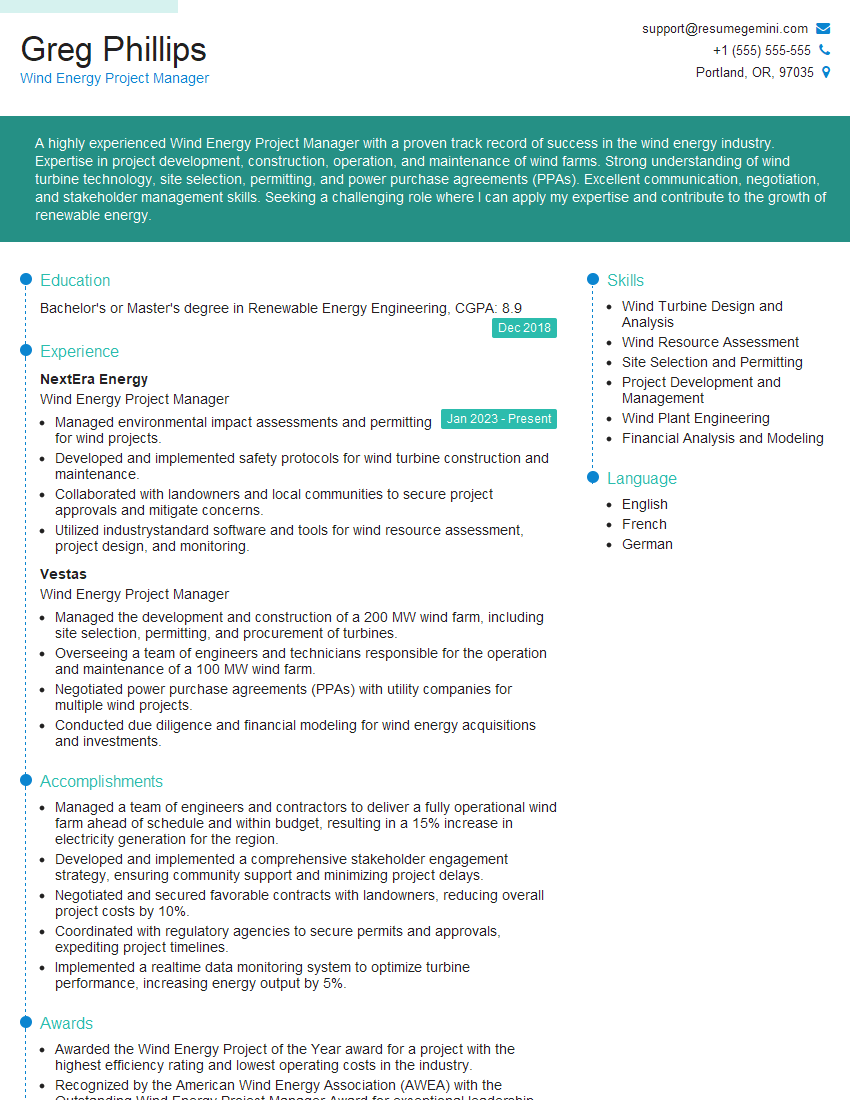
Mastering Wind Energy Assessment is crucial for advancing your career in this rapidly growing sector. A strong understanding of these concepts will significantly enhance your interview performance and open doors to exciting opportunities. To maximize your job prospects, focus on crafting an ATS-friendly resume that showcases your skills and experience effectively. ResumeGemini is a trusted resource that can help you build a professional and impactful resume. We provide examples of resumes tailored to Wind Energy Assessment to guide you. Take advantage of these resources to present yourself in the best possible light.
Explore more articles
Users Rating of Our Blogs
Share Your Experience
We value your feedback! Please rate our content and share your thoughts (optional).
What Readers Say About Our Blog
Really detailed insights and content, thank you for writing this detailed article.
IT gave me an insight and words to use and be able to think of examples