Interviews are opportunities to demonstrate your expertise, and this guide is here to help you shine. Explore the essential Textures and Overlays interview questions that employers frequently ask, paired with strategies for crafting responses that set you apart from the competition.
Questions Asked in Textures and Overlays Interview
Q 1. Explain the difference between procedural and hand-painted textures.
Procedural and hand-painted textures represent fundamentally different approaches to texture creation. Hand-painted textures are created by artists directly painting or drawing the texture onto a digital canvas. This offers maximum artistic control and allows for intricate detail and unique variations. Think of a meticulously painted watercolor texture of a weathered stone wall – each brushstroke contributes to the final look.
Procedural textures, on the other hand, are generated algorithmically. Instead of directly painting, you define mathematical rules and parameters (like noise functions, color gradients, and other algorithms) that the computer uses to create the texture. This allows for generating incredibly complex and large textures efficiently and allows for easy variation, repetition, and control over things like scale and randomness. A wood grain pattern, for example, could be created procedurally by defining rules about the direction and frequency of the grain, the color variations, and the overall roughness. The key difference lies in the method of creation – artistic hand-crafting versus algorithmic generation. Procedural textures are often better for tiling and repeating patterns while hand-painted textures excel in detail and unique, non-repeating designs.
Q 2. Describe your experience with different texture mapping techniques (e.g., UV mapping, projection mapping).
My experience encompasses a range of texture mapping techniques. UV mapping is a fundamental technique where I unfold a 3D model’s surface into a 2D plane (like flattening an orange peel). This 2D plane then receives the texture, which is then projected back onto the 3D model during rendering. This allows for precise control over how the texture wraps around the model, but it can be time-consuming to create good UV maps, especially for complex models. I’ve worked extensively on character models, carefully creating UV layouts to minimize distortion and seams.
Projection mapping offers a different approach. Here, the texture is projected onto the 3D model from various viewpoints, which can be useful for complex geometries or when precise UV unwrapping is difficult. For example, I’ve used projection mapping to quickly apply textures to environments, like projecting a brick texture onto a building. While simpler to set up for complex models, it can sometimes lack the control and precision afforded by UV mapping. The choice between these techniques depends heavily on the model’s complexity, desired level of detail, and time constraints.
Q 3. How do you optimize textures for real-time rendering?
Optimizing textures for real-time rendering involves a multifaceted approach centered on minimizing the memory footprint and processing demands on the graphics card. This is especially critical for games and interactive applications. Key strategies include:
- Reducing texture resolution: Lowering the resolution (e.g., from 4K to 2K or even lower) directly reduces memory usage. We need to strike a balance between visual quality and performance.
- Using appropriate compression: Formats like DXT (BCn) offer good compression ratios with minimal visual loss in real-time rendering. I frequently use these in game development.
- Mipmapping: This creates a series of lower-resolution versions of the texture. When rendering objects far away, the GPU uses the lower-resolution mipmap levels, improving performance without a noticeable decrease in visual quality.
- Texture atlasing: Combining multiple smaller textures into a single, larger texture sheet reduces the number of draw calls, significantly boosting performance. This is like combining many smaller stickers onto one large sheet for efficiency.
- Normal maps and other techniques: Instead of baking high-resolution detail directly into the diffuse texture, I often use normal maps to simulate detail efficiently. Normal maps store surface normal information and add detail without increasing the texture resolution significantly.
The optimal approach depends on the specific project’s needs and hardware capabilities. Profiling the application and analyzing performance bottlenecks guides these decisions.
Q 4. What are the common file formats for textures and their uses?
Several common file formats serve different purposes in texture creation and rendering.
- PNG (Portable Network Graphics): Lossless compression, ideal for textures with sharp lines and details, like logos or UI elements. It handles transparency effectively.
- JPEG (Joint Photographic Experts Group): Lossy compression, generally suitable for photographs and textures with subtle color gradients. Offers smaller file sizes but introduces some artifacting.
- TGA (Targa): Supports various color depths and compression methods, commonly used in game development for its flexibility.
- DDS (DirectDraw Surface): A Microsoft format, often preferred in real-time applications, especially games, for its efficient compression options (e.g., DXT) tailored for GPUs.
- OpenEXR: High dynamic range (HDR) image format, used for textures with a wider range of color and brightness, often employed in high-end rendering and visual effects.
The choice of format often depends on the specific application and the balance between file size, quality, and compression capabilities. For example, I’d use PNG for UI elements and DDS for game textures.
Q 5. Explain your workflow for creating a realistic wood texture.
Creating a realistic wood texture often involves a multi-step process that blends procedural and hand-painted techniques.
- Reference Gathering: I begin by collecting high-quality photographs of various wood types, paying close attention to the grain patterns, color variations, knots, and overall texture. Real-world observation is crucial.
- Procedural Base: I use procedural techniques in software like Substance Designer to generate a base wood grain pattern. This involves using noise functions, wood grain generators, and color variations to create a convincing base.
- Hand-Painting and Detailing: I then refine the procedural base using hand-painting techniques. This might involve adding knots, cracks, and other imperfections using digital brushes. This brings in unique detail that procedural methods often miss.
- Variation and Randomness: To avoid a repetitive look, I introduce randomness in the grain patterns, color variations, and details. This prevents the texture from looking artificial or overly uniform.
- Refinement and Adjustment: Finally, I meticulously refine the texture, adjusting colors, contrast, and values to achieve a realistic look. I frequently iterate, comparing my creation to high-quality photographic references.
The process emphasizes a combination of technology and artistic intuition, leading to a much more realistic and visually appealing outcome than relying solely on one technique.
Q 6. How do you handle texture seams and tiling issues?
Texture seams and tiling issues are common problems in texture creation, especially when using repeating patterns. Seams occur when the edges of a tiled texture are not perfectly matched, resulting in visible discontinuities. Tiling issues arise when a pattern doesn’t seamlessly repeat, creating obvious repetition.
To address these issues, I employ several strategies:
- Overlap and Blending: When creating textures designed for tiling, I create overlapping areas at the edges and then blend these areas together using techniques like feathering or smoothing. This minimizes the visibility of seams.
- Careful Pattern Design: For seamless tiling, the pattern must repeat perfectly. I carefully plan the design to ensure that the edges connect smoothly. This often involves using mathematical or procedural methods to create inherently seamless patterns.
- Noise and Variation: Adding subtle noise or variations across the texture can mask minor imperfections or seams. It makes the pattern less repetitive and less prone to showing obvious tiling repeats.
- Displacement Maps: Displacement maps can help to subtly offset the texture, reducing the impact of visible tiling artifacts by adding slight geometric variation.
- Texture Filtering: Using appropriate filtering techniques in the renderer can further soften the appearance of seams and reduce the visibility of artifacts.
Careful planning and iterative refinement are critical in creating textures that avoid these problems. Frequently checking the texture’s behavior when tiled is key.
Q 7. Describe your experience using Substance Designer or similar software.
I have extensive experience using Substance Designer, a powerful node-based software for creating procedural textures. I leverage its capabilities to build complex and realistic textures efficiently. For example, I’ve used Substance Designer to create highly detailed materials like fabric, metal, and stone. The node-based workflow allows me to easily experiment with different parameters and iterate on designs.
My workflow typically involves:
- Designing the material nodes: I use a combination of built-in generators, filters, and custom nodes to create the desired texture attributes, such as color, roughness, normal, and height maps. This is like building a digital recipe for my material.
- Iterative Refinement: I continually preview and adjust the generated textures to meet the desired level of realism and detail. This iterative process is crucial to fine-tune the parameters.
- Exporting textures: Once satisfied, I export the textures in the required formats, optimized for the target application or game engine.
Substance Designer’s strengths lie in its ability to create consistent and highly customizable textures, perfect for large-scale projects where consistent quality and efficiency are paramount. It allows for a high degree of artistic control while benefiting from the power of procedural generation.
Q 8. How do you create and use normal maps, specular maps, and other texture types?
Creating and using normal maps, specular maps, and other texture types is fundamental to achieving realistic rendering in 3D graphics. Think of these maps as instructions for how light interacts with a surface, rather than simply defining the surface’s color.
Normal Maps: These store surface normal vectors (directions perpendicular to the surface) in a color-encoded format. They simulate surface details like bumps and grooves without increasing polygon count. We create them by baking high-poly models’ geometry data into a texture using specialized software like Substance Painter or xNormal. In the engine, the normal map is sampled at each pixel, and the normal vector is used to calculate lighting. This provides a significant visual upgrade to low-poly models.
Specular Maps: These textures define how much and in what direction a surface reflects light. Shiny surfaces have high specular values, while dull surfaces have low values. A specular map is usually grayscale where brighter pixels mean shinier surfaces. It’s created similarly to a normal map, by baking or painting directly. The game engine uses this data to enhance realism by adjusting the specular highlights based on the light source and viewing angle.
Other Texture Types: Beyond normal and specular maps, we have many others, including:
- Albedo/Diffuse Maps: These represent the base color of the surface.
- Height Maps: Similar to normal maps, but used for displacement or parallax mapping, which visually move the surface.
- Ambient Occlusion Maps (AO): Simulate shadows in the crevices of the model, providing depth and realism.
- Roughness Maps: Control the roughness of the surface, affecting how light scatters.
- Metallic Maps: Indicate metallic properties for physically-based rendering (PBR).
In practice, you’d load these textures into your rendering engine and apply them to your 3D models via materials. The shaders in the engine then use this texture information during the lighting calculation for each pixel, generating the final image.
Q 9. How do you optimize texture memory usage in a game engine?
Optimizing texture memory usage is crucial for game performance, especially on mobile or lower-end devices. The key is to balance visual fidelity with memory constraints. Here are some strategies:
- Texture Compression: Use compression techniques like DXT, ETC, or ASTC to significantly reduce texture file sizes. The tradeoff is often slight visual quality loss but a substantial decrease in memory usage.
- Texture Atlasing: Combine multiple small textures into one larger texture. This minimizes rendering calls and reduces the overhead of switching textures.
- Mipmapping: Generate different resolutions of the same texture (mipmaps). When rendering distant objects, the engine uses lower-resolution mipmaps, reducing the processing load and improving performance. This is vital for preventing artifacts at distance.
- Texture Streaming: Load textures only when they are needed, unloading them from memory when no longer in view. This technique is excellent for large open-world games.
- Reducing Texture Resolution: Use the lowest resolution textures possible that still provide acceptable visual quality. Sometimes, a subtle decrease in resolution can greatly improve performance.
- Selective Texture Quality: Use different texture resolutions depending on the object’s importance. Background objects might use low-resolution textures while player-controlled objects or important characters could use high-resolution textures.
For example, imagine a large city scene. Buildings in the distance might use lower-resolution textures while buildings closer to the player use high-resolution ones. This allows for a visually acceptable experience without exhausting available memory.
Q 10. Explain your understanding of texture compression techniques.
Texture compression techniques are essential for reducing the memory footprint of textures while maintaining acceptable visual fidelity. Different formats are optimized for various hardware and quality levels. The choice often depends on the target platform and desired balance between compression ratio and visual quality.
- DXT (DirectX Texture Compression): A standard for Windows and DirectX applications. Offers good compression with relatively little visual loss.
- ETC (Ericsson Texture Compression): Popular for mobile platforms and OpenGL ES. Provides a good balance between compression ratio and quality.
- ASTC (Adaptive Scalable Texture Compression): A more modern and versatile format offering high compression ratios with customizable quality settings. It’s gaining popularity for its flexibility and support across various platforms.
- BC7 (Block Compression 7): Similar to DXT but with improved quality and compression ratios.
These techniques work by using algorithms that analyze blocks of pixels and represent them with fewer bits of data. Lossy compression methods discard some information to achieve higher compression ratios. Lossless compression retains all data but results in smaller compression.
The selection of the right compression algorithm is important. For example, if memory is extremely limited, a higher compression ratio might be prioritized even if it means some visual fidelity is sacrificed. Conversely, if memory is plentiful, a lower compression ratio with better quality might be preferred.
Q 11. How do you create a seamless tileable texture?
Creating seamless tileable textures is crucial for efficiently representing repeating patterns in environments, reducing texture memory usage, and avoiding visual seams. This is commonly used for things like ground textures, walls, or other repetitive surfaces.
The process involves carefully planning and creating the texture source image. The edges of the texture must match seamlessly when tiled. There are several methods:
- Careful Painting/Modeling: The most straightforward method is carefully painting or modeling the texture so the edges match precisely. This requires attention to detail and potentially iterative refinement.
- Using Procedural Generation: Generating textures algorithmically allows for easy creation of seamlessly tileable textures. This offers more control over the pattern and can avoid manual edge matching.
- Using Image Editing Software Tools: Many image editing programs offer features to help create seamless textures. These might involve cloning or mirroring parts of the texture or using specialized filters.
Key Considerations:
- Edge Matching: Ensure the left and right edges, as well as the top and bottom edges, seamlessly join together.
- Color Blending: Smooth color transitions across the edges are crucial to prevent noticeable seams.
- Pattern Repetition: Consider the pattern’s repetition and ensure it visually works when repeated multiple times.
For example, consider a brick texture. Each brick would need to align perfectly with its neighboring bricks at the edges. Failure to do this would result in visible seams and a less-realistic appearance.
Q 12. Describe your experience with creating and using displacement maps.
Displacement maps are textures that define the height of a surface, allowing for the generation of detailed geometry at runtime. They modify the actual geometry of the mesh, unlike normal maps, which only affect the lighting calculation. This creates more realistic, high-detail surfaces without the memory overhead of high-poly models.
Displacement maps are often created from height maps, grayscale textures where brighter values represent higher elevations. Specialized software packages, like ZBrush or Blender, are used to generate these maps from 3D models. The process usually involves baking the geometry detail into a height map.
In the game engine, the displacement map is used by the shaders to perturb the vertex positions of the mesh, effectively changing its geometry. This can be computationally expensive, so it’s crucial to balance the level of detail with performance. Techniques such as tessellation are often used to optimize this process.
My experience includes using displacement maps to create realistic rock formations, detailed terrain, and intricate architectural elements. I’ve found that optimizing displacement map resolution is key. High-resolution maps lead to very detailed geometry but significantly increase processing time, while low-resolution ones reduce detail but improve performance. It’s a balance between visual quality and performance, where you’ll typically target the highest quality map that fits the performance budget.
Q 13. How do you troubleshoot texture issues in a game or rendering pipeline?
Troubleshooting texture issues in a game or rendering pipeline often involves a systematic approach to identifying the source of the problem.
Common Issues and Solutions:
- Missing or Incorrect Texture Paths: Verify the texture paths are correct within your engine’s configuration files. Common errors include typos or incorrect directory structures.
- Incorrect Texture Format: Ensure that the texture format is compatible with your rendering engine. Conversion to the supported format might be required. Also, check for mipmap generation issues.
- Texture Blending Issues: Examine the blending modes being used and ensure they are appropriately set for the desired effect. Incorrect settings can result in unexpected visual results.
- Memory Issues: If textures are not loading or disappearing, it could be due to insufficient memory. Optimization techniques mentioned previously would apply here.
- Sampling Issues: Incorrect texture filtering settings, for example, linear vs. nearest neighbor, can cause artifacts. Experimenting with different filter modes might resolve this.
- Shader Issues: Incorrect texture coordinates or UV mapping issues in the shader can cause the texture to appear distorted, stretched or completely misplaced. Debugging the shader to ensure the UV coordinates are correctly being passed and interpreted is important here.
- Texture Compression Artifacts: Check for artifacts like banding or loss of detail due to overly aggressive compression. Try reducing compression or using a less lossy compression format.
Debugging Strategies:
- Visual Inspection: Carefully examine the rendered image, look for patterns, and try to understand what is causing the issue.
- Using Debugging Tools: Renderers and game engines often include debugging tools that can help visualize texture data, UV coordinates, and shader outputs.
- Testing with Different Hardware/Drivers: If issues are only on certain systems, it points towards compatibility problems.
- Simplifying the Scene: Isolate the problematic texture by removing other objects and effects to determine if the issue is related to the texture itself or something else in the scene.
Troubleshooting texture issues is iterative. Start with the simplest potential causes and systematically eliminate possibilities until the problem is resolved. A solid understanding of how textures are loaded, processed and used within the rendering pipeline is crucial for effective troubleshooting.
Q 14. How do you work with different color spaces in texture creation?
Working with different color spaces in texture creation is essential for achieving accurate color representation and avoiding color shifts during rendering. The most common color spaces are sRGB and linear RGB. Understanding their differences is crucial for realistic rendering.
sRGB (Standard Red Green Blue): This is a gamma-corrected color space designed for display purposes. It accounts for the non-linear relationship between the intensity of light and how it’s perceived by the human eye. Most images and digital photos are stored in sRGB. When loading these in a renderer you need to convert them to linear space for accurate calculations.
Linear RGB: This color space uses a linear relationship between light intensity and color values. It’s the appropriate space for lighting calculations and rendering, as light behaves linearly. If you work in sRGB for texturing, converting it to linear RGB within the shader before using it in the lighting calculation is key.
Workflow Considerations:
- Image Editing: Your image editing software should support both sRGB and linear RGB color spaces. Make sure your images are saved in the correct space for your workflow. Many digital artists prefer to work in sRGB for intuitive color perception during the creation process. Converting them to linear later is handled by the engine or your shader.
- Texture Creation: If you’re creating textures from scratch or using procedural generation, ensure you understand the color space the shaders are working in. If your engine or renderer expects linear, you need to use linear color values during generation.
- Shader Implementation: Shaders must correctly handle color space conversions. Failure to do so can result in inaccurate colors and washed-out or overly saturated appearances.
- Game Engine Settings: Game engines often have settings to specify the color space of your textures. Ensure these settings are correctly configured to match your workflow.
Failing to manage color spaces correctly can lead to significant color inaccuracies. For example, using an sRGB texture directly in a linear workflow results in darker-than-expected colors. Understanding and consistently using the correct color space throughout the texture creation and rendering pipeline is essential for visually accurate results.
Q 15. Explain your process for creating a PBR (Physically Based Rendering) material.
Creating a Physically Based Rendering (PBR) material involves defining its interaction with light in a realistic way. This goes beyond simply applying a color; we’re mimicking how light reflects, refracts, and scatters from a surface. My process typically begins with selecting base textures: Albedo (diffuse color), Normal (surface detail), Roughness (surface smoothness), and Metallic (metallicity). I use high-resolution images for these, often captured through photogrammetry or created using procedural techniques. For example, I might use a high-res photo of painted wood for the Albedo, and sculpt a normal map in software like ZBrush to capture the wood grain’s finer details.
Next, I carefully adjust each map’s values. Roughness controls how blurry reflections are; a rough surface has blurry reflections, while a smooth surface has sharp ones. Metallic determines how much the surface behaves like a metal, affecting its reflectivity and color. I’ll often iterate on these maps, tweaking values and using masking techniques to control the effect in specific areas. Finally, I bring the textures into a 3D software (like Substance Painter or Marmoset Toolbag) to bake additional maps like Ambient Occlusion (AO), which simulates shading in crevices, and potentially a Height map, depending on the level of detail required. The result is a material that behaves realistically under various lighting conditions.
Career Expert Tips:
- Ace those interviews! Prepare effectively by reviewing the Top 50 Most Common Interview Questions on ResumeGemini.
- Navigate your job search with confidence! Explore a wide range of Career Tips on ResumeGemini. Learn about common challenges and recommendations to overcome them.
- Craft the perfect resume! Master the Art of Resume Writing with ResumeGemini’s guide. Showcase your unique qualifications and achievements effectively.
- Don’t miss out on holiday savings! Build your dream resume with ResumeGemini’s ATS optimized templates.
Q 16. How do you use overlays to enhance textures?
Overlays are used to add additional detail and realism to base textures without the need for high-resolution reshoots or complex modeling. I use them extensively to enhance textures by adding subtle variations in color, wear, dirt, or other effects. For instance, a slightly faded or worn leather texture can be dramatically enhanced by overlaying a subtle texture of scratches and scuffs. This is often done in a non-destructive manner, using layer masks or blending modes within a texture editor like Photoshop or Substance Designer. This allows for easy adjustments and experimentation. I might use a soft light blending mode to subtly integrate the overlay, or multiply to create a darker, more realistic effect depending on the intended result.
Example: Base texture (leather) * Overlay texture (scratches) = Enhanced Leather TextureQ 17. What are some common problems with using overlays, and how do you solve them?
One common problem is over-using overlays, leading to textures that look unnatural or muddy. Another is mismatched color palettes; the overlay might clash with the base texture if it isn’t carefully color-corrected. Poor blending modes can also create unrealistic results.
To solve these issues, I always start with subtle overlays and gradually increase their intensity until I achieve the desired effect. Careful color grading and adjusting the overlay’s opacity is crucial. I experiment with different blending modes to find the one that best integrates the overlay into the base texture. Using masking techniques allows for precise control, ensuring the overlay only affects specific areas. For example, I might mask the scratches overlay to only appear along the edges of a wooden plank.
Q 18. Explain different types of overlays and their applications.
Overlays come in many forms. Some common types include:
- Dirt and grime overlays: These add realism to surfaces exposed to the elements. I use these frequently for buildings, vehicles, or even clothing.
- Damage and wear overlays: These simulate wear and tear, scratches, cracks, and dents, adding age and history to objects.
- Normal map overlays: These add surface details like scratches, bumps, or rivets to the normal map, enhancing the 3D appearance without modifying the base texture. This is very efficient for performance.
- Color variation overlays: These introduce subtle color shifts or variations, creating more visual interest. For example, a slight variation in color across a wooden surface creates more realism.
- Ambient occlusion overlays: Simulate shadows in crevices, enhancing depth and realism. These are usually baked directly onto the model but can be used as overlays for quick adjustment.
The application depends on the specific asset and the desired level of detail. Often, I combine multiple overlays to build up complex and believable textures.
Q 19. How do you create a believable dirt or damage overlay?
Creating a believable dirt or damage overlay involves a multi-step process. I often begin by gathering reference images – photographs of real-world objects with similar dirt and damage patterns. Then, I might create a base using procedural noise in software such as Substance Designer, giving me control over the level of randomness and detail. For example, I would create patterns that reflect the way dirt typically collects in corners or low-lying areas.
Next, I manually paint or sculpt additional details onto this base using a digital painting program like Photoshop. I would adjust the colors and tones to match the reference images and ensure realism, including subtle variations in color and shading. I frequently use layer masks to limit the effects of certain brush strokes, controlling the density and distribution of the dirt or damage. This level of careful manipulation creates a texture that feels both random and believable.
Q 20. How do you balance realism and performance when creating textures?
Balancing realism and performance is crucial, especially in real-time applications like games. High-resolution textures look amazing but consume significant memory and processing power. I approach this challenge by using techniques like:
- Texture optimization: Using appropriate texture formats (like BC7 for games), optimizing texture size, and employing compression to reduce file size without losing significant visual quality.
- Mip-mapping: Generating multiple lower-resolution versions of the texture to reduce aliasing and improve performance at different distances.
- Normal map baking: Baking high-poly details into normal maps allows the use of low-poly models, significantly improving performance while maintaining visual quality.
- Using smaller textures in less visible areas: I’ll sometimes use smaller, lower resolution textures in areas of a model that are less prominent or viewed from a distance.
- Procedural generation: Using procedural techniques, such as noise functions, allows for the generation of highly detailed textures with relatively small file sizes.
The specific approach depends on the platform’s capabilities and the project’s performance requirements. Mobile platforms often require significantly more aggressive optimization compared to high-end PCs.
Q 21. What is your experience with creating textures for different platforms (e.g., mobile, PC, console)?
My experience spans across various platforms, each with its own unique challenges. For mobile devices, optimization is paramount. I prioritize smaller texture sizes, compressed formats, and efficient shaders to maintain frame rates. Memory constraints on mobile devices require careful consideration of texture resolutions and formats. I’ve worked with several mobile engines, and optimizing for them always involves a balance between visual fidelity and performance.
PC and console development allows for higher fidelity textures and more complex shaders. However, even on these platforms, optimizing textures remains important to prevent performance bottlenecks, particularly for large-scale environments or complex scenes. I’ve collaborated on projects ranging from indie games to AAA titles, and the pipeline involved often depends on the platform’s specific rendering engine.
Q 22. Describe a time you had to troubleshoot a texture-related problem. How did you solve it?
One time, I was working on a project with a highly detailed medieval city model. The brick textures, while individually beautiful, looked jarring when placed together due to inconsistencies in color and shading. The problem wasn’t immediately apparent in the individual texture files, but became obvious when assembled in the game engine. It manifested as a noticeable banding and a lack of visual cohesion across different sections of the city walls.
To solve this, I first isolated the problem by systematically removing textures from different sections until I identified the culprit batch. I then analyzed the problematic textures using image editing software, revealing subtle differences in brightness and color profiles between the seemingly identical textures. I utilized tools like histograms and color pickers to quantify these discrepancies. My solution involved batch processing the textures in Photoshop using adjustment layers to subtly standardize the color and brightness across all brick textures. This ensured a more uniform appearance, creating a seamless and visually appealing city wall. After re-importing the adjusted textures, the banding was completely resolved, resulting in a much improved and cohesive visual experience.
Q 23. What software and hardware are you proficient in for texture creation?
My expertise spans a range of software and hardware. For texture creation, I’m highly proficient in industry-standard software such as Substance Designer, Substance Painter, Photoshop, and 3ds Max. I also frequently utilize Blender for its powerful sculpting and texturing capabilities. When it comes to rendering, I’m adept at using Unreal Engine and Unity. For hardware, a high-resolution monitor with accurate color representation is critical, as is a graphics card capable of handling large texture sets and complex shaders efficiently. I’m comfortable working with high-end workstations, but can adapt to optimize workflows for less powerful machines. My experience extends to utilizing cloud-based rendering services for large-scale projects.
Q 24. Explain your understanding of different texture resolutions and their impact.
Texture resolution directly impacts the level of detail and visual fidelity in a 3D model. Think of resolution as the number of pixels used to create the texture image. Higher resolutions (e.g., 4096×4096 pixels) provide greater detail, allowing for sharper lines, finer textures, and more realistic representation of surfaces. Lower resolutions (e.g., 256×256 pixels) result in blurry, pixelated textures, which are often noticeable up close. The impact on performance is also significant. Higher-resolution textures require more VRAM (video RAM), leading to potentially slower rendering times and increased memory usage, especially when dealing with numerous textures in a complex scene. Therefore, choosing the optimal resolution involves a careful balance between visual quality and performance constraints. For example, a highly detailed character model might warrant high-resolution textures for its face and clothing, while less-important elements could use lower resolutions to save resources.
Q 25. How do you maintain consistency in texture styles across a project?
Maintaining consistency in texture style is crucial for visual coherence in a project. My approach begins with creating a comprehensive style guide at the outset, documenting things like color palettes, texture patterns, roughness values, and overall aesthetic direction. I often create master textures or tiling patterns in Substance Designer that serve as a foundation. This ensures that textures used throughout the project adhere to the predefined style, regardless of who creates them. During the production process, I conduct regular quality control checks comparing new textures to the established style guide and addressing any inconsistencies. Version control systems for textures are invaluable for tracking changes and reverting to previous versions if needed. Using a centralized asset library readily accessible to all team members further reinforces consistency across the workflow.
Q 26. What are some current trends in texture creation and rendering?
Current trends in texture creation and rendering are heavily influenced by advancements in technology and artistic styles. We’re seeing a rise in procedural generation techniques using software like Substance Designer, enabling artists to create highly intricate and complex textures with greater efficiency. The use of realistic, physically based rendering (PBR) workflows remains dominant, focusing on accurate material representation. However, there’s also a resurgence of stylized textures, influenced by animation and illustration styles, which prioritize artistic expression over strict realism. In rendering, techniques like ray tracing are becoming increasingly accessible, offering more realistic lighting and reflections. Another trend is the move towards higher resolution textures and the implementation of advanced normal maps and displacement maps to enhance the detail and realism of surfaces without significantly increasing polygon count.
Q 27. How do you approach creating stylized textures versus realistic textures?
Creating stylized textures versus realistic textures involves fundamentally different approaches. Realistic textures aim to mimic the appearance of real-world materials, requiring careful observation, photography, and the use of PBR workflows to accurately simulate lighting interactions. For example, creating a realistic wood texture would involve capturing high-resolution images of real wood, analyzing its grain structure and color variations, and then using software to recreate those details in a 3D-ready texture. In contrast, stylized textures prioritize artistic expression and often deviate from photorealism. These textures might use exaggerated color palettes, simplified textures, and painterly techniques to achieve a specific visual style, such as a cartoonish or hand-painted look. For instance, a stylized wood texture might be created by painting directly in Photoshop or using stylized procedural techniques in Substance Designer, utilizing bold colors and exaggerated grain patterns. The choice between stylized and realistic textures depends on the project’s overall aesthetic goal.
Q 28. Explain your experience with creating and using custom shaders.
I have extensive experience with creating and using custom shaders, primarily within Unreal Engine and Unity. My experience goes beyond simply using pre-made shaders; I frequently modify existing shaders and author completely new ones to achieve specific visual effects. For example, I once created a custom shader to simulate the iridescent effect on a dragon’s scales, requiring a deep understanding of how to manipulate surface normals and color based on the viewing angle. This involved writing HLSL (High-Level Shading Language) code to control the color blending and normal mapping to create the shimmering effect. This process demands a strong grasp of both programming concepts and the underlying principles of shading and lighting. Custom shaders are incredibly powerful tools for achieving unique visual styles and effects not possible with standard shaders. They allow for a level of fine-grained control over the rendering process, leading to highly customized and impressive results.
Key Topics to Learn for Textures and Overlays Interview
- Understanding Texture Types: Explore different texture categories (e.g., procedural, bitmap, displacement), their properties, and optimal application based on project needs.
- Overlay Techniques and Applications: Master blending modes, layer styles, and masking techniques for seamless integration of overlays, enhancing visual appeal and adding depth.
- Resolution and Performance Optimization: Learn how texture and overlay resolution impacts performance, and develop strategies for optimizing assets without sacrificing visual quality.
- Workflow and Best Practices: Familiarize yourself with efficient workflows for managing textures and overlays, including organization, naming conventions, and version control.
- Creating Realistic Effects: Understand how to use textures and overlays to simulate real-world materials (e.g., wood, metal, fabric) and create believable visual effects.
- Non-Destructive Editing: Develop proficiency in non-destructive editing techniques to maintain flexibility and allow for easy adjustments throughout the design process.
- Software Proficiency: Showcase your skills in relevant software (Photoshop, Substance Painter, etc.) and demonstrate your ability to effectively utilize their texture and overlay features.
- Troubleshooting Common Issues: Prepare to discuss common problems encountered when working with textures and overlays (e.g., tiling artifacts, seams, performance bottlenecks) and explain your problem-solving approaches.
Next Steps
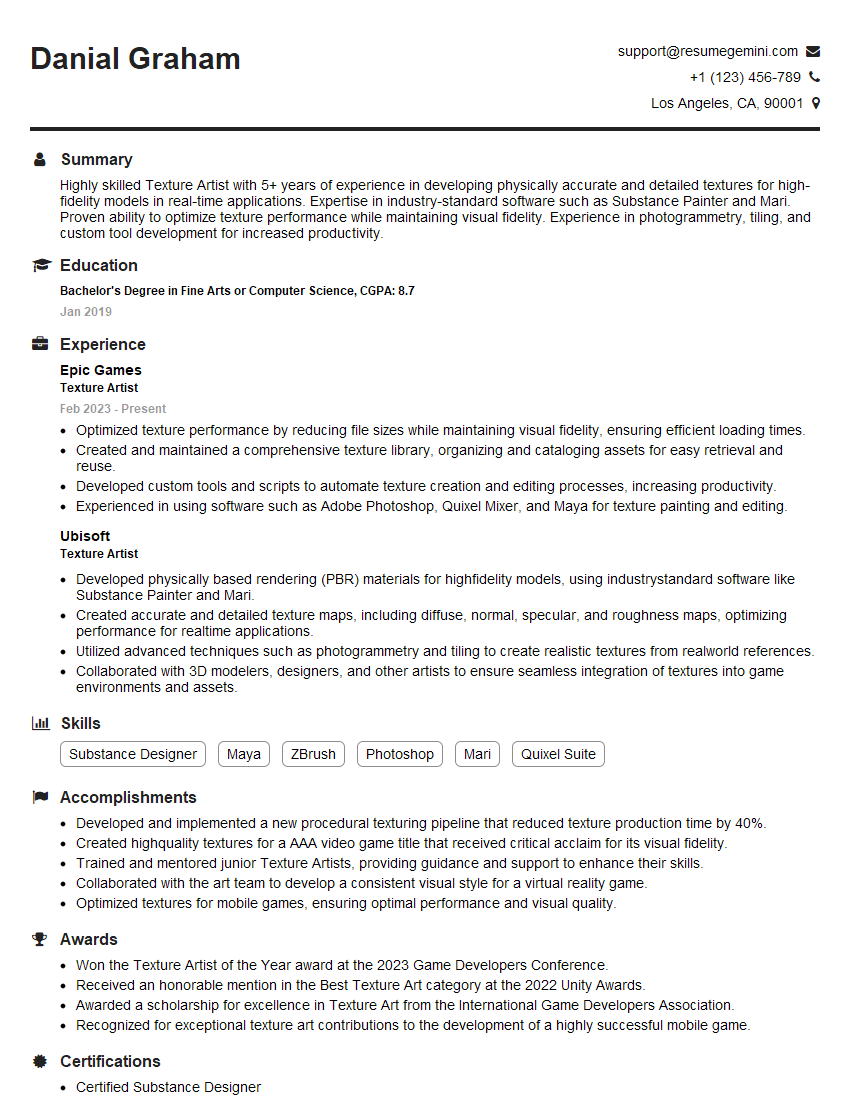
Mastering textures and overlays is crucial for career advancement in various creative fields. A strong understanding of these techniques demonstrates a high level of visual design expertise and problem-solving ability, making you a valuable asset to any team. To significantly boost your job prospects, crafting an ATS-friendly resume is essential. We highly recommend using ResumeGemini to build a professional and impactful resume that highlights your skills effectively. ResumeGemini provides examples of resumes tailored to the Textures and Overlays field to help you craft the perfect application. Take the next step toward your dream job today!
Explore more articles
Users Rating of Our Blogs
Share Your Experience
We value your feedback! Please rate our content and share your thoughts (optional).
What Readers Say About Our Blog
Really detailed insights and content, thank you for writing this detailed article.
IT gave me an insight and words to use and be able to think of examples