Preparation is the key to success in any interview. In this post, we’ll explore crucial Acoustic Guitar Building interview questions and equip you with strategies to craft impactful answers. Whether you’re a beginner or a pro, these tips will elevate your preparation.
Questions Asked in Acoustic Guitar Building Interview
Q 1. Describe the different types of wood used in acoustic guitar construction and their tonal properties.
The choice of wood dramatically impacts an acoustic guitar’s tone. Different woods possess unique density, stiffness, and vibrational characteristics. Think of it like choosing the right instrument for a specific musical genre – a mellow jazz piece might call for a different instrument than a driving rock song.
- Spruce (Top): Highly prized for its responsiveness and projection. Sitka spruce is a common choice, offering a bright, clear tone, while Adirondack spruce provides a warmer, fuller sound. Engelmann spruce leans towards a softer, more delicate tone.
- Mahogany (Back & Sides): A warm, balanced tone with good projection. It’s a very versatile wood, lending itself to a variety of musical styles.
- Rosewood (Back & Sides): Known for its rich, complex, and resonant tone. Brazilian rosewood, though increasingly rare and expensive, is considered the pinnacle, while Indian rosewood offers a similar, albeit slightly different character.
- Sapele (Back & Sides): A more affordable alternative to mahogany and rosewood, offering a warm tone and good projection. It’s a popular choice for guitars aiming for a balance between price and quality.
- Maple (Back & Sides): Brighter, more articulate tone than mahogany or rosewood. It often delivers a more powerful, resonant sound but can be less forgiving to playing imperfections.
The interaction between different wood types is crucial. For example, pairing a spruce top with mahogany back and sides often results in a balanced, versatile instrument, while a spruce top with rosewood back and sides creates a richer, more complex sound.
Q 2. Explain the process of bracing an acoustic guitar top.
Bracing the top is a critical step, determining the guitar’s structural integrity and tonal response. It’s like designing the skeleton of the soundboard. The pattern and design of the bracing significantly influence how the top vibrates and therefore, the guitar’s sound.
Traditionally, X-bracing is used, creating an X-shape across the soundboard. This pattern distributes the string tension across the top, preventing it from collapsing under pressure. The bracing is typically made from spruce, chosen for its strength and stiffness. The size, shape, and placement of the bracing pieces are meticulously determined to balance strength and flexibility. Overly stiff bracing will dampen the soundboard’s vibrations, resulting in a dull tone. Insufficient bracing can cause structural failure. Nowadays, there are variations of X-bracing and alternative patterns, like fan bracing and scalloped bracing, each with its unique tonal characteristics. The specific design is often a trade secret of the luthier, influencing the brand’s unique sound. The process involves careful gluing of the precisely shaped bracing pieces to the inside of the top, ensuring a secure and even bond.
Q 3. What are the different types of guitar finishes and their advantages/disadvantages?
Finishes protect the guitar from environmental damage, but they also affect its tone. Think of it as the guitar’s ‘skin.’ Different finishes offer distinct properties:
- French Polish: A traditional method that produces a thin, highly resonant finish. It allows for maximum vibration of the wood, resulting in a brighter, more responsive tone. However, it’s more susceptible to scratches and wear.
- Lacquer: A durable and widely used finish. Offers excellent protection but can slightly dampen the soundboard’s vibrations compared to French polish. Nitrocellulose lacquer is a popular choice for its durability and vibrant appearance, whereas polyurethane lacquer is very durable but can be perceived as being slightly less resonant.
- Shellac: Another traditional finish, producing a warm, mellow tone. Less durable than lacquer, it requires more care.
The choice of finish involves a trade-off between protection, resonance, and aesthetics. Some builders favor thinner finishes for maximum tonal responsiveness, while others opt for thicker finishes for increased protection. The finish also significantly contributes to the overall look and feel of the guitar.
Q 4. How do you select and prepare wood for acoustic guitar construction?
Selecting and preparing wood is paramount in acoustic guitar making. It’s about choosing the right building blocks for a superior final product.
Selection involves inspecting the wood for defects like knots, cracks, and inconsistencies in grain. The wood should be properly seasoned—dried to the correct moisture content—to prevent warping and cracking later. Kiln-dried wood is commonly used for its predictable properties. The wood’s density, straightness of grain, and resonance are carefully assessed. I often use a tapping test – lightly tapping the wood to listen for its vibrational response. A clear, ringing sound suggests good quality wood. Preparing the wood involves milling it to the required thickness and shape using specialized tools. This requires precision and attention to detail to ensure dimensional accuracy for all parts of the instrument.
Q 5. Describe the process of binding a guitar.
Binding is a decorative and functional element, protecting the edges of the guitar’s body and adding a touch of elegance. Think of it as a protective frame for the guitar’s body.
The process involves carefully gluing a thin strip of material, usually wood, plastic, or other composite material, along the edges of the body and neck. This requires precise measurements and careful alignment to create a neat and even appearance. Specialized tools, such as binding presses and clamps, are used to ensure a clean and consistent bond. Different techniques, such as edge-banding and channel binding, are employed depending on the desired aesthetic and the type of binding material used. Once the binding is secured, it’s carefully shaped and smoothed using files, sandpaper, and other tools to create a flawless finish.
Q 6. Explain the role of the bridge in acoustic guitar construction.
The bridge is the crucial link between the strings and the guitar’s soundboard. It’s like a transducer, transferring the string vibrations to the soundboard. Its design significantly affects tone and projection.
The bridge is usually made of hardwood, such as rosewood or ebony, selected for its density and stability. It’s glued to the guitar top, with its saddle meticulously shaped and positioned to control string height and intonation. The bridge’s design—including its shape, size, and material—influences the transfer of vibrational energy from the strings to the soundboard, affecting the tone and projection of the instrument. A poorly designed or installed bridge can lead to poor intonation or even damage to the guitar top.
Q 7. How do you troubleshoot a buzzing guitar?
A buzzing guitar is frustrating, but often easily fixed. It’s a question of identifying and eliminating unwanted vibrations. It’s like finding a squeak in a door – systematically check the potential sources.
Troubleshooting involves a systematic approach:
- Check the action: High action (the distance between the strings and the fretboard) can cause buzzing. Adjusting the bridge saddle height or truss rod can fix this.
- Check the frets: High or loose frets can create buzzing. A qualified luthier can level, dress, and crown the frets to solve this issue.
- Check string height at the nut: The strings might be too high or low at the nut, causing buzzing on the first fret. This requires adjusting the nut slots.
- Check for loose parts: Any loose hardware, such as tuners, bridge pins, or pickguard can cause buzzing. Tighten them securely.
- Check the body: Any loose parts or areas of the body causing vibration can generate unwanted noise. This may involve strengthening an area or tightening hardware.
If the buzzing persists, consulting a qualified luthier is recommended. They can diagnose the issue more accurately and perform the necessary repairs. A skilled luthier will have the knowledge and tools to address more complex problems.
Q 8. What are the common problems encountered during guitar construction?
Building an acoustic guitar is a meticulous process, and several problems can arise. Common issues include:
- Wood movement: Wood is a natural material and expands and contracts with humidity changes. This can lead to cracks, warping of the top, back, or sides, or neck relief issues. Preventing this requires careful wood selection, acclimation, and proper bracing.
- Gluing problems: Poor glue application or improper clamping can result in weak joints, leading to structural failure. This requires precision and experience in selecting the right glue and applying it correctly.
- Bracing issues: Incorrect bracing patterns can affect the guitar’s tone and volume. This is a complex area requiring a deep understanding of acoustic principles. A poorly braced guitar might sound dull or even crack under tension.
- Finishing problems: Improper finishing techniques can lead to a dull or uneven finish, or even damage the wood. This involves mastering techniques like sanding, spraying, and polishing.
- Fretting inconsistencies: Unevenly leveled frets or improper fretting can lead to buzzing or playability issues. Careful planning and execution are crucial here.
Addressing these problems requires a combination of careful planning, precise execution, and a deep understanding of wood properties and acoustic principles. For example, I once had a guitar top crack due to rapid humidity changes; I repaired it using a hide glue and a cleat, ensuring the repair was both structurally sound and aesthetically pleasing.
Q 9. Describe your experience with different types of guitar necks.
I’ve worked with various neck profiles and construction methods. The most common are:
- Set necks: The neck is glued directly into the body. This provides excellent sustain and resonance but requires precise fitting and gluing. It’s often found in higher-end instruments.
- Bolt-on necks: The neck is attached to the body using bolts. This is easier to manufacture and allows for easier neck replacement or adjustments. They generally offer a bit brighter tone than set necks.
- Neck-through necks: The neck extends the entire length of the guitar body. This provides exceptional sustain and stability, often favored in electric guitars but also found in some high-end acoustics. It’s the most difficult construction method.
Each type has its own advantages and disadvantages regarding tone, playability, and construction complexity. My preference often depends on the guitar’s overall design and target sound. For a vintage-style acoustic, a set neck might be ideal, whereas a more modern design might benefit from a bolt-on neck for its adjustability.
Q 10. Explain the process of fretting a guitar.
Fretting a guitar is a critical step that significantly impacts playability. The process involves:
- Preparing the fretboard: This involves carefully leveling and crowning the fretboard to ensure a smooth, even surface.
- Cutting the fret slots: Precisely cut slots are essential for proper fret seating. Specialized tools are used to ensure accurate sizing and placement.
- Installing the frets: Frets are carefully hammered into the slots, ensuring they are level and flush with the fretboard surface.
- Levelling and crowning the frets: This crucial step ensures the frets are perfectly level and have a consistent crown for optimal playing feel and intonation.
- Finishing the fretboard: This might involve sanding, polishing, and applying a finish to protect the fretboard and enhance appearance.
Improper fretting can result in buzzing, fretting out, and intonation problems. Experience and precision are essential for achieving a well-fretted guitar. I frequently use a fretting jig to ensure consistent fret spacing and alignment.
Q 11. How do you adjust the action of an acoustic guitar?
Adjusting the action (string height) of an acoustic guitar involves modifying the saddle height and/or neck relief. This affects playability and tone.
- Saddle height: Lowering the saddle lowers the action, making it easier to play but potentially reducing sustain. Raising the saddle increases action, improving sustain but possibly making it harder to play. Adjustments are made using specialized tools.
- Neck relief: This refers to the slight curvature of the neck. Too much relief causes buzzing, while too little causes string choking. Relief is adjusted using the truss rod, a metal rod inside the neck. Adjustments must be made carefully to avoid damage.
The process requires careful observation and adjustment. I usually start by checking the neck relief and then adjust the saddle height accordingly. It often involves iterative adjustments to achieve the desired balance between playability and tone.
Q 12. What are the different types of guitar tuners and their advantages?
Several types of guitar tuners are available:
- Friction tuners: These are the simplest and least expensive. They rely on friction to hold the tuning pegs in place. They’re prone to slippage and often require frequent tuning.
- Gear tuners (traditional): These use gears for precise tuning. They’re more reliable and durable than friction tuners, but they can still be prone to slippage if not properly maintained.
- Sealed gear tuners: These are similar to gear tuners, but they are enclosed in a sealed housing to protect them from dust and moisture. They’re more reliable and durable than open gear tuners.
- Locking tuners: These offer a locking mechanism for increased tuning stability. They are particularly useful for guitars that are frequently tuned or subjected to significant string tension changes. They greatly reduce tuning instability.
The choice of tuners often depends on the guitar’s price point and intended use. For a high-end instrument, locking tuners are often preferred for their stability and tuning accuracy. For a more budget-friendly guitar, sealed gear tuners provide a good balance of cost and performance.
Q 13. Describe your experience with guitar setup and maintenance.
Guitar setup and maintenance are crucial for optimal playability and tone. My experience involves:
- Regular cleaning: Cleaning the guitar body and fretboard removes dirt and grime that can affect playability and finish.
- String changes: Replacing old strings maintains optimal tone and playability. I usually recommend changing strings every few months, depending on playing frequency.
- Intonation adjustment: Adjusting the intonation ensures the guitar is in tune across the entire fretboard.
- Neck relief adjustment: Regular checks and adjustments of the neck relief maintain optimal string height and playability.
- Action adjustment: Adjusting the string action balances playability with sustain.
Proper setup and maintenance are essential for keeping a guitar in top condition. Neglecting maintenance can lead to problems like buzzing, intonation issues, and even damage to the instrument. I recommend a professional setup at least once a year, but regular home maintenance checks should be performed more frequently.
Q 14. How do you diagnose and repair cracks in an acoustic guitar?
Diagnosing and repairing cracks in an acoustic guitar requires careful assessment and precise repair techniques. The approach depends on the crack’s location, size, and severity.
- Assessment: Determine the crack’s location, depth, and cause (e.g., wood movement, impact damage). This might involve using a magnifying glass or even an endoscope to see the extent of the damage.
- Cleaning: Thoroughly clean the area surrounding the crack to remove any dirt or debris.
- Repair method: The repair method depends on the severity of the crack. Minor cracks might be repaired using hide glue and a clamp. Larger cracks might require more extensive repair, involving wood fillers, cleats, or even a patch.
- Finishing: After the repair is complete, the area should be carefully refinished to match the surrounding finish.
For example, I once repaired a significant crack in a guitar top using a combination of hide glue, a cleat, and a small patch. The cleat provided structural support, while the patch repaired the visible damage. The result was a structurally sound and aesthetically pleasing repair that was practically invisible. The key is to choose a repair method that’s both effective and preserves the guitar’s integrity and value.
Q 15. Explain your experience working with different finishing techniques.
Finishing an acoustic guitar is a crucial step that protects the wood, enhances its aesthetic appeal, and impacts the instrument’s tone. I’ve worked extensively with various finishes, each offering unique properties and challenges. My experience encompasses:
French Polish: A traditional method involving multiple layers of shellac applied and rubbed out, resulting in a deep, lustrous finish. It’s labor-intensive but produces a warm, resonant tone and a beautiful, highly durable surface. I often use this for high-end instruments where the tonal properties of the finish are paramount.
Lacquer: A faster-drying, more durable option than French polish. I use nitrocellulose lacquer for its clarity and ability to highlight the wood grain, and polyurethane lacquer for its superior protection against scratches and wear. The choice depends on the client’s preferences and the intended use of the guitar.
Oil and Wax Finishes: These provide a more natural look and feel, penetrating the wood to enhance its natural beauty. While less durable than lacquer, they allow the wood to breathe, potentially slightly impacting the tonal response. I use this for instruments where a ‘vintage’ or more organic aesthetic is desired.
The selection of the finish isn’t just an aesthetic choice; it significantly influences the final sound and playability of the guitar. Each finish affects the vibration of the wood, so a careful consideration of the wood type and the desired tonal characteristics is crucial.
Career Expert Tips:
- Ace those interviews! Prepare effectively by reviewing the Top 50 Most Common Interview Questions on ResumeGemini.
- Navigate your job search with confidence! Explore a wide range of Career Tips on ResumeGemini. Learn about common challenges and recommendations to overcome them.
- Craft the perfect resume! Master the Art of Resume Writing with ResumeGemini’s guide. Showcase your unique qualifications and achievements effectively.
- Don’t miss out on holiday savings! Build your dream resume with ResumeGemini’s ATS optimized templates.
Q 16. How do you ensure the structural integrity of an acoustic guitar?
Ensuring structural integrity is paramount in acoustic guitar building. It’s a delicate balance between strength, resonance, and weight. Several key aspects are crucial:
Wood Selection: I carefully select tonewoods known for their strength and acoustic properties, such as Sitka spruce for the top and Indian rosewood or mahogany for the back and sides. The quality and grain orientation of the wood are meticulously checked. I avoid knots or cracks that could compromise strength.
Bracing Pattern: The internal bracing system is vital for transferring string vibrations to the body and preventing structural collapse under string tension. The bracing pattern is carefully designed, considering the wood’s stiffness, guitar size, and the desired tonal characteristics. I often use fan bracing or X-bracing, adjusting the pattern based on the specific needs of the instrument.
Gluing Techniques: Using high-quality wood glue and ensuring proper clamping pressure during assembly are critical. I use hide glue for its traditional qualities and reversibility for repairs, or modern synthetic glues for their superior strength in some applications. Proper curing time is crucial for a strong joint.
Joint Design: Precise joinery is essential. I use traditional dovetail joints and mortise and tenon joints to create strong and durable connections between the different parts of the guitar.
Regular inspections throughout the building process, including checks for cracks or weakness points, guarantee a structurally sound and durable instrument. I treat this as an ongoing process, not a final step.
Q 17. What tools and equipment are essential for acoustic guitar building?
Acoustic guitar building requires a wide range of tools and equipment, ranging from basic hand tools to specialized machinery. Essential tools include:
Hand Tools: Chisels, planes, saws (hand saws and jigsaws), files, sandpaper, clamps, scrapers, measuring tools (rules, calipers, squares).
Power Tools: Routers, belt sanders, random orbital sanders, drill press.
Specialized Tools: Bending iron for bending sides, fretting tools, gluing clamps (various sizes), finishing supplies (brushes, spray guns), sound hole template.
Measuring and Marking Tools: Precision measuring tools like digital calipers, marking gauges, and templates are crucial for accurate work and consistent results. A good workbench and lighting are fundamental too.
The specific tools will depend on the builder’s approach (hand-tool vs. machine-heavy) and the complexity of the guitar design. However, precision and care are essential regardless of the tools used.
Q 18. Describe your experience with different types of guitar soundholes.
Soundholes are more than just aesthetic features; they significantly affect the guitar’s tone and projection. My experience includes working with several designs:
Traditional ‘f’ Holes: These are the classic soundhole design for many acoustic guitars. The shape and size affect the tonal balance of the instrument and how the instrument projects sound. I’ve worked with variations on the classic ‘f’ shape to experiment with tone.
Round Soundholes: Simpler to construct but offer a different tonal character. The diameter influences the resonance and the low-end response.
Other Shapes: I’ve also explored less common shapes, like teardrop, oval, or even custom designs. Each change presents unique challenges in shaping and routing but offer opportunities for tonal exploration and aesthetic variety. The shape’s impact on resonance is carefully considered in the design phase.
The choice of soundhole shape depends largely on the desired acoustic properties, the overall design of the instrument, and the client’s artistic vision. Each shape involves precise cutting and careful attention to detail to ensure the structural integrity of the instrument isn’t compromised.
Q 19. Explain the process of shaping a guitar body.
Shaping the guitar body is a multifaceted process requiring precision and skill. It begins with selecting and preparing the wood:
Template Creation: A precise template of the desired body shape is created. This is essential for maintaining consistency and accuracy. Computer-aided design (CAD) software can be used to create templates but precision hand-drawn templates are also very effective.
Rough Shaping: Using band saws, jigsaws, and other tools, the wood is cut roughly to the shape defined by the template.
Refining the Shape: This is where hand tools like planes, spokeshaves, and sandpaper are crucial for achieving the precise contours and curves of the guitar body. This is a time-consuming process that requires patience and a keen eye for detail.
Finishing Touches: Final shaping involves fine sanding to achieve a smooth surface, ready for finishing. Paying attention to the ergonomics of the guitar body is crucial at this stage. The shape of the body must be comfortable for the player to hold.
Throughout this process, constant checks against the template are crucial to ensure accuracy and avoid mistakes. The quality of the shaping significantly affects the instrument’s aesthetics and playability.
Q 20. How do you ensure consistent quality in your guitar building?
Consistent quality is achieved through a combination of meticulous planning, skilled craftsmanship, and quality control measures. My approach involves:
Standardized Processes: I’ve developed detailed processes for each stage of guitar building, ensuring consistency across projects. This includes detailed written instructions, diagrams, and photographic documentation. This methodical approach minimizes variations and improves efficiency.
High-Quality Materials: I source only the finest tonewoods and other materials from reputable suppliers. This ensures the longevity and sound quality of my instruments.
Regular Tool Maintenance: Sharp tools are essential for precise work. I maintain my tools regularly, ensuring they are in optimal condition for every project.
Continuous Learning: The craft of acoustic guitar building is constantly evolving. I stay updated with the latest techniques and materials through workshops, research, and collaboration with other luthiers.
By adhering to these principles, I strive to maintain the highest standards of quality in every instrument I create.
Q 21. What are your methods for quality control during the guitar making process?
Quality control is an ongoing process, integrated into every stage of the building process. My methods include:
Regular Inspections: At each stage, I meticulously inspect the work for any defects, inconsistencies, or potential problems. This includes visual inspections, measurements, and checks for structural soundness.
Test Assembly: Before final assembly, I conduct test fits of various components to ensure proper alignment and fit. This helps to identify and correct any issues early on, minimizing rework.
Sound Testing: Once assembled, the guitar undergoes rigorous sound testing to evaluate its tone, resonance, and projection. This involves listening carefully to the instrument’s response across the frequency range and adjusting elements like bracing as needed.
Play Testing: The guitar is played extensively to evaluate playability, comfort, and overall feel. This allows for adjustments to the neck profile, action, and intonation.
Documentation: I maintain detailed records of each guitar’s build process, materials used, and any modifications made. This is essential for tracking quality and improving future builds.
Through this comprehensive approach, I aim to deliver consistently high-quality instruments that meet the expectations of even the most discerning players.
Q 22. Describe your experience working with hand tools and power tools.
My experience with both hand and power tools spans over two decades. Hand tools are essential for the intricate detail work in guitar making – from shaping the neck to carving the soundhole. I’m proficient with chisels, planes, files, and various specialized woodworking tools. Think of hand tools as the artist’s brushstrokes, allowing for precise control and a nuanced finish. Power tools, on the other hand, are indispensable for tasks that require speed and efficiency, such as cutting the wood to the initial dimensions or shaping the body. I’m adept at using band saws, routers, planers, and sanders, always prioritizing safety with proper guards and techniques. For example, when shaping the guitar top, I might use a hand plane for fine adjustments after roughing it out with a power planer. This combination of precision and efficiency is key to building a high-quality instrument.
I regularly maintain my tools, ensuring they are sharp and properly adjusted. A dull tool is not just inefficient but dangerous. Sharpening my chisels and keeping the blades of my power tools clean is an ongoing process integral to my workflow and the quality of the final product.
Q 23. Explain your knowledge of different guitar construction methods (e.g., X-bracing, scalloped bracing).
Guitar construction methods significantly impact the instrument’s tone and playability. X-bracing, the most common method, involves a pattern of bracing struts arranged in an ‘X’ shape underneath the top. This pattern provides structural support and influences the sound’s projection and resonance. Different X-bracing patterns, varying in angle, thickness, and spacing, can lead to noticeably different tonal characteristics. For instance, tighter bracing will typically result in a brighter, more responsive tone, while wider spacing might create a warmer, more mellow sound.
Scalloped bracing takes X-bracing a step further. It involves carving away material from the underside of the braces, reducing their mass and creating a more flexible and resonant top. This technique is often used to produce a louder, more responsive instrument, but it requires considerable skill and understanding of wood behavior. Imagine it like sculpting the sound: you’re carefully removing material to shape the instrument’s vibrational characteristics. Other bracing methods include fan bracing, found often in classical guitars, and ladder bracing, more commonly seen in older instruments.
My experience encompasses building guitars using all these bracing patterns and I tailor the choice of bracing based on the specific design goals and the wood I’m working with. I understand the trade-offs between structural strength, resonance, and tonal character that each bracing pattern offers.
Q 24. How do you interpret and follow guitar construction plans?
Interpreting and following guitar construction plans requires careful attention to detail and a strong understanding of woodworking principles. I approach plans systematically. First, I meticulously review the entire plan to understand the overall design and assembly sequence. This includes studying the dimensions, material specifications (wood type, thickness), and joinery techniques. Then, I break down the plan into smaller, manageable tasks. I create a detailed checklist, ensuring I have all necessary materials and tools prepared before starting any step.
I use a combination of digital and physical tools for plan interpretation, often utilizing CAD software to visualize 3D models and create detailed cutting lists. For example, if a plan calls for a specific radius on a curve, I’ll use a template or specialized tools to ensure accuracy. During the process, I continually cross-reference the plan to maintain precision and consistency. Discrepancies are noted and carefully reviewed. Finally, I meticulously document each step of the process, adding notes or sketches as needed for future reference.
Q 25. Describe your experience with repairing and replacing damaged guitar parts.
Repairing and replacing damaged guitar parts requires a keen eye for detail and a deep understanding of the instrument’s structure. I have extensive experience in various repair scenarios, from simple tasks like replacing a broken string peg to more complex repairs, such as crack repairs in the top or neck reset.
For crack repairs, I meticulously clean the crack, stabilize it with glue appropriate for the wood type, and carefully clamp it to ensure proper alignment during curing. For neck resets, a complex procedure involving detaching and reattaching the neck, I assess the extent of the damage, carefully remove the existing glue, and use precise measurements and techniques to ensure the neck is correctly reattached, maintaining proper action and intonation. Replacing damaged parts like bridges or fretboards involves selecting the correct materials and using accurate joinery to ensure a smooth, durable and aesthetically pleasing repair.
Throughout these repairs, I prioritize maintaining the integrity of the instrument’s original design and tonal characteristics.
Q 26. How do you maintain a clean and organized workspace?
Maintaining a clean and organized workspace is paramount for efficiency and safety. My workshop is designed with workflow in mind. Tools are stored in designated areas, readily accessible but out of the way. Materials are organized by project and type, minimizing clutter and maximizing efficiency. I have specific zones for cutting, shaping, finishing, and assembly. Regular cleaning, often at the end of each work session, removes dust and debris, preventing accidents and ensuring a safe working environment.
A clean space allows for better concentration and reduces the risk of damaging parts or tools. It also makes it easier to find what I need quickly, saving valuable time. This organized environment, in turn, results in higher-quality work and improves overall satisfaction. It’s not just about cleanliness; it’s about creating a space conducive to focused, precise work.
Q 27. What are your strategies for managing time and prioritizing tasks in a busy workshop?
Managing time and prioritizing tasks in a busy workshop requires a strategic approach. I use a combination of project planning and time management techniques. Each project starts with a detailed plan that breaks down the work into smaller, manageable tasks with estimated timeframes. I then prioritize these tasks based on urgency and deadline, using tools like Kanban boards or project management software to track progress and identify potential bottlenecks.
I allocate specific time slots for different tasks, aiming for a balanced workload throughout the week. This helps to avoid burnout and maintains momentum. Flexibility is key, as unexpected issues can arise. I build buffer time into the schedule to account for these unforeseen circumstances. Regular review of the project plan allows for adjustments and helps maintain focus on the overall goals.
Q 28. Describe your problem-solving approach when faced with unexpected challenges during guitar construction.
Problem-solving is a critical skill in guitar making. When faced with unexpected challenges, I approach the situation systematically. First, I thoroughly assess the problem, gathering as much information as possible. This includes examining the affected area, reviewing the construction plan, and consulting relevant resources such as books or online forums.
Next, I brainstorm potential solutions, considering various approaches and their potential consequences. I may try simpler solutions first, progressing to more complex ones if needed. Throughout this process, I carefully document the steps taken, the results obtained, and any lessons learned. For example, if a crack appears in the wood during the bending process, I would first determine the cause—perhaps the wood wasn’t adequately steamed or the bending jig was improperly aligned. I’d then address the root cause and choose the most suitable repair method based on the severity of the damage. The key is a systematic, analytical approach combined with a practical, hands-on mindset.
Key Topics to Learn for Your Acoustic Guitar Building Interview
- Wood Selection and Properties: Understanding the characteristics of different tonewoods (e.g., spruce, mahogany, rosewood) and their impact on the final sound and instrument durability. Practical application: Explaining your choices for a specific guitar design and justifying them based on tonal goals.
- Bracing Design and Function: Knowledge of different bracing patterns (e.g., X-bracing, fan bracing) and their influence on resonance, volume, and projection. Practical application: Analyzing a bracing pattern and predicting its effect on the guitar’s sound.
- Joint Construction Techniques: Mastery of various joint types (e.g., dovetail, mortise and tenon, scarf joint) for the neck, body, and other components. Practical application: Describing the advantages and disadvantages of different joint types for specific applications and demonstrating your understanding of precision woodworking.
- Finishing Techniques: Knowledge of different finishing methods (e.g., French polishing, lacquer, shellac) and their impact on the instrument’s appearance, durability, and tone. Practical application: Explaining your preferred finishing method and why you chose it for a given guitar project. Troubleshooting potential issues.
- Setup and Adjustment: Understanding neck relief, action, intonation, and how to adjust them for optimal playability. Practical application: Describing the process of setting up a guitar and troubleshooting common setup problems.
- Tool Knowledge and Usage: Proficiency in using hand tools and power tools relevant to acoustic guitar building. Practical application: Demonstrating your understanding of safe and efficient tool usage, including maintenance and sharpening techniques.
- Troubleshooting and Problem Solving: Ability to identify and resolve common issues encountered during the building process. Practical application: Discussing a past project where you encountered a challenge and how you successfully overcame it.
Next Steps
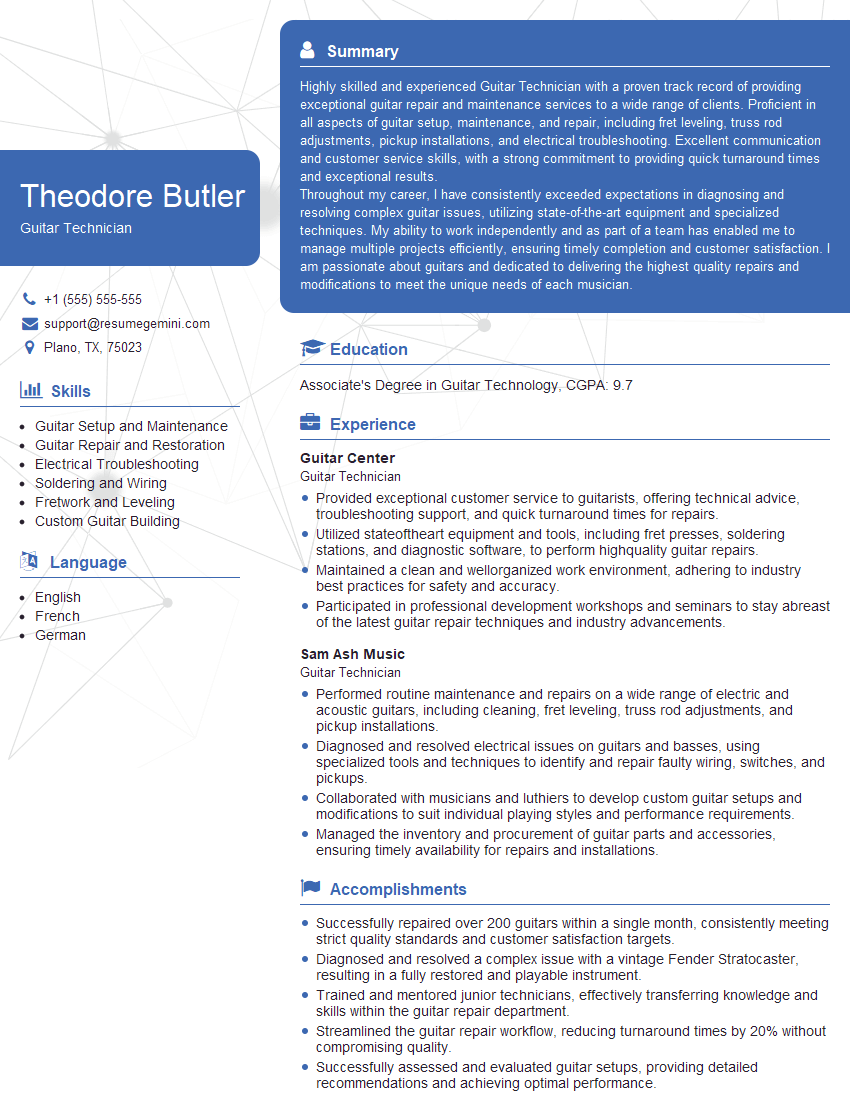
Mastering acoustic guitar building opens doors to a rewarding career filled with creativity and craftsmanship. To maximize your job prospects, a well-crafted, ATS-friendly resume is crucial. ResumeGemini is a trusted resource to help you build a professional and effective resume that highlights your skills and experience. Examples of resumes tailored specifically to the acoustic guitar building field are available to guide you. Invest the time to create a resume that showcases your unique talents and expertise – it’s an investment in your future success.




Explore more articles
Users Rating of Our Blogs
Share Your Experience
We value your feedback! Please rate our content and share your thoughts (optional).
What Readers Say About Our Blog
Really detailed insights and content, thank you for writing this detailed article.
IT gave me an insight and words to use and be able to think of examples