Interviews are opportunities to demonstrate your expertise, and this guide is here to help you shine. Explore the essential Aerodynamic optimization interview questions that employers frequently ask, paired with strategies for crafting responses that set you apart from the competition.
Questions Asked in Aerodynamic optimization Interview
Q 1. Explain the concept of boundary layer separation and its impact on aerodynamic performance.
Boundary layer separation occurs when the flow within the boundary layer (the thin layer of fluid near a surface) is slowed down to the point where it reverses direction and separates from the surface. Imagine a river flowing smoothly around a rock; if the rock’s shape forces the water to slow down too much, it will break away and form eddies downstream. Similarly, on an airfoil, separation is detrimental because it disrupts the smooth flow, leading to a significant loss in lift and an increase in drag.
The impact on aerodynamic performance is severe. Separation leads to a dramatic increase in pressure drag, a reduction in lift (for wings), and an increase in stall angle. Think of a golf ball’s dimples; these create a turbulent boundary layer that delays separation, enabling higher lift and lower drag compared to a smooth ball. In aircraft design, delaying or preventing separation is crucial for achieving efficient flight and preventing stalls.
Examples include the catastrophic stall of an aircraft, where separation on the wing leads to a sudden loss of lift, and the increased drag on a poorly designed car body, which leads to lower fuel efficiency.
Q 2. Describe different turbulence models used in CFD simulations and their applications.
Turbulence models in CFD are mathematical approximations of the Navier-Stokes equations, which are too complex to solve directly for turbulent flows. Different models make different assumptions about the nature of turbulence, leading to varying levels of accuracy and computational cost.
- RANS (Reynolds-Averaged Navier-Stokes): This is the most widely used approach. It decomposes the flow variables into mean and fluctuating components and solves for the mean flow. Different turbulence closure models are used to approximate the effects of turbulence on the mean flow. Popular examples include the k-ε model (relatively simple and robust) and the k-ω SST model (more accurate in near-wall regions).
- LES (Large Eddy Simulation): This method directly resolves the large-scale turbulent structures while modeling the smaller scales. LES is more computationally expensive than RANS but offers higher accuracy, particularly for complex flows. It is often used for studying transitional or separated flows.
- DES (Detached Eddy Simulation): DES combines RANS and LES approaches. It uses RANS in regions of attached flow and switches to LES in separated flow regions where resolving large-scale structures is important. This offers a balance between computational cost and accuracy.
The choice of turbulence model depends on the specific application and available computational resources. For a simple flow around a streamlined body, a k-ε model might suffice. For a complex flow with separation and recirculation, LES or DES would be more appropriate, but at a higher computational cost.
Q 3. How do you validate CFD results? What methods do you use to ensure accuracy?
Validating CFD results is critical to ensure their reliability. It’s not enough to just get numbers; you need to know if those numbers represent reality. We use several methods:
- Grid Independence Study: This involves running the simulation with increasingly finer meshes until the results converge to a stable solution. This proves the solution isn’t dependent on the mesh resolution, within a certain error margin.
- Comparison with Experimental Data: The gold standard is to compare CFD results with data from wind tunnel experiments or flight tests. This provides a direct measure of the accuracy of the simulation.
- Code Verification: This involves rigorously testing the CFD code itself to ensure it’s correctly solving the governing equations. Techniques such as method of manufactured solutions (MMS) are employed.
- Uncertainty Quantification: This is a crucial step to assess the uncertainty associated with the CFD predictions due to factors like turbulence modeling, mesh resolution, and input parameters.
For instance, in designing an aircraft wing, we might compare our CFD-predicted lift and drag coefficients with data from wind tunnel tests on a scaled model. Any discrepancies must be investigated and understood before relying on the CFD results for design decisions. A methodical approach that includes all mentioned aspects is crucial to ensure confidence in the results.
Q 4. Explain the difference between inviscid and viscous flow simulations.
The key difference between inviscid and viscous flow simulations lies in how they handle the effects of fluid viscosity (internal friction).
Inviscid flow simulations assume that the fluid has zero viscosity. This simplifies the governing equations significantly, making the simulations computationally inexpensive. However, inviscid simulations cannot accurately predict effects like boundary layer development, separation, and drag due to friction. They are useful for preliminary design stages where a quick assessment of pressure distribution is needed or where viscous effects are negligible.
Viscous flow simulations account for the effects of viscosity, using more complex governing equations (Navier-Stokes equations). These simulations capture the details of the boundary layer, separation, and viscous drag. They are computationally more expensive but provide much more accurate results for real-world flows.
Imagine a smooth sphere moving through air. An inviscid simulation would predict zero drag, while a viscous simulation would correctly predict a significant drag force due to friction in the boundary layer.
Q 5. What are the key considerations in designing a wind tunnel experiment for aerodynamic testing?
Designing a wind tunnel experiment requires careful consideration of several factors:
- Model Scale and Reynolds Number: The model size needs to be chosen to achieve the correct Reynolds number (a dimensionless quantity that governs the flow regime) to match the actual flight conditions. This ensures dynamic similarity.
- Wind Tunnel Type: Different types of wind tunnels are suited for different applications. For example, a closed-return wind tunnel provides a more uniform flow than an open-return wind tunnel.
- Instrumentation: Appropriate instrumentation, such as pressure taps, force balances, and flow visualization techniques, are required to measure the desired aerodynamic parameters.
- Test Section Design: The test section needs to be large enough to accommodate the model and ensure a uniform flow field around it. It needs to have sufficient settling chambers to reduce turbulence.
- Wall Corrections: The presence of wind tunnel walls can affect the flow around the model. Corrections for these wall effects are often necessary to obtain accurate results.
For example, testing a new aircraft wing design would necessitate a careful selection of model scale to achieve the correct Reynolds number, use of a high-quality wind tunnel with a low turbulence intensity, and deployment of force balances to measure lift, drag, and moments.
Q 6. Describe your experience with mesh generation and its impact on CFD accuracy.
Mesh generation is the process of creating a computational grid that divides the flow domain into smaller elements for CFD simulations. The quality of the mesh directly impacts the accuracy and efficiency of the simulation. A poorly generated mesh can lead to inaccurate results or even convergence failure.
My experience includes using various meshing software packages to generate high-quality meshes for complex geometries. I’ve used structured, unstructured, and hybrid meshing techniques depending on the complexity of the geometry and the desired level of accuracy. For example, I’ve utilized inflation layers near solid surfaces to accurately capture boundary layer details. A good mesh will have appropriate element size and distribution, ensuring sufficient resolution in regions of high flow gradients, such as near leading and trailing edges of an airfoil.
I also understand the importance of mesh refinement techniques to improve accuracy. It’s common to start with a coarser mesh for initial simulations and then refine the mesh in critical areas based on the results. The mesh must balance accuracy with computational cost; an overly fine mesh can lead to excessively long simulation times without a significant improvement in accuracy.
Q 7. How do you handle mesh convergence issues in CFD simulations?
Mesh convergence issues in CFD often arise from poor mesh quality or inappropriate numerical settings. Several strategies can be used to address these issues:
- Mesh Refinement: Refining the mesh in regions where convergence problems occur can improve the solution’s accuracy and stability.
- Mesh Quality Improvement: Addressing issues like skewed elements, high aspect ratios, or poor element distribution can greatly improve convergence. This often involves adjusting meshing parameters or re-meshing parts of the domain.
- Numerical Scheme Selection: Choosing a more stable or higher-order numerical scheme can improve convergence, particularly for challenging flows.
- Relaxation Factor Adjustment: Adjusting relaxation factors within the solver can improve stability and convergence rate.
- Multigrid Methods: Using multigrid methods can accelerate convergence by solving the equations on multiple grid levels.
For example, if a simulation fails to converge due to high aspect ratio elements near a sharp corner, I would refine the mesh in that region and potentially use a more appropriate meshing technique to improve element quality. Systematically investigating and addressing these issues are crucial for obtaining reliable CFD results.
Q 8. Explain different aerodynamic optimization techniques, such as RANS, LES, and DES.
Aerodynamic optimization heavily relies on Computational Fluid Dynamics (CFD) simulations, employing various turbulence modeling approaches. Let’s delve into three prominent ones: RANS, LES, and DES.
- RANS (Reynolds-Averaged Navier-Stokes): This is the most widely used approach due to its computational efficiency. RANS solves the time-averaged Navier-Stokes equations, incorporating turbulence effects through turbulence models like k-ε or k-ω SST. Think of it like taking a blurry picture of the flow – you get the overall picture, but miss the fine details. It’s excellent for capturing overall flow features and is suitable for many engineering applications, especially when dealing with complex geometries or high Reynolds numbers where LES or DES become computationally prohibitive.
- LES (Large Eddy Simulation): LES directly simulates the large-scale turbulent structures, while modeling the smaller scales using subgrid-scale models. Imagine this as taking a higher-resolution photograph; it captures more detail than RANS. This method offers improved accuracy, especially in predicting unsteady flow phenomena, but demands significantly more computational resources. LES is often used for fundamental research and applications where accuracy is paramount, such as studying vortex shedding behind bluff bodies or investigating separated flows.
- DES (Detached Eddy Simulation): DES aims to combine the strengths of both RANS and LES. It uses a RANS model in attached flow regions and automatically switches to an LES-like approach in separated flow regions. It’s like having a camera that automatically adjusts its resolution depending on the scene – sharp in areas with details and blurred in smooth areas. DES offers a good balance between accuracy and computational cost, making it suitable for a wider range of applications where both large-scale and small-scale turbulence are important.
The choice of method depends on factors like the complexity of the geometry, the required accuracy, and the available computational resources. For example, a preliminary design optimization might use RANS for speed, while final design refinement could involve LES or DES for higher fidelity.
Q 9. What are the limitations of CFD simulations, and how do you mitigate them?
CFD simulations, while powerful, have limitations. These include:
- Mesh Dependency: The accuracy of the results is highly sensitive to the quality of the computational mesh. A poorly generated mesh can lead to inaccurate or even erroneous solutions. Mitigation involves employing mesh refinement techniques (e.g., adaptive mesh refinement) and rigorous mesh independence studies to ensure that results are not significantly affected by mesh changes.
- Turbulence Modeling: Accurately simulating turbulence remains a challenge. All turbulence models involve approximations, which can impact the accuracy of the results, particularly for complex flow phenomena. To mitigate this, one can compare results from different turbulence models and explore higher-fidelity methods like LES when computationally feasible.
- Boundary Conditions: Accurate representation of boundary conditions is crucial. Improper boundary conditions can significantly affect the simulation results. Careful consideration and validation of boundary conditions are necessary, often requiring experimental data for comparison.
- Computational Cost: High-fidelity simulations, such as LES, can be computationally expensive, limiting the feasibility of performing extensive design exploration. Techniques such as adjoint-based optimization or surrogate models can help to reduce computational cost.
A robust CFD workflow includes mesh refinement studies, turbulence model comparisons, validation against experimental data, and uncertainty quantification to address these limitations.
Q 10. How do you interpret and analyze CFD results to identify areas for aerodynamic improvement?
Interpreting CFD results involves a systematic approach. First, we examine the overall flow field – pressure contours, velocity vectors, and streamlines – to identify major flow features. We then focus on specific regions of interest, such as areas of high pressure drag or flow separation. For instance, areas with high pressure gradients often correspond to high drag.
Quantitatively, we analyze key performance parameters: lift, drag, pitching moment, and pressure coefficients. We use these parameters to identify regions requiring improvement. Visualizing these parameters (e.g., using contour plots, surface plots) helps in understanding their spatial distribution. Further, advanced techniques like proper orthogonal decomposition (POD) can be employed to extract dominant flow structures and better understand the physics. For example, a high drag coefficient might point towards the need for streamlining the geometry, while regions of flow separation might indicate a need for vortex generators or other flow control devices.
Finally, we correlate the CFD results with experimental data (if available) to validate the accuracy of the simulation and ensure reliability of the findings. This iterative process, involving model refinement and validation, guides the design improvements.
Q 11. Describe your experience with different types of wind tunnels (e.g., subsonic, supersonic).
My experience encompasses both subsonic and supersonic wind tunnels. Subsonic wind tunnels, typically used for aircraft and automotive applications, operate at speeds below the speed of sound. I’ve worked extensively with these, using them for force and moment measurements, surface pressure measurements, and flow visualization techniques like oil flow visualization and particle image velocimetry (PIV). For example, I used a subsonic wind tunnel to optimize the shape of a car’s rear end to minimize drag.
Supersonic wind tunnels, on the other hand, are designed to operate at speeds exceeding the speed of sound. These are crucial for high-speed aircraft and missile design. My experience includes working with such tunnels for evaluating aerodynamic characteristics of hypersonic vehicles, focusing primarily on shock wave interactions and heat transfer considerations. In one project, we used a supersonic wind tunnel to study the performance of a new supersonic inlet design.
The experimental techniques used vary depending on the wind tunnel type and the specific research questions. Data acquisition and reduction procedures also differ, requiring careful calibration and uncertainty analysis.
Q 12. Explain the concept of drag reduction and different methods used to achieve it.
Drag reduction is crucial for improving fuel efficiency in vehicles and aircraft. It focuses on minimizing the resistance to motion caused by air. Several methods exist:
- Streamlining: Shaping the body to minimize flow separation and reduce pressure drag. This is achieved by designing smooth, continuous surfaces and avoiding sharp corners or discontinuities. Think of the teardrop shape, which minimizes drag compared to a blunt object.
- Boundary Layer Control: Manipulating the boundary layer (the thin layer of fluid adjacent to the surface) to reduce skin friction drag. Techniques include suction, blowing, and vortex generators.
- Surface Roughness Control: Minimizing surface roughness to reduce skin friction. This involves careful surface treatment and manufacturing processes. Examples include using specialized paints or coatings to create superhydrophobic surfaces.
- Passive Flow Control Devices: Using devices like vortex generators or dimples to delay flow separation and reduce pressure drag. These have been applied successfully to aircraft wings and golf balls.
- Active Flow Control: Employing active mechanisms to control the flow, such as using microjets or synthetic jets to manipulate the boundary layer. This is a more advanced technique but allows for dynamic control of the flow field.
The choice of method depends on the specific application, the desired level of drag reduction, and the cost-benefit trade-offs. Often, a combination of methods is used to achieve optimal results.
Q 13. How do you account for Reynolds number effects in aerodynamic simulations?
The Reynolds number (Re) is a dimensionless quantity that represents the ratio of inertial forces to viscous forces in a fluid. It significantly influences the flow characteristics, particularly the transition from laminar to turbulent flow. Accurate representation of Reynolds number effects is crucial in aerodynamic simulations.
Several approaches are used to account for Reynolds number effects:
- Direct Simulation: For low to moderate Reynolds numbers, it’s sometimes possible to directly simulate the flow at the desired Reynolds number. This however, can be computationally expensive.
- Scaling Laws: For many applications, scaling laws, such as those based on similarity parameters, can be used to extrapolate results obtained at a specific Reynolds number to other Reynolds numbers. However, the accuracy of such scaling laws can be limited, especially for complex flows.
- Turbulence Models: Most turbulence models implicitly incorporate Reynolds number effects through their formulation. However, the accuracy of the model in capturing these effects depends on the specific model and the flow regime. This makes selecting an appropriate model a critical task.
- Wall-Resolved Large Eddy Simulation (WRLES): For high Reynolds numbers where resolving the boundary layer is crucial, WRLES accurately captures the near-wall behavior, which is highly sensitive to the Reynolds number.
The choice of method depends on the specific application and the desired level of accuracy. Often, a combination of these methods is employed to accurately capture the effects of Reynolds number across the range of interest.
Q 14. What are the key parameters used to evaluate aerodynamic performance (e.g., lift, drag, pitching moment)?
Several key parameters evaluate aerodynamic performance. These parameters describe the forces and moments acting on an aerodynamic body.
- Lift (L): The force acting perpendicular to the direction of motion. It’s essential for generating upward force in aircraft. Lift coefficient (CL) is a dimensionless form, typically obtained from CFD or wind tunnel experiments.
- Drag (D): The force acting parallel to the direction of motion, resisting movement. It’s a major factor in fuel efficiency. Drag coefficient (CD) is the dimensionless form.
- Pitching Moment (M): The moment about the pitching axis, tending to rotate the body. Understanding the pitching moment is crucial for stability and control.
- Pressure Coefficient (Cp): Represents the pressure distribution over the surface. Examining the pressure coefficient distribution can reveal areas of high or low pressure, contributing to lift and drag.
- Skin Friction Coefficient (Cf): Represents the frictional drag on the surface. It’s crucial for understanding the contribution of viscous effects.
These parameters, along with others such as rolling moment and yawing moment, allow for a comprehensive assessment of aerodynamic performance. These parameters are commonly non-dimensionalized by appropriate reference quantities for wider applicability and comparison.
Q 15. Explain the concept of lift-to-drag ratio and its significance.
The lift-to-drag ratio (L/D) is a crucial aerodynamic parameter representing the efficiency of an aircraft or any lifting body. It’s simply the ratio of the lift generated by the body to the drag it experiences at a given flight condition. A higher L/D ratio indicates better aerodynamic efficiency, meaning the body can generate more lift for the same amount of drag, or conversely, requires less energy to maintain altitude.
Significance: In aircraft design, maximizing L/D is paramount. A higher L/D translates to increased range, fuel efficiency, and potentially higher payload capacity. For example, gliders rely on high L/D ratios to stay aloft for extended periods, while passenger aircraft strive for high L/D to minimize fuel consumption on long flights. The L/D ratio isn’t constant; it varies with angle of attack, Reynolds number (related to airspeed and size), and Mach number (related to speed of sound). Understanding this variation is key to optimizing aircraft performance across different flight regimes.
Example: Imagine two aircraft with identical weight and wing area. If one has an L/D of 15 and the other has an L/D of 20, the second aircraft will require significantly less thrust (and hence less fuel) to maintain the same altitude and speed, thus exhibiting superior aerodynamic efficiency.
Career Expert Tips:
- Ace those interviews! Prepare effectively by reviewing the Top 50 Most Common Interview Questions on ResumeGemini.
- Navigate your job search with confidence! Explore a wide range of Career Tips on ResumeGemini. Learn about common challenges and recommendations to overcome them.
- Craft the perfect resume! Master the Art of Resume Writing with ResumeGemini’s guide. Showcase your unique qualifications and achievements effectively.
- Don’t miss out on holiday savings! Build your dream resume with ResumeGemini’s ATS optimized templates.
Q 16. How do you use experimental data to validate and improve CFD models?
Validating and improving CFD models using experimental data is a critical step in ensuring the accuracy and reliability of simulations. This process involves a structured approach:
- Data Acquisition: Experimental data, such as wind tunnel measurements of pressure distribution, forces and moments, and surface flow visualization, are gathered. The quality and precision of this data are crucial.
- Mesh Refinement and Boundary Conditions: The CFD mesh needs to be carefully designed to resolve flow features captured in the experiments. Boundary conditions (inlet velocity, outlet pressure, etc.) must also precisely match the experimental setup.
- CFD Simulation and Post-Processing: The CFD simulation is run using the validated mesh and boundary conditions. The results, including pressure coefficients, lift, drag, and moment coefficients are then extracted.
- Comparison and Analysis: The CFD results are meticulously compared against experimental data. Discrepancies highlight areas where model improvements are needed. Techniques like quantitative analysis of differences (e.g., root mean square error) aid in this process.
- Model Adjustment and Re-validation: Based on the comparison, the CFD model – its turbulence model, boundary conditions, mesh resolution or even the underlying geometry – might be adjusted. The process then repeats, iteratively improving the model’s accuracy.
Example: If the CFD simulation predicts a significantly higher drag coefficient compared to wind tunnel measurements, this could indicate inaccuracies in the turbulence modeling, mesh resolution near the trailing edge, or even errors in the geometry representation within the CFD model. Refining the mesh, adjusting turbulence modeling parameters, or recalibrating the boundary conditions might be necessary.
Q 17. Describe your experience with design of experiments (DOE) for aerodynamic optimization.
Design of Experiments (DOE) is a powerful statistical technique used to efficiently explore the design space during aerodynamic optimization. Instead of testing every possible design combination, DOE strategically selects a subset of designs to maximize the information gained. I have extensive experience using various DOE methodologies, such as:
- Full Factorial Designs: Used when exploring the effects of a small number of design variables. Every combination of variable levels is tested.
- Fractional Factorial Designs: Efficiently explore a large number of design variables by testing only a fraction of the possible combinations. This is useful when the computational cost of a full factorial design is prohibitive.
- Latin Hypercube Sampling (LHS): A random sampling technique that ensures even coverage of the design space. Often used for computationally expensive simulations.
- Response Surface Methodology (RSM): Used to build a mathematical approximation (often a polynomial) of the response surface (e.g., L/D) as a function of the design variables. This allows for efficient optimization using gradient-based methods.
Example: In optimizing an airfoil, DOE might be employed to investigate the effect of camber, thickness, and trailing edge flap angle on lift and drag. A fractional factorial design could be used to efficiently explore the impact of these variables, allowing for identification of the most significant factors and their optimal values, potentially guiding further refinements with more localized simulations.
Q 18. Explain the concept of computational fluid dynamics (CFD) and its applications in aerodynamic optimization.
Computational Fluid Dynamics (CFD) is a branch of fluid mechanics that uses numerical methods and algorithms to solve and analyze problems that involve fluid flows. It’s essentially a computer-based simulation technique that predicts how fluids behave under various conditions.
Applications in Aerodynamic Optimization: CFD is extensively used in aerodynamic optimization because it allows engineers to:
- Virtually test designs: CFD eliminates the need for expensive and time-consuming wind tunnel tests for many design iterations.
- Explore a wide range of design options: Quickly assess the aerodynamic performance of numerous design variations, enabling efficient optimization.
- Visualize flow phenomena: Provide insights into the flow field around a body, helping to understand the underlying physics of lift, drag, and other aerodynamic forces. This visualization can reveal areas of separation, vortices, and other flow features affecting performance.
- Optimize performance: CFD simulations guide the design process toward improved aerodynamic efficiency, reduced drag, increased lift, and better overall performance.
Example: CFD was instrumental in the development of modern aircraft wings with winglets, which reduce induced drag by altering the wingtip vortices. Through simulation, designers can explore various winglet geometries and configurations to optimize their effectiveness.
Q 19. What software packages are you proficient in for CFD simulations (e.g., ANSYS Fluent, Star-CCM+, OpenFOAM)?
I am proficient in several industry-standard CFD software packages, including:
- ANSYS Fluent: A powerful and versatile CFD solver widely used for a broad range of applications, including external aerodynamics.
- Star-CCM+: Known for its robust meshing capabilities and ease of use, particularly effective for complex geometries.
- OpenFOAM: An open-source CFD toolbox that offers great flexibility and customization options, suitable for highly specialized simulations.
My experience encompasses pre-processing (geometry cleanup, mesh generation), solver setup (choosing appropriate turbulence models, boundary conditions), and post-processing (data visualization, quantitative analysis of results). I am also comfortable using scripting and automation tools to streamline workflows.
Q 20. How do you handle complex geometries in CFD simulations?
Handling complex geometries in CFD simulations requires careful consideration of several aspects:
- Geometry Preparation: Complex geometries often need cleaning and simplification before meshing. Software like CAD tools are used to repair any inconsistencies or errors. This step is crucial for accurate simulations.
- Meshing Strategies: Appropriate meshing techniques are crucial. For complex geometries, hybrid meshing strategies, combining structured and unstructured elements, are often used. Mesh refinement in critical regions (e.g., near sharp edges, trailing edges) is also necessary to accurately resolve flow features.
- Mesh Quality: Mesh quality directly impacts the accuracy and stability of the simulation. Parameters like aspect ratio, skewness, and orthogonality must be carefully monitored and optimized.
- Adaptive Mesh Refinement (AMR): For complex flow features, AMR dynamically refines the mesh in regions where high gradients occur, enhancing accuracy without excessive computational cost.
Example: Simulating flow around an entire aircraft, including the fuselage, wings, engines, and landing gear, requires a sophisticated meshing strategy. I often utilize hybrid meshing approaches with local refinement near critical areas like the wing-body junction, where flow separation might occur.
Q 21. Explain the concept of surface pressure distribution and its influence on aerodynamic forces.
Surface pressure distribution refers to the variation of pressure across the surface of an aerodynamic body. This pressure field is directly related to the aerodynamic forces acting on the body.
Influence on Aerodynamic Forces: The pressure distribution is a primary determinant of both lift and drag.
- Lift: A pressure difference between the upper and lower surfaces of a wing, created by the curved shape of the airfoil, generates lift. Higher pressure on the lower surface and lower pressure on the upper surface contribute to the net upward force.
- Drag: Pressure drag is a component of drag caused by the pressure difference between the front and rear of a body. A streamlined shape minimizes pressure drag by ensuring a smoother pressure distribution, minimizing regions of high pressure in front and low pressure at the rear.
Example: Analyzing the surface pressure distribution on an airfoil reveals regions of high and low pressure, indicating areas of favorable and adverse pressure gradients. This analysis allows engineers to modify the airfoil shape, or to use such things as vortex generators to delay flow separation, thereby improving lift and reducing drag. Similarly, the pressure distribution over an aircraft’s fuselage informs designs aimed at reducing pressure drag, leading to improved fuel efficiency.
Q 22. Describe your experience with using optimization algorithms for aerodynamic design improvements.
My experience with optimization algorithms in aerodynamic design is extensive. I’ve worked extensively with gradient-based methods like steepest descent and conjugate gradient, as well as gradient-free methods such as genetic algorithms and particle swarm optimization. The choice of algorithm depends heavily on the complexity of the design space and the computational cost of evaluating the objective function (typically drag or lift-to-drag ratio). For example, in optimizing the airfoil shape of a wind turbine blade, I’ve successfully employed a genetic algorithm to explore a wide range of possible shapes, identifying a design with significantly reduced drag compared to the initial design. This involved parameterizing the airfoil shape using Bézier curves or other suitable representations, then using the genetic algorithm to evolve a population of designs towards optimal performance. In other projects involving simpler design spaces, gradient-based methods proved more efficient. I’ve also incorporated surrogate modeling techniques, like Kriging or radial basis functions, to accelerate the optimization process, especially when CFD simulations are computationally expensive.
For instance, in optimizing the design of a Formula 1 car’s rear wing, the use of a surrogate model allowed us to explore a larger design space efficiently by approximating the aerodynamic performance of many designs without running numerous computationally expensive CFD simulations for each design point.
Q 23. What are the different types of drag (e.g., skin friction drag, pressure drag, induced drag)?
Drag in aerodynamics is the force resisting the motion of a body through a fluid. It’s comprised of several key components:
- Skin Friction Drag: This arises from the shear stress between the fluid and the body’s surface. It’s dominant at low Reynolds numbers and is influenced by surface roughness and the fluid’s viscosity. Think of trying to push your hand through water – the stickiness of the water against your skin represents skin friction drag.
- Pressure Drag (Form Drag): This is caused by pressure differences around the body. A blunt body creates a large pressure difference between the front and rear, resulting in high pressure drag. A streamlined body minimizes this pressure difference. Imagine pushing a flat plate versus a streamlined teardrop shape through the water – the flat plate experiences significantly more resistance due to pressure drag.
- Induced Drag: This occurs primarily in lift-producing bodies like airfoils and wings. It’s a consequence of generating lift, as the air deflected downwards creates a trailing vortex system, resulting in a drag component. The higher the lift, the greater the induced drag – a trade-off that is central to aerodynamic design. Picture a bird flying – the swirling air behind its wings is evidence of induced drag.
Understanding and minimizing these drag components is crucial for improving aerodynamic efficiency.
Q 24. How do you account for the effects of compressibility in aerodynamic simulations?
Compressibility effects become significant at higher Mach numbers (the ratio of the flow velocity to the speed of sound). Ignoring compressibility leads to inaccurate predictions, particularly regarding pressure and shock wave formation. We account for compressibility in aerodynamic simulations primarily through the use of appropriate governing equations. Incompressible flow solvers assume constant density, while compressible solvers, such as those based on the Euler or Navier-Stokes equations, explicitly model density variations.
The choice of solver depends on the Mach number. For low subsonic flows (Mach number << 1), an incompressible solver can often be sufficiently accurate and more computationally efficient. As Mach number increases, the compressible Navier-Stokes equations are necessary, potentially incorporating turbulence models such as k-ε or k-ω SST to capture turbulent flow phenomena accurately. Furthermore, high-fidelity computational fluid dynamics (CFD) approaches might employ higher-order numerical schemes to better resolve shocks and other complex flow features that are more prominent in compressible flows.
Q 25. Describe your experience with analyzing flow fields (e.g., velocity vectors, streamlines, vorticity).
Analyzing flow fields is a critical aspect of my work. I routinely use CFD software to visualize and interpret velocity vectors, streamlines, and vorticity. Velocity vectors show the direction and magnitude of flow at each point. Streamlines illustrate the path that fluid particles would follow. Vorticity represents the local rotation of the fluid, highlighting areas of swirling motion, such as vortices behind an airfoil or in a turbulent boundary layer.
For example, in analyzing the flow around a car, I’d use streamlines to visualize separation points where the flow detaches from the surface, leading to increased pressure drag. Vorticity contours would help identify regions of high turbulence, which can impact drag and noise generation. Understanding these flow features allows me to pinpoint areas for design improvements, perhaps by modifying the car’s shape to delay separation or reduce turbulence.
Q 26. Explain the importance of grid independence studies in CFD simulations.
Grid independence studies are essential to ensure the accuracy and reliability of CFD simulations. The numerical solution obtained depends on the mesh resolution, specifically the number of grid cells used to discretize the computational domain. A too-coarse mesh might lead to inaccurate results due to numerical diffusion or discretization errors, while an excessively fine mesh results in high computational cost without significant improvement in accuracy.
A grid independence study involves performing simulations with progressively finer meshes until the solution converges to a certain tolerance. This ensures that the solution is independent of the mesh resolution, meaning that further refinement wouldn’t significantly alter the results. I typically plot a key quantity, such as drag coefficient, against a measure of mesh density, such as the number of cells. When the curve plateaus, it indicates that the solution is mesh-independent within the desired accuracy.
Q 27. How do you handle multi-phase flows in CFD simulations (e.g., water spray, cavitation)?
Handling multiphase flows in CFD simulations requires specialized techniques, depending on the nature of the interaction between the phases. For example, simulating water spray involves modeling the liquid droplets’ motion and their interaction with the surrounding air. This frequently uses Eulerian-Lagrangian approaches, where the continuous phase (air) is modeled using a volume-averaged Eulerian approach, while the dispersed phase (droplets) is tracked using Lagrangian methods. The interaction between phases is handled through coupling algorithms that account for momentum, heat, and mass transfer.
Simulating cavitation, where vapor bubbles form and collapse in a liquid, often involves solving for multiple phases and using advanced models that account for phase change. This can involve techniques such as Volume of Fluid (VOF) or Level Set methods, which track the interface between the liquid and vapor phases. These simulations often require sophisticated numerical schemes and models to capture the complex dynamics of bubble formation, growth, and collapse accurately.
Q 28. Describe your experience with uncertainty quantification in aerodynamic simulations.
Uncertainty quantification is critical in aerodynamic simulations as input parameters (e.g., inflow conditions, surface roughness, material properties) often have inherent uncertainties. Ignoring these uncertainties can lead to overconfident predictions. I employ several methods for uncertainty quantification, such as:
- Monte Carlo simulations: These involve running numerous simulations with randomly sampled input parameters based on their probability distributions. The resulting output distribution provides insight into the uncertainty in the predictions.
- Sensitivity analysis: This helps determine which input parameters have the most significant impact on the output variables, guiding the focus of uncertainty reduction efforts. Techniques like Sobol indices are frequently employed.
- Stochastic modeling: This involves explicitly incorporating random variables into the governing equations. Methods like polynomial chaos expansions can be used to efficiently quantify the effect of uncertain input parameters on the aerodynamic quantities.
The choice of method depends on the complexity of the problem and the desired accuracy. Incorporating uncertainty quantification into aerodynamic design allows us to make more robust and reliable predictions, which is essential for critical applications like aerospace design.
Key Topics to Learn for Aerodynamic Optimization Interview
- Computational Fluid Dynamics (CFD): Understanding various CFD solvers, meshing techniques, and turbulence modeling (e.g., RANS, LES) is crucial. Consider exploring different software packages used in the industry.
- Design of Experiments (DOE): Learn how to effectively plan and execute experiments to optimize aerodynamic performance. Focus on understanding different DOE methodologies and their applications in aerodynamic design.
- Aerodynamic Shape Optimization: Master the theoretical foundations and practical applications of shape optimization techniques, including gradient-based methods and evolutionary algorithms. Be prepared to discuss case studies and real-world examples.
- Boundary Layer Theory: A strong understanding of boundary layer separation, transition, and control is essential. Be ready to discuss its impact on drag reduction and lift enhancement.
- High-Lift Devices: Familiarize yourself with the design and functionality of high-lift devices such as slats, flaps, and spoilers, and their impact on aircraft performance. Be prepared to discuss their optimization strategies.
- Wind Tunnel Testing: Understand the principles of wind tunnel testing, data acquisition, and analysis. Be prepared to discuss different wind tunnel types and their limitations.
- Aerodynamic Data Analysis and Interpretation: Develop your skills in analyzing and interpreting aerodynamic data obtained from CFD simulations and wind tunnel tests. Practice visualizing and presenting your findings effectively.
- Uncertainty Quantification: Understand how to quantify and manage uncertainties associated with aerodynamic simulations and experimental data.
Next Steps
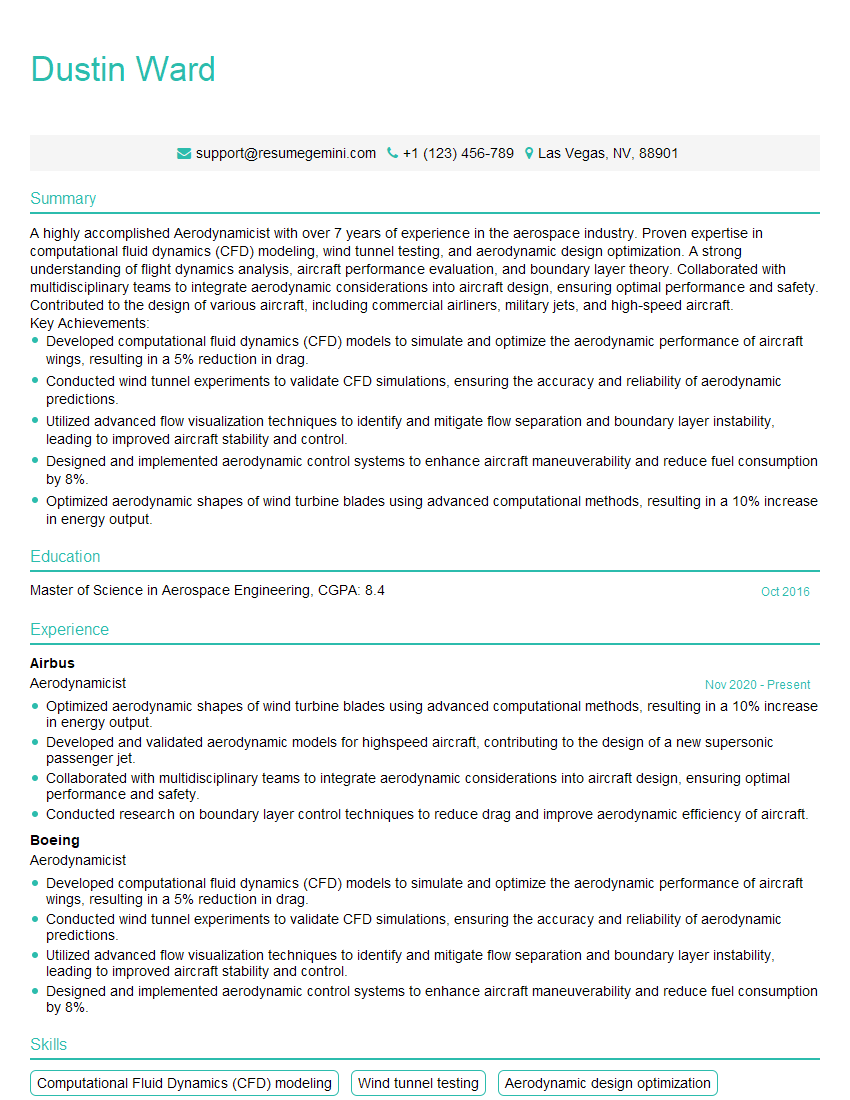
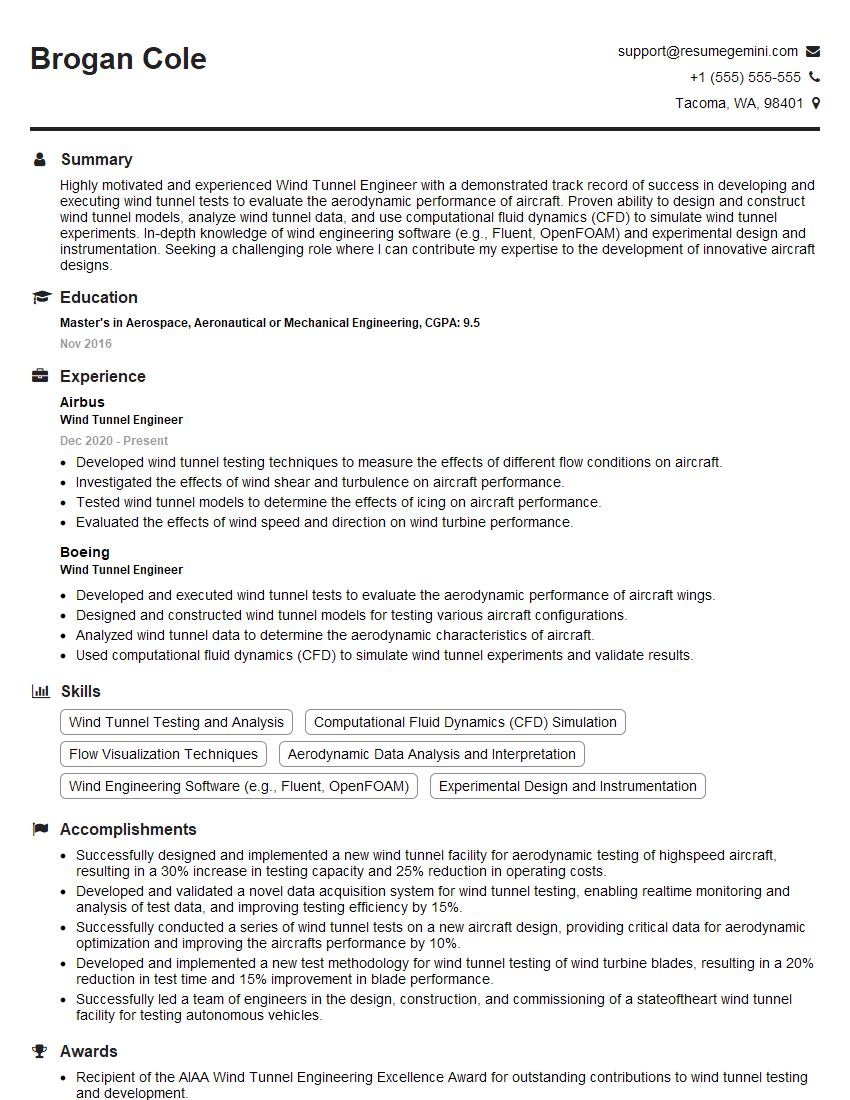
Mastering aerodynamic optimization significantly enhances your career prospects in aerospace engineering, opening doors to exciting roles in research, design, and development. A strong understanding of these concepts will set you apart from other candidates. To maximize your chances of landing your dream job, it’s essential to present your skills and experience effectively. Creating an ATS-friendly resume is paramount in today’s competitive job market. ResumeGemini is a trusted resource to help you build a professional and impactful resume that showcases your expertise in aerodynamic optimization. Examples of resumes tailored to this field are available, helping you present your qualifications in the best possible light.
Explore more articles
Users Rating of Our Blogs
Share Your Experience
We value your feedback! Please rate our content and share your thoughts (optional).
What Readers Say About Our Blog
Really detailed insights and content, thank you for writing this detailed article.
IT gave me an insight and words to use and be able to think of examples