Unlock your full potential by mastering the most common Aerodynamic Testing and Measurement interview questions. This blog offers a deep dive into the critical topics, ensuring you’re not only prepared to answer but to excel. With these insights, you’ll approach your interview with clarity and confidence.
Questions Asked in Aerodynamic Testing and Measurement Interview
Q 1. Explain the principle of Bernoulli’s equation and its application in aerodynamic testing.
Bernoulli’s equation is a fundamental principle in fluid dynamics that describes the relationship between pressure, velocity, and elevation in a fluid flow. It states that an increase in the speed of a fluid occurs simultaneously with a decrease in static pressure or a decrease in the fluid’s potential energy. In simpler terms, faster-moving air has lower pressure, and slower-moving air has higher pressure.
In aerodynamic testing, Bernoulli’s principle is crucial for understanding lift generation. For example, the curved shape of an airplane wing (airfoil) causes air to travel faster over the top surface than the bottom. This faster airflow results in lower pressure on top, creating a pressure difference that generates an upward force, or lift. We use this principle to analyze the pressure distribution around airfoils and other aerodynamic shapes in wind tunnels, enabling us to optimize designs for maximum lift and minimum drag. Think of it like this: the wing is essentially a pressure pump, using the air’s speed to create a pressure imbalance that lifts the aircraft.
Q 2. Describe different types of wind tunnels and their applications.
Wind tunnels come in various types, each suited for different applications.
- Subsonic Wind Tunnels: These are the most common type, designed to test models at speeds below the speed of sound. They are widely used in aircraft, automotive, and building design for assessing aerodynamic forces and flow characteristics.
- Supersonic Wind Tunnels: These tunnels generate airflow faster than the speed of sound, enabling the testing of high-speed aircraft and missiles. They are more complex and require specialized equipment due to the high temperatures and pressures generated.
- Transonic Wind Tunnels: These are designed to operate around the speed of sound, a critical regime where complex aerodynamic phenomena occur. They are particularly important for testing aircraft designs that operate near the speed of sound.
- Hypersonic Wind Tunnels: These advanced facilities create airflow at extremely high speeds, typically many times the speed of sound, vital for researching hypersonic vehicles and space re-entry. They involve highly specialized technologies to manage extreme heat and pressure.
- Low-Speed Wind Tunnels: Often used for educational purposes or preliminary tests, these tunnels provide gentle airflows at relatively lower speeds. These are cost-effective and less complex to maintain.
The choice of wind tunnel depends on the specific test requirements, including the desired speed range and the size and complexity of the model being tested. For example, a small subsonic wind tunnel might be suitable for testing a model car, while a large supersonic wind tunnel would be necessary to test a supersonic jet fighter.
Q 3. What are the key parameters measured in a wind tunnel test?
Wind tunnel tests provide a wealth of aerodynamic data. Key parameters measured include:
- Forces and Moments: Lift, drag, side force, pitching moment, rolling moment, and yawing moment are measured using aerodynamic balances. These are crucial for understanding the overall aerodynamic performance.
- Pressure Distribution: Surface pressure measurements, often taken using pressure taps or pressure-sensitive paint (PSP), provide insights into the pressure field around the model, which is essential for understanding the airflow patterns and lift generation mechanisms.
- Velocity and Flow Visualization: Techniques like Laser Doppler Velocimetry (LDV) and Particle Image Velocimetry (PIV) help visualize the flow field around the model, providing detailed information about flow separation, vortices, and turbulence.
- Temperature: Measuring temperature changes can help detect areas of high friction and energy dissipation.
These measurements allow engineers to analyze the aerodynamic behavior of their designs and make necessary improvements to achieve desired performance.
Q 4. Explain the concept of Reynolds number and its significance in aerodynamic scaling.
The Reynolds number (Re) is a dimensionless quantity that describes the ratio of inertial forces to viscous forces within a fluid. It’s crucial for aerodynamic scaling because it governs the flow regime – whether it’s laminar (smooth) or turbulent (chaotic). The formula is: Re = (ρVL)/μ, where ρ is the fluid density, V is the velocity, L is a characteristic length, and μ is the dynamic viscosity.
In aerodynamic scaling, achieving dynamic similarity is essential; this means having the same Reynolds number in the model test as in the full-scale application. If the Reynolds numbers don’t match, the flow patterns and aerodynamic forces will differ significantly, leading to inaccurate results. For instance, testing a 1:10 scale model of an aircraft requires adjusting the wind speed to maintain the same Reynolds number as the full-scale aircraft to accurately predict its full-scale performance. Sometimes, achieving exact Reynolds number matching isn’t feasible, leading to corrections and correlations based on existing data and understanding the limitations introduced by Reynolds number discrepancies.
Q 5. How do you ensure accurate data acquisition during wind tunnel testing?
Ensuring accurate data acquisition during wind tunnel testing involves meticulous planning and execution. Key aspects include:
- Calibration: Regularly calibrating all measurement instruments (balances, pressure transducers, etc.) against known standards is crucial. This ensures that the readings are accurate and traceable.
- Data Acquisition System: Employing a high-resolution, high-speed data acquisition system capable of accurately recording all relevant parameters simultaneously is vital. The system should also have robust error detection and correction capabilities.
- Environmental Control: Maintaining consistent and stable environmental conditions within the wind tunnel, such as temperature and humidity, is important to minimize variations and ensure repeatable results.
- Model Mounting: Carefully mounting the model to minimize any interference or unwanted forces is crucial. This might involve specialized model supports or sting mounts.
- Data Processing and Analysis: Employing appropriate data reduction and analysis techniques to account for potential errors and uncertainties is key to drawing accurate conclusions. Statistical analysis and error propagation are often utilized.
These steps, along with good documentation practices, help to achieve the highest level of confidence in the acquired data.
Q 6. Describe different types of aerodynamic balances and their functionalities.
Aerodynamic balances are precision instruments used to measure the forces and moments acting on a model in a wind tunnel. Several types exist:
- Internal Balances: These balances are integrated within the model support structure and are used for precise measurement of forces and moments. They are generally more accurate and offer better stiffness but are more complex to design and manufacture.
- External Balances: These balances are positioned externally, measuring forces and moments transmitted through the model support. They are less susceptible to interference from the internal components of the model and are easier to access and repair. However, they may be less accurate than internal balances.
- Strain Gauge Balances: These balances utilize strain gauges to measure the deflection of load-bearing members, providing a direct measurement of the forces and moments applied. Strain gauge balances offer high accuracy and sensitivity.
- Load Cell Balances: These use load cells that provide a direct measurement of force components. They are robust, simple to use, and offer good repeatability.
The choice of balance depends on the specific needs of the experiment, considering factors such as accuracy, stiffness, cost, and ease of use. The functionality is always the same – accurately measure forces and moments acting on the model to understand aerodynamic performance.
Q 7. What are the common sources of error in aerodynamic testing and how can they be minimized?
Several sources of error can affect aerodynamic testing. Minimizing these requires careful attention to detail:
- Model Support Interference: The support system used to hold the model can influence the airflow, creating artificial forces and moments. Minimizing this requires using slender supports and careful design of the support structure.
- Tunnel Wall Interference: The presence of the wind tunnel walls can affect the airflow around the model, causing deviations from free-air conditions. Corrections are often applied using computational or empirical methods.
- Instrumentation Errors: Inaccuracies in sensors and data acquisition systems can introduce errors. Regular calibration and maintenance of instruments are essential to maintain accuracy.
- Flow Non-uniformity: Non-uniformities in the wind tunnel’s flow can lead to inaccurate measurements. Careful design and operation of the tunnel are necessary to ensure a uniform flow field.
- Model Manufacturing Errors: Imperfections in the model’s construction can influence aerodynamic characteristics. Precise manufacturing techniques and quality control are important.
Minimizing errors involves careful experimental design, using appropriate correction methods, rigorous calibration procedures, and thorough data analysis. Understanding the potential sources of error allows for informed decisions on mitigation strategies, thus improving the reliability and accuracy of the results.
Q 8. Explain the process of data reduction and analysis in aerodynamic testing.
Data reduction and analysis in aerodynamic testing is a crucial step that transforms raw sensor data into meaningful aerodynamic coefficients and flow visualizations. It involves several stages:
- Data Acquisition: This involves collecting data from various instruments like pressure transducers, force balances, hot-wire anemometers, and Particle Image Velocimetry (PIV) systems. The raw data often contains noise and inconsistencies.
- Calibration and Correction: Raw data is calibrated using known standards to account for instrument biases and environmental factors like temperature and pressure. Corrections are made for sensor drift and other systematic errors.
- Filtering and Noise Reduction: Techniques like moving averages, digital filters, or wavelet transforms are employed to remove unwanted noise from the signal, improving the signal-to-noise ratio.
- Data Processing and Calculations: This stage involves applying appropriate mathematical models to calculate aerodynamic coefficients like lift, drag, and moment coefficients (CL, CD, CM). These calculations often involve integrating pressure distributions or resolving forces and moments measured by balances. For example, calculating CL requires integrating the pressure distribution over the surface of the airfoil.
- Uncertainty Analysis: A crucial step to assess the reliability of the results. Uncertainty is quantified considering various sources, including instrument errors, calibration uncertainties, and data processing methodologies. This helps determine the confidence level in the obtained aerodynamic coefficients.
- Visualization and Presentation: The processed data is typically visualized using graphs, charts, and contour plots to reveal trends, patterns, and relationships. Examples include pressure coefficient distributions, velocity vector fields, and streamlines. This helps in understanding flow phenomena and identifying critical regions.
For instance, in testing an aircraft wing, data reduction would involve calculating the lift and drag coefficients at various angles of attack, visualizing pressure distributions to identify flow separation regions, and quantifying the uncertainty associated with these results.
Q 9. What is Computational Fluid Dynamics (CFD) and how is it used in aerodynamic analysis?
Computational Fluid Dynamics (CFD) is a powerful numerical method used to simulate fluid flow and heat transfer. In aerodynamic analysis, it predicts the flow around an object, allowing engineers to analyze the forces and moments acting on it without the need for physical wind tunnel testing. This involves solving the Navier-Stokes equations, a set of complex partial differential equations governing fluid motion, using numerical techniques.
The process typically involves:
- Geometry Creation: The object’s geometry is modeled using Computer-Aided Design (CAD) software.
- Mesh Generation: The geometry is divided into a mesh of smaller elements (cells) on which the equations are solved. Mesh quality is crucial for accuracy and convergence.
- Solver Selection: An appropriate solver is chosen based on the flow regime (e.g., laminar, turbulent) and desired accuracy. The solver numerically solves the governing equations.
- Boundary Conditions: Boundary conditions (e.g., freestream velocity, pressure, temperature) are defined to simulate the actual flow environment.
- Post-Processing: Results are visualized and analyzed, extracting aerodynamic coefficients, pressure distributions, velocity fields, etc. This might involve plotting pressure contours or streamlines to gain a better understanding of the flow field.
For example, CFD is extensively used in the automotive industry to optimize vehicle aerodynamics, reducing drag and improving fuel efficiency. Similarly, it’s used in aircraft design to analyze wing performance and reduce noise.
Q 10. Compare and contrast experimental and computational methods in aerodynamic analysis.
Both experimental and computational methods are vital for aerodynamic analysis, offering complementary advantages and limitations.
| Feature | Experimental Methods (e.g., Wind Tunnel Testing) | Computational Methods (CFD) |
|---|---|---|
| Cost | High, especially for complex setups | Relatively lower, but can increase with mesh refinement and complex simulations |
| Time | Long lead times for setup, testing, and data reduction | Faster turnaround time once the model and mesh are created |
| Accuracy | High accuracy with proper calibration and setup | Accuracy depends on mesh quality, turbulence model, and solver accuracy. Validation with experimental data is crucial |
| Flexibility | Limited flexibility; changes require significant reconfiguration | High flexibility; easy to change geometry, flow conditions, and parameters |
| Visualization | Limited visualizations; often restricted to surface measurements | Detailed flow visualizations, including internal flows and 3D structures |
| Accessibility | Requires specialized facilities and expertise | Requires computational resources and expertise in CFD software |
In summary: Experimental methods provide high-fidelity data for specific conditions but are expensive and time-consuming. CFD offers flexibility and speed but relies on accurate models and validations. Often, a hybrid approach, combining both methods, yields the most comprehensive understanding.
For instance, a wind tunnel test might be used to validate a CFD simulation of an aircraft wing, confirming the accuracy of the CFD model and its predictions.
Q 11. Describe different turbulence models used in CFD simulations.
Turbulence models in CFD are crucial for simulating turbulent flows, as directly solving the Navier-Stokes equations for turbulent flows is computationally prohibitive. These models approximate the effects of turbulence on the mean flow. Common turbulence models include:
- RANS (Reynolds-Averaged Navier-Stokes) models: These models decompose the flow variables into mean and fluctuating components. Popular RANS models include:
- k-ε model: Solves transport equations for turbulent kinetic energy (k) and its dissipation rate (ε). Relatively simple but less accurate for complex flows.
- k-ω SST (Shear Stress Transport) model: An improvement over the k-ε model, especially near walls. More accurate for flows with adverse pressure gradients and separation.
- Spalart-Allmaras model: A one-equation model, computationally less expensive than two-equation models, suitable for aerospace applications.
- LES (Large Eddy Simulation): Resolves larger turbulent eddies directly and models smaller eddies using subgrid-scale models. More computationally expensive than RANS but provides more detailed turbulence information.
- DES (Detached Eddy Simulation): A hybrid approach that combines RANS and LES, switching between them based on the local flow characteristics. Offers a compromise between accuracy and computational cost.
The choice of turbulence model depends on the specific application, desired accuracy, and available computational resources. For example, a simpler k-ε model might suffice for a preliminary design study, while a more advanced LES might be necessary for detailed flow analysis.
Q 12. How do you validate CFD results against experimental data?
Validating CFD results against experimental data is crucial to assess the accuracy and reliability of the simulation. This is typically done by comparing CFD predictions with experimental measurements from wind tunnel tests or other experimental techniques. The process often involves:
- Selecting Appropriate Experimental Data: Choose experimental data obtained under conditions similar to the CFD simulation (e.g., Reynolds number, Mach number, angle of attack).
- Quantitative Comparison: Compare key aerodynamic parameters, such as lift, drag, and moment coefficients, between CFD predictions and experimental measurements. Calculate the percentage difference or error between them.
- Qualitative Comparison: Compare flow visualizations (e.g., pressure contours, streamlines, velocity profiles) to identify similarities and discrepancies between the simulation and experiment.
- Grid Independence Study: Perform a grid independence study in CFD to ensure that the results are not significantly affected by the mesh resolution. This involves running simulations with different mesh densities and comparing the results.
- Uncertainty Quantification: Quantify the uncertainties associated with both the experimental data and CFD predictions. This provides a more comprehensive assessment of the validation.
Discrepancies between CFD and experimental results can highlight areas where the CFD model needs refinement or improvements in the turbulence model or boundary conditions. If the discrepancies are within acceptable limits considering uncertainties, the CFD model is considered validated for the specific conditions tested.
For example, validating a CFD simulation of an airfoil might involve comparing predicted lift and drag coefficients with those measured in a wind tunnel, alongside a visual comparison of pressure distributions.
Q 13. What are the limitations of CFD simulations?
While CFD is a powerful tool, it has limitations:
- Computational Cost: High-fidelity simulations, especially for complex geometries and turbulent flows, can be computationally expensive, requiring significant processing power and time.
- Mesh Dependence: The accuracy of CFD results depends on the quality and resolution of the mesh. Improper meshing can lead to inaccurate or unreliable results.
- Turbulence Modeling: Accurate modeling of turbulence remains a challenge. Turbulence models are approximations, and their accuracy varies depending on the flow characteristics.
- Boundary Conditions: The accuracy of CFD simulations is also affected by the accuracy of boundary conditions. Inaccurate or incomplete boundary conditions can lead to significant errors.
- Model Assumptions: CFD simulations rely on various simplifying assumptions (e.g., fluid properties, governing equations). These assumptions might not always be valid in real-world scenarios.
- Validation Challenges: Validating CFD results against experimental data can be difficult, especially for complex flows. Experimental data might not always be readily available or sufficiently accurate.
These limitations highlight the importance of careful model selection, mesh refinement studies, and validation against experimental data to ensure the reliability of CFD results. For example, a simplified model might fail to predict flow separation accurately, leading to erroneous predictions of aerodynamic performance.
Q 14. Explain the concept of boundary layer separation and its effect on aerodynamic performance.
Boundary layer separation occurs when the flow in the boundary layer (the thin layer of fluid near a surface) detaches from the surface. This typically happens when there’s an adverse pressure gradient (pressure increasing in the flow direction). The separated flow forms a recirculation zone behind the separation point, significantly affecting aerodynamic performance.
Effects on Aerodynamic Performance:
- Increased Drag: Separated flow creates a large wake behind the object, resulting in a significant increase in drag.
- Reduced Lift: Separation can drastically reduce lift, especially for airfoils at high angles of attack. This is because the low-pressure region on the upper surface of the airfoil is disrupted.
- Stall: In airfoils, boundary layer separation at high angles of attack leads to stall, a sudden loss of lift and increase in drag, which is highly undesirable for aircraft.
- Noise Generation: Separated flow can generate significant noise, particularly in turbulent flows. This is a concern for aircraft and other aerodynamic systems.
Example: Consider a golf ball. The dimples on a golf ball help to keep the boundary layer attached, delaying separation and reducing drag, resulting in a longer flight. Without dimples, the boundary layer would separate earlier, leading to greater drag and shorter distance. Understanding boundary layer separation is vital for designing aerodynamic shapes and optimizing performance, often requiring advanced CFD simulations to predict and mitigate its effects.
Q 15. Describe different methods for boundary layer control.
Boundary layer control aims to manipulate the flow of air near a surface to reduce drag and improve performance. Think of it like smoothing out wrinkles in a fabric to reduce resistance. Several methods exist, broadly categorized as:
- Passive methods: These don’t require external energy. Examples include:
- Streamlining: Shaping the body to minimize separation and turbulence. Think of the sleek design of a racing car.
- Surface roughness control: Carefully controlled roughness can delay transition from laminar to turbulent flow, reducing drag in specific cases (though often it increases drag). This is a nuanced technique, dependent heavily on Reynolds number.
- Vortex generators: Small devices that create controlled vortices, preventing boundary layer separation and re-energizing the flow. You often see these on airplane wings.
- Active methods: These require external energy input. Examples include:
- Boundary layer suction: Removing the slow-moving air near the surface, preventing separation. This is energy intensive but highly effective.
- Boundary layer blowing: Injecting high-energy air into the boundary layer to energize it and prevent separation. This is commonly used in high-lift devices such as slats and flaps.
- Moving surfaces: Using moving flaps or slots to control the boundary layer, similar in principle to blowing.
The choice of method depends on the application, cost constraints, and desired performance improvements. For instance, streamlining is a cost-effective passive method for general drag reduction, while boundary layer suction might be employed in high-performance aircraft where the benefits outweigh the energy cost.
Career Expert Tips:
- Ace those interviews! Prepare effectively by reviewing the Top 50 Most Common Interview Questions on ResumeGemini.
- Navigate your job search with confidence! Explore a wide range of Career Tips on ResumeGemini. Learn about common challenges and recommendations to overcome them.
- Craft the perfect resume! Master the Art of Resume Writing with ResumeGemini’s guide. Showcase your unique qualifications and achievements effectively.
- Don’t miss out on holiday savings! Build your dream resume with ResumeGemini’s ATS optimized templates.
Q 16. What are the key aerodynamic forces acting on an aircraft?
The key aerodynamic forces acting on an aircraft are lift, drag, thrust, and weight. These forces are crucial in understanding an aircraft’s flight dynamics. Let’s break them down:
- Lift: The upward force perpendicular to the airflow, counteracting gravity. It’s generated by the shape of the wings (airfoils).
- Drag: The force resisting the aircraft’s motion through the air. It’s composed of pressure drag (due to pressure differences) and friction drag (due to shear stresses).
- Thrust: The forward force generated by the engines, propellers, or rockets, overcoming drag.
- Weight: The downward force due to gravity acting on the aircraft’s mass.
In steady, level flight, lift equals weight, and thrust equals drag. Understanding the interplay of these forces is fundamental to designing safe and efficient aircraft.
Q 17. Explain the concept of lift and drag.
Lift and drag are fundamental aerodynamic forces that govern an aircraft’s flight. Imagine throwing a frisbee – it stays aloft because of lift, but eventually falls due to drag.
- Lift: This upward force is generated by the difference in air pressure above and below an airfoil (the wing’s cross-section). The curved upper surface of the wing causes air to travel faster over the top, leading to lower pressure according to Bernoulli’s principle. This pressure difference creates an upward force. Angle of attack (the angle between the wing and the airflow) also significantly impacts lift generation.
- Drag: This force opposes motion through the air. It’s a combination of pressure drag (caused by the shape of the body) and skin friction drag (due to the air’s viscosity rubbing against the surface). A streamlined shape minimizes pressure drag, and a smooth surface minimizes friction drag.
Understanding the relationship between lift and drag is critical for optimizing aircraft design. A higher lift-to-drag ratio means greater efficiency – the aircraft can fly farther or higher with less fuel. For example, a glider relies heavily on achieving a high lift-to-drag ratio for extended flight.
Q 18. How do you analyze aerodynamic data to improve the design of an aircraft or vehicle?
Analyzing aerodynamic data involves a multi-step process to refine a design. It’s like a detective solving a mystery, using clues to improve the performance.
- Data acquisition and validation: This involves gathering data from wind tunnel tests, flight tests, or Computational Fluid Dynamics (CFD) simulations, and ensuring the data’s accuracy and reliability. Checking for systematic errors and outliers is essential here.
- Data processing and visualization: Cleaning and organizing the raw data, often employing techniques like interpolation or smoothing. Creating visualizations such as pressure contour plots, velocity vectors, and coefficient graphs helps interpret the data.
- Aerodynamic analysis: Identifying key aerodynamic characteristics such as lift coefficient (Cl), drag coefficient (Cd), and moment coefficients. Understanding the flow field around the body and identifying areas of high pressure or separation is crucial.
- Design optimization: Using the analysis results to suggest design modifications to improve performance. This could involve changing the shape, size, or surface features of the aircraft or vehicle.
- Validation and iteration: Verifying the improvements through further testing and simulation. The design process is iterative; it’s rare to get it perfect on the first try.
Software tools and techniques like regression analysis are commonly used to model aerodynamic behavior and predict performance with different design modifications.
Q 19. What software packages are you familiar with for aerodynamic analysis?
My experience encompasses several software packages used for aerodynamic analysis, both for computational and data processing aspects:
- ANSYS Fluent: A powerful Computational Fluid Dynamics (CFD) software for simulating fluid flow and heat transfer. I’ve extensively used it to model airflow over aircraft, vehicles, and other complex geometries.
- OpenFOAM: An open-source CFD toolbox, offering flexibility and control. I used it for specialized simulations and validation studies.
- MATLAB: A crucial tool for data post-processing, visualization, and analysis. I’ve used it to generate plots, perform statistical analysis, and develop custom algorithms for aerodynamic data manipulation.
- Tecplot: Excellent for visualizing complex CFD data sets. Its features for creating high-quality contour plots and vector fields were invaluable for understanding flow patterns.
Proficiency in these tools enables me to handle a wide range of aerodynamic analysis tasks, from basic simulations to complex optimization studies.
Q 20. Describe your experience with data acquisition systems and instrumentation.
I have extensive experience with data acquisition systems and instrumentation in aerodynamic testing. This involves the entire process, from sensor selection to data logging and processing.
- Sensor types: I’m familiar with various types of pressure transducers (static and differential), hot-wire anemometers, load cells, and accelerometers. Selecting the appropriate sensor based on the measurement requirement is critical.
- Data acquisition hardware: I’ve worked with various data acquisition (DAQ) systems, from standalone units to integrated systems linked with wind tunnel control systems. Understanding the capabilities and limitations of these systems is important for efficient data collection.
- Data logging and processing: I have experience using software such as LabVIEW and specialized data acquisition software for logging, storing, and initially processing experimental data. This involves calibrating sensors, applying corrections, and managing large datasets.
- Signal conditioning: I understand the importance of signal conditioning to eliminate noise and ensure data accuracy. This could involve filtering, amplification, or other signal processing techniques.
My experience ranges from small-scale experiments to large wind tunnel tests, ensuring the reliable and accurate acquisition of aerodynamic data for analysis.
Q 21. How do you handle discrepancies between experimental and computational results?
Discrepancies between experimental and computational results are common in aerodynamic analysis. Addressing these requires a systematic approach:
- Verify data quality: First, scrutinize both the experimental and computational data for errors. Check for sensor calibration issues, data acquisition problems, or numerical instability in the simulations. Are there obvious outliers?
- Assess modeling assumptions: Examine the assumptions made in the computational model. Does the simulation accurately capture the geometry, boundary conditions, and turbulence model? Sometimes, simplifying assumptions can lead to significant differences.
- Investigate experimental uncertainties: Evaluate the uncertainties associated with the experimental measurements. Wind tunnel effects, model support interference, and sensor inaccuracies can all contribute to discrepancies.
- Mesh refinement and solution convergence: For CFD simulations, refine the mesh and ensure the solution has converged adequately. A coarser mesh or an unconverged solution can lead to inaccurate results.
- Turbulence modeling: The choice of turbulence model can significantly affect the results. Experiment with different turbulence models if necessary.
- Compare qualitative trends: Even if the quantitative results differ, compare the overall trends and flow features. Are the qualitative aspects of the flow similar? This can highlight potential issues in the modeling or experimentation.
Often, a combination of factors contributes to the discrepancies. A thorough investigation, combining engineering judgment and data analysis, is needed to identify the root cause and improve the accuracy of both experimental and computational methods. Iterative refinement of both experimental setup and the computational model is often required for convergence.
Q 22. Explain your understanding of uncertainty analysis in aerodynamic measurements.
Uncertainty analysis in aerodynamic measurements is crucial for understanding the reliability of our data. It’s essentially quantifying the doubt surrounding our experimental results. This doubt arises from various sources, including limitations in instrumentation, environmental factors, and the inherent variability of the flow itself. We use statistical methods to propagate these uncertainties through our calculations, ultimately expressing our final results with a margin of error.
For example, imagine measuring the lift coefficient of an airfoil. The uncertainty could stem from inaccuracies in the force balance readings (instrumentation uncertainty), fluctuations in the wind tunnel speed (environmental uncertainty), and the turbulent nature of the flow itself (flow variability). We might express the lift coefficient as CL = 1.2 ± 0.05, indicating that we’re 95% confident the true value lies between 1.15 and 1.25. This quantification allows us to compare our results with computational models or other experimental data with confidence, making informed engineering decisions.
Common methods used include: GUM (Guide to the Expression of Uncertainty in Measurement), Monte Carlo simulations, and sensitivity analysis. Each has strengths and weaknesses depending on the complexity of the experiment and the nature of the uncertainties involved.
Q 23. Describe your experience with different types of flow visualization techniques.
Flow visualization is invaluable for understanding complex flow patterns. I’ve extensive experience with various techniques, each providing unique insights.
- Surface Flow Visualization: This involves techniques like oil flow, tufts, and liquid crystals to reveal surface flow patterns on models. Oil flow, for instance, shows separation lines and vortices on aerodynamic surfaces. I’ve used this extensively to analyze boundary layer separation on airfoils and optimize their designs.
- Volume Flow Visualization: Techniques like smoke wire, smoke injection, and laser-induced fluorescence (LIF) allow us to visualize the three-dimensional structure of the flow field. I’ve used smoke wire in low-speed wind tunnels to visualize wake vortices behind bluff bodies, revealing separation and vortex shedding patterns. LIF offers higher resolution and is ideal for complex flow phenomena.
- Particle Image Velocimetry (PIV): This is a quantitative technique measuring the instantaneous velocity field by tracking the movement of small particles illuminated by a laser sheet. I’ve used PIV extensively in high-speed wind tunnels to study turbulent boundary layers and quantify flow separation details, providing data for detailed CFD model validation.
The choice of technique depends on the specific flow phenomenon being investigated, the scale of the model, and the desired level of detail.
Q 24. How do you ensure the quality and reliability of aerodynamic test data?
Ensuring data quality and reliability is paramount. My approach involves a multi-pronged strategy:
- Rigorous Calibration and Validation: Regular calibration of all instrumentation (force balances, pressure transducers, etc.) is vital, using traceable standards. Validation of the wind tunnel itself is equally important, often involving comparison with established data or theoretical predictions for well-defined test cases.
- Careful Experimental Design: A well-defined test plan outlining the procedure, measurement techniques, and data acquisition strategies minimizes errors. This includes controlling environmental variables like temperature and humidity and meticulously documenting all aspects of the experiment.
- Data Acquisition and Processing: Employing robust data acquisition systems and implementing quality checks during data processing are crucial. This involves outlier detection, smoothing techniques (where appropriate), and the application of uncertainty analysis.
- Repeatability and Reproducibility: Repeating measurements under the same conditions demonstrates the consistency and reliability of the data. Reproducibility across different wind tunnels or laboratories provides further confidence in the findings.
A systematic approach, attention to detail, and a commitment to best practices are essential for generating high-quality, reliable aerodynamic data.
Q 25. Describe a challenging aerodynamic problem you have solved and how you approached it.
I was once tasked with investigating the aerodynamic performance of a novel wing design featuring a highly complex geometry, including multiple winglets and a swept-back leading edge. Computational fluid dynamics (CFD) simulations showed promising results, but these needed experimental validation. The challenge lay in accurately measuring the pressure distribution across this intricate surface in a wind tunnel.
My approach was multi-faceted:
- Custom Pressure Tap Design: We designed a custom pressure tap arrangement to ensure sufficient spatial resolution across the wing’s complex geometry, minimizing the impact of the taps themselves on the flow.
- Advanced Data Acquisition: We used a high-channel-count pressure scanning system to acquire data rapidly and efficiently. A robust data acquisition and processing strategy was paramount to managing the sheer volume of data.
- Careful Uncertainty Analysis: A comprehensive uncertainty analysis considered all aspects of the experimental setup, including tap positioning uncertainties and sensor accuracy.
- CFD-Experiment Comparison: A detailed comparison of experimental results with CFD data allowed us to identify areas of agreement and discrepancy, leading to insights into the limitations of both approaches. The CFD model was refined iteratively, incorporating the experimental data.
This collaborative approach, integrating experimental and computational techniques, successfully resolved the aerodynamic performance challenges of this complex wing design, leading to design optimization and significant performance gains.
Q 26. Explain your experience with wind tunnel calibration and validation.
Wind tunnel calibration and validation are fundamental to ensuring accurate and reliable data. Calibration involves determining the relationship between the measured quantities (e.g., forces, moments, pressures) and the true values. Validation involves verifying that the wind tunnel meets its design specifications and produces flows that accurately reflect real-world conditions.
My experience includes:
- Force Balance Calibration: This involves using known weights to calibrate the six-component balance, ensuring accuracy in measuring forces and moments acting on the model.
- Pressure Transducer Calibration: This entails using a precision pressure source to calibrate pressure transducers, ensuring accurate pressure measurements across the model’s surface.
- Wind Tunnel Flow Uniformity and Turbulence Measurement: Measuring flow uniformity and turbulence intensity in the test section using pitot tubes, hot-wire anemometry, or laser Doppler velocimetry (LDV). These measurements help assess the quality of the wind tunnel flow and identify areas needing improvement.
- Validation using Standard Models: Comparing wind tunnel measurements on well-defined test cases, like standard airfoils or spheres, with established data from other wind tunnels or theoretical predictions. This provides independent verification of the tunnel’s accuracy and reliability.
The calibration and validation procedures are documented meticulously, ensuring traceability and facilitating future experiments.
Q 27. Describe your understanding of different aerodynamic test sections (e.g., closed-circuit, open-circuit).
Wind tunnels come in various designs, each with its advantages and limitations.
- Closed-Circuit Wind Tunnels: These tunnels recirculate the air, minimizing energy consumption and providing a more stable flow. They are generally quieter and better suited for precise measurements, particularly at higher speeds. However, they are more complex and expensive to build and maintain.
- Open-Circuit Wind Tunnels: These tunnels draw air from the surrounding environment and exhaust it to the atmosphere. They are simpler and cheaper to build, but may experience more flow variations due to environmental conditions. They are often preferred for low-speed testing where energy efficiency is less critical.
- Subsonic Wind Tunnels: Designed for testing at speeds below the speed of sound (Mach 1). These are common for aerodynamic testing of aircraft, automobiles, and other objects.
- Supersonic Wind Tunnels: Designed to achieve speeds above the speed of sound. These require more complex designs and sophisticated instrumentation to manage high-speed flows and shock waves. They are typically used for aerospace applications.
- Transonic Wind Tunnels: Designed to operate at speeds around the speed of sound (Mach 0.8-1.2). Testing in this regime is particularly challenging due to the complex shock wave phenomena.
The choice of test section depends on the specific application and testing requirements, including the speed range, desired accuracy, and available resources.
Q 28. How do you ensure the safety of personnel and equipment during wind tunnel testing?
Safety is paramount in wind tunnel testing. My approach involves a layered safety strategy:
- Engineering Controls: Designing and maintaining the wind tunnel to high safety standards is crucial. This includes robust shielding around moving parts, emergency shut-off mechanisms, and appropriate ventilation systems to prevent the build-up of hazardous materials.
- Administrative Controls: Developing comprehensive safety procedures and training programs for all personnel is essential. This ensures everyone understands the potential hazards and follows the correct safety protocols. Regular safety audits ensure compliance.
- Personal Protective Equipment (PPE): Providing and ensuring the use of appropriate PPE, including hearing protection, safety glasses, and sturdy footwear, is vital to mitigate risks to personnel. This is particularly important in high-speed or large-scale facilities.
- Emergency Procedures: Clear and well-rehearsed emergency procedures, including evacuation plans and first-aid protocols, are in place to handle unforeseen incidents.
- Regular Maintenance and Inspections: Regular maintenance and inspection of the wind tunnel and associated equipment, including instrumentation, are essential to prevent malfunctions and ensure safe operation.
A culture of safety is fostered through continuous training, regular safety audits, and a commitment to proactively identifying and mitigating potential hazards.
Key Topics to Learn for Aerodynamic Testing and Measurement Interview
- Wind Tunnel Testing: Understanding different wind tunnel types (e.g., subsonic, supersonic), data acquisition techniques, and limitations of each method. Practical application: Analyzing pressure distributions and aerodynamic forces on aircraft models.
- Computational Fluid Dynamics (CFD): Familiarity with CFD principles, mesh generation, solver selection, and post-processing techniques. Practical application: Simulating airflow around complex geometries and validating experimental results.
- Data Acquisition and Analysis: Proficiency in using data acquisition systems, sensor technologies (e.g., pressure transducers, load cells), and data reduction techniques. Practical application: Processing raw data to extract meaningful aerodynamic coefficients and visualizations.
- Uncertainty Analysis: Understanding sources of error in experimental and computational data and quantifying their impact on results. Practical application: Presenting findings with appropriate uncertainty margins and confidence intervals.
- Aerodynamic Force and Moment Measurement: Deep understanding of lift, drag, pitching moment, etc. and how these are measured and interpreted. Practical application: Troubleshooting discrepancies between experimental and theoretical values.
- Flow Visualization Techniques: Experience with techniques like oil flow visualization, tufting, and smoke visualization for qualitative flow analysis. Practical application: Identifying flow separation, vortices, and other flow features.
- Instrumentation and Calibration: Knowledge of different types of sensors, their calibration procedures, and data validation methods. Practical application: Ensuring the accuracy and reliability of experimental data.
Next Steps
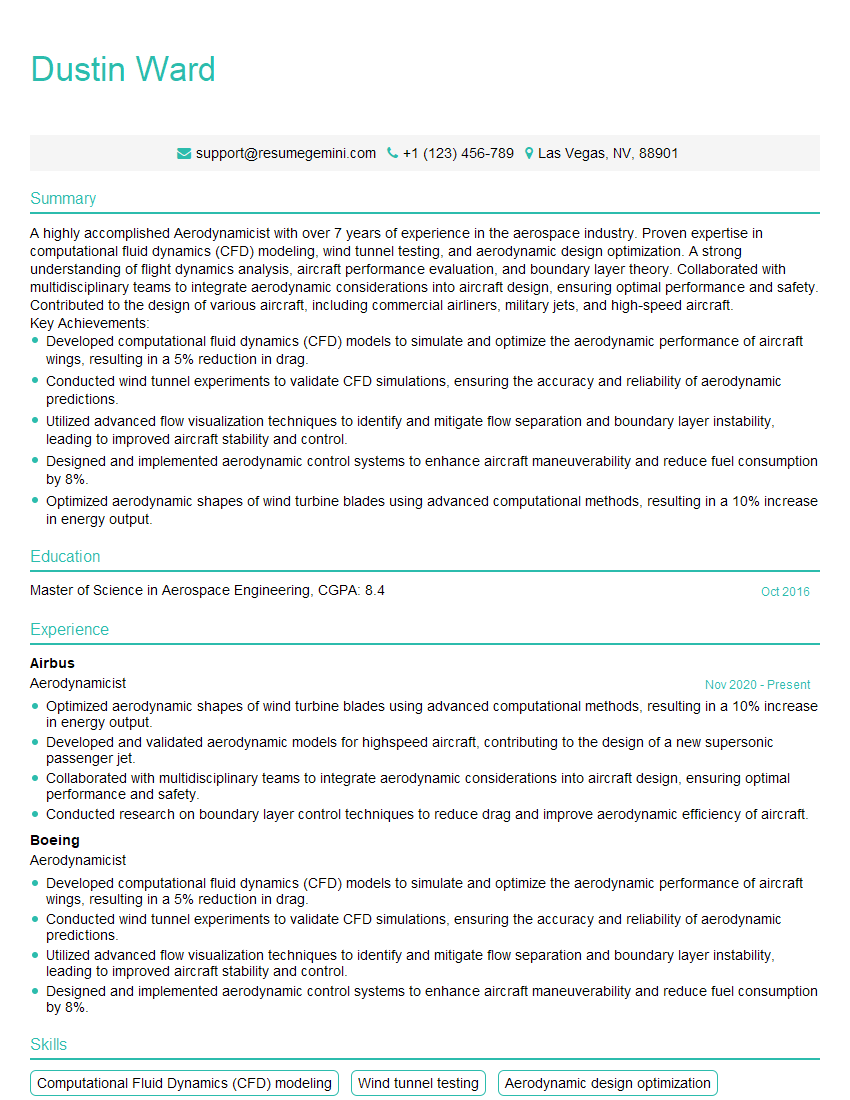
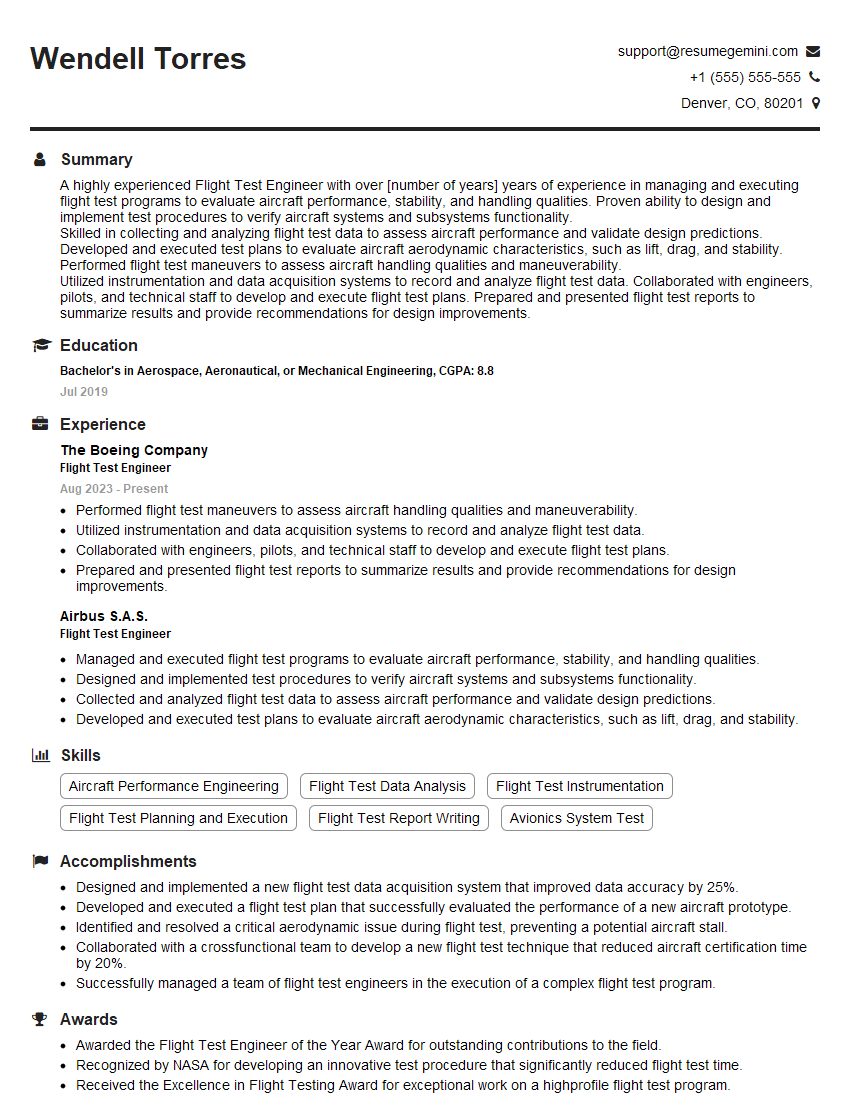
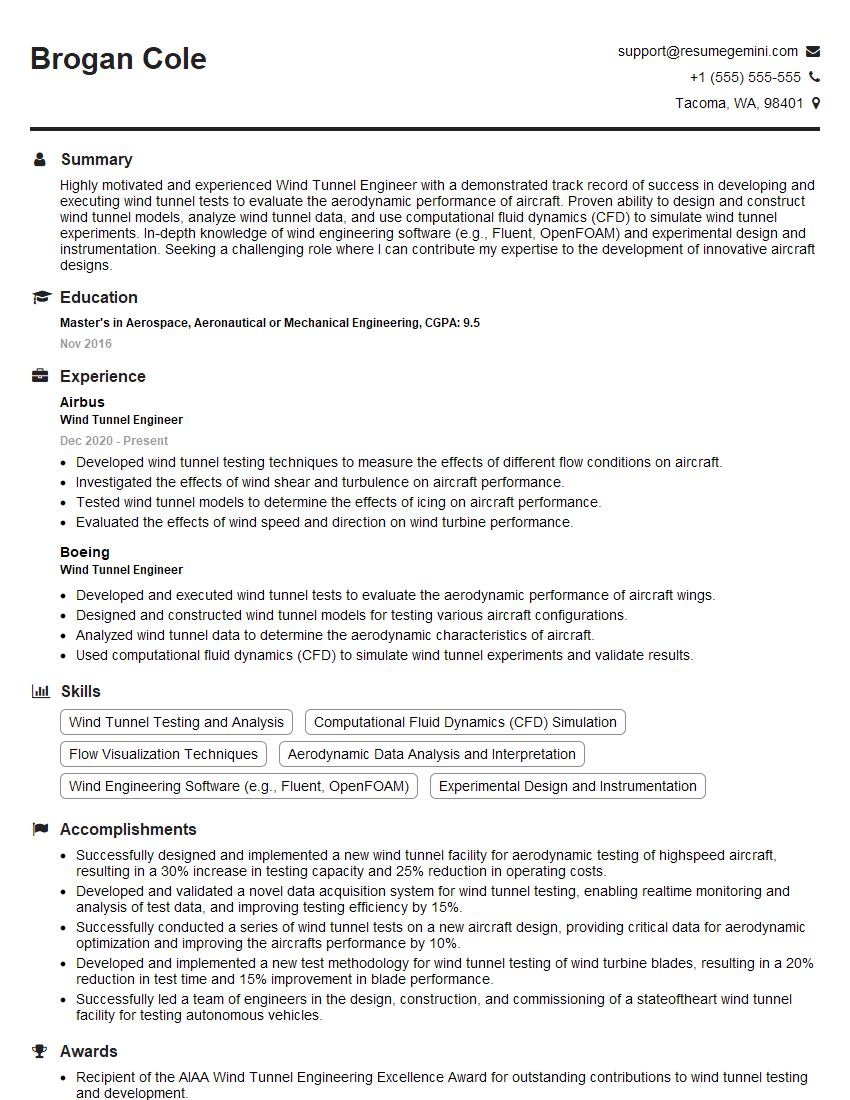
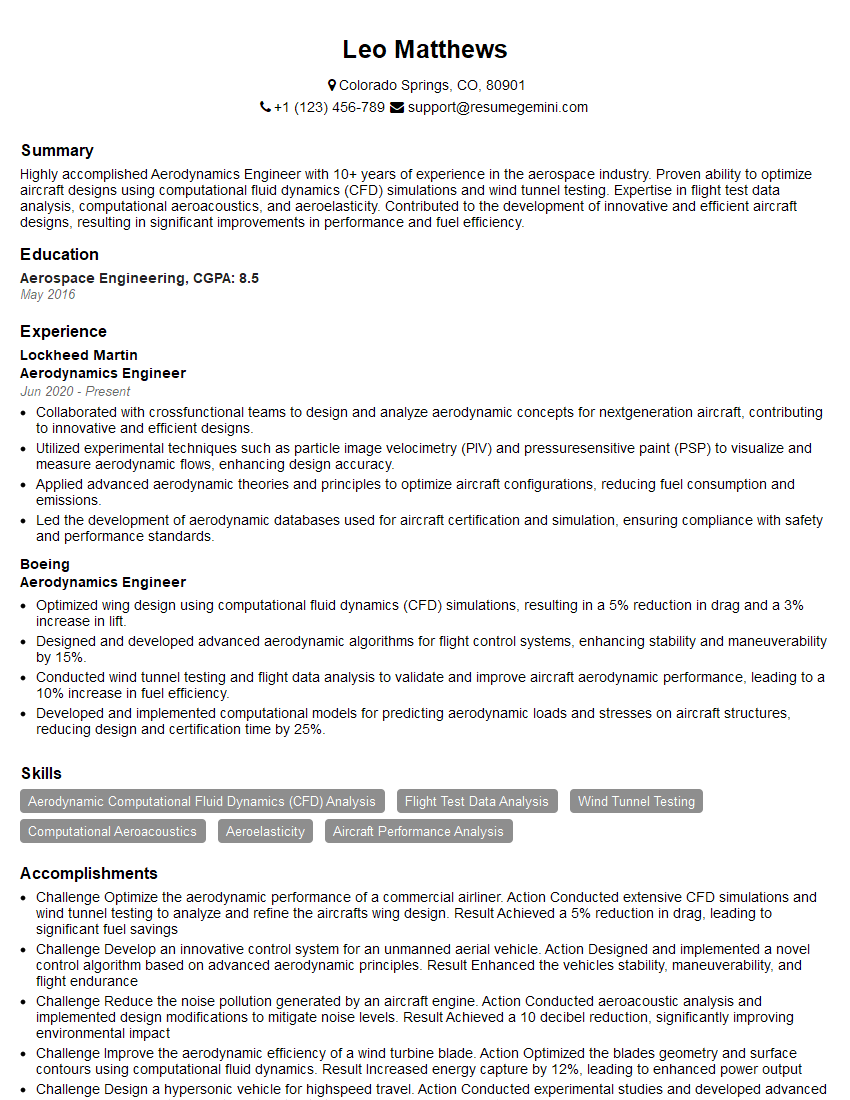
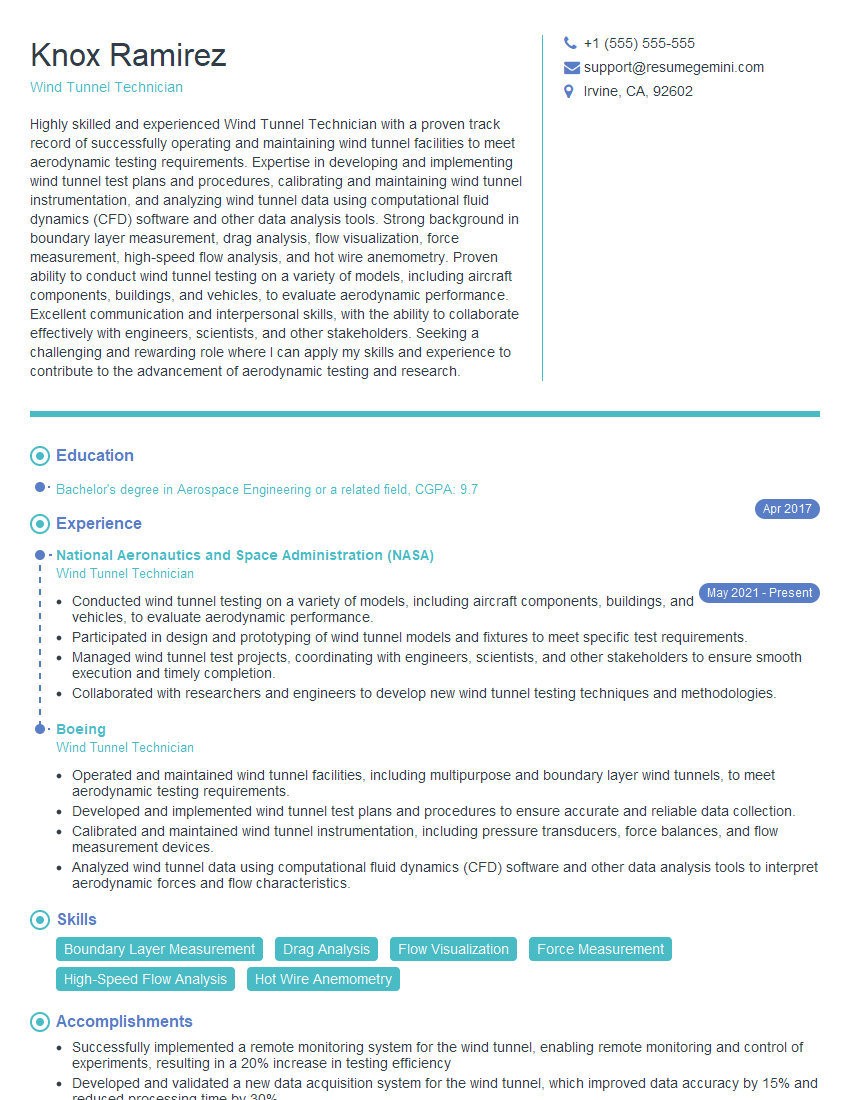
Mastering Aerodynamic Testing and Measurement opens doors to exciting career opportunities in aerospace, automotive, and renewable energy sectors. A strong foundation in these areas significantly enhances your competitiveness in the job market. To maximize your chances, creating an ATS-friendly resume is crucial. ResumeGemini is a trusted resource to help you build a professional and impactful resume that highlights your skills and experience effectively. ResumeGemini provides examples of resumes tailored specifically to Aerodynamic Testing and Measurement roles, giving you a head start in crafting your application materials. Invest time in creating a compelling resume – it’s your first impression on potential employers.
Explore more articles
Users Rating of Our Blogs
Share Your Experience
We value your feedback! Please rate our content and share your thoughts (optional).
What Readers Say About Our Blog
Really detailed insights and content, thank you for writing this detailed article.
IT gave me an insight and words to use and be able to think of examples