Are you ready to stand out in your next interview? Understanding and preparing for Aircraft Avionics interview questions is a game-changer. In this blog, we’ve compiled key questions and expert advice to help you showcase your skills with confidence and precision. Let’s get started on your journey to acing the interview.
Questions Asked in Aircraft Avionics Interview
Q 1. Explain the difference between ARINC 429 and ARINC 629.
ARINC 429 and ARINC 629 are both digital data communication protocols used extensively in aircraft avionics, but they differ significantly in their architecture and capabilities. ARINC 429 is an older, simpler, and less flexible protocol, while ARINC 629 is a more modern, high-speed, and versatile system. Think of ARINC 429 as a single-lane road, while ARINC 629 is a multi-lane highway.
ARINC 429: This is a unidirectional, point-to-point data bus using a Manchester II encoding. It transmits data in short, fixed-length messages (32 bits). It’s relatively simple to implement and troubleshoot, making it suitable for less data-intensive applications. However, its limited bandwidth and lack of addressing capabilities restrict its use in modern, complex systems. Imagine a system where you need to send one piece of information from point A to point B – ARINC 429 might suffice.
ARINC 629: This is a high-speed, flexible, and sophisticated protocol employing a packet-switched network architecture. It’s capable of handling large volumes of data using variable-length messages and has sophisticated addressing capabilities that allow for efficient data routing. It’s better suited for complex avionics systems that require a higher bandwidth, such as those with integrated modular avionics (IMA) architectures. Think of it as a system needed to integrate multiple sources of data and share it amongst different systems – perfect for a large, modern airliner.
In essence, ARINC 629 offers greater flexibility and bandwidth compared to ARINC 429, making it the preferred choice for modern aircraft systems, but ARINC 429 still finds applications in legacy systems and simpler applications due to its ease of implementation and lower cost.
Q 2. Describe the function of a Flight Management System (FMS).
The Flight Management System (FMS) is the brain of modern aircraft navigation and flight planning. It’s a sophisticated computer system that integrates various navigation and flight data to optimize the flight path, manage fuel consumption, and provide critical flight information to the pilots. Think of it as a highly advanced GPS system combined with a sophisticated flight planner.
Functions: An FMS performs many crucial functions, including:
- Flight Planning: Creating and managing flight plans, including route optimization, considering weather, air traffic control restrictions, and fuel efficiency.
- Navigation: Providing precise navigation data using GPS, inertial navigation, and other sensors, guiding the aircraft along the planned route.
- Performance Calculations: Calculating fuel burn, optimal altitudes and speeds, and providing critical performance information to pilots.
- Guidance and Control: Providing guidance commands to the autopilot, assisting in maintaining the desired flight path and performance parameters.
- Data Management: Managing and displaying flight-related data such as weather, terrain, and navigation information.
In essence, the FMS significantly improves flight safety and efficiency by optimizing flight paths, reducing fuel consumption, and providing pilots with essential real-time information. It’s a critical component of modern aviation, contributing to a more streamlined and safer flight experience.
Q 3. How does an Air Data Computer (ADC) work?
The Air Data Computer (ADC) is a crucial component of an aircraft’s avionics system, responsible for processing data from various sensors to determine important flight parameters like airspeed, altitude, and outside air temperature. It’s like a central processing unit for atmospheric data, transforming raw sensor readings into meaningful information for the pilots and other systems.
How it works: The ADC receives inputs from several sensors, including the pitot tube (measures airspeed), static ports (measures static pressure, linked to altitude), and outside air temperature (OAT) probes. It uses these inputs to perform complex calculations, compensating for factors such as altitude, temperature, and air density. These calculations are essential for accurate flight instrument readings, autopilot operation, and various flight-critical functions. The ADC then outputs processed data to other systems like the flight instruments, FMS, and autopilot, ensuring accurate and reliable flight parameter information.
The ADC’s calculations are vital because the raw sensor readings need to be corrected for various factors to produce accurate values. For example, altitude calculation needs correction based on temperature, as warmer air is less dense.
Q 4. What are the common types of aircraft communication systems?
Aircraft communication systems are essential for maintaining contact with air traffic control (ATC) and other aircraft. There are several common types:
VHF (Very High Frequency) Communication: This is the primary means of communication between aircraft and ATC. VHF radios transmit voice communications within a specific frequency range, allowing pilots to receive instructions and clearances.
HF (High Frequency) Communication: HF radios are used for long-range communications, especially over oceans where VHF signals may not reach. They can transmit voice communications over vast distances, though the quality can be affected by atmospheric conditions.
SATCOM (Satellite Communication): Satellite communication systems enable global communication, providing a reliable link even in remote areas without ground-based infrastructure. They’re commonly used for data transmission as well as voice.
ACARS (Aircraft Communications Addressing and Reporting System): ACARS is a data link system used for exchanging data between aircraft and ground stations. This system allows for the transmission of maintenance information, flight data, and other operational data.
ADS-B (Automatic Dependent Surveillance-Broadcast): ADS-B is a surveillance technology that transmits the aircraft’s position, altitude, and other data via satellite or ground stations, enhancing situational awareness for ATC.
The specific communication systems used on an aircraft vary depending on its type, size, and operational requirements. Modern aircraft often incorporate a combination of these systems to ensure reliable communication in various operational environments.
Q 5. Explain the principles of GPS navigation.
GPS (Global Positioning System) navigation relies on a constellation of satellites orbiting the Earth, transmitting precise timing signals. By receiving signals from multiple satellites, a GPS receiver can calculate its precise location (latitude, longitude, and altitude). Think of it as a sophisticated triangulation system in space.
Principles:
Satellite Signals: GPS satellites broadcast radio signals containing information about their location and precise time.
Signal Reception: A GPS receiver on the aircraft receives these signals from at least four satellites.
Triangulation: By measuring the time it takes for the signals to reach the receiver, the receiver can calculate the distance to each satellite. Using the known positions of the satellites and the distances calculated, the receiver uses triangulation to determine its own three-dimensional position.
Error Correction: Various error correction techniques are employed to account for atmospheric delays, satellite clock errors, and other factors, improving the accuracy of the position calculation.
GPS provides highly accurate positioning data, essential for aircraft navigation, allowing for precise route following, approach guidance, and location reporting to ATC. It’s a cornerstone of modern air navigation.
Q 6. Describe the role of an inertial navigation system (INS).
An Inertial Navigation System (INS) is a self-contained navigation system that uses highly sensitive accelerometers and gyroscopes to measure the aircraft’s acceleration and rotation. It calculates the aircraft’s position, velocity, and attitude without relying on external references like GPS. Think of it as a sophisticated internal compass and speedometer.
Role:
Self-Contained Navigation: The INS calculates position and velocity based on internal measurements, making it independent of external signals. This is crucial during GPS outages or when operating in areas with poor satellite coverage.
Attitude and Heading Reference: The INS provides information about the aircraft’s orientation (pitch, roll, and yaw) and heading, essential for flight control and navigation.
Data Integration: INS data is often integrated with other navigation systems like GPS to improve overall navigation accuracy and redundancy.
While very precise initially, INS accuracy degrades over time due to accumulation of errors. This drift is corrected regularly through updates from external systems like GPS. The INS plays a critical role in providing a backup navigation capability, particularly crucial during situations where GPS signals are unavailable.
Q 7. What is TCAS and how does it function?
TCAS (Traffic Collision Avoidance System) is an airborne collision avoidance system designed to prevent mid-air collisions between aircraft. It’s like an early warning system, alerting pilots to potential threats and providing instructions to avoid a collision.
How it functions: TCAS uses transponders to exchange data with other aircraft equipped with TCAS. These transponders transmit information about the aircraft’s altitude and position. The TCAS system processes this information to detect potential conflicts. If a potential collision is detected, TCAS issues a resolution advisory (RA) to the pilots, instructing them to climb or descend to avoid the conflict. The RA is displayed visually and audibly, providing clear instructions to the pilot.
TCAS has two main modes:
TA (Traffic Advisory): Provides alerts when another aircraft is in close proximity, but no resolution advisory is issued.
RA (Resolution Advisory): Provides specific instructions to climb or descend to avoid a collision.
TCAS is a vital safety system, significantly reducing the risk of mid-air collisions. Its effectiveness relies on the widespread use of TCAS-equipped aircraft and proper pilot response to the alerts and advisories.
Q 8. Explain the concept of ADS-B.
ADS-B, or Automatic Dependent Surveillance-Broadcast, is a surveillance technology that uses GPS to pinpoint an aircraft’s location and then broadcasts that information to ground stations and other aircraft. Think of it like a GPS-enabled social network for planes! Instead of relying on ground-based radar, which has limitations in range and accuracy, especially in mountainous or cluttered airspace, ADS-B allows aircraft to transmit their position, altitude, speed, and other data directly. This significantly improves situational awareness for both air traffic controllers and other pilots.
There are two main types: ADS-B Out and ADS-B In. ADS-B Out transmits the aircraft’s data, while ADS-B In receives data from other aircraft and ground stations, giving pilots a detailed picture of their surroundings. This enhanced awareness is crucial for preventing mid-air collisions and streamlining air traffic management, especially in areas with high traffic density. For example, imagine a busy airport during peak hours – ADS-B allows controllers to accurately track every aircraft’s position, enhancing safety and efficiency.
Q 9. Describe the different types of aircraft displays.
Aircraft displays have evolved significantly, moving from simple analog instruments to sophisticated digital systems. We broadly categorize them into:
- Primary Flight Displays (PFDs): These are the most critical, showing essential flight parameters like airspeed, altitude, vertical speed, heading, and attitude. Modern PFDs are typically electronic, offering flexibility and enhanced situational awareness. Think of them as the pilot’s central dashboard, providing a comprehensive view of the aircraft’s status.
- Multi-Function Displays (MFDs): These provide pilots with flexible access to various systems and navigation data. They can display maps, weather radar, traffic information (from ADS-B), and more. They’re highly customizable, allowing pilots to tailor the information presented to suit the flight phase and conditions. Consider them powerful secondary displays that can adapt to different needs.
- Electronic Flight Instrument System (EFIS): This is an integrated system comprising multiple PFDs and MFDs, combining all flight information into a cohesive and efficient interface. It’s the modern standard for larger aircraft, significantly enhancing safety and simplifying pilot workload.
- Head-Up Displays (HUDs): Project critical flight information directly onto the windshield, allowing pilots to keep their eyes focused outside the cockpit. Especially useful during approach and landing, reducing the need to constantly glance down at the instruments. This system is often found in military and advanced commercial aviation.
The specific type and configuration of displays depend on the aircraft’s size, complexity, and operational requirements.
Q 10. What are the safety considerations in avionics maintenance?
Avionics maintenance demands meticulous attention to safety. A single mistake can have catastrophic consequences. Key considerations include:
- Strict adherence to maintenance manuals: Every action must follow the manufacturer’s specified procedures. Deviation can compromise safety and void certifications.
- Proper use of test equipment: Using calibrated and correctly functioning test equipment is paramount for accurate diagnosis and repair. Incorrect readings can lead to faulty repairs.
- Thorough documentation: Meticulous records of all maintenance activities, including parts replaced, tests performed, and findings, are vital for traceability and compliance. This allows easy auditing.
- Grounding and bonding: Preventing static electricity buildup and ensuring proper grounding of equipment and aircraft structures is crucial to avoid damage to sensitive electronic components.
- Qualified personnel: Only trained and certified technicians should perform avionics maintenance. Improper repair can lead to malfunctions and jeopardize safety.
- Use of approved parts: Only using components approved by the manufacturer ensures compatibility and reliability. Using non-approved parts can lead to system failure.
Failure to adhere to these safety considerations can result in serious incidents, ranging from minor system malfunctions to catastrophic failures.
Q 11. How do you troubleshoot an avionics system malfunction?
Troubleshooting avionics malfunctions requires a systematic approach. I typically follow these steps:
- Gather information: Identify the symptoms of the malfunction. What system is affected? What are the error messages or indications? When did the problem start? What was the aircraft doing at the time?
- Consult documentation: Refer to the aircraft’s maintenance manual and relevant system schematics for troubleshooting guidance. This provides clues about potential causes and diagnostic procedures.
- Perform visual inspections: Check for obvious physical damage, loose connections, or corrosion. A simple visual check often reveals the problem.
- Use built-in test equipment (BITE): Most modern avionics systems have built-in test capabilities that can provide diagnostic codes and pinpoint faulty components.
- Employ external test equipment: If BITE doesn’t identify the issue, utilize specialized test equipment to measure voltages, currents, and signals to isolate the fault. This requires expertise and knowledge of the system’s electronics.
- Replace faulty components: Once the faulty component is identified, replace it with an approved part. All replacements need to be documented.
- Verify repair: After the repair, conduct thorough testing to ensure the system functions correctly and the initial fault is resolved.
For example, if a navigation system is malfunctioning, I would systematically check the GPS antenna, the data link, the internal processing unit, and the display unit, following the troubleshooting steps to pinpoint the source of the problem.
Q 12. Explain the process of avionics system integration.
Avionics system integration is a complex process requiring careful planning and execution. It involves seamlessly combining various avionics components into a cohesive and functional system. This involves several steps:
- System Requirements Definition: Defining the specific needs and functionalities of the system, considering factors like aircraft type, mission profile, and regulatory requirements.
- Component Selection: Selecting compatible avionics components from different manufacturers that meet the defined requirements, including considerations like data bus compatibility (e.g., ARINC 429, AFDX).
- Interface Design: Designing the interfaces between different components, ensuring proper data exchange and control signals. This often involves specialized software and hardware interfaces.
- Software Development: Developing the necessary software to manage and control the integrated system, coordinating the interaction between various components.
- Hardware Integration: Physically installing and connecting the avionics components within the aircraft, ensuring proper cabling, grounding, and power distribution. This often requires specialized tooling and expertise.
- System Testing and Verification: Rigorous testing to validate the proper functionality of the integrated system and ensure it meets all requirements. This often includes simulations and flight tests.
- Certification: Obtaining necessary regulatory approvals from aviation authorities to ensure compliance with safety standards. This is a crucial step involving extensive documentation and testing.
A successful integration ensures all avionics systems work together harmoniously, maximizing operational efficiency and safety. This process is often iterative, with refinements and adjustments made throughout the different stages.
Q 13. What are the key components of a typical flight control system?
A typical flight control system comprises several key components working in concert to control the aircraft’s movement:
- Flight Control Surfaces: These are the physical control surfaces on the aircraft (ailerons, elevators, rudder) that are moved to alter flight path and stability.
- Control Columns and Pedals: Pilot inputs via the control column (stick or yoke) and rudder pedals send signals to the flight control system.
- Actuators: These convert electrical or hydraulic signals into the mechanical movement needed to manipulate the flight control surfaces. This is where the actual movement happens.
- Sensors: Various sensors provide feedback to the flight control system, such as airspeed, altitude, angle of attack, and yaw rate. This feedback allows the system to adjust and maintain stability.
- Flight Control Computer (FCC): This is the brain of the system, processing information from sensors and pilot inputs to determine the necessary commands for the actuators. Modern FCCs employ advanced algorithms for flight stability and control augmentation.
- Hydraulic System (or other power source): In many aircraft, a hydraulic system is used to provide power to the actuators. Other systems include electrical or electromechanical actuators.
The interaction of these components ensures precise and safe control of the aircraft, even in challenging flight conditions. Modern systems often include redundancy and fail-safe mechanisms to enhance safety and reliability.
Q 14. Describe your experience with avionics testing and certification.
Throughout my career, I’ve been extensively involved in avionics testing and certification, working on both large and small aircraft projects. I’ve participated in all phases of the testing process, from initial unit level testing, to system integration testing, and finally, flight testing. My experience includes conducting functional tests, environmental tests (vibration, temperature, humidity), and electromagnetic compatibility (EMC) testing to ensure compliance with regulatory standards. I’m proficient in using various test equipment and software tools to analyze and verify system performance.
One notable project involved testing a new automated landing system for a regional jet. We used flight simulators extensively during the development phase to verify the system’s performance in various scenarios before proceeding to real-world flight tests. This rigorous approach ensured the system’s safety and reliability before certification. We documented all tests meticulously and prepared the certification package following the required standards set by aviation authorities. Successful certification is a rewarding aspect of this work, knowing that the systems we test contribute to safer and more efficient air travel.
Q 15. What are some common avionics software programming languages?
Avionics software development utilizes several programming languages, each chosen based on factors like performance requirements, safety certifications, and legacy systems. Common choices include:
- Ada: A highly reliable and robust language specifically designed for embedded systems, widely used in critical avionics applications due to its strong typing and built-in error detection mechanisms. Its formal verification capabilities are particularly crucial for safety-critical software.
- C/C++: These languages offer a good balance of performance and control, allowing for efficient memory management – essential for resource-constrained avionics environments. However, their use requires meticulous coding practices to mitigate potential risks.
- Assembly Language: Used for very low-level programming, often for direct hardware interaction or highly time-sensitive tasks. While offering maximum control, it’s complex and time-consuming to develop and maintain.
- Java/C# (with real-time extensions): These languages are increasingly used for less critical avionics software or applications that interface with other systems. Real-time extensions are necessary to guarantee timing constraints.
The choice of language often depends on the specific avionics system’s function and the applicable safety standards. For example, flight control software would typically utilize Ada or a subset of C, while a less critical system like entertainment might leverage Java or C#.
Career Expert Tips:
- Ace those interviews! Prepare effectively by reviewing the Top 50 Most Common Interview Questions on ResumeGemini.
- Navigate your job search with confidence! Explore a wide range of Career Tips on ResumeGemini. Learn about common challenges and recommendations to overcome them.
- Craft the perfect resume! Master the Art of Resume Writing with ResumeGemini’s guide. Showcase your unique qualifications and achievements effectively.
- Don’t miss out on holiday savings! Build your dream resume with ResumeGemini’s ATS optimized templates.
Q 16. How do you ensure data integrity in avionics systems?
Ensuring data integrity in avionics is paramount for safety. Multiple strategies are employed:
- Data Validation: Checks are performed at every stage to ensure data is within acceptable ranges and conforms to expected formats. For example, airspeed cannot be negative, and altitude data must adhere to specific precision levels.
- Error Detection Codes: Techniques like checksums and cyclic redundancy checks (CRCs) are used to detect errors introduced during transmission or storage. If a CRC doesn’t match the expected value, the data is flagged as corrupted.
- Redundancy and Voting: Multiple sensors and processors provide the same data, and a voting algorithm determines the most likely correct value. If one sensor fails, the others continue to provide reliable data. This is crucial in flight-critical systems.
- Data Logging and Monitoring: All critical data is continuously logged for post-flight analysis, allowing for the identification of any subtle data corruption that might otherwise go unnoticed.
- Secure Boot Process: This verifies the integrity of the software before execution, ensuring that it hasn’t been tampered with. This prevents malicious code from running.
These methods work in concert to ensure that the avionics system operates with reliable, trustworthy data, even in the face of potential errors or failures.
Q 17. Explain the importance of redundancy in avionics systems.
Redundancy is crucial in avionics because a single point of failure can have catastrophic consequences. Imagine a plane’s flight control system failing – the result could be devastating. Redundancy mitigates this risk by having multiple independent systems perform the same function. If one fails, the others take over seamlessly.
This can involve:
- Hardware Redundancy: Having multiple computers, sensors, actuators, or other components performing the same task. For instance, a flight control system might have three independent computers, each processing flight data and sending commands to the actuators.
- Software Redundancy: Implementing diverse algorithms or approaches to the same problem. If one algorithm encounters an unexpected condition, another can provide a reliable solution.
- Data Redundancy: As mentioned before, multiple sensors might provide the same data, with discrepancies being resolved through voting algorithms.
Redundancy comes at a cost, increasing complexity and weight, but the enhanced safety and reliability significantly outweigh the drawbacks, especially in critical systems.
Q 18. What are your experiences with different avionics communication protocols?
My experience encompasses various avionics communication protocols, each with its strengths and weaknesses:
- ARINC 429: A high-speed, serial data bus used for communication between avionics components. It’s relatively simple but can be limited in bandwidth for complex systems. I’ve worked extensively on integrating this into legacy systems.
- AFDX (Avionics Full Duplex Switched Ethernet): A high-bandwidth Ethernet-based network that provides deterministic communication. It’s more complex than ARINC 429 but enables greater data throughput and flexibility, crucial for modern integrated modular avionics (IMA) architectures. I’ve been involved in designing and implementing AFDX networks on several projects.
- CAN bus (Controller Area Network): A widely used, robust protocol for lower-speed communication often found in less critical applications or for sensor networks. Its reliability and low cost make it a good choice for distributed systems.
- 1553B: A MIL-STD protocol providing high-speed, reliable communication often used in military aircraft. Its features, such as remote terminal capability, make it well-suited for managing diverse avionics units.
Understanding these protocols and their differences is essential for designing and maintaining effective and safe avionics systems, choosing the right protocol for the specific application and performance needs.
Q 19. Describe your experience with fault detection and isolation in avionics systems.
Fault detection and isolation (FDI) is critical to ensuring the continued safe operation of an aircraft. My experience includes developing and implementing FDI strategies using various techniques:
- Built-in Test Equipment (BITE): This involves incorporating self-testing capabilities within avionics units to detect internal faults. BITE often generates error codes that can be diagnosed by ground personnel.
- Analytical Redundancy: Using multiple sensors and applying analytical algorithms to detect inconsistencies and isolate faulty components. For example, comparing data from multiple airspeed sensors can help identify a faulty sensor.
- Watchdog Timers: These timers monitor the execution of critical software components. If a component fails to complete its task within a specified timeframe, the watchdog timer triggers an alert or initiates a fail-safe mode.
- Data Consistency Checks: Regularly checking the validity and consistency of data from different sources. Discrepancies can indicate a fault.
I’ve worked on projects using a combination of these techniques, leading to the development of sophisticated FDI systems that rapidly detect and isolate faults, ensuring the aircraft’s safety and minimizing the impact of failures.
Q 20. How do you stay current with the latest advances in avionics technology?
Staying current in the rapidly evolving field of avionics requires a proactive approach:
- Industry Publications and Conferences: I regularly read publications such as Aviation Week and attend industry conferences like the AIAA Aviation Forum to learn about the latest advances and technological trends.
- Professional Organizations: Membership in organizations like the IEEE Aerospace and Electronic Systems Society provides access to valuable resources and networking opportunities.
- Online Courses and Webinars: Numerous online platforms offer courses and webinars on the latest avionics technologies, keeping my knowledge up-to-date on specific areas.
- Collaboration and Networking: Regular interactions with colleagues, attending workshops, and engaging in discussions with experts at conferences help to stay informed about new developments and share best practices.
- Hands-on Experience: Active participation in projects involving new technologies provides practical experience and a deeper understanding of their implementation and challenges.
Continual learning is essential in this dynamic field to maintain proficiency and remain at the forefront of innovation.
Q 21. Explain the concept of data bus architecture in avionics.
A data bus architecture in avionics is a network that connects various avionics components, enabling them to communicate and share data. This allows for a modular and integrated system, replacing the older, point-to-point wiring methods. Think of it as the nervous system of an aircraft.
Key features of a typical avionics data bus architecture:
- Centralized or Decentralized Topology: The network can be structured in various ways, such as a star, ring, or bus topology, each offering different performance and reliability characteristics.
- Communication Protocols: The bus uses specific protocols (like ARINC 429, AFDX, or CAN bus) to govern data transmission and ensure reliability.
- Data Buses: Multiple buses may exist to handle different types of data or prioritize critical information.
- Line Replaceable Units (LRUs): Individual avionics units connect to the bus, allowing for easy replacement and maintenance.
- Message Scheduling and Prioritization: The system manages data traffic to ensure that critical data is transmitted with high priority.
The data bus architecture is crucial for modern aircraft, enabling efficient communication between diverse systems and simplifying maintenance and upgrades. It’s a key component in achieving the integrated modular avionics architecture increasingly prevalent in contemporary aircraft designs.
Q 22. Describe the role of the Aircraft Electrical System in avionics.
The Aircraft Electrical System is the lifeblood of avionics, providing the power necessary for all onboard electronic equipment to function. Think of it as the circulatory system of the aircraft. It encompasses a complex network of generators, batteries, power distribution units, and numerous other components, all working in concert to supply the correct voltage and current to each avionics unit. This power is critical not just for operation, but also for the safety and reliability of the entire system. Without a robust electrical system, navigation, communication, and flight control systems would fail, potentially leading to hazardous situations.
This system isn’t just about providing power; it also includes sophisticated monitoring and protection features. These features include circuit breakers to prevent overloads and fuses to protect individual components. Advanced systems also employ sophisticated power management techniques to optimize power distribution and ensure the availability of power even during emergencies, such as the failure of a generator. The interplay between power generation, distribution and consumption is carefully regulated to ensure safety and uninterrupted functionality of all critical avionics.
Q 23. What are the challenges of working with legacy avionics systems?
Working with legacy avionics systems presents a unique set of challenges. These systems often use outdated technologies, making them difficult to integrate with modern systems. Imagine trying to connect a vintage record player to a modern high-definition television – the compatibility issues are significant. Similarly, legacy systems may lack the processing power and memory capacity of newer systems, limiting their ability to handle the increased data loads of modern flight operations.
- Lack of Documentation: Comprehensive documentation is often unavailable or incomplete, making troubleshooting and maintenance more challenging.
- Obsolete Parts: Sourcing replacement parts for legacy systems can be incredibly difficult and expensive, sometimes requiring the manufacture of custom parts.
- Software Compatibility: Integrating legacy systems with modern software and hardware platforms can be problematic due to incompatible interfaces and communication protocols.
- Limited Upgradability: The ability to upgrade or improve functionality is typically restricted in legacy systems.
Furthermore, maintaining a skilled workforce familiar with these older technologies is another significant hurdle. The expertise to repair and maintain these systems is becoming increasingly rare, thus increasing maintenance and repair costs.
Q 24. What is your experience with avionics hardware troubleshooting?
My experience in avionics hardware troubleshooting spans several years and includes various aircraft platforms. I’m proficient in using standard diagnostic tools like multimeters, oscilloscopes, and logic analyzers to identify and isolate faults. My approach is methodical and follows a structured process:
- Gather Information: Start by carefully documenting the symptoms of the malfunction, including any error messages displayed.
- Visual Inspection: Conduct a thorough visual inspection of the hardware, checking for any signs of physical damage, loose connections, or corrosion.
- Component Testing: Use appropriate test equipment to verify the functionality of individual components, comparing readings with manufacturer specifications.
- Schematic Analysis: Consult the aircraft’s wiring diagrams and schematics to trace signal paths and identify potential points of failure.
- System Level Testing: Once potential faulty components are identified, conduct tests at the system level to validate the repair and ensure the system operates as intended.
For example, during a recent troubleshooting assignment involving an Air Data Computer malfunction, I used an oscilloscope to analyze the signals from the various sensors and identified a faulty pressure transducer causing erroneous altitude readings. Replacing the transducer resolved the problem. I also have experience working with specialized test equipment specific to different aircraft systems and manufacturers.
Q 25. Describe your experience with avionics software debugging.
My avionics software debugging experience involves utilizing a variety of techniques and tools to identify and resolve software issues. This is often done using specialized debuggers and simulators to step through the code, examining variables and memory locations.
My process usually involves:
- Reproducing the Bug: First and foremost, I need to be able to consistently reproduce the bug. This often involves careful analysis of the aircraft’s flight data recorder logs and pilot reports.
- Code Review: A thorough review of the relevant source code is undertaken to find potential errors in logic, syntax or algorithm implementation.
- Using Debuggers: I leverage debuggers to step through the code, setting breakpoints to examine the values of variables at critical points and track execution flow.
- Static Analysis: Automated tools are utilized to analyze code without actually running it, which can help identify potential problems early on.
- Unit and Integration Testing: Writing and running unit and integration tests helps to isolate errors to specific modules and confirm that fixes haven’t inadvertently introduced new problems.
For instance, I once debugged a software issue in a flight management system that caused inaccurate calculations of fuel consumption under specific flight conditions. By using a combination of code review, debugging, and simulation, I pinpointed a flaw in the algorithm’s handling of wind correction factors. The correction was successfully implemented and rigorously tested before deployment.
Q 26. How familiar are you with DO-178C software development standards?
I am very familiar with DO-178C, the standard for software considerations in airborne systems and equipment certification. It’s a crucial standard that defines the processes and procedures required to ensure the safety and reliability of software used in avionics. I understand its various levels of certification, from Level A (the highest level of criticality) to Level E (the lowest).
My experience encompasses applying DO-178C throughout the software development lifecycle, including requirements management, design, coding, testing, and verification. This includes planning for verification activities throughout the lifecycle, ensuring that all software meets the stringent safety and reliability requirements defined by the standard. I’m conversant with the documentation requirements, and understand the importance of traceability between requirements, design, code, and test cases. My experience includes working with tools that aid in compliance, such as requirements management tools and test management systems.
Essentially, DO-178C isn’t just a set of guidelines; it’s a framework that ensures software safety through rigorous and documented processes. It is crucial in building trust in the reliability of the complex software powering modern aircraft.
Q 27. Explain the difference between analog and digital avionics systems.
Analog and digital avionics systems represent two distinct approaches to aircraft instrumentation and control. Analog systems use continuous electrical signals to represent physical quantities, like the aircraft’s altitude or airspeed. Imagine a traditional speedometer in a car; the needle moves smoothly across a graduated scale representing speed. Digital systems, conversely, use discrete numerical values encoded as binary data. Think of a digital speedometer; the speed is displayed as numbers, not a moving needle.
- Analog Systems: These systems typically use potentiometers, pressure transducers, and other similar devices to convert physical quantities into electrical signals. While simpler in design, they are prone to noise interference, drift, and are less precise than digital systems.
- Digital Systems: These systems use sensors that output digital data, often processed by microprocessors or microcontrollers. They are more resistant to noise and offer greater precision and flexibility in processing and display. They also allow for more sophisticated functions like self-testing and data logging.
The aviation industry has largely transitioned from analog to digital systems due to the increased accuracy, reliability, and flexibility that digital systems offer. However, some legacy systems still rely on analog technologies, highlighting the ongoing need for experts proficient in both.
Q 28. Describe a time you had to solve a complex avionics problem.
During a flight test program, we encountered an intermittent malfunction in the aircraft’s autopilot system. The autopilot would randomly disengage during flight, posing a significant safety risk. Initial troubleshooting pointed toward a variety of potential causes, spanning hardware and software issues within the autopilot itself and potential interaction with other aircraft systems.
The challenge was identifying the root cause among numerous potential culprits. My approach involved a systematic investigation. We started by analyzing flight data recorder information to identify patterns in the failures. This data helped narrow down the possibilities, revealing the issue seemed to correlate with specific aircraft attitudes and airspeed combinations. We then meticulously reviewed the software algorithms that govern autopilot behaviour under these conditions, using a combination of simulations and code debugging. This eventually revealed a subtle flaw in the software’s handling of certain edge cases, where the interaction between flight control algorithms and environmental sensor data generated invalid results, leading to unexpected autopilot disengagement.
The solution was a relatively small change to the software’s logic, carefully reviewed and verified against all potential failure modes according to DO-178C guidelines. Post-correction flight testing confirmed that the problem was resolved. This case highlighted the importance of thorough data analysis, meticulous code review, and a structured debugging approach in solving complex avionics problems.
Key Topics to Learn for Aircraft Avionics Interview
- Navigation Systems: Understanding principles of GPS, INS, and their integration. Practical application includes troubleshooting navigation discrepancies and evaluating system accuracy.
- Communication Systems: Familiarization with VHF, HF, and satellite communication systems. Practical application includes understanding communication protocols and troubleshooting signal issues.
- Flight Management Systems (FMS): Knowledge of flight planning, performance calculations, and route optimization using FMS. Practical application includes understanding data inputs and outputs and troubleshooting malfunctions.
- Displays and Indicators: Understanding various types of cockpit displays (e.g., PFD, MFD) and their functionalities. Practical application includes interpreting display information under various flight conditions.
- Autopilot Systems: Knowledge of autopilot modes and their operation, including engagement, disengagement, and safety procedures. Practical application includes understanding limitations and troubleshooting.
- Aircraft Electrical Systems: Understanding the architecture and operation of aircraft electrical systems, including power generation and distribution. Practical application includes troubleshooting power-related issues.
- Data Acquisition and Recording: Familiarity with flight data recorders (FDRs) and quick access recorders (QARs). Practical application includes understanding data analysis techniques.
- Avionics Integration and Troubleshooting: Understanding the overall system architecture and the interaction between different avionic systems. Practical application includes systematic troubleshooting techniques.
- Airworthiness Regulations: A foundational understanding of relevant regulations and their impact on avionics system design and maintenance.
Next Steps
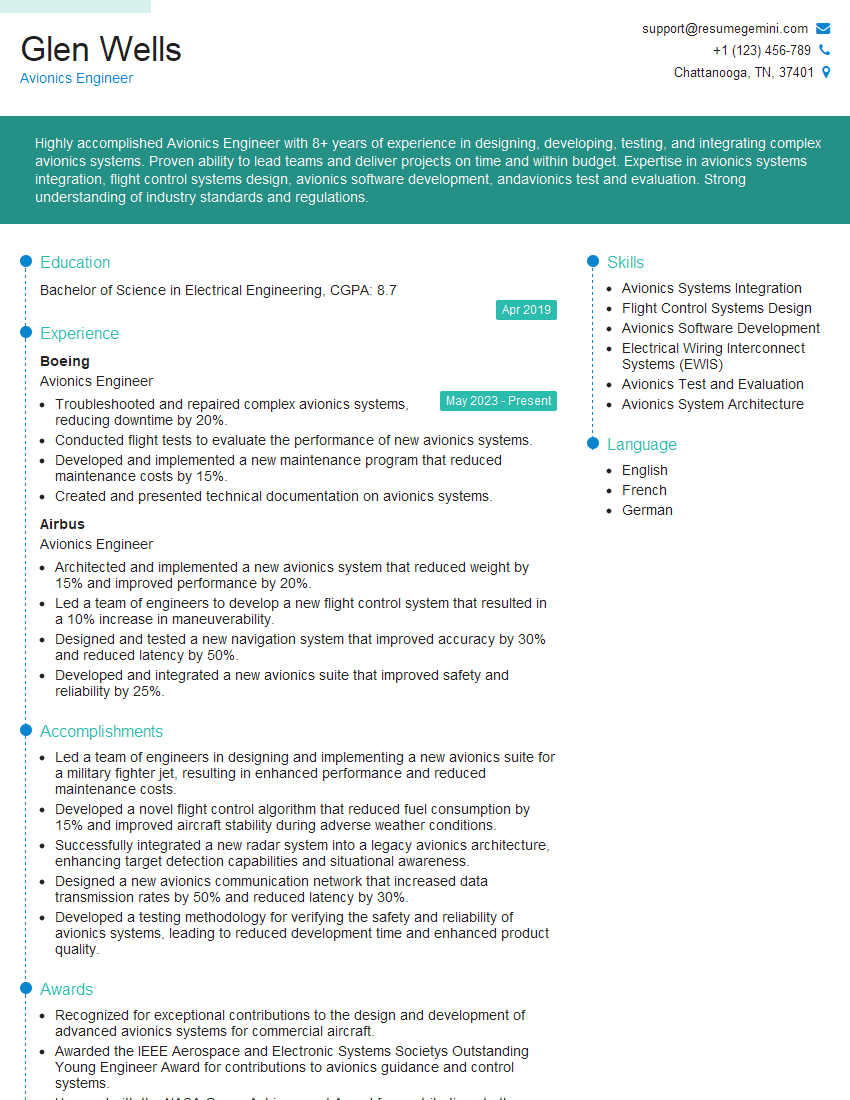
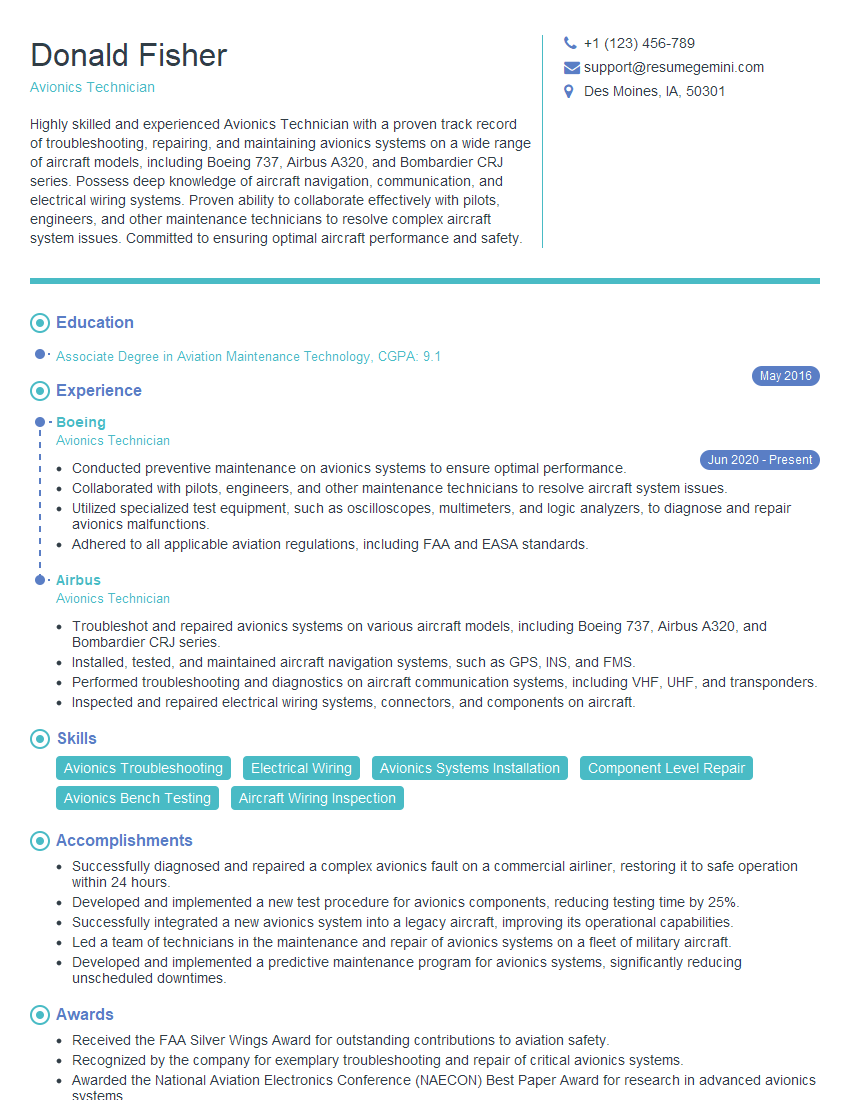
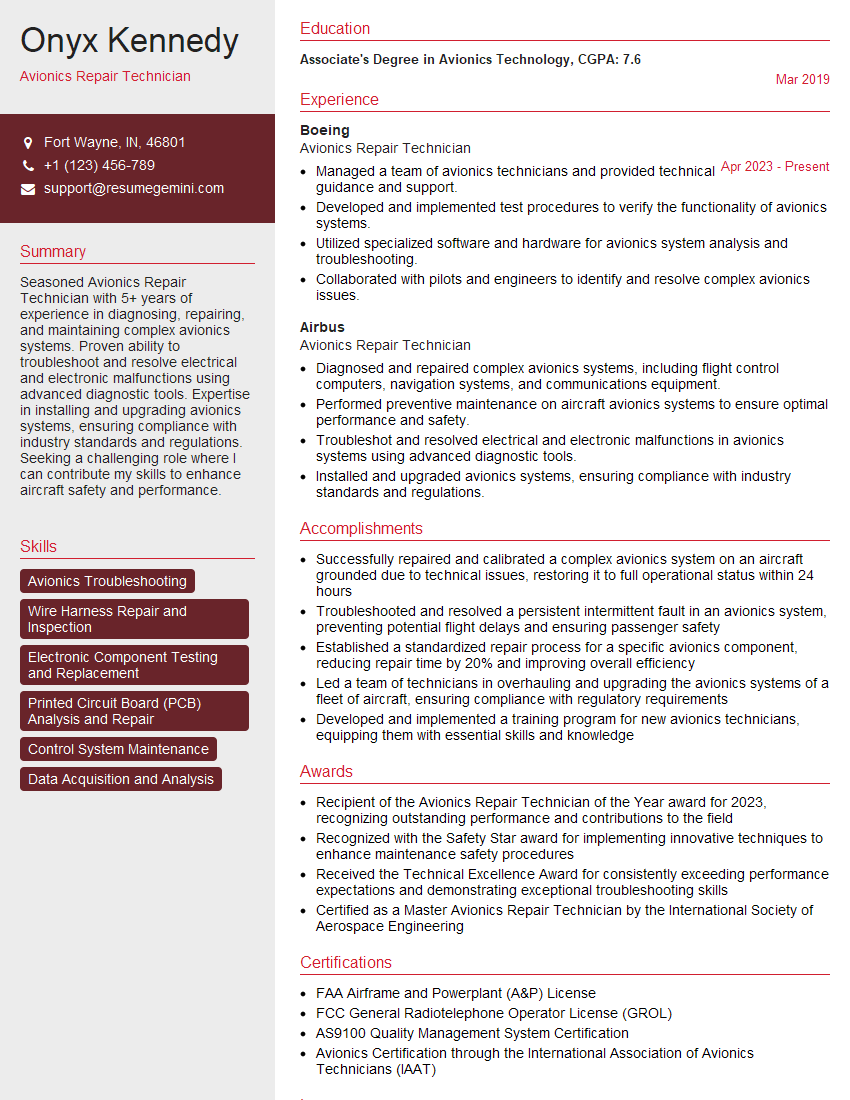
Mastering Aircraft Avionics opens doors to a rewarding career with significant growth potential in a highly specialized and in-demand field. To maximize your job prospects, creating a strong, ATS-friendly resume is crucial. ResumeGemini is a trusted resource that can help you build a professional resume that highlights your skills and experience effectively. They provide examples of resumes tailored to the Aircraft Avionics field, ensuring your application stands out.
Explore more articles
Users Rating of Our Blogs
Share Your Experience
We value your feedback! Please rate our content and share your thoughts (optional).
What Readers Say About Our Blog
Really detailed insights and content, thank you for writing this detailed article.
IT gave me an insight and words to use and be able to think of examples