Preparation is the key to success in any interview. In this post, we’ll explore crucial Aircraft Performance and Modeling interview questions and equip you with strategies to craft impactful answers. Whether you’re a beginner or a pro, these tips will elevate your preparation.
Questions Asked in Aircraft Performance and Modeling Interview
Q 1. Explain the concept of Breguet range equation and its limitations.
The Breguet range equation is a fundamental formula in aircraft performance estimation, providing a simplified relationship between range, fuel efficiency, and aircraft weight. It states that range (R) is directly proportional to the logarithm of the initial weight (Wi) to final weight (Wf) ratio, specific fuel consumption (C), and lift-to-drag ratio (L/D). The equation is typically expressed as:
R = (L/D) * (η / C) * ln(Wi / Wf)
Where:
- R is the range
- L/D is the lift-to-drag ratio
- η is the propulsive efficiency
- C is the specific fuel consumption
- Wi is the initial weight
- Wf is the final weight
This equation provides a valuable tool for preliminary design and performance analysis, allowing engineers to quickly assess the impact of design changes on range. For example, increasing the L/D ratio through improved aerodynamics significantly extends the range. Similarly, reducing specific fuel consumption (using more efficient engines) leads to greater range.
However, the Breguet range equation has limitations. It assumes constant L/D, constant specific fuel consumption, and ignores several important factors like wind, altitude variations, and non-standard atmospheric conditions. It’s a simplification of a complex real-world phenomenon; a more accurate prediction would require complex numerical simulations or flight tests.
Q 2. Describe different methods for calculating aircraft drag.
Calculating aircraft drag involves several methods, each with varying complexity and accuracy:
- Empirical Methods: These methods utilize experimental data and curve fitting to establish drag coefficients as functions of relevant parameters like Reynolds number and Mach number. They are widely used due to their simplicity, often relying on drag polar curves generated from wind tunnel testing or flight tests. This is a common approach for preliminary design and performance estimations.
- Computational Fluid Dynamics (CFD): CFD involves solving the Navier-Stokes equations numerically to simulate airflow around the aircraft. This allows for a detailed analysis of pressure distribution, viscous effects, and the resulting drag forces. CFD is computationally intensive but provides a high level of accuracy, especially for complex geometries and high-speed flows. It’s invaluable for detailed design and optimization.
- Analytical Methods: These methods employ simplified mathematical models to estimate drag components. For instance, the drag due to induced drag can be calculated using lifting line theory or vortex lattice methods. Analytical methods are often used for quick estimations or to understand the contributions of different drag sources. However, they are usually less accurate than experimental or CFD methods.
A comprehensive drag calculation typically involves summing up the different drag components, such as parasite drag (friction and pressure drag), induced drag (due to lift generation), and wave drag (at supersonic speeds). The total drag force is then given by:
D = 0.5 * ρ * V² * S * CD
where:
- ρ is the air density
- V is the velocity
- S is the reference area
- CD is the total drag coefficient
Q 3. How do you model the effects of wind on aircraft performance?
Modeling wind effects on aircraft performance requires resolving the wind vector into headwind, tailwind, and crosswind components. These components then affect the aircraft’s ground speed, climb rate, and flight path. The easiest approach is to consider the effect of wind using vector addition.
For example, if an aircraft has an airspeed of 100 knots and encounters a 20-knot headwind, its ground speed will be 80 knots. A 20-knot tailwind would result in a 120-knot ground speed. Crosswinds affect the aircraft’s heading and require adjustments to maintain the desired track.
More sophisticated models incorporate wind shear, which is the variation of wind speed and direction with altitude. Wind shear significantly impacts takeoff and landing performance, as well as flight stability. In these models, the wind vector is not constant but changes along the flight path, demanding more detailed simulations considering the spatial variations of wind.
In real-world scenarios, weather data such as wind speed, direction, and shear profiles are essential inputs for accurate performance predictions. This data comes from meteorological sources and is often incorporated into flight planning and simulation software.
Q 4. Explain the difference between climb rate and rate of climb.
While both terms relate to the aircraft’s vertical movement, there’s a crucial distinction:
- Climb Rate: This refers to the aircraft’s rate of altitude gain relative to the airmass, often expressed in feet per minute (fpm) or meters per second (m/s). It is independent of the ground speed. Imagine a hot air balloon rising vertically – its climb rate is high, but its ground speed is zero.
- Rate of Climb: This term also describes the rate of altitude increase but is typically expressed as a vertical speed relative to the ground. It accounts for both the aircraft’s vertical speed through the air and the effect of wind. If there’s a significant headwind, the rate of climb observed on the ground will be less than the climb rate.
In simpler terms: climb rate is the vertical speed through the air, while the rate of climb is the vertical speed relative to the ground.
Q 5. What factors influence aircraft takeoff performance?
Several factors significantly influence aircraft takeoff performance. These can be broadly categorized into:
- Aircraft Characteristics: This includes the aircraft’s weight, wing area, lift coefficient at takeoff, and thrust available from the engines. Heavier aircraft require longer distances for takeoff.
- Atmospheric Conditions: Temperature, pressure (altitude), and wind have substantial impacts. Higher temperatures and altitudes reduce air density, thereby decreasing lift and engine power. Headwinds shorten the takeoff distance, while tailwinds increase it.
- Runway Conditions: Runway length, slope, and surface friction are crucial. Longer runways provide more distance for acceleration. Upward runway slopes require greater speed and distance for takeoff. A smooth, dry runway surface offers better traction than a wet or icy surface.
- Pilot Technique and Flight Controls: The pilot’s skill in controlling the aircraft during takeoff, including proper flap settings, throttle management, and maintaining a stable flight path, influences takeoff distance.
Careful consideration of these factors is essential to determine safe takeoff procedures and calculate the required takeoff distance. These calculations are often performed using performance charts and software specific to the aircraft type and operational environment.
Q 6. Discuss the impact of altitude and temperature on aircraft performance.
Altitude and temperature significantly impact aircraft performance, primarily by affecting air density.
- Altitude: As altitude increases, air density decreases. This reduction in air density leads to lower lift, reduced engine thrust (due to less oxygen for combustion), and increased induced drag. Consequently, aircraft will experience lower maximum speeds, reduced climb rates, and shorter ranges at higher altitudes. However, there is also reduced drag, so the effect is not always a simple reduction of performance.
- Temperature: Higher temperatures also reduce air density. Similar to altitude effects, this leads to decreased lift, reduced engine thrust, and increased induced drag. Conversely, lower temperatures result in denser air, leading to improved performance.
These effects are accounted for in aircraft performance calculations through the use of standard atmosphere models, which provide the temperature, pressure, and density as a function of altitude. Flight planning and performance software utilize these models to accurately predict aircraft performance under various temperature and altitude conditions.
Q 7. How do you model the effects of icing on aircraft performance?
Modeling the effects of icing on aircraft performance is a complex task, as ice accretion changes the airfoil shape and increases the aircraft weight. This leads to a substantial decrease in lift and a dramatic increase in drag.
The process often involves:
- Ice accretion prediction: This involves determining the amount and location of ice accumulation based on meteorological conditions such as liquid water content, temperature, and aircraft speed. Specialized models and software are used for this purpose, often utilizing empirical relationships and experimental data.
- Aerodynamic modeling: Once ice accretion is predicted, the modified geometry of the airfoil is incorporated into the aerodynamic analysis. This typically involves CFD simulations to determine the changes in lift, drag, and pitching moment caused by the ice.
- Performance analysis: The modified aerodynamic data are then used to reassess the aircraft’s performance parameters, including stall speed, maximum lift, climb rate, and range. The increase in weight due to ice must also be included in the performance calculations.
Accurate modeling of icing effects is crucial for flight safety, especially in regions prone to icing conditions. This information helps to determine safe flight procedures and operational limitations when encountering icing, often restricting flight speeds and altitudes in such scenarios.
Q 8. Explain your understanding of aircraft flight envelope.
The aircraft flight envelope defines the operational limits within which an aircraft can safely fly. Think of it as a multi-dimensional space encompassing various flight parameters. It’s not a single number or limit, but rather a region defined by boundaries beyond which safe operation is compromised.
These boundaries are determined by factors such as airspeed (minimum and maximum speeds), altitude (service ceiling, maximum operating altitude), angle of attack (stall angle), load factor (g-force), and Mach number (speed of sound). Exceeding any of these limits could result in structural damage, loss of control, or even a catastrophic failure.
For example, exceeding the maximum airspeed could lead to structural stress exceeding the design limits, causing damage to the aircraft. Similarly, flying below the minimum airspeed can lead to a stall, causing a sudden loss of lift and potentially a crash. The flight envelope is crucial for pilot training, flight planning, and aircraft certification.
Q 9. How do you model the effects of fuel consumption on aircraft range?
Modeling fuel consumption’s effect on aircraft range involves integrating fuel burn rate with aircraft performance characteristics. We typically use a Breguet range equation, or more sophisticated models accounting for variations in atmospheric conditions and flight phases. The simplest form of the Breguet range equation is:
R = (V * L/D) * (η * ln(W_i / W_f))Where:
- R = Range
- V = Velocity
- L/D = Lift-to-drag ratio
- η = Propulsive efficiency
- W_i = Initial weight
- W_f = Final weight
However, this simplified equation assumes constant conditions (altitude, speed, etc.). For a more accurate model, we need to consider variations in these parameters during different flight phases (climb, cruise, descent). This involves numerical integration techniques or more advanced methods like using a flight simulator that accounts for real-world conditions and changes in fuel weight during the flight.
In practice, detailed fuel consumption data is often obtained from engine manufacturers and integrated with aircraft-specific performance data. This allows for the creation of accurate range predictions under various operating conditions.
Q 10. What are the key parameters used in aircraft performance simulations?
Aircraft performance simulations rely on a variety of key parameters, which can be broadly categorized as:
- Aircraft-Specific Parameters: These include weight, wing area, aspect ratio, drag coefficients, lift coefficients, engine thrust characteristics, and aerodynamic data (obtained through wind tunnel tests or computational fluid dynamics).
- Atmospheric Parameters: These are crucial and encompass altitude, air temperature, air density, wind speed, and wind direction. These parameters can significantly affect performance and need to be accurately modeled.
- Operational Parameters: These parameters determine the flight conditions, including airspeed, altitude, climb/descent rate, angle of attack, and flight path angle. The pilot’s control inputs are also incorporated here.
The interplay of these parameters, often represented through equations and look-up tables, determines the aircraft’s performance, such as range, endurance, rate of climb, and fuel consumption.
For instance, air density directly impacts lift and drag, thus affecting both cruise speed and fuel efficiency. An accurate representation of atmospheric conditions is paramount for reliable simulation results.
Q 11. Describe different types of aircraft performance software.
Aircraft performance software spans a wide range of complexity and capabilities. We can classify them into:
- Simplified Performance Calculators: These are often spreadsheet-based or simple programs that use basic equations to estimate key performance parameters. They are useful for quick estimations but lack detailed modeling of various flight conditions.
- Advanced Simulation Software: These programs (e.g., specialized flight simulation tools) employ sophisticated numerical methods to solve complex equations and consider a much broader range of variables, such as atmospheric conditions, wind effects, and even flight control system dynamics. These are used for detailed performance analysis and flight planning. They often utilize computational fluid dynamics and other advanced techniques.
- Flight Simulators: High-fidelity flight simulators provide extremely detailed representation of the aircraft, its systems, and its environment. These are primarily used for pilot training but can be invaluable for comprehensive performance analysis in extremely realistic situations.
The choice of software depends on the specific needs of the analysis. A simple range estimation might use a spreadsheet calculator, while designing a new aircraft requires highly sophisticated simulation software.
Q 12. Explain how you would validate and verify an aircraft performance model.
Validation and verification are critical steps in ensuring the accuracy and reliability of an aircraft performance model. Verification confirms that the model is correctly implemented—that the code does what it’s intended to do. Validation, on the other hand, ensures the model accurately reflects reality—that it produces results consistent with real-world observations.
Verification often involves code reviews, unit testing, and comparison with simpler models or analytical solutions. We ensure equations are correctly implemented and the software functions as expected under various conditions. For example, we’d verify the correct calculation of lift and drag forces for different flight conditions.
Validation typically involves comparing the model’s predictions against real flight test data. This could include comparing predicted range against actual flight data, predicted climb rates against measured values, or comparing predicted fuel consumption with real-world fuel logs. Statistical methods are used to assess the level of agreement between the model and the flight test data. Discrepancies need to be investigated and resolved, potentially leading to model refinements.
Both verification and validation are iterative processes; we refine the model until it meets acceptable levels of accuracy and consistency.
Q 13. What are the common sources of error in aircraft performance modeling?
Common sources of error in aircraft performance modeling stem from several factors:
- Inaccurate Input Data: Errors in aerodynamic data, engine performance data, or weight estimates will propagate through the model and lead to incorrect results. Data uncertainties need to be quantified and addressed.
- Simplified Assumptions: Real-world flight conditions are complex. Simplifying assumptions (e.g., assuming a constant wind speed or neglecting atmospheric turbulence) can lead to inaccuracies, especially in detailed analyses.
- Numerical Errors: Numerical methods used in simulations can introduce errors. Improper numerical integration techniques or insufficient grid resolution in computational fluid dynamics can affect results.
- Model Limitations: The model itself might have limitations—it might not accurately represent all relevant physical phenomena. For instance, neglecting the effect of compressibility at higher speeds is a common limitation in simpler models.
- Lack of Consideration of Real-world Effects: Failing to consider effects like icing, precipitation, or non-standard atmospheric conditions can lead to considerable differences between the predictions and reality.
Careful attention to data quality, rigorous model development, and validation with flight test data are crucial for minimizing errors.
Q 14. How do you handle uncertainties in input data during aircraft performance analysis?
Uncertainty in input data is inevitable in aircraft performance analysis. To handle this, several techniques are employed:
- Probabilistic Methods: Instead of using single values for input parameters, we use probability distributions (e.g., normal, uniform) that reflect the uncertainty in each parameter. Monte Carlo simulations then allow us to generate many performance predictions, each based on a random sample from the input distributions. This provides a range of possible outcomes and quantifies the uncertainty in the predictions.
- Sensitivity Analysis: This method helps us identify the parameters that most significantly affect the performance predictions. By systematically varying input parameters and observing their impact, we can focus our efforts on reducing uncertainties in the most critical parameters.
- Data Fusion and Filtering Techniques: Combining data from multiple sources (e.g., wind tunnel tests, flight tests, computational fluid dynamics) with appropriate filtering techniques can help reduce uncertainties and improve the accuracy of the input data.
- Uncertainty Quantification (UQ): Sophisticated UQ methods employ advanced statistical and mathematical techniques to quantify and propagate uncertainties through the entire model, resulting in a range of possible outcomes and a measure of confidence in the predictions.
The choice of method depends on the complexity of the model and the level of detail required in the uncertainty analysis.
Q 15. Explain the process of developing an aircraft performance model.
Developing an aircraft performance model is a multi-faceted process that involves translating the aircraft’s physical characteristics and operational environment into a mathematical representation capable of predicting its behavior. This process typically begins with defining the scope of the model – what aspects of performance will be predicted (e.g., range, climb rate, fuel consumption, etc.) and the level of fidelity required.
Next, we gather data. This includes aerodynamic data from wind tunnel tests or Computational Fluid Dynamics (CFD) simulations, engine performance data, and weight and balance information. We then select an appropriate modeling approach, ranging from simple empirical equations for preliminary design studies to complex, high-fidelity simulations incorporating detailed aerodynamic and propulsion models for detailed performance analysis. The selected method dictates the level of detail in the model, balancing accuracy with computational cost.
Once the model structure is defined, we proceed with parameter estimation. This involves fitting the model to existing data, using techniques like regression analysis or optimization algorithms. The model is then validated against independent data sets to assess its accuracy and predictive capabilities. This iterative process of refinement and validation is crucial to ensure the model’s reliability.
Finally, the model is documented and packaged for use in various applications, such as flight planning, design optimization, or flight simulation. For example, in one project, we developed a model to predict the optimal cruise altitude and speed for a particular aircraft given varying wind conditions, significantly improving fuel efficiency and reducing flight time.
Career Expert Tips:
- Ace those interviews! Prepare effectively by reviewing the Top 50 Most Common Interview Questions on ResumeGemini.
- Navigate your job search with confidence! Explore a wide range of Career Tips on ResumeGemini. Learn about common challenges and recommendations to overcome them.
- Craft the perfect resume! Master the Art of Resume Writing with ResumeGemini’s guide. Showcase your unique qualifications and achievements effectively.
- Don’t miss out on holiday savings! Build your dream resume with ResumeGemini’s ATS optimized templates.
Q 16. Describe your experience with different flight simulation tools.
My experience with flight simulation tools spans several platforms and levels of fidelity. I’m proficient in using tools like XFLR5 for preliminary aerodynamic analysis and performance prediction. This open-source tool is excellent for quick assessments and initial design exploration, particularly useful in early stages of aircraft development.
For more advanced simulations, I have extensive experience with MATLAB/Simulink, which allows for the creation of highly customized and flexible models. I’ve used this environment to build detailed six-degree-of-freedom (6DOF) flight simulators, incorporating complex aerodynamic models, propulsion system dynamics, and atmospheric effects. This level of fidelity enables accurate prediction of aircraft behavior under various flight conditions, including emergency scenarios.
Furthermore, I’ve worked with commercial flight simulation software, such as those offered by industry leaders. These tools often include pre-built aircraft models and detailed atmospheric databases, streamlining the simulation process. The choice of tool always depends on the specific application and the desired level of accuracy. Each tool presents a different trade-off between ease of use, computational cost, and fidelity.
Q 17. Explain your understanding of computational fluid dynamics (CFD) and its application to aircraft performance.
Computational Fluid Dynamics (CFD) is a powerful numerical technique used to simulate fluid flow and heat transfer. In aircraft performance modeling, CFD plays a vital role in predicting aerodynamic forces and moments acting on the aircraft, such as lift, drag, and pitching moment. This is achieved by solving the Navier-Stokes equations, which govern fluid motion, using advanced numerical methods.
CFD allows us to analyze complex flow features such as boundary layers, shock waves, and vortex shedding, which are difficult or impossible to measure experimentally. By simulating airflow around different aircraft configurations, we can optimize wing designs, fuselage shapes, and other components for improved aerodynamic efficiency. For example, using CFD, we can investigate the effects of different wing flaps or high-lift devices on takeoff and landing performance.
The output of a CFD simulation provides detailed pressure distributions, velocity fields, and other flow parameters. This information can then be used as input for more comprehensive aircraft performance models, allowing for a higher level of accuracy and predictability. However, it’s important to acknowledge that CFD simulations are computationally expensive, and their accuracy is dependent on the quality of the mesh and the turbulence modeling techniques used.
Q 18. How do you model the effects of turbulence on aircraft performance?
Modeling the effects of turbulence on aircraft performance is crucial for accurate predictions, especially during flight through turbulent atmospheric conditions. Turbulence is a complex phenomenon characterized by chaotic fluctuations in wind speed and direction. Its impact on aircraft is felt through fluctuating aerodynamic forces, leading to variations in flight path, structural loads, and passenger comfort.
Several methods are employed to model turbulence. One common approach involves using stochastic models, which generate random fluctuations in wind speed based on statistical representations of atmospheric turbulence. These models often utilize spectral methods, like the Dryden or von Kármán models, to define the power spectral density of turbulence. These models specify how the intensity of turbulence varies with different frequencies.
Another approach involves using large-eddy simulation (LES), a type of CFD simulation that directly resolves large-scale turbulent structures while modeling the effects of smaller-scale turbulence. LES is computationally more expensive than simpler stochastic models but provides more detailed and accurate representations of turbulence effects. The choice of method depends on the desired level of fidelity and computational resources available. In practice, a balance needs to be struck between the accuracy of the model and the computational resources needed to run simulations.
Q 19. What is the significance of Reynolds number in aircraft performance modeling?
The Reynolds number (Re) is a dimensionless quantity that represents the ratio of inertial forces to viscous forces in a fluid. It plays a critical role in aircraft performance modeling because it determines the flow regime – whether the flow is laminar (smooth) or turbulent (chaotic).
The Reynolds number is defined as Re = (ρVL)/μ, where ρ is the fluid density, V is the flow velocity, L is a characteristic length (e.g., wing chord), and μ is the dynamic viscosity. At low Reynolds numbers, viscous forces dominate, leading to laminar flow. As the Reynolds number increases, inertial forces become more significant, and the flow transitions to turbulence. This transition has a profound impact on aerodynamic characteristics, particularly drag.
In aircraft performance modeling, the Reynolds number is used to select appropriate aerodynamic data or models. Aerodynamic coefficients, such as lift and drag coefficients, are often strongly dependent on the Reynolds number. Therefore, accurate modeling requires using data or models that are valid for the specific Reynolds number range of the aircraft’s operation. For example, a high-altitude flight will have a different Reynolds number than a low-altitude flight, necessitating adjustments to the aerodynamic model.
Q 20. Explain different flight regimes and their influence on performance.
Aircraft operate in various flight regimes, each characterized by distinct aerodynamic and performance characteristics. Understanding these regimes is critical for accurate performance modeling.
- Subsonic Flight: At speeds below the speed of sound, the airflow remains predominantly subsonic, and aerodynamic forces are governed by the principles of incompressible flow. This regime is the most common for commercial airliners.
- Transonic Flight: Near the speed of sound, the flow transitions from subsonic to supersonic in localized regions. This regime is characterized by the formation of shock waves, which have a significant impact on drag and stability. High-speed aircraft often operate in this regime during acceleration or deceleration.
- Supersonic Flight: Above the speed of sound, the flow is predominantly supersonic, and shock waves become prominent. This regime requires specialized aircraft designs, such as swept wings, to minimize drag and maintain stability. Military fighter jets frequently operate in this regime.
- Hypersonic Flight: At extremely high speeds (many times the speed of sound), the airflow becomes extremely complex, with significant heating effects. This regime requires advanced materials and thermal management systems. Hypersonic flight is still largely in the experimental stage, but advancements in materials science and propulsion technologies are paving the way for future applications.
The flight regime significantly influences the aerodynamic coefficients, thrust requirements, and overall aircraft performance. Accurately capturing these effects in the performance model is essential for achieving accurate predictions across the entire flight envelope.
Q 21. Describe your experience with flight test data analysis.
Flight test data analysis is a crucial aspect of aircraft performance modeling. It involves collecting, processing, and analyzing data obtained from flight tests to validate and refine aircraft performance models. This process typically begins with defining the objectives of the flight test program, which dictates the types of data to be collected.
Data acquisition involves deploying various sensors on the aircraft to measure parameters such as airspeed, altitude, angle of attack, engine parameters, and accelerations. This data is then processed to account for sensor errors, calibration factors, and other systematic effects. Statistical methods are often used to quantify measurement uncertainties. Advanced signal processing techniques might be used to extract relevant information from noisy signals.
Once the data is processed, it’s used to validate and refine existing performance models. Comparison between the predicted and measured performance parameters helps identify discrepancies and potential areas for model improvement. This iterative process of model calibration and validation is crucial for ensuring the accuracy and reliability of the performance models. For example, in a recent project, we used flight test data to calibrate a drag model, resulting in a 5% improvement in the accuracy of range predictions.
Q 22. How do you assess the impact of different design changes on aircraft performance?
Assessing the impact of design changes on aircraft performance involves a multifaceted approach, leveraging both theoretical understanding and computational tools. We start by identifying the specific design change – for instance, a new wing airfoil, a modified engine nacelle, or a change in the tailplane geometry. Then, we use a combination of methods. First, we conduct preliminary estimations using established empirical relationships and performance prediction methods, such as lift-to-drag ratios and other aerodynamic characteristics. This helps identify potential areas of significant impact. Following this, sophisticated computational fluid dynamics (CFD) simulations are employed to model the airflow around the aircraft, providing detailed insights into pressure distributions, lift, drag, and other aerodynamic forces. These simulations are run with the original design and then with the proposed modifications to quantify the changes in performance parameters. Finally, we use established aircraft performance models, often implemented in software packages like MATLAB or specialized aviation software, to integrate these aerodynamic changes with other aircraft characteristics (weight, thrust, etc.) and predict the overall effect on performance metrics such as range, climb rate, and fuel efficiency. For example, a higher aspect ratio wing might increase the lift-to-drag ratio, leading to improved range and fuel efficiency, but possibly at the cost of increased structural weight and complexity. The process demands meticulous attention to detail and a thorough understanding of how different design parameters interact.
Q 23. Explain the concept of trim and its relevance to flight performance.
Trim refers to the state of aerodynamic balance in an aircraft where the pilot doesn’t need to continuously apply control inputs to maintain a steady flight condition. Imagine trying to hold a pencil perfectly still – you’d have to constantly adjust your grip. Similarly, an untrimmed aircraft would require constant control inputs. Achieving trim involves adjusting control surfaces – elevators, ailerons, and rudder – to balance the aerodynamic moments acting on the aircraft, ensuring stable flight. This is crucial for flight performance because it improves handling qualities, reduces pilot workload, and increases efficiency. A poorly trimmed aircraft will require more pilot effort, increasing fatigue and potentially reducing fuel efficiency. Furthermore, an untrimmed aircraft can exhibit undesirable handling characteristics, making it more difficult to control, especially in turbulent conditions. Modern aircraft use sophisticated trim systems that automatically adjust control surfaces based on flight conditions, ensuring optimal performance and ease of handling.
Q 24. Discuss the impact of weight and balance on aircraft performance.
Weight and balance are critical aspects influencing aircraft performance. Weight directly affects almost every performance metric: the heavier the aircraft, the higher the fuel consumption, lower the climb rate, and shorter the range. Balance, on the other hand, refers to the distribution of weight relative to the aircraft’s center of gravity (CG). An aircraft’s CG must remain within defined limits for safe and stable flight. An improperly balanced aircraft might be difficult to control, experiencing excessive pitching or yawing moments. For example, if the CG is too far aft (rearward), the aircraft might be prone to stalling at higher angles of attack, which can be incredibly dangerous. Similarly, a CG that’s too far forward might make the aircraft difficult to recover from a stall. Aircraft manufacturers define acceptable CG ranges, and careful weight management during flight operations (fuel load, passenger weight, cargo) is essential to remain within those limits. Software tools are frequently used to simulate different weight and balance configurations and help pilots ensure safe flight operations.
Q 25. How do you model the effects of air density changes on aircraft performance?
Air density changes significantly impact aircraft performance. Density decreases with altitude, and it’s also affected by temperature and humidity. Modeling the effects involves incorporating air density variations into the aircraft performance equations. This is typically done through the use of a standard atmosphere model, which provides density as a function of altitude. Many aircraft performance models use this standard atmosphere as a baseline. However, for more accurate predictions, especially in non-standard atmospheric conditions, real-time weather data can be integrated. Air density directly affects lift and thrust production. Lower density at higher altitudes means less lift available at a given airspeed, resulting in a lower maximum airspeed and a longer takeoff distance. At the same time, engine thrust also decreases with lower air density, impacting climb performance and fuel consumption. The relationship is not linear; a decrease in air density will result in disproportionate changes in lift and thrust. This is incorporated into models through equations that directly reflect this non-linear relationship. Lift = 0.5 * rho * V^2 * S * Cl (where ‘rho’ is air density, ‘V’ is airspeed, ‘S’ is wing area, and ‘Cl’ is lift coefficient) shows the direct influence of density on lift.
Q 26. Explain your experience with different types of aircraft propulsion systems and how their performance is modeled.
My experience encompasses various propulsion systems, including turbofan, turboprop, and piston engines. Each requires a distinct modeling approach. For turbofan engines, we use models that incorporate parameters such as thrust-specific fuel consumption (TSFC), fan pressure ratio, bypass ratio, and compressor efficiency, taking into account the impact of altitude and air temperature on thrust production. Turboprop models focus on propeller efficiency, which is influenced by airspeed, altitude, and rotational speed. The modelling considers the propeller’s influence on the overall aircraft performance, taking into account the complexities of the propeller’s interaction with the airflow. Piston engine models are more straightforward, incorporating parameters such as brake horsepower, fuel consumption rates, and propeller efficiency. In all cases, the model accounts for the engine’s thermodynamic cycle, energy conversion efficiencies, and the effects of environmental factors. I’ve extensively used software packages like GasTurb or customized simulation environments to develop and validate these models, employing experimental data and flight test results for calibration and validation. The models are crucial for predicting engine performance under various conditions, optimizing flight profiles, and assessing the impact of different engine configurations on overall aircraft performance.
Q 27. How would you approach troubleshooting an unexpected result in an aircraft performance simulation?
Troubleshooting an unexpected result in an aircraft performance simulation requires a systematic approach. The first step is to carefully review the input data to identify any errors or inconsistencies. This includes checking the aircraft geometry, weight and balance data, atmospheric conditions, engine parameters, and any control settings. Often the simplest solutions come first. Next, I’d verify the model’s accuracy by comparing the simulated results with experimental data or results from established validation cases. Discrepancies highlight potential errors in the model assumptions or coding. If the problem persists, I would meticulously examine the code itself, using debugging techniques to identify any logical errors or numerical instabilities. This might involve stepping through the code line by line, examining intermediate results, or using automated testing frameworks. If the issue is still unresolved, I’d explore the potential influence of simplifications made in the model. Many performance models utilize simplifications and approximations; these approximations could introduce errors, especially under extreme flight conditions. A more detailed model or alternative calculation methods may need to be used. Ultimately, understanding the underlying physical processes involved and comparing simulations with reality is key to finding accurate answers.
Q 28. Discuss your experience with integrating aircraft performance models into larger systems.
I’ve had extensive experience integrating aircraft performance models into larger systems, specifically flight simulators and mission planning tools. In flight simulators, the performance model provides real-time predictions of aircraft behavior in response to pilot inputs and environmental conditions. This requires efficient computation and seamless integration with other simulator modules like aerodynamics, flight control systems, and visual displays. For mission planning tools, the aircraft performance model is used to optimize flight routes and fuel consumption based on mission requirements and predicted weather conditions. This involves integrating the model with geographical databases, weather forecasting systems, and route optimization algorithms. The integration process involves careful consideration of data exchange formats, communication protocols, and real-time constraints. I’ve used various techniques to achieve this, including scripting languages like Python and specialized software interfaces. For example, in one project, we used a modular approach, where the performance model was encapsulated as an independent module that could be easily integrated into various flight simulation platforms using standardized APIs. This modular design ensured flexibility and facilitated maintenance and upgrades.
Key Topics to Learn for Aircraft Performance and Modeling Interview
- Flight Mechanics Fundamentals: Understanding forces acting on an aircraft (lift, drag, thrust, weight), and their impact on aircraft performance. This includes mastering equations of motion and stability derivatives.
- Performance Prediction: Applying theoretical knowledge to predict aircraft range, endurance, climb performance, and fuel consumption using various methods and software tools.
- Aerodynamic Modeling: Familiarization with different aerodynamic models (e.g., lift and drag polars, compressible flow effects) and their application in performance calculations.
- Propulsion Systems: Understanding the performance characteristics of different propulsion systems (e.g., turbofans, turboprops, rockets) and their integration into aircraft performance models.
- Flight Planning and Optimization: Developing strategies for optimal flight trajectories considering factors like weather, air traffic control, and fuel efficiency.
- Simulation and Modeling Software: Practical experience with industry-standard software (mentioning specific software without naming is key to broader applicability) for aircraft performance modeling and simulation. Demonstrate proficiency in using these tools to analyze and interpret results.
- Data Analysis and Interpretation: Ability to critically analyze performance data, identify trends, and draw meaningful conclusions to support decision-making.
- Advanced Topics (for Senior Roles): Explore concepts like trajectory optimization algorithms, uncertainties and sensitivities in performance predictions, and integration with flight management systems.
Next Steps
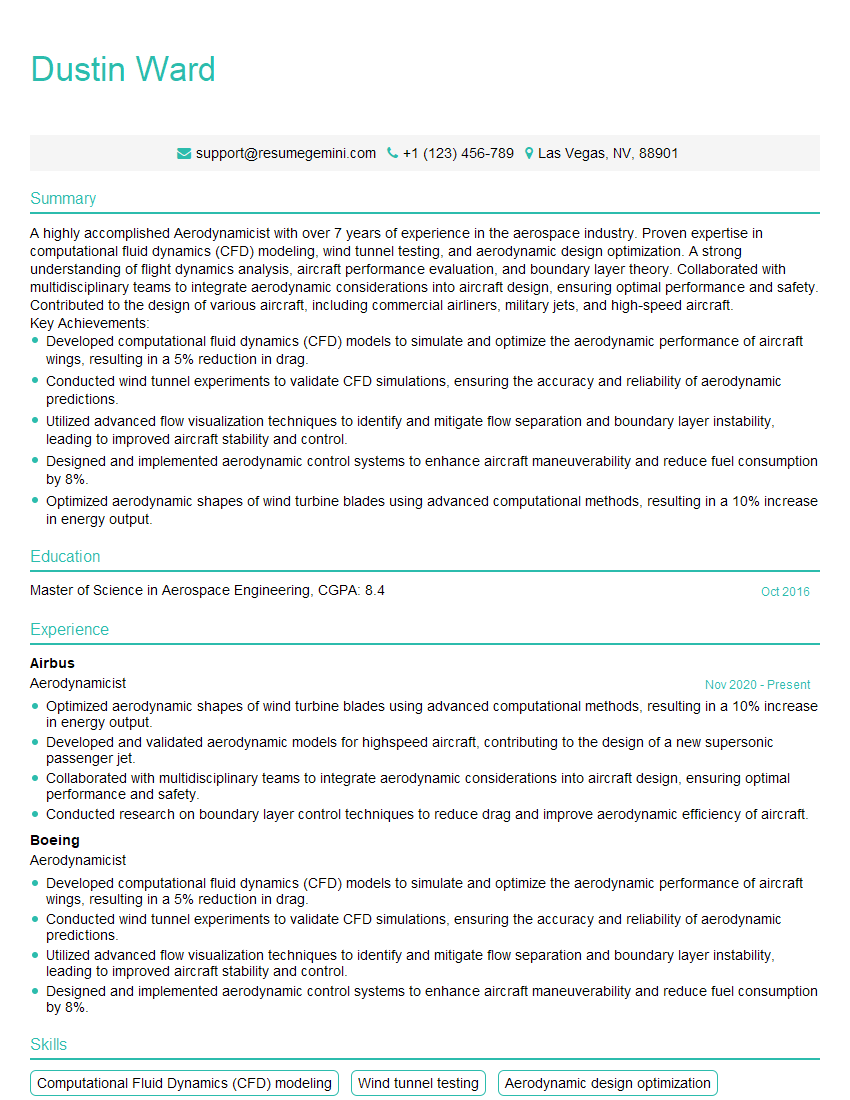
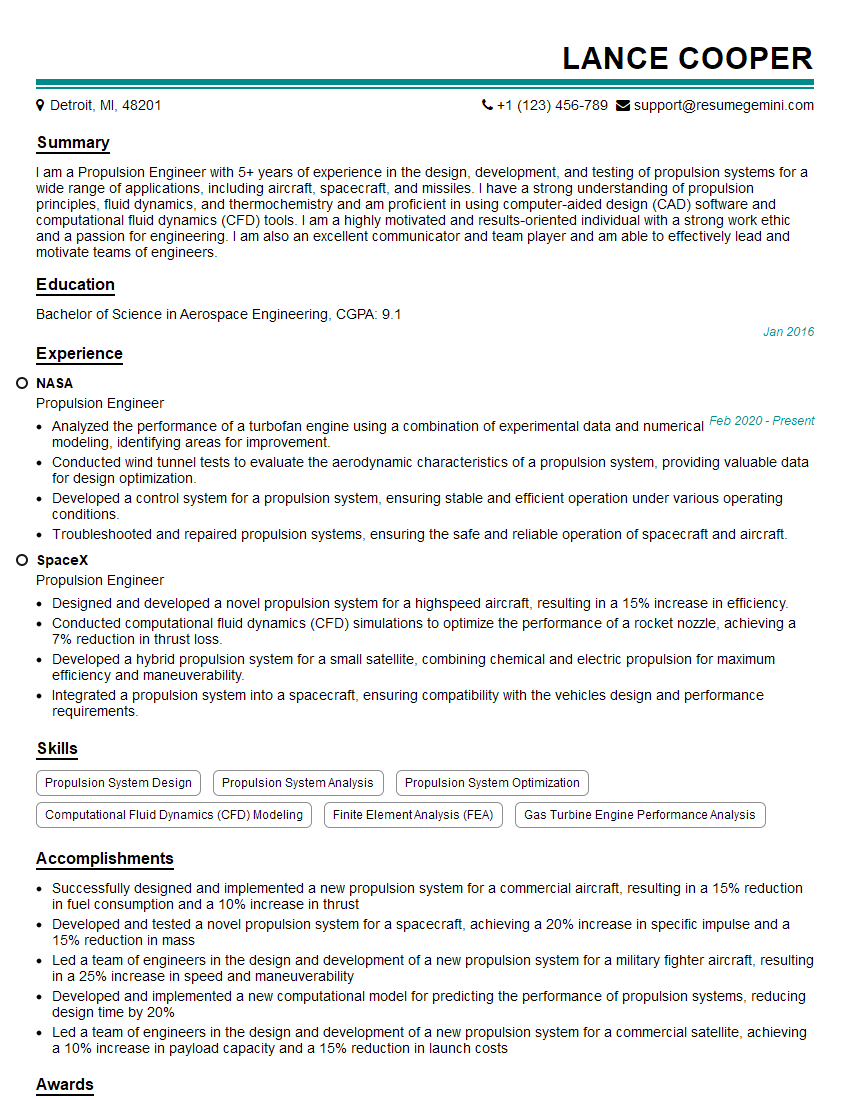
Mastering Aircraft Performance and Modeling is crucial for a successful and rewarding career in the aerospace industry. It opens doors to diverse roles with significant impact, from research and development to flight operations and regulatory compliance. To significantly boost your job prospects, creating a strong, ATS-friendly resume is essential. This is where ResumeGemini can help. ResumeGemini provides a streamlined and effective platform for building professional resumes that highlight your skills and experience in the best possible light. We offer examples of resumes tailored to Aircraft Performance and Modeling to guide you through the process. Take the next step towards your dream career – build a powerful resume with ResumeGemini today.

Explore more articles
Users Rating of Our Blogs
Share Your Experience
We value your feedback! Please rate our content and share your thoughts (optional).
What Readers Say About Our Blog
Really detailed insights and content, thank you for writing this detailed article.
IT gave me an insight and words to use and be able to think of examples